Readers may remember an exchange between John Fea and me about religion and politics from last summer. In the course of that exchange, Fea quoted favorably from President Obama’s welcome to Pope Francis:
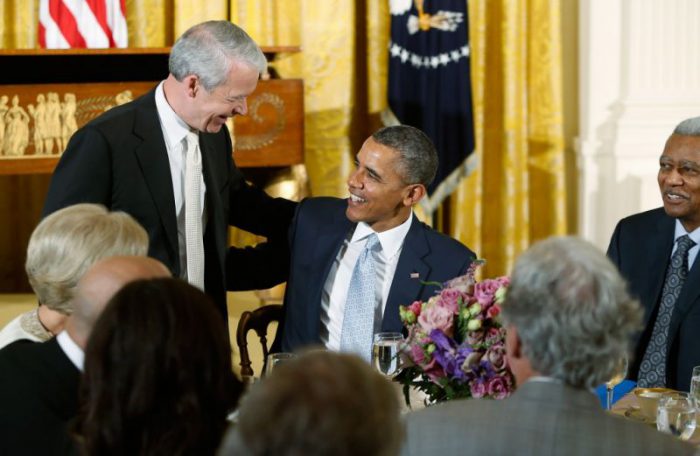
You call on all of us, Catholic and non-Catholic alike, to put the “least of these” at the center of our concern. You remind us that in the eyes of God our measure as individuals, and as societies, is not determined by wealth or power or station or celebrity, but by how well we hew to Scripture’s call to lift up the poor and the marginalized, to stand up for justice and against inequality, and to ensure that every human being is able to live in dignity – because we are all made in the image of God.
You remind us that “the Lord’s most powerful message” is mercy. That means welcoming the stranger with empathy and a truly open heart – from the refugee who flees war torn lands, to the immigrant who leaves home in search of a better life. It means showing compassion and love for the marginalized and the outcast, those who have suffered, and those who seek redemption.
This is a blatant effort to use Christianity for political ends. Because Fea found it agreeable to his own understanding of government, he wrote that if such views made him a Christian nationalist, “then call me a Christian nationalist.”
But when Mike Horton wrote critically about the hobby horse of Fea, the so-called “court evangelicals,” Fea liked the kind of 2k that had originally led me to call him a Christian nationalist. According to Horton:
Liberal and conservative, Catholic and Protestant, have courted political power and happily allowed themselves to be used by it. This always happens when the church confuses the kingdom of Christ with the kingdoms of this present age. Jesus came not to jump-start the theocracy in Israel, much less to be the founding father of any other nation. Even during his ministry, two disciples—James and John—wanted to call down judgment on a village that rejected their message, but “Jesus turned to them and rebuked them” (Luke 9:54–55). He is not a mascot for a voting bloc but the savior of the world. He came to forgive sins and bring everlasting life, to die and rise again so that through faith in him we too can share in his new creation.
Sorry, but President Obama was confusing the kingdom of Christ with the United States when he welcomed the pope. John Fea apparently suffers from the same confusion when approving Obama and then approving Horton.
It’s hard keeping selectivity straight.


 Old Life