Saving the World

One light show at a time.

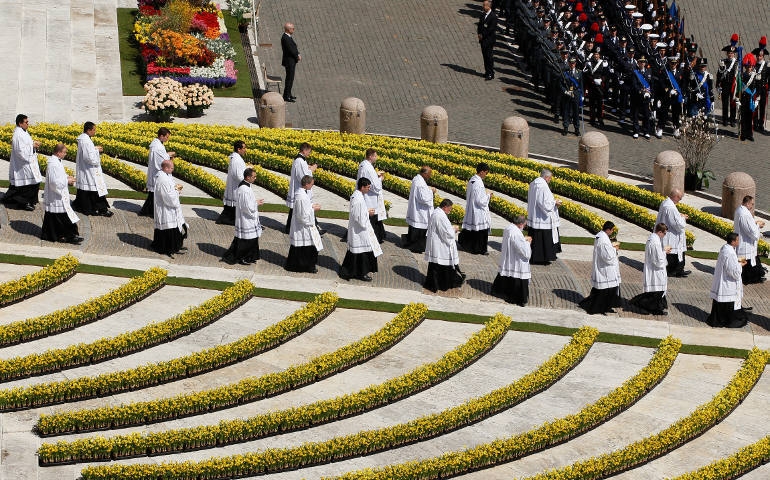
In case you missed it, the Vatican celebrated the Feast of the Immaculate Conception (yesterday) with a light show:

A mixture of fascination, curiosity and consternation is greeting a light show to be projected onto St. Peter’s basilica tomorrow — the Feast of the Immaculate Conception and the opening day of the Jubilee of Mercy.

A coalition of non-Catholic humanitarian, philanthropic and conservation groups along with the World Bank are staging the event. It will be the first time ever that images will be projected onto the 17th century basilica’s façade and Michelangelo’s cupola.

The organizers say the three hour event, called “Fiat Lux, Illuminating Our Common Home”, will tell the “visual story of the interdependency of humans and life on earth with the planet, in order to educate and inspire change around the climate crisis across generations, cultures, languages, religions and class.”

Archbishop Rino Fisichella, president of the Pontifical Council for the New Evangelization, called the event “unique” and said the illumination show “will present images inspired of Mercy, of humanity, of the natural world, and of climate changes.”

He added that the light show, whose images have been shown on various landmarks around the world, is meant to link Pope Francis’ environment encyclical Laudato Si’ with the United Nations Climate Change Conference (COP21) currently underway in Paris until Friday.

“It is our hope that this beautiful and contemporary work of public art will inspire citizens of the world to join together in a moment of compassion and to activate a global movement to protect humankind, our common home and precious endangered species,” said Carole Tomko, vice president of Vulcan, Inc., one of the groups sponsoring the event and which promotes initiatives to “change and improve the way people live, learn, do business and experience the world.”

Some conservative Roman Catholics have taken a page from Protestant iconoclasm and regard such a use of holy buildings as sacrilege:

The sense that St. Peter’s Basilica has been profaned is strong. The symbolic significance of the event is a Church immersed in darkness, but illuminated by the world, by the new climatist-religion-ideology (all financed by the World Bank Group which will now have to explain to us what politics compatible with the teaching of the Church it is promoting..)

The holy place par excellence, the heart of Christianity transformed on a maxi-screen for the show of the New World Power Ideology …and the Nativity Crib was left in darkness.

It does make you wonder what salvation means. If improving the environment can save the world, then what happened to the cross of Christ and the sacraments? Could it be that hell is empty (and will remain so) and so the church can now devote itself to more humanitarian and less heavenly causes? Did Balthasar really win at Vatican 2 as Commonweal suggests? Before Vatican 2, Rome was pretty clear where unbelievers went at death:

Any sin, for Augustine, is an unspeakable offense against God; particularly offensive was the sin of the first man who was singularly graced with an intimate “enjoyment of God” and who stood as the progenitor of the human race. His impiety in abandoning God was so great that it “merited eternal evil” in consequence of which “the whole of mankind is a ‘condemned mass’ [massa damnata]; for he who committed the first sin was punished, and along with him all the stock which had its roots in him.” According to Augustine, no one has the right to criticize that retribution as unjust, and the fact that some are released from it through the free bounty of God is ground for heartfelt thanksgiving.

The same severe doctrine of hell has been affirmed time and again in official church documents. The Fourth Lateran Council in 1215 declared that, at the end of time, “all will receive according to their deeds, good or evil, the former to their everlasting glory with Christ, the latter to perpetual punishment with the devil.” In his constitution of 1336, Benedictus Deus, Benedict XII solemnly defined that “the souls of those who die in actual mortal sin go down immediately after death into hell and suffer the pain of hell.” The Council of Florence in 1442 maintained that “not only pagans, but also Jews, heretics and schismatics” are precluded from salvation for they “will enter into eternal fire” unless they embrace the Catholic Church before their death. Similar declarations on hell and salvation were issued by the Council of Trent in the sixteenth century. Vatican I reinforced them in the nineteenth century. Vatican II did not revisit the solemn definitions of hell by earlier councils, but it did at least affirm that, yes, atheists can be saved.

But that changed when Balthasar and Kung met Barth:

Like Barth and Balthasar, Hans Küng too comes close to proposing universal salvation. And like them, he enlists the virtue of hope to support the idea. In his book Eternal Life, Küng’s critical discussion of hell begins with Jesus’s own words about hell, which, according to Küng, were figurative rather than literal: terms in the New Testament pertaining to final judgment—words like “hell,” “eternal,” ‘fire”—are to be taken as metaphors warning sinners of the delicate edge they’re dancing on. They are “meant to bring vividly before us here and now the absolute seriousness of God’s claim and the urgency of conversion in the present life,” Küng writes. No one should dismiss his or her responsibility to meet the demands of conversion, but how each of us meets them “remains a matter for God as merciful judge” in his “all-embracing final act of grace.” Like Balthasar, Küng maintains that judgment of the individual is in God’s hands; it would be “presumptuous for a person to seek to anticipate the judgement of this absolutely final authority. Neither in the one way nor in the other can we tie God’s hands or dispose of him. There is nothing to be known here, but everything to be hoped.”

Barth, Balthasar, and Küng all agonize over the question of universal salvation, which they treat not just as a theological puzzle but as a genuine mystery. Because we cannot answer the question with absolute certainty, it finally has to be left—in humility and hope—to the judgment of a loving God. This is as much of an affirmation as they dare to make.

What these three theologians show us, however, is that hope is a powerful virtue and not just a matter of wishful thinking. Hope always has its reasons, even earthly hopes. In the everyday sense of the word, a doctor’s skill is reason for his patient to hope for a cure, a worker’s good job performance a reason for her to hope for a promotion—though such hopes, subject to human limitations, can be disappointed. In the economy of salvation, however, the reason for hope is nothing less than the divine will—profoundly declared in the passion, death, and resurrection of Jesus: “For God sent the Son into the world, not to condemn the world, but that the world might be saved through him” (John 3:17). The clarity of this scriptural passage on God’s will reassures not only Christians but all mankind that our hope for salvation will be fulfilled—without exceptions.

But if U.S. parochial schools can reconsider their mission, maybe the Vatican can find it’s pre-Vatican 2 self:

“We don’t open Catholic schools to get kids into college,” Guernsey said. “We open Catholic schools to get them into heaven.”

Would Lutherans (ELCA ones) Ordain Bruce Jenner?

Notice which Lutherans the U.S. Roman Catholic bishops are talking to ecumenically — the ones in fellowship with the Lesbyterians — namely the Evangelical Lutheran Church of America. But the hangup to full communion is not the doctrine of justification by faith alone but — what Allen Iverson was not talking about — practice. That is, the practice of male ordination:

Asked at the news conference what was the most difficult issue that continued to divide Lutherans and Catholics, Bishop Madden cited women’s ordination as “one of those issues that we are still discussing.”

The Lutherans have been ordaining women since 1970; the Catholic Church teaches it has no authority “to confer priestly ordination on women.”

Bishop Eaton said Lutherans still had difficulty with the Catholic understanding of “the role of the bishop of Rome” and the issue of papal infallibility.

“We are really sorry for some of the things (Martin) Luther said about (the pope) back in the day,” she said, adding that there have been “terrible misunderstandings and, on our part, unfortunate caricatures” surrounding the issue.

“But we really like this one (Pope Francis) a lot,” Bishop Eaton said.

Kathryn Johnson, ELCA director for ecumenical and interreligious relations, said the declaration marked the beginning of “a totally different world of relationship and hopefulness” between Catholics and Lutherans.

The Rev. John Crossin, executive director of the USCCB Secretariat for Ecumenical and Interreligious Affairs, said he had been approached by an Anglican colleague about doing a similar document that looks at remaining issues dividing the two communions.

The declaration “is already starting to have a little ripple effect,” he said.

But if you could find pastors who had switched genders, would that satisfy both liberal Lutherans and American Roman Catholics?

Hard to say, but the affinities between Roman Catholics and Protestant modernists keep being hard to miss.

Same Only Different

Are these commentators talking about the same bishop (remember, it’s about office not the man)?

Here‘s an excerpt from a review of a biography of William Henry O’Connell, the archbishop of Boston for the better part of the first half of the twentieth century. Notice how authoritarian the papacy seems in 1992 (not 1492):

Even at the height of the papacy’s temporal power, when medieval and Renaissance popes deposed emperors, appointed kings, and divided the world among competing colonizers; even during the Reformation, when popes fought Protestants to the death and excommunicated half of Europe, the universal Church’s ancient claim to “inerrancy” in its mission of handing on the Gospel was not formally restricted to the person of the Bishop of Rome. The claim that the Pope, teaching ex cathedra on matters of faith and morals, was exempt from the capacity for error was not solemnly made until 1870 — as an act of the fathers gathered at the First Vatican Council. They were moved to make this extraordinary proclamation as a kind of compensation for losing the last remaining temporal holdings of the papacy to King Victor Emmanuel II, in the same period. The Papal States had once stretched from coast to coast across Italy, but from then on the Pope’s worldly sway was to extend only to the hundred-odd acres of Vatican City. The fathers of the council saw to it that the spiritual sovereignty of Peter’s successor would be as absolute as possible — far more absolute than Peter’s authority had ever been.

The story of the Catholic Church from 1870 through the first half of the twentieth century, ending with Vatican II and Humanae Vitae, is the story of an efficient, ever extending spiritual imperialism under the banner of papal infallibility. That proposition has politicized — and parochialized — the New Testament notion of the Holy Spirit’s enduring presence in the Church. Future generations of Catholics will surely seek to explain away this astounding doctrine with ever more arcane redefinitions, much as this generation explains away the once solemn doctrine of no salvation outside the Church. The key to the papacy’s success in solidifying its hold over the soul of the Church was not the virtue of the men who held the office or the clarity of their moral vision but a far simpler thing: the Pope’s expanded authority to appoint bishops without regard for the preferences of local churches. The Pope controls dioceses and archdioceses around the world by making sure they are administered by men whose first loyalty is to him. Nothing demonstrates the significance of this power better than the career of Boston’s flamboyant Cardinal Archbishop William Henry O’Connell.

Now a recent word of encouragement to liberals in the church in relation to the current pope. Notice how open the church now is:

But culture’s about more than sex, and this pope is no less confrontational than his predecessors. In Laudato si’, he treats economic and environmental policy as moral and, yes, cultural issues, and he doesn’t seem to mind offending those who stand in the way of conversion and reform. Did you hear what he said to Congress about the arms trade? If Francis is a pope particularly committed to dialogue, he is also a pope who believes in plain-speaking.

So, if you are a Catholic who supports same-sex marriage, women’s ordination, or anything else about which this pope’s position cannot be described as liberal, you should feel perfectly free to share in the widespread enthusiasm for him. There are, after all, many reasons to admire Francis, and you don’t need anyone’s permission. You should also feel free not to admire him: there’s no obligation, not even for Catholics. But Catholics should at least respect him, and that means taking him at his word. All his words.

Arminians in the Southern Baptist Convention might think that their change of fortunes in the wake of the New Calvinism are just another day at the office compared to this makeover. And the apologists think that we don’t notice the lack of discipline and what goes with it, coherence? Shouldn’t office count for something?

Does that Apply to Justin Bieber and Global Capitalism?

Jason Stellman is back in apologist mode and thinks it great that Roman Catholicism loves paganism (not even Michael Sean Winters says this):

Our paradigm has at its heart the Christmas story, the coming-in-the-flesh of the Son of God. If divinity assumed humanity to the point where the second Person of the Trinity will forever participate in human flesh and human nature, then there simply is no option for pitting heaven against earth, spirit against flesh.

If the Incarnation teaches us anything, it’s that God is all about affirming the world, not destroying it.

When a Catholic considers pagan culture, then, he doesn’t think of it as some kind of defective problem to overcome, but instead views it through the lens of Christ and sees a divine exclamation point placed after every true and beautiful pagan idea or endeavor.

In a word, we see kinship and commonality with paganism. Pagans may worship nature or bow before a sacred tree or stone altar, while we worship the Creator of nature and bow before the cross and venerate the altar on which the Eucharistic sacrifice is offered.

The problem for Jason is that Roman Catholicism didn’t embrace incarnationality when it came to Protestantism in the 16th century. And if what Jason says is true for contemporary Roman Catholicism, does that mean he has gone to the other side about the benefits of free markets and the beauty of Justin Bieber’s music (I seem to recall in the one episode of Drunk Ex Pastors that Jason was gleeful in mocking the teenage crooner)?

It also makes me wonder if Jason became a Roman Catholic because the communion now resembles liberal Protestantism. And that’s another wrinkle in Jason’s argument. Protestants of a certain kind also affirmed the incarnation to embrace the world. We used to call them modernists.

Some Protestants opposed modernism. So did Pope Pius X. Neither wanted Christians to embrace the pagan world the way Jason does. In fact, it used to be the case that Jason would need approval from his bishop to read John Calvin or David Hume. An index of forbidden books does not sound, in Jason’s words, like a “healthier avenue toward dialogue and mutual respect.”

So which Roman Catholicism is Jason talking about? And is that the one to which Bryan Cross is calling?

What A Call with Integrity Sounds Like

If Bryan and the Jasons had truly been conservative Presbyterians, they would have carried suspicions of liberalism into the Roman Catholic Church with them. But that they continue to insist that Protestantism and Roman Catholicism represent two distinct paradigms while not recognizing the two paradigms that exist on both sides of the Tiber — one anti-modernist and one indifferent to modernism and its effects — they miss the central dynamic of modern Christianity.

Boniface at Unam Sanctum lays out that dynamic well. It is the relationship between the church and the world. Conservative Presbyterians after the 1920s were and still are on the look out for compromises with the world. So was the Roman Catholic Church. But since Vatican 2, Roman Catholic wariness has disappeared. Boniface explains:

The goal of the Christian life if holiness. Yet what is holiness? What does it meant to be holy? We understand that we are called to be loving, forgiving, etc. But what does it mean to be “holy”? Is holiness a mere sum of all other natural and supernatural virtues? And what about God? God is love, power, forgiveness, justice and so on. But what does it mean when the angels cry that God is “holy, holy, holy?”

The fundamental definition of holiness is separation. The Latin word for holiness is sanctitas, from whence sanctity. Holiness denotes separation or consecration unto God. When the angels cry “holy, holy, holy” it is because God is so far separate and distinct from all created things that awe is the only appropriate response in his presence. “Between creator and creature there can be noted no similarity so great that a greater dissimilarity cannot be seen between them”, the Fourth Lateran Council taught (cap. 3, “On Heretics”). St. Thomas defines holiness as a firm separation of created things which are translated from profane use to use in the service of God (STh II-II Q. 81 art. 8). This is why Holy Water, Holy Cards, Holy Candles, Holy Oil, etc. have the adjective “holy” – once they are consecrated, they are “set apart” for divine worship exclusively. To use Holy Oil for cooking for Holy Water for common washing would be sacrilegious. Their consecration is what makes them “holy”, and hence set apart for divine use exclusively.

Of course, a person is holy in a different sense than an object, but the fundamental reality that holiness means separation remains. A man with Holy Orders is set apart for the service of God. A holy person is one whose life is separated from worldly concerns and activities and who already lives, even in the flesh, in contemplation of heavenly things. Holiness is separation; separation from worldly uses and a setting apart unto God, “who is above all, through all, and in all” (Eph. 4:6).

* * * * *

With the Second Vatican Council, the Catholic Church adopted a posture of “openness” to the world. Pope John XXIII harbored great hopes for a kind of reconciliation between the Church and the world that would lead to the mutual building up of both; what he called a “new order of human relations”, while also condemning those “prophets of gloom” who only saw the modern world in a negative light. This led to a massive paradigm shift in the post-Conciliar Church, a pivot towards the world. It matters not whether the Council documents ever called for this pivot; the essential weakness of the conservative response to the Council has been a narrow focus on the Council documents’ language and a failure to comprehend the Council as an event (see, USC, “Book Review: Second Vatican Council: An Unwritten Story”, Aug. 2013). The pivot happened and it must be acknowledged as a fact.

The result of this pivot was a blurring of distinction between the Church and world, between merely natural goods and supernatural goods. Worldly concerns seemed to be become the Church’s concerns. It started innocently enough with “world peace,” but then moved on to all sorts of other issues, occupying bigger and bigger parts of the Church’s canvas until the Church appeared as little more than an NGO concerned with worldly problems like climate change and youth unemployment. Not that the Church has no concern with temporal evils that offend God; but as the Church shifted its focus more and more towards merely natural goods, it began to address them with increasingly little reference to man’s supernatural ends.

The results were a spiritually deadening and embarrassingly banal Church that gives us such gems as “Driver’s Ten Commandments”, documents about immigration reform, and of course, encyclicals on global warming.

Boniface even detects such banality in the Pope Emeritus’ recent letter:

Perhaps this all expresses the tension in modern Catholicism – once one has opened up to the world, what is the overlap between one’s duties to the Church and to the world? What happens when they are in contradiction? Can they be in contradiction? In traditional Catholicism the answer was clear: the Church and the world were in a fundamental state of opposition. But once we have pivoted towards the world, what now?

Case in point: Consider Pope Benedict XVI’s recent letter in which the Pope Emeritus states that the Church’s pastors should be “shepherds for the whole world.” Benedict wrote:

“The service of a shepherd cannot be only limited only to the Church [even though] in the first place, we are entrusted with the care of the faithful and of those who are directly seeking faith. [The Church] is part of the world, and therefore it can properly play its service only if it takes care of the world in its entirety.”

What is a Catholic to make of these words? It is certainly true, in one sense, that since the mission of Christ was to redeem the whole human race, the Church can never concern herself solely with matters entirely internal. She must always be considering her mission ad gentes; God wills all men to be saved, and so we must labor for all men to be so.

This is nothing new. But is that the sense in which Benedict means it? He goes on to say that the Church “must be involved in the efforts that humanity and society put into action” to address “the questions of our times.”

The fundamental question is this: Is he envisioning the Church reaching out to make the world think about heavenly things, or the Church focusing more of its attention on worldly things? Does he want the Church to call the world to remember man’s supernatural ends, or is he proposing the Church help to world attain its merely natural ends? Is this a call of the world to the Church or a capitulation of the Church to the world? The problem is both philosophies can be read into Benedict’s words, depending on one’s predisposition.

Let me help Boniface out here by mentioning Pope Francis’ recent promotion of the “new evangelism.” Social gospel alert.

“We must not have fear to make the times of great challenges ours,” he continued.

Francis then said that people today are waiting on the church, “that it may know to walk with them, offering the company of the witness of faith that offers support with all, in particular with the most alone and marginalized.”

“How many poor people are waiting for the Gospel that frees!” the pope said. “How many men and women, in the existential peripheries generated by the consumer society, wait for our closeness and our solidarity!”

“The new evangelization therefore is this: to take awareness of the merciful love of the Father to truly become ourselves instruments of salvation for our brothers,” he said.

The term “new evangelization” was used frequently by Pope Benedict XVI, who created the pontifical council on the issue in 2010 and held a global meeting of bishops in Rome to discuss the matter in 2012. The exact meaning of the term and directive for the council have, however, remained a bit unclear.

Francis’ redefinition of the term seems to place the emphasis on evangelizing by example and in showing mercy and care for the poorest in society.

Touching on the process of catechesis later in his talk Friday, the pontiff said the question of how to educate the faithful “is not rhetorical but essential.”

Of course, the tension between the church and the world is not the dynamic merely of recent church history. When Tertullian asked about the relationship between Jerusalem and Athens, he was invoking the conflict between belief and unbelief. But since the late nineteenth century when Christians of various stripes wanted to do away (anti-dualism) with distinctions between nature and grace, special and general revelation, church and society, sacred and secular, the fundamental dilemma for western Christians (at least) has been whether to insist on such distinctions or whether to do away with them by making the kingdom of God a reality so much larger than the church (either bloated or itty-bitty).

If Bryan and the Jasons had picked this up while in Presbyterian circles, their call would sound different. And Bryan himself might be embarrassed by his alma mater’s decision to embrace diversity over evangelism:

Saint Louis University has removed a statue on its campus depicting a famous Jesuit missionary priest praying over American Indians after a cohort of students and faculty continued to complain the sculpture symbolized white supremacy, racism and colonialism.

Formerly placed outside the university’s Fusz Hall in the center of the private Catholic university, the statue will go to the university’s art museum, a building just north of the bustling urban campus.

The statue features famous Jesuit Missionary Pierre-Jean De Smet S.J. praying over two American Indians dressed in traditional clothing. Last Monday, just two days after graduation, it was removed from the location it has called home on campus for decades. . . .

The statue’s removal comes just months after controversy broke out at the Jesuit campus over a proposed statue to commemorate a six-night sit in that served as an extension of protests in nearby Ferguson.

After donors threatened to pull donations over the proposed statue, the university walked back the original intent of the statue, saying it would instead highlight the university’s values of diversity and inclusion.

If Bryan and the Jasons really want to reach the conservative Presbyterian and Reformed demographic, they really do need to find their anti-modernist selves.

Be Worried, Be (okay) Sort of Worried

Our game-show champion who wears a mullet doesn’t seem to be much concerned about the state of his communion. But others in fellowship with the Bishop of Rome are:

Last Tuesday Paul Baumann posted “An unbroken tradition?”—an analysis of an article by Ross Douthat in The Atlantic. Paul’s post drew almost a hundred comments. Some expressed indignation that anyone claiming intellectual credibility might say anything positive about Mr. Douthat. Others advanced to a lengthy and very substantial discussion of Catholic teaching on marriage. All too belatedly I reintroduced one of the main points of Paul’s original post. By that time, of course, virtually everyone had moved on. Allow me to try again:

Having admitted that Garry Wills is an “outlier” among progressive Catholics, Douthat nonetheless stated that what most progressives share with Wills is a belief “that Catholicism will always somehow remain Catholicism no matter how many once-essential-seeming things are altered or abandoned.”

Paul indicated that he shared some of Douthat’s worries “about how far the sort of church reform called for by some “progressive” Catholics can go before it damages something essential in Catholicism’s DNA.”

“The problem,” he immediately added, “is determining what is essential and what isn’t.”

Well, maybe other modernists can help, such as those Presbyterians who distinguished between fact and theory to tell what’s essential to Christianity and to vindicate their — get this — orthodoxy.

The General Assembly of 1923 expressed the opinion concerning five doctrinal statements that each one “is an essential doctrine of the Word of God and our standards.” On the constitutional ground which we have before described, we are opposed to any attempt to elevate these five doctrinal statements, or any of them, to the position of tests for ordination or for good standing in our church.

Furthermore, this opinion of the General Assembly attempts to commit our church to certain theories concerning the inspiration of the Bible, and the Incarnation, the Atonement, the Resurrection, and the Continuing Life and Supernatural Power of our Lord Jesus Christ. We hold most earnestly to these great facts and doctrines; we all believe from our hearts that the writers of the Bible were inspired of God; that Jesus Christ was God manifest in the flesh; that God was in Christ, reconciling the world unto Himself, and through Him we have our redemption; that having died for our sins He rose from the dead and is our everliving Saviour; that in His earthly ministry He wrought many mighty works, and by His vicarious death and unfailing presence He is able to save to the uttermost. Some of us regard the particular theories contained in the deliverance of the General Assembly of 1923 as satisfactory explanations of these facts and doctrines. But we are united in believing that these are not the only theories allowed by the Scriptures and our standards as explanations of these facts and doctrines of our religion, and that all who hold to these facts and doctrines, whatever theories they may employ to explain them, are worthy of all confidence and fellowship.

Again, progressives that Protestants are, have already found debates over what’s essential to be quite liberating. Welcome Roman Catholics to the modern world (remember aggiornamento?).

Update: More Reasons to Worry

You thought the Western Schism produce three rival popes, well you haven’t seen what Francis has unleashed: now we have the Pope, the media pontificate, and the curial pontificate:

The media pontificate portends an ongoing revolution: the Church finally strips itself of its structures, goes out to the existential peripheries, enhances the power of national Bishops conferences, puts into effect the Gospel of mercy and gets rid of any idea of condemnation. The media pontificate portrays Pope Francis as a champion of social issues and at a same time as one who is able to approach pragmatically human life issues, such as abortion, which are deemed secondary. Conservatives are scared by the media pontificate. They fear – for example – that the naive approach of Pope Francis will lead to an endorsement of birth control in the upcoming encyclical on ecology, as birth control is sponsored by one of the consultants for the encyclical, the economist Jeffrey Sachs. They also fear that the encyclical may contain a certain opening to sustainable development, in the “new age” sense.

But there is a real pontificate that is never discussed. This real pontificate is well known by the “hidden Vatican,” which – in the face of talk about revolution – has faithfully and silently carried on its work, advancing the Vatican reforms that for some time had already been under way. This real pontificate demonstrates that Pope Francis defends the natural family and attacks gender ideology. The media pontificate broadcasts that Pope Francis has opened up to homosexuals, saying “Who am I to judge?” The real pontificate clarifies that, with this sentence, Pope Francis nailed the coffin shut on the issue: if gays live the life of the Church, he is no one to judge them; if they do not, he is still not going to judge them, but they are outside of the Church. Full stop. Any additional word would be superfluous.

Wouldn’t you think Pope Francis could straighten this out? No one seemed to wonder what his comments on the Armenian Genocide meant.

And if this is not enough to keep you reaching for sleeping pills before going to bed, perhaps the report from the German bishops will send you to Walgreens for Ambien:

4. Pastoral Care in Certain Difficult Marital Situations

a) Is cohabitation ad experimentum a pastoral reality in your particular Church? Can you approximate a percentage?

The statements from the dioceses are unanimous in maintaining that “pre-marital unions” are not only a relevant pastoral reality, but one which is almost universal. Almost all couples who wish to marry in Church have already been living together, frequently for several years (estimates are between 90% and 100%). A recent demoscopic survey has shown that a similarly large proportion of Catholics as in the overall population consider this to be acceptable. Weddings between couples who already have children are becoming increasingly common. Here, cohabitation is regarded less as an “experiment”, and more as a generally-customary preliminary stage to marriage which is entered into intending to cement the relationship by these means and to marry later if the partnership proves to be stable. In view of the ultimate binding nature of marriage, and in an awareness that a failed marriage means a profound life crisis, many in fact consider it irresponsible to marry without living together beforehand.

b) Do unions which are not recognised either religiously or civilly exist? Are reliable statistics available?

De facto unions which are not recognised either religiously or civilly are a growing phenomenon. 87% of the heterosexual couples living together in a household in Germany in 2012 (20.693 million) were married (17.993 million) and 13% were non-marital unions (2.693 million). The shift can be made clear by showing another figure: 180,311 children were born to Catholic mothers in Germany in 2012. The mothers of 128,455 of these children were married, but 51,856 were not. This means that 71.8% of all children who were born to Catholic mothers in 2012 were born in wedlock and 28.8% were born to an unmarried mother. This means that, taking society as a whole, the share of children born out of wedlock in the new Federal Länder which make up the former GDR form a definite majority (in 2011: 61.7 % in the new Federal Länder; 29 % in the old Federal Länder). Even the birth of children today is thus no longer an absolute reason to marry. Catholics in Germany accept unmarried couples living together without any major reservations. Only three percent adopt a strictly negative position in this regard.

Is it spiteful to notice what the apologists ignore?

Always is a Long Time

Over at Commonweal, the interpreters interpreting THE interpreter, assert something about the unchanging nature of Roman Catholic teaching:

The Catholic Church has always taught that the right to private property is never absolute, and must always be subordinated to common use—making sure that the needs of all are met. And while collectivism can elevate common use at the expense of private ownership, free-market individualism errs in the opposite direction. Writing at the time of the Great Depression, Pius XI was particularly blunt: “The right ordering of economic life cannot be left to a free competition of forces,” he said. “For from this source, as from a poisoned spring, have originated and spread all the errors of individualist economic teaching.”

The notion that the church goes back to Peter invites this notion of a long tradition of unwavering conviction. But the antiquity of Rome also invites a form of amnesia in which apologists and interpreters read the most recent back into the past. Most people suffer from this problem. Historians call it presentism. But it is a weightier matter for Roman Catholic apologists since so much of the case against Protestantism hinges on the notion that Rome has 1500 more years than Protestantism.

Yet, rarely do the historically minded do justice to the pronounced changes that have accompanied Rome’s own adaptation to modern life. Consider the recent “breathtaking” editorial where editors on the left and the right of matters Roman Catholic experienced a kumbayah epiphany and joined paragraphs to oppose capital punishment:

We, the editors of four Catholic journals — America, National Catholic Register, National Catholic Reporter and Our Sunday Visitor — urge the readers of our diverse publications and the whole U.S. Catholic community and all people of faith to stand with us and say, “Capital punishment must end.”

The Catholic Church in this country has fought against the death penalty for decades. Pope St. John Paul II amended the universal Catechism of the Catholic Church to include a de facto prohibition against capital punishment (2263-2267). Last year, Pope Francis called on all Catholics “to fight … for the abolition of the death penalty.” The practice is abhorrent and unnecessary. It is also insanely expensive, as court battles soak up resources better deployed in preventing crime in the first place and working toward restorative justice for those who commit less heinous crimes.

This also prompted Dwight Longenecker to praise God for a kairos moment. There is nothing wrong — aside from the spirituality of the church — with Roman Catholics opposing the death penalty. It’s a free country and if you’re going to be in the business of editorializing about everything and sundry in the name of Christ, why stop now?

The problem is that the meme of antiquity obscures level headed reflection on what the church has “always” taught and even sometimes did. The much longer history of Christianity indicates that Roman Catholics (Protestants too) not only supported capital punishment but that popes as temporal rulers oversaw the execution of persons who committed capital offenses. I can’t vouch for the accuracy, though the material is plausible, but here is a list of the criminals executed during the reign of the Roman pontiff as a temporal or civil authority. It is long, maybe not as long as that for other kingdoms or nations, but if true in the context of the recent editorial it calls to mind Captain Renault’s shock to learn that gambling was taking place in Rick’s Cafe in Casablanca.

Numbers like this may explain why John Allen was could write the way he did about John Paul II’s change on capital punishment:

So strong had Italian aversion to capital punishment become that when an anarchist named Angelo Bresci assassinated King Umberto I in 1900, Italian courts sentenced him to life in prison. It was the first time a man had killed a European king (without toppling his regime) and not been executed.

Yet the Catholic church was never part of this development. The guillotine was busy up to the very last minute of the pope-king’s regime. Its final use came on July 9, 1870, just two months before Italian revolutionaries captured Rome.

What explains this stubbornness? In part, that Catholic standby — tradition. Christian writers since the fourth century had defended capital punishment.

St. Augustine did so in The City of God. “Since the agent of authority is but a sword in the hand [of God], it is in no way contrary to the commandment `Thou shalt not kill’ for the representative of the state’s authority to put criminals to death,” he wrote.

Augustine saw the death penalty as a form of charity. “Inflicting capital punishment … protects those who are undergoing it from the harm they may suffer … through increased sinning, which might continue if their life went on.”

Aquinas followed Augustine in the 13th century in Summa Contra Gentiles. “The civil rulers execute, justly and sinlessly, pestiferous men in order to protect the state,” he wrote. The Cathechism of the Council of Trent, issued in 1566, solidly endorsed capital punishment as an act of “paramount obedience” to the fifth commandment against murder.

Nor was this tradition confined to the Middle Ages. As late as Sept. 14, 1952, Pope Pius XII echoed its logic. “It is reserved to the public power to deprive the-condemned of the benefit of life, in expiation of his fault, when already he has dispossessed himself of the right to live,” he said.

The leading abolitionists of the 18th and 19th centuries were Enlightenment-inspired critics of revealed religion. Popes defended their right to send people to death because to do otherwise seemed tantamount to abandoning belief in eternal life.

Catholic scholar James Megivern summed up the tradition this way: “If tempted to waver, one needed only to consult the bedrock authorities from Aquinas to Suarez. Questioning it could seem an act of arrogant temerity. If one did not believe in the death penalty, what other parts of the Christian faith might one also be daring or arrogant enough to doubt or deny?”

All of which makes the shift in thinking under John Paul II astonishing.

In the 1995 encyclical Evangelium Vitae, John Poul wrote that the only time executions can be justified is when they are required “to defend society,” and that “as a result of steady improvements … in the penal system such cases are very rare if not practically nonexistent.”

Not only journalists but Cardinals were surprised by the pope’s change. In a piece for First Things in April 2001, Avery Cardinal Dulles reminded the chorus of U.S. Roman Catholic death penalty opponents of their church’s history going back before Vatican II, papal social encyclicals, and the unification of Italy:

In modern times Doctors of the Church such as Robert Bellarmine and Alphonsus Liguori held that certain criminals should be punished by death. Venerable authorities such as Francisco de Vitoria, Thomas More, and Francisco Suárez agreed. John Henry Newman, in a letter to a friend, maintained that the magistrate had the right to bear the sword, and that the Church should sanction its use, in the sense that Moses, Joshua, and Samuel used it against abominable crimes.

Throughout the first half of the twentieth century the consensus of Catholic theologians in favor of capital punishment in extreme cases remained solid, as may be seen from approved textbooks and encyclopedia articles of the day. The Vatican City State from 1929 until 1969 had a penal code that included the death penalty for anyone who might attempt to assassinate the pope. Pope Pius XII, in an important allocution to medical experts, declared that it was reserved to the public power to deprive the condemned of the benefit of life in expiation of their crimes.

Summarizing the verdict of Scripture and tradition, we can glean some settled points of doctrine. It is agreed that crime deserves punishment in this life and not only in the next. In addition, it is agreed that the State has authority to administer appropriate punishment to those judged guilty of crimes and that this punishment may, in serious cases, include the sentence of death.

Dulles added the theological reasons for such a tradition and noted the flimsy premises for opposition to the death penalty:

To warrant this radical revision—one might almost say reversal—of the Catholic tradition, Father Concetti and others explain that the Church from biblical times until our own day has failed to perceive the true significance of the image of God in man, which implies that even the terrestrial life of each individual person is sacred and inviolable. In past centuries, it is alleged, Jews and Christians failed to think through the consequences of this revealed doctrine. They were caught up in a barbaric culture of violence and in an absolutist theory of political power, both handed down from the ancient world. But in our day, a new recognition of the dignity and inalienable rights of the human person has dawned. Those who recognize the signs of the times will move beyond the outmoded doctrines that the State has a divinely delegated power to kill and that criminals forfeit their fundamental human rights. The teaching on capital punishment must today undergo a dramatic development corresponding to these new insights.

This abolitionist position has a tempting simplicity. But it is not really new. It has been held by sectarian Christians at least since the Middle Ages. Many pacifist groups, such as the Waldensians, the Quakers, the Hutterites, and the Mennonites, have shared this point of view. But, like pacifism itself, this absolutist interpretation of the right to life found no echo at the time among Catholic theologians, who accepted the death penalty as consonant with Scripture, tradition, and the natural law.

The mounting opposition to the death penalty in Europe since the Enlightenment has gone hand in hand with a decline of faith in eternal life. In the nineteenth century the most consistent supporters of capital punishment were the Christian churches, and its most consistent opponents were groups hostile to the churches. When death came to be understood as the ultimate evil rather than as a stage on the way to eternal life, utilitarian philosophers such as Jeremy Bentham found it easy to dismiss capital punishment as “useless annihilation.”

In other words, the switch in attitudes about the death penalty among contemporary Roman Catholics (magisterial and lay) has less to do with biblical and theological reflection and more to do with the modernist habit of adapting the faith to modern times. Worse, it reflects the modern sensibility of knowing that we know better than people who lived in the past. Even worse, this notion of knowing better runs up against the problem of knowing more than say, the son of God, the apostles, or (for Roman Catholics) infallible popes knew. I understand that many Roman Catholic apologists think that modernism can’t happen among Roman Catholics because Pius X condemned it and that settles it. But the phenomenon of modernism is always before the church, that is, a temptation to cave in to the pressure that comes from the opposition between the church and the world (as if Vatican II wasn’t a classic case of caving with its program of updating the faith).

The haunting thought that so-called conservatives like Father Dwight should have is this: if the church which for centuries had regarded capital punishment as a plausible outworking of revealed truth can change on this, what might the bishops do at the upcoming summit on families, marriage, and sex?

The Tale of Two Petes

Peter Leithart takes Pete Enns to school on reader-response criticism:

Enns is correct to emphasize that the Bible doesn’t function like an owners’ manual. Proverbs more often proposes riddles than it gives simple pious advice. Still, Paul says that the Scripture is useful for training the man of God for “every good work,” so there must be something owner-manualish about the Bible.

These are old arguments, not to be resolved in a blog review. What’s most interesting about Enns’s book is his self-positioning as a defender of Scripture. This isn’t new either. Others have taken up the task of defending the Bible from the fundamentalist hordes. Enns does it cleverly. The Bible doesn’t act the way we want it to, so we have a choice: “either change our expectations to conform to what is actually in the Bible or find some way to force the Bible into our mold” (76). He claims to be doing the former, and his “unsettled faith is a maturing faith” (238). Enns’s critics are pre-classified as immature, fearful abusers of Scripture who want to press the Bible into their own modern molds. At that point, it’s difficult to know how a debate can continue.

Modernism Watch

The classic definition of Protestant modernism came from J. Gresham Machen in Christianity and Liberalism. He understood that modernism was an apologetic strategy — a way to save Christianity in the face of modern intellectual and social developments. That strategy involved explaining away certain doctrines as the mere husk of Christianity (deity of Christ, virgin birth, infallibility of Scripture) and properly locating the kernel of Christian teaching (the fatherhood of God, the brotherhood of man, the vicinity of Boston). What modernists did and still do is historicize the faith. Christians believed truth X once upon a time but we now understand how X was the product of a historical moment. The modernist looks beneath the exterior of Christian belief, which is historically situated, and finds the universal truth to which it points.

The classic definition for Roman Catholic modernism came from Pius X (hence the Society of Saint Piux X) who in 1907 wrote:

These rebels profess and repeat, in subtle formulas, monstrous errors on the evolution of dogma, on the return to the pure Gospel—that is, as they say, a Gospel purified of theological explication, Council definitions, and the maxims of the moral life—and on the emancipation of the Church. This they do in their new fashion: they do not engage in revolt, lest they should be ejected, and yet they do not submit either, so that they do not have to abandon their convictions. In their calls for the Church to adapt to modern conditions, in everything they speak and write, preaching a charity without faith, they are very indulgent towards believers, but in reality they are opening up for everyone the path to eternal ruin.

And now traditionalist Roman Catholics fear that the Synod of Bishops who are discussing the nature of marriage, that these church authorities are dabbling in modernism. Even some on the left side of the Roman Catholic spectrum seem to agree (even if taking encouragement from such dabbling) though they prefer the phrase “development of doctrine” to modernism (who wouldn’t?):

Let’s look at this issue of developing doctrine and changing pastoral practice as it relates to the “homosexual agenda” which has +Burke so exercised. For years, for centuries, the Church shared the biases of the ambient culture. Homosexuality was the sin that dare not speak its name and gay people were ostracized and worse. There was little in the Church’s teaching on marriage and the family that was crafted with even a thought to the existence of LGBT people and no obvious congruence between that teaching and the lived experience of gay Catholics. But, what the Church neglected for all those years was a core, foundational doctrine: All human persons are made in the image and likeness of God. This doctrine is, I dare say, even more foundational than the Church’s teaching on marriage, indeed, the Church’s teaching on marriage and all ethical issues is built upon the imago dei, but nobody, until our lifetimes, thought to apply this doctrine to the pastoral care of gays and lesbians.

What changed? First, the experience of HIV/AIDS. In the same way that the publication of Uncle Tom’s Cabin demonstrated to all the suffering and horror of slavery to people who knew little about it, the AIDS epidemic called forth the most basic Christian, humane sensibility: compassion. . . .

There is an old joke that when the Church announces a change, the document always begins, “As the Church has always taught….” This is usually cited as a way to suggest that the Church is a bit cynical, even hypocritical. But, in fact, this is how change happens in the Church. “The Church has always taught” that all human beings are made in the image and likeness of God, we just forgot to apply that to gays and lesbians for a few centuries. The Church has always taught that Communion is the food of mercy, essential to the on-going conversion of all Christians, not just the divorced and remarried. No one is going to “change doctrine” at this synod, but the synod fathers are trying to retrieve lost insights, recalibrate the way our doctrines are applied in real pastoral praxis, discern new ways to proclaim the Gospel. The synod is evidence that the Church is alive and still attentive to the Holy Spirit, not only to the treatises on canon law. Those who are afraid of this synod – and of this pope – and the ones of little faith.

It’s hard to know how to argue against a view that says “we have always believed this even though it didn’t look like it.” But then arguing against experience as opposed to debating a proposition (yes, I’ve invoked the bogeyman of propositional truth, language speaker than I am) is like making a case against second-hand smoke. And yet, following experience instead of doctrine appears to be precisely what the cardinals are doing in Rome:

Unlike in the past, when bishops or theologians would deduce theology from general, sometimes idealized notions of God or humanity, the prelates at the Synod of Bishops on the family are using inductive reasoning to instead examine theology in the reality of families today, Canadian Archbishop Paul-André Durocher said.

“What’s happening within the synod is we’re seeing a more inductive way of reflecting, starting from the true situation of people and trying to figure out what’s going on here,” said Durocher, who leads the Canadian Conference of Catholic Bishops.

The prelates, the archbishop said, are “finding that the lived experience of people is also a theological source — what we call a theological source, a place of theological reflection.”

“I think we’re learning to use the Harvard case study method in reflecting theologically on the lives of people,” continued the archbishop, who also heads the archdiocese of Gatineau in Quebec.

“And we’re only, in a sense, starting to learn how to do this as church leaders,” he said. “And this is going to take time for us, to learn to do this and together to come — as we reflect on this — to find what is the way that God is showing.”

When the bishops do eventually figure out how to use the experience of people to construct theology, will Jason and the Callers follow suit? So far the answers from the Callers have been all out of a Pius X framework. They have yet to enter or accommodate the modern world that Vatican II embraced (not to mention missing all the lessons of twentieth-century Protestant history that produced separate communions like the OPC and the PCA).

Welcome to Protestant Land

William Oddie wonders about the state of Roman Catholicism in ways never conceived by Jason and the Callers:

What exactly is going on, when Bishops and parish priests can so radically differ about the most elementary issues of faith and morals—about teachings which are quite clearly explained in the Catechism of the Catholic Church—and when simultaneously one Cardinal describes such teachings as “crazy” and another simply expounds them as the immemorial teachings of the Church? Does nobody know what the Church believes any more?