 Alan Jacobs pushes back against Andrew Sullivan’s recent denunciation of Christianism. According to Sullivan:
Christians will look back on this period, I believe, with horror. The desire to control others’ lives and souls through politics is so anathema to the Gospels it will one day have to be exposed and ended. Until then, we just have to keep our spirits up and attend to our own failures as Christians, which, of course, are many.
Jacobs thinks he has the perfect antidote to Sullivan, and his name is Martin Luther King, Jr. Jacobs seems to think that King was doing what today’s Christians are doing, namely, arguing for conformity between the law of God and the laws of the United States:
[King] could have stayed in his prayer closet instead of politicking; he could have attended to his own failures as a Christian, which of course were many; he could have forgiven white Southerners instead of judging them. But no. He became an “outside agitator,” marching into ordinary American communities and telling them that their local laws, and indeed in some cases federal laws, were not to be obeyed — and why? Because they conflicted with the law of God! Notice the arrogance with which he associates his cause with God Himself. He even asserts that “human progress” only happens when “men [are] willing to be co-workers with God.” His whole vision for America is Christian and Biblical through and through: in his most famous speech he simply identifies the American situation with that of the Biblical Israel: “I have a dream that one day every valley shall be exalted, and every hill and mountain shall be made low, the rough places will be made plain, and the crooked places will be made straight; ‘and the glory of the Lord shall be revealed and all flesh shall see it together.'” Talk about “the desire to control other people’s lives and souls”!
Well, I’ll take the bait. King’s immanentized political theology and identification of the United States with Israel was as bad as Jerry Falwell’s or now Rick Perry’s. That doesn’t stop Jacobs who explains, “After all, Dr. King’s faith commitments were at least as encompassing in their scope, as universal in their claims, as publicly political as Rick Perry’s . . .” Thinking of the United States as the New Israel is wrong no matter who is doing it and no matter what the cause.
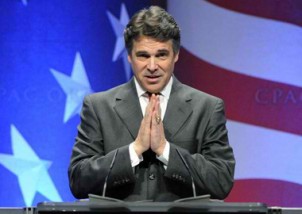
But Jacob’s comparison is far fetched for at least three reasons. First, the Christian or Religious Right has not faced the same sorts of obstacles that African Americans did and IN some cases still do. Trying to glom evangelical politics on to the Civil Rights movement is just plain bad form (and this is from someone who doesn’t care for the increased power of the federal government that came with Civil Rights legislation). Second, King was not running for president. sponsoring a prayer rally around the same time that you are contemplating entering the Republican bid for the presidential nomination is almost as tacky praying before a NASCAR race and thanking the Lord for a “smoking hot” wife. Third, King’s appeal was much more common at a time when mainline Protestants dominated public life and appealed to Christian theology for social reform. For some reason, evangelicals don’t seem to understand that the United States has changed a lot since 1963, along with the etiquette governing public speech about the United States as a Christian nation. If not everyone, including the media elites, believes the United States to be a biblical polity, then maybe you don’t bring up the Bible if you want to persuade the media elites. Maybe also you don’t pray in public with a humongous U.S. flag at your back.
One last point: when Christians enter the public square and start using theology for political purposes, Christian doctrine always, always, always suffers. It happened with the Social Gospel. It happened with Martin Luther King, Jr. It happened with Reinhold Niebuhr. And it’s happening with Rick Perry. Consider the following from a report about the recent prayer rally:
The lineup of speakers at The Response reflect the impact of new charismatic and Pentecostal movements, especially those emphasizing spiritual warfare and round-the-clock prayer and worship, and which have produced another sort of army. That one is not particularly intrigued by the horse race of politics, but rather focused more exclusively on the supremacy of Jesus and preparing for his return.
That caused some controversy for the organizers of Perry’s event, which included speakers and endorsers who follow the New Apostolic Reformation. The NAR’s strident language of spiritual warfare and emphasis on prophecy, signs, and wonders, has drawn scrutiny. But it has the same dominionist aims of the old religious right, even while employing some new rhetoric.
The NAR has also drawn criticism from conservative evangelical “discernment” ministries that consider it heretical—a criticism that Response organizers dismissed. A week before The Response, Marsha West, a conservative writer and editor of the website Email Brigade, wrote a scathing blog post; which she published on the website of Response host the American Family Association, and which was subsequently taken down. West complained that the NAR, which she considers unbiblical, was involved in The Response.
West told me in an email that she was “thoroughly disgusted with Christian Right leaders who have joined forces with a group that is, by definition, a Christian cult. Because of CR leader’s lack of discernment, the NAR is now becoming mainstream.” (According to her website, West also considers Mormonism, the emergent church, new age spirituality, word of faith, homosexuality, and more to be unbiblical.) In the NAR, she particularly identified Mike Bickle of the International House of Prayer, who played a big role in The Response. “[T]hese people are what the Bible calls ‘false prophets’… not true Christians,” West wrote. When I asked Garlow [Jim Garlow heads Newt Gingrich’s nonprofit, Renewing American Leadership]about West’s complaint, he shrugged it off, saying that he was not familiar with the term New Apostolic Reformation, even though he knew its founder, Peter Wagner. “I have a lot of confidence in him spiritually,” Garlow said of Wagner.
“There are a lot of theological differences here, but we’re focusing on one issue: Jesus,” Garlow added. “It’s not about whether Perry becomes president, it’s about making Jesus king.”
Does Jacobs actually believe Garlow? Can he not see that Sullivan is just a little bit justified in being skeptical about today’s “Christian” politics?

 Old Life