

Where Have All the Presbyterians Gone? They Joined Networks

Russell Moore, academic dean at Southern Baptist Seminary, wrote a piece for the Wall Street Journal that attracted the attention of many Presbyterians thanks to his title, “Where Have All the Presbyterians Gone?” Since Moore is a Southern Baptist, perhaps he should not have weighed in on matters Presbyterian. But then again, asking the question “Where Have All the Baptists Gone?” would be silly since the Southern Baptist Convention weighs in a the largest Protestant entity in the United States. We can’t really call it a denomination or a communion because being Baptist is premised on preserving the authority and autonomy of the local congregation.

Moore’s point was not so much to tell Presbyterians to shape up but to observe the decline of denominationalism in the United States – or more accurately, the loss of denominational brands for believers’ identity, such as “Hug me, I’m a Presbyterian.” He writes:

Studies conducted by secular and Christian organizations indicate that we are. Fewer and fewer American Christians, especially Protestants, strongly identify with a particular religious communion—Methodist, Baptist, Presbyterian, Pentecostal, etc. According to the Baylor Survey on Religion, nondenominational churches now represent the second largest group of Protestant churches in America, and they are also the fastest growing.

Moore argues that the rise of megachurches corresponds to Americans looking for church for practical reasons: “Is the nursery easy to find? Do I like the music? Are there support groups for those grappling with addiction?” If people bring these concerns to a Baptist church, they may be disappointed: “A church that requires immersion baptism before taking communion, as most Baptist traditions do, will likely get indignant complaints from evangelical visitors who feel like they’ve been denied service at a restaurant.”

But Moore sees some hopeful signs for a return to an older understanding of church, grounded in a doctrinal and evangelistic identity. One sign is the growth of the Southern Baptist Convention, which has 10,000 seminarians now a six different schools.

Moore concludes:

If denominationalism simply denotes a “brand” vying for market share, then let denominationalism fall. But many of us believe denominations can represent fidelity to living traditions of local congregations that care about what Jesus cared about—personal conversion, discipleship, mission and community. Perhaps the denominational era has just begun.

The SBC may not be the best case for denominationalism not simply because it is self-consciously not a denomination but also because it hardly has the order or unity that insures a SBC congregation in Saddleback, California will be remotely similar to one in Louisville, Kentucky. But the point about the decline of denominations is fitting and the example of Presbyterians is a good one. Aside from the mainline PCUSA, which continue to hemorrhage its millions, the largest Presbyterians denominations are in the thousands: the PCA at roughly 300,000, the EPC at approximately 60,000, and the OPC bringing up the rear at around 30,000.

One factor in Presbyterian decline that Moore should not have been expected to acknowledge (since you need some local knowledge) is the phenomenon of Presbyterians becoming networkers. An irony of Moore’s piece is that it came out the same week that David Nicholas, one of the leaders in church networking, died. The founding pastor of Spanish River Church (PCA) in Boca Raton, Florida, Nicholas also established the Church Planting Network, which according to the website has nine churches around the world.

That may seem an insignificant number until you factor in that Nicholas was an important force behind two other significant church planting networks: Acts 29 and Redeemer City to City. Nicholas’ Church Planting Network may not have impressive numbers, at least according to its website, but his congregation, Spanish River, helped to plant close to forty other churches in the PCA, including Keller’s Redeemer Presbyterian Church. It is hard not to imagine that the idea for Keller’s Redeemer City to City network of churches came from Nicholas’ own Church Planting Network.

But even more impressive, if you’re of the New School Presbyterian worldview, is Nicholas’ connection to Mark Driscoll and the Acts 29 Network. According to the Acts 29 website:

Pastor Mark Driscoll founded the Acts 29 Network with Nicholas in 2000. Nicholas was influential in starting many current Acts 29 churches, and provided much support for many of our church planters.

The list of congregations associate with Acts 29 is too long to count – though it does feature some nifty logos (which also make the page a bit tardy in loading) – but it indicates another successful network that traces its roots to Nicholas. I am almost tempted to say that Nicholas is the man behind the Gospel Coalition since his fingerprints are all over two of the larger celebrities in that phalanx of Christian allies. Which makes Nicholas the leaven for yet another network of congregations, since the Gospel Coalition is also web of congregations.

And just when we were finished with Presbyterian networks comes news of yet another Presbyterian connection of congregations, in this case a group of churches from the mainline PCUSA who have finally concluded that their denomination is “deathly ill.” As such, these pastors believe a new form of connection is important for Presbyterian conservatives:

We believe the PC(USA) will not survive without drastic intervention, and stand ready to DO something different, to thrive as the Body of Christ. We call others of like mind to envision a new future for congregations that share our Presbyterian, Reformed, Evangelical heritage. If the denomination has the ability and will to move in this new direction, we will rejoice. Regardless, a group of us will change course, forming a new way for our congregations to relate. We hate the appearance of schism – but the PC(USA) is divided already. Our proposal only acknowledges the fractured denomination we have become.

In which case, the answer to Moore’s column is this: Presbyterians abandoned the structures that made their denominations tick – such instrumentalities as sessions, presbyteries, synods, and assemblies for overseeing the ministry of word and sacrament. Instead of being Presbyterian, many Presbyterians find more congenial surroundings in locales where the schmoozing, entrepreneurialism and informal alliance-building are characteristic of being the church. Have they swapped Presbyterianism for Rotarianism? Maybe so.

This is a revealing development on two levels. The first is the fading cachet of Presbyterianism itself as a religious and theological brand. Time was in the not so distant past when saying you were Presbyterian was to indicate that you were part of a broad swath of American Protestantism that was respectable, reliable, dignified, and even refined. Granted, such cultural Presbyterianism was too much bound up with the mainstream Protestant project of aiding and abetting the American way as the Protestant way. Still, being Presbyterian was desirable because it connoted a certain seriousness of purpose – like DuPont or IBM.

For conservatives outside the mainline, being Presbyterian said less about being from the right social circles and more about identifying with the Reformation and its wonder-working powers in reshaping western civilization. To be Presbyterian was to draw a connection to John Calvin and John Knox, and to place yourself within a certain trajectory of European history and the West’s heritage. To be sure, Presbyterianism was more than history or cultural significance, but it suggested a faith and worship that was older, weightier, and more profound than fundamentalism or dispensationalism.

But Presbyterianism no longer has such cultural resonance. The networkers seem to have calculated that they have less to lose by abandoning an older identity for a new constellation of congregations orbiting around a single congregation, visionary pastor, or – better yet – celebrity preacher.

The second oddity about the current Presbyterian penchant for networking is how little consideration its advocates seem to give to the ephemeral character of these ties. Say what you will about denominations, they last in ways that networks do not. Does anyone remember the Moral Majority? How about the Evangelical Alliance? So why will Acts 29 survive the career of Mark Driscoll or Redeemer City to City outlive Tim Keller? Once Jack Miller, the founder of one of Presbyterianism’s original networks, the New Life phenomenon, New Life Presbyterian congregations have persisted but the buzz no longer fizzes. So if you are a congregation looking for a larger set of associations, you may think that Acts 29 is a solid bet. But will you actually receive any of the care and oversight that a Presbyterian denomination provides through its – yes dull – but effective structures?

Of course, the more important question is whether God has ordained networks to feed his flock. Granted, some will likely argue that denominations have no such divine imprimatur. But because Presbyterian denominations do have sessions, presbyteries, and assemblies, they are actually far more biblical than any network of churches, no matter how Calvinistic its celebrity leader or creative its congregations’ logos.

Correction: The Evangelical Presbyterian Church claims approximately 115,000 members. (Thanks to one of our scrupulous readers.)
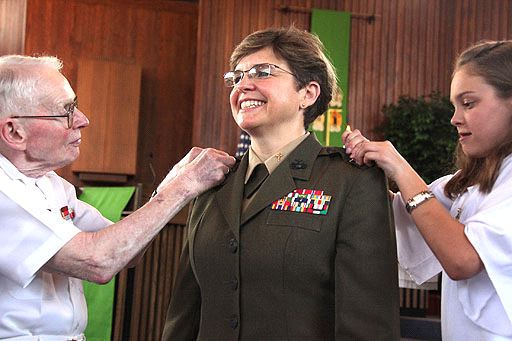
To Ask and Tell, or Not to Ask and Tell: This is the Contradiction

Rabbi Bret is baaaaaaack from vacation (apparently) and he didn’t waste anytime piling on his favorite virus – the infectious disease known as Radical 2K. He reports that the URCNA Synod has decided to send a letter to the U.S. Armed Services official, drafted by the Presbyterian and Reformed Joint Commission on Chaplains and Miltary Personnel (PRJC), that petitions the Pentagon to to hold the line on the current military policy – “don’t ask, don’t tell.”

In the current state of affairs, the various branches of the military do not inquire about the sexual orientation of personnel. But if the Obama administration has its way, “don’t ask, don’t tell” will cease and instead gays and lesbians will be able to come out of the closet. According to the PJRC letter, such a change of policy might force conservative Protestant chaplains to resign because their teaching and preaching of God’s word, especially on homosexuality, will open them to the charge of discrimination. The new policy might even force chaplains those passages in Scripture where God condemns homosexuality.

Bret interprets this URCNA decision as a major smack down of two-kingdom theology.

Despite the ongoing assault against Biblical Christianity from Westminster West Seminary and it’s specious Radical Two Kingdom Theology the URCNA rightly voted to weigh in on a “common realm” issue with an almost unanimous vote to resist, by way of appeal, the US Military’s overturning of “don’t ask, don’t tell.” Apparently the Synodical body was not persuaded by the R2Kt ratiocination and argumentation that the Church has no business speaking beyond the realm of the Church. With this vote there can be no doubt that the URCNA has implicitly rejected, root and branch, the foreign theology now commonly referred to as “R2K.”

One would have thought that after a well-deserved break from pastoral duties and service at Synod the good rabbi would not be so quick to hyperventilate about the meaning of this news. I can think of any number of better indications than this letter that the URC has repudiated 2k. Do the formation of a study committee or an actual report with recommendations against 2k come to mind? But if this gets Bret through the night without having to use his inhaler, so be it.

At the same time, Bret may want to regroup and consider that the policy that PRC now favors – “don’t ask, don’t tell” – was precisely the one they opposed back when President Clinton introduced it during his first weeks in office. Maybe Bret was running for Senate or doing something time consuming like that, but Reformed communions like the OPC and PCA both sent letters in 1993 informing the president of the Bible’s teaching about homosexuality. These communications were supposed to provide the official cover for Reformed and Presbyterian chaplains whose consciences might be violated by openly gay soldiers and officers taking up duties under their charge. In a contest between church and state, supposedly, the chaplains could now appeal to the explicit teaching of their own communions.

What is important to remember, though, is that these letters, also hatched by the Presbyterian and Reformed chaplains, came in reaction to the policy that the PRJC now supports. In which case, in the name of biblical Christianity, the PRJC has reversed course and determined that “don’t ask, don’t tell” is just fine and that Obama will damage the military and the nation if he tinkers with allowing gays now in the closet, to come out.

So the question for Bret and supporters of the PRJC is this: is this what healthy 1k looks like? Can the church really change its mind about the policies the Bible requires? Or is it simply the case that the Bible opposes whatever a Democratic president proposes? (Could a GOP Study Bible be in the offing?)

Even more troubling is the propensity for the chaplains from Reformed communions to manifest their opposition to homosexuality to the exclusion of other sins that the Bible also condemns. I wonder why PRJC doesn’t instruct the president about the idolatry of Mormon worship or the blasphemy of the Roman Catholic Mass? Surely there are Mormons and Roman Catholics out of the closet in the military. Some of them are likely chaplains. Does PRJC think that Clinton and Obama understand the regulative principle of worship but need help with the seventh commandment? Or is it that PRJC thinks sexual sins are more eggregious than false worship?

It could be a tough call since the Westminster Standards allow that not all sins are equally offensive. But if sexual sins are more objectionable than liturgical infidelity (you’d have trouble proving that from Israel’s experience), then why not go after porn in the military, or divorce, or adultery among heteros? I personally don’t buy the logic – on display in spades in American Beauty – that the biggest homophobes are really gay. But if PRJC wanted to avoid that sort of canard from the Hollywood left, why not send a letter or two to the president about stealing and lying?

Mind you, I understand at least some of the difficulties that gay rights create for our society and the Armed Services. Rabbi Bret is well within his duties as a citizen to register his concerns. But I sure wish he’d get his facts straight (no pun intended) about biblical teaching and the PRJC’s flip-flop on don’t ask, don’t tell.

Time Heals Wounds

Today is not only the birthday of the OPC. Closer to home it is also the day my recently deceased dad was born. This is not the place or the time to begin sorting through my relationship to him, but a number of thoughts come to mind on this June 11th.

When I first heard my father had died, I was on my way to the emergency room of a downtown Philadelphia hospital. I had fed the livestock, Cordelia and Isabelle, and during the procedure the lid to the can of cat food made a huge impression on the index finger of my left hand. The gash which would not close after an hour of tinkering was my penalty for kitchen awkwardness. After four hours at the hospital, I took five stitches. The wait in ER gave me time to sort out the logistics of burial and memorial service with my brother.

I was – and still am – glad for that cut because the scar not only reminds me of dad but also the wound that I still feel over his loss. And even if it has healed, and will continue to just as my own spirits have rebounded to some degree, it will always be a reminder of my great loss (because my father was a great man). In which case the cut was a providential form of self-mutilation. I may have been tempted to do so on my own, but cutting the body is not a proper way to honor God’s good creation. So rather than having a stud in my tongue or a tattoo on my left buttock cheek, I have a scar on my left hand. I can live with that. This day I even relish it.

On or before June 11th I usually buy my dad a birthday gift. In later years when he and my mother were both in a nursing home the challenge of buying something that he could use became greater. Now that I no longer need to buy a gift, I wonder what my failure as a consumer will do to our ailing economy. In fact, I wonder what the effects of death are generally for the economic health of a nation. Clearly, the funeral and flower industries benefit. And the federal government breaths a pint-size sigh of relief to have one more of its citizens off its role of Social Security beneficiaries, not to mention the inordinate expense of Medicare. But if a death brings savings for some and expenses for others, it also means none of the purchases that go with birthdays, Fathers’ Day, anniversaries, and the annual spending spree we call Christmas.

So to do my part for the economy, I’ll have to go out and spend on some “spirituous” refreshments. If I drink enough tonight to spend the amount I’d normally use to buy a birthday gift, the elixir may not only further heal my wounds but pickle them.

Right Chronology, Wrong Westminster Professor

Plain as nose
The controversial Kerux review of The Law Is Not of Faith is now available on line. I cannot get past the first sentence: “For the past thirty years, a shift in Reformed covenant theology has been percolating under the hot Southern California sun in Escondido.”

This is an amazing opening because for thirty years the sideline Reformed world has experienced a controversy over the refashioning of covenant theology and the doctrines that flow from it. But Westminster California was not the place where the controverted doctrines came from. Did the reviewers for Kerux notice anything about Federal Vision, or Evangelicals and Catholics Together, or Norman Shepherd? Of course, not. These are real controversies conveniently ignored to go after the alleged real culprit: WSC and its part-time professor, Meredith G. Kline.

Atop the bluff of a former orange grove, a quiet redefinition of the Sinaitic covenant administration as a typological covenant of works, complete with meritorious obedience and meritorious reward has been ripening. The architect of this paradigm shift was the late Meredith G. Kline.

Again, this is truly dumbfounding. The doctrine of justification has been up for grabs in the heart of conservative Reformed and Presbyterian communions such as the OPC, PCA, and URC. The doctrine has received further questions and revisions in the broader Protestant world thanks to the already mentioned Evangelicals and Catholics Together, the Federal Vision, and the New Perspective on Paul. And yet, Kerux decides to lower the boom on Kline and WSC.

It should be noted that Kline, as a professor at Gordon-Conwell, was one of those who thirty years ago supported the Westminster faculty who were opposed to Shepherd’s teaching – among them, W. Robert Godfrey, Palmer Robertson, Robert Knudsen, and Arthur Kuschke. And since then it has been Klineans who have been clearest on justification, its centrality to the Reformed doctrine of salvation, and its priority to sanctification. At the same time, it has been those who have either defended or been silent about Shepherd who have been some of the biggest critics of Westminster California.

Consequently, it is an odd historical judgment that Kerux offers, and one that draws attention away from the real source of controversy in Reformed circles.

But the problems of historical analysis only get worse for the authors of the review. Not only was Kline an important critic of Shepherd but his students have been at least partly responsible for bringing a measure of calm to that controversy within the OPC thanks to the leadership of WSC faculty on the study committee on justification. That report was clear regarding the defects of Shepherd’s views and their ties and affinities to the Federal Vision and the New Perspective on Paul.

And in case anyone actually thought WSC was ambiguous about justification, the seminary has issued a statement on the doctrine, “Our Testimony on Justification,” which counters the Shepherdian claim that justification needs to be set free from its Lutheran bondage. It declares:

. . . some who claim to be Reformed suggest that too many Reformed people have a Lutheran view of justification and need to develop a distinctively Reformed view of justification. These critics usually claim that they accept the Reformed confessions, yet at the same time claim that Reformed theology needs to be changed and clarified to be distinctive. Such critics, called neonomians in the seventeenth century, today are perhaps better labeled covenant moralists.

Our testimony is directed primarily to this third group who claim to be genuinely Reformed. These covenant moralists teach, contrary to the Reformed confessions and/or historic Reformed conviction, some or all of the following:

that the Reformation doctrine of justification is not fully biblical;

that the Lutherans and Calvinists have different doctrines of justification;

that the Reformation misunderstood Paul on justification;

that justification is not by faith alone, but by faithfulness, i.e. trust in Christ and obedience;

that the idea of merit as a way of explaining the work of Christ for us is unbiblical;

that Christ died for our sins but he did not keep the law perfectly in our place (his active obedience);

that Christ does not impute his active obedience to us;

that obedience or good works is not only the fruit or evidence of faith, but is also part of the ground or instrument of justification;

that our justification is in some way dependent on the final judgment of our works.

As the faculty of Westminster Seminary California we believe that we must issue this testimony especially in relation to those who claim to be Reformed in their attack on the Reformation doctrine of justification and who claim to uphold the teaching of the Reformed confessions.

So for the last thirty years, Westminster California has through its faculty, both in the courts of the church and individual authors, during debates about Shepherd, ECT, Federal Vision, and the New Perspective, been on the right side of the doctrines of grace. Now along comes Kerux to re-write history and say that not Shepherd, Richard John Neuhaus, Chuck Colson, nor N. T. Wright was the problem but Meredith G. Kline and his students. To borrow a line from Harry Emerson Fosdick, “what incredible folly!”

What's the Difference between the OPC and PCA?

presbyterian
In 1986 the OPC almost became part of the PCA. In the General Assembly report that laid out the rationale for Joining & Receiving, the OPC’s committee on ecumencity noted the following characteristics of the two communions. (Keep in mind that one of those denominations was 50 years old, the other only 14.)

Strengths
PCA
•Visibility
•Attractive name (though indistinguishable for the general public from the PCUSA)
•Vigorous evangelism
•Aggressive church extension and foreign mission programs
•Expressed commitment to Scripture and the Westminster Standards
•Expressed determination to instruct members in the Reformed faith

OPC
•Commitment to the Reformed faith as the teaching of Scripture
•Theological and ecclesiastical stability that has had world-wide influence for the Reformed
•Practicing Presbyterianism vs. hierarchical and congregational practice
•Church-oriented mission
•Willingness to expend prolonged time and effort to establish soundly-biblical bases for programs and actions
•Revised Form of Government
•Enrichment of the church by willingness to use the insights of other Reformed churches at home and abroad
•International Reformed ecumenical participation

Weaknesses
PCA
•Delegation of judicatories’ functions to commission
•Selective discipline
•Uneven indoctrination of new churches
•Problematical elements in the Form of Government
•Danger of loose subscription by officers
•Inadequate discussion at general assembly, a hindrance to mature biblically-based decisions
•Tendency toward domination of policy by staffs
•Competition among agencies for funds
•Methods of evangelism
•Opposing tendencies: bureaucracy/ congregationalism
•Involvement with non-Reformed foreign mission agencies
•Loyalty to regional (southern. presbyterian) distinctives

OPC
•No means of assuring Reformed training of candidates for the ministry
•No publication for exchange of opinion
•Weakness in local evangelism
•Growing ignorance of Church’s reason for existence
•Growing ignorance of the doctrine of the church
•Frequent inadequate preparation of covenant children and adult candidates for communicant membership

Aside from what these lists reveal about both communions, another consideration worth raising is how much has changed in 23 years in both churches. From the squint of oldlife, these differences appear even more glaring in 2010 than they did in 1986. But the biggest question may be why with these differences in front of them a majority of OPC commissioners voted in favor of J&R (not a sufficient majority, though, to send the matter to the presbyteries for ratification.