Did They Give Rise to Secession?

So here is the problem (aside from Irish department stores stocking washcloths but Irish hotels not owning them, or that no one shows up in Dublin for evening prayers when the fat ladies aren’t singing). Political philosophers and historians have given lots of attention to Calvinism as an engine of modern liberal (read constitutional) politics. Whether it’s resistance theory, the Dutch rebellion, or the so-called Presbyterian revolution of the British colonies in North America, students of Calvinism believe they have a firm read on Reformed Protestant politics as an inherently rebellious outlook, one that won’t let any human authority encroach on the Lordship of Christ. (Why we didn’t celebrate 1861 along with 1776, 1689, and 1567 prior to getting right with race is a bit of an inconsistency.)

That sounds good in theory, and it certainly turns out Calvinist (New, Neo, or Denominational) in large numbers for Fox News. But it doesn’t make sense of history where context matters. Here, the case of Irish Presbyterians are instructive. They were Scottish in background and carried around in their devotional DNA the covenants that Scottish or English-Scottish monarchs had made to ensure the protection of the true religion (Presbyterianism) and the suppression of the false (Roman Catholic or prelatical/Episcopal). But in Ulster they encountered a set of realities remarkably different from Scotland or North American colonies. They were subject politically to English authorities who trying to subdue the Irish and who wanted more Protestants but did not want to provoke the natives. They confronted a native population that was firmly Roman Catholic. And they found themselves on the outside of an ecclesiastical establishment (the Church of Ireland) that was Anglican. If you turn to Scottish history for help, you alienate the English government and your stir up your Irish neighbors. If you want to be part of the ecclesiastical establishment (the way Upper Canada would try in the nineteenth century), you’re guilty of historical anachronism. The closest situation to yours is perhaps Philadelphia which when it comes along toward the end of the seventeenth century provides an attractive alternative to Ulster for Scots-Irish.

Here is how I. R. McBride in Scripture Politics: Ulster Presbyterians and Irish Radicalism in the Late Eighteenth Century puts the challenge of placing Irish Presbyterianism on the map of political theory in the West:

It would be convenient if an analysis of theological controversy could somehow isolate a single gene that programmed radicalism into the Presbyterian Church. Unfortunately, political affiliations were not structured by religious allegiances in any simple way, but resulted from a subtle combination of theological inheritance, social factors, and political circumstances. Ulster radicalism cannot be understood outside the experience of exclusion from the institutions of the state, the social conditions of the north of Ireland, and a deep-seated ambivalence towards a British government which was both the upholder of Anglican ascendancy and the ultimate guarantor of Protestant security. Presbyterianism, furthermore, was neither homogeneous or static, but was fragmented . . . Unlike the monolithic edifices of its Anglican and Roman rivals, this fractured culture allowed theories of both religious and political dissidence to take hold and flourish.

The intellectual inheritance of the Scottish Reformation offered a rich and complex legacy of resistance and radicalism which provided a common platform on which Presbyterians of all theological preferences could unite. The basic principle that Jesus Christ was the sole lawgiver in the Church, though applied in a variety of ways, was shared by all strands of Presbyterian opinion. In its most extreme manifestation, the older ‘prophetic’ theocracy called for Church and state to be brought together to create a society in social and political conformity to the word of God, a vision still shared by those groups which adhered to the Solemn League and Covenant. In an age of social and political disruption, it retained its attraction for poorer Presbyterians in the Synod of Ulster, the Secession, and most of all the Reformed Presbytery. The political theology of the Covenanters, which asserted that all government, temporal and spiritual, must be based on those patterns allegedly found in Scriptures, was violently at odds with the development of an erastian, parliamentary regime. . . .

In their insistence on the supremacy of individual conscience over received authority, the New Lights also regarded themselves as the genuine heirs of the Reformation heritage. The call to separate Christianity from human policy echoed the fundamental Protestant dichotomy between human corruption, evidenced in the false ceremonies and beliefs which had debased the Church, and divine truth as embodied in the Scriptures. While their political principles were no doubt derived from a common Presbyterians, however, they also reflected the rationalism of non-subscribing divinity . . . . Far more important to the evolution of radical ideology was the non-subscribers’ battle for freedom of enquiry, and their conviction that civil and religious liberty were inextricably linked. . . . ‘that religious is a personal thing – that Christ is the head of the church – that his kingdom is not of this world – that the WILL OF THE PEOPLE should be the SUPREME LAW’. Here was the authentic voice of New Light radicalism. [109-110]

The spirituality of the church keeps looking better and better.
Giving Old Meaning to Celebrity Pastor

Can you imagine the mayor of Grand Rapids taking a delegation of city officials to Willow Grove, Pennsylvania, the home of the OPC’s headquarters, to solicit last year’s moderator of General Assembly to attend this year’s assembly in Grand Rapids? I can’t. You can’t. No one can. The reason is that a moderator of an OPC General Assembly is not someone who is going to generate tourism dollars for local business. At best, last year’s moderator will show up (if not a commissioner) and plunk down maybe $1,400 in expenses between room, meals, parking, airport taxes, and miscellaneous items.

The reason for this thought experiment is the news that Michael Nutter, the mayor of Philadelphia, received a bit of a cold shoulder from Pope Francis earlier this week. For a cash-strapped city, it is not enough to be hosting a world conference on families thanks to the Archbishop of Philadelphia’s responsibility. The conference scheduled for next should draw hundreds of thousands to the city. But Nutter wanted to persuade the pope to attend. Since Nutter is not a Roman Catholic (to my knowledge) and since Philadelphia’s origins are Quaker, the only logical explanation for Nutter’s arm-twisting is commercial. With the presence of the pope, maybe those flocking to Philadelphia will double?

Such attention to the papacy, however, has its downside:

The truth is that the more the world flatters the Catholic Church by fixating on the papacy—and the more the internal Catholic conversation is monopolized by speculation about the intentions of one man—the less likely it is that the church will succeed in moving beyond the confusions and conflicts that have preoccupied it since the Second Vatican Council (1962-65). The church desperately needs to reclaim its cultural and spiritual equilibrium; it must find a density and richness of worship and mission and a renewed public presence, which far transcend mere loyalty to the pope. Lacking such equilibrium and self-possession, the church cannot find its true voice. But to find this voice, Catholics will have to turn not to Rome but toward one another, which is where both the problems and the solutions lie.

The fixation on the papacy trivializes the faith of Catholics, the vast majority of whom throughout history have had little knowledge of, and no contact with, any pope. Traditionally, the papacy was the court of last resort in adjudicating disagreements among the faithful. But in the last century or so it has increasingly become the avenue of first resort, determined to meddle in every theological or ecclesiological dispute. If American nuns are flirting with novel styles of ministry, the Vatican intercedes. If translations of liturgical texts incorporate a bit of inclusive language, Rome takes out its red pencil. This meddling Vatican infantilizes the church’s bishops, who seem to change their tune (as well as their dress) in response to every new papal fashion. Bishops in turn demand deference from the clergy and laity. The consequences have been all too clear: As in any heavily top-down organization, local initiatives fail to gain a foothold, or fizzle out for lack of dynamic leadership, and apathy prevails in the pews. Institutional gridlock and paralysis have become the norm. Seminaries are empty, and clerical talent is thin on the ground.

At the same time, the advantage of the papacy is the one that goes with monarchy more generally. Imagine Mayor Nutter having to fly around to all of the largest dioceses in N. America, Africa, and Europe, to persuade archbishops to attend the conference and to pay for some of their parishioners to visit Philadelphia. It would break the Mayor’s travel budget. So with one person in power comes efficiency and decisiveness (no consensus-building among committee members).

And for that reason, Roman Catholicism will have trouble ever finding the road to the spirituality of the church even when the pope’s real power is merely spiritual.

The Man who Made John Facenda and Frozen Tundra Famous

I don’t know how the news of Steve Sabol’s death is traveling outside Philadelphia where chatter on sports-talk radio this morning was all about Sabol’s work in taking the National Football League from a sport like professional hockey into the prime-time attraction that it is today. But word of his death did register with me since Sabol was one of my few brushes with greatness.

Back in my junior year at Woodrow Wilson High, one of my history teachers, obviously looking for a day off without having to call in sick, had Sabol come to campus and speak to various classes. At the time NFL Films was still a relatively new venture, but it was largely responsible for that collection of highlight footage that ESPN would take over. It is an indication of how small-time the effort was that Sabol would mix with ne’er do well youths in Lower Bucks County. But by mythologizing the sport — Sabol played football at Colorado State while majoring in art history — he helped turn the NFL into the corporate behemoth it now is. I wonder if he had regrets.

Fast forward five years. During my junior and senior years at Temple, while studying film — does “the cinema” sound less dilettantish? — I worked for Steve Sabol. At their center city facility in Philadelphia, I mixed chemicals for the film processors between midnight and 8:00 so that the writers and editors could prepare those highlight reels that Howard Cosell announced. Of course, the real voice of NFL Films was John Facenda, the television news anchor for Channel 10 in Philadelphia. Later Sabol would use other Philadelphia voices, like Harry Kalas.

Segments from old soundtracks prompted me to buy one of the cd’s with the remarkably good music that turned football into art. (If readers want proof that my better half doesn’t read Old Life, admission of on-line purchases has to be it.) Folks born after 1970 can likely not imagine a time when professional football was almost as beautiful as it was modest. The irony is that Steve Sabol may have been so accomplished at his craft that he helped turn the NFL into something almost unwatchable (not to mention those vexing violations of the Lord’s Day).

The Day of Moral Perplexity Has Come for Angelo Cataldi

I had thought about entitling this post, “Predators All,” since the revelations of child molestation mount and mount. First it was the Roman Catholic Church, then Penn State, then Hollywood, and now comes word from several adults that Bill Conlin, a longtime baseball beat reporter for Philadelphia’s Daily News, molested them as children. This news cuts close to home for our dear moral blow hard, Angelo Cataldi, since Cataldi has hosted Conlin many times on the show to talk RBI’s and walks-hits-per-inning. Even closer to home, Angelo and Bill are neighbors during the summer when they occupy their beach houses in Sea Isle City, New Jersey.

Not that anyone living outside the Delaware Valley really cares about these Philadelphia media figures, but listening to the shows today (now that classes are over and grades are in) may be of interest to non-Philadelphians if only because of the tone that the various hosts have deployed to discuss this latest scandal. As clear as Angelo and others have been in condemning the alleged acts, the hosts have also exhibited a degree of anguish that was entirely lacking in the case of Joe Paterno. (One important difference is that Conlin yesterday resigned from his writing post, so no one can call for his job.)

On the one hand, all the talk show hosts looked up to Conlin as one of the best baseball minds in Philadelphia (a mind and voice that earned him the J. G. Taylor Spink Award this year for meritorious contributions to baseball writing). In other words, they knew him and could never have imagined that Conlin was capable of such behavior. Now, though, the moral wheels are grinding and different hosts are agonizing over the darkness of human nature, and wondering how much they need to be suspicious of anyone they know.

On the other hand, the hosts are not nearly so condemning of the adults who enabled Conlin (allegedly) to escape any charges for over forty years (and now the statute of limitations means that Conlin will not face criminal charges). No one is wondering who among Conlin’s editors knew about this. No one is blaming the parents of these children who did know (allegedly) of the molestation but did nothing because they did not want to hurt a friend and family member who was coming into his own as a reporter and columnist.

In other words, what is happening in the world of Philadelphia sports journalism is precisely what did not happen when news from Happy Valley arrived in Philadelphia. Instead of imagining how those close to Jerry Sandusky might have reacted to protect both a friend and an institution, Philadelphia journalists called for the figurative death penalty for everyone close to Sandusky.

It is a complicated world out there.

By the way, I keep wondering when the shoe is going to drop in all of these child molestation scandals. We live at a time when practically every form of sexual desire is tolerated; the institutions that promote some of those forms even wind up sponsoring sports talk radio. So why exactly, for instance, do these men who sometimes go to gentlemen’s clubs think that sex between an adult and a child is wicked and perverse? The obvious answer is consent. The children are subordinate to the predators and have no recourse. The flip side of this deduction is that consensual sex is fine, no matter how kinky.

What I don’t understand is how consent makes sex, no matter how perverse, okay. Is the desire of a man for a boy okay? Is it perverse and disgusting? Or does it only become twisted when carried out on a boy (who is incapable of giving consent)? Could it be that certain forms of sex are perverse, no matter whether the partners are consenting and no matter how “natural” either of the partner’s desire is? Could it even be that sex between a married woman and her single boss is also perverse no matter how consensual the sex or natural the adulterers’ desires are?

The reason for asking is to see if the moral sense that does regard child molestation as heinous might also be available to draw lines in other places. These other lines would and should apply as much to heterosexual as to homosexual forms of sexual desire. Ideally, the true form of consensual sex would be one where two people have consented to be each other’s sexual partner for life and to be responsible for rearing any offspring that proceed from their sexual relations.

Does Anyone in the United States Care about Presbyterianism?

The oldest presbytery in North or South America is moving. Actually, the offices are relocating since it is hard to move a jurisdiction or the congregations within it. But the Presbytery of Philadelphia (PCUSA), founded in 1706, is moving from its Center City location at 22nd and Locust to the Mt. Airy neighborhood in the northwest section of the city.

One curious aspect of this move – aside from giving up a very handsome building and reasonably good location – is that no one seems to notice or care. A search at Google for news stories reveals that no editors, even religious ones, have the New World’s oldest presbytery on their horizon. But when the Mormons plan to build a Temple in Center City, well, now you’re talking news copy and readers.

Another consideration is what this move may indicate about the declining fortunes of the mainline Protestant churches. Back in 1989 the United Churches of Christ moved from its Manhattan offices to Cleveland. Nothing wrong with the latter city, and maybe the UCC staff were able to enjoy Lebron’s exploits (they sure beat the Knick’s recent performance). But I’m not sure an NBA game makes up in stature for headquarters in the Big Apple. Tim Keller likely agrees.

Presbyterians had actually begun the trend of denominational downsizing by leaving New York City’s high overhead and big britches reputation to bridge the gap between bureaucrats and regular church folk. After the 1983 merger of the UPCUSA (North) and the PCUS (South) into the present iteration of the PCUSA, the mainline denomination in 1988 gave up its New York City address for Louisville, the biggest city in the old border state of Kentucky. (Another consequence of the merger was that the denomination could not maintain both archival centers, the one in Philadelphia at the Presbyterian Historical Society and the one in Montreat, NC, at the Montreat Historical Society. In 2005 the denomination decided to move the southern materials to Philadelphia, where they are in very good hands but farther from the hands most willing to sort through them.)

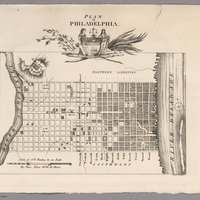
Now the denomination’s oldest presbytery is moving its offices from the center of Philadelphia to one of its peripheral neighborhoods. The presbytery’s website gives no reason but the “for sale” sign on the old location suggests that cheaper real estate is a factor. Mt. Airy is a fine neighborhood but it is not Center City nor was it part of William Penn’s original boundaries for his “Holy Experiment.” The move is a significant development in the life of New World Presbyterianism. But no one seems to care. They don’t even know.