What's Up With Oaths and Vows?

Historians may not be rocket scientists, but they can generally outwit the smartest of their interlocutors simply by knowing the origins of an idea, event, person, or argument. This is not to say that those who talk to historians understand when historical knowledge trumps philosophy, exegesis, or ideology. Some people are so committed to abstract truths that their ideas are impervious to concrete facts. But historians enjoy an advantage in debate thanks to clay feet that all historical actors (short of being divine persons) have.

For instance, knowing that w— v— thinking began at a certain date in the modern era, or that dramatic conversions are not much older, has an effect on claims that these are timeless truths revealed in holy writ. This historical awareness even extends to ideas that Old Lifers promote such as the spirituality of the church. The historical origins of an idea or truth doesn’t mean it is wrong. It only means it is not timeless and so perhaps its connections to the Bible are less certain.

Current reading and teaching has made me aware of the peculiar strains and tendencies of Puritanism both in Old and New England. For instance, it does look to me like chapter eighteen in the Confession of Faith on Assurance is a direct result of debates among the Puritans about the relationship among good works done in preparation for conversion, justification, and how to evaluate good works after conversion. These debates may have absorbed other Reformed churches, but the Westminster Divines’ willingness to explore the interior dimensions of Christian experience does seem to reflect the turn of experimental Calvinism or practical divinity that in the 1590s surfaced in England and caught fire in the Netherlands.

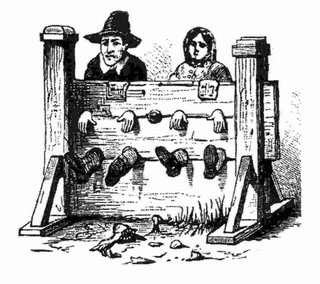
Another feature of the Confession of Faith that seems to reflect its British setting is the twenty-second chapter on Lawful Oaths and Vows. It is not a brief chapter and discusses the topic as follows:

1. A lawful oath is a part of religious worship, wherein, upon just occasion, the person swearing solemnly calleth God to witness what he asserteth, or promiseth, and to judge him according to the truth or falsehood of what he sweareth.

2. The name of God only is that by which men ought to swear, and therein it is to be used with all holy fear and reverence. Therefore, to swear vainly, or rashly, by that glorious and dreadful Name; or, to swear at all by any other thing, is sinful, and to be abhorred. Yet, as in matters of weight and moment, an oath is warranted by the Word of God, under the new testament as well as under the old; so a lawful oath, being imposed by lawful authority, in such matters, ought to be taken.

3. Whosoever taketh an oath ought duly to consider the weightiness of so solemn an act, and therein to avouch nothing but what he is fully persuaded is the truth: neither may any man bind himself by oath to anything but what is good and just, and what he believeth so to be, and what he is able and resolved to perform.

4. An oath is to be taken in the plain and common sense of the words, without equivocation, or mental reservation. It cannot oblige to sin; but in anything not sinful, being taken, it binds to performance, although to a man’s own hurt. Nor is it to be violated, although made to heretics, or infidels.

5. A vow is of the like nature with a promissory oath, and ought to be made with the like religious care, and to be performed with the like faithfulness.

6. It is not to be made to any creature, but to God alone: and, that it may be accepted, it is to be made voluntarily, out of faith, and conscience of duty, in way of thankfulness for mercy received, or for the obtaining of what we want, whereby we more strictly bind ourselves to necessary duties; or, to other things, so far and so long as they may fitly conduce thereunto.

7. No man may vow to do anything forbidden in the Word of God, or what would hinder any duty therein commanded, or which is not in his own power, and for the performance whereof he hath no promise of ability from God. In which respects, popish monastical vows of perpetual single life, professed poverty, and regular obedience, are so far from being degrees of higher perfection, that they are superstitious and sinful snares, in which no Christian may entangle himself.

My point in bringing up this chapter is not to challenge the Confession. I don’t find anything objectionable in this chapter. And the counsel about monastic vows has merit and reflects the genuine challenges that confronted Protestants. Still, I wonder when the last time a pastor taught his congregation about oaths and vows. I also wonder when the last time was that a candidate for ministry had to answer questions about oaths and vows. These questions are all the more pressing when we remember that none of the other Reformed confessions have such extensive comments on oaths and vows. Could it be that the background of the National Covenant in Scotland and the Solemn League and Covenant of Parliament and the Scots had more to do with this chapter than the development of Reformed teaching?

I am just asking.
Give 'Em A Break

A story from the world of higher education caught my eye and started me thinking about the nature of Sunday observance among Roman Catholics. Inside Higher Education reported on a meeting of Roman Catholic bishops and university presidents to consider how their colleges and universities may preserve academic freedom while also remaining faithful to church teaching. That is a riddle that has long affected most Christian institutions of higher learning – not particularly helped by world-viewitis or the notion that the Bible speaks to all of life. But Roman Catholics have faced this difficulty more acutely of late owing to John Paul II’s encyclical, Ex Corde Ecclesiae, which calls upon Roman Catholic schools to remain faithful to church teaching at least in theology departments if not more widely across the campus. (If some of the statements expressed at the conference are indicative of Roman Catholic fidelity, the problem of adjusting church dogma and academic freedom will likely be easy. The first principle adopted by this group – we welcome “all students into a vibrant campus community that celebrates God’s love for all” – won’t force timid administrators and faculty to double down on the church’s catechism or much reason to refuse conclusions from most faculty.)

But aside from the intellectual work of the conference’s participants, what was fairly remarkable was that the meeting the reporter covered took place on Sunday. Granted, Roman Catholics have never been as anal about the Lord’s Day as Reformed Protestants (some say the real anal-retentive award for the fourth commandment belongs to the Puritans, but we all know that no can define Puritanism). At the same time, well before Willow Creek offered services for seekers and those sensitive to them, Rome was providing the Mass at different times during the weekend to accommodate the faithful who preferred other activities on Sunday morning.

Even so, if Rome is not sabbatarian as Reformed understand that notion, the Roman Catholic church does teach about the sanctity of Sunday and the need to set it aside for worship and rest. According to the Catechism:

2189 “Observe the sabbath day, to keep it holy” (Deut 5:12). “The seventh day is a sabbath of solemn rest, holy to the Lord” (Ex 31:15).

2190 The sabbath, which represented the completion of the first creation, has been replaced by Sunday which recalls the new creation inaugurated by the Resurrection of Christ.

2191 The Church celebrates the day of Christ’s Resurrection on the “eighth day,” Sunday, which is rightly called the Lord’s Day (cf. SC 106).

2192 “Sunday . . . is to be observed as the foremost holy day of obligation in the universal Church” (CIC, can. 1246 § 1). “On Sundays and other holy days of obligation the faithful are bound to participate in the Mass” (CIC, can. 1247).

2193 “On Sundays and other holy days of obligation the faithful are bound . . . to abstain from those labors and business concerns which impede the worship to be rendered to God, the joy which is proper to the Lord’s Day, or the proper relaxation of mind and body” (CIC, can. 1247).

2194 The institution of Sunday helps all “to be allowed sufficient rest and leisure to cultivate their familial, cultural, social, and religious lives” (GS 67 § 3).

2195 Every Christian should avoid making unnecessary demands on others that would hinder them from observing the Lord’s Day.

This is not as strict as the Shorter Catechism on the fourth commandment – “spending the whole time in the public and private exercises of God’s worship, except so much is to be taken up in works of necessity and mercy.” But it does tell Roman Catholics that the should attend Mass on Sunday – a rite of obligation – and that they should not work or make demands on others to work (like buying a new flat screen television to watch oversized and overpaid men play football in an oversized bowl). In addition, this teaching would certainly be a tonic for Sabbath-challenged evangelicals.

In which case, why couldn’t the Roman Catholic bishops and presidents have conducted their meetings and delivered their papers on Saturday? If they still had business, they could likely have reconvened on Monday and devoted Sunday to worship and rest. Since they were not Puritan and were meeting in Washington, D.C. they may have even taken in an exhibit at the National Portrait Gallery. But surely they could have rested from their weekday activities for the holy day known as Sunday.

Act Two, Scene Three: How Soon They Forget

In his serialized review of VanDrunen’s Natural Law and the Two Kingdoms, Nelson Kloosterman finishes his inspection of the chapter on Calvin with the line, “Remember the Puritans.”

This is a curious appeal because Kloosterman’s memory may not be as good as his review of VanDrunen is long. His major objection to 2k appears to be that its advocates do not insist that Scripture is necessary for prescribing the duties of the civil magistrate. To VanDrunen’s point that Calvin did not believe civil government should be ruled solely by Scripture, Kloosterman finds an opening to insist that the Bible does inform at least part of the magistrates duties.

On the one hand, Kloosterman asks:

. . . if God’s natural law, embodied in OT Mosaic law, prohibits public blasphemy, and if this natural law ought to underlie civil enactments, then why should Dr. VanDrunen so vigorously oppose appeals to God’s requirements amid public policy discussions about moral issues covered by the Decalogue?

That would seem to mean that the civil magistrate is bound to uphold both tables of the law since Kloosterman is not only concerned about violations of the seventh commandment in the instance of gay marriage but also about instances of blasphemy covered in the third commandment.

Kloosterman also goes on to quote, as he is wont to do, from the Canons of Dort which give him the green light to insist that special revelation must be the lens through which to read general revelation (though he never seems to consider that this reading of Dort would prohibit all non-Christians from using natural law, whether as fathers or magistrates, since without regeneration they cannot properly interpret natural law). This is what Dort says:

There is, to be sure, a certain light of nature remaining in man after the fall, by virtue of which he retains some notions about God, natural things, and the difference between what is moral and immoral, and demonstrates a certain eagerness for virtue and for good outward behavior. But this light of nature is far from enabling man to come to a saving knowledge of God and conversion to him—so far, in fact, that man does not use it rightly even in matters of nature and society. Instead, in various ways he completely distorts this light, whatever its precise character, and suppresses it in unrighteousness. In doing so he renders himself without excuse before God” (III/IV.4, italics added).

Since Kloosterman italicizes those portions which correctly portray the limitations of natural man using natural law, he would seem to be saying that without Scripture, no one can interpret general revelation correctly. In fact, he said this in his interviews on Christ and culture at Reformed Forum.

But on the other hand comes Kloosterman’s selective memory, perhaps a function of having to venture beyond Queen Wilhelmina’s mints and wooden shoes. To VanDrunen’s point that Calvin did not use the Bible solely for civil matters, Kloosterman writes:

“Calvin did not believe,” we are told, “that the civil kingdom can be governed solely or primarily by the teaching of Scripture.” But who does believe that? Some of us insist that the civil kingdom (public society) should be governed in part by the teaching of Scripture, in connection, say, with issues like homosexual marriage and abortion, and even debasing monetary currency. But who among us has ever claimed that “the civil kingdom can be governed solely or primarily by the teaching of Scripture”?

Actually, as already mentioned, Kloosterman did claim that the Bible is the basis for civil government and its laws (and his invocation of Dort is further testimony to this point; how else to read the deficiency of natural revelation apart from the lens of Scripture?). But the curious aspect of Kloosterman’s concession that the Bible does not govern all of public life comes when he mentions those areas where the Bible should govern the civil magistrate – gay marriage and abortion.

What about blasphemy, mentioned in the previous quotation? And what about both tables of the law? Does the magistrate follow only the second table but get a pass on the first? Does this mean that the civil polity should tolerate blasphemy and idolatry, but not murder and stealing? If so, then how does this view follow biblical teaching or even show the usefulness of the Decalogue in civil government? Is Kloosterman really a closet advocate of 2k?

If he remembers the Puritans, he is. Because those English Protestants who fled the old country to establish a city on Beacon Hill were not at all reluctant to let the whole Decalogue (and even parts of the Pentateuch) inform their civil laws. To assist Dr. K’s memory, he might want to consider the following (only the first ten out of fifteen capital offenses) from The Laws and Liberties of Massachusetts (1647):

1. If any man after legal conviction shall have or worship any other God, but the lord god: he shall be put to death. Exod. 22. 20. Deut. 13.6. & 10. Deut. 17. 2. 6.

2. If any man or woman be a witch, that is, hath or consulteth with a familiar spirit, they shall be put to death. Exod. 22. 18. Levit. 20. 27. Deut. 18. 10. 11.

3. If any person within this Jurisdiction whether Christian or Pagan shall wittingly and willingly presume to blaspheme the holy Name of God, Father, Son or Holy-Ghost, with direct, expresse, presumptuous, or highhanded blasphemy, either by wilfull or obstinate denying the true God, or his Creation, or Government of the world: or shall curse God in like manner, or reproach the holy religion of God as if it were but a politick device to keep ignorant men in awe; or shal utter any other kinde of Blasphemy of the like nature & degree they shall be put to death. Levit. 24. 15. 16.

4. If any person shall commit any wilfull murther, which is Man slaughter, committed upon premeditate malice, hatred, or crueltie not in a mans necessary and just defence, nor by meer casualty against his will, he shall be put to death. Exod. 21. 12. 13. Numb. 35. 31.

5. If any person slayeth another suddenly in his anger, or cruelty of passion, he shall be put to death. Levit. 24. 17. Numb. 35. 20. 21.

6. If any person shall slay another through guile, either by poysoning, or other such devilish practice, he shall be put to death. Exod. 21. 14.

7. If any man or woman shall lye with any beast, or bruit creature, by carnall copulation; they shall surely be put to death: and the beast shall be slain, & buried, and not eaten. Lev. 20. 15. 16.

8. If any man lyeth with man-kinde as he lieth with a woman, both of them have committed abomination, they both shal surely be put to death: unles the one partie were forced (or be under fourteen years of age in which case he shall be seveerly punished) Levit. 20. 13.

9. If any person commit adulterie with a married or espoused wife; the Adulterer & Adulteresse shall surely be put to death. Lev. 20. 19. & 18. 20 Deu. 22. 23. 27.

10. If any man stealeth a man, or Man-kinde, he shall surely be put to death Exodus 21. 16.

I wonder if this is the system of law that Dr. K. would have the readers of Christian Renewal remember. Since he seems to shy away from putting people to death for adultery, Kloosterman would appear to be much closer to VanDrunen than he is either to Calvin or the Puritans whose notions of a Christian society perhaps only contemporary theonomists have the stomach to swallow.

In which case, what seems to motivate Dr. K.’s objections to 2k is pining for the sort of American society when liberal Protestants were running things and setting the standards for public life. Ramesh Ponnuru gave a useful description of the virtues of that wonderful time in American life in his essay, “Secularism and Its Discontents” (National Review, Dec. 2004) He wonders what would happen if religious conservatives actually achieved legislative success in the U.S. Their wish-list includes prohibiting abortion, restricting pornography, restraining experimentation on human embryos, and banning gay marriage. Some might like to have more prayer in public schools, and those who don’t home school would prefer that the public school teachers giving tips on condoms. But Ponnuru thinks this is hardly a return to John Winthrop’s Boston or John Calvin’s Geneva:

My point . . . is to note that introducing nearly every one of these policies – and all of the most conservative ones – would merely turn the clock back to the late 1950s. That may be a very bad idea, but the America of the 1950s was not a theocracy.

Likewise, Kloosterman’s critique of 2k is hardly a return to Massachusetts of 1647, Amsterdam of 1595, or to Zurich of 1550. If he could remember the Puritans, he might actually see how much in common he has with his Dutch-American nemesis, the lovely, the talented, David VanDrunen.

If Reformed Needs To Be Distinguished from Puritan, Why Not Presbyterian?

Some historians of seventeenth-century British Protestantism are dismissive of attempts to distinguish between Puritans and Presbyterians. Part of the problem, of course, involves definitions and categories. When it comes to politics, differences between Presbyterians and Puritans do not become clear until the 1650s with the regime of Oliver Cromwell since Puritans in Parliament joined forces with Presbyterians to do battle with the Stuart monarchy partly on the basis of the Solemn League and Covenant. When it comes to religion, Puritans and Presbyterians shared an intense and introspective piety that again makes differentiating them seemingly pointless.

I was surprised to read, then, in his treatment of John Owen Carl Trueman’s distinction between Puritan and Reformed. On the one hand, he argues that Puritan, at least with reference to Owen, is an unhelpful category.

First, . . . there is little consensus on exactly what constitutes a Puritan, let alone the reification of that elusive essence in the phenomenon known as Puritanism. Second, whatever else Puritanism is, it is fairly minimalist in terms of theological content – if John Milton, the quasi-Arian counts as a Puritan, for example, we can scarcely include even that most basic of Christian distinctives, the doctrine of the Trinity, in our definition. Third, Puritanism has, on the whole, far too parochial a range to allow us to see the full context of Owen’s thinking. . . . Thus, the use of a category like “Puritanism,” which brings with it all manner of narrowly parochial connotations, really needs to be deployed very carefully and in very specific contexts if it is to be at all helpful in our understanding of [Owen’s] thought.

The category that Trueman prefers to apply to Owen is Reformed Orthodoxy since it “is at once both more easily defined and less limiting that the category of Puritanism.” By Reformed Orthodoxy Trueman means:

. . . the tradition of Protestant thought which found its creedal expression on the continent in such documents, as, among others, the Belgic Confession, the Heidelberg Catechism and the Canons of Dort, and in Britain in the Westminster Assembly’s Confession of Faith and Larger and Shorter Catechisms. Historically speaking, the immediate roots of this tradition are to be found in the work of Reformers such as Huldrych Zwingli, Johannes Oecolampadius, Martin Bucer and, a generation later, such men as John Calvin, Heinrich Bullinger, Peter Martyr and Pierre Viret. (Trueman, John Owen: Reformed Catholic, Renaissance Man, pp. 6-7)

This is helpful, but it does raise a couple questions. First, since the Parliament that called the Westminster Assembly was dominated by Puritans, is it so easy to distinguish the Puritanism of Parliament from the Reformed orthodoxy of the Westminster Assembly, especially since Puritans were not in short supply at the Assembly?

The other questions concerns the original oldlife effort to distinguish Presbyterianism from Puritanism. If Presbyterians adopted the Westminster Standards as their church’s confession, then that would appear, following Trueman, to make them not Puritan but part of Reformed Orthodoxy. In which case, if Puritanism lacks substantial theological content and is not synonymous with the work of the Westminster Assembly, is distinguishing Presbyterianism from Puritanism really so peculiar?

Presbyterians and Puritans Apart?

Some say it is nonsense to posit any difference between Puritans and Presbyterians. Others put it more delicately and argue for essential agreement among British Calvinists. The URC pastor, Mike Brown, has given some attention to this subject through the lens of Calvin and Owen on worship. He writes with some surprise that “the likes of Horton Davies and J. I. Packer . . . see a gap between the sixteenth and seventeenth centuries (at least) on worship practices. The piece of evidence that stands out is that John Calvin used and advocated a liturgy. John Owen opposed liturgies. To bring the Presbyterians into the debate, John Knox developed a liturgy for the kirk that became part of the early Presbyterian experience.

But Brown is unconvinced. He sees essential agreement:

Where one witnesses obvious discontinuity between the Continental Reformer and the English Puritan is in the use of liturgies. For Calvin, the liturgies he put to use in Strasbourg and Geneva displayed his understanding of a worship service that was spiritual, simple and in complete accordance with what Scripture alone prescribed. On the other hand, Owen clearly reveled great disdain for liturgies. In his Discourse Concerning Liturgies, Owen made many statements that suggest he believed liturgies somehow quenched the Spirit and obscured the simplicity of worship. Understood in its context, however, Owen’s Discourse is a polemic primarily against the imposition of liturgies. While Calvin knew well the difficulties of having a Protestant state make certain impositions upon the order of worship (such as the Genevan city council denying him his request for weekly communion), he never faced the type of situation which Owen and his fellow Nonconformists faced in England during the 1660s. This must be taken into consideration when evaluating any discontinuities between Calvin and Owen and their theologies of worship. Both Calvin and Owen were men of their times. Yet, both of these towering figures in the Reformed tradition firmly and unwaveringly believed that worship must be biblical, spiritual, and simple.

One question that lurks behind assessments like this is whether Puritans like Owen opposed all liturgy all the time, or simply the liturgy coming down from on high in the Church of England. Sure, most state-imposed measures are unwelcome, but Owen seems to go beyond this when he argues that liturgies restrain the free operation of the spirit.

This leads to an additional question, which concerns the way that Puritanism and Presbyterianism played out in the United States. New England was more receptive to revivalism than were the most Scottish segments of the Presbyterian Church (the Old Side and the Old School). This raises the further question, again for some unthinkable, whether Puritanism encouraged enthusiasm and spontaneity in ways that Old World Presbyterians regarded as a threat to confessional subscription and church polity. After all, if you can accept the word of others for creed and church order, why not in the prayers and forms of worship. (And, by the way, the Westminster Standards reveal much more detail on the interiority of Christian devotion — i.e. the ordo salutis — that The Three Forms of Unity or the Scottish Confession of Faith.)

One way to illustrate that these intuitions as more realistic than hypothetical is to remember that Presbyterianism started out in Scotland with liturgies (from Knox) and that arguably the greatest Puritan theologian, John Owen, wrote an essay against liturgy.

It may not prove the point about differences between Puritanism and Presbyterianism. But the different ways that those traditions played out in the United States do make you wonder.