 Does Christianity involve a conviction about roads and their construction? To hear some critics of 2k, the problem with distinguishing between a spiritual and an earthly kingdom is that it creates a vacuum of neutrality. Something is either sacred/religious or secular/non-religious. By granting a sphere that is not religious is to create a bogey that leaves neo-Calvinists, pietists, and theonomists spooked. Dualism (boo!) is scary enough. But to think of a sphere of human existence that doesn’t have religious meaning! It’s worse than making an appointment with the dentist.
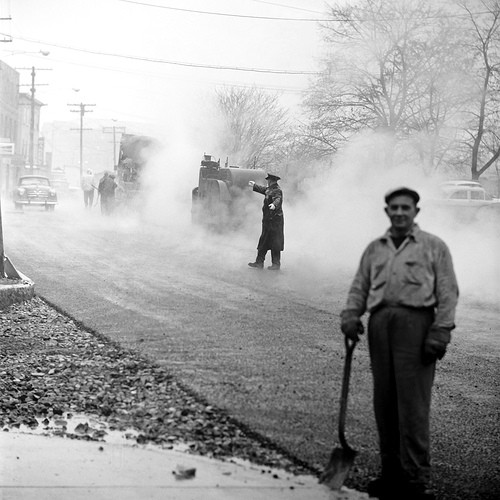
This is why road construction – or at least choosing the surface of roads – is an interesting test case for the 2k critic. If nothing is neutral, if every square inch is Christ’s, if the Bible speaks to all of life, what is God’s will for road surfaces? Should a Christian always use macadam? Or is concrete okay? And if concrete is God’s will, should Christians and their congregations picket alongside roads that are being paved with macadam? Again, the basic premise of the anti-2k critique is that nothing is neutral and everything is religious. So do anti-2kers really want to hang the plausibility of their theory on a matter like road surfaces?
Most 2k critics never really consider road construction. They have their sights set on bigger targets. Politics, economics, art, medicine – those are outlets fitting for a healthy and vigorous worldview. And to suggest that Christianity doesn’t have the answers to these areas of human endeavor is to commit worldview antinomianism. Rabbi Bret is again useful for illustrating the point:
Dr. Darryl’s problem is that he honestly believes that Christianity, as promulgated in the Church, neither asks nor answers the question, “How shall than we live.†Dr. Darryl’s worldview believes that all attempts by the Church to speak God’s mind on this question for the public square is sinful. The consequence of Dr. Darryl’s worldview is that the Gospel’s impact in saving individual lives reaches no further than those individual personal lives. For Dr. Darryl, a medical doctor is saved by the Gospel but after being saved by the Gospel, Christianity, as promulgated by the church, has no word for the medical doctor on how he should speak about medical ethics. For Dr. Darryl, a public square Economist is saved by the Gospel but after being saved by the Gospel, Christianity, as promulgated by the church, has no word for the Economist on whether Keynesianism is consistent with the 7th commandment. For Dr. Darryl, a civil magistrate is saved by the Gospel but after being saved by the Gospel, Christianity, as promulgated by the church, has no answer for the civil magistrate on whether political or cultural Marxism is consistent with the 1st commandment. For Dr. Darryl the third use of the law, as it pertains to the public square, completely disappears. For Dr. Darryl God speaks clearly on how individuals get saved but God speaks only a incredibly contested word (i.e. – Darryl’s appeal to Natural Law) on how Christians as Christians should live.
Dr. Darryl has not escaped the fact that his worldview for the public square antinomianism that he would have the Church embrace, if pursued for the wrong reasons, is as much a form of works righteousness as is adopting a mandate on global warming or as adopting legislation that is pro-life.
So I’ll take Bret’s challenge and raise him one. Is road paving part of a Christian worldview? If not, then isn’t every 2k critic guilty of worldview antinomianism when it comes to paving streets? Doesn’t some level of reality exist that cannot be claimed as black or white, God’s kingdom or Satan’s? And if that’s the case, then why give 2kers such a hard time for worldview antinomianism when every Christian practices it at some level?
Now, the critics of 2k may be willing to concede this point but then counter that some areas of human endeavor still require a Christian worldview – especially those important arenas like public life. Here the logic seems to be that the important stuff needs a worldview of equal importance. We may be indifferent to the little things in life – though agrarians are rarely willing to concede that the things industrialists consider little really are – but we need Christianity to speak to the important matters.
What anti-2kers cannot seem to grasp is that as much as they would like Christianity to speak to all the important stuff, the Bible does not. Here it is useful to keep in mind Charles Hodge’s reasoning at the time when the Old School Presbyterian Church was being asked to support the Federal government in the emerging struggle between North and South — a time in the life of the U.S. that was a big deal. Hodge was a Republican. Hodge voted for Lincoln. Hodge wept when Lincoln was assassinated. Hodge believed in maintaining the union. He even called secession “a ruinous political heresy.†And yet, Hodge could find no reason for the church to remain anything but neutral on the political question of 1861. He wrote:
The church can only exercise her power in enforcing the word of God, in approving what it commands, and condemning what it forbids. A man, in the exercise of his liberty as to things indifferent, may be justly amenable to the laws of the land; and he may incur great guilt in the sight of God, but he cannot be brought under the censure of the church.
Eating meat sacrificed to idols was, the apostle tells us, a matter of indifference. To eat it, however, under the circumstances in which the Corinthians were placed, was a sin not only against their brethren, but against Christ. He [Paul] however expressly forbids the church interfering in the matter. To his own Master, in such cases, a man must stand or fall. Drinking wine, under some circumstances, may be a great sin, but it can never be made a ground of censure at the bar of the church. In like manner, an adherent of the Stuarts may have committed a great sin in refusing allegiance to the house of Hanover, and be justly punished by the state; but he could not be justly censured by the church. . . .
The government of South Carolina is in conflict with the government of the United States; and the Assembly decided that Presbyterians in that State, and everywhere else in this country, are under obligations to strengthen, support, and encourage the Federal Government. If the public mind were not so excited, and, therefore, prone to misapprehension and injustice, it would not be necessary for us to say again that we agree with this decision of the Assembly; we only deny their right to make it. We fully believe that the allegiance of the American citizen is to the Union, . . . . but we have no right to call upon the Assembly to adopt our interpretation of the Constitution, nor to make that interpretation the ground of its official action. (“State of the Country,†1861)
So to make it clear, Hodge does not believe the Bible lays down a Christian position on a momentous matter such as the unity of a federal republic. He also believes that Christians have liberty to be on both sides of the issue, as long as they recognize and accept the civil penalties that may come with their position. But to condemn other Christians for their political convictions, when the Bible does not reveal a Christian position, is to bind their consciences illegitimately.
Of course, many 2k critics suffer from a depleted view of the church and are not clamoring for church censures against 2k indifference to the nickels and dimes of cultural and political life that need to be redeemed. But they do act as if such indifference is sin, when in fact they are doing exactly what fundamentalists do – claiming something to be divinely revealed as good or evil that Scripture itself does not reveal. In other words, the critics of 2k high-brow pietists – for them, everything is either holy or worldly; nothing exists in between.
So if worldview antinomianism is the charge, then let’s see the worldviewers swallow some macadam. Though it seems like an amazingly minor matter on which to hang an all encompassing world view.


 Old Life