If Only He Had Read the Book All the Way Through

Pete Enns introduces his forthcoming book:

If we come to the Bible expecting (as so many do) something like a spiritual owner’s manual complete with handy index, a step-by-step field guide to the life of faith, an absolutely sure answer-book to unlock the mystery of God and the meaning of life, we are setting up an expectation the Bible simply is not designed to handle.

The end product is a fragile, nervous faith. Faith like that produces stress, because it has to be tended and defended with 24/7 vigilance in order to survive—like a sickly baby robin in a shoebox. And even with constant tending, it still may not survive.

Is a life of faith in God truly supposed to be this stressful? Is this what God wants for us? I don’t think so. So let’s stop making it that way by setting the Bible up to be something it’s not prepared to be and then anxiously smoothing over the rough parts to make it fit false expectations. The cost is too high.

I’m all for avoiding the Bible as a how-to manual. Show me Jesus. But that makes the debates about inerrancy all the more poignant.

Enns still hasn’t figured out the stakes of inerrancy. If the Bible is wrong about somethings, it could be wrong about Christ? And if wrong about Christ, my faith is not merely nervous but as Paul says “vain.”

And Pete still hasn’t figured out the Reformed game face; he spent too many years thinking evangelicalism and Reformed Protestantism are the same. Reformed Presbyterians don’t believe in victorious Christian living because we are theo-political refugees during the last stages of a cosmic war.

[10] Finally, be strong in the Lord and in the strength of his might. [11] Put on the whole armor of God, that you may be able to stand against the schemes of the devil. [12] For we do not wrestle against flesh and blood, but against the rulers, against the authorities, against the cosmic powers over this present darkness, against the spiritual forces of evil in the heavenly places. [13] Therefore take up the whole armor of God, that you may be able to withstand in the evil day, and having done all, to stand firm. [14] Stand therefore, having fastened on the belt of truth, and having put on the breastplate of righteousness, [15] and, as shoes for your feet, having put on the readiness given by the gospel of peace. [16] In all circumstances take up the shield of faith, with which you can extinguish all the flaming darts of the evil one; [17] and take the helmet of salvation, and the sword of the Spirit, which is the word of God, [18] praying at all times in the Spirit, with all prayer and supplication. (Ephesians 6:10-18 ESV)

Six days of work and waiting, one of rest in when we enjoy a foretaste of the rest to come.
American Presbyterianism Then and Now (mainline anyway)

Thanks to our southern correspondent, I saw a short piece at the Presbyterian Layman’s website on something called “Narrative on the State of Religion.” The Evangelical Covenant Order (ECO) of Presbyterians (the most recent group to leave, sort of, the PCUSA) was debating whether to re-institute these reports. Each congregation was expected to evaluate its spiritual health and send its “Narrative” to presbytery. Jim Singleton, a leader within ECO, opines that the PCUSA in 1925 stopped using these narratives and resorted to numerical statistics as a measure of congregational health.

Here is the list of questions sessions used for the old Narrative reporting:

Attendance upon the service of the sanctuary by members and others;

Proportions of families that observe family worship;

Observance of the Lord’s day by the members;

Home-training of the children in the Scripture and in the catechism of the church;

Training of pupils in the Sabbath school in the Scripture and the catechism of the church (Singleton said that during that time, Sabbath school was for non-Presbyterian children. The congregation’s children were to be trained at home.);

Fidelity of the membership in honoring the Lord with substance;

Has the congregation paid its minister fully and promptly the amount promised him?

Have there been any special manifestations of the Holy Spirit’s power in the church either by conversions or by increased activity in church work?

To what extent does worldly conformity exist in the church?

What evangelistic work is done by the church outside of its bounds?

What is the church doing to secure people for the Gospel ministry?

For what it’s worth, this is a remarkably good set of questions for pastors and elders to employ in evaluating their flocks and their own ministry. Singleton’s pointing to 1925 is also of interest since for Old Lifers that year was arguably THE turning point in the history of American Presbyterianism, a time when the PCUSA whitewashed the denomination’s health and started to blame conservatives for the church’s woes.

But I cannot go all the way with Singleton or ECO on the “Narrative” they hope to resuscitate. The proposed Narrative looks like this:

How has the Holy Spirit been evident in your congregation in the past year (through conversions, growth in the fruit of the Spirit or other transformational experiences in the congregation)?

How has your congregation extended itself beyond its bounds through the establishment of new communities of worship and discipleship?

In what ways is your congregation seeking the welfare of the “city” (community) to which we are called?

How has your congregation devoted itself to the poor in this past year? Describe the evidence of the heart of compassion.

How has your congregation sought justice as an expression of the Kingdom of God?

Describe the state of moral expression in your congregation — are you more like the world or more like the participants in the values of the Kingdom of God?

How are individuals, including women, men and people of different ethnic groups, experiencing the call to full-time or part-time ministry in your congregation?

Describe how the idea of ministry as the joy and calling of every disciple is evident in your congregation.

Describe how your employment practices are moving toward an expression of the values of the Kingdom of God.

Explain how your congregation understands its commitment to the larger church through our connectional relationships within the Body of Christ.

Strikingly absent are concerns about public worship, observing the Lord’s Day, family worship, and catechesis. It’s as if the folks at Redeemer NYC were responsible for drafting the new Narrative (though I’m not sure the last item about connectional relationships would have made the cut).

Too bad. The old Narrative was a good idea.

Is Edwards' Question Even the Right Question?

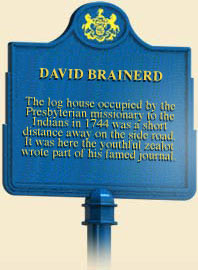
Yes, I may be OCD but my apparent fixation on Edwards has as much to do with current writing projects as taking the pulse of experimental Calvinists. Edwards’ biography David Brainerd has occupied a few mornings this week for a chapter on Calvinism and foreign missions. So sue me.

If Edwards’ defenders are still reading, and if they still think the First Pretty Good Awakening great, then perhaps they could help us all figure out what Edwards was thinking when he wrote this about Brainerd’s conversion and piety:

His first discovery of God, of Christ, at his conversion, was not any strong idea of any external glory or brightness, or majesty and beauty of countenance, or pleasant voice; nor was it any supposed immediate manifestation of God’s love to him in particular; nor any imagination of Christ’s smiling face, arms open, or words immediately spoken to him, as by name, revealing Christ’s love to him; either words of Scripture or any other: but a manifestation of God’s glory, and the beauty of his nature, as supremely excellent in itself; powerfully drawing, and sweetly captivating the heart; bringing him to a hearty desire to exalt God, set him on the throne, and give him supreme honor and glory, as the king and sovereign of the universe; and also a new sense of the infinite wisdom, suitableness, and excellency of the way of salvation by Christ; powerfully engaging his whole soul to embrace this way of salvation, and to delight in it.

Okay, so this is the standard starting point of Christian hedonism. Genuine faith begins with the convert being enraptured with God. Self-interest is forbidden. The aim of faith is to glorify and exalt God, and to deny the self and renounce pride. This description is, for that matter, close to Edwards’ own account of his own conversion.

But Edwards goes on to contrast Brainerd’s conversion with either an inferior or illegitimate kind:

His first faith did not consist in believing that Christ loved him, and died for him in particular. His first comfort was not from any secret suggestion of God’s eternal love to him, or that God was reconciled to him, or intended great mercy for him; by any such texts as these, “Son be of good cheer, thy sins are forgiven thee. Fear not I am thy God,” &c. or in any such way. On the contrary, when God’s glory was first discovered to him, it was without any thought of salvation as his own. His first experience of the sanctifying and comforting power of God’s Spirit did not begin in some bodily sensation, any pleasant warm feeling in his breast, that he (as some others) called the feeling of the love of Christ in him, and being full of the Spirit. How exceeding far were his experiences at his first conversion from things of such a nature! (Life of David Brainered, (1835], 249)

Hence, the question “what must I do to be saved” is the wrong question to ask for someone seeking salvation. Instead, Edwards seems to prefer “how must I glorify and hedonistically enjoy God?” But as close as that question is to the start of the Shorter Catechism, it is several steps removed from “What is effectual calling?” “Effectual calling is the work of God’s spirit whereby, convincing us of our sin and misery, enlightening our minds in the knowledge of Christ, and renewing our wills, he enables us to embrace Christ freely offered to us in the gospel.”

The Shorter Catechism would appear to be describing something close to the beginning of genuine belief in a Christian, and it says very little about the glory of God. It says much about the sinner’s need, and Christ’s remedy for sin, not to mention the work of the Spirit.

So I wonder what Edwards was thinking, and why so many evangelical Calvinists find his devotion appealing.

Desiring God Enough?

I have nothing personal against John Piper. I believe him to be basically sound theologically, though I wish he were a confessional Reformed Protestant. And his earnestness is truly impressive. I do not sense that he is faking what he says or preaches.

Maybe that is why, a Nathaniel Kahn’s aunt says in My Architect, “I don’t get his numbah.” Piper is well known for admiring Jonathan Edwards, and for nurturing a Calvinist constituency among young evangelicals who sing praise songs. That could be a welcome development, except when you read the fine print.

I am currently working on a chapter for a volume on Edwards and have the assignment of covering the recent recovery of Edwardsian theology and piety. In the chapter are sections on John Gerstner, Richard Lovelace, Iain Murray, and — of course — Piper. I need to admit that Edwards leaves me a little cold, which is obviously the opposite of the desired effect. The introspection that reading works like Religious Affections cultivates is not one that lets this sinner feel very good about his progress in mortification of the self.

But for some reason, Edwards’ odd combination of theocentric vision and preoccupation with the inner recesses of the heart resonates– strike that, enthralls — Piper. Still, even the Minneapolis pastor’s best efforts to appropriate Edwards for contemporary believers misses the mark of my weary soul. Here’s is an example from Piper’s reprint of Edwards’ The End for Which God Created the World:

The essence of authentic, corporate worship is the collective experience of heartfelt satisfaction in the glory of God, or a trembling that we do not have it and a great longing for it. Worship is for the sake of magnifying God, not ourselves, and God is magni?ed in us when we are satis?ed in him. Therefore, the unchanging essence of worship (not the outward forms which do change) is heartfelt satisfaction in the glory of God, the trembling when we do not have it and the longing for it.

The basic movement of worship on Sunday morning is not to come with our hands full to give to God, as though he needed anything (Acts 7:25), but to come with our hands empty, to receive from God. And what we receive in worship is the fullness of God, not the feelings of entertainment. We ought to come hungry for God. We should come saying, “As the deer pants for the water brooks, so my soul pants for You, O God. My soul thirsts for God, for the living God” (Ps. 42:1-2). God is mightily honored when a people know that they will die of hunger and thirst unless they have God. (God’s Passion for His Glory, pp. 40-41)

As I have indicated, I find this hard to understand since it sounds like worship is about God but then I read this and start to wonder if I am experiencing God’s glory. And if I am not, then I am in trouble because I am not sufficiently interested in God’s glory. But how can I be sufficiently interested if I need to check how deeply God’s glory goes into the depths of my soul?

I am not writing this sarcastically. I am seriously curious why this kind of piety is attractive to so many evangelicals. And if someone can give me e-counsel about my spiritual torpor, then we should all give a big thanks to God’s providential care in raising up Bill Gates.