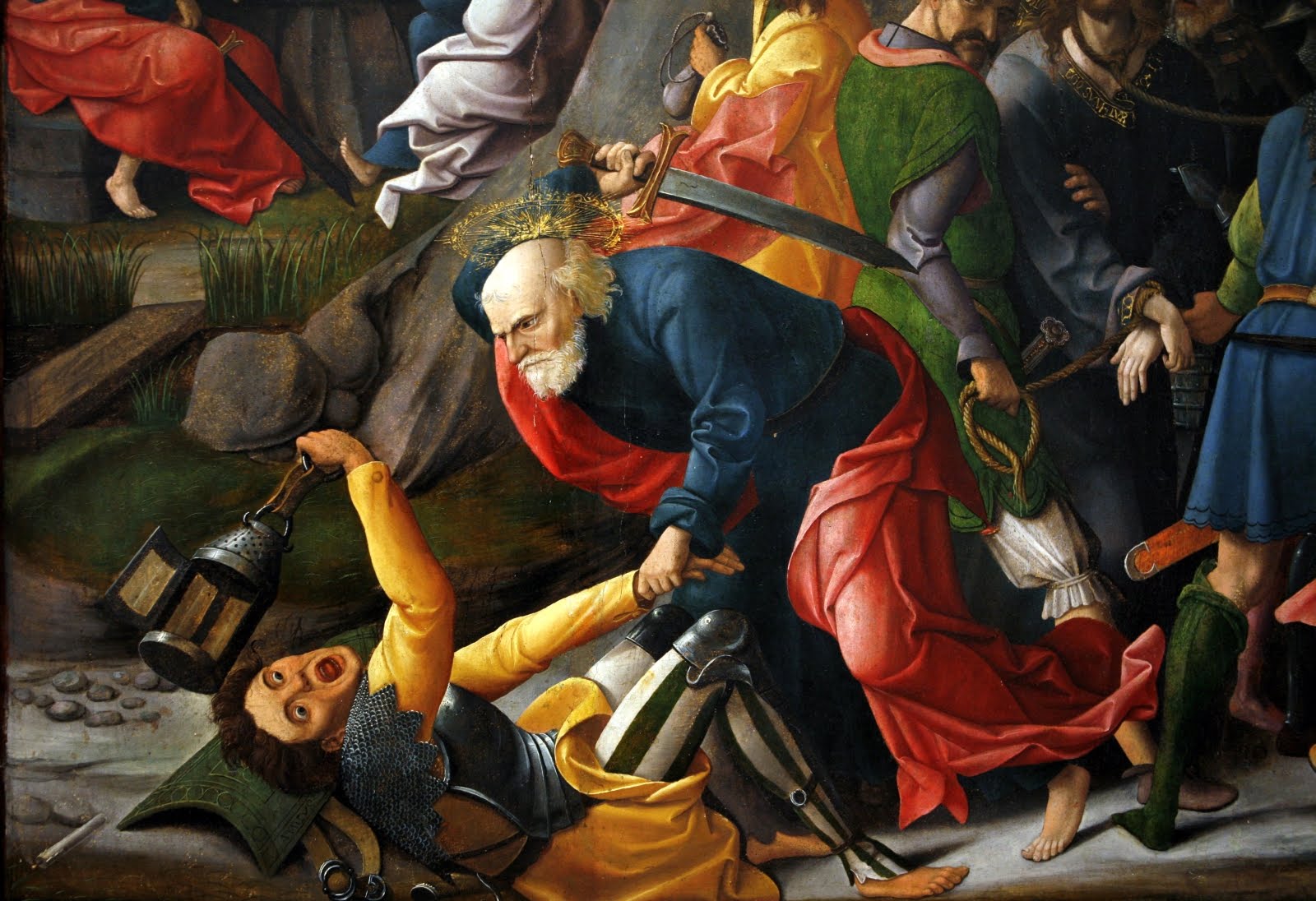
Tim Bayly Does His Impersonation of St. Peter

Apparently the Brothers B have dyslexia, though I am open to other explanations for how they garble other peoples’ writings and ideas. Tim Bayly has written yet another blast of their loud trumpet against 2k theology. This time they identify with the plow boy who knows right from wrong and they pit the common person against the egg-head academics who argue for a two-kingdom perspective and do so by often invoking the apostle Paul. Never mind that the simple apostle, Peter, like the Baylys apparently, found Paul hard to understand sometimes. The plow boy in the Baylys is a cocky little fellow who knows what he knows and disregards any instruction even after he steps in a big pile of mule manure because he was reading Bayly Blog on his I-Phone.

Aside from identifying with Peter’s roots as a man of the fishermen, the Baylys seem to be fond of rushing to judgment and action like the apostle did when evil is prevailing over the good. It was Peter, after all, who committed the only act of outright political defiance by the apostles when he raised the sword and took a swipe at one of the soldiers who arrested Jesus. Anyone with an ounce of sympathy for Christ can also appreciated Peter’s desire and courage in defense of his Lord at a time of great injustice. But Peter still didn’t understand, like the Baylys, that Christ’s kingdom comes not by a physical but a spiritual sword.

That is what 2k strives to clarify, the spiritual nature of the church.

But here is how the Baylys once again misrepresent 2k in tones quite out of tune with the love the repeatedly profess:

They [2k men] are fixated on silencing the voice of their fellow citizens who are religious, particularly those citizens who profess faith in Jesus Christ. Their endless political message is that no man may speak for God outside the privacy of his own home and church-house; and that if he does choose to speak as a citizen of these United States, he must be ever so careful to make it clear he’s not speaking for God or His Church. Our form of government requires him to parse his words and mince his sentences and nuance his tone so that no civil magistrate or fellow citizen will feel threatened by Christians-as-Christians, let alone Church-members-as-Church-members or Church-officers-as-Church-officers. This is the nature of our civil compact, and if religious people speak for God and His Church and people, they are violating that civil compact.

Wrong! The Bible actually requires ministers to parse their words carefully. And the Reformed interpretation of Scripture insists that ministers have a biblical warrant for when they declare what the Lord requires. And lo and behold, one of the doctrines the Bible teaches is liberty of conscience. Again, the egg-headed apostle Paul, did a good job of teaching a doctrine that plow boys and Brothers Bayly have trouble grasping when he talked about the liberty that Christians have to eat meat offered to idols.

According to the Bible, idolatry is wrong.
Also, according to the Bible, meat produced by idolatry is not wrong.
Also, according to the silence of Scripture, ministers are not required to shut down the butchers who sell the meat produced in false temples.

Let’s see about the Baylys red-letter edition of the Ten Commandments.

According to the Decalogue, murder is wrong.
Also, according to the Bible, the penalty for murder is not specified (unless you are a theonomist), which means Christians are free to support and oppose the death penalty.
Also, according to the Bible, ministers are not required to petition the government to punish murderers. Christians themselves as citizens may be free to do so.
But ministers cannot condemn as sinful something about which Scripture is silent.

In which case, the Baylys have substituted their word for the word of God in denouncing as sinful 2k theology.

Here’s the icing on the cake: 2k theology was the doctrine that informed J. Gresham Machen’s opposition to the church’s support for Prohibition and teaching Scripture in public schools. According to Machen:

. . . you cannot expect from a true Christian church any official pronouncements upon the political or social questions of the day, and you cannot expect cooperation with the state in anything involving the use of force. Important are the functions of the police, and members of the church, either individually or in such special associations as they may choose to form, should aid the police in every lawful way in the exercise of those functions. But the function of the church in its corporate capacity is of an entirely different kind. Its weapons against evil are spiritual, not carnal; and by becoming a political lobby, through the advocacy of political measures whether good or bad, the church is turning aside from its proper mission. . . .

Now, of course, the Baylys are not required to affirm Machen’s argument, and their previous credentials within a communion that excommunicated Machen might account for their lack of sympathy for his spirituality of the church idea. But if they are going to re-write the informal rules governing conservative Presbyterianism post-1950 and banish Machen from the list of worthies, they will need to do more than blow their trumpet. They might actually need to read and think about Machen’s reading of Scripture.

Forensic Friday: Machen on Paul

There could be no greater error, therefore, than that of representing the Pauline doctrine of justification by faith as a mere afterthought, as a mere weapon in controversy. Paul was interested in salvation from the guilt of sin no whit less than in salvation from the power of sin, in justification no whit less than in the “new creation.” Indeed, it is a great mistake to separate the two sides of his message. There lies the root error of the customary modern formula for explaining the origin of the Pauline theology. According to that formula, the forensic element in Paul’s doctrine of salvation, which centers in justification, was derived from Judaism, and the vital or essential element which centers in the new creation was derived from paganism. In reality, the two elements are inextricably intertwined. The sense of guilt was always central in the longing for salvation which Paul desired to induce in his hearers, and imparted to that longing an ethical quality which was totally lacking in the mystery religions. And salvation in the Pauline churches consisted not merely in the assurance of a blessed immortality, not merely in the assurance of a present freedom from the bondage of fate, not merely even in the possession of a new power of holy living, but also, and everywhere, in the consciousness that the guilt of sin had been removed by the cross of Christ. (Origin of Paul’s Religion, p. 279)

Where's Waldo Wednesday

From Calvin’s sermon on Ephesians 1: 7, “In him we have redemption through his blood, the forgiveness of our trespasses….”

Now it remains to be seen how God receives us into his favor by means of our Lord Jesus Christ. That is what St. Paul means by adding that “in him we have redemption through his blood, that is to say, the forgiveness of our sins, according to the riches of his grace.” Here we are first of all given to understand that the enmity which God bears us is not with respect to our nature, but with respect to our corruption. I say it is not with respect to nature because, since God has created us, it is certain that he cannot hate us. But since mankind is utterly corrupted and given over to all evil, God must be a mortal enemy to us and an adversary against us, until the remembrance of our sins is buried out of his sight. For we are worthy of eternal death until we are restored again, because God, being the fountain of all justice and righteousness, must detest the evil that he sees in us. Therefore, until our sins are blotted out, it is impossible for us to hope that God should either favor or love us.

But let us notice here how St. Paul uses two words to express how we are reconciled to God. First, he sets down the ransom or redemption, which amounts to the same thing, and afterwards he sets down the forgiveness of sins. How then does it come about that God’s wrath is pacified, that we are made at one with him, and that he even acknowledges us as his children? It is by the pardoning of our sins, says St. Paul. And furthermore, because pardon necessitates redemption, he yokes the two together. The truth is that with respect to us, God blotted out our sins according to his own free goodness and shows himself altogether bountiful, and does not look for any payment for it at our hands. And, in fact, what man is able to make satisfaction for the least fault that he has committed? If every one of us, therefore, should employ his whole life in making satisfaction for any one fault alone, and by that means seek to win favor at God’s hand, it is certain that such a thing surpasses all our abilities. And therefore God must necessarily receive us to mercy without looking for any recompense or satisfaction at our hands. . . .

The whole life of our Lord Jesus Christ has become our ransom, for the obedience which he yielded in this world to God his Father was to make amends for Adam’s offence and for all the iniquities for which we are in debt. But St. Paul speaks here expressly of his blood, because we are obliged to resort to his death and passion as to the sacrifice which has power to blot out our sins. And for that reason God has set forth in types under the law that men could not be reconciled to him except by that means.

Now it is true that Jesus Christ not only shed his blood in his death, but also experienced the fears and terrors which ought to have rested on us. But St Paul here under one particular comprehends the whole, in the manner common to Holy Scripture. In short, let us learn to find all our righteousness in God’s showing himself merciful towards us of his own free goodness. Let us not presume to put before him any virtue of our own to put him in our debt, but let it be sufficient for us that he receives us freely into his love without any worthiness on our part, but only because the remembrance of our sins is buried out of his sight. And again, let us understand that the same cannot be done but by the death and passion of our Lord Jesus Christ, and that is where we must wholly rest.

Where’s Waldo Wednesday: Did He Say “Impetration”?

We are told that God saves us in His mere mercy, by a renovating work of the Holy Spirit, founded on the redeeming work of Christ; and we are told that this renovating work of the Holy Spirit was in order that we might be justified and so become heirs. Here the purchase by the death of Christ is made the condition precedent of the regeneration of the Holy Spirit; but the action of the Holy Spirt is made the condition precedent to justification and adoption. We are brought unto God by Christ in order that we may be brought to God by the Holy Spirit. And in bringing us to God, the Holy Spirit proceeds by regenerating us in order that we may be justified so as to be made heirs. In theological language, this is expressed by saying that the impetration* of salvation precedes its application: the whole of the impetration, the whole of the application. And in the application, the Spirit works first by regenerating the soul, next justifying it, next adopting it into the family of God, and next sanctifying it. In the more vital and less analytical language of our present passage [Titus 3:4-7], this is asserted by founding the gift of the Holy Ghost upon the work of Christ: “which He poured out upon us richly through Jesus Christ our saviour”; by including in the work of the Holy Ghost, regeneration, justification, adoption, and a few verses lower down, sanctification; and by declaring that the regeneration of the Holy Spirit is “in order that being justified we might be made heirs.”

. . . . This is encouraging teaching for believers! Shall they, then, because they are saved out of God’s mercy and not out of works in righteousness which they have done themselves, be careless to maintain good works? I trow** not;; and the Apostle troweth not. Because of this, they will now be careful “to maintain good works.” Let us see to it then that by so doing we approve ourselves as true believers, saved by God’s grace, not out of works but unto good works, which He hath afore prepared that we should walk in them! This is what the Apostle would have us do. (B. B. Warfield, “The Way of Life,” in Faith and Life, pp., 399-400)

*Impetration: 1. The act of impetrating, or obtaining by petition or entreaty.

** Trow: Archaic to think, believe, or trust.

Forensic Friday: Justification and Assurance

Therefore, since we are justified by faith, we have peace with God through our Lord Jesus Christ. (Rom. 5:1)

On this verse Calvin writes:

Here indeed is the chief hinge on which faith turns: that we do not regard the promises of mercy that God offers as true only outside ourselves, but not at all in us; rather that we make them ours by inwardly embracing them. Hence, at last is born that confidence which Paul elsewhere calls “peace” [Rom. 5:1], unless someone may prefer to derive peace from it. Now it is an assurance that renders the conscience calm and peaceful before God’s judgment. Without it the conscience must be harried by disturbed alarm, and almost torn to pieces; unless perhaps, forgetting God and self, for the moment sleeps. And truly for the moment, for it does not long enjoy that miserable forgetfulness without the memory of divine judgment repeatedly coming back and very violently rending it. Briefly, he alone is truly a believer who, convinced by a firm conviction that God is a kindly and well-disposed Father toward him, promises himself all things on the basis of his generosity; who, relying upon the promises of divine benevolence toward him, lays hold on an undoubted expectation of salvation . . . . the apostle does not consider the eyes of our minds well illumined, except as we discern what the hope of the eternal inheritance is to which we have been called [Eph. 1:18]. And everywhere he so teaches as to intimate that we cannot otherwise well comprehend the goodness of God unless we gather from it the fruit of great assurance. (Institutes, 3.2.16)