
 Our friendly interlocutor, Zrim, took a dose of exception to the recent post here about drinking and smoking with Mike Horton – not with Mark Dever. He makes the plausible point that many Reformed types have graduated from a fundamentalist piety to the full-orbed one of smoking, drinking, and maybe even cussing, as part of the cage-phase of becoming Reformed.
He writes:
I have found it crowded with more or less two types: ascetic legalists and sophomoric libertarians who used to be ascetic legalists. . . . Then there is the liberty camp. Blowing smoke into the faces of their past, these find true piety to be measured by relative consumption. There seems always something to prove to some phantom somewhere in the individual or collective self, real or imagined. The way an adolescent speaks a bit higher on the phone so her parents know she is fraternizing with the neighborhood bad boy, certain libertarians want the details of their consumption known to their phantoms.
As I have admitted, this is a point that all Reformed Protestants who revel in the strong consciences need to consider.
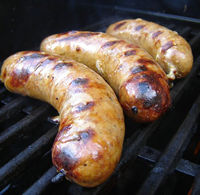
But from the other side of the aisle comes the Reformed tradition itself. One of the more puzzling features of the original Protestant movement was a concern for eating meat – an act that hardly anyone but the most world-and-life view crazed would regard as essentially religious.. In one of the earliest Reformed creeds, Zwingli’s “Sixty-Seven Articles,†we read that the Christian “is free to eat all foods at any time.†This stemmed from the first outbreak of Protestantism in Zurich, eating sausage on Friday, a day on which Roman Catholics fasted by abstaining from meat. And not very long after Zwingli’s creed came the Tetrapolitan Confession which devoted four chapter to eating – or more precisely, to eating in contrast to fasting. One of the chapters was “Of the Choice of Meats.†The chapter on fasting has this:
When, therefore, we saw very evidently that the chief men in the Church beyond the authority of Scripture assumed this authority so to enjoin fasts as to bind men’s consciences, we allowed consciences to be freed from these snares, but by the Scriptures, and especially Paul’s writings, which with singular earnestness removes these rudiments of the world from the necks of Christians. . . . For if St. Paul (than whom no man at any time taught Christ more certainly) maintains that through Christ we have obtained such liberty in external things that he not only allows no creature the right to burden those who believe in Christ, even with those ceremonies and observances which God himself appointed, and wished in their own time to be profitable, but also denounces as having fallen away from Christ, and that Christ is of none effect to those who suffer themselves to be made servant thereto, what verdict do we think should be passed on those commandments which men have devised of themselves, not only without any oracle, but also without any example worthy of being followed, and which, therefore, are unto most not only beggarly and weak, but also hurtful; not elements – i.e., rudiments of holy discipline – but impediments of true godliness? (Ch. VIII)
One possible point to draw from this difficult prose, as sophomoric as it might appear, is that to have a theological journal, the NTJ, dedicated to the chemical found in tobacco is to bear witness to a prominent streak in the Reformed tradition about the importance of proclaiming and demonstrating Christian liberty. If meat on Friday was the way to expose the tyranny of man-made rules and false teaching in the sixteenth-century church, how much more is tobacco today a way to expose the sacred cows of both believers and citizens in the greatest smoke-free nation on God’s green earth?

 Old Life