First Marx, Now Keller?

The word “manifesto” strikes me as an odd one to attach to the idea of evangelism and missions, but the Missional Manifesto has now entered the parlance of our times, alphabetized several lines below the Communist Manifesto. I myself don’t have the energy to devote to the latest of Keller-sponsored cooperative endeavors – I have a hard enough time keeping up with all the doings of the Gospel Coalition. But I do wonder if our brothers and sisters in the PCA take notice of the liabilities of Keller’s efforts as much as they applaud his obvious assets. (Tim Bayly, David Bayly, Hello?)

Helping out on this score is Wes White who noted the publication of the Missional Manifesto and gave his readers the chance to discuss its merits. One comment by Bill Schweitzer was particularly astute:

Another worrying aspect of the missional movement would be the holistic nature of the gospel. This involves a rejection of the “modernist” concept of individual salvation of sinners in favour of a comprehensive gospel of cultural transformation. This is articulated in the manifesto in point 8:

8. Duality: We believe the mission and responsibility of the church includes both the proclamation of the Gospel and its demonstration. From Jesus, we learn the truth is to be proclaimed with authority and lived with grace. The church must constantly evangelize, respond lovingly to human needs, as well as ”seek the welfare of the city” (Jeremiah 29:7).

The idea is that the verbal proclamation alone is only half the picture. But here the movement verges a little too close to an old enemy of the verbal proclamation, the Social Gospel. Listen as the editor of an essay collection on “The Social Gospel Today” summarizes the thought of the “Father of the Social Gospel,” Walter Rauschenbusch:

…he argued that a gospel of individual salvation is a half gospel, for the gospel had social dimensions as well. He pointed out that Jesus continued the call of the prophets for justice and mercy by proclaiming the coming kingdom of God in which unconditional love would eventually triumph over all obstacles in society. Rauschenbusch called on the church to respond to Jesus’ call for bringing in the kingdom of God and to struggle for its realization.” (Christopher H. Evans, The Social Gospel Today xiii)

As far as I know, Rauschenbusch never called for an end to the verbal proclamation of the gospel for individual salvation. Rather, he simply sought to restore what he thought to be the “other half” of the gospel, which is social action (in terms of justice and mercy.) Yet we know how that story ended. Dual mandates do not typically remain equal partners for long, and the call to include social action soon enough became a practical exclusion of the verbal proclamation. Perhaps, therefore, we should think more carefully before we define the Great Commission as a dual mandate involving both word and deed. In conclusion, I can only agree with Frank: however much other things might be lawful or even commanded by Scripture, the Great Commission itself is a single mandate for making disciples through the ordinary means of grace. (Mat 28:18-19)

Chances are that little will come of this manifesto. Does anyone actually remember the Evangelical Manifesto? But I’m glad to know some folks in the PCA are alert.

Pastor 2K to Tim Keller's Rescue

The watchdogs of Redeemer Church in NYC have noted Tim Keller’s response to questions in a public forum about homosexuality and gay marriage. The exchange came at the end of the interview and according to the Bayly’s transcribing powers went like this:

Lauren Green (interviewer): As a church, how should we as Christians and how should the church view gay rights and gay marriage?

Tim Keller: The Minister of the Word: Ha! I would definitely say this is time to come to a conclusion! (Laughter).

I would definitely say… a thoughtful Christian Biblical response doesn’t fit into any of the existing categories out there. It’s not a simple matter of saying there should be no moral differentiation between any kind of sexual activity. Christians can’t go there–they can’t say, “no it doesn’t matter.”

It’s also true however, that this is a country where we’re supposed to love our neighbor. This is a country where a Christian is supposed to care about a just society for ALL our neighbors whether they believe like we do or not. And that’s gotta mean our gay neighbor.

And I would say people in the more conservative movement don’t really want to talk too much about that because they’re very upset because they feel like the gay agenda is too anti-Christian and too anti-religious.

So I would say–the reason it’s good to end on this question is–it’s not something, the way forward, I don’t see spelled out anywhere in public. I don’t see anybody in public taking all the Biblical concerns about justice and mercy in that area and speaking about them. But I’m certainly not going to get started.

Just to let you know I don’t really think the current options out there–about what we should do–are really the best ones from a Christian standpoint.

The Baylys have tagged this post as “two kingdom, spirituality of the church,” which is interesting because if Keller were truly a two-kingdom fellow he would not have has a hard a time answering this question as this interview suggests. What follows, then, are a few pointers to both the Baylys and to Keller on how a 2k pastor – in New York City, no less — might answer questions about the Ten Commandments:

Reporter: What does your church think about the first commandment?

Pastor 2k: We do not tolerate the worship of Allah in our church, but in a free society many members of our church would support religious liberty for peoples of all faiths and as a session we do not believe that his conflicts with their profession of faith.

Reporter: What does your church teach about the second commandment?

Pastor 2k: Well, we forbid images of God – including Jesus – at our church, but many in our congregation are supporters of the Metropolitan Museum of Art which has many depictions of Jesus and the Holy Spirit and again our session does not believe it is a sin to go to museums and see such art.

Reporter: What is your church’s policy on the third commandment?

Pastor 2k: We exhort our members not to use God’s name flippantly, or as an expletive, but many of our members go to movies where Christ’s name is taken in vain and no one on the session is forcing them to repent. Some of them also listen to Rush Limbaugh whom I gather sometimes uses the words “damn” and “hell.” While we wish Mr. Limbaugh would not use such words, our session does not forbid members from listening to conservative talk radio.

Reporter: How does your church implement the fourth commandment?

Pastor 2k: We teach that all our members should avoid all forms of work on Sundays, unless they are in vocations such as the law enforcement, medicine, or public utilities. But we are not looking for the implementation of Blue Laws, again owing to the diversity of faiths and peoples who populate the United States and New York City.

Reporter: What does your church consider to be the obligations of the fifth commandment?

Pastor 2k: We do teach our members to submit to Mayor Bloomberg even if they prefer Rudy Guliani’s administration, but we are not about to endorse any party or set of candidates for the government of New York City.

Reporter: What does your church think about the sixth commandment?

Pastor 2k: We teach that murder is a sin, and that even hate is a violation of the sixth commandment – a spiritual hate crime if you will – but we are not about to go out to Citibank Stadium and tell the Mets fans to give a brotherly kiss to the Phillies fans who come up to see their team play. Please get real.

Reporter: What does your church teach about the seventh commandment?

Pastor 2k: We believe that homosexuality is a sin – as is pornography, adultery, and any form of sexual activity outside marriage. But again we recognize that the state cannot legislate Christian morality, even if some of our members are very concerned about the public policy implications of our currently licentious society. We try to make sure that our own members are living lives that conform to the teachings of Scripture. How the rest of Americans live their lives is not our church’s responsibility even though we proclaim all of God’s word weekly and publicly and call upon all New Yorkers to repent and believe.

Reporter: What is your church’s practice on the eighth commandment?

Pastor 2k: We believe that stealing is wrong but we are not convinced as a session that high tax rates are a form of robbery.

Reporter: How does your church handle the ninth commandment?

Pastor 2k: We do require our members to defend the honor of fellow members and their neighbors. But we also believe that if we name sins, address all people as sinners, and call them to repentance, we are not dishonoring their good names or reputations.

Reporter: What does your church do with the tenth commandment?

Pastor 2k: We teach our members and visitors to be content with their station in life and not envy the prosperity of others. This did not lead us to warn our members away from watching the royal wedding.

2k is complicated, but it doesn’t tie its pastors in knots.

Two-Kingdom Tuesday: How Can You Not Be 2K If You Are Spirituality of the Church?

Calvin makes it easy; you only have to get over the National Covenant, Kuyper, Bahnsen, and Wilson:

My kingdom is not of this world. By these words he acknowledges that he is a king, but, so far as was necessary to prove his innocence, he clears himself of the calumny; for he declares, that there is no disagreement between his kingdom and political government or order; as if he had said, “I am falsely accused, as if I had attempted to produce a disturbance, or to make a revolution in public affairs. I have preached about the kingdom of God; but that is spiritual, and, therefore, you have no right to suspect me of aspiring to kingly power.” This defense was made by Christ before Pilate, but the same doctrine is useful to believers to the end of the world; for if the kingdom of Christ were earthly, it would be frail and changeable, because the fashion of this world passeth away, (1 Corinthians 7:31;) but now, since it is pronounced to be heavenly, this assures us of its perpetuity. Thus, should it happen, that the whole world were overturned, provided that our consciences are always directed to the kingdom of Christ, they will, nevertheless, remain firm, not only amidst shakings and convulsions, but even amidst dreadful ruin and destruction. If we are cruelly treated by wicked men, still our salvation is secured by the kingdom of Christ, which is not subject to the caprice of men. In short, though there are innumerable storms by which the world is continually agitated, the kingdom of Christ, in which we ought to seek tranquillity, is separated from the world.

We are taught, also, what is the nature of this kingdom; for if it made us happy according to the flesh, and brought us riches, luxuries, and all that is desirable for the use of the present life, it would smell of the earth and of the world; but now, though our condition be apparently wretched, still our true happiness remains unimpaired. We learn from it, also, who they are that belong to this kingdom; those who, having been renewed by the Spirit of God, contemplate the heavenly life in holiness and righteousness. Yet it deserves our attention, likewise, that it is not said, that the kingdom of Christ is not in this world; for we know that it has its seat in our hearts, as also Christ says elsewhere, The kingdom of God is within you, (Luke 17:21.) But, strictly speaking, the kingdom of God, while it dwells in us, is a stranger to the world, because its condition is totally different.

My servants would strive. He proves that he did not aim at an earthly kingdom, because no one moves, no one takes arms in his support; for if a private individual lay claim to royal authority, he must gain power by means of seditious men. Nothing of this kind is seen in Christ; and, therefore, it follows that he is not an earthly king.

But here a question arises, Is it not lawful to defend the kingdom of Christ by arms? For when Kings and Princes are commanded to kiss the Son of God, (Psalm 2:10-12) not only are they enjoined to submit to his authority in their private capacity, but also to employ all the power that they possess, in defending the Church and maintaining godliness.

I answer, first, they who draw this conclusion, that the doctrine of the Gospel and the pure worship of God ought not to be defended by arms, are unskillful and ignorant reasoners; for Christ argues only from the facts of the case in hand, how frivolous were the calumnies which the Jews had brought against him.

Secondly, though godly kings defend the kingdom of Christ by the sword, still it is done in a different manner from that in which worldly kingdoms are wont to be defended; for the kingdom of Christ, being spiritual, must be founded on the doctrine and power of the Spirit. In the same manner, too, its edification is promoted; for neither the laws and edicts of men, nor the punishments inflicted by them, enter into the consciences. Yet this does not hinder princes from accidentally defending the kingdom of Christ; partly, by appointing external discipline, and partly, by lending their protection to the Church against wicked men. It results, however, from the depravity of the world, that the kingdom of Christ is strengthened more by the blood of the martyrs than by the aid of arms. (Calvin’s Commentary on John 18)

Important to notice is Calvin’s otherworldliness. The kingdom is not in this world, but it is in believers’ hearts. And it comes not through laws or enforcement of legislation, or clever policy, but by the word and Spirit. If magistrates assist the kingdom of Christ it not because of law or enforcement because Christ’s kingdom is spiritual, and therefore different from the rule of kings.

This would also mean that all those people who cite Calvin and his godly regime in Geneva, like the Baylys, Dr. Kloosterman, and Rabbi Bret are missing the point. Calvin even calls arguments like their “ignorant and unskillful. God’s kingdom is not earthly. And efforts to make this world heavenly are just one more example of immanentizing the eschaton.

I would have thought that differentiation of Christ’s rule from earthly regimes would appeal to the Vossian contingent. I wonder when will they ever come over to the 2k side. 2kers won’t bite, at least not physically.

Kuyperians and Theonomists, Say "Hello" to the Old School Presbyterians

I continue to be amazed by the decibels of hostility and venom heaped upon 2k. From bloggers like Nelson Kloosterman, James K. A. Smith, David Koyzis, Doug Wilson, Steven Wedgeworth, Rabbi Bret and the Bayly Bros., to your average and pseudonymous commenters at various Reformed blogs, many Reformed Protestants and evangelicals believe that 2k theology is either foreign because it is Lutheran or unbiblical because it exempts God’s law from part of life and nurtures dualism.

But for anyone who has spent time with Old School Presbyterians and Old Princeton Seminary, 2k feels comfortable like an old shoe, and that’s because one of the Old School’s hallmark doctrines, the spirituality of the church, is basically the Presbyterian version of 2k.

David Coffin, pastor of New Hope Church (PCA) in Fairfax, Virginia, recently preached on the doctrine of the spirituality of the church. A link to the first sermon is here. It is well worth hearing and filled with numerous quotations that neo-Calvinists and their theological cousins, theonomists, Federal Visionaries, and Erastians, have yet to fit into their schemes of denying dualism and making Christ Lord of every square inch, like the following from Calvin, who is commenting on Christ’s response to a request to settle a property dispute between two brothers (Luke 12:13):

Our Lord, when requested to undertake the office of dividing an inheritance, refuses to do so. Now as this tended to promote brotherly harmony, and as Christ’s office was, not only to reconcile men to God, but to bring them into a state of agreement with one another, what hindered him from settling the dispute between the two brothers? There appear to have been chiefly two reasons why he declined the office of a judge. First, as the Jews imagined that the Messiah would have an earthly kingdom, he wished to guard against doing any thing that might countenance this error. If they had seen him divide inheritances, the report of that proceeding would immediately have been circulated. Many would have been led to expect a carnal redemption, which they too ardently desired; and wicked men would have loudly declared, that he was effecting a revolution in the state, and overturning the Roman Empire. Nothing could be more appropriate, therefore, than this reply, by which all would be informed, that the kingdom of Christ is spiritual. . . .

Secondly, our Lord intended to draw a distinction between the political kingdoms of this world and the government of his Church; for he had been appointed by the Father to be a Teacher, who should “divide asunder, by the sword of the word, the thoughts and feelings, and penetrate into the souls of men, (Hebrews 4:12,)” but was not a magistrate to divide inheritances. This condemns the robbery of the Pope and his clergy, who, while they give themselves out to be pastors of the Church, have dared to usurp an earthly and secular jurisdiction, which is inconsistent with their office; for what is in itself lawful may be improper in certain persons. . . .

P.S. If Dutch-American Calvinists want to write off nineteenth-century American Presbyterians, fine. But don’t be surprised if those Presbyterians descendants remind you that it was the Presbyterians at Princeton that domesticated Kuyper and Vos for American Protestants. Without Benjamin Warfield, Abraham Kuyper and Geerhardus Vos would still be available only in Dutch.

Silence is Leaden

I am detecting a parallel among critics and questioners of 2k. On the one hand, opponents have trouble with the idea (sorry Jeff, I’m not going ad hominem intentionally) that the Bible is silent on a range of subjects and activities. At the same time on the other hand, critics feel free to draw conclusions about someone’s views simply by virtue of their silence upon a subject. I don’t necessarily believe these are at root the same. But I also sense a high degree of affinity.

The latest example of this phenomenon comes yet again from the Baylys in their reaction to a 2k post by Brian Lee over at the Daily Caller. He writes, for instance:

Christianity is not politically conservative or politically liberal — though Christians may be either. Christianity is not political at all. It is in a sense politically agnostic. But in another sense it calls into question the basis of every earthly power, including politics.

The entire article is worth reading as a healthy summary of biblical argument that goes by the name 2k but is really an expression of a redemptive historical reading of the difference between Israel and the church.

But Brian’s silence about abortion is not golden from the vantage of mid-western conservative Presbyterianism. According to the Baylys:

What Pastor Lee needs to think about is that obedience to the call to suffering, to our Lord’s command to take up our cross and follow Him, is at least as applicable to his parishioners as they exercise political authority and power as it was to Herod as he considered the call of John the Baptist, and the Areopagus as they considered the call of the Apostle Paul, to repent. Which is the call it appears Pastor Lee studiously avoids–unless, that is, his call to repentance is aimed at his fellow URC churchmen and women from Grand Rapids and Friesland who pray and write letters and vote, hoping their legislators will, for instance, bear the sword against those slaughtering the unborn across our land.

One wonders when the Baylys will listen to what folks like Brian Lee say rather than simply calling them up short for what they don’t. Maybe the Baylys actually need to cogitate upon pastor Lee’s own views about Christianity and politics as much as they are certain of their own. After all, Lee is a minister of the gospel just like they are. He may know the Bible as well as the Baylys and may actually know what to do when the Bible is silent – namely, remain silent.

A Proposal On Which All Anti-2kers May Unite

I know that not all anti-2kers get along. Heck, the Baylys seem to have banned Rabbi Bret from participating in all the fun over at their free wheeling discussions. Meanwhile, Dr. K., who may be the longest winded of 2k critics has appeal to Bret but may be too Dutch for the Baylys. Then there is the transformer of transformers, Tim Keller, who is not outspokenly critical of 2k but whose theology confuses the kingdoms on route to the polis. And despite Keller’s desire to Christianize the culture, it does not measure up to the standards set by the Baylys, Rabbi Bret, or Dr. K.

So I propose the following statement as a basis on which all transformers, left or right, theonomic or benevolently imperial, Geneva or Big Apple, may unite (no fair doing a Google search to look for its origins):

God’s redeeming work in Jesus Christ embraces the whole of man’s life; social and cultural, economic and political, scientific and technological, individual and corporate. It includes man’s natural environment as exploited and despoiled by sin. It is the will of God that his purpose for human life shall be fulfilled under the rule of Christ and all evil be banished from his creation.

Biblical visions and images of the rule of Christ such as a heavenly city, a father’s house, a new heaven and earth, a marriage feast, and an unending day culminate in the image of the kingdom. The kingdom represents the triumph of God over all that resists his will and disrupts his creation. Already God’s reign is present as a ferment in the world, stirring hope in men and preparing the world to receive its ultimate judgment and redemption.

With an urgency born of this hope the church applies itself to present tasks and strives for a better world. It does not identify limited progress with the kingdom of God on earth, nor does it despair in the face of disappointment and defeat. In steadfast hope the church looks beyond all partial achievement to the final triumph of God.

“Now to him who by the power at work within us is able to do far more abundantly than all we ask or think, to him be glory in the church and in Christ Jesus to all generations, forever and ever. Amen.”

Barefoot, Pregnant, and Unplugged

To say that the Bayly brothers have a one track mind would be to traffic in innuendo. I do not know them well enough to speculate on their sexual desires. I presume that as ministers of the gospel and as husbands their sexual passions are properly regulated.

But in a sense they do have sex on the brain, not in the sense of your average beer sipping NFL fan, but in the sense of men’s and women’s roles and sexual relations that produce offspring. After all, if you have a web page at Amazon dedicated to the ten best and worst books on sex, people might properly conclude you have women on the brain.

Beyond book lists and blog categories, Tim Bayly gave a good example of the borderline obsessiveness that he and his brother have about keeping men men and women women and never the twain shall meet except . . . well, . . .this is a PG blog. When news came out that the Presbytery of Missouri had exonerated the Federal Vision pastor, Jeff Myers, Doug Wilson posted a short notice that led to a rather moderate number of comments. Responses were chugging along about the merits and ties of Federal Visionaries, with an occasional distaff iteration when Tim decided to weigh in – not about Federal Vision, its theology, or merits – but about whether or not women should be discussing such matters at a public forum like a blog. To one female writer, Tim wrote (with love, of course):

it might be best for you to limit your comments when the subject matter here is the discipline of ordained officers of Christ’s Church and the application of God’s Word to that discipline. If there’s ever a time when it might be good for women to limit their online contributions, this would be a good candidate for careful consideration.

When another woman rose to the rebuked woman’s defense, especially because of a recent personal loss, Tim, to his credit, conceded that he should have been more circumspect and offered comfort.

But in further explanations, Tim reminded readers about the need for women to respect church officers like Doug Wilson. He wrote:

We’re not talking about submission, here, but the public rebuke of teaching elders on a matter of doctrine by a woman who does so, publicly, and with some considerable invective. Read what she said about my dear friend, Doug Wilson (who by the way is one of the more humble pastors I’ve met), and ask yourself if it’s seemly for a Christian woman to address a pastor in such a way at all, let alone in public?

Feminine deference is not “submission,” nor is a teaching elder “all men.”

For some reason, the public rebukes that he heaps out on ruling elders and pastors is fine. But the little ladies need to watch out for men and especially for the ordained ones.

I do wonder if Tim realizes the propensity he displays to view almost every issue according to what women are doing as sexual beings. We were once having a very nice conversation at Old Life about Presbyterian justice when Tim had to intervene and censor us for not talking about abortion even though that was not the subject. Now he interjects femininity into a discussion of a controversial and potentially damaging teaching like Federal Vision. Does Tim think that our society and churches would be fine if we could put the genie of women’s spunk back in the bottle of Calvin’s Geneva?

Update: I forgot to add this: when will the Baylys notice that Tenth Presbyterian Church in Philadelphia has two pastors with feminine names? Shocking.

Weaker Bayly Brothers

I have apparently offended a weaker set of brothers. Since the offense occurred on-line, perhaps an on-line mea culpa is in order. The problem though, as is usually the case with weaker brothers, is that these brothers don’t think they are weaker. They think I am.

My error happened during a discussion of what sort of actions are just or fitting regarding one’s membership in a Presbyterian communion. Tim Keller’s own understanding of justice was the basis for thinking not only about what Christians might owe to their neighbors but also their fellow brothers, sisters, and overseers in the Reformed faith.

The comments progressed and the along came the Baylys with their big foot on the matter of abortion. Tim, I believe, intervened with his usually loving touch:

Fifty comments by the most eminent among us filled out with accolades from their admirers and nary a word about the 1,300,000 unborn children slaughtered on our doorsteps, blood running in our gutters and bones in our dumpsters year after bloody year, decade after obscene decade.

When the question of conflict with the civil magistrate is brought up, examples are sodomites, Palestinians, African Americans, and Third Reich Jews.

Not a word about the unborn. Not a word about the greatest injustice in the history of man.

Well over a billion victims felled by this bloody oppression and neither Darryl Hart nor The Prince can quite remember it. The murders are carried out on their doorsteps day after day, many by souls in their congregations, but in a discussion of justice and civil disobedience, that particular injustice doesn’t quite make the cut. It’s not in their memory bank. It doesn’t tug at their minds or hearts.

Now here is the offense, apparently, though Tim (Bayly, that is) never specified the precise error (or sin?). I was carrying on a conversation about justice. The specific context was the justice that Presbyterians owe other Presbyterians. And my failure was not to mention the slaughter of innocents.

If I apply what Paul writes about weaker brothers in Romans 14, I need to start from the perspective that speech is itself not unclean. Paul writes in 14:20 that nothing is unclean in itself. That means that I was not wrong to speak. The further implication of Paul’s assertion is that speaking or writing about justice is also not unclean (two negatives adding up to the positive of “clean”). So far, I think I’m okay.

But then along comes Tim and says that to speak without mentioning abortion, or to speak about Presbyterian justice without mentioning the slaughter of innocents, is unclean. His explanation was that he “found instructive . . . the absence of any discussion of abortion.” But since Tim has gone on record and declared 2k to be deserving of anathemas, he would seem to think that the discussion at Old Life was more than instructive. It was wicked.

The implication here is that Tim and David are like the weaker brothers in Romans and Corinthians who could not bear to watch other Christians eat meat offered to idols. They actually do what Paul professedly forbids: they declare something good (a conversation about Presbyterian justice) to be evil; and they judge other Christian brothers for not mentioning abortion even though Paul says we should not judge each other for either talking about abortion or not mentioning it: “Let not him who eats (talks about abortion) despise him who abstains (silence about abortion), and let not him who abstains (silence) pass judgment on him who eats (talks); for God has welcomed him. Who are you to pass judgment on the servant of another? It is before his own master that he stands or falls” [3-4].

John Murray has a very helpful essay on Romans 14 that explains the logic of Paul’s instruction and also elaborates the enmity that often afflicts the weaker brother. First, on the nature of the weakness:

While it is true that there is nothing unclean of itself; it does not follow that all have the knowledge and faith and strength to use all things. In this matter of conduct we have not only to consider the intrinsic rightness of these usable things but also the subjective condition or state of mind of the person using them. There is not in every person the requisite knowledge or faith. Until understanding and faith have attained to the level of what is actually true, it is morally perilous for the person concerned to exercise the right and liberty which belong to that person in Christ Jesus. The way of edification is not that conduct should overstep the limits of knowledge and faith or to violate the dictates of conscience, but for conscience to observe the dictates of understanding and faith. “Whatsoever is not of faith is sin.” The believer must always act out of consciousness of devotion to Christ and when he cannot do that in a certain particular he must refrain from the action concerned. We must remember that although nothing is unclean of itself; yet to him that reckoneth it to be unclean to him it is unclean. To use other terms, we must remember that though things are indifferent in themselves the person is never in a situation that is indifferent. Things are indifferent but persons never.

In which case, if the Baylys really are weak, their weakness comes from an insufficient understanding of the faith or ignorance. And what goes with this is often a sense of moral superiority. The remedy for this, according to Murray, is further instruction in the faith:

The weak must ever be reminded that their censorious judgment with respect to the exercise of liberty on the part of the strong is a sin which the Scripture condemns. “Let not him that eateth not judge him that eateth: for God hath received him.” “Who art thou that judgest the servant of another? To his own Lord he stands or falls. Yea, he shall be made to stand; for the Lord is able to make him stand” (Rom. 14:3, 4). The censorious judgment in which the weak are so liable to indulge is just as unequivocally condemned as is the contempt to which the strong are too prone. And with such condemnation there is the condemnation of the self-righteousness that so frequently accompanies such censoriousness.

Now, it could be that I am really the weaker brother. It could be that I do not fully understand how I need to mention abortion in every conversation. But if this were the case, is the treatment that I receive from the loving and pastoral words of the Baylys really the way that the stronger should bear with the weaker? Rebukes are one thing, but ridicule? Wouldn’t censoriousness, in fact, be the give away on which brother is weak or strong or whether both brothers are weak?

Two-Kingdom Tuesday: Making Luther Safe for the Baylys

One of the advantages of the holiday season is the excuse it gives for reading Protestants who follow the church calendar – in this case, Martin Luther. The Martin Luther Christmas Book is a wonderfully good read any time of the year, but since sermons, songs, and church events keep reminding us of the nativity passages in Scripture, curiosity should send us to older Protestant divines to compare their exposition to our Protestant ministers. This little book, based on Luther’s sermons from Luke, provides reminders of the original Protestant’s great sensitivity in reading Scripture. (Don’t let the title put you off even if it sounds like a promotion for the Dean Martin Little Book of Christmas Carols.)

An added bonus for culture warriors is the lessons that Luther drew from the example of Mary for contemporary Christian women. Keeping them bare-foot and pregnant may not be the best way of putting it. But if anti-feminazi Presbyterians would only spend time with real two-kingdom theology, rather than its mythological implications, they might recognize kindred spirits.

The following comes from “Visitation”:

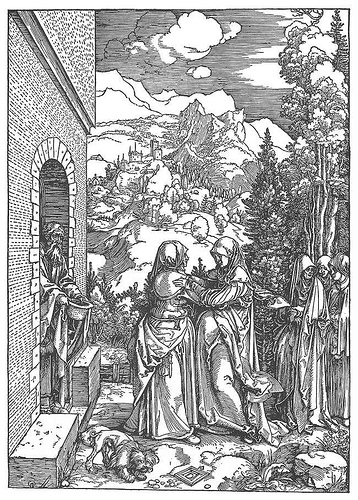
We observe that [Mary] went by the hill country, not by the plain. The journey would take her all of three days. We do not know the precise destination, for although Zacharias was a priest, he was not under the necessity of residing in Jerusalem. He was a poor priest, and we are not to think of Elisabeth as in much more exalted station than Mary.

The Evangelist Luke advisedly inserted those words “with haste.” He meant that she did not stop every five paces to strike up a conversation, as do so many of our maids and matrons. He knew the ways of women and did not wish to give them any handle for justification from the example of Mary.

He meant to say that Mary was like a maid who sees and hears nothing save the commands of her mistress, or like a housewife who does not loiter here and there to chat. The mother of our Lord was no gossip. She went with haste. And that means, too, that she did not act like a pilgrim but circumspectly. The women, therefore, have no warrant for saying, “why should not we go hiking, seeing that Mary went over the hill country and she a virgin?” Yes, but Mary had the command of an angel and she went with haste. You have no command to do as you please. Mary was full of faith, love, and modesty. . . (p. 27)

What Makes Neo-Calvinism Biblical?

Carl Trueman wrote a series of posts about how churches go liberal. Among the culprits are celebrity pastors, pastors who publicly reject a denomination or church’s professed standards, and their enablers, pastors who pursue peace and purity of the church to avoid controversy.

As the Baylys point out — and this is truly scary when you are 2k and find yourself agreeing with 2k haters — Trueman’s post lacks specifics; it’s an abstract account of how churches go liberal (which is surprising since at Westminster Trueman is sitting on a gold mine of evidence about how American Presbyterians lost their way).

One further abstraction that Trueman may have noted was the tendency for Christians to identify their own ideas with the Bible, thus turning the thoughts and words of men into those of God. To avoid the problem of abstraction, I offer the case of — yet again — neo-Calvinism. I understand Baus will go berserk but at his prodding I cracked open Roy Clouser’s Myth of Religious Neutrality and found the following argument identified by Clouser himself as “radically biblical”:

In the context of scientific or philosophical theory making people are generally quite earnest about what they are doing, quite anxious to be as clear as possible, and have nothing to gain by proposing or defending a theory they do not believe. Thus, the possibility of deception rarely interferes in the world of theory making. Of course, the obstacle of cultural difference remains and can perhaps only be overcome by experiencing and appreciating the other culture. But at least one of the two major difficulties with recognizing presuppositions is reduced to a minimum when we are dealing with highly abstract theories.

These features of presuppositions are important because it is by acting as presuppositions that religious beliefs exercise their most important influence on scientific and philosophical theorizing. This point therefore sharply distinguishes the radically biblical position from all the other positions concerning the relation of religion to theory making, including the position of the fundamentalist. The radically biblical view does not seek to find statements in Scripture on every sort of subject matter to establish religious influence. What we want to say is that the influence of religious beliefs is much more a matter of presupposed perspective guiding the direction of theorizing than of Scripture supplying specific truths for theories. (pp. 103-104)

First, I’m not sure why we need a radically biblical understanding of theory making. Why can’t we have Christian liberty about how we make theories — as opposed to the theories we hold. This seems like the philosophical version of the helicopter mom who home schools and doesn’t allow her daughters to eat any nuts for fear of any allergies.

Second, is the Bible given to us to turn us into philosophers? Clouser may think this is a fundamentalist question because it expects to find specific answers from Scripture. But he could simply talk about various philosophies of theory making without using the Bible as an adjective. So why the need to turn a common activity into a supernatural one?

Second, part two, was Paul concerned about theory making? He interacted with philosophers but doesn’t seem to say much about how to do philosophy or the theories of the mind? And what happens when you turn a philosophical theory into the accepted reality for everyone in the church, from Joe the Plumber to Sarah Palin? Do people need to be smart to be Christian?

Third, presuppositions don’t appear to be all that analogous to regeneration. I can see the import of the illumination of the Holy Spirit for understanding and accepting truths in Scripture that had been previously antithetical to my understanding of God, myself, sin, and salvation. But do we need to turn regeneration into a construct of philosophy.

Fourth, and back to the point — if you end up calling human endeavors that are common “biblical,” do you lose sight of what the Bible really teaches and what it doesn’t teach? No matter what the motives may be for overreach — and I generally concede that they are good in Clouser and many neo-Calvinists’ cases — why don’t these smart guys ever see where extending the category of “biblical” beyond the Bible leads? Do historians really need to come to the rescue with specifics from church history like the effects of world-and-life viewism on the Christian Reformed Church where to be Reformed was all Kuyper and Bavinck and very little Dort or Belgic?

BTW, I fear the strained exegesis that this post is inviting.