Tim Bayly Does His Impersonation of St. Peter

Apparently the Brothers B have dyslexia, though I am open to other explanations for how they garble other peoples’ writings and ideas. Tim Bayly has written yet another blast of their loud trumpet against 2k theology. This time they identify with the plow boy who knows right from wrong and they pit the common person against the egg-head academics who argue for a two-kingdom perspective and do so by often invoking the apostle Paul. Never mind that the simple apostle, Peter, like the Baylys apparently, found Paul hard to understand sometimes. The plow boy in the Baylys is a cocky little fellow who knows what he knows and disregards any instruction even after he steps in a big pile of mule manure because he was reading Bayly Blog on his I-Phone.

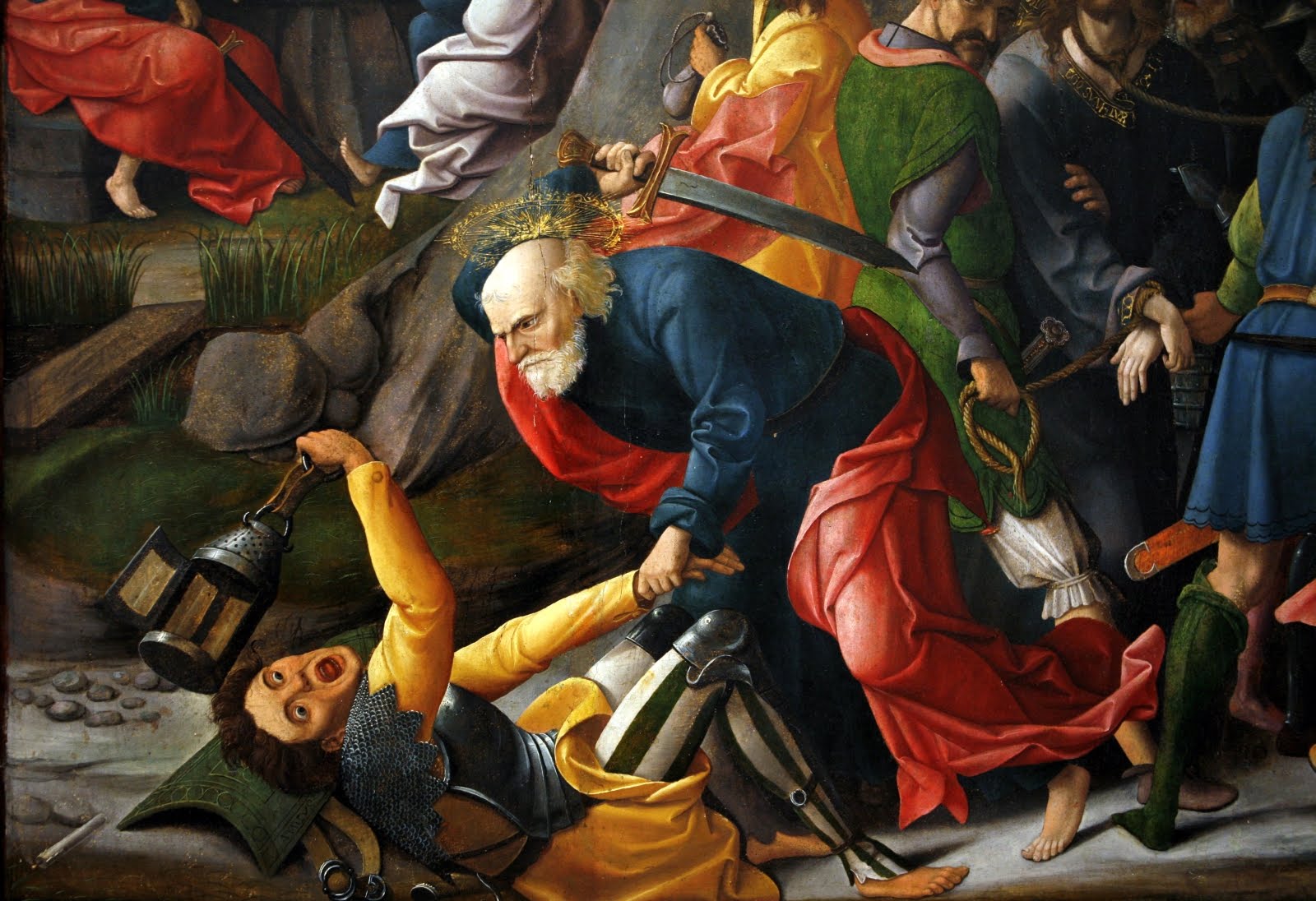
Aside from identifying with Peter’s roots as a man of the fishermen, the Baylys seem to be fond of rushing to judgment and action like the apostle did when evil is prevailing over the good. It was Peter, after all, who committed the only act of outright political defiance by the apostles when he raised the sword and took a swipe at one of the soldiers who arrested Jesus. Anyone with an ounce of sympathy for Christ can also appreciated Peter’s desire and courage in defense of his Lord at a time of great injustice. But Peter still didn’t understand, like the Baylys, that Christ’s kingdom comes not by a physical but a spiritual sword.

That is what 2k strives to clarify, the spiritual nature of the church.

But here is how the Baylys once again misrepresent 2k in tones quite out of tune with the love the repeatedly profess:

They [2k men] are fixated on silencing the voice of their fellow citizens who are religious, particularly those citizens who profess faith in Jesus Christ. Their endless political message is that no man may speak for God outside the privacy of his own home and church-house; and that if he does choose to speak as a citizen of these United States, he must be ever so careful to make it clear he’s not speaking for God or His Church. Our form of government requires him to parse his words and mince his sentences and nuance his tone so that no civil magistrate or fellow citizen will feel threatened by Christians-as-Christians, let alone Church-members-as-Church-members or Church-officers-as-Church-officers. This is the nature of our civil compact, and if religious people speak for God and His Church and people, they are violating that civil compact.

Wrong! The Bible actually requires ministers to parse their words carefully. And the Reformed interpretation of Scripture insists that ministers have a biblical warrant for when they declare what the Lord requires. And lo and behold, one of the doctrines the Bible teaches is liberty of conscience. Again, the egg-headed apostle Paul, did a good job of teaching a doctrine that plow boys and Brothers Bayly have trouble grasping when he talked about the liberty that Christians have to eat meat offered to idols.

According to the Bible, idolatry is wrong.
Also, according to the Bible, meat produced by idolatry is not wrong.
Also, according to the silence of Scripture, ministers are not required to shut down the butchers who sell the meat produced in false temples.

Let’s see about the Baylys red-letter edition of the Ten Commandments.

According to the Decalogue, murder is wrong.
Also, according to the Bible, the penalty for murder is not specified (unless you are a theonomist), which means Christians are free to support and oppose the death penalty.
Also, according to the Bible, ministers are not required to petition the government to punish murderers. Christians themselves as citizens may be free to do so.
But ministers cannot condemn as sinful something about which Scripture is silent.

In which case, the Baylys have substituted their word for the word of God in denouncing as sinful 2k theology.

Here’s the icing on the cake: 2k theology was the doctrine that informed J. Gresham Machen’s opposition to the church’s support for Prohibition and teaching Scripture in public schools. According to Machen:

. . . you cannot expect from a true Christian church any official pronouncements upon the political or social questions of the day, and you cannot expect cooperation with the state in anything involving the use of force. Important are the functions of the police, and members of the church, either individually or in such special associations as they may choose to form, should aid the police in every lawful way in the exercise of those functions. But the function of the church in its corporate capacity is of an entirely different kind. Its weapons against evil are spiritual, not carnal; and by becoming a political lobby, through the advocacy of political measures whether good or bad, the church is turning aside from its proper mission. . . .

Now, of course, the Baylys are not required to affirm Machen’s argument, and their previous credentials within a communion that excommunicated Machen might account for their lack of sympathy for his spirituality of the church idea. But if they are going to re-write the informal rules governing conservative Presbyterianism post-1950 and banish Machen from the list of worthies, they will need to do more than blow their trumpet. They might actually need to read and think about Machen’s reading of Scripture.
At Least He Has An Ergo

Nelson Kloosterman and Brad Littlejohn have been tag-team reviewing David VanDrunen’s recovery and defense of two-kingdom theology. Apparently, VanDrunen is deficient because he does not follow Abraham Kuyper (according to Klooserman’s pious desires) or Richard Hooker (by Littlejohn’s Anglophilic standards). Never mind that VanDrunen may have historical, theological, or biblical reasons for arguing the case for natural law and two-kingdom theology.

Recently, Littlejohn reviewed VanDrunen’s Living in God’s Two Kingdoms and summarized the two-kingdom perspective as follows (with a little instruction in Latin from Kloosterman):

1) Christ has fulfilled Adam’s original task.
2) Therefore [Latin, ergo], Christians are not called to fulfil that task.
3) Christians do not need to earn eternal life by cultural labours; they already possess the eternal life that Christ has won for them.
4) Our work does not participate in the coming of the new creation–it has already been attained once and for all by Christ.
5) Our cultural activity is important but temporary, since it will all be wiped away when Christ returns to destroy this present world.

Sounds pretty good to me (except for number 5 which is a bit of a caricature), but it also makes sense theologically since you wouldn’t want to argue the opposite of these deductions, would you? Do you really want to be on the side of affirming that Christians earn eternal life through cultural labors?

Such a question does not appear to be sufficiently troubling for Littlejohn or Kloosterman who regard VanDrunen as betraying the genius of a culturally engaged Christianity. According to the former, with a high five from the latter:

. . . for VanDrunen, the suggestion that we are called to participate with Christ in restoring the world suggests synergism, suggests that Christ is not all-sufficient—if we have something to contribute to the work of redemption, then this is something subtracted from Christ, something of our own that we bring apart from him. Solus Christus and sola fide must therefore entail that there is nothing left to do in the working out of Christ’s accomplishment in his death and resurrection, that we must be nothing but passive recipients.

Here we find, then, that Puritan spirit at the heart of VanDrunen’s project–the idea that God can only be glorified at man’s expense,** that it’s a zero-sum game, and that thus to attribute something to us is to take it away from Christ, and to attribute something to Christ is to take it away from us. If Christ redeems the world, then necessarily, we must have nothing to do with the process. But this is not how the Bible speaks. He is the head, and we are the body. We are united to him. He looks on us, and what we do, and says, “That is me.” We look on him, and what he does, and say, “That is us.” He invites us to take part in his work—this is what is so glorious about redemption, that we are not simply left as passive recipients, but raised up to be Christ-bearers in the world.

Sorry, but I missed the ergo after union with Christ. We are united with Christ, ergo, we take part in redeeming the world? How exactly does that follow?

Actually, God’s glory is not a zero-sum game but redemption is. Somehow my blogging may glorify God. Somehow my cat, Isabelle, doing her best impression of a rug, is glorifying God. Somehow John F. Kennedy, as the first Roman Catholic president of the United States, glorified God. Which is to say it is possible for the glory of God to be differentiated and seen apart from the work of redemption. Since the heavens declare the glory of God and Christ did not take human form in order to redeem the heavens, such a distinction does not seem to be inherently dubious.

But to turn cultural activity into a part of redemption does take away from the all sufficiency of Christ or misunderstands the nature of his redeeming work (not to mention his providential care of his creation). And this is the problem that afflicts so many critics of 2k, even those who claim to be allies for the proclamation of the gospel. You may understand the sole sufficiency of the work of Christ for saving sinners, but if you then add redeeming culture or word and deed ministries to the mix of redemption, you are taking away from Christ’s sufficiency, both for the salvation of sinners and to determine what his kingdom is going to be and how it will be established. Maybe you could possibly think about cultural activity as a part of sanctification where God works and we work when creating a pot of clay. But as I’ve said before, the fruit of the Spirit is not Bach, Shakespeare, or Sargent; if you turn cultural activity into redeemed work you need to account for the superior cultural products of non-believers compared to believers.

To Littlejohn’s credit (as opposed to Kloosterman who fails to notice that Littlejohn has anything positive about VanDrunen), he does see merits in VanDrunen’s position:

In short, I really do salute VanDrunen’s intention to liberate Christians for cultural engagement as a grateful response to Christ’s gift, but I have a hard time seeing how he can give any meaningful content to this, given the theological foundations he has provided.

Actually, VanDrunen supplies plenty of theological justification for his view of Christ and culture since he sees important layers of discontinuity between Israel and the church (which many Kuyperians, Federal Visionaries, and theonomists fail to see and refuse to concede any ground to Meredith Kline). It does not take much imagination to see that the Israelites, even the ones who trusted in Christ during his earthly ministry, were completely unprepared for the new order that was going to emerge after the resurrection. They were still committed to Jerusalem, the Temple, the sabbath, and eating kosher. And Paul, who set the Gentiles free from those obligations, even submitted to the old arrangements for the sake of unity. But the new order of the church was completely unprecedented in the history of redemption to that point in time.

I see no reason why the next age of redemptive history will similarly exceed any expectation that we have based on our experience of this world. In fact, it strikes me that those who can’t imagine a very different order in the new heavens and new earth — what, after all, is it like to be male and female without marriage or reproduction? — are so tied to the arrangements and attractions of this world that they cannot set their minds on things above.

At Least Theonomists Are Consistent (well, maybe not)

I participated yesterday in my first interview on my new book (all about me, remember), From Billy Graham to Sarah Palin, yesterday on a local Detroit Christian radio station. The host was gracious but unfortunately we talked much less about the book than about his and my own differences over theology and politics. One take-away from the exchange was that many evangelicals, if this host is representative, think they are political conservatives simply because they are conservative Christians. No matter that American conservatives have been discussing the boundaries of the Right for over fifty years in such outlets as the National Review, Modern Age, or the American Conservative, a conversation led initially by the likes of William F. Buckley, Jr. and Russell Kirk. I actually invoked Michigan’s own Kirk yesterday, twice. And I don’t think it had any effect. Evangelicals seem to believe they are conservative because they follow the Bible and it doesn’t faze them that folks like Kirk and Buckley let the Bible seldom if ever enter into their considerations of conservatism.

The most frustrating part of the interview was the phenomenon I have repeatedly observed here and at other blogs — the appeal to Scripture selectively. As readers might well imagine, the interviewer was opposed to abortion and gay marriage, as am I, and believed that biblical teaching should be followed by the U.S.A. I responded with a question about the commandments that precede the sixth and seventh (fifth and sixth for the Protestant-challenged) and the answer distinguished between America as a republic and not a theocracy. Evangelicals believe that their designs have nothing to do with theocracy even when they follow a book that does describe a polity that at the very least had theocratic aspects.

The frustration escalated when I brought up the example of Michele Bachmann who is receiving questions about the place of her husband in the White House should she win the election. Biblical teaching does require women to submit to their husbands and so journalists, whether for gotcha reasons or not, do have plausible reasons for asking how Bachman’s evangelical faith would square her political power with the Bible’s call for wifely submission. (This is the same kind of question, by the way, that journalists put to Morman and Roman Catholic politicians who seemed to be under obligation to authorities in competition with the U.S. Constitution.) The response, quite sensible, was to distinguish the spiritual aspects of Bachman’s life from her political responsibilities. But if you can do that with Bachmann’s marriage, why can’t you do so with the civil institution of marriage more generally? After all, if biblical teaching demands that marriage be between a man and a woman (which it does lest anyone think I’ve gone soft), why aren’t evangelicals also calling for policy and legislation that would enforce biblical teaching about divorce, or about the way Paul describes the relationship between a husband and a wife? Also, if you are going to appeal to the Bible for certain aspects of public policy, is it really bad form for journalists to inspect Scripture to see how far such appeal will take a candidate? Saying that suggestions that evangelicals are theocrats is silly just isn’t much of a defense.

But if you believe in natural law or that the light of nature does reveal certain ethical norms, then it is possible for evangelicals to oppose gay marriage and abortion without appealing to Scripture and bringing up that unfortunate business about women wearing hats.

During the interview I did think that theonomists are more consistent than your average evangelical. Theonomists want all of the Bible to inform public policy, and I also suspect that theonomy gained a hearing in the 1980s as the more consistent, philosophically and theologically compelling, critique of secular politics and secular humanism than what folks like Jerry Falwell and Francis Schaeffer were offering.

And then I actually picked up a book by Greg Bahnsen and had to scratch my head about such consistency. For some reason, Bahnsen was eager to follow Old Testament teaching but drew the line at jihad. Not even general equity could prompt him to embrace God’s reasons for the Israelites purging the promised land of the pagan tribes. “The command to go to war and gain the land of Palestine by the sword,” Bahnsen wrote, “is not an enduring requirement for us today.” How this squares with Bahnsen’s earlier assertion that “God’s law as it touches upon the duty of civil magistrates has not been altered in any systematic or fundamental way in the New Testament,” is a mystery. [By This Standard, pp. 5, 3] After all, the command to go to war against the pagan tribes was hardly a local circumstance but a reflection of God’s holy and righteous opposition to sin and unbelief and a revelation of how he will punish it.

The take away is that the world of biblical politics is filled with inconsistencies. Of course, we all have our problems. But evangelical politicians should at some point not be surprised but expect to receive questions about where the appeal to the Bible begins and ends, that is, in which areas they are prepared to be 1k and in which domains they will follow 2k teaching. Until both Christians and secularists receive such an explanation, political biblicists will continue to be exasperated and exasperating.

What's Good for the Immanentizer is Good for the Post-Millennialist

Alan Jacobs pushes back against Andrew Sullivan’s recent denunciation of Christianism. According to Sullivan:

Christians will look back on this period, I believe, with horror. The desire to control others’ lives and souls through politics is so anathema to the Gospels it will one day have to be exposed and ended. Until then, we just have to keep our spirits up and attend to our own failures as Christians, which, of course, are many.

Jacobs thinks he has the perfect antidote to Sullivan, and his name is Martin Luther King, Jr. Jacobs seems to think that King was doing what today’s Christians are doing, namely, arguing for conformity between the law of God and the laws of the United States:

[King] could have stayed in his prayer closet instead of politicking; he could have attended to his own failures as a Christian, which of course were many; he could have forgiven white Southerners instead of judging them. But no. He became an “outside agitator,” marching into ordinary American communities and telling them that their local laws, and indeed in some cases federal laws, were not to be obeyed — and why? Because they conflicted with the law of God! Notice the arrogance with which he associates his cause with God Himself. He even asserts that “human progress” only happens when “men [are] willing to be co-workers with God.” His whole vision for America is Christian and Biblical through and through: in his most famous speech he simply identifies the American situation with that of the Biblical Israel: “I have a dream that one day every valley shall be exalted, and every hill and mountain shall be made low, the rough places will be made plain, and the crooked places will be made straight; ‘and the glory of the Lord shall be revealed and all flesh shall see it together.'” Talk about “the desire to control other people’s lives and souls”!

Well, I’ll take the bait. King’s immanentized political theology and identification of the United States with Israel was as bad as Jerry Falwell’s or now Rick Perry’s. That doesn’t stop Jacobs who explains, “After all, Dr. King’s faith commitments were at least as encompassing in their scope, as universal in their claims, as publicly political as Rick Perry’s . . .” Thinking of the United States as the New Israel is wrong no matter who is doing it and no matter what the cause.

But Jacob’s comparison is far fetched for at least three reasons. First, the Christian or Religious Right has not faced the same sorts of obstacles that African Americans did and IN some cases still do. Trying to glom evangelical politics on to the Civil Rights movement is just plain bad form (and this is from someone who doesn’t care for the increased power of the federal government that came with Civil Rights legislation). Second, King was not running for president. sponsoring a prayer rally around the same time that you are contemplating entering the Republican bid for the presidential nomination is almost as tacky praying before a NASCAR race and thanking the Lord for a “smoking hot” wife. Third, King’s appeal was much more common at a time when mainline Protestants dominated public life and appealed to Christian theology for social reform. For some reason, evangelicals don’t seem to understand that the United States has changed a lot since 1963, along with the etiquette governing public speech about the United States as a Christian nation. If not everyone, including the media elites, believes the United States to be a biblical polity, then maybe you don’t bring up the Bible if you want to persuade the media elites. Maybe also you don’t pray in public with a humongous U.S. flag at your back.

One last point: when Christians enter the public square and start using theology for political purposes, Christian doctrine always, always, always suffers. It happened with the Social Gospel. It happened with Martin Luther King, Jr. It happened with Reinhold Niebuhr. And it’s happening with Rick Perry. Consider the following from a report about the recent prayer rally:

The lineup of speakers at The Response reflect the impact of new charismatic and Pentecostal movements, especially those emphasizing spiritual warfare and round-the-clock prayer and worship, and which have produced another sort of army. That one is not particularly intrigued by the horse race of politics, but rather focused more exclusively on the supremacy of Jesus and preparing for his return.

That caused some controversy for the organizers of Perry’s event, which included speakers and endorsers who follow the New Apostolic Reformation. The NAR’s strident language of spiritual warfare and emphasis on prophecy, signs, and wonders, has drawn scrutiny. But it has the same dominionist aims of the old religious right, even while employing some new rhetoric.

The NAR has also drawn criticism from conservative evangelical “discernment” ministries that consider it heretical—a criticism that Response organizers dismissed. A week before The Response, Marsha West, a conservative writer and editor of the website Email Brigade, wrote a scathing blog post; which she published on the website of Response host the American Family Association, and which was subsequently taken down. West complained that the NAR, which she considers unbiblical, was involved in The Response.

West told me in an email that she was “thoroughly disgusted with Christian Right leaders who have joined forces with a group that is, by definition, a Christian cult. Because of CR leader’s lack of discernment, the NAR is now becoming mainstream.” (According to her website, West also considers Mormonism, the emergent church, new age spirituality, word of faith, homosexuality, and more to be unbiblical.) In the NAR, she particularly identified Mike Bickle of the International House of Prayer, who played a big role in The Response. “[T]hese people are what the Bible calls ‘false prophets’… not true Christians,” West wrote. When I asked Garlow [Jim Garlow heads Newt Gingrich’s nonprofit, Renewing American Leadership]about West’s complaint, he shrugged it off, saying that he was not familiar with the term New Apostolic Reformation, even though he knew its founder, Peter Wagner. “I have a lot of confidence in him spiritually,” Garlow said of Wagner.

“There are a lot of theological differences here, but we’re focusing on one issue: Jesus,” Garlow added. “It’s not about whether Perry becomes president, it’s about making Jesus king.”

Does Jacobs actually believe Garlow? Can he not see that Sullivan is just a little bit justified in being skeptical about today’s “Christian” politics?

Kingdom Sloppy: A Big Bowl of Wrong

Readers of Oldlife may think I am too hard on Kuyper and neo-Calvinism. I know of one reader and commenter who regularly replies that I am just pointing out errors but that neo-Calvinism in its purity is — well — pure. Another respondent has admitted to some flaws along the way but nothing inherently erroneous about neo-Calvinism per se.

And then I receive a deluge of examples that suggest neo-Calvinism is not simply prone to abuse by a few of its proponents. Instead, repeatedly, neo-Calvinism blurs the distinctions between the church and culture (what we used to call the world), and consistently does not recognize the fundamental difference between redemption and cultural activity. Herewith some examples (and I have the good Dr. K. to thank for several of them).

The first comes from James K. A. Smith in an article he wrote for Pro Rege in which he tried to argue for more of a liturgical component for neo-Calvinism. (I actually think Smith has a point, especially when he conceives of a church-college as a worshiping community in which liturgy should be at the center of campus life.) But to defend his view, he observes a tendency within neo-Calvinism (and he is pro-neo-Calvinist) that is precisely what Old Lifers detect in Kuyperianism:

Kuyper has been inherited in different ways in North America, yielding different Kuyperianisms. While Zwaanstra suggests that “ecclesiology was the core of [Kuyper’s] theology,” one quickly notes that it is the church as organism that is the “heart” of his doctrine. This emphasis, coupled with some other emphases in Kuyper, led to a strain of Kuyperianism that actually had little place for the church as institute in its understanding of Christian engagement with culture. Indeed, there have even been strains of Kuyperianism that have been quite anti-ecclesial. On the other hand, Kuyper himself clearly saw a crucial role for the church as institute and devoted a great deal of his time, energy, and gifts to its welfare and reform.

Next comes a quotation, which also came to my attention through Dr. K., which seems to run rough shod over distinctions between redemption and creation, such that Bach, bordeaux, and republican governments become the fruit of the Spirit.

Reformational Christians are not very accustomed to relating the working of God’s Spirit to nature and to culture. The under-appreciation of the broader work of the Spirit betrays an incorrect vision of the relationship between nature and grace. Here, too often the point of departure involves an antithesis between the general and the special working of the Spirit. Only the latter is saving.

For the Reformation, grace is not opposed to nature, but opposed to sin. By grace, a person does not become super-human, but genuinely human. Grace restores and redeems nature, but it adds nothing new to nature. “The re-creation is not a second, new creation. It introduces no new substance, but is essentially reformatory,” according to Herman Bavinck. . . .

The Bible connects the work of the Spirit also to the gift of art. That applies to devotional music, to be sure. But architects and visual artists like Bezalel and Oholiab were also filled with the Spirit of God in order to be able to do their creative work [Ex. 31.6; 36.1-2; 38.23].

Christians may pray for the working of the Holy Spirit in their own lives, but also for the corruption-restraining working of the Spirit in society. That working extends to the meetings of literary guilds, of the advertising review council, and of the film rating commission. Where the Holy Spirit is absent, the demons of terror have free reign.

Therefore the church prays for the world this petition as well: “Veni creator Spiritus”—Come, Creator Spirit! (Dr. H. van den Belt, “Focus op bekering mag zicht op vernieuwing aarde niet ontnemen,” Reformatorisch Dagblad [13 June 2011])

We can see where such blurring leads when we look at a new initiative at Redeemer Presbyterian Church. I learned about this one thanks to the ever watchful eyes of the Brothers Bayly. (It should also be mentioned that the good Dr. K. seems to approve of Tim Keller because of the New York pastor’s use of Kuyper.)

The Center for Faith and Work at Redeemer PCA/NYC is hosting a conference this fall on the gospel and culture. The vision for this conference sounds like this:

“And I saw the holy city, new Jerusalem,coming down out of heaven from God, prepared as a bride adorned for her husband.” Rev 21:2

In this great climax of redemption, we get a glimpse of where all of history is moving, and the scope of God’s redemptive purposes extends far beyond what we could have ever imagined. God is at work preparing his bride, and this bride is a holy city—a city designed and built by God Himself. God has intimately invited us into this redemptive story, and when we understand how the story ends, the way we see and engage the city around us changes. When we begin to realize that God cares for New York City, in all of its dimensions and sectors, our eyes become opened to see His love and care for all that we often overlook. Our hope for this conference is that you will begin to see how real the gospel is in every inch of our city and to leave with a renewed sense of purpose and calling as you see hope-filled glimpses of the great City of Peace that is to come.

What is striking about this understanding of the gospel in the city is that the gospel seems to be there even if the church isn’t proclaiming the gospel or transforming the culture. It sounds like this wing of Redeemer believes that the gospel is already there in NYC and so Christians need to become more sensitive to it so they can see how God is at work everywhere. So much for needing to transform the city. The church needs to be culturalized.

To add plausibility to this interpretation, consider that one day of the conference will be devoted to “glimpses,” that is, a “cultural event (1) based in New York City, (2) experienced in community, (3) which points toward evidence of God’s glory and Sovereignty over all things.” Conference participants may gain a glimpse by engaging in one of the following suggested activities:

STARTER IDEAS — Food Tour · Metropolitan Museum · BAM · NYPhil · Brooklyn Heights History Walk · Brooklyn Bridge Architecture Walk · The Morgan Library · Times Square “Branding” Walk · Off B’way · Carnegie Hall · City Opera · City Ballet · IFC · Angelika · Lincoln Square Cinema · Jazz @ Lincoln Center · Fashion Show · Joyce Dance · B.B. King’s · NY Historical Society · The MET · Rockwood Hall · Living Room · 92nd St.

I have had some very good meals in NYC. They were better temporally than the meal of the Lord’s Supper that I now eat weekly at our OPC congregation (though the bread made by the pastor’s wife is very good!!). But I never suspected that when dining on Osso Bucco I was actually experiencing the coming of the kingdom of grace or the relishing the fruit of the Holy Spirit. And I don’t think it is necessarily fundamentalist to distinguish peace, love, and joy from the creations of Winslow Homer and Woody Allen.

In which case, if the gospel can be construed so broadly, and if Kuyperianism has a tendency for the church as organism to outrun the church as institute, why won’t neo-Calvinists exert a little internal regulation and pot down the excess? For that matter, do the Allies at the Gospel Coalition really endorse Redeemer church’s understanding of the gospel and culture?

The culture cannot be saved — only created beings with souls can. But if you are in the habit long enough of thinking that cultures can be saved, then perhaps you start to adjust your understanding of the gospel and find salvation in the culture that you deem civilized (or hip).

Kingdom Sloppy: Michele Bachmann and Her Interpreters

Mollie Hemingway, our favorite Lutheran journalist, over at GetReligion has alerted readers to a Lutheran slur against Michele Bachmann (who grew up in the Wisconsin Evangelical Lutheran Synod — who knew? — which is a communion to the right of the Missouri Synod). Mollie herself does not think much of Lutheran theology stuck with Michele:

I’m a confessional Lutheran. Ostensibly, Michele Bachmann was a member of a more conservative but also confessional Lutheran church body. And for years, whenever I heard her speak, she never sounded even mildly Lutheran to me. The “the Lord put it on my heart” type language. The “the Lord anointed me” stuff. This is not how Lutherans speak, although I won’t bore you with all of the why. Her other affiliations have always been more evangelical than Lutheran, going back decades.

But the point of Mollie’s piece is a story in The Atlantic which attempts to make Bachmann look bad because of her former church’s teaching (chances are the reporter could not find a confession or creed from Bachmann’s current church):

Michele Bachmann is practically synonymous with political controversy, and if the 2008 presidential election is any guide, the conservative Lutheran church she belonged to for many years is likely to add another chapter due to the nature of its beliefs—such as its assertion, explained and footnoted on this website, that the Roman Catholic Pope is the Antichrist.

Mollie responds:

Now, as anyone who knows anything about church history can tell you, the papacy is not a feature of Protestantism. And if you followed the Reformation or knew anything about the abuses of Pope Leo X or the anathemas of the Council of Trent, it’s not really newsworthy that the reformers looked at what Scripture says are the marks of the anti-Christ and basically said “yep — the papacy has those.” What makes the church to which Michele Bachman was once joined slightly different is that while most Lutheran church bodies will talk about the historical context into which they were made, the Wisconsin Synod says that basically they’re still Protestants who still don’t believe in the papacy and still think it sits in opposition to the Gospel of Christ.

And, again, if you don’t know that Catholics and Protestants have very strongly held different views on whether the papacy is on the whole a really good or really bad institution, you should repeat 8th grade or whatever.

The irony, of course, is that if the reporter had studied Lutheran theology further, he would have discovered a doctrine of the kingdoms what would allow a political candidate to affirm that the pope is the anti-Christ and also promise to serve Roman Catholic citizens according to the laws of the United States. In fact, there is a better chance that Bachmann’s studies with Francis Schaeffer, not the teaching of WELS, make her less flexible in negotiating the the claims of Christ’s lordship over greatest nation on God’s green earth.

Kingdom Sloppy: Southern Baptists and Immigration Policy

‘Tis the season of thinking about the relations between evangelicalism and political conservatism thanks to the release of From Billy Graham to Sarah Palin. With such heightened sensitivity come examples that show fuzziness on the differences between the kingdoms of redemption and providence.

I begin with the reaction of Jerry Salyer to the recent Southern Baptist Resolution, “On Immigration and the Gospel,” a statement that in itself is a grab bag of truths that do not cohere either theologically or politically. Salyer writes:

One defender of the new SBC policy is Southern Baptist Seminary theologian Russell Moore, who declares in “Immigration and the Gospel” that “[t]he Christian response to the immigrant communities in this country cannot be ‘You kids get off my lawn’ in Spanish.” Up until now I have had nothing but respect for Moore – anyone who appreciates Berry and Genovese can’t be all bad – which is precisely why his trite and thoughtless remarks pain me so. Does he really mean that no Christian can offer an argument against mass-immigration better than that of Mr. Wilson from Dennis the Menace? Can one really dismiss so quickly classicist Thomas Fleming, or philosopher Roger Scruton? What about journalists like Tom Piatak, Patrick Buchanan, and Peter Hitchens?

Whether one ultimately agrees with the positions taken by immigration restrictionists is beside the point. The point is that the Southern Baptist leadership hide from their flock the fact that such positions even exist. Should we be concerned about, say, the socioeconomic consequences of a vastly expanded labor pool? Soaring crime rates? What about the implications of perpetual war with the Muslim world even as mosques simultaneously sprout all across the Midwest? How seriously should we take those activists who celebrate the Reconquista of “Aztlan”?

In other words, opposition to open borders may not simply be an expression of nativist prejudice. It may actually stem from plausible political considerations, such as these that Salyer quotes from James Kalb who recognizes that the motivations for unrestricted immigration may stem less from what is true or good or noble and more from economic and political interests:

Ruling elites . . . are concerned with the power and efficiency of governing institutions, the status and security of those who run them, and maintenance of the liberal principles that support and justify their rule. It is in their interest to expand the human resources available to them, even at the expense of those who are already citizens, and to weaken the mutual ties that make it possible for the people to resist rational management and to act somewhat independently.

The practical result of such influences has been the suppression of immigration as an issue in the interest of an emerging borderless world order. Restrictionist arguments are scantily presented in the mainstream media, and concern with cultural coherence, national identity, or even the well-being of one’s country’s workers is routinely denigrated as ignorant and racist nativism.

Whether you agree with Kalb’s skeptical analysis, it is a reminder that beyond the calls for making the gospel relevant or pursuing social justice are political considerations that religious idealism ignores. In which case, the book of redemption (which is silent on immigration policy) tells the book of nature (which has much to say) to “shut up.”

When Private Goes Public

(TMI Alert!) Last Sunday my wife and I were publicly received by the OPC congregation in Hillsdale, Michigan. The reception took place during a public worship service on Sunday morning. Despite all the public matters transpiring, very few people noticed. Aside from members of session who decided to receive us by letter of transfer, the email recipients who learned of the time for our reception, and the worshipers themselves who gathered last Sunday (a small group when the college is not in session), no one else knew about these public events. No one from the Hillsdale newspaper covered the event. Session filed no papers with state or federal authorities monitoring church membership. Session did not even hire a publicity firm to promote this part of the worship service. (How dare them!)

And yet it was all public.

According to the OPC’s Directory for Public Worship, Lord’s Day worship is public:

While believers are to worship in secret as individuals and in private as families, they are also to worship as churches in assemblies of public worship, which are not carelessly or willfully to be neglected or forsaken. Public worship occurs when God, by his Word and Spirit, through the lawful government of the church, calls his people to assemble to worship him together. (1.1.c

Also, according to the Directory the reception of members is also public, as in the Directory supplies directions for “The Public Reception of Church Members”:

When a person is received into membership on letter of transfer from another Orthodox Presbyterian congregation, that reception is effective at the time of the action of the session to receive him. Nevertheless, a session may deem it appropriate to welcome that person publicly into the congregation and allow him to give public expression to his faith. If this is done, it shall be made clear to the congregation that the person has already been received by action of the session. (DPW, 4.C)

Critics of 2k often point out that this dualistic doctrine is wrongheaded because it marginalizes faith and puts in a box of privacy. Instead of interacting with all spheres of life, as allegedly all Christians are required to do, 2k believers hide their faith under a bushel. Even worse, they supposedly ratchet up the binary distinction between the public and the private, leaving the former to public officials and the latter to people who do ministry.

But if I’m right about the public nature of what happened last Sunday at Hillsdale OPC, then the critics of 2k are wrong. A spiritual church is just as public as what happens in the public square. It’s just that people who believe in the spirituality of the church don’t need the people supervising the public square to validate the importance of what transpires in public spiritual activities. Public church affairs are plenty important even if the public authorities don’t notice.

Is This Where Neo-Calvinism Leads?

Our favorite PCA blogger (why? He’s more my age than Stellman) has adapted an older article from the Nicotine Theological Journal for his blog, calling it “Bye, Bye Kuyper.” Here is an excerpt:

Christians have come to believe that they worship God as much in their weekday jobs as they do on the Lord’s Day gathered with the congregation to pray, sing, read, and preach. In fact, Monday can be more important than Sunday. Sunday’s gathering is justified not by offering God acceptable worship and dispensing the means of grace, but only if it has some good effect on one’s work and leisure Monday through Saturday.

Ministers who lead in worship, preach the Word, and administer the sacraments are doing nothing more important than the politician or housewife (or husband) or professor of physics or laborer. In fact he may be doing something less important as he provides only the spiritual inspiration for those who really advance the kingdom. The Christian school is as important as the Church, perhaps more important if we want to prepare our young people to conquer the world for Christ.

The whole thing has led to a denigration of the traditional mission of the church. Churches are embarrassed to say that they have no more to offer than the ordinary means of grace. Ministers feel they must apologize if they do no more than preach the Word, administer the sacraments, show lost sheep the way to the fold, and help make sure the gathered sheep have the provision and protection they need as they make their way to the heavenly sheepfold. The world, it is contended, will rightly condemn the church if it does not see the “practical effects” of its existence (hence the church must distribute voters’ guides to promote Christian political agendas, create faith-based ministries to provide cradle to grave welfare, put on get seminars so everybody can communicate and have good sex, and offer concert seasons and art shows to provide the congregants and community with cultural experiences).

I know that not all Kuyperians approve of the way Kuyperianism has been domesticated. But what I am still waiting for is an account of neo-Calvinism that avoids the unhinging of the church that The Christian Curmudgeon describes. It is one thing to say that voters’ guides are a problem. It is another, though, to say that voting is kingdom work. It seems to me that Kuyperians are so reluctant to give in to the spirituality of the church that they end up making the world safe for both Jim Skillen and Jim Wallis.

Lay Plumbing

Since relocating to Michigan I have not only had to think about whether Christians plumb differently from non-Christians. I have also had to think and act plumbingly.

First, I had to purchase a toilet auger to unblock a clogged septic line.

Then, I had to figure out how to displace a large puddle that had emerged in our “Michigan basement” after several heavy rains. A wet-dry shop vacuum allowed the removal of 14 gallons of water fairly easily.

And then I needed to consider the various features of dehumidifiers in order to prevent such puddles in the basement from repeating and growing. And this has led to further consideration about installing a sump with its related pump in order to allow the dehumidifier to keep working without having to empty its water receptacle.

In which case, a sump pump might allow putting the washer and dryer in the basement, as well as the installation of a sink for the sorts of cleaning and rinsing that are less than desirable in the kitchen or bathroom.

If I did not know better, I would be tempted to think that God is mocking my repeated (and perhaps overused) point about Christian plumbing (or the lack thereof). But at least this much can be said in defense of 2k: so far the creational wisdom of the local hardware store staff has yet to steer wrong this mortgage payer who is not doctrinaire about water and its movement within and outside the home.