
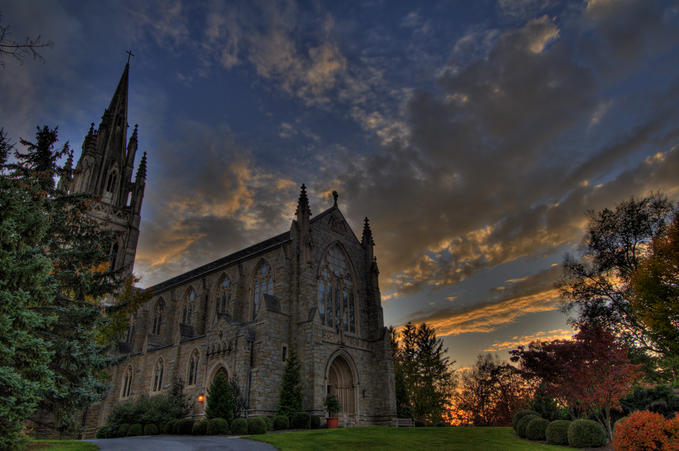
 This is an account of Nevin’s experience as an undergraduate at Union College. It shows what happens to children of the covenant, away at college, when confronted with the modern revival system. And this was only 1819. Yikes!
Being of what is called Scotch-Irish extraction, I was by birth and blood also, a Presbyterian; and as my parents were both conscientious and exemplary professors of religion, I was, as a matter of course, carefully brought up in the nurture and admonition of the Lord, according to the Presbyterian faith as it then stood. I say with purpose as it then stood; for I cannot help seeing and feeling, that as a very material change has come upon since, and this in a way not without serious interest for my own religious life.
What I mean, will appear at once, when I state, that the old Presbyterian faith, into which I was born, was based throughout on the idea of covenant family religion, church membership by God’s holy act in baptism, and following this a regular catechetical training of the young, with direct reference to their coming to the Lord’s table. In one word, all proceeded on the theory of sacramental, educational religion, as it had belonged properly to all the national branches of the Reformed Church in Europe from the beginning. In this respect the Reformed Churches of Switzerland, France, Germany, Holland and Scotland were of one mind; and this mind still ruled, at the time to which I now refer, the Presbyterianism of this country. True, there was no use here of the rite of confirmation in admitting catechumens to full communion with the Church; but there was, what was considered to be substantially the same thing, in the way they were solemnly received by the church session. The system was churchly, as holding the Church in her visible character to be the medium of salvation for her baptized children, in the sens of that memorable declaration of Calvin (Inst 4.1.4), where, speaking of her title, Mother, he says: “There is no other entrance into life, save as she may conceive us in her womb, give us birth, nourish us from her breasts, and embrace us in her loving care to the end” . . . .
We had no religion in college, so far at least as morning and evening prayers went; and we were required, on Sundays, to attend the different churches in town. But there was no real church life, as such, in the institution itself. . . . . All this involved, of course — although, alas, I knew it not then — a very serious falling away from the educational and churchly scheme of religion, in which I had been previously born and bred. It was my very first contact with the genius of New-England Puritanism, in its character of contradiction to the old Reformed faith, as I had been baptized into it, in its Presbyterian form. . . . It is hardly necessary to say, that circumstanced as I then was, I had no power to withstand the shock. It brought to pass, what amounted for me, to a complete breaking up of all my previous Christian life. For I had come to college, a boy of strongly pious dispositions and exemplary religious habits, never doubting but that I was in some way a Christian, though it had not come with me yet (unfortunately) to what is called a public profession of religion. But now one of the first lessons inculcated on me indirectly by this unchurchly system, was that all this must pass for nothing, and that I must learn to look upon myself as an outcast from the family and kingdom of God, before I could come to be in either in the right way. Such, especially, was the instruction I came under, when a ‘revival of religion,’ as it was called, made its appearance among us, and brought all to a practical point. . . . For I, along with others, came into their hands in anxious meetings, and underwent the torture of their mechanical counsel and talk. One after another, however, the anxious obtained ‘hope;’ each new case, as it were stimulating another; and finally, among the last, I struggled into something of the sort myself, a feeble trembling sense of comfort — which my spiritual advisers, then, had no difficulty in accepting as all that the case required. In this way I was converted, and brought into the Church — as if I had been altogether out of it before — about the close of the seventeenth year of my age. My conversion was not fully up to my own idea, at the time, of what such a change should be; but it was as earnest and thorough, no doubt, as that of any of my fellow-converts. . . . It was based throughout on the principle, that regeneration and conversion lay outside of the Church, had nothing to do with baptism and Christian education, required rather a looking away from all this as more a bar than a help to the process, and were to be sought only in the way of magical illapse or stroke from the Spirit of God;. . . An intense subjectivity, in one word — which is something always impotent and poor — took the place of a proper contemplation of the grand and glorious objectivities of the Christian life, in which all the true power of the Gospel at last lies. My own ‘experience’ in this way, at the time here under consideration, was not wholesome, but very morbid rather and weak.
Alas, where was mother, the Church, at the very time I most needed her fostering arms? Where was she, I mean, with her true sacramental sympathy and care? How much better it had been for me, if I had only been properly drawn forth from myself by some right soul-communication with the mysteries of the old Christian Creed. (My Own Life, 1870)
 Old Life