
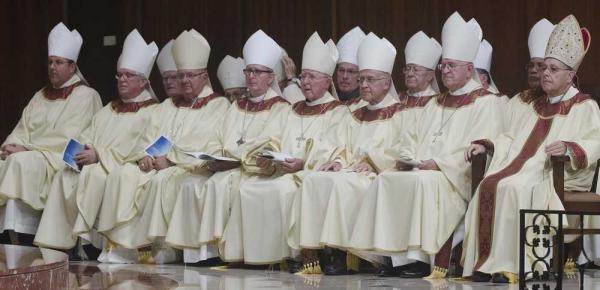
I noticed today at Cardinal Sean Patrick O’Malley’s blog a statement by the Massachusetts’s bishops on opiate abuse:
The abuse and misuse of opioids has become a national and local epidemic that has increasingly been felt in the Commonwealth of Massachusetts in recent years. On average, four people lose their lives each day in this state, due to illegal and legal drug overdoses. It is a disturbing trend that must be stopped. In this year of Divine Mercy in the Catholic Church, we, the four Bishops of Massachusetts join health care professionals, law enforcement, first responders, elected officials and countless others affected by this epidemic in calling for a comprehensive plan to address this growing crisis.
Given the scope of the problem, we feel some degree of urgency to find a solution to this public health and policy crisis that has reached dangerous levels. The lives negatively impacted by this disaster represent all economic, age, gender or racial categories. The impact is far reaching, leading to the eventual breakdown of families, friendships, neighborhoods and communities.
The solution to this tragic problem is not easy to define; it will be even more difficult to implement. The enormity of the problem, however, calls for an immediate and sweeping response. As that response is crafted, we must be mindful that on one hand, medical professionals must continue to care for their patients by prescribing these powerful drugs for long and short term pain management. On the other hand, overuse by the patient, along with access to vast quantities of opioids by unintended users, often leads to abuse, addiction and death. We exhort health care providers to demand improved education within their own professional groups about the appropriate indications, prescriptions and use of opioid medications.
We must offer help, support and comfort to those who have formed an addiction to prescription pain killers, as well as to those individuals who have formed an addiction to illegal drugs. While new legislation alone will not solve the opioid crisis in Massachusetts, it is a critical step that must be taken soon. We urge the Governor and the legislature to continue their work on this legislation and to provide the necessary resources, human and fiscal, to implement comprehensive education and treatment services to address and correct this ever-growing crisis.
We encourage our sisters and brothers who are suffering addiction or the addiction of loved ones to turn to their faith community for support, counsel and compassion, and we pray that those most affected will receive the physical, emotional and spiritual help that they need.
How different is something as unspecified as this call to action from the sorts of complaints that students have been bringing against university administrations, such as the Black Students Union at Johns Hopkins University?
1. We demand a public address to be held by the administration (including but not limited to President Ron Daniels, Provost Lieberman, Provost Shollenberger, and the Board of Trustees) to The Johns Hopkins community in which President Ron Daniels will announce an explicit plan of action detailing how the following demands will be instated.
2. We demand that The Johns Hopkins University creates and enforces mandatory cultural competency in the form of a semester long class requirement for undergraduate students as well as training for faculty and administration.
3. We demand that the Center for Africana Studies be recognized as a Department.
4. We demand an increase in the number of full-time Black faculty members, both in the Center for Africana Studies and throughout other departments within the institution. Moreover, we demands equal representation of self-identifying men, women, and non-binary Black individuals within these positions.
5. We call on The Johns Hopkins University Krieger School of Arts & Sciences to support the hiring of faculty concerned with the history, culture, and political position of peoples of African descent. Calls for diversifying faculty are important, but equally crucial is attracting faculty whose work creates a scholarly community dedicated to Africana studies.
6. We demand accountability for peers, faculty, and staff who target Black students both inside of and outside of the classroom. Attending to such situations must transition from a passive email sent to the student body, to an active stance taken against racial intolerance by the administration. Perpetrators that aim to make Black students uncomfortable or unsafe for racial reasons must complete additional diversity training and face impactful repercussions for their actions.
7. We demand a transparent five year plan from The Johns Hopkins University Office of Undergraduate Admissions regarding the welcoming of and retention of Black students. We demand black bodies be removed from diversity marketing campaigns until Hopkins addresses the low quality of life here that many Black students experience and the problems with retaining Black students all four undergraduate years and then takes the necessary steps to resolve them.
8. We demand more Black professors within the Women, Gender and Sexuality program to add a new dimension to the Department on intersectionality and inclusivity that is currently being neglected and ignored.
Actually, in most cases the students’ demands are much more specific than the bishops’ statement. If Massachusetts were a Roman Catholic state, the call by church officials to governmental officers to look into a certain matter might make sense. Or, if the bishops sent a memo to the administrators and public health officials at Roman Catholic hospitals and medical schools and asked for policy recommendations, they might have more to say even while not exactly ministering God’s word. But at the end of the day is a statement like this from the church anything more than an indication that bishops care? Didn’t church members already know that?
 Old Life