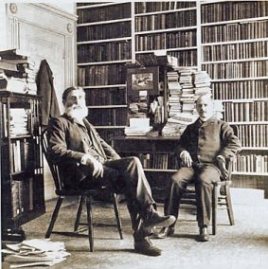
Where’s Waldo Wednesday: Did He Say “Impetration”?

We are told that God saves us in His mere mercy, by a renovating work of the Holy Spirit, founded on the redeeming work of Christ; and we are told that this renovating work of the Holy Spirit was in order that we might be justified and so become heirs. Here the purchase by the death of Christ is made the condition precedent of the regeneration of the Holy Spirit; but the action of the Holy Spirt is made the condition precedent to justification and adoption. We are brought unto God by Christ in order that we may be brought to God by the Holy Spirit. And in bringing us to God, the Holy Spirit proceeds by regenerating us in order that we may be justified so as to be made heirs. In theological language, this is expressed by saying that the impetration* of salvation precedes its application: the whole of the impetration, the whole of the application. And in the application, the Spirit works first by regenerating the soul, next justifying it, next adopting it into the family of God, and next sanctifying it. In the more vital and less analytical language of our present passage [Titus 3:4-7], this is asserted by founding the gift of the Holy Ghost upon the work of Christ: “which He poured out upon us richly through Jesus Christ our saviour”; by including in the work of the Holy Ghost, regeneration, justification, adoption, and a few verses lower down, sanctification; and by declaring that the regeneration of the Holy Spirit is “in order that being justified we might be made heirs.”

. . . . This is encouraging teaching for believers! Shall they, then, because they are saved out of God’s mercy and not out of works in righteousness which they have done themselves, be careless to maintain good works? I trow** not;; and the Apostle troweth not. Because of this, they will now be careful “to maintain good works.” Let us see to it then that by so doing we approve ourselves as true believers, saved by God’s grace, not out of works but unto good works, which He hath afore prepared that we should walk in them! This is what the Apostle would have us do. (B. B. Warfield, “The Way of Life,” in Faith and Life, pp., 399-400)

*Impetration: 1. The act of impetrating, or obtaining by petition or entreaty.

** Trow: Archaic to think, believe, or trust.

Forensic Friday: Warfield on Justification

Sometimes we are told that Justification by Faith is “out of date.” That would be a pity, if it were true. What it would mean would be that the way of salvation was closed and “no thoroughfare” nailed up over the barriers. There is not justification for sinful men except by faith. The works of a sinful man will, of course, be as sinful as he is, and nothing but condemnation can be built on them. Where can he get works upon which he can found his hope of justification, except from Another? His hope of Justification, remember – that is, of being pronounced righteous by God. Can God pronounce him righteous except on the ground of works that are righteous? Where can a sinful man get works that are righteous? Surely, not from himself; for, is he not a sinner, and all his works as sinful as he can offer to God as righteous. And where will he find such works except in Christ? Or how will he make them his own except by faith in Christ?

Justification by Faith, we see, is not to be set in contradiction to justification by Works. It is set in contradiction only to justification by our Own Works. It is justification by Christ’s Works. The whole question, accordingly, is whether we can hope to be received into God’s favor on the ground of what we do ourselves, or only on the ground of what Christ does for us. If we expect to be received on th e ground of what we do ourselves – that is what is called Justification by Works. If on the ground of what Christ has done for us – that is what is mean by Justification by Faith. Justification by Faith means, that is to say, that we look to Christ and to him alone for salvation, and come to God pleading Christ’s death and righteousness as the ground of our hope to be received into his favor. If Justification by Faith is out of date, that means, then, that salvation by Christ is out of date. There is nothing, in that case, left to us but that each man must just do the best he can do to save himself.

Justification by Faith does not mean, then, salvation by believing things instead of by doing right. It means pleading the merits of Christ before the throne of grace instead of our own merits. It may be doing right to believe things, and doing right is certainly right. The trouble with pleading our own merits before God is not that merits of our own would not be acceptable to God. The trouble is that we haven’t any merits of our own to plead before God. Adam, before his fall, had merits of his own, and because he had merits of his own he was, in his own person acceptable to God. He didn’t need Another to stand between him and God, whose merits he could plead. And, therefore, there was no talk of his being Justified by Faith. But we are not like Adam before the fall; we are sinners and have no merits of our own. It we are to be justified at all, it must be on the ground of the merits of Another, whose merits can be made ours by faith. And that is the reason why God sent his Only Begotten Son, that whosoever believeth on him should not perish but have everlasting life. If we do not believe in him, obviously we must perish. But if we believe in him, we shall not perish but have everlasting life. That is just Justification by Faith. Justification by Faith is nothing other than obtaining everlasting life by believing in Christ. If Justification by Faith is out of date, then salvation through Christ is out of date. And as there is none other name under heaven, given among men, wherein we must be saved, if salvation through Christ is out of date then is salvation itself out of date. Surely, in a world of sinful men, needing salvation, this would b a great pity. (“Justification by Faith, Out of Date,” Selected Shorter Writings, I, pp. 281-282)

What is interesting to notice, at least for this forensically obsessive compulsive oldlifer, is the way Warfield identifies salvation with justification as in: “If Justification by Faith is out of date, that means, then, that salvation by Christ is out of date. There is nothing, in that case, left to us but that each man must just do the best he can do to save himself.”

Warfield may be in error, and may need correction by the likes of — insert the name of your favorite union theologian here. But he does exemplify the way some of us old timers have regarded the centrality of justification to the Reformed faith. It also accounts for why some become a tad concerned to hear that without union in the picture to supplement justification we have an impoverished understanding of salvation. Warfield explains well that justification is at the heart of the gospel.

Warfield on the Centrality of Justification

In an ongoing attempt to explain why some Reformed Protestants – okay, this one – are concerned about any formulation of doctrine that would de-center justification by faith, the following quotation from Benjamin Warfield is especially apt. It expresses the problem of human sin and the need for perfect righteousness with the sort of clarity that not only made Warfield legendary but also more importantly clarifies the significance of the righteousness that believers receive through faith alone.

Sometimes we are told that Justification by Faith is “out of date.” That would be a pity, if it were true. What it would mean would be that the way of salvation was closed and “no thoroughfare” nailed up over the barriers. There is no justification for sinful men except by faith. The works of a sinful man will, of course, be as sinful as he is, and nothing but condemnation can be built upon them. Where can he get works upon which he can found his hope of justification, except from Another? His hope of Justification, remember – that is, of being pronounced righteous by God. Can God pronounce him righteous except on the ground of works that are righteous? Where can a sinful man get works that are righteous? Surely, not from himself; for, he is a sinner, and all his works as sinful as he is. He must go out of himself, then, to find works which he can offer to God as righteous. And where will he find such works except in Christ? Or how will he make them his own except by faith in Christ?

Justification by Faith, we see, is not to be set in contradiction to justification by Works. It is set in contradiction only to justification by our Own Works. It is justification by Christ’s Works. The whole question, accordingly, is whether we can hope to be received into God’s favor on the ground of what we do ourselves, or only on the ground of what Christ does for us. . . . Justification by Faith means, that is to say, that we look to Christ and him alone for salvation, and come to God pleading Christ’s death and righteousness as the ground of our hope to be received into his favor. If Justification by Faith is out of date, that means, then, that salvation by Christ is out of date. . . .

Justification by Faith does not mean, then, salvation by believing instead of by doing right. It means pleading the merits of Christ before the throne of grace instead of our own merits. . . . Justification by Faith is nothing other than obtaining everlasting life by believing in Christ. . . .

(Warfield, Selected Shorter Writings, vol. 1, 283-84)