The Whatever Confession of Faith

I don’t suspect David French will be blowing the Machen Horn anytime soon, at least if his reflections on evangelicalism from three years ago (recently discovered) are any indication. Then French agreed with Tim Keller that evangelicalism may have reached its expiration date:

I grew up in a fundamentalist, sectarian church — the a capella churches of Christ — and when I left that church I eagerly called myself Evangelical. For most of us who came of age in the late 1980s and early 1990s, it was a way of distinguishing yourself from the mainline and the extremes. It broadcast that you took your faith seriously, but you didn’t obsess over denominational differences. Within evangelical circles the term was a clear marker of friendship and unity. As Keller notes, it used to clearly distinguish you from the fundamentalists. Now, sadly, it’s more likely to identify you as a fundamentalist. 

Now, evangelical has become too political even though French first identified himself as an evangelical at peak Jerry-Falwell-Pat-Robertson-James-Dobson evangelicals. (Timelines.)

Or maybe it just increasingly identifies you as a Republican. When you hear the word, who do you think it describes? A large number of conservative voters describe themselves as Evangelical to pollsters when they’re no such thing — at least according to the classic definitions. For them, “evangelical” is simply the term that best fits their demographic amongst the limited menu of options in an exit poll. But these polling options have consequences, leading to self-identification and public identification that’s clearly at odds with historic definitions. 

Don’t definitions lead to denominational differences?

French suggests that “Christian” is better than “evangelical”:

After all, denominational and sectarian lines are blurring so much that basically every day except Reformation Day there’s a Catholic/Protestant lovefest online and in the real world. Old rivalries have largely disappeared. Old theological arguments have become increasingly academic. The questions are increasingly basic. “Do you believe the Apostle’s Creed?” “Is the Bible the inspired Word of God?” Cool. We’re brothers. Let’s roll. 

I remember my first few weeks at Harvard Law School. For the first time in my life I was part of a fellowship group that featured virtually every major Protestant denomination and even (sometimes) a Catholic or two. I came from a world that debated whether Baptists could get into heaven. I entered a world where Baptists and Pentecostals and Anglicans worshipped side-by-side, united by their mere Christianity. A quarter-century later, American culture is more like Harvard than I ever thought it would be. When the word “evangelical” sheds more heat than light, then perhaps “Christian” is the only label we need. 

French may not realize, but he reinvented the Old School/New School Reunion wheel. In 1869 the PCUSA declared that the old debates that had produced different strands of Protestantism were no longer relevant in the light of the United State’s recent changes:

The changes which have occurred in our own country and throughout the world, during the last thirty years – the period of our separation – arrest and compel attention.  Within this time the original number of our States has been very nearly doubled. . . . And all this vast domain is to be supplied with the means of education and the institutions of religion, as the only source and protection of our national life.  The population crowding into this immense area is heterogeneous.  Six millions of emigrants, representing various religious and nationalities, have arrived on our shores within the last thirty years; and four millions of slaves, recently enfranchised, demand Christian education.  It is no secret that anti-Christian forces – Romanism, Ecclesiasticism, Rationalism, Infidelity, Materialism, and Paganism itself – assuming new vitality, are struggling for the ascendency.  Christian forces should be combined and deployed, according to the new movements of their adversaries. It is no time for small and weak detachments, which may easily be defeated in detail. . . .

Many of the ecclesiastical organizations of Protestant Europe had their origins in remote controversies connected with the Reformation.  That was a time for the assertion of truth, rather than for the expression of love. . . Nothing is so long-lived and inveterate as ancestral memories and prejudices.  Before the world we are now engaged, as a nation, in solving the problem of whether it is possible for all the incongruous and antagonistic nationalities thrown upon our shores, exerting their mutual attraction and repulsion, to become fixed in one new American sentiment.  If the several branches of the Presbyterian Church in this country, representing to a great degree ancestral differences, should become cordially united, it must have not only a direct effect upon the question of our national unity, but, reacting by the force of a successful example on the Old World, must render aid in that direction, to all who are striving to reconsider and readjust those combinations, which had their origin either in the faults or the necessities of a remote past. (1869 Plan of Union, Old School-New School)

This is how doctrinal indifferentism happens.

How Puritans Shaped Anglicanism

Some will not like reading this, but Alec Ryrie cannot be canceled so readily .

Between the Elizabethan settlement and the English Civil War, the Church of England was unapologetically a Reformed Protestant church. It was also much closer to being a truly national Church than it has ever been since. This has left some awkward legacies to later Anglicanism. The fact that many Puritans were driven into nonconformity after the Restoration has given rise to a wholly unjustified myth among Anglicans: that Puritans had been cuckoos in the Church of England’s nest since the beginning, and so are not truly a part of Anglicanism’s history. The majority of Anglicans are in long-standing denial over their Puritan heritage, reluctant to recognize that these people are part of Anglicanism’s story — and fully so, not on sufferance. Meanwhile, a minority strain within Anglicanism is so enthusiastic to claim England’s Protestant, Puritan Reformation as its heritage that it asserts that Reformation ought to be normative for Anglicanism, not merely a strand within it.

The plain facts are, first, that the Church of England was once a mainstream Reformed Protestant church; and second, that is is not any more. How it, and the English-speaking world more widely, should deal with that mixed heritage is a story of two books.

The Book of Common Prayer is the more complicated of the two. When Thomas Cramner introduced its first two editions in 1549 and 1552, it was an alarmingly radical engine of reform. . . this new English ‘common prayer’ was intended to be a united voice, in which the minister spoke to the people as much as to God and in which the greatest part of worship was instruction. The outwardly traditional elements of the new liturgy were a digestif intended to make two novel features palatable to a largely conservative people: first, the huge slabs of the Bible that comprise the bulk of most of the services; and second, the robustly Protestant theology that is texts taught. . . . But when the Prayer Book was re-imposed by Charles II in 1662, although its text was virtually unchanged from a century earlier, its meaning was reversed. Despite its title, it no longer aspired to national ‘common prayer.’ It was an instrument of division, not of unity. It was designed to smoke out those who wished to remain part of the national church but could not tolerate this half-reformed liturgy. . . .

The second book is of course the English Bible. The English Reformation produced no theologians of European stature, but in Tyndale it did produce a truly great translator. It is a plain fact that he did more than any other individual to shape the modern English language, and that the English Bible he set in motion would become central to English identity for centuries. (The English Reformation, 63-65)

Keeping Thanksgiving Real

Two years before the 1619 Project — even — the New York Times was demythologizing America’s Protestant history.

The Mayflower did bring the Pilgrims to North America from Plymouth, England, in 1620, and they disembarked at what is now Plymouth, Mass., where they set up a colony. In 1621, they celebrated a successful harvest with a three-day gathering that was attended by members of the Wampanoag tribe. It’s from this that we derive Thanksgiving as we know it.

But it wasn’t until the 1830s that this event was called the first Thanksgiving by New Englanders who looked back and thought it resembled their version of the holiday, said Kate Sheehan, a spokeswoman for Plimoth Plantation, a living history museum in Plymouth.

The holiday wasn’t made official until 1863, when President Abraham Lincoln declared it as a kind of thank you for the Civil War victories in Vicksburg, Miss., and Gettysburg, Pa.

Beyond that, claiming it was the “first Thanksgiving” isn’t quite right either as both Native American and European societies had been holding festivals to celebrate successful harvests for centuries, Mr. Loewen said.

If you think about giving thanks for religious freedom (as if, during the pandemic) over your white meat and mashed potatoes, think again.

The Pilgrims had religious freedom in Holland, where they first arrived in the early 17th century. Like those who settled Jamestown, Va., in 1607, the Pilgrims came to North America to make money, Mr. Loewen said.

“They were also coming here in order to establish a religious theocracy, which they did,” he said. “That’s not exactly the same as coming here for religious freedom. It’s kind of coming here against religious freedom.”

And if you wind up unwittingly at a casino today, you have something in common with those seventeenth-century theocrats.

Possibly the most common misconception is that the Pilgrims extended an invitation to the Native Americans for helping them reap the harvest. The truth of how they all ended up feasting together is unknown.

But don’t feel too badly about the day that we are sort of celebrating in a way that saves lives. The Times has plenty of recipes to satisfy even the most sinful glutton. The Harts will be serving Turkey Breast Roulade with Garlic and Rosemary.

Turkey Breast Roulade With Garlic and Rosemary

I feel white Protestant guilt floating away.

I Prefer Metrosexual Evangelicalism

But such a category is not available, apparently.

Instead, the one that “thought leaders” are adopting is “cosmopolitan” evangelical as opposed to its “populist” evangelical sibling (or cousin, or in-law, or neighbor — the relationship is unclear). Dan Hummel tries to explain cosmopolitan evangelicalism:

“Cosmopolitan” does not necessarily mean “liberal” or “progressive.” What cosmopolitan denotes are the priorities and practices of a subculture. Following Lindsay’s schematic, cosmopolitan evangelicals are sociologically distinct (they “travel frequently, are involved in the arts, and live affluent lifestyles”); they possess cultural power (often affiliated with universities, “have greater access to powerful institutions, and the social networks they inhabit are populated by leaders in government, business, and entertainment”); and they eschew large-scale action and mass politics in favor of invited or “exclusive gatherings” or at least ones that bring together “social and professional peers” that have as their aim not immediate conversions but cultural legitimacy and cultivating long term influence (Faith in the Halls of Power, 218-222).

Hummel goes on to locate cosmo eevees in a set of knowledge producing (or repackaging) institutions:

Perhaps drawing the circle beyond the “faculty lounge” to include study centers, independent artists, and a bunch of InterVarsity, Zondervan, Baker Academic, and Eerdmans authors doesn’t change the calculation much. But perhaps it is notable how much of the institutional infrastructure of evangelicalism is run by cosmopolitan types, from those Christian presses, to many of the Christian colleges, universities, and seminaries, to Christianity Today. Organizations like World Vision, the National Association of Evangelicals, Intervarsity Christian Fellowship, and Made to Flourish fall into this category. And plenty of local churches craft identities that, to varying degrees, embrace some form of the above cosmopolitans.

Another marker is the knowledge cosmo eevee’s consume:

Tisby’s The Color of Compromise is fifth, and judged by numbers of reviews easily outperforms the book by Huckabee or books by Eric Metaxas. The new study by Robert P. Jones, White Too Long, is in the top ten, as is du Mez’s Jesus and John Wayne. Du Mez’s book outperforms Al Mohler’s The Gathering Storm, a perhaps more useful comparison because they both were released in June 2020 (and Mohler is a subject in du Mez’s book). Others in the top echelon include Mark Charles and Soong-Chan Rah’s Unsettling Truths, Giboney, Wear, and Chris Butler’s Compassion & Conviction, and Eric Mason’s Woke Church. Tisby’s forthcoming How to Fight Racism is already in the top fifty and does not release until 2021.

Decidedly missing is any recognition of the church or a Christian communion. These are places where cosmo’s might reasonably interact with populists (though it can go very badly) and where the two sides might recognize truths and practices each group has in common. Such unity could help to diminish the partisanship among evangelicals that often stems from differences in socio-economic status.

A recent read through Kenneth Woodward’s essay about growing up Roman Catholic in the Cleveland suburbs suggests that church and ecclesiastical life is pretty good at breaking down barriers that emerge from education, degrees, credentials, and salaries:

every religious group formed its own subculture, some more closed to the outside world than others. Lutherans, Adventists, and some (mostly Orthodox) Jews also operated their own religious schools, and in Utah, as in much of the South, Mormon and Southern Baptist majorities effectively determined the religious ethos of public classrooms. But at mid-century only Catholics inhabited a parallel culture that, by virtue of their numbers, ethnic diversity, wide geographical distribution, and complex of institutions mirrored the outside “public” culture yet was manifestly different. We were surrounded by a membrane, not a wall, one that absorbed as much as it left out. It was, in other words, the means by which we became American as well as Catholic.

Catholic education was the key. Through its networks of schools and athletic leagues, the church provided age-related levels of religious formation, learning, and belonging that extended through high school and, for some of us, on into college. Church, therefore, always connoted more than just the local parish: kids experienced it anywhere, including schools, where the Mass was said. In this way, Catholicism engendered a powerful sense of community—not because it sheltered Catholic kids from the outside world, as sectarian subcultures try to do, but because it embraced our dating and mating and football playing within an ambient world of shared symbolism, faith, and worship. In my adolescent years, for example, St. Christopher’s transformed its basement on Saturday nights into the “R Canteen” where teenagers from all over Cleveland’s West Side danced to juke-box music; a muscular young priest from the parish roamed the premises to prevent fights and keep the drunks at bay. Yes, Catholics felt like hyphenated Americans, but nothing in human experience, we also came to feel, was foreign to the church.

Perhaps this Roman Catholic culture was too thick for the good of finding a common enterprise in the wider society, though it is striking that when denominational consciousness was at it highest, national purpose was also clearest (at least during the twentieth-century). Forming religious ghettos could conceivably add to the fragmentation of national life that has only multiplied during the Trump presidency.

But, whatever thick religious identity that centers around the church means for the nation, worshiping together and belonging to the same communion is one important source for a common Christian identity. Of course, evangelicals do not have much of an ecclesiology so it may be asking too much of cosmo eevee’s to start now.

At the same time, the knowledge class of evangelicals might have acquaintance with scholarship on religious identity and awareness of other groups to prevent the creation of yet another stripe of evangelical.

Can You Write This after 2019? (part one)

Chalk this one up again in the category of timelines:

The white evangelical church of the 1700s is largely credited with giving birth to the African American church in the plantation south. Missionaries and evangelists associated with Baptist and Methodist churches were the first to make successful inroads into the religious lives of African Americans. Contrary to what might be supposed given the prohibition of education, reading and writing among slaves, early black Christians evidenced a rather sophisticated and clear theological corpus of thought. This clarity of early theological insight produced perhaps the most authentic expression of Christianity in American history, forming the basis for the African American church’s engagement in both the propagation of the gospel and social justice activism.

However, over time, especially following emancipation from slavery through the Civil Rights era, the theological basis for the church’s activist character was gradually lost and replaced with a secular foundation. The church became less critical theologically and increasingly more concerned with social, political and educational agendas. Disentangled from its evangelical and Reformed theological upbringing, the church became motivated by a quest for justice for justices sake rather than by the call and mandate of God as expressed in more biblical understandings of Christianity. Secularization overtook the African American church, along with its “white” counterpart.

As secularization took root, the predominant framework for understanding the African American church shifted from theology to sociology and was influenced by the work of W. E. B. DuBois, E. Franklin Frazier, and others. With an emphasis on a sociological framework for studying the church, the African American church came to be understood primarily as a social institution and self-help organization with a vague spiritual dimension, rather than as a spiritual organism born of God’s activity in the world. This is not to imply that the church has not always played a role in educational, social and political agendas, but to point out the loss of a God-centered understanding of why such pursuits were appropriate for the church. (Thabiti Anyabwile, The Decline of African American Theology: From Biblical Faith to Cultural Captivity, 17-18)

Hope For Fans of Ravi Zacharias

Reporting on the alleged sexual abuse of a prominent apologist has shaken parts of the evangelical world if the coverage at Christianity Today is any indication. I for one still find it hard to believe that Zacharias was the owner of two day spas. Imagine Tim Keller or Francis Schaeffer having side businesses like a delicatessen or mountain-climbing equipment store.

Here’s the thing. As I read and listen to people lamenting an evangelists fall from grace (alleged), I can’t help wondering whether the people who converted or became more convinced of Christianity through Zacharias are any less converted or convinced because of the apologist’s sins. The truth of the gospel, after all, does not depend on the character or zeal or holiness of the one proclaiming the gospel.

And here evangelicals depressed by the news about Zacharias might be envious of Reformed Protestants because we have a tradition that recognizes that the efficacy of preaching does not depend on the character of the minister. Cue the Second Helvetic Confession:

THE PREACHING OF THE WORD OF GOD IS THE WORD OF GOD. Wherefore when this Word of God is now preached in the church by preachers lawfully called, we believe that the very Word of God is proclaimed, and received by the faithful; and that neither any other Word of God is to be invented nor is to be expected from heaven: and that now the Word itself which is preached is to be regarded, not the minister that preaches; for even if he be evil and a sinner, nevertheless the Word of God remains still true and good.

I understand not all Reformed Protestants believe this. But even in Zurich, which was not exactly Geneva on the spectrum of high church/low church convictions, the church confessed a high view of preaching that could rival Rome’s teaching on transubstantiation for unbelievability.

Mencken Day 2020

“Life in the Republic grows increasingly uncomfortable to men of the more urbane and seemly sort, and, despite the great material prosperity of the country, the general stock of happiness probably diminishes steadily. For the thing that makes us enjoy the society of our fellows is not admiration of their inner virtues but delight in their outward manners. It is not enough that they are headed for heaven, and will sit upon the right hand of God through all eternity; it is also necessary that they be polite, generous, and, above all, trustworthy. We must have confidence in them in order to get any pleasure out of associating with them. We must be sure that they will not do unto us as we should refuse, even for cash in hand, to do unto them. It is the tragedy of the Puritan that he can never inspire this confidence in his fellow-men. He is by nature a pedant in ethics, and hence he is by nature a mucker. With the best of intentions he cannot rid himself of the belief that it is his duty to save us from our follies— i. e., from all the non-puritanical acts and whimsies that make life charming. His duty to let us be happy takes second, third or fourth place. A Puritan cannot be tolerant—and with tolerance goes magnanimity.

The late Dr. Woodrow Wilson was a typical Puritan—of the better sort, perhaps, for he at least toyed with the ambition to appear as a gentleman, but nevertheless a true Puritan. Magnanimity was simply beyond him. Confronted, on his death-bed, with the case of poor old [Eugene V.] Debs, all his instincts compelled him to keep Debs in jail. I daresay that, as a purely logical matter, he saw clearly that the old fellow ought to be turned loose; certainly he must have known that Washington would not have hesitated, or Lincoln. But Calvinism triumphed as his intellectual faculties decayed. In the full bloom of health, with a plug hat on his head, he aped the gentry of his wistful adoration very cleverly, but lying in bed, stripped like
Thackeray’s Louis XIV, he reverted to his congenital Puritanism, which is to say, bounderism. (“From the Memoirs of a Subject of the United States,” Prejudices, Sixth Series)

Evangelical History written by Mainline Presbyterian Abides

Some obsess about Jerry Falwell, Jr., other about Tim Keller. This time the latter obsession runs to Keller’s recommendation of a book that came out over forty years ago and remains seminal for him. Richard Lovelace’s Dynamics of Spiritual Life (1979) is what made Redeemer NYC tick. As Keller admits, “Anyone who knows my ministry and reads this book will say, ‘So that’s where Keller got all this stuff!'” (He has help from other allies.)

One oddity is thinking back to what you were reading forty years ago and then seeing whether it still holds up. Since Keller has ministered in NYC, he has read a lot of books that other pastors and theologians do not typically read — works in sociology, history, urbanism, journalism. He is the pastor as intellectual. Someone might think that reading historical scholarship over the course of a career would give you a different estimate of a history of revivalism, one not written for a university press and that reflects more the debates among 1970s evangelicals than it does what happened with Whitefield and Edwards. This is sort of like mmmmeeeEEE today recommending Francis Schaeffer’s He Is There and He Is Not Silent as the key to understanding God and revelation. After reading Schaeffer in the 1970s, I went on to read a number of theologians and confessions that let me know how little I had understood from reading Schaeffer (who at the time was a great aid). I now turn to Ursinus, Berhkof, Calvin, and Bavinck. Aren’t I special.

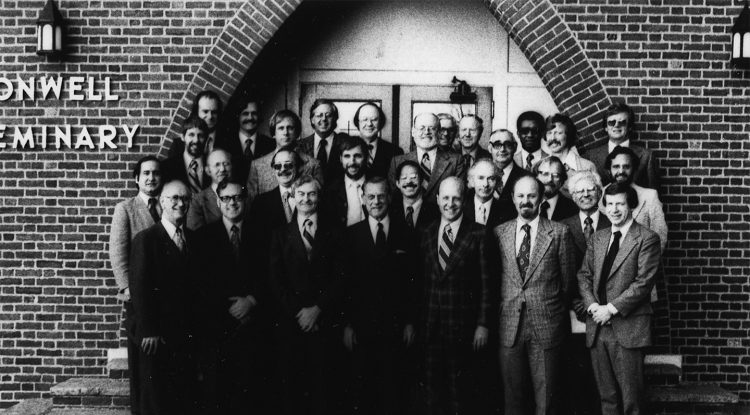
Equally odd but also perhaps revealing of Keller’s place in PCA dynamics are a number assertions and arguments that Lovelace, who was ordained as a minister in the PCUSA while teaching at Gordon-Conwell Theological Seminary, makes about evangelicalism around the time the book was written. These may reveal less about planting churches or carrying out the ministry than they do about ways of perceiving the church in the United States.

Lovelace abounds in identifying the polarities of a dynamic and then shooting for the middle, the third way, which of course is classic Keller:

Currently our denominations seem to break down into two categories: smaller, conservative separatist bodies maintaining the pure church ideal with antisceptic discipline so strong that it occasionally sterilizes their own creativity; and the large, historical descendants of earlier separations, now so indiscriminately inclusive that to Evangelicals they resemble mission fields. Evangelicals themselves, similarly, are divided into those who might be characterized as white corpuscles, members of separated churches committed to rigorous discipline, and red corpuscles, those who have tried to adapt themselves to the large, pluralistic bodies in order to feed and serve their memberships. (291-92)

Notice the biological metaphors and think the Gospel Ecosystem.

Here’s another contrast that makes the way straight for the via media:

In the early twentieth century the immense thought storm of secular humanism, made up of apparently consistent and convincing alternates to the biblical world view, burst upon the church and shattered the clarity of its thinking and hence the unity of its forces. Live orthodoxy might have weathered the storm and risen to the educational challenge humanism presented, setting out to construct a consistently biblical counter-position which would seek to integrate all the new data pouring into human consciousness. But [Evangelicalism] broke into two. Half of it emulated the ostrich, turned its back on the culture, immersed its head in the biblical world and almost became an enculturated folk religion. The other half grappled with the task of integrating modern and biblical thought but often lost its biblical moorings and slipped away into another kind of enculturalst: conformity to the secular mind. (281)

Actually, that does remind me of Schaeffer, sweeping historical claims with remarkable confidence. A sentence distills a book and a century of developments (or not). Who does that after reading at all widely in history and knowing how accidental and contingent the past was?

Where you do see in Lovelace a forerunner to Keller’s operations is this:

What about transdenominational renewal within the ecumenical movement? We have noted above that there is already a functionally Evangelical ecumenical movement. The recognition of this fact is remarkably apparent in the recent admirable decision of the Presbyterian Church of America (the product of secession from the Northern and Southern Presbyterian Churches) not to form its own Department of Missions, but rather to use the existing network of interdenominational Evangelical faith missions to disseminate its Reformed doctrinal position throughout the church. (332)

Come to think of it, with Redeemer City-to-City in mind, the blueprint for Keller’s ministry very well have been in Lovelace’s book (except that City-to-City, though interdenominational, is not OMF International, Africa Inland Mission, and Ethnos 360).

Luther on Protests (violent, verbal, or peaceful)

In light of the point derived from Luther that justice requires peace (“No Peace, No Justice“), along comes Luther’s reflections on Psalm 37 (“Fret not yourself because of evil-doers; be not envious of wrong-doers”):

The 37th psalm is a psalm of comfort that teaches and exhorts us to have patience in the world and warns us, especially, against envy. For it is vexing and painful to the ‘Weak in faith when things go so well for the godless and the opposite happens to those who fear God. It is a great spiritual virtue when-seeing the great misdeeds of the peasants, the townspeople, the nobility, the princes, and every one who has any power-one yet exerts himself not to blaspheme or inwardly wish this and that curse on them. Moreover, he still suffers and sees that all things go well for them and they remain unpunished. Indeed, they are praised and honored, while the God-fearing are miserable, despised, hated, begrudged, obstructed, vexed, and persecuted.

The message is: Learn to have endurance. Take your heart to God and do not let yourself be vexed. Do not become envious, or curse, or with evil to fall, or murmur, or look at them with hatred. Let these people go and commend them to God, who will surely find all things out. The psalm teaches this and comforts us in a variety of ways with abundant promises, with examples, with warnings. For it is a great and difficult art to manifest such patient longsuffering, when reason and all the heathen count envy as virtue. For it appears as though it were just and fair to envy and begrudge the ungodly for their wantonness, their good fortune, and their riches.

This works so many ways. It should caution those woke Christians who rush to join the ranks of all those condemning all manner of imperfection. It should also provide counsel for Christian political conservatives who think the American republic is about to sink.

Beware, of course, that if you follow such advice you may be on the receiving end of those who think you are just like the German Lutherans who did not rise up and overthrow the Nazis. If that happens, remember “No peace, no justice”:

The office of vengeance has not been given to [us]. Later he will talk about the law of the gospel, which calls us to turn the other cheek, but that is not his point here. Luther’s point here about nonviolence does not rest on a Christian account of pacifism, but rather on natural law: civil society requires that some rule while others are ruled. Even if rulers are morally unjust, subjects have no right to rebel, which is tantamount to pretending that they themselves must rule. Such a pretension violates order, or “justice” in the Platonic sense of “everyone doing his own job.” Luther puts it this way: “The fact that the rulers are wicked and unjust does not excuse disorder and rebellion, for the punishing of wickedness is not the responsibility of everyone, but of the worldly rulers who bear the sword.” Order has priority over justice.

Selah

Why Do Anglicans Get a Pass?

Anyone familiar with debates over two-kingdom theology have also encountered the argument that allegedly proves this outlook’s error — namely, that Lutherans were 2k and it led them not to offer any resistance to Nazi Germany. Case closed. But here‘s an example of that logic — more like a claim:

the charge made against Luther is not that he made theological errors that led his followers astray in their private religious lives. On the contrary, the accusation is that Luther’s beliefs and actions led to disastrous historical consequences, not only in the Germany of his time (with the Christian submission to the princes and the slaughter of the peasants), but in the Germany of the twentieth century, when Lutheran Christians failed to resist the rise of Adolf Hitler. These charges are extended to Lutheran communities in South Africa and Chile, for example, which allegedly identified themselves with an unjust status quo on the basis of their Lutheran convictions. Further, so the indictment goes, the Lutheran accommodation to the Communists in East Germany is a confirmation of Troeltsch’s judgment that Lutheranism will comply with any political establishment. It has no social ethic on which to take a stand against worldly powers.

The thing is (maybe only “a” not “the” thing) that bishops and theologians in the Anglican church, especially under Elizabeth, James I, and Charles I (roughly 1570 to 1650) went Lutherans one better. They did not commit the supposed error of separating the church from the state in a way that left minsters without a voice in politics (a prophetic one, of course). Anglican theologians actually argued for the supremacy of the crown over the church and insisted that this was God’s will as revealed both in nature and Scripture. Imagine trying to find an argument for resistance to a selfish and bloated ruler when your queen or king is not merely the head of the church (instead of Christ) but also the divinely appointed guarantee
of order and truth in church and society.

Consider the following summary of Richard Hooker’s views (he was the author of The Laws of Ecclesiastical Polity and lived between 1554 and 1600):

The political philosophy of Hooker is an integral part of his defense of the Erastian relationship of the Church of England and the Tudor monarchy. He was commissioned to supply the reasonable foundation for the existing establishment. Hooker writes from the standpoint or a conservative impelled by the exigency of the time to justify the status quo. In order to prove that the Puritan contentions were inconsistent with the political structure of England, he was obliged to examine the nature or the State and the sources of authority. He hoped to show that criticism or the Anglican Church and refusal to conform to the Elizabethan Settlement could not be rationally justified. He had concluded in Book III that the Scriptures do not require a particular form of church polity, and thus, demonstrated that the Church of England was not contrary to either the Word of God or to reason. His doctrine that resistance to authority can be vindicated only in the case of immoral law condemns the Puritan position as a denial of the fundamental nature of political obedience.

The motivation for Hooker’s conservative political theories and indeed for the philosophical and theological work as a whole, was an intrinsic fear
that a general acceptance of the doctrine of private revelation would lead to spiritual chaos and civil confusion. Hooker distrusted the extreme individualism of Puritanism, alarmed by the possibility that it might replace the corporate spirit of the English State. For the all-embracing cause of public order, Hooker was willing to submit private interpretation to public reason determined by the law of the legislature. He believed that a rational decision of a Parliament or Convocation was more likely to be in accordance with the will or God than the inspiration of a saintly individual. (pp. 19-20)

Of course, no English monarch measures up on the scales of heinousness crimes to Hitler (though most governments commit unjust actions and hurt innocent people). That is not the point. Nor is this an case of an American who takes democracy for granted taking exception to what looks like an odd form of government. Actually, The Crown portrays monarchy in a way that has this American second-guessing (even more) the powers of POTUS.

The question is why the critics of two-kingdom theology who fault it for an inability to resist tyranny (or its mistaken detection of tyranny) don’t see the much greater dangers that lurked in English bishops who sidled up to English and British monarchs. They did so not only for the sake of administering the church. They also made the case for divine-right monarchy in a way that made dissent sinful.