Another Case for the Gateway Drug

Once again comes a suggestion that neo-Calvinism in its desire for comprehensiveness paves the way for Roman Catholicism:

As it happened, the young pastor Abraham Kuyper found something to like in the “Syllabus [of Errors]” too, and said so on no less an occasion than his Reformation Day sermon in 1865! The pope went too far, Kuyper quickly assured his startled (if not outraged) congregation; the document was not to be affirmed in all its details. But its intention was correct. The rising philosophy of naturalism and ethical materialism which the pope was condemning was exactly the enemy that needed to be opposed, Kuyper said, and that opposition would mark his work in church, state, and cultural commentary across the 50+-year career upon which he was just embarking. In fact, this philosophical challenge—this rise of a cruel worldview antithetical to Christianity—is what motivated Kuyper’s turn to strict Calvinism from the more nebulous piety in which he had started out his ministry a few years before. A much older Brownson, now near the end of his career, held much the same sentiments.

If I understand the implications of James Bratt’s argument, reasoning about politics, society, economics, and education apart from first principles (read revealed truth) — one of the building blocks of modern liberalism (and secularism) — is an indication of naturalism, and the enemy of Christians. Thus the antithesis between Christianity and secularism, between 1689 (the Glorious Revolution) and 1789 (the Inglorious French Revolution), between Christian schools, labor unions, and political parties and secular schools, labor unions and political parties.

I can understand that. But if the antithesis is right and if Christians live in societies with unbelievers, on what basis are non-Christians supposed to operate in their social endeavors? If Christians alone have the true w-w, then should they allow those with false w-w’s to “run things?” Or if unbelievers do have access to positions of authority, wouldn’t they need to rely on what they know which does not include revealed truth?

Separating church and state was a long and difficult struggle for Roman Catholics. Distinguishing the differences between neo-Calvinist and theonomic arguments is also difficult. Of course, it needs to be noted that Kuyper did affirm social pluralism and found remarkable ways to include Roman Catholics in Dutch society. Still, when you start with opposition to naturalism and the antithesis between Christians and unbelievers, how you avoid winding up in theonomy or church-above-the-state (e.g. Roman Catholicism) is not at all obvious.

Now More than Ever We Need Women to Shoot!

So imagine the following scenario:

You are at a holiday office party. Conversations are flowing as swimmingly as the beverages. You notice out of the corner of your eye a person who seems to be bulkier than usual. You look over and see this person taking off a back pack and removing from it an automatic hand gun. He starts to shoot. Your wife, who is registered for “open carry,” prefers to keep her Sig Sauer P220 in her purse. She proceeds to remove her handgun and shoots the gunman just as he fires his first two rounds. Her shot does not kill but it does incapacitate the assailant. You call the police. The party breaks up but no one dies.

Consider the scenario that Harry Reeder proposes so oddly close chronologically to the shootings in Southern California:

It’s late at night. I hear the glass in the door downstairs breaking, the door opening and then footsteps. I turn to my wife and say “Honey, someone is breaking into our home downstairs and since I know you are willing, why don’t you go downstairs and see if you can overpower him? By the way if he maims you or kills you don’t worry! I have two daughters who are brave enough to follow you and risk their life to protect our home while I remain here safe.”

Reeder uses this case to argue against women in the military:

The unbelievable reality is that the men of this nation now allow politically correct elected officials in general and a President in particular (along with the elite self-appointed culture-shapers pontificating while shielded in the media and the academy) to institute policies which send our wives and daughters, not into the military to use their unique skills and abilities to enhance our armed forces, but into combat units to protect our Home(land) while they (and we) remain safely tucked away in our rooms. Forget for the moment the obvious arguments of how ignoring gender differences will inevitably force the adoption of inadequate training regimens, lowered physical and combat readiness standards, the redefining of combat protocols, inevitable sexual mayhem and a loss of combat unit efficiency which will cost lives (documented by a Marine Corp. study- more on this in Pt.2). Yes, I am aware of the claim that combat zones are now defined differently. But hand to hand combat, dragging a 200+ lb. comrade to safety, carrying 85 lb. support equipment, etc. has not and will not change.

But why couldn’t the first scenario work to argue for women in the military? If women may carry weapons for self-defense, how far removed is that from defending the homeland? And if women can defend themselves and their kin here in the United States, why not overseas (one reason is that we should not have so many troops overseas, but that’s a different question)?

But arguably the biggest question of all, why do you bring up biblical arguments against women serving in the military now when many Americans feel threatened by terrorists?

Timing is everything.

Saving the World

One light show at a time.

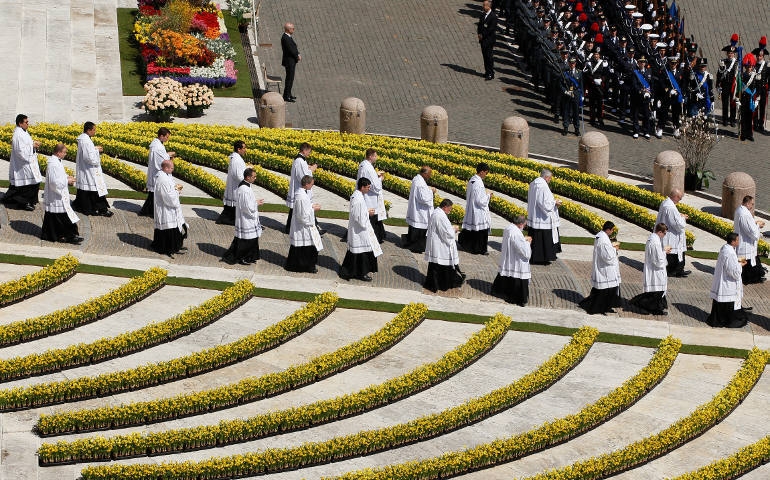
In case you missed it, the Vatican celebrated the Feast of the Immaculate Conception (yesterday) with a light show:

A mixture of fascination, curiosity and consternation is greeting a light show to be projected onto St. Peter’s basilica tomorrow — the Feast of the Immaculate Conception and the opening day of the Jubilee of Mercy.

A coalition of non-Catholic humanitarian, philanthropic and conservation groups along with the World Bank are staging the event. It will be the first time ever that images will be projected onto the 17th century basilica’s façade and Michelangelo’s cupola.

The organizers say the three hour event, called “Fiat Lux, Illuminating Our Common Home”, will tell the “visual story of the interdependency of humans and life on earth with the planet, in order to educate and inspire change around the climate crisis across generations, cultures, languages, religions and class.”

Archbishop Rino Fisichella, president of the Pontifical Council for the New Evangelization, called the event “unique” and said the illumination show “will present images inspired of Mercy, of humanity, of the natural world, and of climate changes.”

He added that the light show, whose images have been shown on various landmarks around the world, is meant to link Pope Francis’ environment encyclical Laudato Si’ with the United Nations Climate Change Conference (COP21) currently underway in Paris until Friday.

“It is our hope that this beautiful and contemporary work of public art will inspire citizens of the world to join together in a moment of compassion and to activate a global movement to protect humankind, our common home and precious endangered species,” said Carole Tomko, vice president of Vulcan, Inc., one of the groups sponsoring the event and which promotes initiatives to “change and improve the way people live, learn, do business and experience the world.”

Some conservative Roman Catholics have taken a page from Protestant iconoclasm and regard such a use of holy buildings as sacrilege:

The sense that St. Peter’s Basilica has been profaned is strong. The symbolic significance of the event is a Church immersed in darkness, but illuminated by the world, by the new climatist-religion-ideology (all financed by the World Bank Group which will now have to explain to us what politics compatible with the teaching of the Church it is promoting..)

The holy place par excellence, the heart of Christianity transformed on a maxi-screen for the show of the New World Power Ideology …and the Nativity Crib was left in darkness.

It does make you wonder what salvation means. If improving the environment can save the world, then what happened to the cross of Christ and the sacraments? Could it be that hell is empty (and will remain so) and so the church can now devote itself to more humanitarian and less heavenly causes? Did Balthasar really win at Vatican 2 as Commonweal suggests? Before Vatican 2, Rome was pretty clear where unbelievers went at death:

Any sin, for Augustine, is an unspeakable offense against God; particularly offensive was the sin of the first man who was singularly graced with an intimate “enjoyment of God” and who stood as the progenitor of the human race. His impiety in abandoning God was so great that it “merited eternal evil” in consequence of which “the whole of mankind is a ‘condemned mass’ [massa damnata]; for he who committed the first sin was punished, and along with him all the stock which had its roots in him.” According to Augustine, no one has the right to criticize that retribution as unjust, and the fact that some are released from it through the free bounty of God is ground for heartfelt thanksgiving.

The same severe doctrine of hell has been affirmed time and again in official church documents. The Fourth Lateran Council in 1215 declared that, at the end of time, “all will receive according to their deeds, good or evil, the former to their everlasting glory with Christ, the latter to perpetual punishment with the devil.” In his constitution of 1336, Benedictus Deus, Benedict XII solemnly defined that “the souls of those who die in actual mortal sin go down immediately after death into hell and suffer the pain of hell.” The Council of Florence in 1442 maintained that “not only pagans, but also Jews, heretics and schismatics” are precluded from salvation for they “will enter into eternal fire” unless they embrace the Catholic Church before their death. Similar declarations on hell and salvation were issued by the Council of Trent in the sixteenth century. Vatican I reinforced them in the nineteenth century. Vatican II did not revisit the solemn definitions of hell by earlier councils, but it did at least affirm that, yes, atheists can be saved.

But that changed when Balthasar and Kung met Barth:

Like Barth and Balthasar, Hans Küng too comes close to proposing universal salvation. And like them, he enlists the virtue of hope to support the idea. In his book Eternal Life, Küng’s critical discussion of hell begins with Jesus’s own words about hell, which, according to Küng, were figurative rather than literal: terms in the New Testament pertaining to final judgment—words like “hell,” “eternal,” ‘fire”—are to be taken as metaphors warning sinners of the delicate edge they’re dancing on. They are “meant to bring vividly before us here and now the absolute seriousness of God’s claim and the urgency of conversion in the present life,” Küng writes. No one should dismiss his or her responsibility to meet the demands of conversion, but how each of us meets them “remains a matter for God as merciful judge” in his “all-embracing final act of grace.” Like Balthasar, Küng maintains that judgment of the individual is in God’s hands; it would be “presumptuous for a person to seek to anticipate the judgement of this absolutely final authority. Neither in the one way nor in the other can we tie God’s hands or dispose of him. There is nothing to be known here, but everything to be hoped.”

Barth, Balthasar, and Küng all agonize over the question of universal salvation, which they treat not just as a theological puzzle but as a genuine mystery. Because we cannot answer the question with absolute certainty, it finally has to be left—in humility and hope—to the judgment of a loving God. This is as much of an affirmation as they dare to make.

What these three theologians show us, however, is that hope is a powerful virtue and not just a matter of wishful thinking. Hope always has its reasons, even earthly hopes. In the everyday sense of the word, a doctor’s skill is reason for his patient to hope for a cure, a worker’s good job performance a reason for her to hope for a promotion—though such hopes, subject to human limitations, can be disappointed. In the economy of salvation, however, the reason for hope is nothing less than the divine will—profoundly declared in the passion, death, and resurrection of Jesus: “For God sent the Son into the world, not to condemn the world, but that the world might be saved through him” (John 3:17). The clarity of this scriptural passage on God’s will reassures not only Christians but all mankind that our hope for salvation will be fulfilled—without exceptions.

But if U.S. parochial schools can reconsider their mission, maybe the Vatican can find it’s pre-Vatican 2 self:

“We don’t open Catholic schools to get kids into college,” Guernsey said. “We open Catholic schools to get them into heaven.”

When the Skinny Lady Sings "Silent Night" You Live In A Christian Nation

Even before I watched Senator Ben Sasse’s video about the murders in San Bernadino, I had a sense that what binds Americans together is not freedom (as Sasse argues) but Christianity. How’s that? Well, take a gander at the Netflix Christmas special and watch Miley Cyrus, with her tatted-up arms and long legs, atop a white piano, sing the worst of Christmas carols — Silent Night (lame lyrics, awful, repetitive and simple melody). When you have Hollywood stars singing and listening to the line, “Christ, the savior is bor-ooorn,” you have to wonder what Muslims see when they look at the United States.

To make the case for Christian America, you don’t need to argue as some do that even secularists adhere to Christian morals:

The other half of the population dismisses conventional expressions of Christianity but actually believes more fervently than any Falwell, albeit in attenuated form. They are Christian radicals that have taken the Christian idea of loving one’s neighbor, stripped it of every attendant belief, and elevated it to an absolute principle. Theirs is a faith of nonjudgmentalism, accepting every refugee, and always blaming oneself whenever one is attacked. Call this outlook “multiculturalism” if you like, but the only culture capable of producing it is a Christian one.

Nor do you have to mock those believers who oppose commercializing Christmas as if the secular observation of a church holiday has no religious significance:

In their militant efforts, evangelicals have not only politicized the debate, but they have appropriated a “tradition” and even a word. To say “Christmas” is to state one’s faith. Now, any use of the phrase, “Happy Holidays,” calls into question the state of one’s soul. I’m reminded of Tracy Fessenden’s work here, as I think what we are seeing is “the ability of a Protestantized conception of religion to control the meanings of both the religious and the secular.” What we are seeing is a Protestantized conception of religion to control the meanings of both “Christmas” and “Holiday.”

As if scholars who study the history of religion can’t pay some heed to the millennium old conflict between Islam and the West and not notice that to outsiders the festivities that crowd the December datebook of most Americans might seem like a lot of Christian remembrance of the birth of Christ. When Muslims observe Ramadan, do scholars chalk it up to secular celebrations of a Middle-Eastern holiday? It is hard to imagine cultural Muslims producing the kind of songs that Americans have for Christmas. What might be the Islamic equivalent for Hajj that Sleigh-Ride captures for American Christians as they prepare home decorations and bake cookies?

Just hear those sleigh bells jingle-ing
Ring ting tingle-ing too
Come on, it’s lovely weather
For a sleigh ride together with you

Outside the snow is falling
And friends are calling “Yoo Hoo”
Come on, it’s lovely weather
For a sleigh ride together with you

Giddy-yap giddy-yap giddy-yap
let’s go
Let’s look at the snow
We’re riding in a wonderland of snow

Giddy-yap giddy-yap giddy-yap it’s grand
Just holding your hand
We’re gliding along with the song
Of a wintry fairy land

Our cheeks are nice and rosy
And comfy cozy are we
We’re snuggled up together like two
Birds of a feather would be

Let’s take the road before us
And sing a chorus or two
Come on, it’s lovely weather
For a sleigh ride together with you

There’s a birthday party at the home of Farmer Gray
It’ll be the perfect ending of a perfect day
We’ll be singing the songs we love to sing without a single stop
At the fireplace while we watch the chestnuts pop
Pop! Pop! Pop!

There’s a happy feeling nothing in the world can buy
When they pass around the coffee and the pumpkin pie
It’ll nearly be like a picture print by Currier and Ives
These wonderful things are the things
We remember all through our lives

Of course, it doesn’t take an infallible bishop to know that the Christmas holidays in the United States are much less about religious devotion than they are an excuse for mirth, relaxation, and consumption. (And in an all about me moment, I am an enthusiastic supporter of mirth, relaxation, and consumption once final grades are in). But right in the middle of it all are celebrities like Miley Cyrus, or Frank Sinatra, or Elvis Presley (think all those Christmas albums) whose personal lives are far removed from communicant membership in a Christian communion, singing about the savior who saves the world from sin.

In which case, when Muslims look at the United States, they may see Christianity much more than they see freedom, or godlessness, or secularism. After all, the American soldiers who keep watch in Muslim dominated societies in the Middle East do not attend services that recite the American creed of freedom of religion, speech, and assembly, but the Christian creed of Father, Son, and Holy Ghost.

None of this amounts to anything like a basis for policy for either domestic security or foreign relations. But it does point to a longer history of which Americans are both ignorant and part. For over a millennium Europeans have been either explicitly fighting Islam or implicitly forcing Muslims to conform to a global order dominated by the West. After World War II, the United States was the last pro-Western nation standing to defend the West’s hegemony in an order that Europeans had been building ever since the Portuguese and Spanish began to chase Muslims in the Mediterranean Sea and on the continent of Africa. If Americans noticed their ties to this larger history, Miley Cyrus might be less comfortable singing “Silent Night” and U.s. legislators might frame the nation’s relationship to Islam and Islamism differently than they do.

In Defense of Neutrality

When did “neutral” become such a dirty word (along with Lutheran; is it because Lutheran’s cuss?)? It’s a perfectly fine word to use on colors such as beige, ivory, taupe, black, gray, and white. It also works when describing countries like the United States before 1917 or Switzerland to this day. It’s a word that any of us going to court hope is in play with the judge hearing our case — though fair comes close. In sports, if an umpire is wearing the colors of one of the competing teams, we would definitely wonder about his (or her) — watch out — neutrality. By the way, if your run a word search for the word at the ESV websit, you get verses that include the word, “natural.” Which makes me think that the neo-Calvinists gremlins got into Crossway’s software.

Scott Clark explains that the aversion Reformed Protestants have to “neutral” — not because they are flashy dressers — owes to the influence of Dutch (neo) Calvinism:

Anyone who is familiar with the work of Abraham Kuyper or Herman Bavinck or Cornelius Van Til knows that the idea of “neutrality” is consistently and thoroughly rejected by the framers of much of modern Dutch Reformed theology and thus, were the 2K (as people like to put it) guilty of introducing it into Reformed theology that would be a great, even fatal flaw. In this discussion, “neutrality” means “a sphere of life which is un-interpreted by God’s Word” or “an un-normed sphere of life” or “an un-interpreted sphere of life” over which the Christian or even an unbeliever would be able to say, “This is mine.” This is a truly legitimate concern. Reformed theology opposes human autonomy (self-rule). Abraham Kuyper was absolutely correct to say, “There is not one square inch of the entire creation about which Jesus Christ does not cry out, ‘This is mine! This belongs to me!’””

For proponents of the so-called 2K ethic, the question is not whether Jesus is sovereign but how. As I understand the neo-Calvinist movement (van Prinsterer, Kuyper, Bavinck, Van Til, Berkhof, et al) they all taught two complementary principles: antithesis and common grace (Gemeene Gratie). As I understand the so-called 2K model, it is an attempt to describe the way common grace functions relative to the antithesis.

So if the question is only about the ultimate day of judgment when the goats and lambs go their separate ways, then who could defend using neutral to describe persons standing before a holy God?

The problem is that with the exception of the keys of the kingdom, when pastors and elders administer God’s word and open and shut the kingdom of heaven, most us using the English language are dealing not with ultimate but proximate realities. And in this world of sports, politics, law, and interior design, neutral is a good thing.

Here’s one example, Ross Douthat (via Rod Dreher) on the problem of guns in the United States:

With 300 million guns in private hands in the United States, it’s very difficult to devise a non-intrusive, “common-sense” approach to regulating their exchange by individuals. Ultimately, you need more than background checks; you need many fewer guns in circulation, period. To their credit, many gun control supporters acknowledge this point, which is why there is a vogue for citing the Australian experience, where a sweeping and mandatory gun buyback followed a 1996 mass shooting.

The clearest evidence shows that Australia’s reform mostly reduced suicides — as the Brady law may have done — while the evidence on homicides is murkier. (In general, the evidence linking gun ownership rates to murder rates is relatively weak.) But a lower suicide rate would be a real public health achievement, even if it isn’t immediately relevant to the mass shooting debate.

Does that make “getting to Australia” a compelling long-term goal for liberalism? Maybe, but liberals need to count the cost. Absent a total cultural revolution in America, a massive gun collection effort would face significant resistance even once legislative and judicial battles had been won. The best analogue is Prohibition, which did have major public health benefits … but which came at a steep cost in terms of police powers, black markets and trampled liberties.

Does any policy on gun use and restrictions rise to the level of “neutral”? Maybe not. But neither does this issue of public safety and personal freedom achieve the ultimate heaviosity of the anti-thesis. Most matters stemming from our common life together — Augustine’s heavenly city living in the earthly city — do not have a Christian solution. So turning “neutral” into an expletive really does nothing to help pilgrims living in exile, except to tempt some to think their real home is in a low-lying delta below sea level (and I’m not talking about New Orleans).

Bringing Up the Rear

If Islam is going to develop into a religion of peace and tolerance, it doesn’t need either a Reformation or an Enlightenment, according to Daniel Philpott. Instead it needs a Vatican Council — preferable Vatican Council 2.0 since the first council was a tad militant and intolerant.

Here are the limitations of Protestantism and philosophy:

Protestant reformers enforced their orthodoxy with every bit the deadliness that Catholics employed. While England’s Queen Mary acquired the sobriquet “bloody” for her brutal restoration of Catholicism, her little sister Elizabeth was equally violent in reestablishing the Anglican Church.

The 18th century Enlightenment advanced individual religious freedom but was skeptical towards religion. The French Revolution, the Enlightenment’s political enactment, asserted the rights of man but severed the heads of men and women of faith.

Yes, lots of blood before 1800. But where’s the American exceptionalism? Where’s John Courtney Murray arguing for the Enlightenment tradition of natural law that shaped the founding of the United States? Maybe Philpott’s editor didn’t give him enough words to embrace the religious freedom that his bishops celebrate every fortnight for freedom:

Catholics must fight against forces seeking to remove the influence of religion from American culture, Archbishop William E. Lori of Baltimore told over 1,000 Catholics at a Mass beginning a 14-day campaign for religious freedom.

“In differing ways, both the Church’s teaching and our nation’s founding documents acknowledge that the Creator has endowed individuals with freedom of conscience,” said Archbishop Lori. “Such freedom goes to the heart of the dignity of the human person.”

The archbishop delivered the opening homily for the Fortnight for Freedom, the two-week period leading up to the Fourth of July that the bishops have dedicated as a time for prayer, education and advocacy for religious liberty.

That was 1776. But the real lesson of religious freedom, for Philpott, comes in 1965 (for the historically minded, notice the chronology and the Roman-centric w-w paradigm):

. . . western history contains a more promising pathway, ironically one found in the very religious body that the Reformation and the Enlightenment considered freedom’s greatest enemy: the Catholic Church.

It was in Second Vatican Council’s declaration, Dignitatis Humanae, on Dec. 7, 1965 — a date whose 50th anniversary is right around the corner — that the Church finally and authoritatively endorsed the human right to religious freedom.

While the Catholic Church’s road to religious freedom will not suit Islam in every respect, it shows how a religious community that for many centuries did not teach religious freedom could discover grounds for the principle that were rooted in its own teachings rather than in modern secularism.

Like Islam, Catholicism long predates the modern world. The period from which Dignitatis Humanae most dramatically departs is medieval Christendom, when the integrity of the Catholic faith was regarded as crucial for social order. Heresy was not merely a sin but an act of sedition.

Not the point of the post, but notice how this booster also notices what the rest of us without a dog in the fight of papal supremacy notice — namely, that Roman Catholicism changed from medieval to modern at the Second Vatican Council. Everyone sees this except for those who put their trust in ecclesiastical princes.

What is the point here, though, is how Rome is an example to Islam. Was it not the case that modern developments in Europe and North American finally forced bishops to open the church’s windows to modernity? In which case, it was not that the church embraced religious freedom on its own but “finally” — Philpott’s word — caught up to religious freedom in trails blazed by Americanists (and others). Of course, Protestantism did not usher in freedom of conscience. But Protestants did adjust much earlier than Rome. And Philpott gives Protestants no credit.

Instead, he thinks Muslims should look to Roman Catholics — who still celebrate the Battle of Lepanto.

Yup.

Journalists and their Discontents

With the Vatican prosecuting journalists for publishing leaked information, Terry Mattingly thinks the pope may have some lessons for the press.

First Pope Francis:

The free press, secular and also religious, but professional; because the press, secular or religious, must be professional. It’s important that they are truly professional, that the news isn’t manipulated. For me it’s important, because the denunciation of corruption, of injustice, is good work, because there is corruption. And then the one in charge must do something, make a judgment, a tribunal.

The professional press must tell everything, without falling into the three most common sins: misinformation, to tell one half but not the other; calumny, which is not professional – when there is no professionality, you dirty the other person, with or without truth; and defamation, to take away the good name of the person who right now hasn’t done anything wrong to anyone; maybe it’s something from the past.

These are the three defects that are an attack against the professionality of the press. We need professionality, what’s right: things are like this and this. And on corruption? To see the data well and say it: this, this and this. If there is corruption, they should say it. And if a journalist, if they are truly professional, gets it wrong, he should excuse himself. Things go very well like this.

Mattingly comments:

However, it goes without saying that – in the age of Kellerism (click here for background) – I found it interesting that the first thing the pope mentioned was the tendency for modern journalists to act, when covering many hot-button news topics, as if there is only side of a debate that is worthy of coverage, accurate coverage or coverage that shows respect. This is especially true when covering issues of moral theology linked to sexuality and marriage.

Then again, perhaps Francis simply believes that he has, at some point, been the victim of reporting that actually turns information into misinformation.

So what happened to Mattingly when reporting on the press’ coverage of David Daleiden? At that point he faulted journalists for only regarding Daleiden as a politically motivated actor and overlooking the “documentarian’s” religion:

So, basically, the impact of his Catholic faith (which has quite a bit to say, doctrinally speaking, on the sanctity of human life) on his work received the same amount of space – in terms of word count – as his hybrid car (shocking, one must assume, since he is a social conservative) and less attention than his socks.

Perhaps Daleiden is the wrong kind of Catholic?

But the key: When a reporter asks Daleiden why he does what he does, how does he answer that question? Is the Post accurate in its assumption that his primary motives are political?

Perhaps his motives are personal, the kinds of motives that would be explored in-depth in this kind of profile? That would have meant taking the contents of this phrase – “he described himself as the result of a ‘crisis pregnancy’ ” – MUCH more seriously.

But here’s the catch. Why don’t the pope’s remarks about journalists apply to Daleiden? That is how he identified himself — as a reporter and a Roman Catholic to boot — and yet he seems to be guilty of the very errors that Francis says afflict the press:

1: a misrepresentation intended to harm another’s reputation
2: the act of uttering false charges or misrepresentations maliciously calculated to harm another’s reputation

I guess we need another Jesuitical casuist to resolve this one.

In the meantime, sometimes the folks who point out the inconsistencies of journalists might take their own into account.

Have You Guys Heard of Assemblies?

Maybe not among the Eastern Orthodox bishops or the Anglican ones, but it’s not as if Protestants don’t regularly meet to find a consensus on what the Bible means. Even so, Alan Jacobs and Rod Dreher repeat the Roman Catholic charge that you need tradition to augment Scripture (when in fact tradition comes all balled up in the magisterium — read bishops).

Jacobs worries:

The elevation of method to magisterial principle was supposed to make it possible for scholars to discern, and then agree on, the meaning of biblical texts. Instead it merely uprooted them from Christian tradition and Christian practice — as Michael Legaspi has shown in a brilliant book — and left many of them unequipped to understand the literary character of biblical texts, while doing nothing to promote genuine agreement on interpretation. In fact, the transferring of the guild of interpreters from the Church to the University, given the University’s insistence on novelty in scholarship, ensured that no interpretative consensus would be forthcoming.

But if Christians are supposed to take their cues less from the university and more from churches, the latter still exist and provide interpretive consensuses. Maybe the mainstream media and scholars who identify with the academic guild are not impressed by church synods and councils (though they sure were attentive to the Ordinary Synod of Rome; maybe you need special get ups to gain journalists and scholars’ attention, or you need to meet in buildings suffused with Renaissance art — so much for poor church for the poor). But it’s not as if those assemblies even among Protestants have gone away. Given a recent reminder about the illusion of respectability, maybe the work that existing churches still do could receive more credit.

Rod makes Jacobs’ point with flair:

what Protestant churches and organizations are really doing in these debates are trying to find out if its membership wants to change, and if so, how much change will it accept. The truth is, says Beck, is that Protestantism is a “hermeneutical democracy,” in which the individual consciences of believers determine what is true and what is false. This, he says, is the “genius of the tradition,” and having to do all this “relational work” is a key part of what it means to be Protestant. The Bible doesn’t speak for itself; it has to be interpreted, and for Protestants, that means that everybody gets a vote.

“Own your Protestantism,” he says. “The ultimate authority in Protestantism isn’t the Bible, it’s the individual conscience.”

Well, it’s not as if hermeneutical democracy doesn’t afflict churches that have episcopal authoritative structures (where exegeting the Bible is not as important as reading the times’ signs). All churches, Roman Catholic, Protestant, and Orthodox are in the same boat of having members who regularly pick and choose, cafeteria style, what they believe and that they don’t. Having tradition, bishops, or councils doesn’t fix any of this. What would fix this is having magistrates who enforce religion and where civil penalties are bound up with religious teaching and practice. But wouldn’t that be Islamic?

At least give Protestants credit for trying to discern what God revealed through the prophets and apostles. Adding tradition to Scripture has generally meant the dog of tradition wagging the tail of the Bible.

Those Were The Days

Makes you wonder why some want more religion in politics or why others object to Luther’s meager efforts at reform:

On Sunday May 9, 1527, an army descending from Lombardy reached the Janiculum. The Emperor, Charles V, enraged at Pope Clement VII’s political alliance with his adversary, the King of France, Francis I, had moved an army against the capital of Christendom. That evening the sun set for the last time on the dazzling beauties of Renaissance Rome. About 20,000 men, Italians, Spaniards and Germans, among whom were the Landsknecht mercenaries, of the Lutheran faith, were preparing to launch an attack on the Eternal City. Their commander had given them license to sack the city. All night long the warning bell of Campidoglio rang out calling the Romans to arms, but it was already too late to improvise an effective defense. At dawn on the 6th of May, favoured by a thick fog, the Landsknechts launched an assault on the walls, between St. Onofrio and Santo Spirito.

The Swiss Guards lined up around the Vatican Obelisk, resolute in their vow to remain faithful unto death. The last of them sacrificed their lives at the high altar in St. Peter’s Basilica. Their resistance allowed the Pope along with some cardinals the chance of escape. Across the Passetto di Borgo, the connecting road between the Vatican and Castel Sant’Angelo, Clement VII reached the fortress, the only bastion left against the enemy. From the height of the terraces, the Pope witnessed the terrible slaughter which initiated with the massacre of those who were crowding around the gates of the Castle looking for refuge, while the sick of Santo Spirito Hospital in Sassia were massacred, pierced by spears and swords.

This unlimited license to steal and kill lasted eight days and the occupation of the city nine months. We read in a Veneto account of May 10, 1527, reported by Ludwig von Pastor “Hell is nothing in comparison with the appearance Rome currently presents” (The History of Popes, Desclée, Rome 1942m, vol. IV, 2, p.261). The religious were the main victims of the Landsknechts’ fury. Cardinals’ palaces were plundered, churches profaned, priests and monks killed or made slaves, nuns raped and sold at markets. Obscene parodies of religious ceremonies were seen, chalices for Mass were used to get drunk amidst blasphemies, Sacred Hosts were roasted in a pan and fed to animals, the tombs of saints were violated, heads of the Apostles, such as St. Andrew, were used for playing football on the streets. A donkey was dressed up in ecclesiastical robes and led to the altar of a church. The priest who refused to give it Communion was hacked to pieces. The City was outraged in its religious symbols and in its most sacred memories”. (see also André Chastel, The Sack of Rome, Einaudi, Turin, 1983; Umberto Roberto, Roma capta. The Sack of the City from the Gauls to the Landsknechts, Laterza, Bari 2012).

Clement VII, of the Medici family, had paid no attention to his predecessor, Hadrian VI’s appeal for a radical reform of the Church. Martin Luther had been spreading his heresies for ten years, but the Roman Papal States continued to be immersed in relativism and hedonism. Not all Romans though were corrupt and effeminate, as the historian Gregorovius seems to believe. Not corrupt, were the nobles Giulio Vallati, Giambattista Savelli and Pierpaolo Tebaldi who hoisted a flag with the insignia “Pro Fide et Patria” and held the last heroic stance at Ponte Sisto. and neither were the students at Capranica College, who hastened to Santo Spirito and died defending the Pope in danger.

It is to that mass slaughter, the Roman ecclesiastical Institute owes its name “Almo”. Clement VII survived and governed the Church until 1534, confronting the Anglican schism following the Lutheran one, but witnessing the sack of the City and being powerless to do anything, was for him, much harder than death itself.

On October 17, 1528, the imperial troops abandoned a city in ruins. A Spanish eyewitness gives us a terrifying picture of the City a month after the Sack: “In Rome, the capital of Christendom, not one bell is ringing, the churches are not open, Mass is not being said and there are no Sundays nor feast days. The rich merchant shops are used as horse stables, the most splendid palaces are devastated, many houses burnt, in others the doors and windows broken up and taken away, the streets transformed into dung-heaps. The stench of cadavers is horrible: men and beasts have the same burials; in churches I saw bodies gnawed at by dogs. I don’t know how else to compare this, other than to the destruction of Jerusalem. Now I recognize the justice of God, who doesn’t forget even if He arrives late. In Rome all sins were committed quite openly: sodomy, simony, idolatry, hypocrisy and deceit; thus we cannot believe that this all happened by chance; but for Divine justice”. (L. von Pastor, History of Popes, cit. p. 278).

Pope Clement VII commissioned Michelangelo to paint the Last Judgment in the Sistine Chapel, conceivably to immortalize the dramas the Church had undergone during those years. Everyone understood that it was a chastisement from Heaven. There were no lack of premonitory warnings: lightening striking the Vatican and the appearance of a hermit, Brandano da Petroio, venerated by the crowds as “Christ’s Madman”, who, on Holy Thursday 1527, while Clement VII was blessing the crowds in St. Peter’s shouted: “sodomite bastard, for your sins Rome will be destroyed. Confess and convert, for in 14 days the wrath of God will fall upon you and the City.”

The year before, at the end of August, the Christian army had been defeated by the Ottomans on the field of Mohacs. The Hungarian King, Louis II Jagiellon died in battle and Suleiman the Magnificent’s army occupied Buda. The Islamic wave in Europe seemed unstoppable.

Yet, the hour of chastisement was, as always, the hour of mercy. The men of the Church understood how foolishly they had followed the allurements of pleasures and power. After the terrible Sack, life changed profoundly. The pleasure-seeking Rome of the Renaissance turned into the austere and penitent Rome of the Counter-Reformation.

Shrugs only go so far.

Inconsistency, Hypocrisy, and Clueless

Unless the Obedience Boys have figured out a way to make Wesleyan perfectionism a reality, all Christians struggle with the Lutheran paradox of being simultaneously a saint and a sinner (sorry to those professors of Christianity who need Vatican validation for sainthood). That paradox means that all Christians in their honest moments admit to struggling with and yield to sin. Which makes Christians inconsistent at least to outsiders. How can these people, the lament goes, who constantly prattle on about the moral law not see that they are immoral themselves? There’s a point in that somewhere, just as there is in stories about the guhzillions of pounds of CO2 that participants in the Climate Change Convention produced. But the impossibility of perfection in this life does not prevent either pastors or legislators from calling people to follow God’s law any more than the reality of political corruption prevents voters from voting for “good” candidates.

A measure of hypocrisy is part and parcel of the Christian life. Christians may be overly afflicted with temptations to promote sanctity all the while knowing that sanctification is a battle in which the believer always comes up short in a glass-completely-full-kind-of way.

But to go out of your way to oppose sinfulness in others while you yourself know you are guilty of the very sinfulness to which you object seems to be in a different category. 2k has regularly received opposition from those who think it leads to antinomianism, a disregard for God’s moral law. The reason runs something like this: if you can follow God’s law on Sunday but don’t need to the rest of the week, or if you strive to be holy as a Christian but not as a plumber, then you undermine the authority of God’s law in all areas of life.

But what happens if you are making that case against 2k at the very same time that you are knowingly violating God’s law? Is that hypocrisy? Or is it some other kind of disorder?

If, for instance, I were in the process of embezzling funds from an organization because finances on the home front were tight, wouldn’t it be foolish (aside from hypocritical) to become a champion of upholding the eighth commandment? Sure, I might still think others are sinful to steal, and if I’m an embezzling church officer I might would still vote to convict someone brought up on charges for stealing. But would I go out of my way in a public manner to identify stealing as a great form of wickedness? Would I write a series of blogposts about a sin I believe is responsible for destroying the church’s witness all the while I am guilty of that sin? Mightn’t I want instead to lay low? Wouldn’t I at least know that now — during this time of personal financial crisis — is not the occasion to stand atop the moral soapbox and point the finger?

We have a word for hypocrisy. What is the word for such lack of self-awareness? Clueless?