Looking More and More Like Paul Wrote Romans around 1971 (A.D.)

On the way to church yesterday, I was listening to the latest episode of Mars Hill Audio and I swear I heard Ken Myers complain that modern thinkers do not consider human nature in the light of the incarnation and the resurrection. That would imply an understanding of human nature without sin since Jesus lived a perfect life and since believers who go to heaven will live lives in which it is impossible to sin. If the desire is to call people to live virtuous lives and leave behind the viciousness and debauchery that characterizes modern America, the appeal to something higher is understandable. But it also needs to be plausible. And that means taking sin and unbelief into account when thinking about personal and civic virtue. How much “goodness” is truly possible in a world distorted by sin?

And then at church we read an excerpt from Paul’s epistle to the Romans which made me think he must have been writing at a time when he was observing How (or Why) Liberalism Failed (even though the secular liberals at Columbia University set the date for the epistle around 57 AD):

For although they knew God, they did not honor him as God or give thanks to him, but they became futile in their thinking, and their foolish hearts were darkened. Claiming to be wise, they became fools, and exchanged the glory of the immortal God for images resembling mortal man and birds and animals and creeping things.

Therefore God gave them up in the lusts of their hearts to impurity, to the dishonoring of their bodies among themselves, because they exchanged the truth about God for a lie and worshiped and served the creature rather than the Creator, who is blessed forever! Amen.

For this reason God gave them up to dishonorable passions. For their women exchanged natural relations for those that are contrary to nature; and the men likewise gave up natural relations with women and were consumed with passion for one another, men committing shameless acts with men and receiving in themselves the due penalty for their error.

And since they did not see fit to acknowledge God, God gave them up to a debased mind to do what ought not to be done. They were filled with all manner of unrighteousness, evil, covetousness, malice. They are full of envy, murder, strife, deceit, maliciousness. They are gossips, slanderers, haters of God, insolent, haughty, boastful, inventors of evil, disobedient to parents, foolish, faithless, heartless, ruthless. Though they know God’s righteous decree that those who practice such things deserve to die, they not only do them but give approval to those who practice them. (Romans 1:20-32)

Is that a description of Times Square circa 1970 or of Trump’s America? Well, if Columbia University is correct, Paul was actually depicting the society of first-century Mediterranean world. And if Paul was writing about his own time, not the United States with its defective Lockean political theory, then maybe the problems we twenty-first-century Americans face are not the product of bad political theory but of bad people who live at all times.

Notice too, how Paul goes on in that epistle to advise about the remedy for such a sorry state. Is it to have a church that becomes a civilizing force among barbarian tribes? Is it more governmental programs that make two-parent families plausible? Is it reading Aliadair MacIntyre and Charles Taylor on the problems of secular modernity? No. All of these remedies might help to lessen the blows of our fallen estate. But the only solution is — wait for it — justification by faith (chs 4-6) and preachers who will proclaim the good news (ch 10). He doesn’t even invoke the Virgin Mary for help.

But what about politics? Paul even addressed that. Honor the emperor, you know, the one who was not very virtuous and didn’t seem all that interested in rolling back modernity.

Where Taking a Knee and Taking a Life Differ

Reporters and academics appealing to the Bible – have we gone back to Christian America? To see arguments over the Bible’s meaning that implicitly accept its authority is mildly amusing if only because the whole endeavor is so patently selective. Do reporters ever write stories about the Fourth Commandment and Christians playing in the NFL? They might if it turned out the chaplains running devotionals for football teams were part of President Trump’s team of religious advisers.

Anyway, the recent kerfuffle over Romans 13, political authority, and immigrants was another window into the weird world of Donald Trump. At Slate, Ruth Graham wrote about Jeff Session’s invocation of Romans 13 to explain law enforcement — as in, “I would cite you to the Apostle Paul and his clear and wise command in Romans 13, to obey the laws of the government because God has ordained the government for his purposes.” Of course, she threw in for bad measure opposition to the American founding (from John MacArthur), defense of slavery, and submission to Hitler as further examples of Romans 13 interpretation. She does not consider that pitchers batting in the National League, submitting tax forms by April 15, or using physicians licensed by the state as other instances of honoring civil government and the rule of law.

Still, the stunner in the piece was the idea that martyrdom only made sense if Christians refused to honor and obey the law:

Romans 13 goes on to command the early church to “Give to everyone what you owe them: If you owe taxes, pay taxes; if revenue, then revenue; if respect, then respect; if honor, then honor.” Arbo pointed out the importance of the clause about giving what is owed, which allows for the possibility that some authorities are not owed honor and respect. “If Sessions’ interpretation of Romans 13 were followed, it would render martyrdom meaningless,” he said. “If the Christian were always in every instance to honor the authority’s command then as a result there would never be an instance of dying for allegiance to Jesus Christ.”

I understand that part of what makes martyrdom possible is refusing to obey the law. A Christian may not disobey God to submit to Caesar, though the rationale for disobedience may not be as straightforward as the civil disobedient thing.

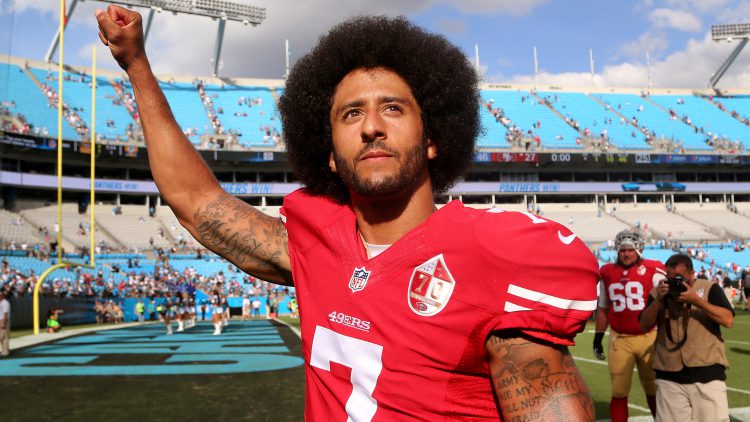
Still, the kicker is that martyrdom also makes no sense unless the state has the authority to execute those who disobey and uses it. You may refuse to bow before the emperor’s statue and the authorities decide not to prosecute you. If the United States required standing for the National Anthem, Colin Kaepernick would have been guilty of breaking the law. But for him to become a martyr, the state needs to use its bearing-the-sword authority to execute law breakers. Also required is that Kaepernick submit to death, another way that someone may honor the state and submit to law. Defiance does not simply make someone a martyr. Running away from executioners . . . . well, you get the point.

So as much as the administration’s opponents might like to think that this government is dishonorable, they need to see that only if the executive branch has legitimate power and uses it will those who defy it become martyrs.

Look Ma, No Anthropology

Maybe it was Rod Dreher, but orthodox anthropology is supposed to be key to understanding the West’s contemporary ills. If you do a search for Dreher and anthropology (a word invoked often in recent reading material) you come to this:

Every educational model presupposes an anthropology: an idea of what a human being is. In general, the mainstream model is geared toward equipping students to succeed in the workforce, to provide a pleasant, secure life for themselves and their future families, and ideally, to fulfill their personal goals—whatever those goals might be. The standard Christian educational model today takes this model and adds religion classes and prayer services.

But from a traditional Christian perspective, the model is based on a flawed anthropology. In traditional Christianity, the ultimate goal is to love and serve God with all one’s heart, soul, and mind, to achieve unity with Him in eternity. To prepare for eternal life, we must join ourselves to Christ and strive to live in harmony with the divine will.

I’m not sure I see the fall in that description of Christian anthropology.

Patrick Deneen’s new book, Why Liberalism Failed, is also based on the idea that liberty in the West stems from a flawed anthropology:

First-wave liberals are today represented by “conservatives,” who stress the need for scientific and economic mastery of nature but stop short of extending this project to human nature. They support nearly any utilitarian use of the world for economic ends but oppose most forms of biotechnological “enhancement.” Second-wave liberals increasingly approve nearly any technical means of liberating humans from the biological nature of our own bodies. Today’s political debates occur largely and almost exclusively between these two varietes of liberals. Neither side confronts the fundamentally alternative understanding of human nature and the human relationship to nature defended by the preliberal tradition.

Liberalism is thus not merely, as is often portrayed, a narrowly political project of constitutional government and juridical defense of rights. Rather, it seeks to transform all of human life and the world. (36-37)

Deneen assumes that the ancients (pagan) and Christians were on the same page, anthropologically speaking, and that Locke and Hobbes broke with that older view of human nature. But that seems like a debating technique where you hope your opponent doesn’t look too closely at Aristotle and Paul.

For that reason, Damon Linker’s recent post on the deficiencies of liberalism came as a breath of fresh air. No anthropology, just politics:

Classical liberalism is the cluster of ideas devised by a series of political philosophers who wrote between the 17th and 19th centuries: John Locke, Adam Smith, James Madison, and John Stuart Mill, among others. Against defenders of absolute monarchy and the mercantilist economic order of the early modern period, these writers advocated a minimal, nightwatchman state founded on the consent of the governed and an economy of free trade based on private contracts freely entered into by equal individuals. This political and economic arrangement would valorize and protect individual freedom, foster a burgeoning and peaceful civil society, produce massive increases in wealth, and encourage revolutionary scientific and technological advances.

That was the theory.

In the reality of U.S. history, classical liberalism had two moments of special prominence: the era in which the federal Constitution was adopted and the subsequent early national period, and then in the decades following the Civil War. The latter period was especially significant, because it was a time of economic “takeoff” in which lightly regulated industries grew enormously, contributing to a significant leap in economic growth along with a surge in wages for many.

Linker goes on to argue that classical liberalism isn’t sufficient to address the inequalities (he calls them tyrannies) that free markets produce:

If you’re standing against a tyrannical and unjust government, classical liberalism can be a fabulously potent force for fighting it. But when confronting the myriad tyrannies and injustices promulgated by private power, it counsels only complacency and resignation. “That’s life; suck it up” — in previous, far more inegalitarian centuries, such a lesson might have been acceptable. In the modern world, it simply isn’t.

I get it. I don’t like Microsoft for all the updates forced on me and robbing me of Classic Hearts. I’m not wild about the challenges of Comcast’s customer service. But are these really tyrannies or nuisances?

Having to use a men’s bathroom is another matter.

He Really Went There?

Casey Chalk, formerly a regular contributor to Called to Communion, is increasingly at home writing for The American Conservative. His latest is a case for deporting John Oliver. Chalk tries to distinguish good from bad criticism of the U.S. by ferners internationals:

The reason Hitchens, Scruton, and others like them are effective is because they are indefatigably modest, restrained, and courteous. If they did nothing but scold, they would quickly become tiresome. And when they do criticize, they do so with charity and respect for a country not their own. I was under the impression these were traits that Brits prided themselves as possessing. Not so for Mr. Oliver. His program is filled with caustic insults directed at a panoply of American individuals and institutions. His coverage of the 2016 presidential election was particularly scornful of the American political process. The content is also typically boorish—of all the episodes seen, narry one misses an opportunity to make a joke about sex with animals. Are such things suddenly funny if offered with an English accent?

Since arguments that Roman Catholics did not make for the best citizens or residents of the U.S., I was surprised to see Chalk list Oliver’s anti-Catholicism as a reason for sending him home:

His vitriol against the Catholic Church—still the largest religious institution in the United States—is especially antagonistic: Oliver has suggested that Pope Francis’s opposition to gay marriage demonstrates that the pontiff has “lost touch with reality.” He’s labeled the Church a “vast criminal enterprise,” and sarcastically accused it of “victories for humanity” like the Crusades, forced adoptions, and an “international pedophile exchange program.”

Once the objects of discrimination, Roman Catholics might want to avoid returning the favor.

But the coup de grace was Chalk’s appeal to Patrick Deneen, whose book, Why Liberalism Failed, has become the equivalent to Francis Schaeffer’s How Should We Then Live? for traditionalist conservatives. Instead of conceding as Deneen does that thanks to liberalism, western societies have no core identity, Chalk rejects Oliver as someone who undermines American traditions (in ways similar to Protestant anti-Catholicism):

The America of Oliver and his audience is not one of interdependent communities and time-proven customs, but of “increasingly separate, autonomous, nonrelational selves replete with rights and defined by our liberty, but insecure, powerless, afraid, and alone.” This is perhaps no surprise, given that Oliver broadcasts from New York City, the epicenter of technocratic snobbery and what Charles Murray calls “superzips,” or zip codes with tremendous concentrations of people with high educational attainment and income.

As Deneen observes, “much of what today passes for culture—with or without the adjective ‘popular’—consists of mocking sarcasm and irony.” This is certainly the case with Oliver, who snidely labels many Americans bigoted and backward and pursues a policy of damnatio memoriae that condemns any American tradition that fails to correlate with his anemic, progressivist vision for our nation’s future. Yet as much as Oliver has shone his spotlight on many targets worthy of reproach (e.g. Infowars, unverified scientific studies, multi-level marketing), his larger, self-referential project undermines core elements of American identity, ones we should be most wary of losing in this time of socio-cultural distemper.

To recap:

Chalk thinks that outsiders should be careful in their criticisms of the U.S. unless they go too far and show disloyalty. Protestants accused Roman Catholics of disloyalty by virtue of their obedience to a foreign prince.

Chalk appeals to Deneen to defend American customs and identity. Deneen thinks such coherence and stability is a sham after Hobbes and Locke.

Maybe it’s time for Mr. Chalk to write for Bryan and the Jasons again.

Machen, Golden State, and Social Justice

What binds these three items together? Warrior, as in Machen’s Warrior Children, Golden State Warriors, and Social Justice Warriors.

The average American (unless you are LeBron James) thinks positively of the NBA franchise. If that American is under 30, she likely adds Social Justice to Golden State since both are very popular.

Your average Presbyterian in one of the NAPARC communions, you might think, would add Machen happily to the Golden State Warriors since J. Gresham Machen was arguably the greatest defender of historic Presbyterianism during the twentieth century. And if you are a conservative Presbyterian under 30 you might also want to add Social Justice to Machen and the Golden State team because Social Justice and Golden State are very popular.

But what does the PCA do? It embraces Social Justice and disdains Machen — Golden State is probably agreeable.

Consider that two of the more prominent figures in the PCA during the last twenty years are John Frame, who coined the phrase, “Machen’s Warrior Children,” and Tim Keller. Almost everyone knows Frame’s opposition to Machen’s spiritual offspring. Keller less so. Here is part of his take on twentieth-century conservative Presbyterianism:

A more normal result of church splits is the pruning off of branches in a way that both wounds and yet, ironically, does not last. Something of this pattern, I think, can be seen in the history of the Orthodox Presbyterian Church. Early in its history, after the death of J. Gresham Machen, the OPC went through a split in which its New Side/New School branch left, led by J.Oliver Buswell of Wheaton College and Carl T. McIntire. But, no surprise, by the 1970s the OPC had grown a new ‘pietist/revivalist’ wing under the influence of Jack Miller. The New Life Churches and their Sonship course was classic revivalism, and it did not fit well with the more doctrinalist cast of the OPC. While not a formal split, like that of 1937, the New Life churches were made to feel unwelcome and nearly all left in the early 90s to swell the pietist ranks of the PCA.

Whenever a Reformed church purifies itself by purging itself of one of its impulses, it finds that within a generation or two, its younger leaders are starting to at look in a friendly way toward the lost parts.

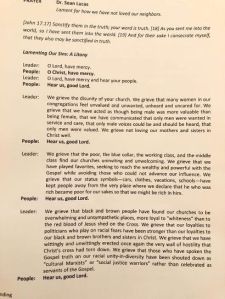
With that kind of suspicion about Machen’s Warriors, the liturgy at the PCA’s General Assembly this week was notable:

Notice that last line, the contrast between social justice warriors and servants of the gospel.  The idea that social justice is an extension of critical race theory was one that the curmudgeon, Bill Smith, proposed. Curiously enough, Sean Lucas accused Bill Smith of the genetic fallacy.

And that raises a question of whether Pastor Lucas himself has committed the liturgical fallacy. Does simply praying that Social Justice Warriors need to be celebrated as “servants of the gospel” measure up to the rigors of logic? Simply praying it doesn’t make it so.

But it does seem safe to say that Bill Smith is in Sean Lucas’ head.

Nothing Could Possibly Go Wrong

Not only is the magisterium’s teaching infallible, but a Roman Catholic’s salvation is never in doubt:

neither the Catholic or Orthodox speakers accepted the term ‘nominal Christian’. People from a Catholic or Orthodox background do not think about people in this category; it is a very Protestant way of thinking. Because of their sacramental theology, when you are baptized as a Catholic you are Christian from that point on, no matter what. You can be a naughty Catholic or a lapsed Catholic but you are still truly Catholic. Meanwhile, most Protestants believe that you are saved by faith alone and not through a sacramental process, so it is possible for Protestants to call themselves Christian and be baptized—but to have never trusted Jesus as their Lord and therefore be Christian in name alone.

Then why would Jesus explain the parable of the sower this way:

18 “Hear then the parable of the sower: 19 When anyone hears the word of the kingdom and does not understand it, the evil one comes and snatches away what has been sown in his heart. This is what was sown along the path. 20 As for what was sown on rocky ground, this is the one who hears the word and immediately receives it with joy, 21 yet he has no root in himself, but endures for a while, and when tribulation or persecution arises on account of the word, immediately he falls away. 22 As for what was sown among thorns, this is the one who hears the word, but the cares of the world and the deceitfulness of riches choke the word, and it proves unfruitful. 23 As for what was sown on good soil, this is the one who hears the word and understands it. He indeed bears fruit and yields, in one case va hundredfold, in another sixty, and in another thirty.” (Matt 13)

In other words, the seed’s effectiveness is not automatic. Mark Gilbert might claim that baptism is different from preaching and that sacraments always trump the word. If so, that’s odd because — well — Paul:

10 For with the heart one believes and is justified, and with the mouth one confesses and is saved. 11 For the Scripture says, “Everyone who believes in him will not be put to shame.” 12 For there is no distinction between Jew and Greek; for the same Lord is Lord of all, bestowing his riches on all who call on him. 13 For “everyone who calls on the name of the Lord will be saved.”

14 How then will they call on him in whom they have not believed? And how are they to believe in him of whom they have never heard?3 And how are they to hear without someone preaching? 15 And how are they to preach unless they are sent? As it is written, w“How beautiful are the feet of those who preach the good news!”

If Roman Catholics want to maintain the view of baptism that Gilbert maintains, it sure would help them if Paul wasn’t so logocentric.

Which Social Cause Is Right for Your Congregation (and Denomination)?

Forbes magazine has several tips for businesses to find the proper outlet for their social activism that may also be instructive for churches wanting to enter the social justice field.

1. Look in the mirror. When it comes to defining your social mission, start with your business mission. Increasingly, we find it helpful when these two are aligned from the start – even if your company makes widgets. Strategic leaders recognize that giving back can be baked right into your corporate DNA, such as with equity pledges, where companies offer a small percentage of their equity to nonprofits. Regardless of your organization’s structure, your business mission will help inform the most aligned direction to harness your corporate energies and offer the best opportunities for pro bono volunteering and other engagement.

2. Go on a listening tour. As you consider your mission and values, it’s important to get your employees involved so that they feel “heard.” Surveys are a common tool to cull employee interests around causes, including where many of them may already be volunteering and giving. Sure, you won’t be able to prioritize every cause, but you may be able to find patterns of common interests, which will help when it comes to increasing volunteer participation if you decide to pursue these causes. And even with the many causes that you don’t elevate to the corporate level, a volunteer platform will empower employees to pursue many different interests as a part of their volunteer work.

3. Do your research. When it comes to selecting specific nonprofits to ally with or support, tools like Charity Navigator provide insight into organizational history, financial health, accountability and transparency. Make sure that you do your due diligence in assessing how your company can make the biggest impact at the most minimal cost.

4. Get help. Experts in the field can serve as invaluable translators helping companies and nonprofits speak the same language, align expectations and goals and establish relationships destined for success. Guidance from a trusted expert in the nonprofit world can help steer your company to the cause area and nonprofit that is the best possible match.

Since confessional churches rely on word and sacrament, perhaps activism related to literacy, wheat farms, and grape growing is the best fit. Here‘s a story about wine cellar workers at Woodbridge who want to join the Teamsters. Perhaps your diaconate could help.

Also, the National Association of Wheat Growers has several items on its list of policies that might guide a session or diaconate’s thoughts about social justice.

Too bad, though, that cellar workers and wheat growers are not high on the list of causes that motivate millennials. The top five are:

Civil rights/racial discrimination 29%
Employment (job creation) (tie) 26%
Healthcare reform (tie) 26%
Climate change 21%
Immigration 19%
Education (K-12) 17%

The runners up:

Respondents also sited wages (15%), environment (14%), college/post-secondary education (13%), poverty and homelessness (13%), mental health and social services (12%), criminal justice reform (11%), women’s rights (10%), women’s health and reproductive issues (9%), early education (8%), sexual orientation-based rights (8%), and literacy (4%) as issues they care about.

That’s a boat load of activity for any single congregation. Even a denominational agency, like the Committee on Social Justice, would have a hard time meeting at most three times a year to give due attention and resources to all of these matters.

The encouraging news, though, is that millennials have a fairly low bar for what constitutes social activism:

Researchers also asked respondents what types of actions they take on behalf of the causes important to them. Voting topped the list, in order or priority, followed by signing a petition, no action, posting on social media, and changing purchase of products and services. Voting, researchers surmised, is seen as a vital form of activism; the survey found that nearly two-thirds (65 percent) of respondents said they had voted in the 2016 presidential election.

So, if your officers are voting, Tweeting, and posting on Facebook, they already have a social-justice ministry.

Isn’t This Like a Constitutional Amendment in Favor of Fast Food?

John Fea objects to the American Bible Society’s “Affirmation of Biblical Community” as a break with the institution’s past and an attempt to signal an evangelical brand (yuck):

There is nothing unusual with a religious organization making employees sign a statement of faith or requiring them to practice certain behavior that fits with the teachings of historic Christianity. Christian ministries and colleges, for example, do this as a matter of course.

But the fact that the ABS has decided to adopt such a statement after functioning for 202 years without one does make this development noteworthy. As the author of perhaps the only scholarly history of this storied Christian organization, I can attest that the “Affirmation of Biblical Community” represents a definitive break with the vision of its founders.

It also represents the culmination of a roughly 20-year transformation of the Society from a diverse Christian organization to a ministry with strong ties to American evangelicalism.

Fea is gaining a following, even to the point that Ruth McCambridge calls this a “hi-jacking”:

Here are some of the potentially break-worthy aspects of the Affirmation as reported at Christianity Today:

“I believe the Bible is inspired by God, an open invitation to all people, and, for me, provides authoritative guidance for my faith and conduct.”

“I will seek spiritual maturity through regular Bible engagement…”

“I will seek to refrain from sexual activity outside of the marriage covenant prescribed and exemplified in the Bible.”

If Fea’s point is that ABS never codified its doctrines or morals, he has a technical point. But do technicalities add up to a “break” or “hi-jacking?” Americans love fast-food but don’t have a national affirmation in favor of double-cheeseburgers. If someone in Congress proposed an amendment to affirm McDonalds and Whataburger, would it constitute a break with American norms, or an unusual step in merging the nation’s politics and tastebuds?

Still, the way Fea and others comment on the Affirmation is to suggest the folks at ABS were indifferent to morality and doctrine, or that the Bible Society was never truly in the evangelical camp. I don’t like to do this but I did learn from John Fea that ABS was part of a 19th-century push by evangelical Protestants to form voluntary parachurch agencies and change the world. In his history of ABS, he writes:

At the start of the Civil War, close to half of the population of the United States were evangelical Christians, and most of these evangelicals were sympathetic to the work of benevolent societies. . . . Between 1789 and 1829 the nation’s thirteen largest benevolent socieites — most of them unaffiliated with a specific denomination — spent more than $2.8 million to promote a more Christian and moral nation. . . . Lyman Beecher, perhaps the most vocal champion of a Christian nation and a founder of the ABS, believed that such interdenominational society should supplement the churches as a “sort of disciplined moral militia.” (51-52)

Is it just I or does that sound like Beecher could well affirm the ABS’s recent Affirmation (and might even add a few more items like drinking, smoking, movies, novels, Sabbath desecration)?

Indeed, one of Beecher’s colleagues in founding ABS, Elias Boudinot, was according to Tommie Kidd “the most evangelical founding father” and no slouch in the moralizing business. Here is how Kidd described Boudinot:

Boudinot was a member and president of the Continental Congress, a member of the U.S. House of Representatives, and the director of the U.S. Mint from 1795 to 1805. Boudinot became increasingly alarmed about the rise of Deism and the attacks on traditional Christianity by Thomas Paine and others. He helped found the American Bible Society in 1816, and became the president of the American Society for Evangelizing the Jews in 1820 (John Quincy Adams was a vice president of this organization). Boudinot wrote Christian treatises such as The Age of Revelation and The Second Advent, which used prophecies from the Bible to argue that America risked losing the blessings of God if it continued to pursue faithlessness and worldliness.

Kidd then included an excerpt from Boudinot’s book, The Second Advent:

But has not America greatly departed from her original principles, and left her first love? Has she not also many amongst her chief citizens, of every party, who have forsaken the God of their fathers, and to whom the spirit may justly be supposed to say, “ye hold doctrines which I hate, repent, or else I will come unto you quickly, and will fight against you with the sword of my mouth.”

America has been greatly favoured by God, in all her concerns, both civil and religious, and she has much to hope, and much to fear, according as she shall attentively improve her relative situation among the nations of the earth, for the glory of God, and the protection of his people—She has been raised up in the course of divine Providence, at a very important crisis, and for no very inconsiderable purposes. She stands on a pinnacle—She cannot act a trifling or undecided part—She must determine whom she will serve, God or mammon—She stands by faith, and has great reason to take heed lest she should fall, from a vain confidence in her own internal strength, forgetting “the rock from whence she has been hewed, and the hole of the pit, from whence she has been digged.” …

Hearken then, ye who are happily delivered from many of the evils and temptations to which the European nations are exposed. Your fathers fled from persecution: a glorious country was opened to them by the liberal hand of a kind Providence;—a land, literally, flowing with milk and honey;—they were miraculously delivered from the savages of the desert;—they were fed and nourished in a way they scarcely knew how. Alas! what have been the returns, their descendants, of late years, have made for the exuberant goodness of God to them? The eastern states, however greatly fallen from their former Christian professions, were settled by a people really fearing God. “Remember therefore from whence thou art fallen, and repent, and do thy first works, or else I will come unto thee quickly and will remove thy candlestick out of its place, except thou repent,” that is, will deprive thee of those Gospel privileges with which thou hast been so greatly favoured.

Again, Boudinot sounds like the sort of fellow who would likely add to ABS’ recent enumeration of biblical convictions. Kidd adds, “Whatever you might think of Christians today who say we need to bring America ‘back to God,’ it is a concern that evangelicals like Boudinot were expressing from the beginning of the nation.”

So just how much is Affirmation of Biblical Community a “definitive break” with the founders of ABS? Fea could well be right that compared to later developments in the Society’s history, when it became more mainline and even “liberal” Protestant, the current statement is a “hi-jacking.” But not with ABS founders who may not have supported Donald Trump but would be as obnoxious now about marriage, sex, family life, and public morality as they were then.

Reformed or Simply American Middle-Class?

The Gospel Allies would have us believe (in their It’s Always Sunny in Philadelphia way) that Andy Crouch is channeling Reformed teaching on culture:

Crouch had read “social constructionist” figures like Peter Berger, but “it wasn’t until I started reading Reformed writers that I found really careful theological work that correlated well with cultural sociology. I’ve certainly been influenced by other streams to some extent—Anabaptists like Yoder and Hauerwas and Ellul (who was technically Reformed but temperamentally more Anabaptist, I’d say), as well as Catholic social teaching—but the truth is that among Protestants especially, the Reformed community has nurtured the most careful thinking about the breadth of human cultural activity.”

In 2008, Crouch released Culture Making: Recovering Our Creative Calling, which argues that Christians can best affect culture not by withdrawing from it, but by making more of it.

His Reformed bent was immediately apparent.

“Andy Crouch makes the case for cultural discipleship by giving us an exciting overview of the drama of creation, fallenness, and renewal,” Fuller Theological Seminary president emeritus Richard Mouw wrote. Tim Keller wrote that it was “one of the few books taking the discussion about Christianity and culture to a new level,” while LifeWay Christian Resources publisher and TGC blogger Trevin Wax called it “a landmark work that will create a new culture of its own within evangelicalism.”

Here’s a different reading:

To be sure, the advantage of this approach, and the astute recommendation that evangelical Protestants need to develop postures of cultivation and creation in cultural endeavors is its recognition that human beings cannot escape culture (the fundamentalist temptation) and that simply imitating culture (the Jesus Rock temptation) is inferior to creative expressions of worth. In fact, Crouch even ups the ante for his fellow evangelicals when he turns from culture-making as basic to human identity to culture-making as a biblical duty.

In the second section of the book, Crouch decides to take a relatively quick tour of the history of salvation recounted in the Old and New Testaments. Not surprisingly, in a book devoted to not simply the legitimacy but also the necessity of culture, Crouch sees cultural life writ large throughout the pages of holy writ. This strategy can become tedious. Creation in Genesis 1 is culture. Adam and Eve were given the task of creating culture, specifically, agriculture. As a nation, Israel was political culture, while its cultural insights in the religious sphere replaced henotheism with monotheism. Jesus was a cultural figure in his training and work as a carpenter. He died on a cross, a cultural instrument of torture. The apostles took the message of Christianity to cities, arenas of great cultural significance. Pentecost overturned Jewish culture and gave Christianity’s blessing to cultural diversity. Finally, the new heavens and new earth in the last book of the Bible reassert the import of the city and cultural life. According to Crouch, culture is “the furniture of heaven.” [170] He adds, “human beings, in God’s original intention and in their redemptive destination, cannot be separated from the cultural goods they create and cultivate at their best.” [170]

As inspiring as such a cultural reading of the Bible may be for evangelicals like Crouch, it loses some of its loftiness when in the next paragraph the author adds a few of his favorite things, such as fish tacos, the iPod, and Moby Dick. The impression Crouch creates is that without a biblical justification, evangelical Protestants would be powerless to recognize the value of cultural activities. It is as if being human is not good enough for cultural life; so culture needs the lift of redemption and the approval of God to lose either its worldly reputation or become the object of devotion. Indeed, confusion about the relationship between creation and salvation haunts Crouch’s argument. The muddle might have been avoided had Crouch interacted carefully with Christian teaching (whether Protestant or Roman Catholic but especially Augustinian) on the relationship between nature and grace. As it stands, Crouch interacts with Niebuhr’s Christ and Culture not to discover analytic categories for reflecting on the relationship between cult and culture but mainly to find Niebuhr’s implicit endorsement of cultural transformation deficient for the aim of evangelical cultural engagement.

The reason for Niebuhr’s deficiency becomes clear in the third and final section of the book where Crouch provides a number of worthwhile insights into the work of culture engagement. To avoid the culture-war propensity, Crouch steers clear of the word transformation, preferring “culture making” to “changing the culture.” Here he addresses topics such as unintended consequences, economies of scale, power, wealth, and consumption. These cautions are intended to direct evangelicals away from imposition or conquest. Instead, he recommends that their cultural posture be one of introducing the fundamental realities of human beings as culture makers wherever they go. He offers the example of the Charlotte Douglas International Airport. There travelers may find a high modern oasis of an atrium with rocking chairs across from a food court. As opposed to the dehumanization of air travel, this space introduces smiles and relaxed conversations “where good news whispers just a bit more audibly.” [215] Crouch believes that this human touch is at the heart of culture and is needed in exurbs, cities, and suburbs. It is also at the heart of being Christian because “our calling is to join [God] in what he is already doing—to make visible what, in exodus and resurrection, he has already done.” [216]

Examples such as Crouch’s reflections on Charlotte’s airport and omelets leave the impression that the new evangelical cultural engagement is no thicker than baby boomers’ parents’ ideal of a cultural remnant preserving the faith once delivered. To be sure, rocking chairs in airports can buoy the spirits of weary travelers and a fluffy omelet may hit the spot on a leisurely Saturday morning (if, of course, the eater’s cardiologist approves). But unclear is whether attention to small rays of uplift that shine through either the most unpleasant form of human transportation or food preparation is sufficient for confronting the cultural decay that affects the West. Crouch’s book does signal a hopeful development, which is that the evangelical pursuit of culture warfare was and is a dead end. Had evangelicals been reading the likes of Kirk or Dawson, though, they would have known that the ballot box and the White House were poor vehicles, even if sometimes necessary conditions, for a healthy culture. Less encouraging is the motive behind Crouch’s apparent fatigue with the culture war. He does not simply find the warrior mindset defective but seems to be mainly comfortable with the cultural goods available to middle-class, urban-friendly, suburban Americans. Evangelicals like Crouch have found a home in the modern world; they are no longer a-passing through.

The whole not-so-sunny review of Crouch’s Culture Making is here.

You Can Get Away With More With A Committee

Sorry to see that the Christian Curmudgeon is hanging up his cleats as a blogger. It seems that his bishop is hands on (unlike the loosey-goosey way in which Presbyterians operate):

One of the vows a Reformed Episcopal minister (presbyter, minister, pastor, priest – you choose) takes is to obey his Bishop. My Bishop, whom I consider also to be my pastor of 5 years and my friend of 50+ years, has directed me not to continue my work as a Blogger. While I know he has been from time to time displeased with the content of my Blogs and other comments as they related to the Reformed Episcopal Church, his reason(s) for directing me not to Blog have to do with me – who I am and my life’s failings. In this case, the fault is not at all with him and entirely with me.

I remain a Reformed Episcopalian. I am in agreement with the 1662 Book of Common Prayer (though my preference would be the Edwardian Prayer Book), the 39 Articles of Religion, and the preaching, teaching, and writing of the English martyr Thomas Cranmer, and the Founding Principles of the Reformed Episcopal Church. I also accept and submit to Episcopal government. I believe in Prayer Book worship, the Articles, the equality of ministry of Word and Sacrament, weekly Holy Communion, and the Church Year.

I for one will miss Bill’s posts. The Christian world does not have enough contrarians and few that could spot the folly of mob mentalities the way Bill did from a Reformed Protestant perspective.

I hear that the PCA is fairly hands off. I wonder if Bill be tempted to return if only to have another round with Tim Keller.