Evangelicals Need to Take a Page from Roman Catholics (year 501)

Inspired by some minor reflections on personal identity and politics, I present recent findings on Roman Catholics and the 2016 Presidential election.

According to our May 2017 survey, just over three-quarters of American Catholics said that they voted in the November 2016 presidential election. Of those who voted, 43 percent said they voted for Trump while 48 percent said they voted for Clinton. The other nine percent voted for minority candidates. This is fewer Trump voters and more Clinton voters than the percentages among self-identified Catholics as reported in the exit polls, which reported 52 percent voting for Trump, 45 percent voting for Clinton, and 3 percent going to other candidates. But this survey took place six months after the election and some may have been recalling the candidate they wish they had voted for rather than their actual vote.

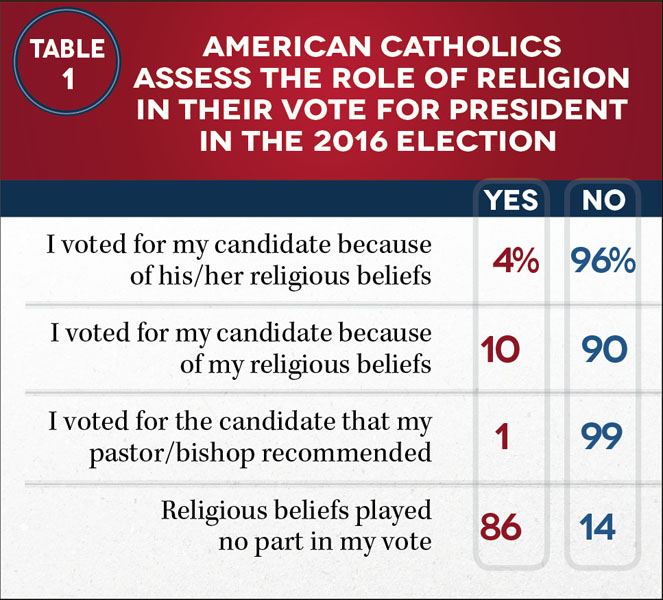
We began our 2017 survey with a series of questions about the possible role religious beliefs might have played among American Catholics In the 2016 election.

The responses of American Catholics to the questions cited in Table 1 make clear their assertion that their religious beliefs were not relevant to their vote for president in the 2016 election. The great majority (86 percent) said that religious beliefs (their own or that of the candidates) played no role in their vote. Just one in ten said that they voted for their candidate because of their own personal religious beliefs and even fewer — just 4 percent — said that they voted for their candidate because of the candidate’s religious beliefs.

Beliefs and values that are essential

That raised the question whether and to what extent did Catholics who voted for Trump differ in their religious beliefs and practices from Catholics who voted for Clinton. We have a standard block of questions about the beliefs and values that many consider essential to being a “good Catholic” that we have asked, in some form, on every survey since 1987. Table 2 compares the proportion of Trump and Clinton voters who say that each item is “essential to your vision of what it means to be Catholic.”

Catholics who supported Trump and Catholics who supported Clinton generally share very similar beliefs about how essential each of these items is to their vision of what it means to be Catholic. Differences of less than 10 percentage points between the two are not statistically significant. Both types of Catholic voters rank all ten items in virtually the same order.

Belief in the resurrection of Jesus, devotion to Mary as the Mother of God, and the papacy are essential to more than half of Trump voters and Clinton voters. Only about half saw charitable efforts to help the poor as essential and the percentage who saw the celibate male clergy as essential continues to have only a small percentage of support among either Trump or Clinton voters.

In other words, religion had little to do with the vote. That seems precisely what evangelicals should be doing. If you can segregate politics from faith, you don’t have the problem of evangelicals leaving the fold because of the movement’s political significance. Faith is one part of your life. Politics another.

Roman Catholics are doing it. Why can’t evangelicals?
Gospel Coalition Haiku

Why does a complementarian organization promote a congregation that belongs to a communion that ordains women?

Here‘s an explanation of complementarianism’s importance from TGC poobahs:

Probably all of us who share The Gospel Coalition’s vision to renew our faith in the gospel of Christ and to reform our ministry practices to conform fully to the Scriptures have been asked, “So why is TGC complementarian? Are you saying only those who uphold male leadership in the home and church believe the gospel?”

If you’ve ever wondered and asked the question yourself, we hope you’ll watch this video featuring TGC founders Don Carson, Tim Keller, and John Piper. Keller opens with a hermeneutical argument about what sometimes happens when we apply arguments in favor of egalitarianism to biblical passages that relate directly to the gospel. He also explains why TGC’s confessional statement and theological vision for ministry go beyond basic gospel doctrines to include such issues as gender roles. As Piper explains, TGC wants to say things that protect the gospel, display the gospel, and release the gospel for human flourishing. And our current age demands that believers model and argue the biblical case for Christ-like headship.

“We live in a culture where for the last 30 or 40 years, the collapse of the meaning of biblical masculinity has not produced a beautiful egalitarian society,” Piper observes. “It has produced a brutal masculine society.”

Here‘s a profile of puff piece on Hope Church, the largest Presbyterian Church in the nation (even larger than Redeemer NYC) that avoids questions about gender by featuring the topics of race and ethnicity:

The principles were solid: Churches should reflect their neighborhoods, and relationships are a good way to show God’s love to the unchurched. But the results were decidedly monoethnic congregations.

Within 20 years, Hope was the largest church in Memphis, regularly drawing 7,000 worshipers each weekend. But in a city that was nearly 60 percent black, less than 1 percent of them were African American.

At first, Hope reflected its neighborhood. The city to Hope’s south—Germantown—was 93 percent white in 2000, and 90 percent white in 2010. But its county—Shelby—fell from 47 percent white in 2000 to 41 percent white in 2010. And Cordova, the small suburb where Hope sits, dropped from nearly all white in 1988 to 68 percent white in 2010.

So Strickland and Morris set out to do what had never successfully been done before—to convert a white megachurch into a multiracial congregation.

They’re doing it.

Today, one out of five people who attends Hope is black. Of the 106 staff, 18 are nonwhite—including the senior pastor. The congregation sings hymns, contemporary Christian, and black gospel. Members work in predominately black, underresourced neighborhoods in north Memphis together through Hope’s community development corporation. They attend biannual three-day urban plunges and regularly spend eight weeks eating dinner with someone of another ethnicity.

Here’s the Evangelical Presbyterian Church’s statement on women’s ordination (Position Paper, 1984):

Thus, while some churches may ordain women and some may decline to do so, neither position is essential to the existence of the church. Since people of good faith who equally love the Lord and hold to the infallibility of Scripture differ on this issue, and since uniformity of view and practice is not essential to the existence of the visible church, the Evangelical Presbyterian Church has chosen to leave this decision to the Spirit-guided consciences of particular congregations concerning the ordination of women as elders and deacons, and to the presbyteries concerning the ordination of women as ministers.

It is in this context that the Evangelical Presbyterian Church states in its Book of Govern-ment, Chapter 6, titled “Rights Reserved to a Local Church” that “The local church has the right to elect its own officers” (6-2). This right is guaranteed in perpetuity.

Does this mean that race trumps gender?

Ecumenism is Radical (and that’s not good)

If conservatives value variety, why do conservative Roman Catholics insist on church unity? Russell Kirk said that true conservatives actually appreciate difference and pluriformity:

[C]onservatives pay attention to the principle of variety. They feel affection for the proliferating intricacy of long-established social institutions and modes of life, as distinguished from the narrowing uniformity and deadening egalitarianism of radical systems. For the preservation of a healthy diversity in any civilization, there must survive orders and classes, differences in material condition, and many sorts of inequality. The only true forms of equality are equality at the Last Judgment and equality before a just court of law; all other attempts at levelling must lead, at best, to social stagnation. Society requires honest and able leadership; and if natural and institutional differences are destroyed, presently some tyrant or host of squalid oligarchs will create new forms of inequality.

Maybe that makes John Turner a conservative who is not going along with the Reformation as tragedy because it divided the church:

First and foremost, there was no good reason for the primacy of the Bishop of Rome in the first place. Jesus bestowed the keys of the kingdom on Peter, but it seems clear from the Book of Acts and the Pauline epistles that Peter hardly exercised anything like papal authority in the early church. The historical evidence for Peter becoming the first bishop of Rome (or even being in the city) is unconvincing to one not already convinced. While Protestants obviously sundered the institutional unity of the Western church, it was a sort of unity unauthorized by scripture and unwarranted by the circumstances of the early church. (It also seems snarky but necessary to mention that Rome bore considerable responsibility for the Great Schism between East and West that preceded the Reformation by a half-millennium).

Second, it is not at all clear to me that Jesus’s prayer for Christian unity means that Jesus wanted his church to have an institutional, hierarchical unity along the lines of either the late-medieval or contemporary Catholic Church. The Book of Acts suggests that the apostles in Jerusalem exercised a measured primacy among early Christians, but for the most part Christianity spread around the Mediterranean world and to the East in a way that fostered local autonomy and diversity. This diversity of theologies and even collections of scripture alarmed many Christians, some of whom identified many strands of Christianity as heresy. By the fourth century, newly tolerated and then established Christianity sought to impose theological order on this chaos. The result was the institutionally useful but not terribly New Testament idea that all Christians had to have essentially the same understanding of Jesus Christ and of the relationship among the members of the Trinity. Getting at least most Christians to assent to the fourth- and fifth-century creeds took a considerable amount of viciousness and sometimes violence.

So it’s the church unitedists who also likely go for the United Nations and the European Union (even while in some parts of the world arguing for a “two-state” solution).

Celebrating a Reformed Church

I saw a story today about the U.S. bishops having to calculate the uprightness of the Republican tax plan:

After Paul Ryan told an audience at Georgetown University that his legislative work conforms to Catholic social teaching “as best I can make of it,” he homed in on the importance of reducing the federal deficit. “The overarching threat to our whole society today is the exploding federal debt,” he said. “The Holy Father, Pope Benedict, has charged that governments, communities, and individuals running up high debt levels are `living at the expense of future generations’ and `living in untruth.’”

That was in 2012—a smart (if incomplete) retort to scholars, bishops, and commentators who argued that Ryan’s budget priorities ran afoul of Catholic social doctrine. But on October 25, House Republicans under the Wisconsin congressman’s leadership approved a budget blueprint that would bring about an alarming increase in federal debt to achieve tax cuts weighted to benefit the rich. Even in the annals of federal budgeting, an additional gap of $1.5 trillion or more over ten years is a lot of money. When the Senate put forth this plan, which the large majority of Ryan’s caucus rubber-stamped, the Congressional Budget Office warned that “the high and rising debt that is projected would have serious negative consequences for the budget and the nation.” . . .

To give Ryan the benefit of the doubt, there is still time to work out a more principled budget. But, like just about every American politician who claims support in Catholic teaching, he needs to go beyond cherry-picking. He’ll need to consider factors beyond the deficit—especially distributive justice, which, as Pope Benedict wrote in his 2009 encyclical Caritas in veritate, the church has highlighted “unceasingly.”

The U.S. Conference of Catholic Bishops highlighted this facet of Catholic teaching in an October 25 letter on “moral criteria to assist Congress during deliberations on possible tax reform.” The letter said that the tax burden should not be shifted from the rich to the poor, and noted that the Republicans’ “Unified Framework for Fixing Our Broken Tax Code” states that a revised tax code “would be at least as progressive as the existing tax code.” . . .

The bishops’ moral criteria also include concern for the poor; strengthening families; “adequate revenue for the sake of the common good”; avoiding cuts to poverty programs to finance tax reform; and encouraging charitable giving.

I don’t know what Ryan would make of this list, which was part of a letter to all members of Congress from Bishop Frank Dewane of Venice, Fla., chairman of the bishops’ Committee on Domestic Justice and Human Development. But these are points the bishops have made time and again as they advance the notion that a budget is a moral document. Before the House vote on October 25, the bishops’ conference took the step of posting a notice online saying that “Christ teaches that we should find Him the `the least of these,’ (Matthew 25). Call on your Representatives to not forget the poor as they debate and vote on the budget resolution.”

On Reformation Day 2017 I’m so thankful for pastors who actually attend to God’s word and leave politics to politicians.

I’m also glad for reformers who created a separate realm for the church so that secular society could be secular.

I’m especially glad that Orthodox Presbyterian pastors and elders, as gifted as they are, don’t feel responsible for explaining tax policy to Congress.

Union with Christ for Experimental Calvinists

According to a pseudonymous author, 1978 was the year Reformed theology changed:

Reformed theology has changed. And there seems to be no going back. It was in the year 1978 that a tectonic shift in the underlying structure of Reformed theology began with the publication of a small book. The changes were not only systematic, but also systemic—affecting all aspects of it. Yet, interestingly, the changes were initially imperceptible until several years later.

Dr. Richard Gaffin, of Westminster Theological Seminary published his first book, The Centrality of the Resurrection, which would later be renamed and mass published under the title Resurrection and Redemption: A Study in Paul’s Soteriology. It was in this fine exegetical work that Dr. Gaffin unpacked the meaning of the Apostle Paul’s salvation vocabulary. Words like justification, sanctification, adoption, etc. would be understood differently in light his research. Dr. Gaffin was building upon historical Reformed theology as well as critiquing it. To do this he was deeply influenced by the work of various theologians across denominational distinctions, and in particular he was shaped by Reformed thinkers such as Herman Ridderbos and John Murray. But in the end, Dr. Gaffin would put together the exegetical conclusions in a way that had never been done before.

A recovery of union with Christ could have led to a higher view of the sacraments, the way it did for John Williamson Nevin, who also stressed union with Christ:

Most people are taught in Reformed churches and seminaries, to think linearly about salvation (e.g. Justification leads to Sanctification which leads to Glorification). A person is first justified (i.e. saved, forgiven) and then comes sanctification (i.e. growth, maturity), and then comes glorification (i.e. dying and rising from the dead at the resurrection). Other words may be added to this order of salvation (e.g. regeneration, adoption, etc.) but the historical way of looking at these words fits them in an unbreakable, linear, “golden” chain. This is called the ordo salutis (Latin term: “order of salvation”). It’s the Reformed way of explaining the application of salvation to a person from beginning to end. Once a person is justified, the other benefits follow in due course. If a person is “truly” justified, the rest will follow.

This is one reason why Reformed theology has always struggled to “fit” the sacraments into any meaningful place in its systematic theology. If the golden chain of salvation can’t break, then it’s difficult to see how baptism is really all that important or why the Lord’s Supper is necessary. While Reformed theology held to the Lord’s Supper as a “means of grace” it was rare to find a Reformed church practice weekly communion or place it on par with preaching. The sacraments were aids to faith–crutches if you will–but not really necessary in the life and practice of Reformed churches considering the logical consequences of the “golden chain.” If you focus on the linear progression of the ordo salutis, the unbreakable chain of salvation, starting with predestination and ending with glorification then, the sacraments have little need in such a theological system, logically and practically speaking.

But that isn’t where Dr. Gaffin wanted union to go:

But if soteriology is eschatology, then doesn’t soteriology also include the restoration and renewal of personal relationships in a new community? If that’s the case, then isn’t soteriology also ecclesiology? This conclusion, in particular, the “New Gaffin” in his By Faith would attempt to avoid in order distance himself from the sacramental and ecclesiological implications. While many scholars and theologians were coming to this particular conclusion, Dr. Gaffin was distancing himself away from the conclusion that soteriology is ecclesiology.

But despite his attempts to ward off the conclusions, there were clear biblical arguments that couldn’t be avoided by many. Baptism engrafts into Jesus Christ. As Dr. Gaffin had originally said, “…if ‘washing’ on which ‘regeneration’ is directly dependent in Titus 3:5, refers to baptism, then what Romans 6:3ff…teaches concerning baptism as a sign and seal of incorporation with the resurrected Christ, and so the implications of that incorporation, will have to be brought to bear here.” The implications were clear to many: All the benefits of salvation are given in baptism because baptism engrafts into Christ. Soteriology didn’t simply have “implications” on ecclesiology; it is ecclesiology. To be baptized into the Christian church is to be baptized into Jesus Christ.

In which case, how revolutionary was the recovery of union with Christ? Did its advocates simply tinker with the ordo salutis or did they seek to apply union to ecclesiology, liturgy and the sacraments? From this seat, it looks like union had a narrow application, chiefly to a discussion of the application of redemption that comes up in questions 29 through 38 in the Shorter Catechism. For union to apply to questions 88 through 97, unionists would need the Federal Visionaries.

Send the Confederate Monuments to Canada

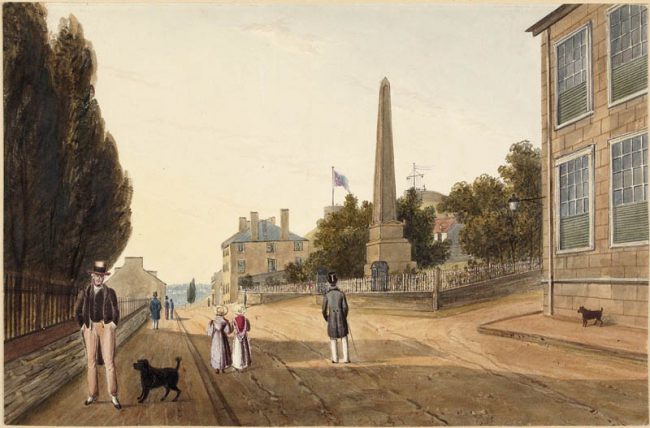
After all, as Wilfred Laurier asserted, where else does a nation honor both the victors and the defeated?

Where is the Canadian who, comparing his country with even the freest countries, would not feel proud of the institutions which protect him? Where is the Canadian who, passing through the streets of this old city and reaching the monument raised a few steps from here to the memory of the two brave men who died on the same field of battle while contending for empire in Canada, would not feel proud of his country? In what other country under the sun can you find a similar monument reared to the memory of the conquered as well as of the conqueror? In what other country under the sun will you find the names of the conquered and the conqueror equally honored and occupying the same place in the respect of the population? (The Benefits of British Institutions, 1877)

Laurier, Canada’s first francophone Prime Minister (1896-1911), was referring to the Wolfe-Montcalm Monument that memorialized the two generals who fought on opposite sides and died in the Battle of the Plains of Abraham, a decisive battle in 1759 during the Seven Years War when the British rolled back French colonial presence in North America.

Canada’s capacity to honor both anglophones and francophones in one monument may give provide reasons for thinking of the nation up north as exceptional.

If Lecrae Can Leave, Why Can’t Orthodox Presbyterians Get Out

Some of us have been saying for a while that Reformed Protestants are not evangelical, but the standard scholarship puts conservative Presbyterians squarely in the evangelical camp. Those different assessments of Presbyterian and evangelical relations make the recent discussion of Lecrae’s departure from white evangelicalism seem partial and shortsighted. But they should give confessional Presbyterians sympathy with black Protestants.

For instance, notice what happens if you change words in Raymond Chang’s defense of Lecrae:

We need to be aware of how we bring unconscious biases to our own litmus tests of whether people of color Orthodox Presbyterians are theologically correct enough based on their emphasis on justice doctrinal issues. Often times, people of color are viewed with greater scrutiny simply because of their skin tone dress. We need to be concerned with the ways our political commitments co-opt our faith commitments. The fact that people equate Christians with a particular political party is problematic, especially if we consider how both parties are deeply flawed. We need to redefine our understanding of organizational fit. This means we need to reconsider what it means to be equipped. For example, is someone equipped for the pastorate if they have racist heterodox tendencies or beliefs? And who gets to decide if they do, white people or the people they disparage?

We also need to be mindful of how networks and credibility is established. Consider who is promoted within evangelicalism through publishing deals. If a Christian publisher looks through their catalogues and white people overwhelmingly occupy the authorial space, it is likely because the people they have come across were developed through their white evangelical network. Consider who speaks at conferences like The Gospel Coalition and Together for the Gospel and you’ll see how people who had local or regional platforms, now have national or international ones. Whether you are aware of it or not, we normalize whiteness in evangelicalism by having an overwhelming majority of white speakers and only one or two plenary speakers of color Orthodox Presbyterians. Consider the ways in which people get mentored. There are tremendous barriers to mentorship felt by Christians of color Orthodox Presbyterians who would say they hold the same faith commitments and convictions as evangelicals do, but don’t either know or have an entry point into these networks (I fortunately, had people who helped me navigate in, but I am a part of the exception, not the rule). Consider who is appointed the most senior level leadership roles and how they are found and determined upon. It cannot be true that only white people are “called” to these positions of authority and influence and people of color Orthodox Presbyterians are not.

If white evangelicalism is serious about representing the unity Christ calls us to in this world, this means you cannot find successors who preach like you do, see the world like you do, and share the same skin tonefashion as you. This means Thabiti Anyabwile or Bryan Lorritts (or any of the small handful of others) Carl Trueman cannot be the only black preachers Orthodox Presbyterian in your conferences (despite their his wonderful gifts). This means that conferences need to provide substantial opportunities for Asians and Latinos and Native Americans Presbyterians, Lutherans, and Reformed to speak as well. This means that senior leadership at churches cannot be satisfied with a disproportionate percentage of white pastors/elders to non-white confessional pastors/elders.

Further, we need to look deeply into the reasons why leaders of color Orthodox Presbyterians who occupy the top spots in Christian (evangelical) organizations and churches do not last. This means we need to have the humility to listen, but not just listen, and act upon the problems we see. This also means evangelicalism needs to allow people of color Orthodox Presbyterians to speak for themselves and on their own terms. We also need to create pipelines for evangelicals of color confessional Protestants to grow in leadership opportunities (see what Intervarsity did with the Daniel Project) because we know that leadership matters and that leadership shapes organizations.

Of course, the difference is that Orthodox Presbyterians already have their own institutions and structures. That institutional basis means that OP’s aren’t necessarily jonesing for leadership in TGC. Since that is true, and since the freedom of religion means that all Protestants have the opportunity to form their own structures (which the black church already has), then why is it that Christians of color or some Orthodox Presbyterians aspire to receive the imprimatur of John Piper, D. A. Carson, and Tim Keller?

General Revelation

Why don’t Christians have all the truth? Because non-Christians are smart and attend well to creation. Some highlights of recent revelations from people not explicitly illumined by the Holy Spirit or committed to Reformed Protestant epistemology:

First, a great piece on the films of Whit Stillman which includes this:

Though certainly a contemporary filmmaker and not in any sense a stranded nostalgist, Stillman nevertheless displays qualities that, while once common, are now so rare that they put him in stark relief against nearly all of his contemporaries. Perhaps most pronounced is his distinctive affection for his uniformly well-born characters. If revulsion for bourgeois hypocrisy seems an obligatory quality in American independent filmmaking these days, Stillman will have none of it. He offers instead a gentle satire of his characters’ foibles combined with a frank sympathy for their principles. While quite natural in Austen novels and RKO comedies of the 1930s and ’40s, this is rare today. Thus is it all the more striking that Stillman continues to receive critical acclaim from disparate publications and institutions, from a Vanity Fair photo spread for the 25th anniversary of Metropolitan to a volume of effusive essays from the Intercollegiate Studies Institute.

Second, the short-sightedness of suburban growth:

Since the end of World War II, our cities and towns have experienced growth using three primary mechanisms:

1. Transfer payments between governments: where the federal or state government makes a direct investment in growth at the local level, such as funding a water or sewer system expansion.

2. Transportation spending: where transportation infrastructure is used to improve access to a site that can then be developed.3

3. Public and private-sector debt: where cities, developers, companies, and individuals take on debt as part of the development process, whether during construction or through the assumption of a mortgage.

In each of these mechanisms, the local unit of government benefits from the enhanced revenues associated with new growth. But it also typically assumes the long-term liability for maintaining the new infrastructure. This exchange — a near-term cash advantage for a long-term financial obligation — is one element of a Ponzi scheme.

The other is the realization that the revenue collected does not come near to covering the costs of maintaining the infrastructure. In America, we have a ticking time bomb of unfunded liability for infrastructure maintenance. The American Society of Civil Engineers (ASCE) estimates the cost at $5 trillion — but that’s just for major infrastructure, not the minor streets, curbs, walks, and pipes that serve our homes.

The reason we have this gap is because the public yield from the suburban development pattern — the amount of tax revenue obtained per increment of liability assumed — is ridiculously low.

Last, the folly of an all volunteer military:

When the Gates Commission set up the rationale for the AVF in 1970, it did so at the behest of a president, Richard Nixon, who had come to see the conscript military as a political dagger aimed at his own heart. One could argue that the decision to abolish conscription was a foregone conclusion; the Commission simply provided a rationale for doing it and for volunteerism to replace it.

But whatever we might think of the Commission’s work and Nixon’s motivation, what has happened in the last 16 years—interminable war—was never on the Commission’s radar screen. Like most crises, as Colin Powell used to lament when he was chairman of the Joint Chiefs of Staff, this one was unexpected, not planned for, and begs denial as a first reaction.

That said, after 16 years of war it is plain to all but the most recalcitrant that the U.S. cannot afford the AVF—ethically, morally, or fiscally.

Fiscally, the AVF is going to break the bank. The land forces in particular are still having difficulties fielding adequate numbers—even with lowered standards, substituting women for men (from 1.6 percent of the AVF in 1973 to more than 16 percent today), recruitment and reenlistment bonuses totaling tens of millions of dollars, advertising campaigns costing billions, massive recruitment of non-citizens, use of psychotropic drugs to recycle unfit soldiers and Marines to combat zones, and overall pay and allowances that include free world-class health care and excellent retirement plans that are, for the first time in the military’s history, comparable to or even exceeding civilian rates and offerings.

A glaring case in point is the recent recruitment by the Army of 62,000 men and women, its target for fiscal year 2016. To arrive at that objective, the Army needed 9,000 recruiting staff (equivalent to three combat brigades) working full-time. If one does the math, that equates to each of these recruiters gaining one-point-something recruits every two months—an utterly astounding statistic. Additionally, the Army had to resort to taking a small percentage of recruits in Mental Category IV—the lowest category and one that, post-Vietnam, the Army made a silent promise never to resort to again.

Moreover, the recruiting and retention process and rich pay and allowances are consuming one half of the Army’s entire annual budget slice, precluding any sort of affordable increase in its end strength.

All of these pieces relate to the United States’ growth as a world power and the way we pay (or don’t) for it. Stillman’s movie, Barcelona, is an amusing take on the convergence of economic interest and Cold War policy. And none of it will you (nor should you) find in New Horizons.

Why Pietism and Liberalism Go Hand in Hand

Amy Julia Becker declares her independence from evangelicalism — for at least the reign of President Trump. She seems to think that evangelical stands for something on the conservative side of Christianity’s spectrum. But she now sees how political evangelicalism has become. I’m not sure if she just landed from Mars.

Here is what makes her a pietist:

I am still tempted to categorize my Christian friends with words like “liberal” or “progressive” or “orthodox” or “conservative” or “evangelical.” I am still tempted to judge the faith of other people according to my standards of who and what constitutes Christianity. But when I stop and ask how I see God’s work in their expressions of faith — when I stop and consider the expansive love of God at work in and through countless people, people like me, people who have our theology wrong plenty of the time, people who have our theology right and still behave badly, people who are bumbling around in a world of sin and are still at our core beloved by God and invited to participate in God’s work in the world — when I do that, I start to believe that we are Christians.

Imagine what Ms. Becker would do with Arius. Look at how much he loves God.

Or what about Jacob Arminius? Well, he sure seems serious about the faith.

But such displays of or criteria for genuine faith have little to do with forms. In fact, it’s not just that Christianity revolves around feelings. The people who hurt feelings, the ones who stress right doctrine, the inerrancy of the Bible, or the regulative principle of worship, they are people who care more about forms than feelings. And therefore, such conservatives are inferior kinds of Christians. Tight sphinctered. Machen’s warrior children. They lack charity.

Snowflake Christians beget snowflake nones.

Before Calvin

What would happen if critics of 2k had to think about the relationship between the church and magistrates before emperors got religion (and who knows if they grasped Christianity for the right reasons)?

In the current issue of New Horizons, David VanDrunen explains where 2k reflection on the state starts — not in 1536 but in 33.

The apostolic church lived under civil magistrates who did not confess Christ and sometimes persecuted people who did. Yet New Testament texts such as Romans 13:1–7 and 1 Peter 2:13–17 taught that God had ordained civil magistrates and that believers ought to honor and submit to them.

Following the Roman emperor Constantine’s conversion to Christianity in the early fourth century, the status of Christians in society changed. The contemporary church historian Eusebius, in his Ecclesiastical History, described the Roman Empire under Constantine as the fulfillment of Old Testament texts prophesying that war would cease and the wicked would be cut off: Constantine was realizing Christ’s kingdom on earth. Shortly thereafter, Augustine (354–430) provided a much more modest view. In his City of God, Augustine described Christians as sojourners, on a pilgrimage in this world toward the heavenly city. He acknowledged that Christians should participate in their political communities, but he taught that all earthly rulers and empires are provisional, not to be confused with Christians’ eschatological hope.

In the fifth century, the “Christendom” model emerged. As described by Pope Gelasius I, there are “two powers” that exercise authority under God in this world: the emperor has authority over “temporal affairs” for the sake of “public order,” and the priest controls the sacraments and “spiritual activities,” toward the goal of “eternal life.” Priest and emperor should submit to one another in their proper spheres.

This model was helpful in important respects. It affirmed that civil governments are legitimate, ordained by God. It also taught that their jurisdiction is limited and subject to God’s authority.

But notice the problems:

First, it essentially wed the church to the state in a confessionally unified Christian society. The New Testament, however, never suggests that Christians should expect or seek such a society.

Second, the state was expected to enforce the church’s claims about doctrine and worship by punishing dissenters with the sword. This reality sat uncomfortably beside New Testament teaching that Christ’s gospel and kingdom do not advance by the weapons of this world. Many who sought to reform the church—such as John Hus in the fifteenth century—would meet untimely ends as victims of this church-state alliance.

So long as a Protestant city council supports our guy, John Calvin, we forget about the problems of a religious magistrate? It’s our civil government.

And so long as that Cadillac CTS that only gets 13.8 mpg is a comfortable ride to church, we forget about the price of gas or limits on fossil fuels? It’s our gas guzzler.