Presbyterians Who Don’t Want to Be

David Robertson gives away his tell when he responds to criticism for dedicating children. He thinks that critics strain at gnats while swallowing camels — the camel being a market model of ministry:

At the risk of overgeneralization it seems to me that there is a Scottish/UK version of Presbyterianism that seeks (but does not often practice) visible church unity and does not accept the ‘market place’ mentality that Paul mentions. On the other hand in the US, the land of 1,000 denominations, there is a much greater market place mentality with the pros (greater initiatives, freedom etc.) and cons (disunity, less church discipline etc.). It seems sad to me that even as the number of Christians in the US declines, the number of Presbyterian denominations will probably increase – all owning allegiance to a Confession of Faith which was set up to prevent that happening!

In England there are hardly any Presbyterians and yet we have at least two denominations committed to the WCF. In Scotland the situation is embarrassingly worse. I feel bad that the Free Church has to exist. Because of the apostasy of the Church of Scotland, I think we do have to, but I would much prefer that we didn’t. At one point I was even part of a delegation from the Free Church that met with the C of S and looked at whether and how we could reunite. But it is even more shameful to me that after a lifetime devoted to evangelism in a declining church in a decaying culture, instead of the churches which adhere to the WCF uniting together we have further divided. In my time in ministry in Scotland we have even seen four new Presbyterian denominations, all adhering to the WCF, come into being. The Associated Presbyterians, the Free Church Continuing, International Presbyterian Church and Covenant Fellowship. We talk about church unity but actions speak louder than words. My hope and prayer is that one day the Free Church will cease to exist (that will certainly come true in heaven!). I would be even more radical than that – I would prefer to work in organizational unity with Baptists and others – not just networking but pooling resources and genuinely being the one Church of Jesus Christ.

Notice that he wishes the Free Church did not exist and that he would prefer to minister with Baptists. There’s nothing inherently wrong with that. Scotland, I suppose, like the United States is a free country (Free Church in a Free Country). But I’m not sure how confessional or Presbyterian that attitude is. It does explain Robertson’s attachment to Tim Keller. It also suggests a certain kind of naivete. Does Robertson really think that TKNY is not part of a market model, or that Keller has not become a brand? Either way, why be a Presbyterian when you could just as easily minister with Baptists?

Robertson may also explain why Keller appeals to pastors in small, out of the way, denominations (perhaps unintentionally):

When evangelicals in the Church of Scotland decided that enough was enough and began to leave – they of course looked for a Confessional Presbyterian Church that was faithful to the Bible. For doctrinal and practical reasons most could not join the Reformed Presbyterians, the APC, the Free Church Continuing or the Free Presbyterians – amongst other reasons they were exclusive psalmody. That basically left the Free Church. Now there may be theological reasons why some ex C of S ministers and congregations could not join the Free Church (e.g. those who had women elders and wanted to retain them), but what of those who subscribe to the WCF, are complementarian and Presbyterian? Many have joined but an equal number haven’t – why? Some of it may be the Free Churches own fault – not being welcoming enough etc., but is that the real or adequate reason?

I think that it is the religious market place that Paul so rightly complains about which kicks in here. The reasons are not doctrinal and theological but social, personal and historical. Some had an aversion to the Free Church because of past experience (love remembers no wrongs?), image or misunderstandings about our positions. I have heard others though express things in terms of what I could only call social and class snobbery. We are perceived as not sophisticated enough, too Highland, too working class. I recall a C of S man having what I can only describe as a ‘coming out’ dinner in his home – where he invited his middle class friends to a dinner at which he introduced myself and a couple of others from the church and then announced he was attending the Free Church. It was as though he had announced he was gay! In fact he probably would have got a more favourable response! That attitude may be extreme but in a more modified form it is still there. Is not wanting to be called ‘Wee Free’ a sufficient reason for setting up yet another denomination?

This part of Robertson’s post was intriguing if only because in the United States, conservatives in the PCA seem to have a similar aversion to the OPC — not sophisticated, too tacky, ugly buildings on the wrong side of the beltway. But instead of identifying with communions of like faith, practice, and awkwardness, Robertson instead regards Keller as the right kind of American Presbyterian.

This may make sense since with all of the writing for newspapers and speaking in public that Robertson does, he may regard himself as a kind of public intellectual after the fashion of Keller. He is certainly akin to Keller in the way in which denominational attachments rest lightly on his ministerial shoulders:

The parish and pastoral approach is one that I prefer. We are not engaging in the religious market place (ironically those who take the purist/polemical approach are much more likely to do that), but we are seeking to reach out to every one in the community where we are based. (I realize of course that most of us would claim that is what we are doing and I should also point out that I think that is what Paul’s church is doing in Ealing – I’m talking about the wider issue here – not having a subtle dig – I don’t do subtle!). This means that our primary identity is not that we are a Free Church, or a Reformed church, or the church with the best preaching in Dundee, or David Robertson’s church or any other claim we might foolishly want to make. We are a church of Jesus Christ.

This is the way of pietists, to claim the high ground and act as if denominational particularities are inconsequential in comparison to vision, mission, or devotion. What happens, though, when Robertson or Keller need to explain why another church, say the Church of Scotland or the PCUSA or the Methodists are not quite up to the status of “the church of Jesus Christ”? At that point, don’t arguments about purity and polemics and doctrine kick in?

And what happens when Robertson or Keller receive funds from Presbyterian sources that were given precisely to uphold Free Church and Reformed convictions? Don’t you have to explain the way you are going to use the funds? You will use them for generic Christian purposes, not for Presbyterian ones only?

That is the sort of equivocation that captured the Church of Scotland and the Presbyterian Church in the U.S. before the Free Church and the PCA formed separate communions. Such a separate status is not everyone’s cup of tea. That’s why we have evangelicals. But evangelicals presenting as Presbyterian? That’s why we have The Gospel Coalition.

All Political Sermons are Bad

In the spirit of J. Gresham Machen, remember that if you don’t mix religion and politics, you don’t have to perform the contortions that allow you to affirm Civil Rights legislation (as a work of God) and oppose Prohibition (not as a work of God even though Protestants did think it was a work of God). Just keep politics out of the church.

But that’s not what Christians do.

And American Presbyterians have been guilty for a long time before liberal Protestants went all in on the Social Gospel. Mark Tooley reminds:

This week I studied at the Army War College at Carlisle Barracks in Pennsylvania, a fort dating to the 1700s, when President George Washington led an army there in route to suppress the Whiskey Rebellion. Farmers in western Pennsylvania had revolted against the authority of the new republic to tax the whiskey they distilled from grain otherwise expensive to ship from their remote frontier.

Quickly realizing this threat to the new nation’s cohesion, Washington in 1794 summoned the militias from Pennsylvania and nearby states into an army of 13,000 that he personally led against the rebellion. At an evening celebration of greeting for the President and his army, the town of Carlisle illumined a special proclamation simply declaring: “The Reign of the Laws.”

Such a poignant and wonderful exclamation: “The Reign of the Laws.” The people saluted Washington, but they, like he, did not place their faith in his personal rule but in impartial law as the antidote to anarchy.

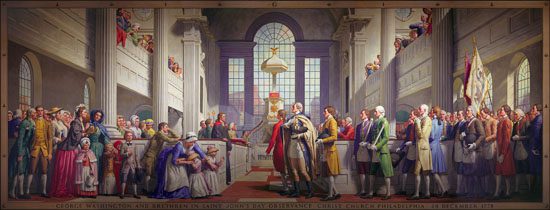
While in Carlisle Washington worshiped at the stone Presbyterian church, which I visited, and where he heard Dr. Robert Davidson preach “A Sermon on the Freedom and Happiness of the United States of America.” Washington described it in his diary: “Went to the Presbyterian meeting and heard Dr. Davidson preach a political sermon, recommendations of order and good government and the excellence of that of the United States.”

Washington’s summary was fair and succinct, but the sermon merits elaboration, both for illustrating how Christians in early America viewed God’s purposes for their nation, and for modeling, at least in part, how we today might view government, justice and nationhood providentially.

The sermon is based on King David’s question in 2 Samuel 7:23: “And what one nation in the earth is like Thy people, even like Israel?” Pastor Davidson warned against being “carried away by the spirit of the times, to substitute mere political harangues in the place of the Gospel of Christ,” recalling, per Proverbs 27:34, that “righteousness exalteth a nation; but sin is a reproach to any people.” And he noted the “duties of citizens are not to be considered as topics foreign to the Gospel” as the “Gospel views man in every condition in which man can be placed.”

Davidson heralded the “great goodness of God to our own state and nation in particular; our high and many privileges, the gratitude due from us to God for them; and the wise improvement which we ought to make of them.” As a national comparison, Davidson recalled:

The history of the Jewish nation, if read with suitable views, and especially in order to gain an acquaintance with the ways of God to men, would be one of the most instructive that could merit our attention. …We see how much superior, in point of privileges, the Jewish nation was, to all the other nations around them.

As God had showed unmerited and unprecedented favor to the Hebrew nation, Davidson urged considering the “great goodness of the Divine Being to our state and nation in particular; – our high privileges; the gratitude which we owe to God for them…” And he recalled:

This part of the New World presented itself as a place of refuge for those who wished to enjoy religious and civil freedom, unmolested, and to the greatest extent. They hoped that here they could worship God according to their consciences, and would be at a secure distance from all the insults of tyranny.

After reciting the British oppressions precipitating the American Revolution, Davidson declared the new independent nation had the “freest and best form of civil government, which could be learned from the wisdom and experience of ages,” and that with “all the imperfections” still “is one of the most free and excellent under the sun.”

Of the American republic, Davidson further rhapsodized:

This is a government, which all the real friends of freedom in the old world appear to admire; and under the wings of which the oppressed of every nation would wish to take refuge. Here is liberty and equality, according to the just acceptation of those favorite terms; liberty, civil and religious to the utmost extent that they can be, where there is any government at all; and an equality of rights, or provision made for the equal protection of the lives and properties of all. That all men should be equal, as to abilities, station, authority, and wealth, is absolutely, in the present state of things, impossible. But where every citizen has a voice in making the laws, or in choosing those who make them, and is equally under their protection, – there is equality.

I for one (why not five) am convinced that modernism did not begin with adapting Christianity to biology, higher criticism, or immigration reform. It began when Christians, like Pastor Davidson, started to adapt Christianity to modern nations like the United States. Once you start making the Bible say things it doesn’t, it’s hard to stop.

Machen Day 2017

One of the very greatest evils of present-day religious life, it seems to me, is the reception into the Church of persons who merely repeat a form of words such as “I accept Christ as my personal Saviour,” without giving the slightest evidence to show that they know what such words mean. As a consequence of this practice, hosts of persons are being received into the Church on the basis, as has been well said, of nothing more than a vague admiration for the moral character of Jesus, or else on the basis of a vague purpose of engaging in humanitarian work. One such person within the Church does more harm to the cause of Christ, I for my part believe, than ten such persons outside; and the whole practice ought to be radically changed. The truth is that the ecclesiastical currency in our day has been sadly debased; Church membership, as well as Church office, no longer means what it ought to mean. In view of such a situation, we ought, I think, to have reality at least; instead of comforting ourselves with columns of church statistics, we ought to face the facts; we ought to recall this paper currency and get back to a standard of gold.

To that end, it should, I think, be made much harder than it now is to enter the Church: the confession of faith that is required should be a credible confession; and if it becomes evident upon examination that a candidate has no notion of what he is doing, he should be advised to enter upon a course of instruction before he becomes a member of the Church. Such a course of instruction, moreover, should be conducted not by comparatively untrained laymen, but ordinarily by the ministers; the excellent institution of the catechetical class should be generally revived. Those churches, like the Lutheran bodies in America, which have maintained that institution, have profited enormously by its employment; and their example deserves to be generally followed. (What is Faith? 156-57)

Professional Historians Don’t Do Religion

That is one way to explain why the editors of the American Historical Review, the flagship journal for professional historians in the United States published by the American Historical Association, let Randall Balmer, a long time student of American evangelicalism, open his book review of Darren E. Grem, The Blessings of Business — when will this sentence end!?! — this way:

On the face of it, the evangelical embrace of capitalism and free enterprise should be a tough sell. Jesus himself warned that rich men face long odds against entering the kingdom of heaven and that it is impossible to serve both God and Mammon. First-century Christians, as recorded in the Acts of the Apostles, held goods in common, a nascent form of socialism. So how is it that many contemporary evangelicals who trumpet their fidelity to the Bible have become such ardent evangelists for affluence and free-market capitalism? How could Jerry Falwell plausibly argue that “God is in favor of freedom, property, diligence, work, and acquisition”? (AHR, June 2017)

Does this mean that the AHA favors socialism even though it requires members to pay upwards of $200 to attend annual conferences where hotel rooms often go for at least $150 per night? Are we supposed to believe that in a socialist world the workers would unite to underwrite historians gathering annually to hear and present papers, meet with editors, and wine and dine with old colleagues?

Or could it be that Balmer thinks the Bible, which talks about the sin of stealing in pretty big letters, favors “a nascent form of socialism,” one without Gulags or walled cities?

And how is it that Balmer, historian of the United States, is such an expert about religion and society in first-century Palestine? “On the face of it” is not the kind of intellectual muscle needed to master the kinds of research techniques that antiquity requires.

And does Balmer actually believe that Jesus is opposed to property but favors freedom, especially liberty for consenting adults to experience sexual pleasure?

My sense is that the editors understood they had no dog in this hunt — the evangelical left versus the evangelical right — and let Balmer take his swipes.

I do wonder though how Balmer gets up in the morning and goes to lecture in classrooms at Dartmouth College, an institution which boasts an endowment of $4.5 BILLION (according to Google). That, my friends, is a lot of property that resulted from a lot of acquisition. Does Balmer ever trumpet Jesus’ teaching about rich men and serving Mammon with Dartmouth’s administration?

How Did Nancy MacLean Miss Calvinism?

The Duke historian’s book, Democracy in Chains: The Deep History of the Radical Right’s Stealth Plan for America has generated lots of attention and the debate appears to be one more indication of how much the United States resembles Turkey. For those who missed it, here is how the story at the Chronicle summarized the book:

At the heart of this purported plot is a Nobel-winning economist whose ideas MacLean characterizes as “diabolical” and “wicked”: James McGill Buchanan. Buchanan, a libertarian who taught at George Mason University and died in 2013, developed a novel way of analyzing government that would have far-reaching consequences for democracy, MacLean argues. In his view, self-interest dictated the behavior of public officials and those who tried to influence them. The incentives that shaped officials’ actions — winning re-election, expanding their bureaucratic turf — encouraged profligate government spending at the expense of a minority of taxpayers. This violated the taxpayers’ freedom and burdened the economy.

In MacLean’s telling, Buchanan was both an intellectual and a “deeply political foot soldier of the right.” Over time, she says, he came to believe that the best way to bring about radical change was to focus on the rules, not the rulers. Freedom would flourish only by imposing legal and constitutional shackles that prevented public officials from responding to the will of democratic majorities. In the late 1990s, MacLean writes, a like-minded billionaire, Charles Koch, seized on Buchanan’s ideas as a “personal operational strategy” for his campaign to “save capitalism from democracy — permanently.” Because most Americans didn’t support their ideas, that strategy required stealth: small, piecemeal moves that could win approval without provoking an outcry.

This is one more instance where I marvel at professionals who work in privileged and hierarchical environments like universities with tenure and ranks become indignant defenders of democracy. As if any senior professor would submit to democratic rule at his or her institution — let the students, groundskeepers, and athletic trainers in on running the university.

But I do wonder if MacLean might have made her story even juicier if she had thrown in that Buchanan (sort of a Presbyterian name, no?) was part of a sinister plot of Calvinists to control America. After all, the way Sam Tanenhaus describes Buchanan’s contribution sure sounds like the economist knew the fall infected politics:

Yet race, MacLean acknowledges, was not ultimately a major issue for Buchanan. Fending off desegregation was only a skirmish in the long campaign to revive antigovernment ideas. That campaign dated back to the nation’s founding, gained new strength in the pre–Civil War nullification arguments of John Calhoun, and reached its modern apogee in debates over taxes and spending. Here the enemies were unions (“the labor monopoly movement,” in Buchanan’s phrase), leftish policy makers, and also Keynesian economists. Together these formed a “ruling class” that was waging war against the marketplace. This was not a new argument, but Buchanan gave it fresh rigor in his theory of “public choice,” set forth in his pioneering book, The Calculus of Consent (1962), written with Gordon Tullock. Governments, they argued, were being assessed in the wrong way. The error was a legacy of New Deal thinking, which glorified elected officials and career bureaucrats as disinterested servants of the public good, despite the obvious coercive effects of the programs they put into place. Why not instead see politicians and government administrators as self-interested players in the marketplace, trying to “maximize their utility”—that is, win the next election or enlarge their department’s budget?

Real Calvinists don’t believe in public good and reach for their two-edged sword whenever a public servant serving servers invokes such immodest language.

David Robertson is What’s the Matter with Tim Keller

Amy Mantravadi wanted to know what’s the matter with Tim Keller around the same time that David Robertson decided to make Keller the test for loyalty to gospel ministry. Amy makes careful evaluations (charitable) of Keller. Robertson sneers at anyone who takes issue with Keller.

And that is the problem. Keller is merely one pastor whose foibles would be unknown to any outside his congregation if he had not allowed himself to be a poster-boy for urban, transformationalist, pastor-to-(some of)-the-intelligentsia ministry.

Lots of pastors in the Reformed world do not follow the rules of polity, liturgy, and confessional austerity. They likely face their own sets of critics whether from within the congregation or at presbytery. But these pastors do not pretend to have written the book for successful ministry or allow fans to crow about their success.

Keller, however, has become a brand and pastors like David Robertson have gladly wrapped themselves in it. In fact, when Keller says something that so patently needs qualification, Robertson is there to dare anyone who would question Keller’s devotion, wisdom, and truth.

Keller is too big to fail and defenders like Robertson made him so.

Here is what Keller said about art:

The Church needs artists because without art we cannot reach the world. The simple fact is that the imagination ‘gets you,’ even when your reason is completely against the idea of God. ‘Imagination communicates,’ as Arthur Danto says, ‘indefinable but inescapable truth.’ Those who read a book or listen to music expose themselves to that inescapable truth. There is a sort of schizophrenia that occurs if you are listening to Bach and you hear the glory of God and yet your mind says there is no God and there is no meaning. You are committed to believing nothing means anything and yet the music comes in and takes you over with your imagination. When you listen to great music, you can’t believe life is meaningless. Your heart knows what your mind is denying. We need Christian artists because we are never going to reach the world without great Christian art to go with great Christian talk.

If you are a minister devoted to the sufficiency of Scripture, maybe you qualify this a little? You put yourself in the situation — wouldn’t all that reading of Charles Taylor help you? — of Christ and the apostles and maybe remember that art did not seem to be high on the apostles agenda.

Instead, Robertson doubles down and does for Keller what so many Roman Catholic apologists do for Pope Francis — spin:

Now there is a narrower sense in which art is used – I guess the sense in which it is studied in art colleges. And if Keller was saying without painting we can’t communicate the Gospel then he would deserve the ridicule that comes his way. But do you think Keller is restricting ‘art’ to the narrower sense of painting only (or perhaps ballet?). Can’t you be a little more charitable and assume that a bible believing teacher such as Keller might actually know something about the bible, church history and evangelism? At least enough to prevent him accusing Paul and Jesus of not knowing how to proclaim the Gospel?

The truth is that Keller and the upcoming downgrade in the PCA is not the problem. He is not a heretic and his views on art are not heretical – they are basic Kuyperian Calvinism. No, it is the ugliness of some who profess the Reformed Faith, those macho keypboard warriors who think that putting the adjective effeminate in front of anything is enough to damn it; seeking their own niche and identity by dissing others who are the real heretics. Why? Because although they profess orthodox faith in Christ – it’s not enough. We must reflect the glory and beauty of Christ. To turn beauty into ashes is anti-Christ and the real heresy.

You mean, all that time in the city has not in the least influenced Keller and how he presents? You mean, Robertson has never studied the history of how Presbyterians are like frogs in the kettle and become used to the cultural temperature around them? You mean, that a minister in the Free Church cannot ever fathom how liberal Presbyterianism happens?

That’s a problem.

More of Those (were the) Days

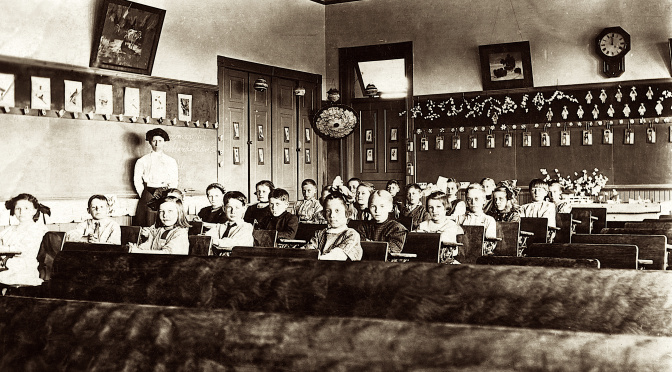
And we think contemporary public schools suffer. They had challenges even before Richard Nixon:

The super-science of pedagogy, that fairest flower of the New Thought, has achieved its greatest triumphs in the reclamation of the erring, or, as the old-time schoolmasters had it, the bad. Those old-time schoolmasters knew nothing about scientific pedagogy. They were not experts. When, for example, a boy hooked school they had no remedy for his error save the application of the birch to his pantaloons, and this barbarous remedy they kept on applying, in more and more heroic doses, until he abandoned the practice or graduated into long trousers and a political job. Such was pedagogy in its Gothic days, before it began to mellow and expand. Such were the dark ages before psychotherapy and raffia work.

Today, as everyone knows, the birch is under the ban of all recognized experts, and the inhuman teacher who resurrects it and applies it is promptly burned at the stake. In its place we have the “correctional” or “parental” school, in which original sin is combatted with moral suasion, and the erring are seduced to diligence by the subtle arts of the Chautauqua psychologist. New York city now has such a school “on the cottage plan,” and the hunkerous New York Sun presents an illuminating report thereon. Each of the six cottages, it appears, houses 32 pupils–and each cottage cost the taxpayers $81,500 to build! The cost of maintenance is $5.50 a pupil a week, the which, added to a reasonable interest on the investment, works out to between $8 and $9 net!

Why Never Trumpers Need the Falwells

Because they are both fundamentalists of the double-separatist variety.

Here’s something for John Fea to consider (as he passes on advice to the new White House press secretary, Sarah Huckabee Sanders):

There is a moral argument, I suppose, for men and women who chose to go into this administration to serve in Cabinet-level or sub-Cabinet positions out of a sense of obligation to the country. (The better argument is that working in this administration inevitably leads to enabling wrongdoing and horrible policy decisions, but I understand the rationale of those who disagree with me.) However, there is no moral argument for going directly into the president’s senior/political staff, which in this administration means defending indefensible conduct, denying reality and encouraging others to lie in defense of the administration. You cannot serve in a dishonorable White House honorably.

Now substitute mainline Protestant churches (read modernist) for Cabinet and president in that quotation and you have the same argument that prompted Bob Jones to reject Billy Graham’s — get this — crusades when in 1957 the revivalist started cooperating with mainline churches. It was the same rationale that led the OPC to reject the leadership of the National Association of Evangelicals for including in its membership ministers, laity, and congregations that belonged to the mainline churches. That was double-separatism then, and historians like John Fea who know a thing or two about fundamentalism have argued that such institutional purity lacked Christian charity and was even ornery.

But if applied to the secular realm, such double-separatism makes perfect sense.

Pardon me for thinking evangelical historians are not up to their A-game with Trump. Is it because they’ve gone soft on Russia?

The Surprising Admissions Converts Make

David Mills tries to defend being casual about sin, though he rebrands it as familiarity:

In the Protestant world of my youth, nearly everything was a matter of life or death. The Evangelicals made your salvation a drama that depended on you making a decisive commitment. They loved the drama of a sobbing sinner stumbling forward at the altar call.

The mainliners didn’t sweat salvation the same way, but they made your social conscience almost as crucial. God expected you to respect picket lines, protest the war, protect the environments, eat union-grown grapes.

But the Catholics. Gosh, they didn’t seem to sweat anything. The few Catholics I knew — my college town had more Wiccans than Catholics — didn’t seem vexed by human sins, personal or social. They might like devotion and care about social causes, but they didn’t pursue them as intensely as the Protestants I knew.

Older people told me that Catholics had confession. They could axe-murder an entire middle school, go to confession, and Whoosh! they were okay. God was happy with them again. The axe murder? No big deal. Confession magically wiped the slate clean no matter what you did.

Except that the whoosh only got you as far as purgatory if you went to confession.

But now Mills sees the benefits of Rome’s lack of rigor:

After being a Catholic for a few years, I can understand why people think the Church is too casual about sin. I can be too casual about it. It’s easy to use confession as a forgiveness machine and the Mass as a medicine that cures you without your having to do anything. I know how easily you can presume on God’s love.

But that’s just the risk God chose to take when he gave us the Church and her sacraments. Our Protestant friends are not wrong in their criticism, but they miss what God Himself is doing through the Church. He flings his grace around, as we heard in last Sunday’s gospel reading. He lets some fall on rocky or thorny ground, so that some will fall on fertile ground. He gives us gifts we can abuse, because he wants to give us life.

What Mills fails to add (aside from the punishment for mortal sins) is that Protestants exalt Christ. To be hard on sin is to take seriously the cross. Christ died to save sinners from the penalty of sin. That shows that God was not very casual about sin. It also means Christ didn’t die to give sinners a second chance — in purgatory.

Improving Disagreement since 2009

Old Life may not be every Protestant’s pint of IPA. But at least critics can’t fault Old Lifers for attributing the worst to non-Old Life Protestants (sorry if that sounds like the Pharisee’s prayer). Consider:

ad hominem is a problem, but if you watch cable news, or follow Twitter, or reflect on the way that Donald Trump engages with Democrats, or Democrats with other Republicans, you notice a style of argument every bit as pernicious. It consists of constantly elevating the very worst of the other side, attacking only the weakest rather than the strongest part or version of the ideas held by the other political party or ideological tribe or cultural identity group. As Scott Alexander puts it, “The straw man is a terrible argument nobody really holds, which was only invented so your side had something easy to defeat. The weak man is a terrible argument that only a few unrepresentative people hold, which was only brought to prominence so your side had something easy to defeat.”

To call a Presbyterian like Tim Keller an evangelical is not ad hominem. No either-or here. Old Life recognizes many shades of Christian. The question is whether Presbyterians really want to be Reformed or whether they simply want a better grade of Protestantism than Baptist or Christian & Missionary Alliance.