For the Umpteenth Time, Grace is Not Nature

Once again the lame argument that nominalism (and its Protestant progeny) severed the chain of being and gave us Walmart:

One can now readily see the theological pitfalls of this position. It means that in Genesis, when God called creation ‘good’—it was only because He said so, not because it was really good. It also contravenes the testimony of the Old Testament, where creation as seen as reflecting the beauty and goodness of God—Dreher quotes Psalm 19:2, “The heavens declare the glory of God.” Finally, Ockham’s position is at odds with the reality of the Incarnation itself, along with the reality of the visible Church and the sacramental system. (Certainly it is now apparent how nominalism helped pave the way for the Protestant Reformation.)

In the context of the Christian faith, the errors and perils of nominalism may seem manifest, but what about its broader cultural implications? As Dreher explains, once the world had been emptied of inherent meaning and bore only that meaning imposed on it by God, the next big step was to replace God with man.

How and why did this happen?

The real answer, of course, is beyond our scope, but we can briefly point to it here. (See Dreher’s second chapter, “The Roots of the Crisis” for the full summary.) Once the sacred chain connecting all being to God was severed, creation shrunk back from its Creator: the world became a smaller place.

Hello! The heavens declaring the glory of God doesn’t make the heavens a sacrament.

Hello! Affirming the profound chasm between Creator and creature (can you say transcendence?) does not destroy the light of nature that shows “that there is a God, who hath lordship and sovereignty over all, is good, and doth good unto all, and is therefore to be feared, loved, praised, called upon, trusted in, and served, with all the heart, and with all the soul, and with all the might” (Confession of Faith 21.1).

Hello! Saying that God’s ways are not our ways is not to deny that God superintends all things.

In fact, if you believe in providence:

God the great Creator of all things doth uphold, direct, dispose, and govern all creatures, actions, and things, from the greatest even to the least, by his most wise and holy providence, according to his infallible foreknowledge, and the free and immutable counsel of his own will, to the praise of the glory of his wisdom, power, justice, goodness, and mercy. (Confession of Faith 5.1)

you can also believe in sacraments:

A sacrament is an holy ordinance instituted by Christ; wherein, by sensible signs, Christ, and the benefits of the new covenant, are represented, sealed, and applied to believers. (Shorter Catechism 91)

But if you so closely identify God with his creation, you may have trouble distinguishing the church from Europe. Hillaire Belloc anyone?

Europe is the faith, and the faith is Europe.

Surely, somewhere in all those Aristotelian categories appropriated by Aquinas, Roman Catholics have a way of distinguishing the world from God who is a “spirit, infinite, eternal, and unchangeable in his being, wisdom, power, holiness, justice, goodness, and truth.” You have to preserve those incommunicable attributes of God somehow.

Rating Professors is Arbitrary

So warns Jacques Berlinerblau:

Professorial prestige, I contend, is an awfully arbitrary thing.

Among professors, where one works is a marker of status. Thus, the assistant professor employed by an Ivy League college accrues greater glory than her counterpart at a midsize regional university. The latter, in turn, is more esteemed than an assistant professor laboring at some far-flung small liberal-arts college. The same hierarchies prevail, I guess, among high-school seniors comparing their college-acceptance letters as they hotbox their parents’ Toyota Priuses.

The juveniles and, distressingly, the professors are just following the logic of popular college-ranking systems. They are assuming that the greater the renown of an institution as measured by U.S. News & World Report, the greater will be the quantity and quality of research produced by scholars in its employ. Is this assumption accurate?

If it were, it would follow that an assistant professor in anthropology at Princeton University (U.S. News 2016 rank No. 1) publishes more and better work than her exact counterpart at the University of Southern California (U.S. News 2016 rank No. 23). The USC savant, in turn, outperforms the identically ranked anthropologist at Clark University (U.S. News 2016 rank No. 75). The Clark ethnographer has a heftier CV than a comparable scholar employed at Oklahoma State University (U.S. News 2016 rank No. 149). The better the institution, the better the research its tenure-line professors produce. Right?

Well, practice has a habit of trolling theory. Let’s imagine an experiment. All four of our hypothetical tenure-track anthropologists are asked to submit an updated CV and all of their relevant publications. Upon their arrival, these materials are scrubbed of any identifying markers. The anonymous files are then forwarded to a panel of experienced academicians, no-nonsense types who understand how the game is played. Their task: Figure out which CV corresponds to which sage employed at colleges ranked 1, 23, 75, and 149.

Our arbiters, I’m convinced, would fail this blind test. They would fail even if we asked them not to look at mere quantity of publications but quality as well. That’s because the contestants would all look puzzlingly similar. The judges might assume that the assistant professor at Clark worked at Southern California. And, yes, it is not unthinkable that they would place the Oklahoma State ethnographer in New Jersey. The problem is not that the Princeton person is a slouch. The problem is that all four are publishing a lot and all are very impressive on paper. Ergo, it would be impossible for the judges to distinguish between scholarly Coke and Pepsi.

Does this apply to New York City pastors?

What about U.S. Senators?

What about platforms makes an author more of an authority than another author?

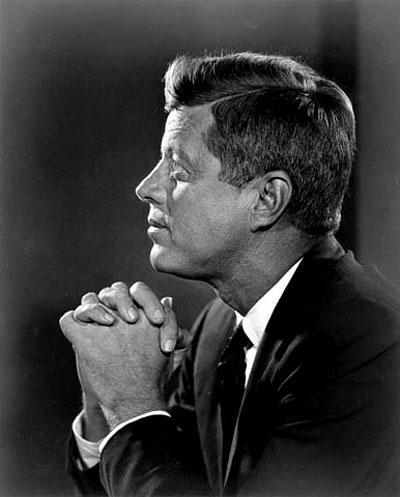
Were FDR, JFK, and LBJ Dispensationalists?

Maybe if being dispensationalist means going by three initials.

But I worry that Donny Friederichsen is barking up the wrong tree when he blames those Scopes Reference Bible-thumping end-of-time worriers for American exceptionalism — the idea that the United States is better and more blessed than other nations:

The belief in American exceptionalism was wedded to the growing theological movement known as Dispensationalism in the late 19th and early 20th century. Dispensationalism, a novel theological movement that was popularized by J.N. Darby and C.I. Schofield, convinced Christians that they could most certainly find American exceptionalism in the Scriptures. Through the vehicle of Dispensationalism, America became the pinnacle of Christendom, the “City on a Hill,” but not in the manner it was originally used by John Winthrop when he quoted Matthew 5:14 in 1630. Winthrop argued that the eyes of the world would be upon their colony and if they dealt falsely with God, then God would make them a byword. Winthrop saw no special virtue or exceptionalism in his colony, rather he used it as a call to actually live out their Christian faith in spite of their inherent sinfulness. Instead, American evangelicals began to see the United States as THE beacon of God’s divine light and the highpoint of humanity. For example, the fiction series, Left Behind, by Tim LaHaye and Jerry Jenkins presents a Dispensational view of the end times, which makes clear that the US and the modern nation-state of Israel are the principal players in God’s great redemptive plan of history. Any attitude that suggests that the US has a divine right to global supremacy, is pervasive.

The thing is, American exceptionalism was (and is) mainstream. Dispensationalism was and is not. Listen to FDR:

We are fighting today for security, for progress, and for peace, not only for ourselves but for all men, not only for one generation but for all generations. We are fighting to cleanse the world of ancient evils, ancient ills.

Our enemies are guided by brutal cynicism, by unholy contempt for the human race. We are inspired by a faith that goes back through all the years to the first chapter of the Book of Genesis: “God created man in His own image.”

We on our side are striving to be true to that divine heritage. We are fighting, as our fathers have fought, to uphold the doctrine that all men are equal in the sight of God. Those on the other side are striving to destroy this deep belief and to create a world in their own image—a world of tyranny and cruelty and serfdom.

That is the conflict that day and night now pervades our lives.

No compromise can end that conflict.

Or what about JFK?

Finally, whether you are citizens of America or citizens of the world, ask of us here the same high standards of strength and sacrifice which we ask of you. With a good conscience our only sure reward, with history the final judge of our deeds, let us go forth to lead the land we love, asking His blessing and His help, but knowing that here on earth God’s work must truly be our own.

And don’t discount LBJ.

We are also there because there are great stakes in the balance. Let no one think for a moment that retreat from Viet-Nam would bring an end to conflict. The battle would be renewed in one country and then another. The central lesson of our time is that the appetite of aggression is never satisfied. To withdraw from one battlefield means only to prepare for the next. We must say in southeast Asia–as we did in Europe–in the words of the Bible: “Hitherto shalt thou come, but no further.” . . .

We may well be living in the time foretold many years ago when it was said: “I call heaven and earth to record this day against you, that I have set before you life and death, blessing and cursing: therefore choose life, that both thou and thy seed may live.”

This generation of the world must choose: destroy or build, kill or aid, hate or understand.

We can do all these things on a scale never dreamed of before.

Well, we will choose life. In so doing we will prevail over the enemies within man, and over the natural enemies of all mankind.

Of course, Bible-believing Protestants have a lot for which to answer. But a POTUS who uses the Bible and doesn’t believe the passage he invokes, may have more answers to give. And if he believes those passages, said POTUS may be a bigger fool than President Trump.

Biblical Appropriation

If Oberlin College students may complain about inauthentic renditions of ethnic recipes, may not Christians complain about less than complete appeals to the Bible (fake proof texting)? For instance, here is Michael B. Curry, the presiding bishop of the Episcopal Church, on what obligates his communion to welcome LGBT ect. persons:

I’ve said it publicly in a variety of contexts, that as a church, as the Episcopal Church, we really have wrestled with how do we take seriously what Jesus was talking about. He was quoting the prophets, but when he said “my house will be called a house of prayer for all people,” and part of that quote is from Isaiah 56, it’s there in that vision of the temple where there are no outcasts in the temple. Remember that Jesus is pointing back to the eunuch, the foreigner, categories of people who, by part of the law, were excluded from worship in the temple, but are now included. My house should be called a house of prayer for all people.

And so how do we live that? How do we live that house of prayer for all people? Or to take it another step, how do we, as a community, take seriously when St. Paul in Galatians says all who have been baptized into Christ, and put on Christ, and there is no more Jew or Greek, slave or free, male or female, but all are one in Christ—how do we live into that? And so as I’ve said on other occasions, part of how we’ve lived into that is by recognizing in our community all who have been baptized, whether they’re gay, straight, lesbian, bisexual, transgender, rich, poor, Republican, Democrat—you know, just roll out the list.

Do liberal Protestants really buy this? Do people who have gone to college, done a graduate degree, have professional jobs, and read the New York Times, all the while maintaining a church membership, really believe this argument is the slightest bit plausible? And they worry about fake news! This is like saying the United States is committed to equality for all people, extending to equal access to marriage, simply by invoking the Declaration of Independence and not paying a whiff of attention to the Constitution or the Bill of Rights. You simply look into revered documents to justify whatever you believe (or more likely want).

But what if the Bishop had to pay as much attention to other passages of Scripture?

If anyone comes to me and does not hate his own father and mother and wife and children and brothers and sisters, pyes, and even his own life, he cannot be my disciple. Whoever does not bear his own cross and come after me cannot be my disciple. (Luke 14:26-27)

What if Bishop Curry wanted to create a church that encouraged hatred within families? Of course, that sounds kind of silly. But the Bible does have troubling bits (think the whole Old Testament). If you want to invoke the Bible and Jesus, you really do need to pay attention to everything. And if you find stuff there that you don’t like, then maybe you need to reject it all rather than just take the parts that are agreeable.

I mean, we have learned to dispense with the Confederacy. So when will those committed to social justice learn to abandon a book that in roughly 2 percent of its contents supports their convictions? Heck, even Russia has elections.

And mainliners are supposed to be the smart Christians in the room?

Pascal’s Wager After Vatican II

Father Dwight thinks that the arguments for becoming a Roman Catholic have to do with having more Christianity, not with whether or not you are saved:

So is there salvation outside the Church? Does that mean “There no salvation outside the Catholic Church?” The old guys said, “No Way.” The new guys say, “Well, you know the Church is bigger than the Catholic Church. Christ’s salvation extends to all who are baptized and have faith in Christ.”

Uh-huh. I get it.

“Furthermore, it may extend to all men and women of goodwill who follow the light to the best of their ability. They’re salvation is also through Christ for he is the source of all goodness, truth and beauty even if they don’t know it.”

OK. If you say so.

Well, good for them, but I’m not taking any chances.

I want more Christianity, not mere Christianity, and it is only within the great, graced riches of the Catholic Faith that I can hope for this wounded soul to be healed and for me to make my long journey home.

Why does more Christianity always involve less Christ? Liberal Protestants added western civilization and modern science to Christianity and abandoned the atonement. Neo-Calvinists add the transformation of culture and forget the Canons of Dort. Now in the post-Vatican II Church you get all the statues and rites and holy days without the assurance that you need them for salvation. I don’t know why Father Dwight considers that more. Where else do you go for salvation than to Jesus?

Cool or Wretched: Which Kind of Christian are You?

Here is what one of the apostles’ successors says makes Roman Catholicism “cool”:

Guilt. Pundits and comedians make fun of “Catholic guilt,” often described as an overactive conscience that makes us think everything is a sin. For example, when forgetting to floss, or not finishing all the food on your plate becomes confession material. But while people make fun of Catholics for their scrupulosity, in fact, having a little guilt is a healthy habit. It keeps us from getting into trouble and inspires us to do the right thing. Our world today would benefit from a little “Catholic guilt.”

What happened to that sense of the penalty for sin that Paul agonized in Romans 7?

21 So I find it to be a law that when I want to do right, evil lies close at hand. 22 For I delight in the law of God, in my inner being, 23 but I see in my members another law waging war against the law of my mind and making me captive to the law of sin that dwells in my members. 24 Wretched man that I am! Who will deliver me from this body of death? 25 Thanks be to God through Jesus Christ our Lord! So then, I myself serve the law of God with my mind, but with my flesh I serve the law of sin.

Funny how a little bit of guilt goes a long way — all the way to the cross.

How can you be scrupulous and turn guilt into something by which to appeal to youth?

What I Learned about My Brother

Today is his birthday and he shares it with Bob Dylan.

Of course, Dylan is better known than Don Hart. But they share the same birthday and they are both musicians. Talk about harmonic — see what I did there? — convergence.

But Don Hart is way better know than IiiiiiiiiiIIIIIIII.

America First as NIMBY for the Nation

Old neighbors in Philadelphia are objecting to a business that is expanding its hours and footprint:

Past residents of Chestnut Hill, through great effort, created a vision for the neighborhood. We owe them a great debt and we believe that we have a duty to be just as vigilant and visionary as our forebears.

Nearly 40 years ago, under the auspices of the Chestnut Hill Community Association, and well covered by this newspaper, a covenant was hammered out between the owners of the Chestnut Hill Hotel and its near neighbors on Ardleigh Street. This was no easy task. It took the efforts of hundreds of Chestnut Hill residents, city politicians, and the CHCA. The covenant runs in perpetuity with the property.

Such covenants are extremely important and should not be discarded or ignored in a willy-nilly fashion. Certainly, any attempt to supersede or challenge the covenant should be presented and discussed with the parties involved. Such was never done with the neighbors on Ardleigh Street. Only the heavy construction work we heard coming over the fence in the dead of night alerted us that something was happening. Now we are faced with a fait accompli, and our only recourse seems to spend thousands of dollars in legal fees to have our living covenant recognized. How is this at all neighborly?

As development proceeds in Chestnut Hill, all of us should be concerned about the abrogation of covenants. Ours is not the only such covenant here, and by acceding to the development whims at the Chestnut Hill Hotel property without any review, all such covenants are mocked and threatened. I appeal to the CHCA to take careful note.

Finally, the system set up to monitor local development, which includes building codes, zoning and the associated permits, are not to be ignored. All those seemingly petty requirements – the posting of permits, height restrictions, propinquity to elementary schools – are important. And again, the wider community should take note because what is scoffed at and ignored in our neighborhood is coming your way sooner or later. There is and will continue to be voracious demand for development in Chestnut Hill.

Given the demographics of the place, I assume many of these concerned residents are liberal politically and supported Hillary Clinton in last year’s election for POTUS. But imagine if these same people thought about the United States, its borders, and the expectations underwritten by the Constitution the same way that they think about their neighborhood and what threatens their way of life.

If they did that, would they really have trouble understanding people who voted for a president who campaigned to take borders seriously, to put national interests first, and who annoyed a lot of citizens who disdained rather than cared for Americans living in fly-over country?

Deep inside every American, conservative or liberal, beats a Not In My Back Yard heart. Why the outrage when the wrong side shows it has a pulse?

How the Making of Saints Led to the Eating of Sausage

In other words, you don’t want to see how they make saints any more than you want to observe the making of sausage. Consider, for instance, Francis Oakley’s review of a new book on canonization:

During much of the first millennium of Christian history, when it came to the recognition of sanctity, spontaneity seems to have been the order of the day. That is to say, the initiative was usually taken at the popular local level in Christian communities where cults of martyrs, confessors, and other saintly individuals had welled up and found expression in rituals and offerings at the tombs of the deceased or pilgrimages to reputedly holy sites. Official ecclesiastical sanction for such cultic practices was at first no more than sporadic. In the latter part of that era, however, local ordinaries increasingly undertook to exercise at least a supervisory role in relation to such saintly cults. And in a third phase, the one on which Prudlo focuses in this book, the high medieval quickening of papal centralization led to the growing papal domination of the process of saintly canonization, culminating in the fourteenth century with what almost amounted to papal monopolization of the whole business. “Almost” because, as Prudlo prudently concedes, that development may not have been “fully completed” until Urban VIII in 1634 definitively reserved to the papacy the prerogative of canonization.

The church that Jesus founded? Hardly.

The implications of this process for papal infallibility are also intruiguing:

the accumulating discourse pertaining to infallibility in canonization provided a new vocabulary and a new lexicon with which to carry on development of the infallibility discussion into the Counter-Reformation and beyond. It is true that when the First Vatican Council came finally to define the dogma of papal infallibility it made no mention of infallibility in canonization and focused exclusively on the broader issue of ex cathedra papal doctrinal definitions on matters of faith and morals. But recondite though the canonization-infallibility nexus may be, Prudlo’s findings are directly and significantly pertinent to the ongoing debate about the historical origins of the infallibility dogma and any historians working henceforth in that conflicted field will certainly have to take those findings into account.

In other words, papal infallibility is bound up with the debatable practice of recognizing saints.

Notice too that the doctrine of infallibility was originally designed to restrict, not enhance, papal authority:

the doctrine had been advanced with the goal not of enhancing papal power but of limiting it via the insistence that popes were bound by the inerrant, irreformable teachings of their predecessors. It is not surprising, then, that Pope John XXII (1316–34), no theologian but a canonist of distinction, seeing the insistence on papal infallibility as an infringement upon the pope’s sovereignty, described it as a “pestiferous doctrine” and treated it accordingly as some sort of dangerous novelty.

Meanwhile, everyone should have known that if Paul could refer to the Corinthians as saints, such hoops and hurdles were hardly necessary or very sanctified.

Tim Keller Plants, New York City Gives the Growth

In the ballpark of always affirming, always sunny religious journalism comes Sarah Eekhoff Zylstra’s puff piece on Tim Keller’s retirement at Redeemer NYC. I am not sure that this is the kind of analysis of context that Joe Carter had in mind for the Gospel Coalition’s journalistic forays:

The three main forms of journalism we use at TGC (opinion and advocacy journalism; reporting and narrative journalism; explanatory journalism) are all used to help the church think more clearly about the gospel and how it leads us to interact with the world.

Although, since Carter thinks journalism at TGC should promote revivals, Zylstra’s piece certainly does that. Her account shows, whether she intended or not, how much Keller’s position in New York City made him stand out in ways that no one else among the Allies could. If you do a word count on Zylstra’s story, she mentions the PCA twice, Presbyterian six times, and New York 37 times. As for the work of the Holy Spirit — nada.

If religious journalism at TGC is supposed to promote revivals, that would place Zylstra’s rendering of Keller more on the Finney than the Whitefield side of pretty good awakenings since Finney wasn’t big on the Holy Spirit either.

What I don’t understand is why Mark Dever doesn’t get more attention in the TGC world. There he is ministering in the nation’s capitol, the center of American power, the place from which the United States leads the free world. And yet, to get traction as an urban church planter you need the mojo of the nation’s biggest city, the place that nurtured and shaped Donald J. Trump.

What’s up with that?