Good and Bad Israel Complexes

David P. Goldman (aka Spengler) tries to explain appropriate and inappropriate appropriations of Israel:

There is a fine but definite line, to be sure, between the Gentiles’ identification with Israel and their idolatrous desire for election in place of Israel. It is one thing for the Puritans to speak metaphorically of a new chosen people in a new promised land, and quite another for Joseph Smith to rewrite Scripture in order to place Jesus Christ on American soil. African Americans saw themselves as suffering Israel in Egypt, and their emancipation as a new exodus; that is not the same as James Cone’s eccentric 1969 claim that Jesus was black and that blacks are the chosen people.

Goldman thinks the key to this distinction is whether or not Christians engage in theocracy because he believes Christians are people of God “by the Spirit” not “by the flesh.” As such, Christians have a dual loyalty, one their nation by birth, the other their kingdom by new birth. He invokes the Jewish theologian Michael Wyschogrod:

As understood by Christianity, a model of dual loyalty develops. The individual belongs both to a nation and to a religion. He is a Frenchman and a Christian or a German and a Christian. As Frenchman or German, he is a member of a national community with territorial and linguistic boundaries. But he is also a member of the supra-national church which has no national boundaries . . . . The church is a spiritual fellowship into which men bring their national identities because they possess these identities but not because such identities play a role in the church. The church thus understands itself as having universalized the national election of Israel by opening it to all men who, in entering the church, enter a spiritualized, universalized new Israel.

This sure seems 2k friendly.

Who Paved the Way for Trump?

It was not Jerry Falwell (or his son).

It was the gatekeepers who decided gates were simply mental constructions and who celebrated those who ran with the new freedom.

Want to know where fake news came from? Looks like it was Harvard not Liberty University (thanks to one of our many southern correspondents):

Trump’s playbook should be familiar to any student of critical theory and philosophy. It often feels like Trump has stolen our ideas and weaponized them.

For decades, critical social scientists and humanists have chipped away at the idea of truth. We’ve deconstructed facts, insisted that knowledge is situated and denied the existence of objectivity. The bedrock claim of critical philosophy, going back to Kant, is simple: We can never have certain knowledge about the world in its entirety. Claiming to know the truth is therefore a kind of assertion of power.

These ideas animate the work of influential thinkers like Nietzsche, Foucault and Derrida, and they’ve become axiomatic for many scholars in literary studies, cultural anthropology and sociology.

From these premises, philosophers and theorists have derived a number of related insights. One is that facts are socially constructed. People who produce facts — scientists, reporters, witnesses — do so from a particular social position (maybe they’re white, male and live in America) that influences how they perceive, interpret and judge the world. They rely on non-neutral methods (microscopes, cameras, eyeballs) and use non-neutral symbols (words, numbers, images) to communicate facts to people who receive, interpret and deploy them from their own social positions.

Call it what you want: relativism, constructivism, deconstruction, postmodernism, critique. The idea is the same: Truth is not found, but made, and making truth means exercising power.

Casey Williams argues that the populist right has abused postmodernism.

The reductive version is simpler and easier to abuse: Fact is fiction, and anything goes. It’s this version of critical social theory that the populist right has seized on and that Trump has made into a powerful weapon.

One might object that Trump’s disregard for the truth is nothing new. American presidents have always twisted facts to fit their agenda and have always dismissed truths that threatened to sink them. Even George Washington’s great claim to honesty — that he ’fessed up to felling a cherry tree — was a deception. One could also argue that Trump is more Machiavellian than Foucauldian and that he doesn’t actually believe what he says: He propagates misinformation strategically, to excite his base and smear his opponents.

Not to be missed is what happens when other celebrities flout conventions. Then it becomes art and poignant. And so Lena Dunham is prescient (while Trump is so ordinary when he is not despicable):

The romance between this newspaper and the HBO show “Girls” is somewhat legendary. Between its debut in 2012 and its finale last Sunday, according to some exhaustive data journalism from The Awl, The New York Times published 37 articles about the show, its fans, its creator and star, Lena Dunham, plus her co-stars’ clothes and paintings and workout routines and exotic pets.

Except, fact-check: I made up the exotic pets, and The Awl’s list unaccountably failed to include my own contribution to The Times’s Dunham-mania, a love letter to the show’s flirtations with cultural reaction.

Was some of this coverage excessive? Well, let’s concede that the ratio of thinkpieces (all over the web, not just in this newspaper) to actual viewers was considerably higher for “Girls” than for, say, “Game of Thrones.” Let’s concede that the media loved to talk about the show in part because it was set among young white people in Brooklyn, a demographic just possibly overrepresented among the people who write about pop culture for a living. Let’s concede that Dunham’s peculiar role in electoral politics, as one of the most visible and, um, creative millennial-generation surrogates for Barack Obama and then Hillary Clinton, played some role in the press’s fascination with her show.

But now that we have the show in full, I think the scale of coverage actually holds up quite well — my own small part in it very much included. Indeed, I suspect that “Girls” will be remembered as the most interesting and important television show of the years in which it ran, to which cultural critics will inevitably return when they argue about art and society in the now-vanished era of Obama.

I know it’s hard to seem to be upholding the status quo. Baby boomers would rather have an edge, be a little deviant, and resist being part of the establishment.

But at some point you grow up, or you find no rationale for opposing a man (now president) who has been simply floating along with the decline of standards.


But (not all about) Me No Buts

In honor of the Bard’s birth which occurred sometime before his baptism recorded on April 26, 1564 — puts the Elizabeth in Elizabethan English.

Founding Fineprint

Lots of apologists insist that the Church of Rome is the one that Jesus Christ founded. That strikes me as a real slight to the Eastern churches and especially to the Church of Jerusalem where Jesus ministered. After all, Tertullian didn’t ask, “What Hath Rome to do with Athens?”

Now it turns out that the original language of the church that Jesus founded was not Latin but Greek:

First, we should know that the Apostles all spoke Greek in addition to their native Aramaic. It was the language of education and business. In Galilee (Galilee of the Gentiles as it was known in Palestine) a Jew had to know Greek if he wanted to talk to a gentile. Perhaps Our Lord Himself spoke Greek with the Roman centurion and Pilate. In the synagogues the Jews read from the Hebrew translation of the Greek translation (the Septuagint) of the Old Testament. Second, all of the New Testament — with the exception of Saint Matthew’s original Gospel which was written in Aramaic — was inspired in Greek. Third, when Saint Peter came to Rome the Jews residing there spoke Greek, the whole Mediterranean world did. Saint Peter offered Mass in Greek. Around his tomb, deep in the catacombs under Vatican hill (beneath Saint Peter’s main altar), the faithful who were buried all around the Apostle had “Peter pray for us” written in Greek on their own tombs. Fourth, the Roman Latin Rite grew slowly out of Itala Latin which was spoken by the gentile converts in Italy and North Africa and used in the liturgy sometime after Greek fell into desuetude in the West. Classical Latin (Ciceronian) was not used in the liturgy, but was used by the well-educated fathers, such as Tertullian, Saint Cyprian, Saint Hilary of Poitiers, Saint Ambrose, and Saint Augustine, in their writings. By the fourth century, Itala Latin, which was rather fluid, dominated in most of Italy and North Africa. Enter Saint Jerome (d. 420). His Latin Vulgate translation of the Bible facilitated the birth of what developed into “ecclesiastical,” Church Latin. Many Greek words found their way into Church Latin on account of their theological and scriptural importance. Ecclesia (church) is only one such word — there was no word in Latin adequate enough to convey such a Greek concept. By the sixth century, Latin became the standard for the Roman liturgy, as we see in the Leonine Sacramentary and later the Gelasian. By the time of Gregory the Great (d. 604) the Latin Canon of the Mass was fixed (canonized) with the addition of a number of Roman martyrs in the Memoriam and the Nobis Quoque Peccatoribus. The Roman Canon remained untouched for nearly fourteen hundred years.

If you want to be the Church that Jesus founded, shouldn’t you use the original language of the apostles you’re claiming to represent?

That’s not what Pope John XXIII thought:

Universal

Since “every Church must assemble round the Roman Church,”8 and since the Supreme Pontiffs have “true episcopal power, ordinary and immediate, over each and every Church and each and every Pastor, as well as over the faithful”9 of every rite and language, it seems particularly desirable that the instrument of mutual communication be uniform and universal, especially between the Apostolic See and the Churches which use the same Latin rite.

When, therefore, the Roman Pontiffs wish to instruct the Catholic world, or when the Congregations of the Roman Curia handle matters or draw up decrees which concern the whole body of the faithful, they invariably make use of Latin, for this is a maternal voice acceptable to countless nations.

Immutable

Furthermore, the Church’s language must be not only universal but also immutable. Modern languages are liable to change, and no single one of them is superior to the others in authority. Thus if the truths of the Catholic Church were entrusted to an unspecified number of them, the meaning of these truths, varied as they are, would not be manifested to everyone with sufficient clarity and precision. There would, moreover, be no language which could serve as a common and constant norm by which to gauge the exact meaning of other renderings.

But Latin is indeed such a language. It is set and unchanging. it has long since ceased to be affected by those alterations in the meaning of words which are the normal result of daily, popular use. Certain Latin words, it is true, acquired new meanings as Christian teaching developed and needed to be explained and defended, but these new meanings have long since become accepted and firmly established.

Non-vernacular

Finally, the Catholic Church has a dignity far surpassing that of every merely human society, for it was founded by Christ the Lord. It is altogether fitting, therefore, that the language it uses should be noble, majestic, and non-vernacular.

In addition, the Latin language “can be called truly catholic.”10 It has been consecrated through constant use by the Apostolic See, the mother and teacher of all Churches, and must be esteemed “a treasure … of incomparable worth.”11. It is a general passport to the proper understanding of the Christian writers of antiquity and the documents of the Church’s teaching.12 It is also a most effective bond, binding the Church of today with that of the past and of the future in wonderful continuity.

Tell me it’s not odd when you insist on a language that God refused to use when he revealed the gospel.

Public Intellectuals, Public Protestants

This piece is making the rounds, one about the sorts of public intellectuals that now sound off at TED talks and other such progressive forums. And it got me thinking about differences between Presbyterians and Princeton Seminary:

Early on, [Drezner] he makes a crucial distinction between old-fashioned “public intellectuals” and the now-trendy “thought leaders.” The latter model is one that sells itself less to an identifiable “public”—something that has become increasingly difficult to define in a society continually segmenting itself according to ever-more-narrow criteria—than to plutocratic patrons. Once upon a time, we relied on intellectuals to “speak truth to power,” as the saying goes. Of course, real life was never so simple. But the adversary culture that arose in the bohemia of Greenwich Village in the early 20th century and among the (mostly) Jewish intellectuals who founded the independent Partisan Review in the 1930s offered at least a basis from which both to critique capitalism and to imagine alternative systems that might one day replace it.

Today, our most famous purveyors of ideas sell themselves to the wealthy much like the courtiers of the Middle Ages. Drezner notes that these ideas are therefore shaped by the “aversion” that plutocrats share toward addressing the problems we face. Inequality? Global warming? Populist nihilism? An explosion of global refugees? From a Silicon Valley perspective, Drezner notes, such things are not a failure of our system but rather “a piece of faulty code that need[s] to be hacked.” Examining data from a survey of Silicon Valley corporate founders, Drezner notes their shared belief that “there’s no inherent conflict between major groups in society (workers vs. corporations, citizens vs. government, or America vs. other nations).”

So is Machen more like the old Jewish intellectuals who spoke truth to power, while Keller is more like the “famous purveyors of ideas”? Does that explain why Princeton repudiated Machen altogether but still made a place for Keller who still went there to speak about planting churches?

Just an obsession.

Can Fairy Tales Do More than the Holy Spirit?

As much as I live and breathe and have my being in conservative circles in the United States, I cannot understand how conservatives who are Christians can write so cheerfully about virtue and what it takes to cultivate it:

Mere instruction in morality is not sufficient to nurture the virtues. It might even backfire, especially when the presentation is heavily exhortative and the pupil’s will is coerced. Instead, a compelling vision of the goodness of goodness itself needs to be presented in a way that is attractive and stirs the imagination. A good moral education addresses both the cognitive and affective dimensions of human nature. Stories are an irreplaceable medium of this kind of moral education. This is the education of character.

The Greek word for character literally means an impression. Moral character is an impression stamped upon the self. Character is defined by its orientation, consistency, and constancy. Today we often equate freedom with morality and goodness. But this is naïve because freedom is transcendent and the precondition of choice itself. Depending upon his character, an individual will be drawn toward either goodness or wickedness. Moral and immoral behavior is freedom enacted either for good or for ill.

The great fairy tales and children’s fantasy stories attractively depict character and virtue. In these stories, the virtues glimmer as if in a looking glass, and wickedness and deception are unmasked of their pretensions to goodness and truth. These stories make us face the unvarnished truth about ourselves while compelling us to consider what kind of people we want to be.

Calvinists have a problem with this, obviously, since they put the T in Total Depravity. But shouldn’t any Christian who considers himself Augustinian or any theist who believes in the fall (recorded in the not so fair tale of Genesis)? Can’t we at least, if you’re not going to talk about effectual calling, reserve some space for baptism and the sacraments more generally?

Or, are we supposed to conclude that a kid reared on Beauty and the Beast has as much a shot at virtue as the one who’s baptized? If that’s the case, then why is cult so much the bedrock of culture?

Why Didn’t Douthat Recommend Keller?

When Ross encouraged liberals to go to church on Easter, he even mentioned Marilynne Robinson:

Liberals, give mainline Protestantism another chance.

Do it for your political philosophy: More religion would make liberalism more intellectually coherent (the “created” in “created equal” is there for a reason), more politically effective, more rooted in its own history, less of a congerie of suspicious “allies” and more of an actual fraternity.

Do it for your friends and neighbors, town and cities: Thriving congregations have spillover effects that even anti-Trump marches can’t match.

Do it for your family: Church is good for health and happiness, it’s a better place to meet a mate than Tinder, and even its most modernized form is still an ark of memory, a link between the living and the dead.

I understand that there’s the minor problem of actual belief. But honestly, dear liberals, many of you do believe in the kind of open Gospel that a lot of mainline churches preach.

If pressed, most of you aren’t hard-core atheists: You pursue religious experiences, you have affinities for Unitarianism or Quakerism, you can even appreciate Christian orthodoxy when it’s woven into Marilynne Robinson novels or the “Letter From Birmingham Jail.”

Did Princeton Seminary spook Douthat? Shouldn’t Jonathan Merritt be outraged that Douthat snubbed Keller?

What about John 18:11 Did They Not Understand?

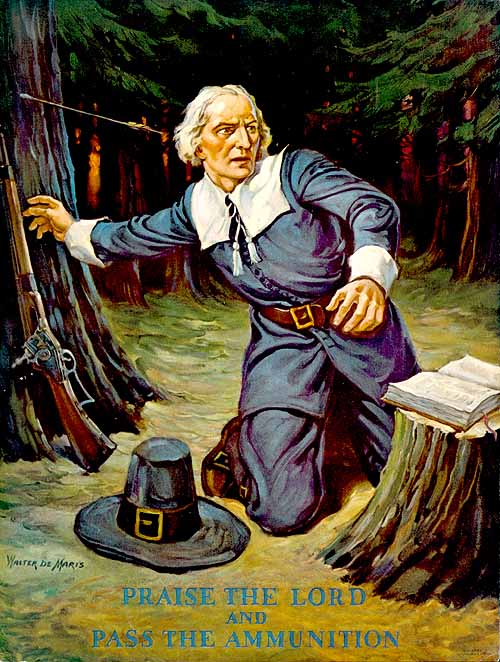
Civil religion comes in many forms, but this one (heard yesterday morning during Big Band Sunday) was stunning:

Down went the gunner, a bullet was his fate
Down went the gunner, and then the gunner’s mate
Up jumped the sky pilot, gave the boys a look
And manned the gun himself as he laid aside The Book, shouting

Praise the Lord and pass the ammunition
And we’ll all stay free

Praise the Lord and swing into position
Can’t afford to be a politician
Praise the Lord, we’re all between perdition
And the deep blue sea

Yes the sky pilot said it
Ya gotta give him credit
For a son of a gun of a gunner was he shouting

Praise the Lord, we’re on a mighty mission
All aboard, we ain’t a-goin’ fishin’
Praise the Lord and pass the ammunition
And we’ll all stay free

Praise the Lord (Praise the Lord) and pass the ammunition
And we’ll all stay free

Praise the Lord and pass the ammunition
And we’ll all stay free

The problem isn’t passing the ammunition. If you want to shoot to defend your country, that’s a responsible end. But why would your baptize retaliating against Japan’s attack at Pearl Harbor with an Hallelujah?

Christ’s kingdom in the New Testament (as opposed to the Israelites conquest of Canaan) doesn’t come by the physical sword (unless you want to get really technical about the Bible):

2 Now Judas, who betrayed him, also knew the place, for Jesus often met there with his disciples. 3 So Judas, having procured a band of soldiers and some officers from the chief priests and the Pharisees, went there with lanterns and torches and weapons. 4 Then Jesus, knowing all that would happen to him, came forward and said to them, “Whom do you seek?” 5 They answered him, “Jesus of Nazareth.” Jesus said to them, “I am he.”a Judas, who betrayed him, was standing with them. 6 When Jesus said to them, “I am he,” they drew back and fell to the ground. 7 So he asked them again, “Whom do you seek?” And they said, “Jesus of Nazareth.” 8 Jesus answered, “I told you that I am he. So, if you seek me, let these men go.” 9 This was to fulfill the word that he had spoken: “Of those whom you gave me I have lost not one.” 10 Then Simon Peter, having a sword, drew it and struck the high priest’s servant and cut off his right ear. (The servant’s name was Malchus.) 11 So Jesus said to Peter, “Put your sword into its sheath; shall I not drink the cup that the Father has given me?” (John 18)

I wonder if the Reformed and Presbyterian chaplains would object to the song.

Why Protestantism Matters

Things you may hear in Rome during holy week:

“It is more important that men and women become holy,” Cantalamessa said, “than that they know the name of the one Savior.”

“Without the Madonna, we can’t go forward in our priesthood!” Francis said.

“Each one of us has entered into our own personal tomb,” Francis said, in the one extemporaneous addition to his homily. “I’m inviting you to come out.”

“God loves like this: Until the end, giving his life for each one of us,” Francis said in his homily. “It’s not easy, because all of us are sinners, we have limits, flaws. Yes, we all know how to love, but not like God loves, without looking at the consequences, until the end.”

Could this kind of teaching be the reason the Roman church is facing a shortage of priests?

Father Douglas Grandon is one of those rare exceptions – a married Roman Catholic priest. He was a married Episcopalian priest when he and his family decided to enter the Catholic Church 14 years ago, and received permission from Benedict XVI to become a Catholic priest.

Even though Grandon recognizes the priest shortage, he said opening the doors to the married priesthood would not solve the root issue of that shortage.

“In my opinion, the key to solving the priest shortage is more commitment to what George Weigel calls evangelical Catholicism,” Grandon told CNA.

“Whether you’re Protestant or Catholic, vocations come from a very strong commitment to the basic commands of Jesus to preach the Gospel and make disciples. Wherever there’s this strong evangelical commitment, wherever priests are committed to deepening people’s faith and making them serious disciples, you have vocations. That is really the key.”

If it’s broke, why convert?

United Statesist Christianity

We need a new name for Christianity in the United States. The contributors to this podcast at Christianity Today are still lamenting the turnout of white evangelicals for Donald Trump and so one of them called for more attention to what it means to be evangelical. Are you kidding? We’ve had almost four decades of scholarship on evangelicalism, and at least three of chanting the integration of faith and learning, and we still don’t know what evangelical is? Please.

Then comes the objection to calling Lee Stroebel, whose new film is drawing attention to the Bill Hybels-spawned apologist, a fundamentalist.

A note or two about Strobel, the legal-affairs journalist. He did his undergraduate degree at a top j-school, the University of Missouri, and then went to Yale University to get his law degree. That gives some clues as to his approach to research and writing.

Strobel converted to Christianity in 1981 and, after a few years, went into ministry – becoming a “teaching pastor” at the world famous Willow Creek Community Church in the Chicago suburbs.

Now, WIllow Creek – led by the Rev. Bill Hybels – has for decades been known as, literally, a globel hub for the “seeker friendly” school of mainstream (some would say somewhat “progressive”) evangelicalism. Hybels, of course, became a major news-media figure in the 1990s through his writings and his role as one of the “spiritual advisors” and private pastors to President Bill Clinton.

Willow Creek is not a fundamentalist church.

From there, Strobel went west and for several years served as a writer in residence and teaching pastor at Saddleback Community Church, founded and led by the Rev. Rick “The Purpose Driven Life” Warren. In addition to writing one of the bestselling books in the history of Planet Earth, Warren has also received quite a bit of news-media attention through his high-profile dialogues with President Barack Obama, both during Obama’s first White House campaign and in the years afterwards.

Saddleback is not a fundamentalist church.

Fair points. I don’t think Stroebel is a fundamentalist either. But evangelical is increasingly meaningless even among Protestants who haven’t read (hades!, heard of) Deconstructing Evangelicalism.

So why not simply identify Christianity in the United States according to the degree to which its adherents adapt their faith (or pick and choose) to national norms? (Do remember that in 1899 Leo XIII identified Americanism as a heresy.) Once upon a time, Protestants came to North American and tried to transmit the version of Protestantism (works for Roman Catholics and Jews also) they brought to a New World setting. Some confessional Protestants still do this and triangulate their ministry in the U.S. according to precedents set in Europe whether at the time of the Reformation or when specific episodes upset national churches (think Scotland, England, Netherlands, Germany). Presbyterians in NAPARC still live with a foot (or – ahem – toe nail) in Old World Protestantism even as they have repudiated (except for the Covenanters) the political structures that animated their European predecessors.

But then along came awakenings and parachurch associations and increasingly Protestantism in the U.S. was known less for the fingerprints of its European origins than for those innovators (Whitefield and Moody) or structures (American Bible Society or National Association of Evangelicals) who were as independent of Old World Protestantism as their nation was of the United Kingdom. Once freed from European constraints, American Christianity used markets, earnestness, activism, and relevance as the basis for Christian identity. Evangelicalism was the kinder gentler version of fundamentalism. But neither showed the slightest bit of deference to the churches that came out of the Reformation.

Now, even the labels fundamentalist and evangelical make little difference. The gatekeepers won’t stand at the gate and even if they did the gateway has no wall to make the gate functional. Anyone can be a Christian on their own terms, with celebrities and parachurch agencies gaining the most imitators. But those instances of fame collect no dues, make no demands, and provide no institutional support. It’s like belonging to Red Sox Nation. Wear your bumper sticker. Listen to your Tim Keller sermon (now on sale for $1,500). Got to the next Gospel Coalition conference. You have Jesus in your heart and United Statesist Christianity has lots of proprietors to make your heart burn.

The good thing about United Statesist Christianity is that it allows its adherents to revel in exceptionalism. If America is a great nation, United Statesist Christianity is no less exceptional. Instead of a Pretty Good Awakening, United Statesist Christianity puts the Great back in Great Awakening.