Do Southern Baptists Need a Pope of Public Policy?

What could possibly go wrong? A communion appoints an officer to represent members’ views within the corridors of the most powerful nation on God’s glowing earth. And all the members — who are Protestants, mind you and not used to submitting to church hierarchy — are going to agree with all that the officer says or the agency he leads? Heck, even in the little old OPC where the stakes are considerably lower than the Southern Baptist Convention, you cannot get church members to agree with the editor of New Horizons magazine.

So why are so many people concerned and surprised that Southern Baptists are challenging Russell Moore at the Ethics and Religious Liberty Commission? Funny the way president-elect Trump winds people up.

I (all about me) have nothing against what Dr. Moore seems to be doing. I do suspect sometimes that he’s trying to soften the edge of the religious right in a way that Tim Keller tries to make Christianity less objectionable. Maybe Aaron Sorkin and David Simon have poisoned me to suspect that public statements always come through spinners and handlers who are looking at polls and access to power or gatekeepers. But some of Dr. Moore’s recent statements do seem to have more the fingerprints of building coalitions than those of “thus, saith the Lord” or even, “this is what Southern Baptists believe, gosh darn it.”

Here’s the problem. Moore heads an agency whose mission more Kuyperian than Williamsian (think Roger Williams):

The ERLC exists to articulate every priority and every agenda item in terms of where it fits in seeking the kingdom of God in this era, in order to equip churches to stand before the watching world with the sort of quiet confidence that characterized Jesus.

The kingdom is an “already” present reality (within the life of the church) but also a “not yet” future hope (as we await the coming of Jesus). This kingdom come includes not just worship, but righteousness (ethics), freedom (religious liberty), communion (society), authority (politics), and “the glory and honor of the nations” (culture). Seeking first the kingdom of God should not dampen our concern for ethics but should instead heighten it. After all, the priorities of the King must become the priorities of his kingdom colony, the church. Therefore, the kingdom of God sets both the content of our concern and the tone with which we speak.

That’s pretty broad. Southern Baptists might want to take note that Kuyperians and 2kers disagree about the nature of the kingdom (or kingdoms), so Christ as king is hardly a consensus building affirmation. Worse, hardly clear is the understanding that such a view of God’s kingdom emerges organically from Baptist theology and experience. As dissenters for a long time in England and low on the list of Anglo-American Protestants, some might be surprised to see Southern Baptists doing their impersonation of Puritans or their descendants, the United Church of Christ. Once up a time, Southern Baptists (I’ve heard) saved string so they could send foreign missionaries to India.

So this presence in the capitol of the world’s most powerful nation seems out of character for those little old Southern Baptists.

But if you are going to enter that environment as an ambassador of the Southern Baptist Convention, please don’t tell us you are doing so in a non-partisan way:

There is no more effective evangelical leader than Moore. Under his leadership the ERLC has grown in reach and influence, hosting numerous seminars on a variety of issues with policy-making attendees from both sides of the aisle. Additionally, the ERLC plays a vital role in a number of conservative coalitions. I have witnessed House and Senate leadership offices ask for Moore to personally participate in various events to lend legitimacy and gravitas.

Too often evangelical leaders get pigeonholed into partisan identities. This is not the case with Moore. Both parties see him as a leader transcending partisan divide and stereotypes. This is because Moore and his team balance speaking truth to power while achieving real policy victories.

Being Southern Baptist is non-partisan? This is the affliction that haunts American Protestantism. We somewhere along the line — think the Second Glorious Awakening (if the Brits can have a Glorious Revolution . . . ) — believed that Protestantism is a public faith. It is the religion of the United States. That didn’t work out real well for Roman Catholics or Jews or Mormons. But it had its moments and gave the United States a measure of national identity and spiritual overtones to reasons for fighting tyranny and authoritarianism. That conviction also hollowed out the gospel from the mainline churches. Access to power became something to protect lest the offense of the gospel and calls to repentance offend. The irony is that this mainline Protestant agenda for a Christian nation left the mainline churches without a voice once they questioned America for being too white, male, anti-Communist, Christian, and hetero. The mainline lost both the nation (it was never Christian but sexist and racist) and their place at the table (do mainline pastors even have access to the boards of Harvard, Yale, and Princeton?).

The solution to Dr. Moore’s woes is to close down ERLC and let the Southern Baptist Convention be a church that is fully Baptist (whether particular or general). We have public policy agencies for matters like religious liberty, marriage, civil society, and human dignity. Sometimes even the Democrats and Republicans consider those matters. Not to mention that the Roman Catholic Church has a far greater reach than Southern Baptists.

Let the church not be non-partisan, earnest, well-meaning, tolerant, or humanitarian. Let Southern Baptists be Southern and Baptist. (Or be really Kuyperian and form an Anti-Secularist Political Party.)

Christmas as Old School Presbyterianism’s Coexist Moment

Mustafa Akyol’s column on Christmas in Turkey revealed that paleo-Calvinists share much in common with conservative Muslims and Jews during the holiday season:

Islamists in Turkey, every year, come out on the streets or in their media with the slogan, “Muslims do not do Christmas.” Of course, they have every right to not to celebrate a religious feast that is not a part of their religion. But they not only refrain from Christmas; they also protest it.

In fact, those Islamists of Turkey, and other likeminded Christmas-despisers, often “do not know what they are doing,” to quote the noble words of the very person whose birthday is at question here. They typically condemn Santa Claus costumes and Christmas trees as signs of “Western cultural imperialism.” But Christianity is not merely Western; it is also African, Asian and, in fact, global.

Hmm. Christmas as a global solvent of local Reformed Protestant teachings and practices. Go figure.

Jews — ya think? — have similar problems with Christmas.

Israel, too, seems to have a similar problem.

I read about this in an Al-Jazeera English story titled, “Israeli rabbis launch war on Christmas tree.” It reported how the Jerusalem rabbinate issued a letter warning hotels in the city that “it is ‘forbidden’ by Jewish religious law to erect a tree or stage New Year’s parties.” In Haifa, a rabbi, Elad Dokow, went even further, called the Christmas tree “idolatry,” and warned that it was a “pagan” symbol that violated the kosher status buildings.

At a time when New Calvinists heighten their sensitivity to Muslims and Jews, when will they show a little concern for Old Calvinists?

On 2K, Lutheran 2K, Anabaptists, Theonomy, and Germany

Proto-Protestant supplies perspective.

First, Anabaptists are out:

Westminster West’s Two Kingdom theology breaks at points with the Lutheran variety and is certainly somewhat hostile to Theonomy and yet its retention of Kuyperian Dominionism places it much closer to the Lutheran and Theonomist understandings of the Kingdom than it does to the Anabaptist. Westminster’s version of Two Kingdoms is still very much pro-culture formation and while not Transformationalist in a de jure sense, from the standpoint of ‘radical’ Two Kingdom theology it represents a de facto rejection of Two Kingdoms.

The Anabaptist position if we are to accept that unfortunate label would identify both the Lutheran and Westminster West (or Escondido) positions as being One Kingdom with different nuances and not genuine expressions of Biblical Two Kingdom theology. From my standpoint it’s just a diluted (and thus somewhat improved) One Kingdom or Sacralist understanding of the Kingdom.

Second, Lutherans are as 1k as Kuyperians and theonomists:

Cooper is to be commended in some aspects of his presentation and argument. He does a great job demonstrating the actual Sacralist (One Kingdom) nature of Lutheran so-called Two Kingdom theology, a point I’ve been trying to make for many years. He intimately weds it to the Magisterial Reformation. His proper explanation of Lutheran Two Kingdom theology demonstrates that the charges made by Theonomists regarding its equivalence with the Anabaptist version are completely false.

For example whenever the Theonomists wish to attack what they call Radical Two Kingdom theology they will pin the indifference and acquiescence of the German population in the 1930s on their embrace of Lutheran Two Kingdom theology. Two Kingdom theology led to separatism (it is argued) and passivity. And thus the German Church and people let the Nazis come to power.

And then when Westminster Two Kingdom advocates point to Lutheranism as an example of a Two Kingdom Reformation heritage, and that their view is not guilty of novelty, the Theonomists will suddenly argue that Lutheran Two Kingdoms is more akin to their own Sacralist and Established Church position. They will then argue the Escondido variety is actually a version of Radical Two Kingdom theology.

In other words, the fundamental difference between magisterial and Anabaptist Protestants is that the former do not reject the state or the sword as legitimate spheres for Christians. (Not to mention that magisterial Protestants don’t question Christendom until 1789.)

Third, theonomists lie:

As usual the Theonomists have little interest in the truth of the matter and wish instead to destroy their intra-denominational opponents. Their historical theology is politicised and that’s something that always needs to be recognised when dealing with the Christian Right.

The politicisation of theology can be frustrating but Cooper makes it exceedingly clear. The Lutheran view has a very positive attitude to the state and in reality its model can be described as One Kingdom in two spheres… very much like the Kuyperian model embraced by Westminster West.

Finally, what went wrong in Germany (it wasn’t 2k):

This further demonstrates a point I have often made that it was the Sacral Theology of German Lutheranism that taught moral complacency, compliance and social conformity. They lost their sense of antithesis and equated German Kultur with Christianity. Hitler’s nationalism and anti-communism were sentiments they readily identified with. The German Church didn’t embrace Nazism due to passivity. Rather they (speaking in general terms) actively embraced it, viewing nationalism and political anti-communism (not to mention anti-Semitism) as expressions of piety and Christian culture.

True advocates of Two Kingdom theology are governed by antithesis and would never be taken in by or support such agendas. This is not to blame or slander Lutherans for what happened under the Third Reich but it helps to understand why an ostensibly ‘Christian’ nation would embrace a figure like Hitler and the agenda of his regime.

The Virtue of Being Vindictive

Morning reading left me stunned with this observation about the way Americans understand recent terrorist acts:

When Muslim Americans commit acts of terrorism, we hold ISIS and Hezbollah and “radical Islam” accountable for their actions, even if they are mentally unstable, and even if there is no direct connection between them and the groups that inspired them. We call these terrorists “self-radicalized.” It is how we see Dzhokhar and Tamerlan Tsarnaev, who bombed the Boston Marathon in 2013; and Omar Mateen, who went on a murderous rampage at the Pulse Night Club in Orlando last June; and Mohamed Lahouaiej-Bouhlel, who killed 86 people and injured 434 at a celebration in Nice on Bastille Day. They did not go to a terrorist training camp, or join an organized cell, or attend an anti-Western madrassa. They learned to hate from a network of web sites and magazines and videotapes. Their madrassa was the media….

[Robert] Dear became radicalized in precisely the same way. But because the media he listened to advocated war in the name of a Christian god, and argued for an ideology considered “conservative,” he is portrayed as no one’s responsibility. In fact, as I learned from hours of speaking with Dear, the narratives he learned from Rush Limbaugh and Alex Jones and Bill O’Reilly and countless far-right web sites meshed perfectly with his paranoid delusions, misogynist beliefs, and violent fantasies. The right-wing media didn’t just tell him what he wanted to hear. They brought authority and detail to a world he was convinced was tormenting him. They were his shelter and his inspiration, his only real community.

The point of Amanda Robb’s piece, coincidental that it comes in New Republic’s issue on President Obama’s legacy, seems to be that right-wing media is evil (just like the party they support). The Planned Parenthood shooter received lots of ideas from radio preachers even more obscure than Jen Hatmaker:

In those days, thanks to the Fairness Doctrine, major broadcast outlets were forbidden from running partisan content without providing equal time to opposing views. But on shortwave channels, right-wing broadcasts were proliferating. Dear tuned in as often as possible. “That’s what turned me on to the conspiracies and the Bible prophecies,” he recalled. His favorites included Brother Stair, a Pentecostal minister who has predicted the end of the world; William Cooper, who preached that aids was a man-made disease; Pete Peters, whom the Anti-Defamation League has called a “leading anti-Jewish, anti-minority, and anti-gay propagandist”; and Texe Marrs, leader of the Power of Prophecy Ministries, who claimed that the federal government committed the Oklahoma City bombing and framed Timothy McVeigh.

Dear also became fixated on small magazines devoted to right-wing conspiracies. He spent hours at Barnes & Noble poring over magazines like The Prophecy Club, The Spotlight, and Paranoia, obsessing over their brand of crackpot theorizing: how the Robert Bork confirmation battle was connected to the JFK assassination, how the World Trade Organization ran a secret “Codex Alimentarius,” how the government operated a series of Deep Underground Military Bases, how it was planning an “American Hiroshima.”

But you know, the Fairness Doctrine paved the way for Rush Limbaugh, Bill O’Reilly’s John the Bapist:

Those in the right-wing media who traffic in hate and conspiracy theories are quick to deny that they should be held responsible for the consequences of their words. After Waco, Rush Limbaugh took to the airwaves to predict that “the second violent American revolution” was imminent. Yet two weeks after the Oklahoma City bombing, he published an op-ed in Newsweek entitled “Why I’m Not to Blame.” After running 29 shows attacking George Tiller as “Tiller the Baby Killer” and saying there was “a special place in hell” for him, Bill O’Reilly dismissed any accountability for inciting the doctor’s murder: “I reported extensively on Tiller and after he was assassinated by a man named Scott Roeder, some far-left loons blamed me.”

So, if we blame ISIS for random acts of mass murder, why not the right-wing media? Possibly because POTUS and the Department of Justice and mainstream media have warned us from jumping to conclusions about Islam or Islamic organizations.

Here’s how the New York Times handled the Boston bombers’ religion:

While Dzhokhar’s adjustment seemed to be going smoothly as he reached his teens, Tamerlan’s disillusionment with their adopted country grew as he got older, as did his influence on his younger brother.

Baudy Mazaev, a Chechen friend of the Tsarnaevs, said that Tamerlan and his mother, Zubeidat Tsarnaeva, “had a deep religious epiphany” involving Islam a few years before the bombing.

Initially, according to friends, Tamerlan’s new religious devotion seemed to only irritate Dzhokhar: Mr. Mazaev said that on one of his visits to the Tsarnaev house during that period, Tamerlan ordered him and Dzhokhar to read a book about the fundamentals of Islam and prayer. After that, Mr. Mazaev said, they began avoiding the apartment.

But the family’s relationship to Islam, and one another, evolved. In February 2011, roughly when the boys’ mother embraced Islam, she separated from her husband, Anzor, a tough man trained in the law in Russia who in Cambridge was reduced to fixing cars in a parking lot. The two divorced that September, and Anzor returned to Russia; his ex-wife followed later.

Tamerlan filled the void as head of the family’s American branch. On Twitter, Dzhokhar wrote that he missed his father. Days before his citizenship ceremony — on Sept. 11, 2012 — he expressed wonder at why more people did not realize that the 2001 attack on the World Trade Center “was an inside job.”

Not exactly a slam dunk link to ISIS or Hezbollah.

What about this treatment of Omar Mateen?

Other hints of a disturbed mind continued to emerge. In 2013, G4S removed Mr. Mateen from his security post at the St. Lucie County Courthouse after he had made “inflammatory comments” about being involved somehow in terrorism. Though far-fetched and even contradictory — he claimed connections to Al Qaeda, the Sunni extremist group, and ties to its near opposite, the Shiite Hezbollah — his comments were troubling enough for the county sheriff’s office to notify the Federal Bureau of Investigation.

The bureau’s subsequent inquiry was inconclusive.

The next year, Mr. Mateen again attracted federal scrutiny, after an acquaintance from his mosque, the Islamic Center of Fort Pierce, carried out a suicide bombing in Syria. According to F.B.I. Director James B. Comey, federal investigators concluded that Mr. Mateen knew the bomber only casually.

The mosque’s imam, Syed Shafeeq Rahman, insisted that Mr. Mateen had never heard teachings at the mosque that would have radicalized him. “There is nothing that he is hearing from me to do killing, to do bloodshed, to do anything, because we never talk like that,” the imam said.

But if you can link an attack on Planned Parenthood to the media that opposed President Obama, well, why not?

And this was an issue of New Republic that celebrated the President’s decency, centrism, and dignity. According to Andrew Sullivan:

People will see the sheer caliber of this man [President Obama]. The grace and poise with which he conducted himself in unbelievably difficult circumstances; the way he withstood abuse and disrespect with extraordinary calm and goodwill. He will in his post-presidency become a symbol, maybe somebody we need more than when he was president, to remind us of what it is to be dignified in public life. Especially if this hideous monster who’s succeeding him continues to despoil the public culture.

So why exactly did the editors include a piece so out of sync with the President’s virtues? Maybe because they only want the other side to be virtuous?

You Don’t Need an Education to be Outraged

Molly Worthen wrote a good piece at the New York Times about the way that conservatives take ideas seriously (and by implication, liberals not so much):

The syllabuses and faculty range from say, the secular Jewish milieu of Hertog to the libertarian Cato Institute to the Christian traditionalism of the John Jay Institute. But all these programs seek to correct the defects they see in mainstream higher education by stressing principles over pluralism, immersing students in the wisdom of old books and encouraging them to apply that wisdom to contemporary politics.

Liberals have their own activist workshops and reading groups, but these rarely instruct students in an intellectual tradition, a centuries-long canon of political philosophy. Why have philosophical summer schools become a vibrant subculture on the right, but only a feeble presence on the left? The disparity underscores a divide between conservatives and liberals over the best way to teach young people — and, among liberals, a certain squeamishness about the history of ideas.

Liberals, however, can’t afford to dismiss Great Books as tools of white supremacy, or to disdain ideological training as the sort of unsavory thing that only conservatives and communists do. These are powerful tools for preparing the next generation of activists to succeed in the bewildering ideological landscape of the country that just elected Mr. Trump.

One reason that liberals and progressives don’t study the past or its leading voices is that so many of the authors fail so quickly on the left’s moral grid of identity righteousness/victimhood (race, class, gender, sexual orientation). If John Stuart Mill was on the wrong side of women’s liberation or Immanuel Kant wasn’t a proponent of civil rights for blacks — a bit anachronistic, mind you — then what could they possibly teach about the plight of trannies in search of a public bathroom? It worked the same way in the world of mainline churches. Who reads Henry Sloane Coffin, William Adams Brown or their evangelical enablers like Robert Speer? These modernists or doctrinal indifferentists were on the cutting edge of reducing the conservative orientation of the PCUSA. But by the 1960s when sex, Civil Rights, and Vietnam were the topics of debate, the old contests of the 1920s had no value.

In point of fact, activism needs no serious reflection if you listen to interviews with contemporary Ivy League students like this. Sure, the Princeton University editor is respectful and intelligent in some respects. But he has no clue about the impropriety of going to college to learn while also saying that faculty need to be re-educated about race and safe spaces. If this student is representative, today’s college students, the really smart ones, can’t tell the difference between being policed in Ferguson, MO or by campus police at Princeton University. Heck, they even think that the oppression African-Americans have confronted historically is on a par with what women, gays, and trannies face.

Meanwhile, the therapeutic quality of contemporary activism should never be discounted. The idea of not hurting students’ sense of empowerment is prominent in discussions of critical race theory like Henry Louis Gates, Jr.’s in Speaking of Race, Speaking of Sex. Where that leads was the subject of Judith Shulevitz’s New York Times piece on safe spaces discussed here.

With all the smart people running the world for the last 8 years, you might think that colleges and universities would themselves provide the sort of intellectual training for which Worthen calls. Why do you need supplemental education when you are in a four-year accredited and, in some cases, prestigious university? The reason is that universities, even the good ones, treat students like this:

But the fixation on diversity in our schools and in the press has produced a generation of liberals and progressives narcissistically unaware of conditions outside their self-defined groups, and indifferent to the task of reaching out to Americans in every walk of life. At a very young age our children are being encouraged to talk about their individual identities, even before they have them. By the time they reach college many assume that diversity discourse exhausts political discourse, and have shockingly little to say about such perennial questions as class, war, the economy and the common good. In large part this is because of high school history curriculums, which anachronistically project the identity politics of today back onto the past, creating a distorted picture of the major forces and individuals that shaped our country. (The achievements of women’s rights movements, for instance, were real and important, but you cannot understand them if you do not first understand the founding fathers’ achievement in establishing a system of government based on the guarantee of rights.)

When young people arrive at college they are encouraged to keep this focus on themselves by student groups, faculty members and also administrators whose full-time job is to deal with — and heighten the significance of — “diversity issues.” Fox News and other conservative media outlets make great sport of mocking the “campus craziness” that surrounds such issues, and more often than not they are right to. Which only plays into the hands of populist demagogues who want to delegitimize learning in the eyes of those who have never set foot on a campus. How to explain to the average voter the supposed moral urgency of giving college students the right to choose the designated gender pronouns to be used when addressing them? How not to laugh along with those voters at the story of a University of Michigan prankster who wrote in “His Majesty”?

Imagine that: a good novel, historical investigation, and even philosophical deliberation might lift a person out of their own set of ideas and consider those of other people. They might even experience empathy with hillbillies (or they can simply deconstruct and carry on impervious to others).

Yes, there are lots of good faculty, serious students, and great classes across the board in U.S. colleges and universities. But the limits of smarts are well on display. Can U.S. higher education self-correct? Can the Vatican? You do the math and set the odds.

Republicans are Always Evil Everywhere

I still remember my days at Harvard Divinity School when most if not all of my friends mocked Ronald Reagan as a boob and a divorcee who had snowed God’s faithful within the Moral Majority. In fact, every nominee of the GOP since Goldwater (in my memory) has been of dubious character and intellect. That makes evangelical support for Republicans the height of hypocrisy, not to mention a threat to the Republic.

I went to church with some of my friends on a number of occasions, mostly to see what they were teaching their followers. While I disagreed with much of it, I couldn’t help but like the people I met there and admire their sense of community and devotion to something bigger than themselves. I took part in discussion groups with church members too, and again, while I thought much of it was intellectually indefensible, the intent was genuine and their desire to do good in their communities laudable.

I could not for the life of me understand how these good people could vote for someone like George Bush and Dick Cheney — oil funded war hawks who spent their political careers wrecking social programs for the poor and doing everything in their power to trash the environment. The contradiction between their personal humility and willingness to vocally support and vote for greedy millionaires with a penchant for violence in the Middle East was completely alien to me.

So why be shocked if those same evangelical Protestants vote for Trump? Because he is so much more wicked?

White evangelical Christians came out in droves to support Donald Trump — a man who exemplifies literally everything Jesus Christ stood for. Trump is a rich braggart who has made a name for himself flaunting his wealth. He openly denigrates women, has a lurid history of sexual assault, insults minorities and holds petty grudges against anyone who speaks out against him. In no rational universe can these two completely contradictory beliefs be reconciled. If you believe that the gospels accurately depict the life of Christ, then supporting a man who calls women “pigs” and “dogs” and has spoken about grabbing them “by the pussy”, you cannot be called a Christian in any meaningful sense of the word.

Did this narrative of Republican depravity help either evangelicals or editors at the New York Times tell the difference between decent and vulgar GOP nominees? Not really, but one of the blessings of Trump is adding nuance to perceptions of the Republican Party (barely):

This uniquely American phenomenon of equating greed, misogyny and racism with moral righteousness appears to be getting more and more pronounced. In retrospect, George W. Bush was a shining example of moral virtue when compared with Donald Trump.

Hmm. What if the mainstream media had treated George W. Bush, John McCain, and Mitt Romney — all persons who had served in public administration and were serious politicians (compared to Trump) — as real players in U.S. politics rather than benighted fools of questionable morals? Perhaps the electorate might have had the tools to discern the difference between Trump and John Kasich. Maybe some voters would not have sensed that they were damned no matter for which Republican they voted.

But from the perspective of the elite press rooms, spotting the difference among Republicans is as unusual as white Americans thinking Asian Americans look different.

I guess evangelicals are guilty of introducing self-righteousness into politics, but I blame the Puritans and all graduates of their universities, you know, the schools from which anyone worth a darn graduates (think Harvard and Yale).

Giving Credit Where It’s Due

Sure, we’ve heard lots about how evangelicals overwhelmingly voted for Donald Trump and then the after-doom and gloom of evangelical leaders considering turning in their born-again credentials. But it turns out the really decisive demographic in the election was Roman Catholics (from one of our southern correspondents):

You only think you know what won the election for Donald Trump.

Hillary’s corruption? The betrayal of the American Dream? Vladimir Putin? Wrong. Wrong. Wrong. Let me tell you the real story, and the person behind it.

Elections are won by the marginal voter, the swing voter, the guy right at 50 percent. And in American politics he’s generally a Catholic. That’s the story this time, too.

It wasn’t the white Evangelicals. They went overwhelmingly for Trump, but that was also true in 2012 when they weren’t even sure Romney was Christian. They aren’t the swing voters.

Catholics, on the other hand, were plus-2 for Obama in 2012 and plus-7 for Trump this year. Evangelicals helped Trump in states he was mostly going to win anyway. Catholics? Now we’re talking about Pennsylvania, Ohio, Michigan and Wisconsin. And that was the election.

It nearly didn’t happen. Trump’s outreach people were tone-deaf about Catholic voters. They were putting their eggs in baskets marked Evangelicals, African-Americans and Hispanics. Catholics were of secondary importance.

But one Catholic leader, Deal Hudson, didn’t believe this, and he single-handedly organized a big-name Catholic Advisory Committee, a conference call with state campaign directors, a conference call between Trump and Catholic leaders, a tweet and video from Trump when Mother Teresa was canonized and an interview with Trump on the Catholic EWTN television network.

Meanwhile, the liberal press ran stories about how Catholics hated Trump and bishops condemned Trump’s immigration rhetoric. As for the Catholic intellectuals, they mostly went full-bore NeverTrump (with some honorable exceptions, such as Jim Piereson and Roger Kimball).

You mean all those stories about evangelical voters were fake? The wrong narrative?

How the Mind Works

Consider two different takes on Russia’s involvement in the recent presidential election. The first from my friend and evangelical historian colleague, John Fea:

At the 2:45 mark in the video Smerconish wonders why Americans of all parties are not upset with the fact that Putin and Russia has influenced a presidential election. If Smerconish is correct, and I tend to think that he is, then “identity politics” (or, as Little puts it, just good old fashioned political partisanship) has now gotten in the way of the national security interests of all Americans, regardless of political party.

Yes, the Cold War is over. The Soviet Union has been gone for over 25 years. But if Putin represents some kind of revival of the Russian threat (as Mitt Romney correctly implied during his 2012 presidential run) then it looks are response to this threat will not follow the Cold War model of unified resistance. Whatever collective outrage we have had in the past about Russians trying to influence American life seems to have now been subordinated to party politics.

Then this from James Kunstler:

The New York Times especially worked the “Russia Hacks Election” story to a fare-the-well, saying in its Sunday edition:

The Central Intelligence Agency has concluded that Moscow put its thumb on the scale for Mr. Trump through the release of hacked Democratic emails, which provided fodder for many of the most pernicious false attacks on Mrs. Clinton on social media.

False attacks? What, that Hillary’s cronies put the DNC’s “thumb on the scale” against Bernie Sanders? That Donna Brazille gave Hillary debate questions beforehand? That as Secretary of State Hillary gave more face-time to foreign supplicants based on their contributions to the Clinton Foundation, and expedited arms deals for especially big givers? That she collected millions in speaking fees for sucking up to Too-Big-To-Fail bankers? That The Times and The WashPo and CNN reporters were taking direction from Hillary’s PR operatives?

Consider, too, how the Deep State “Russia Hacks Election” meme was ramped up to top volume coincidentally the week before the electoral college vote, as a last-ditch effort was launched by the old-line media, the diehard Hillary partisans, and a bunch of Hollywood celebrities, to persuade electoral college delegates to switch their votes to deprive Trump of his election victory.

President Obama did his bit to amplify the message by coloring Russian President Vladimir Putin as being behind the so-called hacking because “not much happens in Russia without, you know, Vladimir Putin,” just like not much happened in old Puritan New England without the involvement of Old Scratch. So now we have an up-to-date Devil figure to stir the paranoid imaginations of an already divided and perturbed public.

In John’s and my world, lots of exchanges go round about w-w, what difference faith makes for scholarship, and (John more than I) whether historians add value to discussions of contemporary events. Perhaps the question too often left out is what accounts for the trust that people put in large scale institutions — from the New York Times to the Central Intelligence Agency. I bet that Kunstler isn’t much impressed by powerful institutions. In fact, he seems to know as watchers of The Wire do that institutions and the individuals who work in them are prone to self-interest and corruption. I don’t want to put words in John’s mouth, but he does seem to share with many other academics a trust in the mainstream media.

Is that what history teaches us?

Christianity?

W-w thinking?

Maybe the world is divided between those who put their hopes in princes (depending on the party occupying the White House), and those who think that Progressives were wrong, that there is no “right side of history,” that it’s all “vanity under the sun.”

Not to be missed, though, in Kunstler’s post was this:

Hillary and her supporters have vehemently asserted that “seventeen intelligence agencies” agree with the assessment that Russia hacked the election. It might be greater news to the American people to hear that there actually are seventeen such agencies out there. Perhaps Mrs. Clinton or Mr. Obama might explain exactly what they are beyond the CIA, the FBI, the DIA, the NSA, and DHS. Personally, I feel less secure knowing that there are so many additional surveillance services sifting through everybody’s digital debris trail.

Exactly. Well, not exactly since I’m not sure what U.S. spies would actually do with my ordinary digital footprint. But 17 intelligence agencies. Where’s the academic left’s outrage over President Obama and Secretary Clinton’s compromise with the Bush Administration’s draconian surveillance state? Can we get an “amen” for original sin and power’s corruption?

It

Jeremy Young explains what he explored in his book on the charisma of politicians between the Civil War and World War II:

One of the central questions I had to answer in researching my book on turn-of-the-century charisma was how to determine whether a given leader was actually charismatic. Charisma is an enigmatic quality, both ineffable and deeply subjective; who was I to say that Theodore Roosevelt was more or less charismatic than, say, Woodrow Wilson? Ultimately, I realized that I was asking the wrong question; charisma was not a characteristic of leaders, but a relationship between them and their followers. By observing how Americans described their leaders, then, I could let followers do the work of identifying charisma.

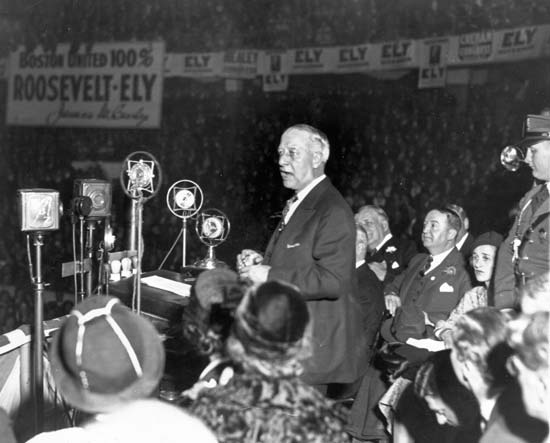
H. L. Mencken had another theory. It was whether or not a politician had “it.” Mencken thought Al Smith did.

There is something about Al’s aspect that the plain people like, not kowing why, and they seem to like it almost as well where cops are curiosities as where cows are curiosities. I have watched them at a dozen country railway stations, crowding up to the observation platform. Maybe the stop is for but two or three minutes; sometimes there is no more than a slowing down. They crane their necks expectantly, waiting for they know not what. Suddenly Al is on view, waving the brown derby, reaching out to shake hands, hauling in the bouquets brought for Mrs. Smith and joshing the local worthies. They regard him quizzically for a moment, and even with a certain hostility, but then, of a sudden, he has landed them, and as the train rolls on they are howling. . . .

The plain fact is that Al’s points are mainly infra-red and ultra-violet. It is impossible to chart or label them. He simply has the thing that the movie folk call IT — and the movie folks discovered long ago that it could not be described with any precision. There are grand and gaudy beauties who lack it altogether, and there are shabby little girls who radiate it at a pressure of a million volts. Al has it as no American politician has had it since Roosevelt. Has more of it, indeed, than Roosevelt, for the popularity of Roosevelt was largely logical: the plain people admired him because he had waded in blood and saved American womanhood from the Spanish Hun. But they know very little about Al, and what little they know, at least in these back reaches of the land, is mainly unfavorable. I don’t think it would be exact to say that they admire him, even after they have seen him. But it is as plain as day that they delight in him. He somehow thrills them and makes them happy. When he casts his magic over them it penetrates to their gizzards. (“Smith Has ‘It'” – 1928)

I suspect that Hillary didn’t have it but Trump did.

Postscript: Machen voted for Al.

Certainly Not Calvinist But Not Even Baptist

How do you explain selectivity (cafeteria Protestantism) about — wait for it — the Ten Commandments? But the Allies have their ways of satisfying itching ears. Here’s the latest — positive thoughts about Nativity Scenes:

I’ve changed my views because our culture has changed. As society becomes increasingly secular, it seems to me that just about anything that ties Christmas back to the historical account of Jesus’s birth provides an important point of connection. These small displays are an opportunity for engagement and conversation between those in our communities who celebrate nothing more than Santa and those who love the message of the Jesus’s incarnation.

In fact, I’m always intrigued when someone is offended by the presence of a nativity scene. It’s quite fascinating that people can be offended by a collection of miniature ecclesiastical characters. Why do people get upset? Perhaps it’s because they recognize that what’s being said in that small scene is challenging and even personal: “This happened, this is history, there is a Jesus, and you have to deal with him one way or another.” The person who gets annoyed by public nativity scenes is someone I want to have a conversation with.

Actually, it may be that the people who most often miss the message of the nativity scene are Christians. How easy it is to rush through the whole Christmas experience—the music in the mall, the services in your church, the presents in your house—and be left with sweet sentiments but no real worship in your heart. How easy it is to sing along to “Once in Royal David’s City”—

He came down to earth from heaven,
Who is God and Lord of all.

—and feel neither awe nor offense, but simply nothing much at all.

My point is that it’s not only non-Christians who trivialize Christmas. It’s us. The claims the Bible makes about the first Christmas are either fact or fiction, so they’re either awesome or offensive. They should move us to worship or to resistance. But so often Christians seem to be pursuing a pristine Christmas experience that more reflects the store-bought nativity scene than the costly and messy account of the Bible.

Calvinists did not celebrate Christmas. They avoided also any representation of any member of the Trinity. The same goes for Baptists. Until the twentieth century, non-Episcopalian and non-Lutheran Protestants didn’t do Christmas or display its wares. They only way to get around the second and fourth commandments (for the fourth, one day in seven is holy, not Jesus’ birthday) is if you so elevate feelings or evangelism and argue that rules don’t matter (sometimes). That’s more Whitefield than Edwards. In which case, the Allies can’t even honor properly their “homeboy.”

Just to keep score: justification is supposed to result in sanctification.

Good works constitute indispensable evidence of saving grace. Living as salt in a world that is decaying and light in a world that is dark, believers should neither withdraw into seclusion from the world, nor become indistinguishable from it: rather, we are to do good to the city, for all the glory and honor of the nations is to be offered up to the living God. Recognizing whose created order this is, and because we are citizens of God’s kingdom, we are to love our neighbors as ourselves, doing good to all, especially to those who belong to the household of God. The kingdom of God, already present but not fully realized, is the exercise of God’s sovereignty in the world toward the eventual redemption of all creation. The kingdom of God is an invasive power that plunders Satan’s dark kingdom and regenerates and renovates through repentance and faith the lives of individuals rescued from that kingdom. It therefore inevitably establishes a new community of human life together under God.

Maybe the Allies problem with the Decalogue is that they think of obedience too much in the context of the city and not being ye separate. Don’t want to take God’s word too far.