Liberalism 101

From the January 2000 issue of the Nicotine Theological Journal:

On June 24, 1936, the Christian Century reported that with the founding of the Orthodox Presbyterian Church, J. Gresham Machen had finally come “very close to the place where he will find peace in no church except one of his own making.” Among the reasons for the Century’s condescension was the fact that the OPC had been formed because of modernism in the Presbyterian Church, U.S.A.’s Board of Foreign Missions. According to the Century, anyone who could possibly detect apostasy in the “operations of a missions board administered by such men as Robert E. Speer [and] John Mackay” should finally have done with the PCUSA. The point being that the likes of Speer and Mackay were so honorable and men of such character that they could never countenance the apostate views that Machen deemed modernist.

Surprisingly, the verdict of modern day conservative Presbyterians is similar to that of the Century two generations ago. Of course, today’s conservatives, if they know who Speer and Mackay were, would not judge them to be as good and decent as the editors of the Chicago religious weekly. But they do evaluate liberals in remarkably similar terms: if someone is a moral and decent Christian he can’t be a liberal or apostate. This line of reasoning is especially evident when contemporary Reformed believers conclude that a liberal must have a character on the degenerate order of William Jefferson Clinton because any decent person (who doesn’t beat his wife, gives to the poor, picks up trash) must be a conservative. In other words – to put it succinctly in the parlance of rabid Presbyterianism – liberals are scoundrels. (Which is the flip side of the modernist argument against conservatives – fundamentalists are un-American. Talk about ad hominem.)

THEN HOW DO WE EXPLAIN THE pro-family, love-thy-neighbor tone of the liberals who suspended Machen from ministering in the PCUSA? The very same report in the Century that summarized the proceedings of the General Assembly were Machen was suspended (June 17, 1936) also carried word that with the conclusion of the fundamentalist controversy the Presbyterian Church could turn to more pressing issues of social welfare. Among the items on the PCUSA’s agenda were the “evils” of Hollywood and alcohol. The church’s standing committee on social welfare was particularly alarmed that the movie industry “seems to have joined hands with the liquor traffic in portraying drinking scenes which tend to give young people the impression that these practices have general social approval.” The church also reaffirmed its commitment to “abstinence from the use of alcoholic beverages as the Christian ideal” and to “the progressive control and eventual elimination of the liquor traffic.”

BUT WHILE THE POWER OF liquor interests was “brazen” and “unparalleled,” at least the Century could find a few good words about Hollywood, which it supplied regularly in its weekly column, “The New Films,” which rated the latest movies and made recommendations for family viewing. For instance, here’s the capsule summary of “Border Flight,” a 1936 thriller, starring John Howard and Frances Farmer: “Crudely portrays coast guard’s heroic airplane fights against smugglers. Much thrill, mediocre acting, absurd character values. Villain, completely obnoxious throughout, becomes heroic suicide and wins what sympathy is left.” For “intelligent adults,” the Century’s reviewer deemed it “crude. For ages 15 to 20, “Poor.” And for children under 15, “Poor.” Later in the column the author recommended for family viewing “Mr. Deeds Goes to Town,” “Show Boat,” and “Dancing Pirate.” Villains must not be so bad if their nimble on their feet.

To change the old adage, with liberals like this, who needs friends? So ingrained is the habit of thinking defective theology and loose morals go together that many contemporary conservative Presbyterians would be shocked to see how family-friendly institutions the Century and PCUSA were and still are. That’s because some conservatives have never thought carefully about the relationship between theology and practice. Instead, they have assumed that right practices automatically follow from orthodoxy and hence that anyone with questionable doctrine is invariably wicked. Which is only another way of saying that conservative Presbyterians fundamentally misunderstand liberalism. Hence the need for some remedial instruction.

THE BEST BOOK ON LIBERALISM in the United States is still William R. Hutchison’s Modernist Impulse in American Protestantism (1976). And Hutchison gives a handy definition that should be particularly useful for conservative Presbyterian types. Simply put, liberalism is any modification of received orthodoxy. Typically, the doctrinal changes advocated by liberals run along the lines of divine sovereignty, human depravity, and Christian exclusiveness. But in America, liberalism made its biggest splash when Unitarians denied the deity of Christ. This is why Hutchison begins his study of modernism with a chapter on Unitarianism.

But for Hutchison liberalism does not equal modernism, and here is where this introductory course becomes tricky. Modernists advocated the self-conscious adaptation of Christianity to modern society by appealing to the doctrine of God’s immanence and by locating God’s presence in the unfolding of western civilization, which for them was the kingdom of God. Though modernism and liberalism clearly overlap, one need not believe in adapting Christianity to culture to be a liberal. Some liberals, Hutchison points out, were deeply suspicious about developments in modern society. Modernism, then, is a subset of liberalism. And as Hutchison also shows, the sorts of liberals that J. Gresham Machen was battling in the 1920s were actually modernists. They were not doctrinaire liberals. Instead, they were intent on being all things to all people (well, at least all WASPs ) for the sake of maintaining a Christian culture.

JUST AS SUBTLE AS THE distinction between modernism and liberalism is the apologetical nature of liberalism. Typically conservatives think that a liberal is someone who has denied the faith and that such denials are easy to spot. Having grown up in a fundamentalist home, I can well remember visiting preachers haranguing liberals for denying the deity of Christ, the virgin birth – the list goes on – the way that Hell’s Angels did. Liberals came across as scary people, sort of like witches or Democrats, folks who not only could not be trusted but were vicious, mean and calculating. But the classic work on liberalism, Machen’s Christianity and Liberalism, assumes the best, not the worst, about the Protestant left. Modern science, technology, and culture had all made historic Christian teaching implausible. And so liberals, seeking to save Christianity, rescued “certain general principles of religion,” the so-called “essence of Christianity.” This was the same verdict of H. L. Mencken who wrote, modernists, “no doubt with the best of intentions,” have “tried to get rid of all the logical difficulties of religion and yet, preserve a pious cast of mind.” The Baltimore sage thought it a “vain enterprise.” But it was still an attempt to defend Christianity against its culture despisers.

AND IT IS THIS APOLOGETICAL side of liberalism that confounds so many conservatives. If liberalism is pernicious – which it is ultimately – how can it be credited with doing anything honorable? The answer to that question is fairly obvious when you keep in mind that there is another option available – it is to reject Christianity outright and become an atheist or pagan. But typically conservatives treat all non-conservatives as if they are atheists or pagans, forgetting that there is a middle ground, no matter how flawed, inconsistent or dishonest it is. Which is just to say that there is a huge difference whether you have a member of a Satanic cult, a member of the Dallas Cowboys, or a member of the Episcopal church living next door. Eternally all three persons may be heading for the same place, but here and now the Episcopalian would be more likely to take in the mail when you’re out of town, let the gas meter reader in without stealing the high fi, or feed the cat without strangling her. So the question, “how can people deny orthodoxy with good intentions?” invites the obvious answer, “well, duh.” Everyday when we cross intersections, balance check books, or buy bread, we assume that other drivers, bank clerks, and bakers, who may not hold orthodox views of the atonement or the inscripturation of God’s word, will not try to destroy us, our property or our reputations. Why would liberals be any different?

The decent and honorable intentions of liberals also helps to explain why liberalism is hard to spot. In his book on the Presbyterian controversy of the early twentieth century, Presbyterian Pluralism (1997), the sociologist William Weston claims that the PCUSA contained no full-blown modernists. Instead, the church only had the milder sort, evangelical liberals. And this was the same conclusion that the Special Commission of 1925, appointed to study the cause of the fundamentalist controversy. No one in the church was denying Christianity outright. But whoever said that liberals did that? It’s as if Madeline Murray O’Hair defines liberalism and since Harry Emerson Fosdick was not an atheist he must have been evangelical, though a little light in the divinity-of-Christ loafers. Liberalism, like life, is a lot subtler than that. Liberals try to have it both ways – being Christian without being orthodox. But they don’t want to abandon Christianity.

OF COURSE, THE HARD PART IS determining whether they have left the faith. This is hard because a liberal affirmation of the faith usually employs evasive language. But ethical considerations will not yield any greater clarity because liberals are generally such upright people, the kind who see villainy everywhere, from tobacco to racism.

J. Gresham Machen had no trouble recognizing the high ethical standards of liberal Protestantism. In fact, that is how he explained their inability to account for the apostle Paul’s invective against the Judaizers. “What a splendid cleaning up of the Gentile cities it would have been,” Machen could hear a run of the mill liberal saying, “if the Judaizers had succeeded in extending to those cities the observance of the Mosaic law, even including the unfortunate ceremonial observances.” But this excessive interest in making people moral is also what prompted Machen’s devastating critique. Instead of taking comfort in the Golden Rule or the Sermon on the Mount as liberals were wont to do, as if successful Christian living hinged on determining what Jesus would do, Machen thought Christ’s ethical teaching only produced despair. “In reality, if the requirements for entrance into the Kingdom of God are what Jesus declares them to be,” Machen wrote, “we are all undone; we have not even attained to the external righteousness of the scribes and Pharisees.” The problem with liberals, then, wasn’t their disregard for Christian morality. It was that their high regard of human nature.

BUT IF MACHEN WAS HARD ON liberals for denying historic Christian teaching about sin and grace, he did not stoop to calling them villains. He believed it a Christian duty to sympathize with anyone who had lost their “confidence in the strange message of the cross.” What is more, despite their deep and abiding differences, he thought conservatives still shared “many ties – ties of blood, ties of citizenship, of ethical aims of humanitarian endeavor” with those who had abandoned the gospel. Believers even had a good deal to learn from non-believers and should treat those who differed from them with respect. Socrates and Goethe were not Christians but still towered “immeasurably above the common run of men.” And the reason for this respect was the gospel. “If he that is least in the Kingdom of Heaven is greater than [non-believers], he is certainly greater not by any inherent superiority, but by the virtue of an undeserved privilege which ought to make him humble rather than contemptuous.”

So instead of piling on liberals and attributing all manner of wickedness to their theological equivocation, a basic lesson is in order: to paraphrase Neuhaus’ Law, Where Orthodoxy Is Optional, Righteousness Will Sooner Or Later Be Proscribed.

Allen Rich
How Broad Can Confessional Presbyterians Be?

The subject of confessionalism in relation to the Gospel Coalition has again come up, this time with a charitable defense of the organization from Ligon Duncan. The article that elicited this response is not at issue here.  I have not read it nor is that as pertinent as what Duncan says about confessionalism:

None of us are a part of TGC because we don’t care about our ministerial vows or because we don’t really believe our Confession.

We are a part of TGC because TGC beautifully promotes certain important things in the wider Christian and evangelical world that are needed, vital, true, good, right, timely, healthful, and which are also perfectly consistent with our own confessional theological commitments, so we want to be a part and a help. We also think that we have a thing or two to learn from our non-Presbyterian friends in TGC that “sweetly comport” with our vows and our church’s doctrine and practice. And we love the friendship and fellowship we enjoy with like-minded brethren from and ministering in settings denominationally different from our own, but committed to the same big things.

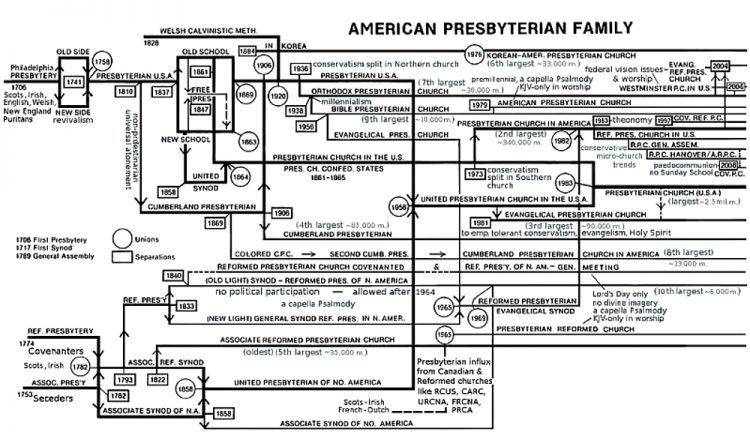
Just as Charles Hodge of Princeton (not one shy of his confessional Presbyterian commitments), for similar reasons, was happy to participate in the Evangelical Alliance in the nineteenth century, so also I am happy to participate in TGC.

This is an important historical matter that deserves more attention. What was the relationship of Hodge’s Old School Presbyterianism to interdenominational endeavors like the Evangelical Alliance? And how did Hodge’s own opposition to the 1869 reunion of the Old and New School churches relate to endeavors like the Evangelical Alliance?

One way of answering that question is to notice that the sorts of cooperation in which mainline Protestants engaged after the Civil War, with the 1869 Presbyterian reunion paving the way, fueled ecumenical and social gospel endeavors that produced conservative opposition in the 1920s and 1930s. The Evangelical Alliance was the Moral Majority of its day, wanting immigrants to conform to Protestant norms, opposed to Romanism and communism (for starters), and it provided the vehicle for Protestants to unite to defend a Christian America. Those ecumenical impulses eventually produced the Federal Council of Churches in 1908 and the Plan for Organic Union in 1920, a proposal that would have united all mainline Protestants into one national church — the way Canadian Protestants at roughly the same time formed the United Church of Canada (1925).

What the period of interdenominational cooperation meant for Presbyterians was a 1903 revision of the Confession of Faith. That revision enabled the PCUSA to receive the Cumberland Presbyterians. Revision softened the Confession’s Calvinism to make room for a body that had left the church almost one hundred years earlier over objections to election and limited atonement. Presbyterians going along for the ecumenical ride included the president of Princeton Theological Seminary, J. Ross Stevenson, who presented the Plan for Organic Union to the 1920 General Assembly. J. Gresham Machen was a first-time commissioner to that Assembly and Princeton’s faculty’s opposition to that plan was start of a denomination wide controversy that forced the 1929 reorganization of Princeton Seminary (to make it tolerant of diversity) and the simultaneous founding of Westminster Seminary.

According to Lefferts Loetscher, who wrote a book with a title that frightened conservatives in the PCUSA and the PCUS, The Broadening Church (1954), the reunion of Old and New School in 1869 touched off developments that saw the PCUSA recover its historic breadth:

Once again in 1869, as in 1758, the Presbyterian Church was restoring unity not by resolving its differences, but by ignoring and absorbing them. Men who had been denounced as “heretics” in 1837 and who had professed no change of theological viewpoint in the interim were welcomed in 1869 as honored brethren. The result was, of course, that the theological base of the Church (especially of the former Old School branch of the Church) was broadened and the meaning of its subscription formula further relaxed. The gentlemen’s agreement of 1869 to tolerate divergent types of Calvinism meant that clear-cut definitions of Calvinism would not be enforceable in the reunited Church, and that it would be increasingly difficult to protect historic Calvinism against variations that might undermine its essential character. (8)

No one actually doubts whether the Old and New Schools were liberal. By almost every measure, both sides would come out as evangelical today (especially if you don’t apply the category of confessionalism). And yet, the breadth necessary for combining both sides also made room for a range of theological ideas that spawned liberalism.

In other words, breadth is not a good thing. Broadening churches are usually ones that become liberal.

So why is an organization that tolerates a diversity of “evangelical” convictions going to avoid that problems that usually surface when you recognize you need to be broader than your own communion is? The answer is not that the Gospel Coalition is going liberal. But an objection to the Gospel Coalition is that it does not have built in transparent mechanisms for identifying and disciplining liberalism.

And here are a couple ways that the Coalition’s breadth could collide with my own Presbyterian confessionalism. If I am a member of the Council and an officer in a confessional Presbyterian church, and my communion has a controversy over someone ordained who does not affirm the doctrine of limited atonement, will I receive support for my opposition to this erroneous officer from my friends and colleagues at TGC? Or what about the Federal Vision? If my church decides that Federal Vision is a dangerous set of teachings that need to be opposed, will my friends and colleagues at TGC support my church in its decision? Will people who write for Gospel Coalition even be clear about the covenant theology that is clearly taught in the Confession of Faith? Or will some of them think that my communion is too narrow in its understanding of Reformed Protestantism? Will they think that the proper response should be one to include a breadth of views in denominations because that is the norm for the Coalition? I could well imagine feeling some pressure to weigh matters before a presbytery or Assembly with my peers in the Coalition in mind? Will I disappoint them? Maybe that’s the wrong way of asking the question. What if they don’t care about the affairs of my communion the way I do? (Why should they care since they are not members or officers of my denomination?)

These are real dilemmas for anyone who has subscribed the Confession and Catechisms and been ordained in a Presbyterian communion while also belonging to an evangelical organization with standards different from the church. They are concerns that have been around for almost 160 years. The Gospel Coalition has not brought an end to church history.

The Old Testament Church and Plague(s)

During the blizzard-like conditions of COVID-19’s spread, Christian writers have been thinking about ways to minister during a plague. Some appeal to Luther. Some about the ongoing urgency of preaching the gospel. Some discuss the tension among commitments to love neighbors, serve God, and obey civil magistrates. Some compare COVID-19 to an atomic bomb (seriously). And some describe at great length and with much unction how the church needs to respond redemptively.

Ed Stetzer may be the best example of evangelicals’ historical imagination during a major, worldwide illness. His is exclusively post-canonical:

Sociologist Rodney Stark explored one such one example where during a plague AD 251 swept through the Roman Empire decimating the population. In his Easter letter around AD 260, Dionysius wrote a tribute to the believers whose heroic efforts cost many of them their lives during the plague.

Pagans tended to flee the cities during plagues, but Christians were more likely to stay and minister to the suffering. According to Dionysius: “Most of our brother Christians showed unbonded love and loyalty, never sparing themselves and thinking only of one another. Needless of danger, they took charge of the sick, attending to their every need and ministering to them in Christ, and with them departed this life serenely happy.”

Dionysius added: “The best of our brothers lost their lives in this manner, a number of presbyters, deacons, and laymen winning high commendation so that death in this form, the result of great piety and strong faith, seems in every way the equal of martyrdom.”

In Christians in the Age of Outrage I offered a more recent example of sacrificially living out the gospel in the midst of suffering. During the Fall of 1793, yellow fever gripped the city of Philadelphia. Historian Richard Newman writes that, “from the moment it began, the yellow fever epidemic was a public-health crisis. Thousands of citizens fled, hospitals became overwhelmed, and dead bodies rotted in homes.”

Within this crisis, it was the emerging black church under the leadership of Richard Allen which entered into the suffering. Some assumed that persons of African descent were immune to Yellow Fever, and the free black community was approached to provide help. Spurned by the church they had served and slandered by others, Allen and his church served the sick when others isolated themselves for fear of catching the disease.

…Through both examples, we are reminded that the gospel calls us to live sacrificially in the face of crisis.

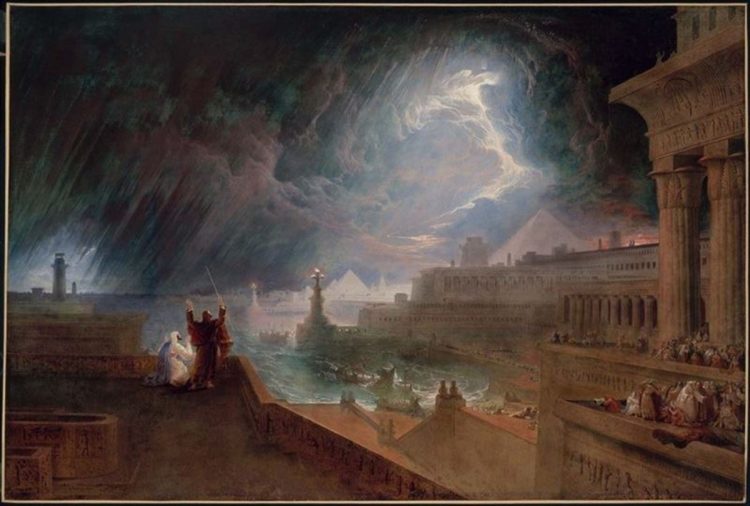
If these Christian authors had the Old Testament background to the New Testament more in mind, what might they say about the mother of all plagues, the one that forms the background for the Lord’s Supper, the Eucharist, even the Mass. That plague, as Psalm 78 has it, was also at the center of the Exodus, the Old Testament redemptive historical event that inspired many of the modern world’s social justice activists:

42 They did not remember his power
or the day when he redeemed them from the foe,
43 when he performed his signs in Egypt
and his marvels in the fields of Zoan.
44 He turned their rivers to blood,
so that they could not drink of their streams.
45 He sent among them swarms of flies, which devoured them,
and frogs, which destroyed them.
46 He gave their crops to the destroying locust
and the fruit of their labor to the locust.
47 He destroyed their vines with hail
and their sycamores with frost.
48 He gave over their cattle to the hail
and their flocks to thunderbolts.
49 He let loose on them his burning anger,
wrath, indignation, and distress,
a company of destroying angels.
50 He made a path for his anger;
he did not spare them from death,
but gave their lives over to the plague.
51 He struck down every firstborn in Egypt,
the firstfruits of their strength in the tents of Ham.
52 Then he led out his people like sheep
and guided them in the wilderness like a flock.
53 He led them in safety, so that they were not afraid,
but the sea overwhelmed their enemies.
54 And he brought them to his holy land,
to the mountain which his right hand had won.

If Christians identified more with Old Testament saints than with modern humanitarians, then, would they be more inclined to view COVID-19 as God’s judgment on a neo-liberal, morally indifferent, systemically unjust society and a hypocritical evangelical church? You could even turn in this into God’s judgment on a nation’s president who is entirely without a moral compass.

Then again, invoking God’s righteous judgment on a wicked society is so Pat Robertson (though anti-Trump prophets are hardly Mr. Rogers).

What Must I (a Protestant) Do to be Saved?

In the fine print of church teaching (via the church’s lay apologists), being Protestant is inferior to being Roman Catholic. Jimmy Akin explains that Protestants are partial Christians:

the Catholic understanding is that Protestants are our brothers and sisters in Christ. So all Christians who profess faith in Christ and who are properly baptized are Christians and were put into a relationship with Jesus that Scripture describes in terms of being members of his Body. Different people have different degrees or forms of incorporation into His Body, though. And the goal is for everyone to be fully incorporated into Jesus, so we’re united with Him in the most ways possible. So that includes things like having the fullness of the Christian faith, understanding and accepting all of Jesus’s teachings. It also includes things like receiving all of the Sacraments that he would have us receive. Not just baptism, but the other Sacraments as well, and in the Catholic view there are seven sacraments.

It also includes being fully united with His Church, because Jesus said, “I will build my Church–” singular, not plural– “and the gates of Hell will not prevail against it.” So Jesus established a Church in the first century, and it’s continued down to the present day. And we also know that that Church is a visible Church, because he gave it leaders, like Saint Peter and the other Apostles, and the other ministers that they appointed to lead the Church in their absence, and so there has been a single visible communion of believers in Jesus that’s existed all the way from the first century to today.

The fullness of Rome has a lot to do with history — the apostles, the apostles’ successors, and the apostles Christ founded.

Not even Protestantism’s benefits can measure up to Rome’s antiquity:

[Protestants] still share many elements of grace, and have many wonderful aspects about them; they they honor Scripture, they may have a slight difference about, you know, what some of the books of the Bible should be, but they still honor God’s Word, they believe in Jesus, they believe in the Holy Trinity, they have a valid Sacrament of Baptism, and they have a lot of elements of grace and sanctification.

At the same time, we have to acknowledge that, you know, there are some differences between Protestants and Catholics, and from a Catholic perspective, those differences aren’t a good thing, … “What if someone knowingly refuses to accept something that Jesus willed us to have?”

If someone knew that the Catholic Church was founded by Jesus and that He wanted all of his followers to be united to it, and they said, “You know, I’m just not going to do that. I know Jesus wants me to do it, I know that he prayed for Christian unity on the night of the Last Supper, I know that’s a high on his priority list, but I’m just not going to do that,” well, then you’d have to question whether that person actually has a saving relationship with God, because he’s turning his back on something that’s fundamental and very important to Jesus, and therefore it looks, at least from outward appearances, like he’s cutting himself off from the means of grace that Jesus gave us. And so that person would be in spiritual jeopardy.

Is there salvation outside the Roman Catholic Church? The answer seems to be, yes, as long as either you don’t believe Rome is the church Jesus founded or you don’t know there’s no salvation outside the church. Knowledge (or ignorance) of the church is key as Akin claims:

You could have someone who, let’s say, was raised in a Protestant community, may have heard that Catholics believed Jesus founded the Catholic Church, but they don’t KNOW that; that hasn’t been proven to them, they haven’t seen sufficient evidence for that, and so through no fault of their own, they’ve never joined the Catholic Church–but they would if they knew that this was Jesus’s Church.

I know a lot of people who are in the Protestant community who would say, “Oh yeah, if I was convinced the Catholic Church was the one founded by Jesus, I would join it today.” Well, that person is not deliberately cutting himself off from from what Jesus would have him experience. He’s open to what Jesus would have him experience, and he’s already experiencing many elements of grace and sanctification. But he’s not deliberately refusing to do something he knows Jesus wants him to do. And so that person, even though they haven’t been fully incorporated into the Catholic Church, they’re still in a saving relationship with God. And so, if someone is not Catholic, through no fault of their own, but they’re otherwise responding to God’s grace, then they’ll be saved.

So the real question of salvation for Protestants is their knowledge of and degree of hostility to the Roman Catholic Church. A pious Protestant who hasn’t given much thought to Rome is apparently in a state of grace.

But if a person, whether they’re Catholic or not, refuses to do something of fundamental importance, like it could be not joining the Catholic Church, could be leaving, it could be any number of other grave things, like go out and commit murder or adultery; well, you’re deliberately defying the will of Christ in a fundamental matter there, and that will result in you being lost unless you repent. So everybody, both Protestant and Catholic, needs to be open to the grace that God wants us to have, and needs to be willing to respond to the call of Christ in all of these very fundamental matters.

The openness goes only one way though. Roman Catholics do not need to be open to the grace that is available in Protestant churches to be saved. For a Roman Catholic, salvation depends on the church. (Which is why a website can describe how to become Roman Catholic without ever mentioning Jesus Christ).

Presbyterians in Charge

The news of Julius Kim’s appointment as president of the Gospel Coalition should put the organization’s sometime fascination with Anglicanism in perspective — Anglophilia runs deep in Americans (as does venerating the Founders many of whom were Anglican).

Worthwhile to recall is that when TGC aired differences over church polity, they did not include a brief for episcopacy. Instead, it was mainly a choice between Presbyterians and Congregationalists (read Baptists).

On the Presbyterian side were Kevin DeYoung and Mark Jones. DeYoung wrote in defense of the office of elder:

I hold to the Presbyterian position because of the overall New Testament teaching about eldership. The office of eldership is one of teaching and authority (1 Tim. 5:17), which is why the position is reserved for qualified men (1 Tim. 2:11-12; 3:1-7). Elder-pastors are given by Christ to be overseers and shepherds of the flock of God (Acts 20:28, Eph. 4:11). The leaders in Hebrews 13:17 who must watch over the souls of God’s people are almost certainly elders. We know from 1 Peter 5:2-3 that elders must exercise gracious oversight in the church. They are the under-shepherds serving and representing Christ, our Chief Shepherd and Overseer (1 Peter 1:25; 5:4). It is, therefore, everywhere in keeping with a biblical theology of eldership to have the elders of the church exercising the authority of the keys through preaching and discipline. In fact, it’s hard to imagine how the elders are to shepherd, govern, and protect as the New Testament commands if the final authority rests with the congregation and not with the officers who represent Christ in their midst.

Jones dug in with presbytery:

Despite what you may think, Presbyterian ecclesiology is not primarily defined by churches governed by elders, but by churches governed by presbyteries. Presbyteries can encompass the elders of a local church, a regional church, and what is termed a “general assembly.” This view is established from the oneness of the visible church. Based on the sufficiency of Scripture, Presbyterians hold that the church is governed jure divino (by divine right). There are certain fixed principles in the government of the church. We hold that Christ has blessed the church with the Scriptures, church officers, and sacraments. In doing so, Christ has “ordained therein his system of doctrine, government, discipline, and worship, all of which are either expressly set down in Scripture, or by good and necessary inference may be deduced therefrom” (Presbyterian Church in America Book of Church Order).

While there is much that Presbyterians and classic congregationalists can agree on, nevertheless, against the congregationalist view, Presbyterians affirm the authority of presbyteries beyond the local church. That’s the crux of the issue between Presbyterians and congregationalists: authority.

From the other side came Hunter Powell, a Baptist pastor, in defense of Congregationalism which appeared first at Gospel Coalition, vanished, and then moved to IX Marks:

Elders have authority given to them in the Bible. They should be obeyed. The problem is whether that paragraph says all there is to say about church power. If church members are to vote on their elders, and if church members have a right to vote in excommunication (which many Reformed divines, particularly some notable Dutch divines, argued for), then we must say that there is some church power in the congregation as a whole. But that does not by any means argue against the unique role of elders and the fact that the Bible commands churches to submit to their elders. Nor does this mean that people are mini-elders arbitrarily deciding when and where they actually submit to their leaders. If a church feels a tension there, then that is actually a good thing. The reformed divines certainly did….

It is true some congregationalists fear elders because of the tyranny of the few, but on the other hand some presbyterians fear members involvement because of the anarchy of the many. But fear never leads to good polity. The question really comes down to this: Did Christ give any share of church power to the congregation? If so, then we must account for it.

Again, no brief for bishops. The world of New Calvinism seems to have little room for the rule by one in the palace of the church. It may owe to church history like this.

Machen Death Day 2019: Elites in the Ancient Church

It must be remembered that what Paul in Gal. ii. 1-10 desires most of all to prevent is the impression that he is appealing to the Jerusalem apostles as to a higher instance. He is not basing the authority of his preaching upon any authorization that the apostles gave him; he is not saying that he has a right to be heard because those who were the pillars of the Church endorsed his message. Such a representation of the conference would have cast despite upon all the work which he had done before, and would have made it necessary for him in the future to prove constantly against all Judaizers and other opponents his agreement with the Jerusalem authorities. The profound consciousness which he had of his apostolic authority did not permit any such course of action; and such restrictions would have hindered his work wherever he went. It was absolutely essential in the economy of God that the leader of the Gentile work should have independent authority and should not be obliged to appeal again and again to authorities who were far away, at Jerusalem. Hence what Paul desires to make clear above all in Gal. ii.
1-10 is that though he appealed to the Jerusalem authorities it was not necessary for his own sake for him to appeal to them.

They were great, but their greatness had absolutely nothing to do with his authority; for they added nothing to him. It was therefore not the real greatness of the original apostles which caused him to appeal to them (for he needed no authorization from any man no matter how great), but only the greatness which was attributed to them by the Judaizers. They really were great, but it was only the false use which had been made of their greatness by the Judaizers which caused him to lay his gospel before them. The Judaizers were to be refuted from the lips of the very authorities to whom they appealed. (The Origin of Paul’s Religion, 121-22)

Moderate Presbyterians, Irish or American

Seeing the looks on Ben Preston and Craig Lynn’s faces last week while recording a session on J. Gresham Machen, I worried not only that American indelicacy had run up against Irish sensitivities, but also that the Orthodox Presbyterian habit of being opinionated had offended the moderate sense of the Presbyterian Church of Ireland ministers.

As it happens, while waiting for a meeting with staff at Union College (Ireland’s equivalent of Princeton Theological Seminary), I found a copy of the Presbyterian Herald, the Irish equivalent of New Horizons. I read an article about church attendance that I am not sure could have been published in the OPC’s magazine. The author wrote this:

Christian ought to be encouraging of and encouraged by para-church organisations which seek to spread the gospel. Being committed to such enterprises, however, before the local church is idolatry, for God will not share the glory of his church with another (Isaiah 42:8).

Shazam!

Membership of and support for para-church organisations, whether mission agencies, evangelicist bands or cultural/religious institutions must all come after commitment to the local church and never before.

Imagine what American Protestantism would look like if The Gospel Coalition adopted that set of priorities.

An End Run

Imagine you are a Reformedish Protestant around the time of George W. Bush’s election. You have entered the world of Reformed Protestantism by way of the biblical theology (which leaned Federal) of Peter Leithart and James Jordan, you agree with a number of Doug Wilson’s critiques of modern America, and you became acquainted with the West and the Great Books again through Wilson’s Recovering the Lost Tools of Learning. Say you want a Reformed or Presbyterian church with a narrative that inspires, that connects with the sort of intellectual creativity that Leithart displays, that shows little of the wear and tear that afflicts most denominations in the United States whether sideline or mainline, and that connects with the larger history of the West, from Plato to Erasmus.

Where do you turn?

The OPC is too small and too theologically sectarian. The PCA suffers from similar problems among the TRs (Truly Reformed) and is blithely naive about modernity and urbanity on its progressive side. The ARP and the CRC are too ethnic and suffer from a measure of parochialism within their Scottish and Dutch traditions respectively. The same goes for the RPCNA which is even smaller than the OPC. The CREC might work but in 2000 that communion is only two years old, not the strongest case for a church with roots.

To your credit, you were enough of a Protestant not to find Roman Catholicism as a viable alternative.

What then? Why not turn to Elizabethan Anglicanism, like this?

The early English church, despite all the misconstruals of it by Anglo-Catholics, was Protestant and Reformed. The history of the 19th Anglo-Catholic attempt to deny this is a painful one for those who prize integrity of inquiry. The work of Peter Nockles and the more recent, and excellent, work of Jean-Louis Quantin, have shown how wrongheaded that 19th century orgy of wishful thinking really was. But this was proved back in the 19th c itself by Nathaniel Dimock, regarding sacramental theology, and regarding ecclesiology, by the American Bishop Charles McIlwaine, in his Roman, Oxford, and Anglican Divinity Compared.

The English Church of Elizabeth, James, and Charles is, in some ways, a model of importance for own time. Reformed churches, their common mind constricted by familiarity only with Scots and English Presbyterianism, miss the riches of Reformed thought available in Richard Hooker, or Richard Field, or Lancelot Andrewes (just as they miss the riches available in the thought of German and French Reformed). Anglo-Catholic attempts to prove that the established church was somehow not really Protestant are attempts to deprive modern Protestants of useful heritage.

What is important to notice about this way of being Reformed is that it allowed you to occupy the catholic and moderate middle while also regarding the regulative principle as too Puritan and biblicist (and sectarian) and two-kingdom theology as a betrayal of the godly monarch (which allegedly made the English church tick until those rowdy Presbyterians and Puritans conspired to take down Charles I).

What is also striking about this line of argument about the American church scene at the beginning of the 21st century was that it was precisely the way priests and bishops who were part of the Anglican establishment saw Christianity in England:

The great innovation of Elizabeth’s reign was what we might term the internalization of anti-sectarian rhetoric, as anti-puritanism. In Edward’s reign that language had been used to associate the English church with the foreign reformed churches in the common defence of an emergent reformed orthodoxy. Now it was introjected, to precisely opposite effect, into the conduct of intra-Protestant debates between defenders of the ecclesiastical status quo and proponents of various styles and modes of further reformation. The central figure here was John Whitgift who, in an extended exchange with the leading presbyterian ideologue of the day, Thomas Cartwright, deployed the Edwardian version of the two extremes used to define the via media of the English church, popery and Anabaptism, to exclude, as he hoped, the likes of Cartwright and his ilk, from the charmed circle of English Protestant respectability. True to the spirit of his Edwardian forebears, Whitgift sought to assimilate Cartwright and his associates both to popery and to Anabaptism, using what he took to be their ultra-scripturalism and populism to associate them with the latter and what he took to be their clericalist opposition to the Royal Supremacy to associate them with the former.

Ostensibly a form of religious polemic, Whitgift’s anti-puritanism was also inherently political. It dealt with issues of governance and jurisdiction and stressed heavily the extent of direct royal authority over ecclesiastical affairs. In so doing it encoded within itself a set of (intensely monarchical) political values, defined against what he took to be the ‘popularity’ inscribed within presbyterian theory and puritan political practice. By popularity Whitgift mean a commitment to theories of government in which the role of the people was expanded. But he also used the term to refer to the political methods used by the supporters of the discipline to put their case to a variety of more or less popular publics through the pulpit and the press, and through the the circulation of manuscripts and of rumours and a variety of petitioning campaigns, some of them aimed at the parliament rather than at the prince. (Peter Lake, “Post-Reformation Politics, or On Not Looking for the Long-Term Causes of the English Civil War,” 28)

When Machen, Witherspoon, and Knox won’t do, turn to Whitgift and Hooker? In the United States, a country that made its name by rejecting Royal Supremacy?

It is an intellectually energetic way to find an alternative to American politics and the Reformed and Presbyterian churches that have persisted in the United States. But it is as arbitrary as thinking that the debates surrounding foreign missions and church government of Machen’s time are the terms by which Presbyterians in Australia ought to operate.

That Sound You Heard Was Paul Blanshard’s Head Exploding

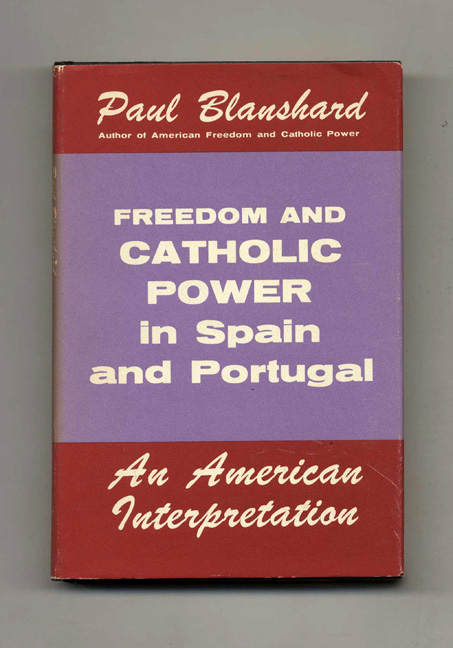
Paul Blanshard, for those born after Richard Nixon defeated George McGovern, was a lapsed Congregationalist (redundant?) who wrote the last best-selling work of anti-Catholicism. American Freedom and Catholic Power was perhaps the last gasp of Protestant bigotry, but it was still sufficiently forceful and plausible into the 1950s that Blanshard did not get cancelled for expressing hurtful thoughts.

That was 15 years before the end of Vatican II (roughly), when Rome still on paper and through political channels was skeptical about the kind of freedoms embodied in American political norms. In 1950 the church still insisted that “error has no rights,” a position that ran into something of a hurdle with the United States’ Bill of Rights which guaranteed rights for all sorts of groups who held erroneous views (even Roman Catholics).

But Vatican II sort of kind of ended all that and Rome changed its mind about freedom for false religions. That explains this post, an argument that assumes Roman Catholicism and freedom go hand in hand. That Americanist position is receiving push back from integralists (among others). So imagine writing advice about liberal democratic institutions with Roman Catholic integralists as the ones defenders of civil liberties need to fear:

I think the recent intra-conservative French-Ahmari debate can be partially resolved by determining the extent to which secular progressives integralists can be trusted to protect robust freedom of religion for religious traditionalists with conservative views about human sexuality.

If secular progressives integralists are trustworthy, at least by and large, then French’s strategy of working within liberal democratic institutions makes sense. Conservatives should hold secular progressives integralists to a constitutional order that they accept in general, but chafe at in certain cases. Secular progressives Integralists cannot always be trusted to uphold robust freedom of religion, but they’re trustworthy enough not to fundamentally undermine Christianity in the United States. They will obey liberal democratic norms on the whole; conservatives just have to fight to keep them honest.*

However, if secular progressives integralists aren’t trustworthy, then Ahmari’s approach starts ceases to make sense. Secular progressives Integralists will tend to undermine robust protections for freedom of religion in a systematic way, and so ignore constitutional constraints whenever they can get away with it. In that case, politics is war regarding freedom of religion, and conservatives may be permitted to respond in kind. Perhaps the liberal legal settlement is therefore unstable because the left cannot be trusted to uphold it, and so the only truly feasible arrangement is cultural and political victory in the fight against the left. There’s no peace and no middle ground because the other side isn’t trustworthy, and so can’t be trusted to keep a liberal democratic peace.

Actually, I’m not sure if more sentences need to be changed to maintain the parallels. Either way, secular progressives are not the only ones about which to worry. They would likely let Presbyterians worship (and other groups). That was not an option in Roman Catholic societies.

The Heart is Desperately Wicked, Who Can “Really” Know It?

For Justin Taylor at a webpage the purports to do “history,” this exchange rises to the level of true knowledge about human motivation — in this case, why American Protestants fought for independence:

“Captain Preston,” he asked, “what made you go to the Concord fight?”

“What did I go for?” the old man replied, subtly rephrasing the historian’s question to drain away its determinism.

The interviewer tried again, “. . . Were you oppressed by the Stamp Act?”

“I never saw any stamps,” Preston answered, “and I always understood that none were sold.”

“Well, what about the tea tax?”

“Tea tax? I never drank a drop of the stuff. The boys threw it all overboard.”

“I suppose you had been reading Harrington, Sidney, and Locke about the eternal principle of liberty?”

“I never heard of these men. The only books we had were the Bible, the Catechism, Watts’s Psalms, and hymns and the almanacs.”

“Well, then, what was the matter?”

“Young man, what we meant in going for those Redcoats was this: we always had been free, and we meant to be free always. They didn’t mean we should.”

Taylor adds:

Historical causation is notoriously complex. Yet sometimes we forget that a historical actor’s motivation can be surprisingly simple. As those interested in correctly interpreting the past, we should never stop our investigation with the self-perception or motivation of those involved in the events. But we should often start there.

But if you listen to someone who is trying to make sense of his own life, like Glenn Loury is while writing his memoirs, you might actually wonder if any of us can make sense of our motivations. It is one of the reasons we have friends, spouses, pastors, and even therapists — to learn that sometimes what we thought we were up to was actually done for different reasons. Most of us delude ourselves much of the time. It is part of being a sinner.

I suspect what caught Taylor’s eye was the soldier’s reference to the Bible, and other religious texts and ignorance of English political theory. I wonder, though, why Taylor would not question a devout Christian was so willing to take up arms without political reasons. I remain unconvinced that the Bible teaches rebellion. That’s why you need 2k, to find reasons to do things about which the Bible is silent or not conclusive.