The Surprising Admissions Converts Make

David Mills tries to defend being casual about sin, though he rebrands it as familiarity:

In the Protestant world of my youth, nearly everything was a matter of life or death. The Evangelicals made your salvation a drama that depended on you making a decisive commitment. They loved the drama of a sobbing sinner stumbling forward at the altar call.

The mainliners didn’t sweat salvation the same way, but they made your social conscience almost as crucial. God expected you to respect picket lines, protest the war, protect the environments, eat union-grown grapes.

But the Catholics. Gosh, they didn’t seem to sweat anything. The few Catholics I knew — my college town had more Wiccans than Catholics — didn’t seem vexed by human sins, personal or social. They might like devotion and care about social causes, but they didn’t pursue them as intensely as the Protestants I knew.

Older people told me that Catholics had confession. They could axe-murder an entire middle school, go to confession, and Whoosh! they were okay. God was happy with them again. The axe murder? No big deal. Confession magically wiped the slate clean no matter what you did.

Except that the whoosh only got you as far as purgatory if you went to confession.

But now Mills sees the benefits of Rome’s lack of rigor:

After being a Catholic for a few years, I can understand why people think the Church is too casual about sin. I can be too casual about it. It’s easy to use confession as a forgiveness machine and the Mass as a medicine that cures you without your having to do anything. I know how easily you can presume on God’s love.

But that’s just the risk God chose to take when he gave us the Church and her sacraments. Our Protestant friends are not wrong in their criticism, but they miss what God Himself is doing through the Church. He flings his grace around, as we heard in last Sunday’s gospel reading. He lets some fall on rocky or thorny ground, so that some will fall on fertile ground. He gives us gifts we can abuse, because he wants to give us life.

What Mills fails to add (aside from the punishment for mortal sins) is that Protestants exalt Christ. To be hard on sin is to take seriously the cross. Christ died to save sinners from the penalty of sin. That shows that God was not very casual about sin. It also means Christ didn’t die to give sinners a second chance — in purgatory.
You Can Make This Up

Father Z explains the old and new rules for becoming a saint after the Vatican’s recent expansion of the categories of beatification:

In the Church we have had the ancient teaching and tradition of “red” or bloody martyrdom for the sake of charity whereby the martyr dies giving witness in the face of hatred for Christ, the Church, the Faith or some aspect of the Christian life that is inseparable from our Christian identity. There is also a long tradition of identifying “white” martyrdom, coined by St. Jerome, whereby a person gives witness through an ascetic life, withdrawal from the world, pilgrimages involving great sacrifice, or who suffer greatly for the Faith but who do not die in bearing witness. Coming from another tradition there is a kind of “blue” (or “green”) martyrdom, involving great penance and mortifications without necessarily the sort of withdrawal from life that a hermit or a cenobite might live. Gregory the Great in his Dialogues, writes of different kinds of martyrdom, bloody, public martyrdom in time of persecution and secret martyrdom, not in time of persecution. He wrote that secret martyrs are no less worthy of honor, because they also endured sufferings and the attacks of hidden enemies, but they persevered in charity.

In principle I think that this is a good move… if we are going to stay on the course of so many causes for beatification, that is. Once upon a time, it was an extremely difficult process to investigate a life, gather proofs and organize all the documentation properly, and then study it thoroughly, etc. Now, with the modern means of travel and communication, that process is easier. Many more causes have resulted and, because they in fact corresponded to the criteria established, more causes have been successful. Also, it was the clear desire of John Paul II that there be more examples of Christians “raised to the altar” for our edification and imitation, so as to say, “Yes, it IS possible to be a saint!” I think that results have varied in that project. In a way, it is good to encourage people to aspire to sainthood. However, once the number of beatifications and canonizations multiplied, they seems less “special”.

Whatever happened to faith in Christ (doesn’t look like that Joint Declaration with the Lutherans on justification changed all that much the sufficiency of Christ)?

Meanwhile, for the rest of the church, beatification is not the end but purgatory:

Let’s start by reviewing what the Catechism of the Catholic Church (1030-1032) teaches about Purgatory:

“All who die in God’s grace and friendship, but still imperfectly purified, are indeed assured of their eternal salvation; but after death they undergo purification, so as to achieve the holiness necessary to enter the joy of heaven.”

“The Church gives the name Purgatory to this final purification of the elect, which is entirely different from the punishment of the damned. … The tradition of the Church, by reference to certain texts of Scripture, speaks of a cleansing fire…”

“This teaching is also based on the practice of prayer for the dead, already mentioned in Sacred Scripture…”

“From the beginning the Church has honored the memory of the dead and offered prayers in suffrage for them, above all the Eucharistic sacrifice, so that, thus purified, they may attain the beatific vision of God…”

“The Church also commends almsgiving, indulgences, and works of penance undertaken on behalf of the dead…”

Is the lesson then that a hierarchical church produces a hierarchical plan of salvation? The saints and the rest?

In Protestantism, all believers are saints. Even Paul knew that:

Paul, an apostle of Christ Jesus by the will of God, and Timothy our brother, To the church of God that is at Corinth, with all the saints who are in the whole of Achaia: Grace to you and peace from God our Father and the Lord Jesus Christ. (2 Cor:
1-2)

What’s Next, Women Bishops?

The Vatican is apparently pleasantly disposed to the decision of the Reformed Churches (the modernist and always modernizing ones) to sign on to the Lutheran-Roman Catholic Joint Declaration on the Doctrine of Justification:

The Vatican’s Pontifical Council for Promoting Christian Unity has released a note regarding the association of the Reformed Churches to the Joint Declaration on the Doctrine of Justification (JDDJ), calling the occasion an “important milestone”.

The Joint Declaration was signed between the Catholic Church and the Lutheran World Federation in 1999, with the World Methodist Council adopting the document in 2006.

On Wednesday, 5 July 2017 the World Communion of Reformed Churches becomes the fourth party to associate itself to the doctrine on Justification as accepted by Catholics, Lutherans, and Methodists.

“One of the crucial issues of dissent between the Reformers and the authorities of the Catholic Church in the sixteenth century is thus being diffused and overcome, making further growth in spiritual and ecclesial communion between the Protestant and Catholic Churches possible,” the note states.

An ecumenical prayer service held in Wittenberg, Germany by the Communion of Reformed Churches, along with representation by the Vatican and other signatories, marks their association with the Joint Declaration.

The Vatican is represented by Bishop Brian Farrell, Secretary of the Pontifical Council for Promoting Christian Unity, and Fr. Avelino Gonzalez, an official of the Western Section of the same dicastery.

Though a milestone in ecumenical relations and “the full, visible unity of Christians”, the note says the event is “not yet the end of the road but a significant stage on the way.”

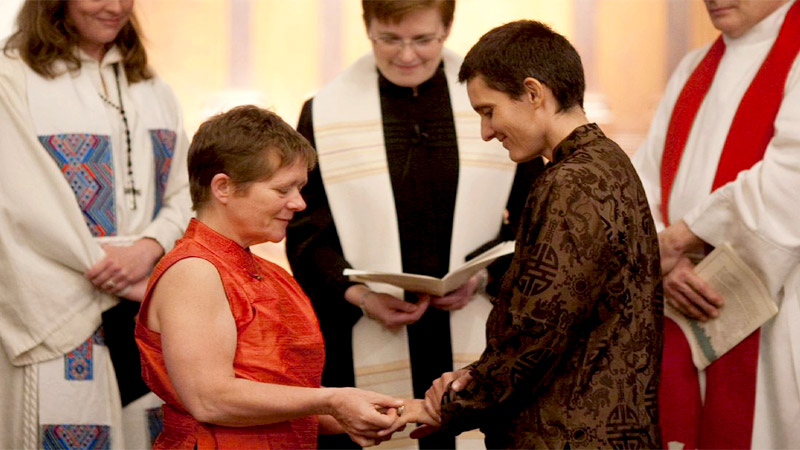
So will the Vatican help modernist Lutherans, Methodists, and Reformed Protestants overcome their errors of ordaining women and celebrating gay marriages? Or are such matters merely ecclesiastical preferences, like using port instead of a red blend?

Whatever the answer, ecumenism only happens when churches become indifferent to doctrine. Of course, doctrine doesn’t change. Churches don’t have to. You just stop enforcing orthodoxy.

Are Bryan and the Jasons really that gullible?

But What About Those Tough Stains?

Maybe purgatory makes sense if sin is like routine dirt that comes with perspiration, dust, food, like going through the motions in worship:

Let’s imagine you’re dead…. But you were busy….

So we, sinful creatures all, step out of this life into eternity—and we know, more clearly than we have never known anything, that we are not worthy to be in the presence of the Almighty God. In life, we may have casually popped the Eucharist onto our tongue, drunk of the Precious Blood, then gone back to our pews to idly watch the others return to their seats, ogling the cute boys or checking out the fashion faux pax, hardly pausing to ponder the great impossibility, the unimaginable truth, that God has given Himself to us, in the flimsy gift wrap of bread and wine. Wholly. Fully.

We have ignored Him, too, when we have not bothered to pray; when we have gossiped about our neighbors; when we have shirked our responsibilities in the workplace, when we have allowed anger to govern our relationships or our driving, when we have cheated on our diets or (yikes!) cheated on our spouses.

We are earthen vessels, all of us. And we know instinctively that we cannot face the great and mighty God in our current condition. True, we have been redeemed by the Blood of Christ, and His sacrifice has made it possible for us to be with Him for all eternity. First, though, we need to wash up—get ready for the party, for the great receiving line.

That’s what Purgatory is. It’s the washroom, the hot shower, where we become like Him.

Just imagine being in a hot shower for a millennium.

But if sin is like murder or deceit, something that takes you from innocent to guilty, maybe even gets you kicked out of the Garden of Eden and forces God to position angels with fiery swords to prevent you from going back, maybe you need something stronger to remove the stain of guilt.

Something like the active obedience of Christ? No clean without it.

For the Umpteenth Time, Grace is Not Nature

Once again the lame argument that nominalism (and its Protestant progeny) severed the chain of being and gave us Walmart:

One can now readily see the theological pitfalls of this position. It means that in Genesis, when God called creation ‘good’—it was only because He said so, not because it was really good. It also contravenes the testimony of the Old Testament, where creation as seen as reflecting the beauty and goodness of God—Dreher quotes Psalm 19:2, “The heavens declare the glory of God.” Finally, Ockham’s position is at odds with the reality of the Incarnation itself, along with the reality of the visible Church and the sacramental system. (Certainly it is now apparent how nominalism helped pave the way for the Protestant Reformation.)

In the context of the Christian faith, the errors and perils of nominalism may seem manifest, but what about its broader cultural implications? As Dreher explains, once the world had been emptied of inherent meaning and bore only that meaning imposed on it by God, the next big step was to replace God with man.

How and why did this happen?

The real answer, of course, is beyond our scope, but we can briefly point to it here. (See Dreher’s second chapter, “The Roots of the Crisis” for the full summary.) Once the sacred chain connecting all being to God was severed, creation shrunk back from its Creator: the world became a smaller place.

Hello! The heavens declaring the glory of God doesn’t make the heavens a sacrament.

Hello! Affirming the profound chasm between Creator and creature (can you say transcendence?) does not destroy the light of nature that shows “that there is a God, who hath lordship and sovereignty over all, is good, and doth good unto all, and is therefore to be feared, loved, praised, called upon, trusted in, and served, with all the heart, and with all the soul, and with all the might” (Confession of Faith 21.1).

Hello! Saying that God’s ways are not our ways is not to deny that God superintends all things.

In fact, if you believe in providence:

God the great Creator of all things doth uphold, direct, dispose, and govern all creatures, actions, and things, from the greatest even to the least, by his most wise and holy providence, according to his infallible foreknowledge, and the free and immutable counsel of his own will, to the praise of the glory of his wisdom, power, justice, goodness, and mercy. (Confession of Faith 5.1)

you can also believe in sacraments:

A sacrament is an holy ordinance instituted by Christ; wherein, by sensible signs, Christ, and the benefits of the new covenant, are represented, sealed, and applied to believers. (Shorter Catechism 91)

But if you so closely identify God with his creation, you may have trouble distinguishing the church from Europe. Hillaire Belloc anyone?

Europe is the faith, and the faith is Europe.

Surely, somewhere in all those Aristotelian categories appropriated by Aquinas, Roman Catholics have a way of distinguishing the world from God who is a “spirit, infinite, eternal, and unchangeable in his being, wisdom, power, holiness, justice, goodness, and truth.” You have to preserve those incommunicable attributes of God somehow.

Every Member Ministry

Remember how the Second Vatican Council affirmed the priesthood of believers?

The baptized, by regeneration and the anointing of the Holy Spirit, are consecrated as a spiritual house and a holy priesthood, in order that through all those works which are those of the Christian man they may offer spiritual sacrifices and proclaim the power of Him who has called them out of darkness into His marvelous light. (Lumen Gentium 2.10)

Look where it leads:

Here is part of what the pope said:

And today Lutherans and Catholics, Protestants, all of us agree on the doctrine of justification. On this point, which is very important, he did not err.

No, no, no. Now see, this infuriates me as an apologist (and former Protestant). It is one thing to have to correct this nonsense when it comes from the late Anglican bishop Tony Palmer. But from the pope? I defend the poor man, but at times he exasperates me.

Turns out Lutherans and Roman Catholics don’t agree:

Now, it is true, that some consensus has been reached between Catholics and Lutherans on justification. But it is not at all true to say, as Pope Francis does, that we all “agree” now, as though there are no differences to speak of. And for him to say that Luther “did not err” on justification is just flat baloney.

I mean, for heaven’s sake, Luther taught justification by faith alone. The Council of Trent condemned this error. Was Trent wrong? Or was Pope Leo X wrong in Exsurge Domine?

Leo X condemned Martin Luther’s view that the sacraments give pardoning grace

Leo X condemned Martin Luther’s teaching that sin remains after baptism

Leo X condemned Martin Luther’s view that a just man sins in doing a good work

And in its Canons on Justification, the Council of Trent pronounced an anathema on the following views of Luther:

Canon 5 anathematized the view that Adam’s sin destroyed free will

Canon 7 anathematized the view that good works before justification are sinful

Canon 9 anathematized justification by faith alone

Canon 11 anathematized imputed righteousness

Canon 25 anathematized the view that good works are venial sins even for the just man

There are important differences between Protestants and Catholics, and ecumenism is of no use if we don’t treat them honestly. We can’t just pretend they are not there and wish them away. If Luther “did not err,” did the Church err? Should we all become Protestants?

Trent was right; Leo X was right. Luther did indeed err; and in this particular statement, so did Pope Francis. I love Pope Francis; he’s my Father; but no, no, no. He was wrong.

Move over papal audacity. Say hello to lay audacity.

When Did Sex Become Orthodoxy?

This is how you know when the Church of England goes over the cliff:

I left the Church of England when, in 2008, it became clear what the inexorable trajectory had become. Wherever it leads, it doesn’t lead to orthodoxy and will always be shipwrecked on the rocks of secular liberalism and cultural Marxism. Secular liberalism rejects the Church’s notion of the complementarity of the sexes – male and female having separate and distinct roles within the economy of salvation – and cultural Marxism would do away entirely with the biblical teaching on marriage and the family. Both liberalism and Marxism reject the sanctity of life from conception to natural death.

Aside from the difficulties that Rome is not enduring with debates about marriage, divorce, and homosexuality (not to mention the sex scandal), why is sex such an indicator of sound doctrine? The only reproduction mentioned in the creed is the divine conception of the incarnate Christ.

But if you want to be on the Christian side of the culture wars, avoiding churches that ordain women and that prohibit abortion is apparently the preferred strategy for those who either have never heard of the NAPARC churches or who think evangelicalism is tacky.

Founding Fineprint

Lots of apologists insist that the Church of Rome is the one that Jesus Christ founded. That strikes me as a real slight to the Eastern churches and especially to the Church of Jerusalem where Jesus ministered. After all, Tertullian didn’t ask, “What Hath Rome to do with Athens?”

Now it turns out that the original language of the church that Jesus founded was not Latin but Greek:

First, we should know that the Apostles all spoke Greek in addition to their native Aramaic. It was the language of education and business. In Galilee (Galilee of the Gentiles as it was known in Palestine) a Jew had to know Greek if he wanted to talk to a gentile. Perhaps Our Lord Himself spoke Greek with the Roman centurion and Pilate. In the synagogues the Jews read from the Hebrew translation of the Greek translation (the Septuagint) of the Old Testament. Second, all of the New Testament — with the exception of Saint Matthew’s original Gospel which was written in Aramaic — was inspired in Greek. Third, when Saint Peter came to Rome the Jews residing there spoke Greek, the whole Mediterranean world did. Saint Peter offered Mass in Greek. Around his tomb, deep in the catacombs under Vatican hill (beneath Saint Peter’s main altar), the faithful who were buried all around the Apostle had “Peter pray for us” written in Greek on their own tombs. Fourth, the Roman Latin Rite grew slowly out of Itala Latin which was spoken by the gentile converts in Italy and North Africa and used in the liturgy sometime after Greek fell into desuetude in the West. Classical Latin (Ciceronian) was not used in the liturgy, but was used by the well-educated fathers, such as Tertullian, Saint Cyprian, Saint Hilary of Poitiers, Saint Ambrose, and Saint Augustine, in their writings. By the fourth century, Itala Latin, which was rather fluid, dominated in most of Italy and North Africa. Enter Saint Jerome (d. 420). His Latin Vulgate translation of the Bible facilitated the birth of what developed into “ecclesiastical,” Church Latin. Many Greek words found their way into Church Latin on account of their theological and scriptural importance. Ecclesia (church) is only one such word — there was no word in Latin adequate enough to convey such a Greek concept. By the sixth century, Latin became the standard for the Roman liturgy, as we see in the Leonine Sacramentary and later the Gelasian. By the time of Gregory the Great (d. 604) the Latin Canon of the Mass was fixed (canonized) with the addition of a number of Roman martyrs in the Memoriam and the Nobis Quoque Peccatoribus. The Roman Canon remained untouched for nearly fourteen hundred years.

If you want to be the Church that Jesus founded, shouldn’t you use the original language of the apostles you’re claiming to represent?

That’s not what Pope John XXIII thought:

Universal

Since “every Church must assemble round the Roman Church,”8 and since the Supreme Pontiffs have “true episcopal power, ordinary and immediate, over each and every Church and each and every Pastor, as well as over the faithful”9 of every rite and language, it seems particularly desirable that the instrument of mutual communication be uniform and universal, especially between the Apostolic See and the Churches which use the same Latin rite.

When, therefore, the Roman Pontiffs wish to instruct the Catholic world, or when the Congregations of the Roman Curia handle matters or draw up decrees which concern the whole body of the faithful, they invariably make use of Latin, for this is a maternal voice acceptable to countless nations.

Immutable

Furthermore, the Church’s language must be not only universal but also immutable. Modern languages are liable to change, and no single one of them is superior to the others in authority. Thus if the truths of the Catholic Church were entrusted to an unspecified number of them, the meaning of these truths, varied as they are, would not be manifested to everyone with sufficient clarity and precision. There would, moreover, be no language which could serve as a common and constant norm by which to gauge the exact meaning of other renderings.

But Latin is indeed such a language. It is set and unchanging. it has long since ceased to be affected by those alterations in the meaning of words which are the normal result of daily, popular use. Certain Latin words, it is true, acquired new meanings as Christian teaching developed and needed to be explained and defended, but these new meanings have long since become accepted and firmly established.

Non-vernacular

Finally, the Catholic Church has a dignity far surpassing that of every merely human society, for it was founded by Christ the Lord. It is altogether fitting, therefore, that the language it uses should be noble, majestic, and non-vernacular.

In addition, the Latin language “can be called truly catholic.”10 It has been consecrated through constant use by the Apostolic See, the mother and teacher of all Churches, and must be esteemed “a treasure … of incomparable worth.”11. It is a general passport to the proper understanding of the Christian writers of antiquity and the documents of the Church’s teaching.12 It is also a most effective bond, binding the Church of today with that of the past and of the future in wonderful continuity.

Tell me it’s not odd when you insist on a language that God refused to use when he revealed the gospel.

Why Protestantism Matters

Things you may hear in Rome during holy week:

“It is more important that men and women become holy,” Cantalamessa said, “than that they know the name of the one Savior.”

“Without the Madonna, we can’t go forward in our priesthood!” Francis said.

“Each one of us has entered into our own personal tomb,” Francis said, in the one extemporaneous addition to his homily. “I’m inviting you to come out.”

“God loves like this: Until the end, giving his life for each one of us,” Francis said in his homily. “It’s not easy, because all of us are sinners, we have limits, flaws. Yes, we all know how to love, but not like God loves, without looking at the consequences, until the end.”

Could this kind of teaching be the reason the Roman church is facing a shortage of priests?

Father Douglas Grandon is one of those rare exceptions – a married Roman Catholic priest. He was a married Episcopalian priest when he and his family decided to enter the Catholic Church 14 years ago, and received permission from Benedict XVI to become a Catholic priest.

Even though Grandon recognizes the priest shortage, he said opening the doors to the married priesthood would not solve the root issue of that shortage.

“In my opinion, the key to solving the priest shortage is more commitment to what George Weigel calls evangelical Catholicism,” Grandon told CNA.

“Whether you’re Protestant or Catholic, vocations come from a very strong commitment to the basic commands of Jesus to preach the Gospel and make disciples. Wherever there’s this strong evangelical commitment, wherever priests are committed to deepening people’s faith and making them serious disciples, you have vocations. That is really the key.”

If it’s broke, why convert?

You Gotta Serve Somebody

Will it be the Bible or the magisterium? Massimo Faggioli worries that papal audacialists are turning into magisterial fundamentalists:

Now, four years into the pontificate of Francis, only the traditionalist wing still uses the hermeneutics of “continuity and reform” versus “discontinuity and rupture” in interpreting Vatican II; Francis has never used it. But the damage is done, and not just in Rome or in the Vatican. For while on one side there is the minimizing of the role of critical thinking about Church history, on the other there is the cultural turn to an emphasis on identity studies. Even at those universities where a historical-critical approach to Church institutions and magisterial texts persists, things tend to gravitate around “religious studies” instead of theology.

This poses a problem for history and religious studies as disciplines: trying to understand the past lives of Christians without a theological line of credit open toward the faith of those Christians limits the ability of the historians to understand the lives of those Christians. But it’s an even bigger problem for theology. The historical-critical method is facing some pushback today even when it comes to biblical studies, as seen recently in overblown reactions to what the new general of the Jesuits said about the interpretation of the Gospel a few weeks ago. Paradoxically it seems more acceptable in today’s Catholic Church to bring the historical-critical method to bear on Scripture than to documents of the magisterium; it’s become more acceptable to critique divinely inspired authors of Scripture than a pope writing on sexual morality. A creeping magisterial fundamentalism toward the encyclicals of this last century is part of the “biopolitical” problem of Catholicism. This is clearly visible in the debate over Amoris Laetitia. But it would also be worth exploring how naively and uncritically Leo XIII’s Rerum Novarum is sometimes used (or misused) in the U.S. church to make arguments about Catholic social teaching.

But with a reduced papacy, what separates Roman Catholicism from Anglicanism? And without the audacity of the papacy, how do you argue for Rome’s superiority to Geneva?