Which Victims Do You Believe?

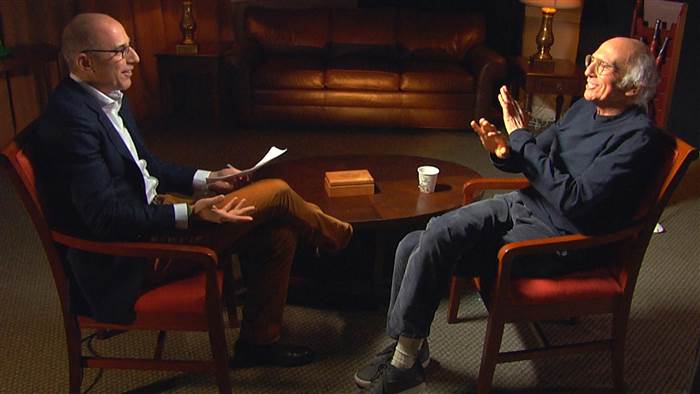
Yet another mainstream figure bites the dust — Matt Lauer of morning news fame whose performance only matter to mmmeeeEEE when he interviewed Larry David; I just can’t figure out any of the appeal of morning network news. Once again, women have come forward to accuse Lauer of inappropriate sexual behavior. NBC executives believed the women. And so Lauer loses his job.

What I can’t understand is the willingness of business, political, and journalistic authorities to believe what is generally one person’s word against another. This is not an opinion based on male privilege. It’s a legal reality hammered home by the Netflix series, The Keepers, in which Baltimore prosecutors and Roman Catholic Archdiocese officials were unwilling to believe the testimony of women who came forward almost 30 years later to accuse a specific priest of molesting them (and setting up meetings for other priests and police). No priest lost his standing (though a trip outside the country swept the controversy under the proverbial rug for a time). The reason as one of Baltimore’s States Attorneys explained was that the testimony of one person — even if memories were credible — was insufficient to start the engine of prosecution. (Of course, what is liable to prosecution in a court of law is not the same as public opinion or the rules of private employers.)

So what happened only six months after The Keepers was gaining some attention from video streamers?

And imagine writing today what one author did about the documentary series when it appeared:

How can anyone believe this?

The central thesis of The Keepers is that an alleged abusive priest, the now-deceased Rev. Joseph Maskell, can be tied to the disappearance and murder of Sr. Cathy. However, some of the central accusers in all of this, who claim that Maskell sexually abused them when they were young girls, have quite a bit of explaining to do.

For example, in 1995, a woman named Jean Wehner – whose claims play a central role in The Keepers – filed a civil lawsuit against Maskell under the name Jane Doe. What was uncovered in the course of her suit can only described as disturbing. It turns out that all of Wehner’s claims of abuse surfaced through the dangerous and discredited practice of “repressed memory therapy.”

It turns out that, according to court documents, Wehner has not just claimed that Rev. Maskell abused her in her life. Wehner has also claimed that she has somehow also been abused by:

four additional priests; three or four religious brothers; three lay teachers; a police officer; a local politician; an uncle; and two nuns.

Good grief. Really, Jean?

For a fuller account of the Archdiocese’s responses, see here.

Is it I or does it seem that Roman Catholics have been a little shy about weighing in on the current spate of revelations if only because of the church’s recent scandal-ridden past? Never to be intimidated, though, is Father Dwight:

What does this new and unexpected social phenomenon mean?

I think it indicates that a new generation of women don’t give two hoots about the old feminist agenda. The main objectives for women have been pretty much obtained-fair pay and fair treatment in the workplace. Now a new generation of women is saying, “We don’t have to put up with the harassment and objectification that still continues.

Hands off!

This is very interesting because, whether they like it or not, the modern women who take this view are echoing a very traditional set of values–ones which their great grandmothers would have recognized.

Its called modesty. In the past women were expected to draw the line, slap the man’s hand away and refuse a kiss until he was worthy.

The woman was the one who was supposed to be pure and unsullied and the keep the horny man at bay.

Father Dwight does realize, doesn’t he, that this “just-say-no” approach did not apparently work for the girls in The Keepers.

Meanwhile, some think the new found disgust with male appetites is not so much a recovery of virtue as an acquisition of power:

…what puzzles many of us is why the definition of deviance varies so dramatically over time. We cannot always predict who will become defined as deviant, and when the definitions will change. We do know that power plays the most important role in identifying who gets to define deviant behavior.

Until recently, allegations of sexual harassment and abuse by powerful men were not taken seriously—they were not viewed as deviant because the acts were perpetrated by powerful men on less powerful women. Now, the power to define sexual deviance has shifted to women—those who have collaborated with the media to bring attention to the issue and reform how such behavior is perceived and dealt with by society.

Until recently indeed — only 4 months ago.
Not So Messy

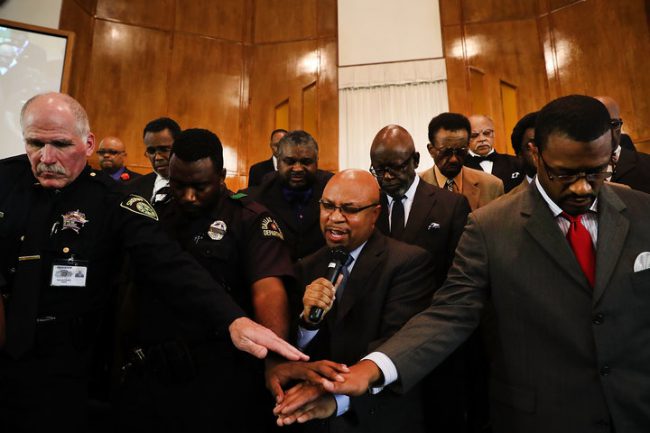
The folks at Witness have abandoned a theological system (Reformed) to rally around a racial (black) identity. Jemar Tisby explained:

Christianity is not some otherworldly religion that is only concerned with our spiritual lives. True faith acknowledges that our souls inhabit bodies and we experience the world in a physical and material way. So Christianity is also concerned with our reality as a people who have been marginalized due to the racial caste system in America.

We are a “black Christian collective” because we are made in the image of God and part of that image includes our melanated skin along with the culture and experiences that go along with it….

As a “black Christian collective,” The Witness has returned to its original mission to serve black people. The move from “African American” to “black” acknowledges this endeavor is international scope. The Witness is for the entire African diaspora. We are also a collective in the sense that a variety of black Christians from different denominations, ages, regions, and experiences all contribute their perspectives. The Witness is not the voice of black Christians; it is the microphone that amplifies those who have often gone unheard.

I was curious, in light of these changes, what The Witness’ perspective or counsel on the shootings in Texas might be. After all, the congregation is white and the shooter was white. So how would black Christians speak to or about Sutherland Springs?

It turns out, they sound like any other U.S. evangelical (white or person of color):

Tragedies like this provoke many discussions and debates around issues such as domestic violence, gun control, and church security protocols. We absolutely need to address these issues and seek concrete solutions, but that is not the focus of this post. Honestly, I don’t feel like I have the proper words at this point. I am tired saints. I have been to war and back and I am tired of violence.

Will you join me in praying that those in Sutherland Springs would be comforted by the God of all comfort? Is it alright if we include Charleston, Las Vegas, Orlando, San Bernardino, Blacksburg, Aurora, and all of those who have been struck by this plague of gun violence?

Let us pray.

Father God, we cry out to you. We thank you that we can approach your throne of grace boldly through the person and work of Jesus Christ. We thank you that you have caused us to be born again by the power of your Spirit who now indwells us and testifies with our spirits that we are the sons and daughters of God.

Father, you are able to do exceeding abundantly above all that we ask or think. We come to you now and we ask that your kingdom would come and that your will would be done on earth as it is in heaven. Lord God, bring healing to the families and communities impacted by these tragedies. We ask that you invade every place of darkness with your glorious light. Let grace abound.

I do wonder about the use of the word “darkness,” but otherwise, kudos to The Witness for showing solidarity with white Baptists.

Beware Medical Missions

Frederick Lugard, a British colonial administrator and Governor at distinct times of Hong Kong and Nigeria, included this estimate of medicine and preaching in his report on the “Rise of our East African Empire” (1893):

I think the most useful missions are the medical and the industrial, in the initial stages of savage development. A combination of the two is, in my opinion, an ideal mission. Such is the work of the Scotch Free Church on Lake Nyasa. The medical missionary begins work with every advantage. Throughout Africa the ideas of the cure of the body and of the soul are closely allied. The “medicine man” is credited not only with a knowledge of the simples and drugs which may avert or cure disease, but owing to the superstitions of the people, he is also supposed to have a knowledge of the charms and dawa which will invoke the aid of the Deity or appease His wrath, and of the witchcraft and magic (ulu) by which success in war, immunity from danger, or a supply of rain may be obtained. As the skill of the European in medicine asserts its superiority over the crude methods of the medicine man, so does he in proportion gain an influence in his teaching of the great truths of Christianity. He teaches the savage where knowledge and art cease, how far natural remedies produce their effects, independent of charms or supernatural agencies, and where divine power overrules all human efforts. Such demonstration from a medicine man, whose skill they cannot fail to recognize as superior to their own, has naturally more weight than any mere preaching. A mere preacher is discounted and his zeal is not understood. The medical missionary, moreover, gains an admission to the houses and homes of the 10 natives by virtue of his art which would not be so readily accorded to another. He becomes their adviser and referee, and his counsels are substituted for the magic and witchcraft which retard development.

Meredith Kline had a point.

Evangelicals Need to Take a Page from Roman Catholics (year 501)

Inspired by some minor reflections on personal identity and politics, I present recent findings on Roman Catholics and the 2016 Presidential election.

According to our May 2017 survey, just over three-quarters of American Catholics said that they voted in the November 2016 presidential election. Of those who voted, 43 percent said they voted for Trump while 48 percent said they voted for Clinton. The other nine percent voted for minority candidates. This is fewer Trump voters and more Clinton voters than the percentages among self-identified Catholics as reported in the exit polls, which reported 52 percent voting for Trump, 45 percent voting for Clinton, and 3 percent going to other candidates. But this survey took place six months after the election and some may have been recalling the candidate they wish they had voted for rather than their actual vote.

We began our 2017 survey with a series of questions about the possible role religious beliefs might have played among American Catholics In the 2016 election.

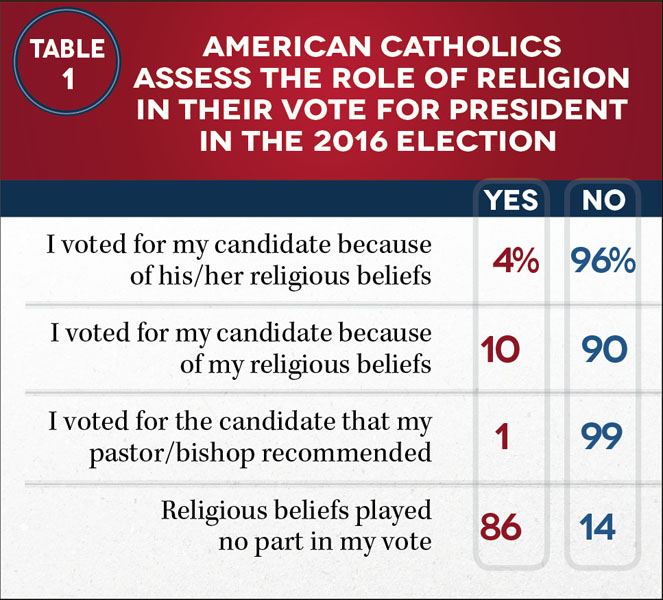
The responses of American Catholics to the questions cited in Table 1 make clear their assertion that their religious beliefs were not relevant to their vote for president in the 2016 election. The great majority (86 percent) said that religious beliefs (their own or that of the candidates) played no role in their vote. Just one in ten said that they voted for their candidate because of their own personal religious beliefs and even fewer — just 4 percent — said that they voted for their candidate because of the candidate’s religious beliefs.

Beliefs and values that are essential

That raised the question whether and to what extent did Catholics who voted for Trump differ in their religious beliefs and practices from Catholics who voted for Clinton. We have a standard block of questions about the beliefs and values that many consider essential to being a “good Catholic” that we have asked, in some form, on every survey since 1987. Table 2 compares the proportion of Trump and Clinton voters who say that each item is “essential to your vision of what it means to be Catholic.”

Catholics who supported Trump and Catholics who supported Clinton generally share very similar beliefs about how essential each of these items is to their vision of what it means to be Catholic. Differences of less than 10 percentage points between the two are not statistically significant. Both types of Catholic voters rank all ten items in virtually the same order.

Belief in the resurrection of Jesus, devotion to Mary as the Mother of God, and the papacy are essential to more than half of Trump voters and Clinton voters. Only about half saw charitable efforts to help the poor as essential and the percentage who saw the celibate male clergy as essential continues to have only a small percentage of support among either Trump or Clinton voters.

In other words, religion had little to do with the vote. That seems precisely what evangelicals should be doing. If you can segregate politics from faith, you don’t have the problem of evangelicals leaving the fold because of the movement’s political significance. Faith is one part of your life. Politics another.

Roman Catholics are doing it. Why can’t evangelicals?

General Revelation

Why don’t Christians have all the truth? Because non-Christians are smart and attend well to creation. Some highlights of recent revelations from people not explicitly illumined by the Holy Spirit or committed to Reformed Protestant epistemology:

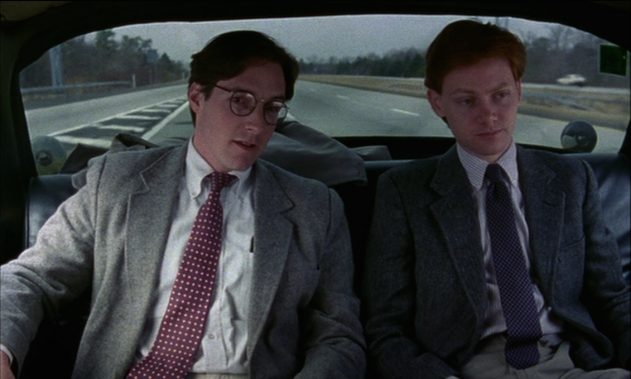
First, a great piece on the films of Whit Stillman which includes this:

Though certainly a contemporary filmmaker and not in any sense a stranded nostalgist, Stillman nevertheless displays qualities that, while once common, are now so rare that they put him in stark relief against nearly all of his contemporaries. Perhaps most pronounced is his distinctive affection for his uniformly well-born characters. If revulsion for bourgeois hypocrisy seems an obligatory quality in American independent filmmaking these days, Stillman will have none of it. He offers instead a gentle satire of his characters’ foibles combined with a frank sympathy for their principles. While quite natural in Austen novels and RKO comedies of the 1930s and ’40s, this is rare today. Thus is it all the more striking that Stillman continues to receive critical acclaim from disparate publications and institutions, from a Vanity Fair photo spread for the 25th anniversary of Metropolitan to a volume of effusive essays from the Intercollegiate Studies Institute.

Second, the short-sightedness of suburban growth:

Since the end of World War II, our cities and towns have experienced growth using three primary mechanisms:

1. Transfer payments between governments: where the federal or state government makes a direct investment in growth at the local level, such as funding a water or sewer system expansion.

2. Transportation spending: where transportation infrastructure is used to improve access to a site that can then be developed.3

3. Public and private-sector debt: where cities, developers, companies, and individuals take on debt as part of the development process, whether during construction or through the assumption of a mortgage.

In each of these mechanisms, the local unit of government benefits from the enhanced revenues associated with new growth. But it also typically assumes the long-term liability for maintaining the new infrastructure. This exchange — a near-term cash advantage for a long-term financial obligation — is one element of a Ponzi scheme.

The other is the realization that the revenue collected does not come near to covering the costs of maintaining the infrastructure. In America, we have a ticking time bomb of unfunded liability for infrastructure maintenance. The American Society of Civil Engineers (ASCE) estimates the cost at $5 trillion — but that’s just for major infrastructure, not the minor streets, curbs, walks, and pipes that serve our homes.

The reason we have this gap is because the public yield from the suburban development pattern — the amount of tax revenue obtained per increment of liability assumed — is ridiculously low.

Last, the folly of an all volunteer military:

When the Gates Commission set up the rationale for the AVF in 1970, it did so at the behest of a president, Richard Nixon, who had come to see the conscript military as a political dagger aimed at his own heart. One could argue that the decision to abolish conscription was a foregone conclusion; the Commission simply provided a rationale for doing it and for volunteerism to replace it.

But whatever we might think of the Commission’s work and Nixon’s motivation, what has happened in the last 16 years—interminable war—was never on the Commission’s radar screen. Like most crises, as Colin Powell used to lament when he was chairman of the Joint Chiefs of Staff, this one was unexpected, not planned for, and begs denial as a first reaction.

That said, after 16 years of war it is plain to all but the most recalcitrant that the U.S. cannot afford the AVF—ethically, morally, or fiscally.

Fiscally, the AVF is going to break the bank. The land forces in particular are still having difficulties fielding adequate numbers—even with lowered standards, substituting women for men (from 1.6 percent of the AVF in 1973 to more than 16 percent today), recruitment and reenlistment bonuses totaling tens of millions of dollars, advertising campaigns costing billions, massive recruitment of non-citizens, use of psychotropic drugs to recycle unfit soldiers and Marines to combat zones, and overall pay and allowances that include free world-class health care and excellent retirement plans that are, for the first time in the military’s history, comparable to or even exceeding civilian rates and offerings.

A glaring case in point is the recent recruitment by the Army of 62,000 men and women, its target for fiscal year 2016. To arrive at that objective, the Army needed 9,000 recruiting staff (equivalent to three combat brigades) working full-time. If one does the math, that equates to each of these recruiters gaining one-point-something recruits every two months—an utterly astounding statistic. Additionally, the Army had to resort to taking a small percentage of recruits in Mental Category IV—the lowest category and one that, post-Vietnam, the Army made a silent promise never to resort to again.

Moreover, the recruiting and retention process and rich pay and allowances are consuming one half of the Army’s entire annual budget slice, precluding any sort of affordable increase in its end strength.

All of these pieces relate to the United States’ growth as a world power and the way we pay (or don’t) for it. Stillman’s movie, Barcelona, is an amusing take on the convergence of economic interest and Cold War policy. And none of it will you (nor should you) find in New Horizons.

The Small Town and Its Defenders

The missus and I were glad to be in Jackson, Michigan, at the Grand River Brewery, for a set of presentations sponsored by The American Conservative. We heard Bill Kauffman, who is arguably conservatism’s funniest voice. Here’s an excerpt:

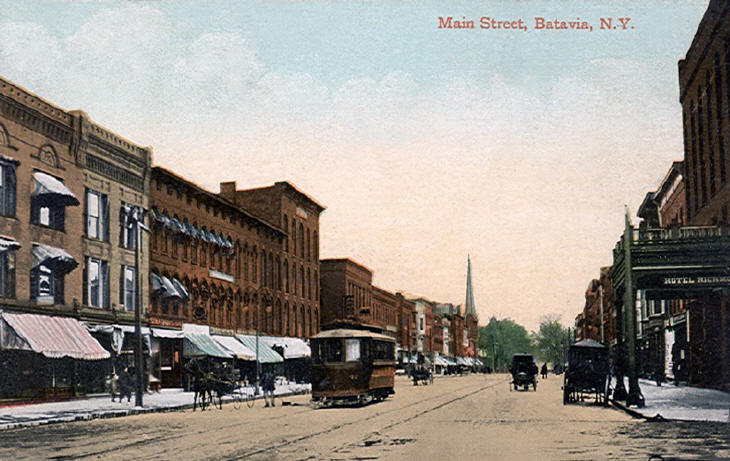
My hometown, Batavia, New York, population 15,500, has had plenty of Bill Baileys and Hughie Cannons over the years. I don’t mean by that shiftless drunks, daydreaming musicians, guys who stay out all night—they’re okay by me—but rather people who leave town, or who refuse to make a home in the place where they live. They reject Booker T. Washington’s wise injunction to cast down your bucket where you are.

In 2003 I published a book called Dispatches From the Muckdog Gazette, which is, megalomaniacally, a memoir about my repatriation to Batavia, but it’s also about the way that Batavia—and by extension all the Batavias from sea to dimming sea—has struggled to maintain a distinct identity, a character, rather than becoming just another formless wattle on the continental blob.

To the world, Batavia is merely Exit 48 on the New York State Thruway, that hideous gray scar across our green and lovely state, that drab version of the Erie Canal dedicated to that drab man Thomas E. Dewey, who fled his fine little hometown of Owosso, Michigan, which was too small to contain a man of his talent, or ego.

I don’t know how much anyone here knows of Batavia—I’m afraid we keep our little light well hidden under the bushel—but I will skip lightly over the first 160 or so years of our history and say only that it is rich, mythopoeic, beguilingly strange, as befits the cradle of the Anti-Masons, the first third party in American history.

Batavia was a prosperous little city, manufactory of combines and tractors and shotguns. English and Scots and Germans were the early settlers, coexisting uneasily with the late 19th-century polyglot influx of Italians and Poles. I’m a mongrel, a mixture of several of these streams—though my beloved late Italian grandmother insisted that we were “northern Italian—almost Swiss.” So in my book I gave myself license to write freely, even raucously, of the ethnic conflicts that once cleaved Batavia—but also gave it a good deal of its spice.

In some ways we were a typical small American city but in other ways we were “Batavia”—our own place. We did not yet bow down before the new American royalty: Burger King and Dairy Queen.

Then, as Joseph Heller would say, something happened. Urban renewal. My old boss Senator Pat Moynihan once said, when driving through Auburn, New York, which was decimated rather as Batavia was—I would do my Moynihan impression but I’m afraid I teetotaled at the reception—“in the 1950s, with a progressive government and newspaper, you got into urban renewal and destroyed everything of value in your town. If you’d had a reactionary newspaper and a grumpy mayor, you might still have it.” (Try to imagine any U.S. senator today saying something one ten-thousandth as perceptive.)

Expiration Date Passed

Apparently Ta-Nehisi Coates’ magic has worn off. Several writers have recently taken issue with his ideas about race relations and whiteness (and white superiority). Thomas Chatterton Williams, who was one of the first black authors to take Coates on, returns for another at bat under with the approval of editors at the New York Times (not the New York Post or the Washington Times). This must be serious.

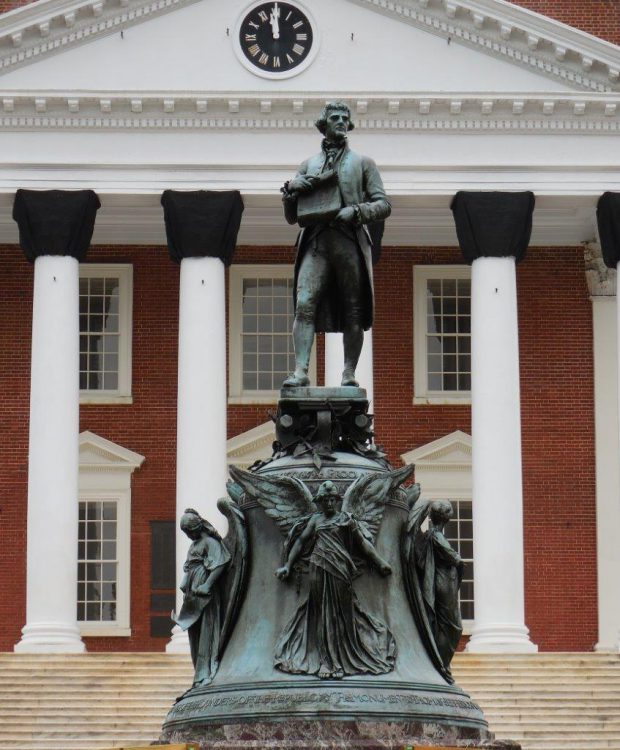
At the Atlantic though, where Coates writes regularly and achieved some of his fame, his editors still think Coates is brilliant and that they bask in the brilliance by publishing and endorsing his ideas. For instance, on a recent podcast about Charlottesville and the Confederate Monuments, Jeffrey Goldberg described President Trump’s reaction, in which he wondered if taking down Robert E. Lee leads to Jefferson and Washington, in cataclysmic terms:

It is an amazing moment when the president of the United States can’t delineate the difference between the Civil War and the Revolutionary War. I think this is a breakpoint in modern American history.

Hasn’t Goldberg read Coates? Someone well before Trump showed a lack of nuance in describing white supremacy in U.S. history:

For the men who needed to believe themselves white, the bodies were the key to ta social club, and the right to break the bodies was the mark of civilization. “The two great division of society are not the rich and poor, but white and black,” said the great South Carolina senator John C. Calhoun. “And all the former, the poor as well as the rich, belong to the upper class, and are respected and treated as equals.” And there it is — the right to break the black body as the meaning of their sacred equality. And that right has always given them meaning, has always meant that there was someone down in the valley because a mountain is not a mountain if there is nothing below.

You and I, my son, are that “below.” That was true in 1776. It is true today. (Coates, Between the World and Me, 104-105).

So what do the editors at the Atlantic think of a staff writer who cannot tell the difference between the Civil War and Revolutionary War?

Was the NFL the Gateway Drug for Playboy?

I wonder when neurological scientists will study the effects on the brain of watching football on the Lord’s Day. Until then, these conclusions look shaky (even a tad reductionist along materialist lines — but, hey, it’s our reductionism):

We now see the effects of having it “all out there now.” We can see how the constant exposure to pornography is not just eating away at our souls but is quite literally highjacking our brains.

In 2011, Struthers wrote an article for Christian Research Journal that explains the effects of porn on the male brain.

“Because the human brain is the biological anchor of our psychological experience, it is helpful to understand how it operates,” he wrote. “Knowing how it is wired together and where it is sensitive can help us understand why pornography affects people the way it does.”

Here’s a simplified explanation: Sexually explicit material triggers mirror neurons in the brain. These neurons, which are involved with the process for how to mimic a behavior, contain a motor system that correlates to the planning out of a behavior. In the case of pornography, this mirror neuron system triggers the arousal, which leads to sexual tension and a need for an outlet.

“The unfortunate reality is that when he acts out (often by masturbating), this leads to hormonal and neurological consequences, which are designed to bind him to the object he is focusing on,” Struthers wrote. “In God’s plan, this would be his wife, but for many men it is an image on a screen. Pornography thus enslaves the viewer to an image, hijacking the biological response intended to bond a man to his wife and therefore inevitably loosening that bond.” (For more on this see “9 Things You Should Know About Pornography and the Brain.”)

Imagine if neurological scientists tried to measure lust in the heart. And what about those long lasting effects of images of football players kneeling during the National Anthem on a Christian’s loyalty to the God-ordained powers?

The full story has yet to be told.

Speaking of Transformationalizationism

Ken Myers once upon a time took instruction from Meredith Kline about why the idea of Christian culture is wrongheaded:

The experience of human culture in all its diversity is the way we enjoy being human. And enjoy it we must. Being human is the most profound aspect of the creation for which we ought to give thanks. If we can enjoy the beauty of all else in creation, how foolish to resent or ignore the image of the Creator, the pinnacle of creation. It is being human, not being saved — it is the image of God in us, not regeneration — that established the capacity to recognize the distinctions between the beautiful and the ubly, between order and chaos, between the creative and the stultifying.

We were created beings before we were redeemed beings. God’s benediction on creation has not been entirely erased by the Fall. Jesus Himself is not only divine, He is human. Does he enjoy it, or simply endure it? Until our bodies are made new, like the body Jesus now enjoys, our calling is not to escape fleshly existence, nor to sanctify culture (since it is “common,” shared by believer and unbeliever, and cannot be made holy), but to so influence our culture as to make it more consistent with the created nature of man, and to sanctify our own lives, because we are also living in the Spirit, with our minds set on the things that are above.

We acknowledge this distinction between the holy and the common each time we partake of the Lord’s Supper. Every meal I eat, I eat to the glory of God, under the Lordship of Christ. But not every meal I heat has the significance and the power to transform that the Lord’s Supper has. It is a holy meal in a way last week’s visit to Burger King is not. Not everyone is allowed to eat this holy meal, but everyone is allowed to eat at Burger King. If there are deficiencies within the culture that have produced Burger King, the deficiencies are not due to the fact that it is not a holy place, but because it violates or compromises aspects of our experience as human beings. If we believe that to be the case, our goal as Christians would not be to sanctify the Whopper, to make it into a sacrament, but to attempt to influence our culture to make it more fitting for human beings bearing the image of God.

While our culture may not be holy, it should not be inhuman. (All God’s Children and Blue Suede Shoes, 50-51)

Transformationalize This

Michael Oakeshott on culture (from Alan Jacobs):

A culture, particularly one such as ours, is a continuity of feelings, perceptions, ideas, engagements, attitudes and so forth, pulling in different directions, often critical of one another and contingently related to one another so as to compose not a doctrine, but what I shall call a conversational encounter. Ours, for example, accommodates not only the lyre of Apollo but also the pipes of Pan, the call of the wild; not only the poet but also the physicist; not only the majestic metropolis of Augustinian theology but also the “greenwood“ of Franciscan Christianity. A culture comprises unfinished intellectual and emotional journeyings, expeditions now abandoned but known to us in the tattered maps left behind by the explorers; it is composed of light-hearted adventures, of relationships invented and explored in exploit or in drama, of myths and stories and poems expressing fragments of human self-understanding, of gods worshipped, of responses to the mutability of the world and of encounters with death. And it reaches us, as it reached generations before ours, neither as long-ago terminated specimens of human adventure, nor as an accumulation of human achievements we are called upon to accept, but as a manifold of invitations to look, to listen and to reflect.

And the holy urbanists actually think they are up to taking every thought captive? They may have bought that bridge in Brooklyn.