Buyer Beware

A common refrain among converts to Roman Catholicism is a lament about the sorry state of Protestantism, especially the mainline Protestant churches. Betsy Fox Genevose spoke for many when she described the lack of Christianity she had experienced while growing up a Protestant:

Throughout my non-churchgoing, non-believing adult years, I had always considered myself a Christian in the amorphous cultural sense of the world. Having been reared on the Bible and Protestant hymns, I was conversant with the language and basic tenets of Christianity. I had, moreover, been reared with a deep respect for the great Hebrew prophets, assorted Protestant leaders and Catholic saints, and even the unique value of Jesus Christ as the preeminent exemplar of loving self“sacrifice. Never, I am grateful to say, did I, like too many secular intellectuals, denigrate or disdain believing Christians, whom I had always been inclined to regard with respect. But for long years, I did not give much thought to joining their number.

So why is it that the communion that was supposed to elevate former Protestants and give them a better grade of faith is entering into ecumenical discussions with one of the churches, mainline Lutherans, that sent Protestants in search of witness firm on sex and the body?

Nearly 500 years after Martin Luther nailed his 95 theses to the Castle Church door, the largest Lutheran denomination in the U.S. has approved a declaration recognizing “there are no longer church-dividing issues” on many points with the Roman Catholic church.
The “Declaration on the Way” was approved 931-9 by the 2016 Evangelical Lutheran Church in America Churchwide Assembly held last week at the Ernest N. Morial Convention Center in New Orleans.

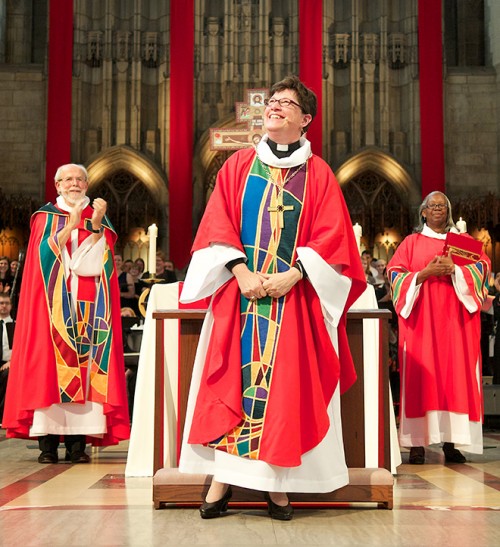
ELCA Presiding Bishop Elizabeth A. Eaton called the declaration “historic” in a statement released by the denomination following the Wednesday vote.

That’s right. A female bishop welcomed the news of entering into closer relations with church that will not ever ordain women.

But some Roman Catholics are not happy (the unhappy Lutherans are already in a different synod — LCMS):

The ecumenical drive has been part of the check-list of popes before the current pontiff. The joint worship service has been described by both the Vatican and the Lutheran World Federation as a “commemoration” rather than a “celebration” in order to avoid further controversy. Some Catholics, especially traditionalists, have criticized the prospect of a pope celebrating a schism. Another issue that has traditionalist Catholics and some clerics baleful is the issue of the differing theologies held by the Catholic Church and Lutherans regard the nature and the confection of the Eucharist.

On the upside, Betsy Fox Genovese, who died in 2003, will not have to witness her church’s pursuit of unity with her former church.


When Fundamentalists Do It, It’s not Sexy

It in this case is separatism. Back in grad school days the historiographical truism about evangelical Protestantism was that they were not separatists. Fundamentalists were. And so, evangelicals were good (broad minded) and fundamentalists were bad (intolerant). The dividing line was particularly the question of whether conservative Protestants could cooperate with the mainline (read liberal) Protestant denominations. When Billy Graham did reach out to mainline Protestants during his 1957 New York City Crusade (hee hee), fundamentalists like Bob Jones (harumph) broke with Graham’s evangelism. Thus you have separatism and the difference between an evangelical and a fundamentalist. The latter is an evangelical who is angry. Or, an evangelical is someone who likes Billy Graham (thank you George Marsden).

You wouldn’t know it, but separatism is rearing its poorly groomed head again and its not fundamentalists’ fault. Consider the following forms of separatism. First, the Benedict Option (as stated by Ken Myers):

The recovery of the culture of the people of God will make us look profoundly different from our neighbors. In a post-Christian society, all faithful people begin to look a little Amish. But we must remember that we are always against the world for the world.

Bob Jones didn’t withdrawal either. He didn’t even look Amish.

Then consider the academy’s moralism in the case of Yale professor, Thomas Pogge, allegedly guilty of sexually harassing female students:

To some students, responding means boycotting Pogge’s classes. A closed Facebook group called Students Against Pogge asks supporters to stand in solidarity with Lopez Aguilar “and the other foreign women of color targeted by [Pogge] by, at a minimum, not taking any of his classes in the fall.” The page notes that it’s also “a place to brainstorm other means of pressuring the university into making student voices heard and removing Pogge from the classroom,” according to the popular philosophy blog Daily Nous.

Other academics have said they won’t participate in conferences where Pogge is present. Most controversially, some professors have said that responding means eliminating Pogge from their syllabi.

James Sterba, a professor of philosophy at the University of Notre Dame, for example, told The Huffington Post that he’s no longer including Pogge’s work in exams for graduate students. “You don’t need him,” Sterba said. “He carries too much baggage — he doesn’t have to be cited anymore. … He’s a negative image and we don’t need that. Maybe if he was Einstein we’d have to cite him, but he’s not.”

That sounds like shunning.

But fundamentalists still bear the burden of separatism:

Thus, by the mid to late 1950s, the heirs of anti-modernist “second phase” fundamentalism were divided. An organization such as the American Council of Churches and separatists such as Rice and Jones Sr. and Jr. understood themselves as continuing in the historic line of militant, anti-modernist fundamentalism with a new emphasis on ecclesiastical separation. On the other hand, more open-minded heirs of second-phase fundamentalists, who would lead the neo-evangelical surge, sought to return to the era associated with the nineteenth-century evangelical scholarship of The Fundamentals.

On the verge of the tumultuous sixties, the fundamentalist movement had become deeply divided. Those who affiliated with the positive agenda of the non-separatist faction took the name neo-evangelical (eventually simply evangelical) and the separatists militantly clung to the label fundamentalist. Neo-evangelicals often repudiated the term fundamentalist, and fundamentalists did the same with the neo-evangelical moniker.

What if separatism is basic to what all humans do? We identify with some things and reject others. None of us are tolerant all the way down. We are all fundamentalists.

Is It the Economy or Social Media?

I (all about me) like it when discussions of spiritual matters include material causes. Calvinism isn’t just an idea (or five of them), but it is a form of western Christian that emerged at a specific time and place and its social location is part of Reformed Protestantism’s DNA (ever heard someone complain that Calvinism is too white, male, and suburban?). George Whitefield was not merely an evangelist but a person who had theatrical training and could really punch “Mesopotamia” so that the women fainted (which made the children cry).

So when Carl Trueman complained about the economic factors that contribute to the creation of an elite group of pastors and theologians who have an outsized influence in Protestant circles thanks to finances, I liked the point. If you can show that someone’s authority has at least something to do with their material standing rather than divine unction, then you have reason to follow your gut and take them with less seriousness.

But here’s the thing: if you look at the finances, the influence is disproportionate. Here are some sample numbers (gleaned primarily from the Evangelical Council for Financial Accountability and Guidestar):

2015 Mission to the World (PCA): $65 million+ revenues; $54 million+ expenses

2014 Council on Biblical Manhood and Womanhood: $287k+ revenues; $187k+ expenses

2015 Gospel Coalition: $2.6 million+ revenues; $2.2 million+ expenses

2015 Good News Publishing (Crossway, parent company [?] of Gospel Coalition): $17 million+ revenues; $15 million+ expenses

2014 Committee on Foreign Missions (OPC) budget: $1.6 million+

Judging by the wealth, CBMW’s influence is breathtaking (if you follow that sort of thing).

Also, judging by the numbers, the PCA’s foreign missionaries should be the topic of every other blog post by the folks who spin mortification.

I agree with Carl when he says:

My earlier questions — ‘How did these men get to such positions of far-reaching influence? Who appointed them to speak for me? How do we get rid of them if they go astray?’ – are the pertinent ones.

But since social media is cheap and the way these days to create a brand and gain a following, perhaps the better question is why Mission to the World and the OPC’s Committee on Foreign Missions aren’t creating a blog with regular contributions from their personnel.

The Limits of W-w

Like I say, transformationalism is good on inspiration but not so good on transformation. Jim Bratt gave a peak behind the curtain of neo-Calvinist culture in the U.S. in his last post before heading to China on a Fulbright (happy trails, Jim):

Boy, do we need that now. I’m thinking of the death this past week of Tim LaHaye. The span of tomfoolery he pumped out in the name of Christianity has created lasting disrepute for the faith. The creation “science.” The “end-times” irresponsibility, compounded of self-pity, blaming others, and a certain cultural idolatry. All of it redolent of the John Birch Society swamp from which he first slithered. Still, it’s the sort of religious fantasy you can expect to hit the American best-seller list. The death that really strikes home for me is the moral nadir of Mr. Family Values, “Dr.” James Dobson. His endorsement of Donald Trump puts paid to any pretense that the ethics and politics he pushed, lo, these many years have come to anything but authoritarian nationalism with a particular macho strut. For that is Trump. Dobson’s worse for covering it with smarmy God-talk.

I say this hits home for me because back when I was on a denominational committee studying the future of the CRC’s magazine, The Banner, we were given some research stats of readership habits and opinion. James Dobson turned out to be the CRC’s #1 rated authority on current events. Charles Colson was its #1 theologian. The Fraud and the Felon atop the Calvinist hit parade. Two minor sins in that revelation somehow stuck out for me. Dobson, a member of the Church of the Nazarene. Read rank Armininian. Colson, invoking the name of Kuyper as he bullied along.

All this, I mused, was the price of that “Americanization” to which the CRC, as an immigrant church, had been long pushed to accede. Well, nationalist mush compounded by militancy turns out to be the bitter fruit of that process. And so it is today.

I don’t pretend that Kuyper ever represented more than a small fraction of Dutch people claiming a Reformed commitment. Ditto, in Dutch-American Reformed circles, for The Forum, The Journal, or Perspectives. But these magazines have fought hard and punched way above their weight because of that magic formula that Kuyper caught, and taught. And it’s worth carrying on their mission, worth trying to maintain cultural, political, and theological integrity above the open sewer into which white-American Christianism has descended.

I bring this up not to delight in the sufferings of neo-Calvinists, nor to take a shot at Jim on his way out of the blogosphere. Bratt, it must be said, is honest about the state of neo-Calvinism and properly annoyed at its abuses.

I do refer to this to remind those would-be Kuyperians that the neo-Calvinist project is a lot harder than it sounds. Take every thought captive. Christ is Lord of every square inch. Television (and plumbing) redeemed. Integration of faith and learning. New York City as a tipping point for global revival. Bratt’s own account of the CRC is a ready warning that even with all the infrastructure of neo-Calvinist culture — church, school, catechesis, denominational magazine, world-and-life bleep, you are a poor match for mass culture in a liberal capitalist democracy.

Take every though captive? More like, kid yourself that you are large and in charge.

I truly admire the grit and determination of Dutch-American Calvinists. They are one of the true success stories of transplanting a distinct form of Old World Calvinism to the New World. They were BenOp Calvinists before the Benedict Option became hip.

But as all immigrant groups know, leaving the ghetto for the suburbs is part of the American dream. So for w-w to happen you may need to hunker down in the ghetto (or if Amish on the farm or if Benedictine in the monastery). But if you are going to live and move and have your being as a citizen of a modern nation state, chances are many of your square inches will be taken captive.

And if you want a theological rationale or explanation for that, for being part of the mainstream society but not, learn, live, and love 2k. The water’s warm.

For Those Without Ears to Hear

Justin Taylor revives Billy Sunday’s career by collecting comments on what the evangelist sounded like and even a few clips of the preacher himself. Taylor leaves out arguably the most insightful observer of Sunday, H. L. Mencken, whose critique extends as much to evangelicalism as to the baseball-player-turned-evangelist himself:

As for his extraordinary success in drawing crowds and in performing the hollow magic commonly called conversion, it should be easily explicable to anyone who has seen him in action. His impressiveness, to the vegetal mind, lies in two things, the first being the sheer clatter and ferocity of his style and the second being his utter lack of those transparent pretensions to intellectual superiority and other worldliness which mark the average evangelical divine. In other words, he does not preach down at his flock from the heights of an assumed moral superiority — i.e. inexperience of the common sorrows and temptations of the world — but discharges his message as man to man, reaching easily for buttonholes, jogging in the ribs, slapping on the back. The difference here noted is abysmal. Whatever the average man’s respect for the cloth, he cannot rid himself of the feeling that the holy man in the pulpit is, in many important respects, a man unlike himself . . . .; his aura is a sort of psychic monastery; his advice is not that of a practical man, with the scars of combat on him, but that of a dreamer wrapped in aseptic cotton.

Even setting aside [Sunday’s] painstaking avoidance of anything suggesting clerical garb and his indulgence in obviously unclerical gyration on his sacred stump, he comes down so palpably to the level of his audience, both in the matter and the manner of his discourse, that he quickly disarms the old suspicion of the holy clerk and gets the discussion going on the familiar and easy terms of a debate in a barroom. The raciness of his slang is not the whole story by any means; his attitude of mind lies behind it, and is more important. . . . It is marked, above all, by a contemptuous disregard of the theoretical and mystifying; an angry casting aside of what may be called the ecclesiastical mask, an eagerness to reduce all the abstrusities of Christian theology to a few and simple and (to the ingenuous) self-evident propositions, a violent determination to make of religion a practical, an imminent, an everyday concern.

Beaver Cleaver Was Lost in His Trespasses and Sins

Trigger warning to self: you’ve engaged Carl Trueman critically before and it did not go well. So be careful, be very careful.

The reason for bringing up Dr. Trueman again, even if ever so gingerly, has to do with his recent evaluation of Rusty Reno’s new book about prospect for a Christian society. Trueman writes:

I simply am not convinced that change can be achieved on any significant scale. The causes of the modern malaise are complicated, and their solution must be equally elaborate. For example, as George Grant and David Schindler have shown, technology brings with it a different view of reality from that of traditional Christianity. This mindset is now deeply embedded in our world. The entertainment industry mediates much of what is taken for reality and grips the moral imagination of the masses. The globalized economy has transformed communities and community expectations in ways we have yet to fathom. To borrow that hackneyed but poetic phrase from Marx, all that is solid melts into air. Zygmunt Bauman’s argument, that we live in a time when even the most longstanding and reliable social structures are in permanent flux, seems to me compelling. It must be accounted for by any hope that depends upon the solidity of concepts or institutions from the past. How does one reform or recapture or rebuild that which has been robbed of solid existence?

I generally agree.

But where I push (not shove) back is with the idea that modernity alone has these problems. Ever since the fall, it seems to me, the possibilities of pursuing lives of holiness and passing on the faith have been hard. Just remember what Paul warned Timothy about the “last days”:

understand this, that in the last days there will come times of difficulty. 2 For people will be lovers of self, lovers of money, proud, arrogant, abusive, disobedient to their parents, ungrateful, unholy, 3 heartless, unappeasable, slanderous, without self-control, brutal, not loving good, 4 treacherous, reckless, swollen with conceit, lovers of pleasure rather than lovers of God, 5 having the appearance of godliness, but denying its power. Avoid such people. 6 For among them are those who creep into households and capture weak women, burdened with sins and led astray by various passions, 7 always learning and never able to arrive at a knowledge of the truth. (2 Tim 3:1-8)

Was Paul predicting a time when Marx, Freud, and Nietzsche would dominate understandings of human nature and the created order, or was he talking about life in the Roman Empire circa 60 AD? My understanding is that he was talking about life in the Mediterranean world then.

So why do Christians believe modernity is so much worse than any other time? Well, it sure seems that Roman Catholics have a certain nostalgia for the Christian society of medieval Europe, neo-Calvinists for the Christian society of the Kuyperian era of Dutch history, evangelicals in the U.S. for the First Pretty Good Awakening that of course led up to the Christian founding of the United States. Here Protestants want to recalculate critiques of modernity since Kuyper and George Whitefield both fall on the modern side of the divide between medieval and modern periods. In other words, Protestant critiques of modernity play into the hands of certain Roman Catholic apologetics (even if nostalgia for the flourishing of the Middle Ages seldom extends to the Crusades or the Inquisition).

But surely anyone with eyes and ears has to admit that we are living in worse times than 1950s American when Ward and June Cleaver reared Wally and the Beave. I have eyes and ears. I will concede that the 2010s are worse than the 1950s, though I did live through 1968 and that was not a good time. But on a scale of fallen humanity, are modern or contemporary times really worse than what Noah lived through, or Lot, or Jeremiah, or our Lord himself? Doesn’t the fall mean we always live in desperate times?

The point here is not that people who believe in original sin should be relativists when it comes to assessing the way humans live together or proposing ways that are better for a common life together and for the proclamation of the gospel. But I think it is a mistake to cultivate the notion that human flourishing is possible whether by putting in place the right policies or institutions, or by thinking about the past a certain way. I know Dr. Trueman knows this. But it sounds like he thinks we are living through one of the worst times in human existence. No matter how pleasant and reassuring Beaver Cleaver’s America was, it was not the new heavens and new earth. When sin abounds, it’s not a good time. The Cleavers were certainly flourishing as we now count such living, but they were also drowning in sin (and never in church). Shouldn’t that perspective inform the way we view the West post-Foucault?

It’s Still Not 1968

Is this why Hillary Clinton will bring Bill back to the White House?

It’s worth repeating: there is no precedent in modern history for such a mass display of disunity by elected delegates at a national political convention as occurred this week in Philadelphia. Hundreds of people elected at primaries and caucuses not only vacated the Wells Fargo arena, they subsequently staged incendiary acts of civil disobedience and stared down Pennsylvania State Police riot cops—all to express the depth of their opposition to Hillary. Then, on Thursday, swaths of delegates chanted, booed, jeered, and walked out on Hillary during her nomination-acceptance speech. The closest analog may be the infamous Democratic convention of 1968, which erupted into turmoil mainly over the Vietnam War. But that turmoil mostly had to do with external protests met with violence by Chicago police. These acts of rebellion in Philadelphia were carried out by duly credentialed delegates.

The lack of coverage the tumult received, despite its historical significance, is indicative of a wider problem that Sanders supporters have long identified: few members of the elite media are sympathetic to the “Bernie or Bust” movement, which has resulted in disproportionately little media attention. Conversely, the failed #NeverTrump movement had countless devotees active in elite political, media, and ancillary spheres, so it received outsized coverage relative to the actual number of GOP voters who supported that position.

Machen Day 2016: Before Jimmy and Bunk

My father, who died in 1915 at the age of eighty-eight, and my mother, who died in 1931 at the age of eighty-two, were both Christians; from them I learned what Christianity is and how it differs from certain modern substitutes. I also learned that Christian conviction can go hand in hand with a broad outlook upon life and with the pursuit of learning.

My father was a lawyer, whose practice had been one of the best in the State of Maryland. But the success which he attained at the bar did not serve in the slightest to make him narrow in his interests. All his life he was a tremendous reader, and reading to him was never a task. I suppose it never occurred to him to read merely from a sense of duty; he read because he loved to read. He would probably have been greatly amused if anyone had called him a “scholar”; yet his knowledge of Latin and Greek and English and French literature (to say nothing of Italian, which he took up for the fun of it when he was well over eighty and was thus in a period of life which in other men might be regarded as old age) would put our professional scholars to shame. . . .

He was a profoundly Christian man, who had read widely and meditated earnestly upon the really great things of our holy faith. His Christian experience was not of the emotional or pietistical type, but was a quiet stream whose waters ran deep. He did not adopt that “Touch not, taste not, handle not” attitude toward the good things or the wonders of God’s world which too often today causes earnest Christian people to consecrate to God only an impoverished man, but in his case true learning and true piety went hand in hand. Every Sunday morning and Sunday night, and on Wednesday night, he was in his place in church, and a similar faithfulness characterized all his service as an elder in the Presbyterian church. At that time the Protestant churches had not yet become political lobbies, and Presbyterian elders were chosen not because they were “outstanding me [or women] in the community,” but because they were men of God. I love to think of that old Presbyterian session in the Franklin Street Presbyterian Church of Baltimore. It is a refreshing memory in these days of ruthless and heartless machinery in the church. God grant that the memory may some day become actuality again and that the old Christian virtues may be revived! (J. Gresham Machen, “Christianity in Conflict,” Selected Shorter Writings, 548, 549)

Will A Revival Save Us?

In hopes of understanding my own blindness about race relations in America and what I (me me I I me me) might do to make the nation and me less racist, I listened to Thabiti Anyabwile’s discussion with Carmen Fowler LaBerge. Here’s what I learned. First, I need to acknowledge that whites have treated blacks badly:

We need to acknowledge the ways in which the church has intentionally, historically refused to be the Body of God along the lines of race. Whether it from Virginia’s enactment of laws that if a slave became a Christian did not mean they would be freed from slavery, to the segregation of congregations in the 1800s and into the 1900s, to the Evangelical church just missing the ball in the Civil Rights Movement and other areas. We have to tell the truth- the bone deep truth- about our complicity if we will ever be free from it.

When I taught colonial America last fall, I ended with the point that race is one of the lasting and darkest legacies of colonial slavery. I may need to do more in class. But I think I’ve got this part of it. I understand in part if not in full.

Second, I need to do something:

Pastor T says one tangible step is to pray for revival. Pray that God pours out his Spirit on His church, and that His spirit would graciously bring conviction of sin. That He would quicken His church in repentance and holiness. Pray that God would subdue the hearts of those hearts in rebellion against God and turn to Him.

Pastor T hopes the Lord would use the grief and mourning that has gripped the nation to break our hearts in repentance and so we would draw near to Him in revival.

Here I’m scratching my head. Does Pastor Anyabwile (and Carmen) not know that revivals were incredibly divisive throughout U.S. history? Revivals don’t unify. They divide churches between pro- and anti-revivalists.

If Pastor Anyabwile means that revival might bring sanctification, I appreciate the point. But in the case of cop shootings, does that mean city governments should only hire applicants who have made a profession of faith? If revival saves America, aren’t we still thinking about politics the way Constantinians, neo-Calvinists, Covenanters, and theonomists do? Can we only trust officials who are saved?

So what do we do if we are to live with non-Christians? Any policies? Interestingly enough, Pastor Anyabwile faulted Ta-Nehisi Coates in the latter’s piece on mass incarcerations for not recommending any policies:

Coates repeats the significant failure he recognizes in an earlier Moynihan. Coates tells us that the fatal flaw in Moynihan’s infamous report was Moynihan’s decision to omit specific policy solutions. Having seen that so clearly, it’s odd that Coates should repeat that failure so often in the important writing he now undertakes. A mind as formidable as Coates’s ought not stop with descriptive analysis, however compelling its portrayal of the problem. It should push itself to hazard a prescription, to call for some specific redress.

Pastor Anyabwile is of course right. He should also know that revival is not policy.

So what policy is out there? Maybe Peter Moskos is on to something about what California and Chicago police can learn from New York City’s patrol people and their supervisors:

Last year in California, police shot and killed 188 people. That’s a rate of 4.8 per million. New York, Michigan, and Pennsylvania collectively have 3.4 million more people than California (and 3.85 million more African Americans). In these three states, police shot and killed (just?) 53 people. That’s a rate of 1.2 per million. That’s a big difference.

Were police in California able to lower their rate of lethal force to the level of New York, Michigan, and Pennsylvania — and that doesn’t seem too much to ask for — 139 fewer people would be killed by police. And this is just in California! (And California isn’t even the worst state; I’m picking on California because it’s large and very much on the high end.)

Now keep in mind most police-involved shootings are not only legally justifiable, they are necessary and good at the moment the cop pulls the trigger. But that doesn’t mean that the entire situation was inevitable. Cops don’t want to shoot people. They want to stay alive. You give cops a safe way to reduce the chance they have to pull the trigger, and they’ll certainly take it.

I really don’t know what some departments and states are doing right and others wrong. But it’s hard for me to believe that the residents of California are so much more violent and threatening to cops than the good people of New York or Pennsylvania. I suspect lower rates of lethal force has a lot to do with recruitment, training, verbal skills, deescalation techniques, not policing alone, and more restrictive gun laws. (I do not include Tasers on this list.)

If we could bring the national rate of people shot and killed by police (3 per million) down to the level found in, say, New York City (The big bad NYPD shoots and kills just 0.7 per million) we’d reduce the total number of people killed by police 77 percent, from 990 to 231!

The thing is, we don’t need the Holy Spirit’s miraculous powers for this. Providential control is always appreciated.

Republicans – The Party of Christian Charity

I don’t know why evangelical historians are so opposed to Trump. Have they not seen how forgiving Republicans are when it (thanks to one of our southern correspondents) comes to failed campaigns and the managers who run them?

The Republican Party has no natural defense mechanism against charlatans and saboteurs because politics is not what Republicans think about every second. Democrats love government. They spend their lives trying to maneuver themselves into a position to run other people’s lives. Republicans don’t want careers in government and give little thought to how to get there. Often they run for president only because they hope it will lead to more speaking gigs and TV appearances. […]

Anyone who hurts the Democrats’ electoral prospects is dead. Not so, the Republicans. If John Edwards, Ned Lamont, and Bill Bradley were Republicans, they’d have radio shows, TV gigs, and bestselling books.

What ever happened to Wesley Clark? Where’s Mike Gravel? Mike Huckabee has a TV show. If you want to know what the other former Republican presidential candidates are doing these days, just turn on the radio or TV. […]

No one gets rich by sabotaging the Democratic Party. But a lot of people get rich off losing races for the Republican Party. […]

There are no prizes in politics for caring the most, only for scoring the most. Devotion to the cause isn’t better than having a modicum of political savvy. If we’re serious about improving the country, we need candidates to be brutally honest about their own appeal. That’s if they really care about the team.

That sounds like conservatives are the truly loving and caring Americans.

Update:

Even when you fail, you win:

Fox News confirmed to The Daily Beast editor-at-large Lloyd Grove on Tuesday that beleagured chairman and CEO Roger Ailes will depart the cable news network following sexual harassment claims by former anchor Gretchen Carlson. According to a document obtained by the Drudge Report, Ailes will receive at least a $40 million buyout from the network. The news comes hours after New York Magazine reporter Gabe Sherman wrote that Fox News star Megyn Kelly told investigators hired by 21st Century Fox that Ailes had sexually harassed her ten years ago.

See how conservatives love one another?