Both Cannot Be True

On the one hand, preaching the Bible is haahht:

According to a new study by Gallup, the hottest thing at church today is not the worship and not the pastor. It’s not the smoke and lights and it’s not the hip and relevant youth programs. It’s not even the organic, fair trade coffee at the cafe. The hottest thing at church today is the preaching. Not only is it the preaching, but a very specific form of it—preaching based on the Bible.

On the other hand, Americans who go to church wouldn’t know a Bible if you threw it at them:

Over half of Americans have read little or none of the Bible, according to findings released Tuesday (April 26) by LifeWay Research.

“Most Americans don’t know first-hand the overall story of the Bible—because they rarely pick it up,” said Scott McConnell, executive director of LifeWay Research. “Even among worship attendees less than half read the Bible daily. The only time most Americans hear from the Bible is when someone else is reading it.”

Only 11 percent of survey respondents said they have read all of the Bible. Even less (9 percent) have read all of the Bible multiple times.

Stop making sense.

What Princeton Seminary Could Learn from the Pentagon

Peter Berger notices a sector of American religiosity where true inclusion and diversity reigns — the military chaplaincy:

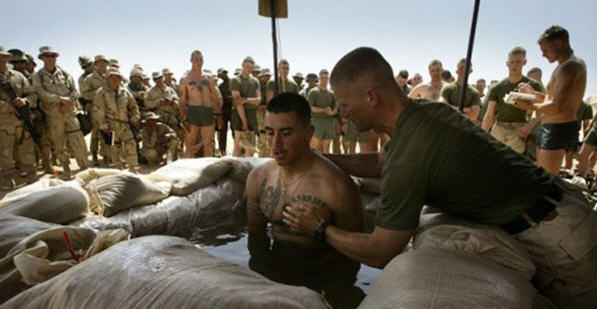
One particularly interesting development is that the military chaplaincy, in its Protestant group, is increasingly filled with Evangelicals, who feel more at home in the military than among largely liberal mainline clergy, whose concerns over gender and multiculturalism Evangelicals don’t resonate with. Some years ago I presided over a seminar dealing with whatever issues members of the seminar were concerned about. One of the seminar students was an Evangelical Air Force chaplain. This was the issue she wanted to think through: She served on a small base in the Arctic where she was the only Protestant chaplain. Of course she was not expected to perform religious services that did not agree with her own beliefs. But she was expected to facilitate services for any group of Air Force personnel. A group of Air Force women wanted to perform the rituals of Wicca, which defines itself as a modernized version of the old witches’ Sabbath. How, she asked, could she help organize a worship service of the devil without betraying the core of her Christian faith? I tried to convince her that the devil part was not to be taken seriously, that Wicca was a rather harmless form of nature worship—dancing naked in the moonlight and showing respect for menstrual blood. She said that the way I spoke about this showed I did not take the religious beliefs of this group seriously. I’m afraid she was quite right. In the end she had no choice unless she wanted to resign from the chaplaincy—so the would-be witches did their thing as facilitated by a nonsectarian Evangelical minister. (Religious freedom bears strange fruit, including the struggle of conscience of an Evangelical pastor ordered to go against her conscience by her commanding officer.)

Here’s the thing: if NAPARC communions and the PCUSA wonder about the fit between Tim Keller and a liberal Presbyterian seminary, why are those same NAPARC communions willing to send their pastors off to work not only with ordained women but even witches? I keep asking. I’m still not hearing many answers.

Curmudgeonly Evangelicals?

Old Life is not the only place where the dissatisfied express their dissatisfaction. Evangelical scholars are weighing in on Francis Fitzgerald’s new book, The Evangelicals: The Struggle to Shape America. If Barry Hankins thinks Fitzgerald neglects evangelicalism’s religious character, Randy Balmer faults her for not noticing evangelicals’ progressive politics:

FitzGerald recounts the drafting of the Chicago Declaration of Evangelical Social Con­cern in November 1973, but then progressive evangelicals drop almost entirely from the narrative until the waning years of the George W. Bush administration. Jimmy Carter, a Southern Baptist deacon and Sunday school teacher, the nation’s first avowed born-again president and a progressive evangelical, receives only scattered mention—far less, for example, than Phyllis Schlafly or even Herb Titus, a truly fringe figure. The chapter on George W. Bush, the nation’s second born-again president, by contrast, consumes more than a hundred pages.

FitzGerald renders the inner workings of the religious right in granular detail. We hear, for example, about James Dob­son’s tantrums and Richard Land’s partisan harangues, but only brief and belated reference to Sojourners magazine’s Call to Renewal or the effort of Red Letter Christians to emphasize the social teachings of Jesus. The author commendably plunges into the works of Rousas John Rushdoony and Francis Schaeffer, but the writings of Jim Wallis receive no comparable midrash. Shane Claiborne, a “rock star” among younger evangelicals and a radical (not progressive) evangelical, merits only a single reference.

The problem that Balmer fails to notice is that Christian progressives (evangelical or not) are in decline:

If the religious right has a single lesson to offer the left, it’s that churches make excellent incubators for political movements. With the decline of unions, progressive organizing has been left with a vacuum to fill. Left-leaning congregations could provide much-needed organizational apparatus that would be particularly important in local and off-year elections — the type of contests Democrats have struggled with in recent years.

Yet the the religious left has never faced more serious challenges. Religious progressives are fighting for relevance at a time when secular voters are becoming an increasingly crucial part of the Democratic coalition, and their political clout is only going to grow. Recent work suggests that secular voters are often uncomfortable with religiously infused political appeals, which could hurt the prospects of creating a secular-religious coalition. Progressives have always celebrated the big-tent nature of their movement, but religious liberals who once operated in the center ring may now have to come to terms with working outside the spotlight.

Since we live in a democracy, numbers matter? If we want an aristocracy of the few, the virtuous, the woke, fine. But that means giving up all that idealism about the equality of all people.

Don’t forget to notice also that the problem for Balmer with evangelicals is not Hankin’s complaint — that they are too political. Instead, the evangelical error is having the wrong politics. That would be an amusing exegetical show to find the Democratic (or Republican) platform in the pages of Holy Writ.

United Statesist Christianity

We need a new name for Christianity in the United States. The contributors to this podcast at Christianity Today are still lamenting the turnout of white evangelicals for Donald Trump and so one of them called for more attention to what it means to be evangelical. Are you kidding? We’ve had almost four decades of scholarship on evangelicalism, and at least three of chanting the integration of faith and learning, and we still don’t know what evangelical is? Please.

Then comes the objection to calling Lee Stroebel, whose new film is drawing attention to the Bill Hybels-spawned apologist, a fundamentalist.

A note or two about Strobel, the legal-affairs journalist. He did his undergraduate degree at a top j-school, the University of Missouri, and then went to Yale University to get his law degree. That gives some clues as to his approach to research and writing.

Strobel converted to Christianity in 1981 and, after a few years, went into ministry – becoming a “teaching pastor” at the world famous Willow Creek Community Church in the Chicago suburbs.

Now, WIllow Creek – led by the Rev. Bill Hybels – has for decades been known as, literally, a globel hub for the “seeker friendly” school of mainstream (some would say somewhat “progressive”) evangelicalism. Hybels, of course, became a major news-media figure in the 1990s through his writings and his role as one of the “spiritual advisors” and private pastors to President Bill Clinton.

Willow Creek is not a fundamentalist church.

From there, Strobel went west and for several years served as a writer in residence and teaching pastor at Saddleback Community Church, founded and led by the Rev. Rick “The Purpose Driven Life” Warren. In addition to writing one of the bestselling books in the history of Planet Earth, Warren has also received quite a bit of news-media attention through his high-profile dialogues with President Barack Obama, both during Obama’s first White House campaign and in the years afterwards.

Saddleback is not a fundamentalist church.

Fair points. I don’t think Stroebel is a fundamentalist either. But evangelical is increasingly meaningless even among Protestants who haven’t read (hades!, heard of) Deconstructing Evangelicalism.

So why not simply identify Christianity in the United States according to the degree to which its adherents adapt their faith (or pick and choose) to national norms? (Do remember that in 1899 Leo XIII identified Americanism as a heresy.) Once upon a time, Protestants came to North American and tried to transmit the version of Protestantism (works for Roman Catholics and Jews also) they brought to a New World setting. Some confessional Protestants still do this and triangulate their ministry in the U.S. according to precedents set in Europe whether at the time of the Reformation or when specific episodes upset national churches (think Scotland, England, Netherlands, Germany). Presbyterians in NAPARC still live with a foot (or – ahem – toe nail) in Old World Protestantism even as they have repudiated (except for the Covenanters) the political structures that animated their European predecessors.

But then along came awakenings and parachurch associations and increasingly Protestantism in the U.S. was known less for the fingerprints of its European origins than for those innovators (Whitefield and Moody) or structures (American Bible Society or National Association of Evangelicals) who were as independent of Old World Protestantism as their nation was of the United Kingdom. Once freed from European constraints, American Christianity used markets, earnestness, activism, and relevance as the basis for Christian identity. Evangelicalism was the kinder gentler version of fundamentalism. But neither showed the slightest bit of deference to the churches that came out of the Reformation.

Now, even the labels fundamentalist and evangelical make little difference. The gatekeepers won’t stand at the gate and even if they did the gateway has no wall to make the gate functional. Anyone can be a Christian on their own terms, with celebrities and parachurch agencies gaining the most imitators. But those instances of fame collect no dues, make no demands, and provide no institutional support. It’s like belonging to Red Sox Nation. Wear your bumper sticker. Listen to your Tim Keller sermon (now on sale for $1,500). Got to the next Gospel Coalition conference. You have Jesus in your heart and United Statesist Christianity has lots of proprietors to make your heart burn.

The good thing about United Statesist Christianity is that it allows its adherents to revel in exceptionalism. If America is a great nation, United Statesist Christianity is no less exceptional. Instead of a Pretty Good Awakening, United Statesist Christianity puts the Great back in Great Awakening.

Machen’s Warrior Mother

Another difference between New Calvinists and Reformed Protestants — sentimentality. Tim Challies does his best to present J. Gresham Machen as — we used to call them mama’s boys — the godly Christian son:

Because Gresham was a lifelong bachelor, his mother would remain the closest woman in his life until her death in 1931. This was the most grievous event he had experienced, for no one had held him in greater esteem than his mother. No one had been so unswervingly loyal to him. Perhaps no one had been so impacted by him. She once wrote to him: “I cannot half express to you my pride and profound joy in your work. You have handled in a very able manner the most important problem of the age, and you have given voice to my own sentiments far better than I could myself.” On the day the family laid her to rest, Gresham wrote, “My mother seems—to me at least—to have been the wisest and best human being I ever knew.”

God used Minnie’s powerful intellect and warm kindness to raise up a man who would benefit generations of Christians by his stalwart defense of the faith. And he continues to use such mothers to this day. Mothers, as you struggle to instruct your children in the Word and in sound doctrine, learn from Minnie that your labor is setting a strong foundation for years to come. As you strive to show steadfast love to your faltering children, learn from Minnie that God often uses such compassion to draw his children back to himself. Through your training and your tenderness, you are displaying the love of the Father.

Minnie had been her son’s first teacher and, with her husband, the one who led him to Christ. “Without what I got from you and Mother,” he would tell his father, “I should long since have given up all thoughts of religion or of a moral life. . . . The only thing that enables me to get any benefit out of my opportunities here is the continual presence with me in spirit of you and Mother and the Christian teaching which you have given me.” At his time of deepest need, she had comforted him with love and counseled him with the Word of God. She had remained loyal to him in that crisis and through every other controversy he endured. In his greatest and most enduring work, Christianity and Liberalism, it is fitting that its opening page bears this simple dedication: “To my mother.”

Tender. Warm. Kind. Compassion. Love. Loyalty. Those are all appealing words and they no doubt capture some of the relationship that Machen had with his mother, Mary Gresham.

But that portrait of the close relationship of mother and son (which those skeptical of Machen’s virtues have used to raise questions about his sexuality) doesn’t prepare New Calvinist admirers for the Warrior Children side of Machen. And to keep the spread sheets properly balanced, the New Calvinists (at least) need to remember how John Frame described the less than appealing side of Machen’s controversial proclivities:

The Machen movement was born in the controversy over liberal theology. I have no doubt that Machen and his colleagues were right to reject this theology and to fight it. But it is arguable that once the Machenites found themselves in a “true Presbyterian church” they were unable to moderate their martial impulses. Being in a church without liberals to fight, they turned on one another.

One slogan of the Machen movement was “truth before friendship.” We should laud their intention to act according to principle without compromise. But the biblical balance is “speaking the truth in love” (Eph. 4:15). We must not speak the truth without thinking of the effect of our formulations on our fellow Christians, even our opponents. That balance was not characteristic of the Machen movement.

Fighting for the sake of contention is one thing. Fighting for a Reformed church according to the word is another. Many of Machen’s warrior children think they fight for the sake of God’s word. New Calvinists tend to be skeptical, as Frame is, about the extent of battle fronts. They even call Old Calvinists mean and ornery.

As long as New Calvinists also know that Machen had critics who called him mean and ornery, they might avoid sentimentalizing Machen. If they want to sanitize him, they need to explain how Minnie Machen ever let her son become such a controversialist.

This IS White Normativity

Maybe not, but who can imagine that regeneration washes away the perspective that comes with being a white man? Joe Carter, for instance, wrote a series on Christian journalism for the gospel allies that contains this nugget:

Almost all news stories we encounter are devoid of context. They assume we understand the broader background and that we have followed the details from previous iterations of the story. But most of us tend to “catch up” on a news item only when we have to, when we realize that a particular current event item is not going away that we should probably develop a basic awareness and understanding of why it’s important.

My role as an explanatory journalist is to “make complicated things clear, quickly” by reinserting some of the missing context. Again, this doesn’t take any unique skill. I’m able to do this not because of my own specialized knowledge but merely because I have the time, willingness, and patience to dig through a backlog of material to put together a few key details that might be useful to a casual consumer of news.

What does race do to Carter’s perspective? If, as Thabiti Anyabwile and other African-American pastors tell us, that white Americans can never escape the blinkers that filter their perceptions of the news of a black young man shot by police, how are the non-white readers of Carter going to trust the context he supplies? Won’t his perspective reflect white-middle-class America with a helping of Christianity on the side?

Or maybe regeneration is supposed to supply a better perspective. But since Carter and Anyabwile are both regenerate, then why do they see some news matters differently? So much for Christian w-w. More like ethnic/racial-Christian w-w.

When Carter further explains the work of the Christian journalist, he summons help from Tim Keller:

“When the third, ‘eschatological’ element is left out,” Keller says, “Christians get the impression that nothing much about this world matters. Theoretically, grasping the full outline should make Christians interested in both evangelistic conversions as well as service to our neighbor and working for peace and justice in the world.”

This eschatological element motivates and frames the calling of the gospel-oriented journalist. The Christian journalist must constantly ask how, in the light of the gospel, we are to do God’s work of enlightening our neighbors with truth. Sometimes this means the work will have a definite and obvious gospel outcome (i.e., the article is explicitly biblical in the “Christian” genre). Other times it may mean that while the final product is indistinguishable from “secular” work (in the “common grace” sense), the journalistic process (the choosing of sources, the purpose for the writing, and so on) was guided by a commitment to the gospel.

This is where neo-Calvinist-like endeavors to claim every square inch break down. Journalism is properly a matter of providence, not redemption. Secular journalists, thanks to their creaturely capacities, have the ability to see and understand the real world in ways that escape Christians. Some of it may be IQ. Some of it may be more experience as a journalist and being skeptical about the claims that humans make. Regeneration doesn’t make someone a better journalist. One’s location in the created order — family, schooling, native ability, personal instincts — makes someone a better journalist.

Just the same, if Carter and Keller want to claim that the gospel makes Christians more interested in peace and justice in the world, they need to use that argument the next time that an African-American pastor or activist claims that white Christians “don’t get it.” If getting the gospel is what really matters for seeing things whole, Joe Carter is just as good a source on race relations at Ta-Nehisi Coates.

Between Tim and Carl — The NAPARC Dilemma

Rod Dreher calls attention to one NAPARC pastor who is not thrilled with current ecclesiastical options and so curious about — wait for it — The Benedict Option:

Meanwhile younger evangelicals are busy recapitulating the 20th century church’s fatal embrace of theological liberalism. As long as it’s packaged in an emotionally compelling way, their elders can be induced to swallow it as well, as “The Shack” easily demonstrates.

Within the more conservative strains of Reformed and Lutheran Protestantism there are other problematic dynamics. I have many Lutheran friends, but I’ll stick to generalizing about the Reformed. There is a spectrum in the PCA, for instance. The disciples of Tim Keller are almost as ready to give away the store in the name of reaching the culture as the mainstream evangelicals are, and there is a small but significant number of these Young Turks who are busy trying to combine AngloCatholicism and hipster feminism into a small enough package to smuggle into the PCA. On the other extreme are the Confessionalist Conservatives (with whom I mostly identify, tho less and less) many of whom seem to be suffering from Asperger’s Syndrome. Carl Trueman’s denomination is chock full of these. The focus here is on doctrine in an increasingly nuanced form, but it’s not particularly connected to real life most of the time. They tend to build small, unattractive churches full of Christians with advanced degrees in physics or engineering. They love doctrinal controversy, not because they love controversy, but because they love debating ideas. But regular people have no desire to follow the subtle arguments and hate the atmosphere of conflict coupled with a lack of any recognizably pleasing social interaction, so they run away pretty quickly. At my worst, I could easily fall into these pitfalls (indeed, I have) but the Lord is graciously restraining me and reshaping me, and by grace I am better than I was.

Pastor Brian, as he identifies himself in Rod’s comment boxes, should add that an important help to his dismissal of Keller’s giving away the story is the doctrinal zeal for which Carl Trueman’s Asperger Presbyterians are known.

But missing from this pastor’s dilemma is a recognition that the politics of identity (think race and gender) are leaving Tim Keller without a secure legacy in the PCA. Could it be that Keller is too white for the Leadership and Diversity Resource (talk about an Orwellian title) of the PCA?

When Wy Plummer invited one African-American seminarian to Chattanooga, Tennessee, to see a multiethnic PCA congregation, he had no idea the weekend would turn into an annual event attracting hundreds of men and women in Reformed denominations.

The event is now called Leadership and Development Resource (LDR), a weekend for African -Americans to see that they have a place in Reformed denominations. Since blacks are usually the minority in a PCA church, many feel as though they need to hide their ethnic culture in order to fit in at church, Plummer said. . . .

Now Plummer works with Tisby and Michelle Higgins to organize the annual gatherings. As LDR attracts more people, Higgins wants to equip teams to host regional LDR gatherings.

Plummer believes that LDR is playing a key role in creating diversity in the PCA. It gives Reformed African-American leaders the chance to address a national audience. For whites who attend, it is a place to learn about how African-Americans preach, pray, and worship.

If the OPC is getting too much doctrinal precision (haven’t heard that one before), has the PCA been getting too much Keller? Then again, the PCA establishment has to know that if push comes to shove and they have too choose between Tim and Kathy Keller or Jemar Tisby and Michelle Higgins, they’ll choose New York City over Chattanooga.

These days, though, you never know.

You Can’t Claim the Reformation and the First Gross (think German) Awakening

While the Gospel Allies put on the mantle of Luther — LUTHER!!! (that antinomian, beer drinking, potty mouth) — they should really be reading Garry Wills on the problem with evangelicalism. As I’ve been trying to say for some time, revivalism is antithetical to reformation. The church (as in reform the church) matters to Luther and Calvin. The parachurch is at the heart of revivals and the Gospel Coalition. To that end, consider the following:

Evangelicalism tends to break out of any single denomination—think of the preachers from various bodies at Cane Ridge. It is fissiparous even in its most favorable environments—think of Methodism branching into the Disciples of Christ, the Holiness Movement, the African Methodist Episcopal Church. (Whitefield, it should be remembered, was an ordained Anglican.) Evangelicalism is a style—Mark Noll calls it a “value system.” It can affect even some “high church” bodies or members. There are Pentecostalists among Roman Catholics. (Phyllis Schlafly, it should be remembered, was a Catholic, as Kellyanne Conway and Steve Bannon are. Bannon showed his allegiance in his 2014 Skype address to the Institute for Human Dignity at the Vatican.)

Given this description of evangelical style, two things should be noticed. America is, or likes to think of itself as, a “do-it-yourself democracy.” Many of the traits I have been listing are ones Americans will fancy themselves as embodying (or wanting to). People who hit the sawdust trail are working a kind of do-it-yourself salvation. The credentialing by the people is what all presidents claim. No wonder Noll thinks of evangelical religion (despite its roots in Wesley’s England) as native to America, as giving America its most recognizable God. Calvin said God “elects” his chosen ones. In America we choose to elect our leaders. The crowd credentials the preacher. Historians rightly observe that our national political conventions have borrowed elements from revivals.

The Allies should be especially mindful, as the crowds gather this week that “crowds credential preachers.”

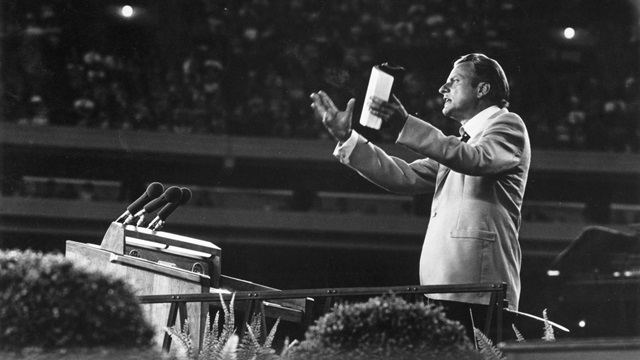
When You Think Billy Graham You don’t Think Lent

But such are the fortunes of evangelicalism that the people running the magazine that Billy Graham (trans-denominational) helped to found with Carl Henry (Baptist), and J. Howard Pew (anti-Communist Presbyterian) are fully comfortable with Anglicanism, and so have posted another article recommending Lent. In this case, telling points mount to show how poorly Lent fits with Christian piety:

heightened devotion is fruitful for a season, but cannot be sustained indefinitely. The Christian calendar offers a sustainable rhythm of which Lent is a part, and the fasting of Lent gives way to the feasting of Easter. Fasting and feasting are interconnected disciplines that teach us to love the King and his coming kingdom. In Lent, we learn to confess our sins, practice self-denial, and take on the humility of Christ. In Easter, we learn to rejoice, exult, and feast in Christ’s victory. As historian William Harmless explains, “In these two liturgical seasons Christians drank in, by turns, the ‘not yet’ and ‘already’ of New Testament eschatology.”

Repentance is fruitful for only part of the year? Moderation is something to observe but only for a time? Imagine if American Christians were moderate and humble the entire year. They wouldn’t binge or purge on American greatness or heinousness depending on which of their favorite presidential candidates was in the White House. Indeed, encouraging the idea that restraint and repentance are only for a while and not for all of life nurtures antinomianism: “I wouldn’t do this during Lent, but the other 325 days I will.”

If Lent is not supposed to lead to those thoughts (which I assume it’s not), then why not make Lenten practices year round? Because repentance and moderation can’t be “sustained indefinitely”? So people practicing Lent are Snowflake Christians? They don’t have the stomach for life-long dying to sin and living to Christ?

Aaron Damiani concedes that “Many Christians choose to keep or modify their Lenten disciplines for the rest of the year, as they have established helpful routines.” So now you have churches divided between full-time Lenten Christians, and ones who only observe Lent in late Winter and early Spring? Christians who truly sanctified and some who aren’t? Not only does this allow a culture of spiritual superiority to gain traction, but it also violates the rules of the liturgical calendar. Who sings Lenten hymns during Advent (oh, the hay that evangelicals make of tradition)?

Then there is the argument that Lent and the church calendar evoke the Jewish liturgical calendar (have you heard that Jesus fulfilled all of the law?):

It’s important to remember that the Christian liturgical calendar developed in part out of the rhythms of Jewish practice. The Old Testament indicates seasons of both heightened devotion and celebration, including Levitically led “sabbaths, new moons, and feast days” (1 Chron. 23:31) and “seasons of joy and gladness and cheerful feasts” (Zech. 8:19). Fasting and feasting were part of the “architecture of time,” in which Jesus participated as an observant Jew.

So what does Father Damiani do with Apostle Paul:

So let no one judge you in food or in drink, or regarding a festival or a new moon or sabbaths, which are a shadow of things to come, but the substance is of Christ. (Col 2:16-17)

Here‘s what Calvin did:

The reason why he frees Christians from the observance of them is, that they were shadows at a time when Christ was still, in a manner, absent. For he contrasts shadows with revelation, and absence with manifestation. Those, therefore, who still adhere to those shadows, act like one who should judge of a man’s appearance from his shadow, while in the mean time he had himself personally before his eyes. For Christ is now manifested to us, and hence we enjoy him as being present. The body, says he, is of Christ, that is, IN Christ. For the substance of those things which the ceremonies anciently prefigured is now presented before our eyes in Christ, inasmuch as he contains in himself everything that they marked out as future. Hence, the man that calls back the ceremonies into use, either buries the manifestation of Christ, or robs Christ of his excellence, and makes him in a manner void.

In other words, Lenten Christians are still holding on to a piety that clings to outward and physical attributes of unseen realities (heard of faith vs. sight?). They are incomplete Christians. They demand outward expressions of spiritual realities. They forget that Paul also wrote:

Jews demand signs and Greeks look for wisdom, but we preach Christ crucified: a stumbling block to Jews and foolishness to Gentiles, but to those whom God has called, both Jews and Greeks, Christ the power of God and the wisdom of God. For the foolishness of God is wiser than human wisdom, and the weakness of God is stronger than human strength. (1 Cor 1:22-25)

Oh by the way, Paul’s contrast between the visible and invisible, between the external and internal, is why the Confession of faith contrasts Old Testament and New Testament worship this way:

Under the gospel, when Christ, the substance, was exhibited, the ordinances in which this covenant is dispensed are the preaching of the Word, and the administration of the sacraments of baptism and the Lord’s Supper: which, though fewer in number, and administered with more simplicity, and less outward glory, yet, in them, it is held forth in more fullness, evidence and spiritual efficacy, to all nations, both Jews and Gentiles; and is called the new testament. There are not therefore two covenants of grace, differing in substance, but one and the same, under various dispensations. (7.6)

The comparison of Lent to the Old Testament is epic fail.

But remember what Calvin went on to say about Colossians 2. The rejection of the church calendar and other external ways of commemorating salvation doesn’t mean that Protestants throw out the sacraments:

Should any one ask, “What view, then, is to be taken of our sacraments? Do they not also represent Christ to us as absent?” I answer, that they differ widely from the ancient ceremonies. For as painters do not in the first draught bring out a likeness in vivid colors, and (eikonikos) expressively, but in the first instance draw rude and obscure lines with charcoal, so the representation of Christ under the law was unpolished, and was, as it were, a first sketch, but in our sacraments it is seen drawn out to the life. Paul, however, had something farther in view, for he contrasts the bare aspect of the shadow with the solidity of the body, and admonishes them, that it is the part of a madman to take hold of empty shadows, when it is in his power to handle the solid substance. Farther, while our sacraments represent Christ as absent as to view and distance of place, it is in such a manner as to testify that he has been once manifested, and they now also present him to us to be enjoyed. They are not, therefore, bare shadows, but on the contrary symbols of Christ’s presence, for they contain that Yea and Amen of all the promises of God, (2 Corinthians 1:20,) which has been once manifested to us in Christ.

I understand the appeal of Lent over the Anxious Bench. The followers of Billy Graham needed to graduate to something more meaningful, something more historical. How about the Reformation? How about the Bible? It replaces the altar call with the Lord’s Supper and gives us fifty-two Easters a year, fifty-two feast days with six days every week to prepare.


Remember When Being Nice Would Win the Day?

How a little reminder of 1929 clears the cobwebs.

Once upon a time, the Gospel Allies scored points against Reformed confessionalists by claiming the high ground of nice. Remember when Jared Wilson wrote this?

Cold-hearted rigidity is not limited to those of the Reformed persuasion, of course. You can find it in Christian churches and traditions and cultures of all kinds. In fact, to be fair, I have found that those most enthralled with the idea of gospel-wakefulness, those who seem most prone to champion the centrality of the gospel for life and ministry, happen to be of the Reformed persuasion. So there’s that. But gracelessness is never as big a disappointment, to me anyway, as when it’s found among those who call themselves Calvinists, because it’s such a big waste of Calvinism.

Or how about when Justin Taylor chimed in?

Angry Calvinists are not like unicorns, dreamed up in some fantasy. They really do exist. And the stereotype exists for a reason. I remember (with shame) answering a question during college from a girl who was crying about the doctrine of election and what it might mean for a relative and my response was to ask everyone in the room turn to Romans 9. Right text, but it was the wrong time.

This raises an important qualifier. The “angry” adjective might apply to some folks, but it can also obscure the problem. In the example above, I wasn’t angry with that girl. I wasn’t trying to be a jerk. But I failed to recognize what is “fitting” or necessary (cf. Eph. 4:29) in the moment. This is the sort of thing that tends to be “caught” rather than “taught” and can be difficult to explain. But there’s a way to be uncompromising with truth and to be winsome, humble, meek, wise, sensitive, gracious. There’s a way of “speaking the truth in love” (Eph. 4:15) such that our doctrines are “adorned” (Titus 2:10) and our words are “seasoned” with salt and grace (Col. 4:6). To repeat, the category of “anger” is often too broad and can miss the mark. As Kevin DeYoung pointed out to me, “Some Calvinists are angry, proud, belligerent people who find Calvinism to be a very good way to be angry, proud, and belligerent. Other Calvinists are immature—they don’t understand other people’s struggles, they haven’t been mellowed by life in a good way, they can only see arguments and not people. The two groups can be the same, but not always.”

So when Tim Keller advocated women’s subordination, he did so in precisely the categories that elicit New Calvinist religious affections (thanks to our southern correspondent):

We feel that there is a deep inconsistency in the phrase “evangelical feminism”. The feminists who are consistent recognize the Bible as a sexist book throughout. They reject it. The feminists who try to hold to complete Biblical authority have, really, an impossible balancing act to conduct. . . .

We know from experience that our position on women-in-ministry dissatisfies many people. Many friends from the traditional evangelical church find it far too “liberal” and “permissive”, while many other friends on the other side still feel it is oppressive. Our position is not totally unique. See J. Hurley’s book, Man and Women in Biblical Perspective or Susan Foh’s book, Women and the Word of God. They come close to where we are.

The fact remains that nearly everyone we meet is more “conservative” or else more “liberal” than we are. Thus we appeal to our friends to work with us on this. We do not to make this issue a cause of division, as we said above. We see no reason why friends with the same view of the Bible cannot work together, all the while influencing each other and refining one another’s viewpoint in order to become truly Biblical. Please be partners with us.

Balance, moderation, partnership — these were the calling cards of the New Calvinists. And for them, it was the Old Schoolers and Truly Reformed who were poorly positioned to represent Calvinism to the contemporary urban and global world. Some of us tried to explain that disagreement was not anger, and that standing in a specific tradition might cut down on “partnership.” We even thought that the medium of the World Wide Interweb thrived better on provocation than moderation. But for almost fifteen years the New Calvinists thought they had squared the circle, and Keller was proof positive at ground zero of global urban life in the United States.

What went wrong? One problem may have been living in a Gospel Coalition bubble and not engaging the concerns of “angry Calvinists.” But even more harmful was forgetting the antithesis and misreading the culture. Keller’s “success” in New York suggested (and sometimes actually asserted) that a new day had dawned for conservative evangelicalism. Modern Americans were truly willing to hear a kinder, gentler Protestantism. How could you deny that if the most secular and most urban place in the United States had received Keller the way New York City did? You certainly had to think that modern America was much more hospitable to faith if Keller was a best-selling author and the darling of religion journalists? Keller himself told lots of Presbyterians how the direction of the modern world was heading in a faith-friendly direction. I still remember the Power Point presentations I witnessed while on the faculty at WTS about the church in the city’s future.

What if while considering those trends predicted by economists and futurologists, New Calvinists had pondered the Bible more?

3 Above all, you must understand that in the last days scoffers will come, scoffing and following their own evil desires. 4 They will say, “Where is this ‘coming’ he promised? Ever since our ancestors died, everything goes on as it has since the beginning of creation.” 5 But they deliberately forget that long ago by God’s word the heavens came into being and the earth was formed out of water and by water. 6 By these waters also the world of that time was deluged and destroyed. 7 By the same word the present heavens and earth are reserved for fire, being kept for the day of judgment and destruction of the ungodly. (2 Peter 3)

That may tilt more Rod Dreher than Jamie Smith. But if you’re going to minister the word and teach in a seminary, doesn’t the apostle Peter count more than Peter Drucker?