It

Jeremy Young explains what he explored in his book on the charisma of politicians between the Civil War and World War II:

One of the central questions I had to answer in researching my book on turn-of-the-century charisma was how to determine whether a given leader was actually charismatic. Charisma is an enigmatic quality, both ineffable and deeply subjective; who was I to say that Theodore Roosevelt was more or less charismatic than, say, Woodrow Wilson? Ultimately, I realized that I was asking the wrong question; charisma was not a characteristic of leaders, but a relationship between them and their followers. By observing how Americans described their leaders, then, I could let followers do the work of identifying charisma.

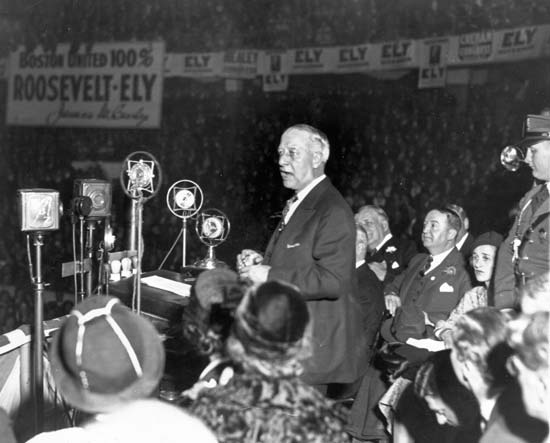
H. L. Mencken had another theory. It was whether or not a politician had “it.” Mencken thought Al Smith did.

There is something about Al’s aspect that the plain people like, not kowing why, and they seem to like it almost as well where cops are curiosities as where cows are curiosities. I have watched them at a dozen country railway stations, crowding up to the observation platform. Maybe the stop is for but two or three minutes; sometimes there is no more than a slowing down. They crane their necks expectantly, waiting for they know not what. Suddenly Al is on view, waving the brown derby, reaching out to shake hands, hauling in the bouquets brought for Mrs. Smith and joshing the local worthies. They regard him quizzically for a moment, and even with a certain hostility, but then, of a sudden, he has landed them, and as the train rolls on they are howling. . . .

The plain fact is that Al’s points are mainly infra-red and ultra-violet. It is impossible to chart or label them. He simply has the thing that the movie folk call IT — and the movie folks discovered long ago that it could not be described with any precision. There are grand and gaudy beauties who lack it altogether, and there are shabby little girls who radiate it at a pressure of a million volts. Al has it as no American politician has had it since Roosevelt. Has more of it, indeed, than Roosevelt, for the popularity of Roosevelt was largely logical: the plain people admired him because he had waded in blood and saved American womanhood from the Spanish Hun. But they know very little about Al, and what little they know, at least in these back reaches of the land, is mainly unfavorable. I don’t think it would be exact to say that they admire him, even after they have seen him. But it is as plain as day that they delight in him. He somehow thrills them and makes them happy. When he casts his magic over them it penetrates to their gizzards. (“Smith Has ‘It'” – 1928)

I suspect that Hillary didn’t have it but Trump did.

Postscript: Machen voted for Al.
Christianity Framed Mencken

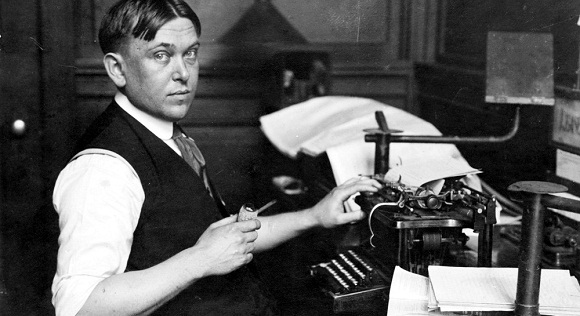
Andrew Ferguson wonders why Eerdmans would include an entry in its American religious biography series on H. L. Mencken:

The co-editor of the series, the church historian Mark A. Noll, raises the question in his foreword: “Whatever could have led Darryl Hart, himself the author of several worthy books patiently explaining the virtues of historical Calvinism, to think that any one at all could be interested in a religious biography of H.L. Mencken?”

A few pages later, the author himself wonders the same thing. After ticking off Mencken’s many admirable qualities—his productivity as a journalist, his fearlessness as a magazine editor, his unfailing humor, his tough-mindedness—Mr. Hart asks: “What does any of this have to do with religion? Why should Mencken qualify for entry in a series of religious biographies?”

I would like to report that the answer Mr. Hart gives to this question is an irrefutable and bold assertion about . . . something or other. But I can’t. For all the book’s virtues—it is charmingly written and comprehensive of its subject—the author struggles to explain why it should have been written at all.

But, for what is Mencken best remembered? The Scopes Trial. What about his attack on Puritanism (“the haunting idea, that someone, somewhere, may be happy”)? And what about his confrontation with the nation’s Protestant-inspired decency laws? Also, what to make of his withering critique of the moral idealism that Woodrow Wilson used to rally the United States to enter a war “to end all wars?”

The point is not that Christianity defined Mencken and that he ironically owed a debt to the believers who bemused him. Instead, taking account of his life makes little sense without noticing how his literary battles with Puritanism, his columns against Prohibition, his pointed coverage of the Scopes Trial, his protracted legal contest with Boston’s Watch and Ward Society, or the book he considered his most important, Treatise, set Mencken apart from his contemporaries, gave him a lot to say along with a large readership that wanted to listen. Christianity and its dominant position in American society was not responsible for producing Mencken. But it was a sufficiently large part of his experience and thought to justify a religious biography. (Damning Words, 4)

If Mencken is best remembered for his opposition to Christianity in its political, cultural, and moral dimensions, then isn’t religion a big part of his life even if he didn’t believe? Christianity framed Mencken. He would not be the man or writer he was without having been surrounded by and pondered Christianity. That makes a religious biography plausible.

Mencken Day 2016

After a visit to Charm City for Mencken festivities, the man remains the king of charm and truth (general revelation sense). What follows is from his coverage of the 1928 presidential election which witnessed the first Roman Catholic run for the White House on a major party ticket (that would be Al Smith):

I daresay the extent of the bigotry prevailing in America, as it has been revealed by the campaign, has astounded a great many Americans, and perhaps even made them doubt the testimony of their own eyes and ears. This surprise is not in itself surprising, for Americans of one class seldom know anything about Americans of other classes. What the average native yokel believes about the average city man is probably nine-tenths untrue, and what the average city man believes about the average yokel is almost as inaccurate.

A good part of this ignorance is probably due to the powerful effect of shibboleths. Every American is taught in school that all Americans are free, and so he goes on believing it his whole life — overlooking the plain fact that no Negro is really free in the South, and no miner in Pennsylvania, and no radical in any of the dozen great States. He hears of equality before the law, and he accepts it as a reality, though it exists nowhere, and there are Federal laws which formally repudiate it. In the same way he is taught that religious toleration prevails among us, and uncritically swallows the lie. No such thing really exists. No such thing has ever existed.

This campaign has amply demonstrated the fact. It has brought bigotry out into the open, and revealed its true proportions. It has shown that millions of Americans, far from being free and tolerant men, are the slaves of an ignorant, impudent and unconscionable clergy. It has dredged up theological ideas so preposterous that they would make an intelligent Zulu laugh, and has brought the proof that they are cherished by nearly half the whole population, and by at least four-fifths outside the cities. It has made it plain that this theology is not merely a harmless aberration of the misinformed, like spiritualism, chiropractic of Christian Science, but the foundation of a peculiar way of life, bellicose, domineering, brutal and malignant — in brief, the complete antithesis of any recognizable form of Christianity. And it has shown, finally, that this compound of superstition and hatred has enough steam behind it to make one of the candidates for the Presidency knuckle to it and turn it upon his opponent — basely to be sure, but probably wisely. (“The Eve of Armageddon,” Nov. 5, 1928)

I wonder if neo- and New Calvinists with all that w-w and earnestness and hope for a Christian society would have voted for the Democrat and Roman Catholic Smith. J. Gresham Machen, a life-long Democrat, did. Part of the reason was 2k.