
Darryl G. Hart speaks about Machen’s experience through World War I.  This is part three of a series on Machen taught at Calvary OPC in Glenside, PA.
Category: J. Gresham Machen
What Prepared Machen to Fight?
Darryl G. Hart continues his course on J. Gresham Machen at Calvary Orthodox Presbyterian Church in Glenside, PA. Â Hart explore several key aspects to Machen’s family and early life.
Fighter of the Good Fight
Darryl G. Hart begins a new course on J. Gresham Machen at Calvary Orthodox Presbyterian Church in Glenside, PA.
Family and Sabbath
Darryl G. Hart and Camden Bucey converse about family and Sabbath through the writings of Wendell Berry.
Books by Wendell Berry
Was Machen Wrong Not to Appeal to Union?
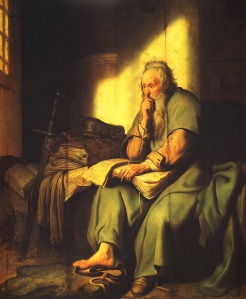 Writing on Gal. 2:19 (“For I through the law died to the law, that I might live to Godâ€), a verse smack dab in a passage where Paul talks a lot about being “in†Christ, Machen writes the following:
The law . . . led men, by its clear revelation of what God requires, to relinquish all claim to salvation by their own obedience. In that sense, surely, Paul could say that it was “through the law†that he died to the law. The law made the commands of God so terribly clear that Paul could see plainly that there was no hope for him if he appealed for his salvation to his own obedience to those commands.
This interpretation yields a truly Pauline thought. But the immediate context suggests another, and an even profounder, meaning for the words. The key to the interpretation is probably to be found in the sentences, “I have been crucified together with Christ,†which almost immediately follows. “The law,†Paul probably means, “caused me to die to the law, because the law, with its penalty of death upon sins (which penalty Christ bore in our stead) brought Christ to the cross; and when Christ died I died, since he died as my representative.†In other words, the death to the law of which Paul here speaks is the death which the law itself brought about when it said, “the soul that sinneth it shall die.†Christ died that death, which the law fixes as the penalty of sin, when He died upon the cross; and since He died that death as our representative, we too have died that death; the penalty of the law is for us done away because theat penalty has been paid in our stead by the Lord Jesus Christ. Thus our death to the law, suffered for us by Christ, far from being contrary to the law, was in fulfilment of the law’s own demands. We are free from the penalty of death pronounced by the law upon sin not because we are rebels against the law, but because the penalty has been paid by Christ. (Machen’s Notes on Galatians, p. 159)
It is striking that Machen, a none too shabby Pauline scholar, preferred to use the language of representation or substitution rather than union with Christ. And instead of seeing union as the sub-text, Machen interprets this passage in what appears to be straightforwardly forensic categories.
The Two-Kingdom Case for Blue Laws

(Not to be confused with the “Blue Letter.â€)
In 1933, the years the Philadelphia Eagles football club started (thank you Dan Borvan), the state of Pennsylvania considered reforming its laws prohibiting commercial activity on Sunday, the Christian Sabbath, so that football players and coaches could play in the afternoon. (How would the NFL make it without violating the fourth and eighth commandments?) J. Gresham Machen, then a resident of Philadelphia, wrote a letter to Gifford Pinchot, the governor of Pennsylvania and requested the retention of the Blue Laws as they were then written.
Machen’s reasoning in this letter is instructive for what it says about a recognition and acceptance of religious diversity, a commitment to religious freedom, and the tensions within a democracy between majority rule and minority protection. Perhaps most important for two-kingdom purposes is the place of an appeal to Scripture in public debate. In this case, Machen argues not for the magistrate to enforce divine law, but for the advantages that come to everyone when the law protects the practices of some citizens.
Not to be missed is what this letter says about the fourth commandment, and that keeping the whole day holy with two services is an occasion of Christian liberty. If only the Bible speaks to all of life crowd would take up the cause of the sanctity of the Lord’s Day. (Do we see a pattern here? Two kingdoms, two services?)
April 20, 1933
The Honorable Gifford Pinchot
Governor of Pennsylvania
Harrisburg, Pa.Dear Sir:
Will you permit me to express, very respectfully, my opposition to the Bill designated “House Bill No. 1″ regarding permission of commercialized sport between the hours of two and six on Sunday afternoons?
It is clear that in this matter of Sunday legislation the liberty of part of the people will have to be curtailed. It is impossible that people who desire a quiet Sunday should have a quiet Sunday, while at the same time people who desire commercialized sport on Sunday should have commercialized sport. The permission of commercialized sport will necessarily change the character of the day for all of the people and not merely for part of the people.
The only question, therefore, is whose liberty is to be curtailed. I am convinced that in this case it ought, for the welfare of the whole people, to be the liberty of those who desire commercialized sport.
The curtailment of their liberty, through the existing law, does not, I am convinced, go beyond reasonable bounds. There is, it seems to me, a sharp distinction of principle between complete prohibition of some form of activity or enjoyment and reasonable regulation of it in the interest of other people. To ask that commercialized sport should dispense with one day out of seven for the benefit of that large part of our population that desires a quiet Sunday and believes that it is necessary to the welfare of the State does not seem to me to be unreasonable.
Of course it is perfectly clear that in a democracy the majority should rule in this matter as in other matters. I should be the last to advocate any attempt to make people religious or even to make people ordinarily moral or decent against their will by mere legislative enactment. I should also be the last to advocate any tyrannical imposition of the convictions of a minority upon the majority. But how shall the majority will be exercised? I think that it ought to be exercised through the ordinary processes of representative government. To allow commercialized sport on Sunday in Pennsylvania will be a radical change in the whole life of our people. It is a wise provision of representative government that such radical changes should not be hastily accomplished, as might be the case by the referendum vote, but that they should be accomplished only when it is quite clear that the majority of the people really and seriously and permanently desires the change. . . .
As to the merits of the question, I could hardly find words strong enough to express what my feeling is. It does seem to me that the profoundest dangers to our entire civilization are found in the constant rush of noise and jazz and feverish activity which is one of the great faults of the American people and which is a great barrier to true efficiency as well as to the cultivation of the deeper things.
Of course, my own cultivation of a quiet Sunday is based on considerations much more fundamental than these. I am a Christian, and it is quite clear that a commercialized Sunday is inimical to the Christian religion. There are many other Christians in Pennsylvania, and because they are Christians they do not cease to be citizens. They have a right to be considered by their fellow-citizens and by the civil authorities. But the reason why they can with a good conscience be enthusiastic advocates of the Christian practice in the matter of Sunday is that they regard it as right, and as for the highest well-being of the entire State.
Very truly yours,
J. Gresham Machen, Professor of New Testament in Westminster Theological Seminary, Philadelphia
Postscript: over at David Strain’s blog come a couple of helpful posts about sabbath observance. As a native Scot, Strain knows first-hand about patterns of sabbatarianism among Old World Presbyterians, both mainline and sideline. In fact, during a Hart expedition to Scotland a decade ago, Mrs. Hart and her husband were delighted to see that even the Church of Scotland congregations conducted morning and evening service. This contrasts with the practice of one service among conservative Reformed and Presbyterians in the United States where supposedly Reformed Christianity is doing better.
Strain also mentions one of the common complaints about sabbatarianism – that is it legalistic. Well here is one radical two-kingdom virus carrier who also fully supports the supposed legalism of sabbath observance. In fact, the critics of 2k ought to consider where the leading 2k voices are on matters like the fourth commandment and the regulative principle of worship (as in the second commandment). Antinomian? Reconsider.
Some Happy New Year
 Seventy-two years ago on January 1, J. Gresham Machen died. He was fifty-five. It was a great loss to the church and the Reformed tradition. It is a sober way to wake up after a night of revelry. (If you care to drink a toast, you have time to recover. Machen did not die until approximately 7:30 Central Standard Time.)
To honor the day and the man, here is arguably the most poignant and profound passage from Machen’s writings:
. . . whatever the solution there may be, one thing is clear. There must be somewhere groups of redeemed men and women who can gather together humbly in the name of Christ, to give thanks to Him for his unspeakable gift and to worship the Father through Him. Such groups alone can satisfy the needs of the soul. At the present time, there is one longing of the human heart which is often forgotten — it is the deep, pathetic longing of the Chrsitian for fellowship with his brethren. One hears much, it is true, about Christian union and harmony and co-operation. But the union that is meant is often a union with the world against the Lord, or at best a forced union of machinery and tyrannical committees. How different is the true unity of the Spirit in the bond of peace! Sometimes, it is true, the longing for Christian fellowship is satisfied. There are congregations, even in the present age of conflict, that are really gathered around the table of the crucified Lord; there are pastors that are pastors indeed. But such congregations, in many cities, are difficult to find. Weary with the conflicts of the world, one goes into the Church to seek refreshment for the soul. And what does one find? Alas, too often, one finds only the turmoil of the world. The preacher comes forward, not out of a secret place of meditation and power, not with the authority of God’s Word permeating his message, not with human wisdom pushed far into the background by the glory of the Cross, but with human opinions about the social problems of the hour or easy solutions of the vast problem of sin. Such is the sermon. And then perhaps the service is closed by one of those hymns breathing out the angry passions of 1861, which are to be found in the back part of the hymnals. Thus the warfare of the world has entered even into the house of God. And sad indeed is the heart of the man who has come seeking peace.
Is there no refuge from strife? Is there no place of refreshing where a man can prepare for the battle of life? Is there no place where two or three can gather in Jesus’ name, to forget for the moment all those things that divide nation from nation and race from race, to forget human pride, to forget the passions of war, to forget the puzzling problems of industrial strife, and to unite in overflowing gratitude at the foot of the Cross? If there be such a place, then that is the house of God and that the gate of heaven. And from under the threshold of that house will go forth a river that will revive the weary world. (Christianity and Liberalism [1923], 180-81)
Machen on Roman Catholic Indoctrination
 Since the Christian school advocates are invoking Machen, here is one more relevant quotation that may clarify his views on American liberty and how it affects folks from different faiths even if they happen to be in the Protestant majority. Since Machen refers in the following to debates over public education, the quotation may also shed light on why he admired the Dutch Calvinist day schools.
The attack upon tolerance in America is appearing most clearly in the sphere of education. The Oregon school law, it is true, with its provision that children should be taken by brute force from their parents and delivered over to the tender mercies of whatever superintendent of education happens to be in power in the district where they reside, will probably be declared unconstitutional by the Supreme Court. And the Nebraska language law, which made literary education a crime, was thrown out by the same tribunal. But the same ends may well be accomplished by indirect means, and if the Sterling-Reed Bill is passed by Congress, we shall have sooner or later that uniformity of education under the control of the state which is the worst calamity into which any nation can fall.
Against such tyranny, I do cherish some hope that Jews and Christians, Roman Catholics and Protestants, if they are lovers of liberty, may present a united front. I am for my part an inveterate propagandist; but the same right of propaganda which I desire for myself I want to see also in the possession of others. What absurdities are uttered in the name of a pseudo-Americanism today! People object to the Roman Catholics, for example, because they engage in “propaganda.” But why should they not engage in propaganda? And how should we have any respect for them if, holding the view which they hold — that outside the Roman church there is no salvation — they did not engage in propaganda first, last, and all the time? Clearly they have a right to do so, and clearly we have a right to do the same. . . .
Does this mean, then, that we must eternally bite and devour one another, that acrimonious debate must never for a moment be allowed to cease? . . . . There is a common solution of the problem which we think ought to be taken to heart. It is the solution provided by family life. In countless families, there is a Christian parent who with untold agony of soul has seen the barrier of religious difference set up between himself or herself and a beloved child. Salvation, it is believed with all the heart, comes only through Christ, and the child, it is believed, unless it has really trusted in Christ, is lost. These, I tell you, are the real tragedies of life. And how trifling, in comparison, is the experience of bereavement of the like! But what do these sorrowing parents do? Do they make themselves uselessly a nuissance to their child? In countless cases they do not; in countless cases there is hardly a mention of the subject of religion; in countless cases there is nothing but prayer, and an agony of soul bravely covered by helpfulness and cheer. (From “The Relations between Christians and Jews,” in Selected Shorter Writings, pp. 419-20)
Machen, the Educational Ecumenist
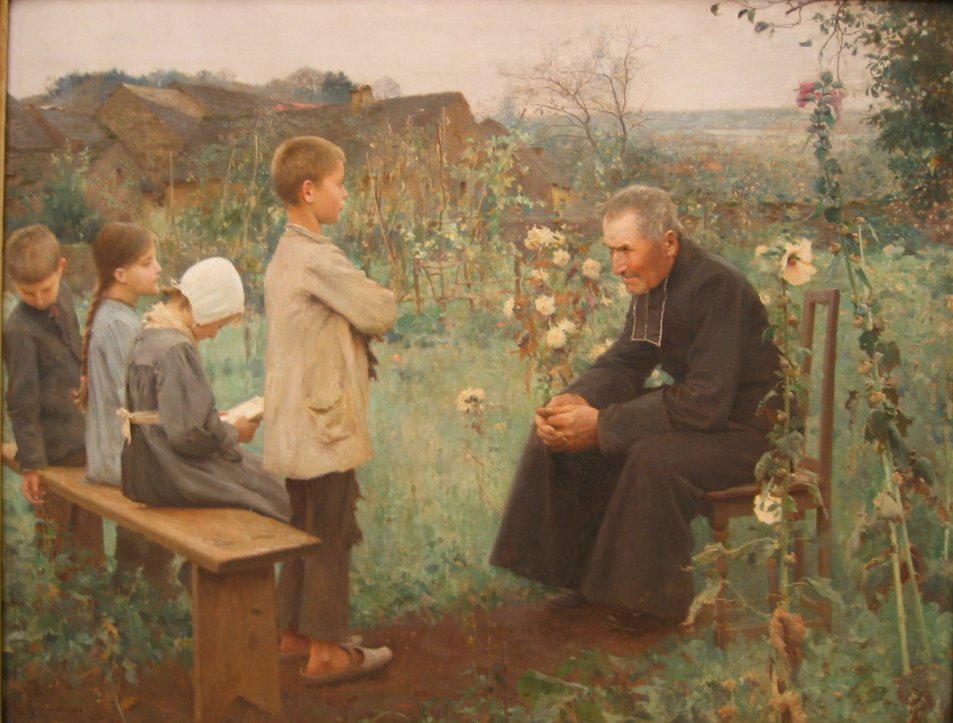 So Machen thought highly of Christian day schools among the Dutch Reformed. He also thought that public schools had their place. And to round out the picture, here he is on Lutheran education:
. . . it should, I think, be made much harder than it now is to enter the Church: the confession of faith that is required should be a credible confession: and if it becomes evident upon examination that a candidate has no notion of what he is doing, he should be advised to enter upon a course of instruction before he becomes a member of the Church. Such a course of instruction, moreover, should be conducted not by comparatively untrained laymen, but ordinarly by the ministers: the excellent institution of the catechetical class should be generally revived. These churches, like the Lutheran bodies in America, which have maintained that institution, have profited enormously by its employment; and their example deserves to be generally followed. (What is Faith, pp. 156-57)
Now we’re talking Christian education.
Machen on Public Schools
 Thanks to S. M. Hutchens at Touchstone for this reminder of what Christian school advocates selectively leave out when quoting Machen:
A public-school system, in itself, is indeed of enormous benefit to the race. But it is of benefit only if it is kept healthy at every moment by the absolutely free possibility of competition of private schools. A public-school system, if it means the providing of free education for those who desire it, is a noteworthy and beneficent achievement of modern times; but when once it becomes monopolistic it is the most perfect instrument of tyranny which has yet been devised.
Freedom of thought in the middle ages was combated by the Inquisition, but the modern method is far more effective. Place the lives of children in their formative years, despite convictions of their parents, under the intimate control of experts appointed by the state, force them to attend schools where the higher aspirations of humanity are crushed out, and where the mind is filled with the materialism of the day, and it is difficult to see how even the remnants of liberty can subsist. Such a tyrrany, supported as it is by a perverse technique used as the instrument in destroying human souls, is certainly far more dangerous than the crude tyrannies of the past . . . .
From Christianity and Liberalism, p. 14.
Before the posts begin, let me say I get it that Machen is not saying great things about public schools. He is saying that a better education comes elsewhere. But he does say public education is beneficial. Could Dr. K. ever say that?
Even more important is that Machen thinks Christian schooling is a way to resist the tyranny of the state — not a way to promote and maintain a Christian culture. That is a very different argument from the one made by Dr. K. and his assistants.
Which leads to the question, do Christian school advocates believe that Christian schools should teach that quoting selectively is bad scholarship? Or do Christian school advocates require a proof text for Christian schools to teach that lesson?
 Old Life