Communicants, Siblings, Friends, and Others

When you have a comprehensive view (w-w) of the world, when you think that your faith informs (or should) everything you do, hard are those distinctions that 2k so readily supplies, like — this is the church so Christian rules apply, this is not the church so freedom applies.

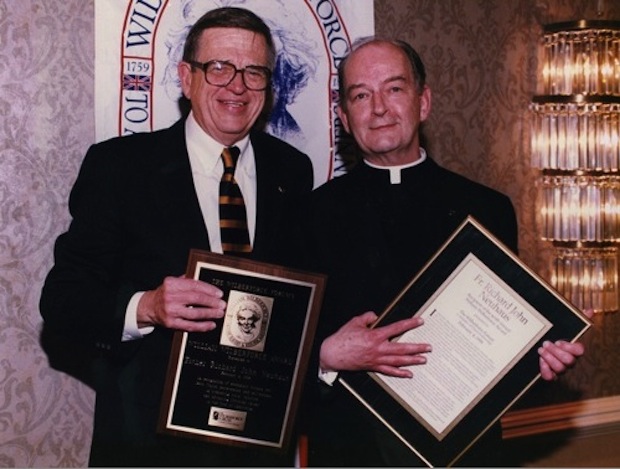
This problem is no less challenging for Roman Catholics than for neo-Calvinists since both are in the comprehensiveness business of showing how faith relates to EVERYthing a Christian does. Cathleen Kaveny took the comprehensiveness and catholicity of Rome in an arresting direction when she accused Richard John Neuhaus and the First Things crowd of partisanship and undermining the bonds of Roman Catholic unity:

Some conservative Catholics have blamed Pope Francis for sowing division among the members of the Body of Christ. But the charge is more properly lodged against one of the heroes of conservative Catholicism: the late Richard John Neuhaus.

It was Neuhaus, after all, who advanced the view that conservative Roman Catholics have more in common with orthodox Jews and Evangelical Protestants than they do with progressive members of their own religious communities. In fact, that view was an operational premise of First Things magazine under his leadership. This approach is based on a thoroughly distorted view of religious realities and commitments.

Does honoring Jesus as the Son of God count as a commonality? Like their conservative counterparts, progressive Roman Catholics acknowledge the divinity of Jesus Christ, and find the interpretive key to the Hebrew Bible in the New Testament. Orthodox Jews do not—indeed, must not—treat Jesus as the Messiah foretold in the Book of Isaiah. It would be blasphemous for them to do so.

Does living in the grace imparted by the sacraments count as a commonality? Both progressive and conservative Roman Catholics believe that God’s grace is channeled through the seven sacraments. Many Evangelical Protestants do not have the same view of grace or the sacraments; they often view the Eucharist as a memorial of a past event, not a way of being present with Christ here and now.

In trying to find common ground with evangelicals, then, Neuhaus was not truly Roman Catholic but actually Protestant:

Ultimately, Neuhaus’s focus was on nurturing these commonalities in the American political context—he was building a political movement. For a variety of partially overlapping reasons, conservative Roman Catholics, Evangelical Protestants, and orthodox Jews were inclined to vote Republican in political elections. Along with George Weigel and Robert George, Neuhaus coached Republican politicians in Catholic-speak to win national elections. . . . But here’s the irony of Neuhaus’s project: in treating theological belief and commitment as mere instruments of political will, Neuhaus’s view of religion resonated more with Feuerbach, Marx, and Leo Strauss than with the church fathers. In separating his own church of the politically pure from the hoi polloi of the body of Christ, his ecclesiology better reflects Protestant sectarianism than Roman Catholicism.

For the record, I too took issue with Evangelicals and Catholics Together for putting politics ahead of theology and for locating Christian unity not in ecclesiastical contexts but in parachurch groupings.

But Rusty Reno didn’t particularly care for Kaveny’s shot at Neuhaus. And so he tried to justify finding fellowship among religious people who were political liberals and then got mugged by reality:

many of the founding figures who played such a prominent role in First Things, as well as early readers like me, came to some shared conclusions. We became less and less impressed with the modern conceit that ours is a time of the unprecedented. We became more and more convinced that our traditions contained an inherited wisdom—a divine revelation—that provides greater insight into the human condition than any modern method, mentality, or revolution. Again, in the magazine’s early years, it was an exciting and invigorating to find others who were coming to the same post-liberal conclusions, whether they were Jewish, Catholic, or Protestant.

That is mainly true but does not represent the nature of Evangelicals and Catholics Together. Otherwise, ECT should have been called Evangelicals and Liberal Protestants and Roman Catholics and Mormons and Jews and Stanley Hauerwas Together. But at least Reno recognizes different layers of commonality:

When it comes to many things that are important to me, I have more in common with friends than with my brother. But my brother’s still my brother. It in no way compromises the truth of our fraternal bond for me to link arms with those with whom I have more in common politically, intellectually, or even theologically. The same goes for the sacramental bond that units us in Christ.

That is more or less a 2k point. But a 2ker would not call a magazine about religion and public life First Things. It’s not elegant but Penultimate Things or Proximate Things or Common Things would work better.

That left Michael Sean Winters to settle the debate and he did so (in neo-Calvinist-friendly ways) by taking issue with Reno’s separation of life into different spheres:

There may be “other dimensions” as Reno notes, but surely, for the Christian, those other dimensions need to be related to “what matters most.” It was this dualism between the Catholic faith and Catholic morality that stalked Neuhaus’s writings and continues to afflict the journal he founded. This dualism not only colored Neuhaus’ judgment, but it kept much of his otherwise enjoyable controversial writings at a fairly superficial level. It also led him to overlook the failings of his own team, both in politics and in religion: His defense of the Iraq War and of Fr. Maciel were stains on Neuhaus’ intellectual project that deserve attention and explanation by those who champion him.

. . . Reno, too, puts his sacramental beliefs in one silo, and his moralizing in another, and never the two need challenge each other. That is not how Catholics think when we are thinking at our best.

Apparently, 2k thinking is a no-no for Roman Catholics as much as it is for neo-Calvinists. Everything belongs to God. Or the papacy has universal jurisdiction (which is a topic for discussion in its own right). Which makes it hard to justify solidarity with people of a different faith.

But if you limit that solidarity to the church and find all sorts of room for cooperation outside the church, problem solved. Why does that solution seem so impious?


If Kuyper Could, Why Can’t Swanson?

Rebecca Hamilton adds U.S. political parties to the list of spheres to be evangelized (now that the Vatican has removed Jewish persons):

We must, if we are survive as a nation and a people, re-take control of these run-away political parties. We must also, if we ever hope to build a culture of life, convert both of them.

That means, my dear pro-life brothers and sisters, that we must stop thinking of the other political party as the devil incarnate and begin to look on it as a mission field, ripe for the harvest. In short, we need to stop following political hucksters who want to use our votes to gain power for themselves to be used for themselves, and follow Christ the Lord.

It was Jesus who told us to go out and convert the world. It is Satan who tells us to look at those folks over there and condemn them and damn them to hell with all the smug self-righteousness we can muster. Even if the thought that converting people is what Christ specifically told us to do doesn’t move you, then consider once again the sheer political cliff that we are standing on due to Justice Scalia’s death.

We’ve been trying to pack this court for almost 50 years now, and what we’ve gotten for our efforts is corporatism that is breaking the backs of the people of this nation and gay marriage.

We need to convert the Democratic Party to a party of life. We need to convert the Republican party to a party of conservatism rather than abject corporatism. We need to convert both of them into entities that are focused on how to help America and Americans rather than just raid the national treasury for those who pay for their political campaigns.

Here’s the problem: maybe the existing parties aren’t ripe for taking over. So why not start a new political party? Abraham Kuyper did and it became the vehicle for his tenure of prime minister:

Moving from the pastorate to the Dutch parliament by age 35, Kuyper also became the editor of a daily newspaper, De Standaard. From this post, he rallied and educated a movement that would have a transformative impact in the 1870s. Besides ushering in a new denomination, that movement would launch the Anti-Revolutionary Party (ARP), which endured for several decades thereafter. (About 30 years ago, it merged with two other parties that were important to Kuyper’s governing coalition.) By 1901, as leader of the ARP, Kuyper would become prime minister, an office he held for four tumultuous years.

His political vision was worked out over decades, and aimed to impede the centralizing tendencies that capitalism appeared to require. The vision rested upon the notion of “sphere sovereignty”: The belief that God created the distinct realms of life—church, education, family, state—to function independently, each ruled by the “ordinances” God had set in place. “It was identifying, celebrating, guarding, and translating those ordinances into action,” Bratt notes, “that defined his ultimate purpose in politics.” Under Kuyper, the ARP sought to convince the nation of these ordinances and align its policy and law according to them. It was a narrow pathway indeed, yet for a time, the ARP was able to follow it with success, thanks in part to an alliance with Roman Catholics seeking to “restore a Christian Netherlands.”

To be sure, I have reservations about parts of the neo-Calvinist project. But Kuyper’s political savvy sure looks much more important and effectual than Christians kvetching about the state of their nation from the relatively comfortable locations of podcasts, blogs, radio shows, or conference addresses. At least Kuyper did more than theorize, cheerlead for w-w, and write op-eds. He built institutions and forged political alliances. Even more, he governed.

If Christians want to “change” their nation, they need to do more than aim at changing the minds of their political representatives (as if that happens).

Is Universal Suffrage One of the Benefits that Accompany or Flow from Justification, Adoption, and Sanctification?

Matt Tuininga is back to remind us of how far short the contemporary advocates of the spirituality of the church (SpofCh) fall. In this case, the proponents of 2k and SpofCh are in solidarity with the southern Presbyterian opponents of integration who formed the PCA. That’s sort of like the students at Princeton who liken the university’s faculty to the KKK on the spectrum of institutional racism. Here’s the key Tuininga challeng:

Until advocates of the doctrine of the spirituality of the church (not to mention advocates of two kingdoms theology) come to grips with the social implications of the spiritual gospel they will not be able to make the necessary distinction between inappropriate meddling in civil and political affairs (which they rightly criticize) and the church’s responsibility to proclaim the full scope of the gospel, with all of its social implications (which duty they avoid). Until we understand how the spirituality doctrine not only permits the use of church discipline and the diaconate to promote the justice and righteousness of the kingdom, but requires it, we have not grasped just what it is that spirituality means. To politicize the church is surely a horribly misguided attempt to manipulate the Spirit for our own purposes, but to muzzle the Spirit or partition the social dimension of human life from the gospel is hardly less a display of rebellion.

So the question for Tuininga is whether social advances like the civil rights movement or integration are parts of the coming of the kingdom of Christ. For instance, one of the great achievements of Martin Luther King, Jr. and other civil rights advocates was the Voters Rights Act which prohibited local and state policies that prevented African-Americans from exercising their right to vote.

That was not the only time that suffrage included more Americans. The Puritans restricted suffrage to members of congregations, and only when Massachusetts Bay became more secular (less controlled by Christian norms) did the franchise extend to residents who were not church members. Even then, property holdings were necessary to qualify for the vote.

More recently, the nineteenth Amendment prohibited restrictions on voting based on sex.

The question for Tuininga is whether the churches should have endorsed these enlargements of the franchise? If so, why does he not complain about the Puritans who were comfortable with restricting suffrage, or the mainline churches who for so long said nary a word about women not having the right to vote?

Or could it be that most policies and laws are not benefits of the gospel the way that assurance of God’s love, peace of conscience, joy in the Holy Ghost, increase of grace and perseverance of the saints accompany and flow from justification, adoption, and sanctification? Is it also the case that if you can tell the difference between voting in a democracy and peace of conscience, you actually know what the spirituality of the church is?

So I throw the challenge back to Tuininga: until he can show that certain social reforms are evidence of the gospel, he needs to come down from his high horse about the deficiencies of the spirituality of the church and its proponents. I, for one, would love to believe that prison reform and abandonment of the War on Drugs as federal policy are part of “the transforming impact of the gospel.” But I have a hard time understanding how policies reformed and prisoners freed are signs of the coming of the kingdom when the people reforming the policies and the ex-cons don’t confess Jesus Christ as Lord.

C-Folds or Rolls of Paper Towels

The resurrection of Jesus will help you decide (courtesy of neo-Calvinism):

To put it another way, one who says that their commitment to the primacy of preaching, leads them to have little regard for the music, parking, greeting, signage, aesthetics, friendliness, hands-on ministry, evangelism, outreach, care-giving, announcements, and so on, is simply theologizing their laziness and apathy. Abraham Kuyper once said, “There is not a square inch in the whole domain of our human existence over which Christ, who is Sovereign over all, does not cry, Mine!” (“Sphere Sovereignty,” in James D. Bratt, ed., Abraham Kuyper, A Centennial Reader, 488). The pastor committed to the primacy of the word of Christ will be faithful and focused on the pulpit, but he should also examine every single aspect of ministry in the life of the church to make sure it reflects the glory of God in Christ. A valuable question to ask about every ministry and function in the church is, “How does the fact that Jesus Christ is risen from the dead impact the way we do this?” Also, could Christ look at how we do each aspect of our ministry and say, “Mine!”?

Embarrassment alert (thanks to Tim)!

Do We Need Transcendence to Plow Streets?

Neo-Calvinist praise from David Koyzis for Bruce Ashford’s contention that political liberals and political conservatives both lack transcendence:

Politics in the United States has, for some time, assumed a binary structure. On one side stand the Republicans, who represent conservatism. On the other side stand the Democrats, who represent progressivism. But what most Americans fail to see is that conservatism and progressivism are similar in one significant respect. Both ideologies are “moving targets” that lack transcendent norms, which leads to a nearly endless variety of social ills. It may, at times, be appropriate to be conservative, and at others progressive. But when these designations become normative, they become idolatrous.

This sort of observation seems to be tone deaf to the religious inflection of contemporary politics. Just remember all the national exceptionalism that appeals to the United States’ special (read divine) role in world affairs.

But this way of looking at politics also seems to be oblivious to the actual stuff of civic life, namely, ordinary affairs as opposed to supernatural aspirations. Would transcendence, for instance, really resolve the snow-removal crisis in Baltimore (thanks to our Pennsylvania correspondent)?

In Harford County, residents complained that their online snow tracker went dark overnight. Baltimore County officials fielded complaints from constituents who remained snowbound Monday. And some residents in Anne Arundel and Carroll counties griped about the pace of the cleanup.

But many residents also said they gained a greater appreciation for how their tax dollars are spent to carry out one of government’s most essential functions: keeping the roads functioning.

Facebook pages for nearly all of the area’s jurisdictions lit up with complaints and compliments for how snow removal crews were progressing.

For their part, elected officials don’t shy from public appearances during major storms, promising a diligent response and hoping to win political currency. And in Maryland, voters are typically more forgiving of any failures, said Matthew Crenson, a Johns Hopkins University political scientist.

Not so where major snow events are more common. Crenson pointed to Michael Bilandic, mayor of Chicago in the late 1970s when a blizzard crippled that city for months.

“His snow removal efforts were so feeble he lost the next election,” Crenson said. Maryland voters “are likely to give their elected officials a pass.”

I understand the appeal of thinking the Lordship of Christ will fix what ails fallen life. After all, Christ is the great fixer. But sometimes, when Protestants or conservatives invoke divine or philosophical categories as the cure for political woes, I can’t help but think they have missed the point of politics.

Kevin Swanson is not Tim Keller

Some critics of the OPC and 2k wonder why Old Life has been silent about Kevin Swanson, the Generations with Vision Director who pastors and OPC congregation in Elizabeth, CO.

A simple reason is that Pastor Swanson has no following (to my knowledge) in the OPC say the way Lig Duncan, or Harry Reeder, or Tim Keller do in the PCA.

It’s also the case that Swanson almost never refers to the OPC in his self-identifications. At Generations with Vision:

Homeschooled himself in the 1960’s and 70’s, Kevin Swanson and his wife, Brenda, are now homeschooling their five children. Since graduating from his homeschool and then serving as student body president of a large west coast university, he has gone on to other leadership positions in corporate management, church, and other non-profits. Kevin has 43 years of experience in the homeschooling movement and serves as the Director of Generations – a ministry he founded to strengthen homeschool families around the country. As a father who wants to leave a godly heritage for his own five children, Kevin’s passion is to strengthen and encourage the homeschooling movement all over the world, and to cast a vision for generations to come. For the last 10 years Kevin has hosted a daily radio program – Generations Radio – the world’s largest homeschooling and Biblical worldview program that reaches families across the US and in over 100 countries.

Kevin has also served as the Executive Director of Christian Home Educators of Colorado for the last nine years. He has also authored several popular books for homeschoolers, including Freedom, Apostate, Upgrade-10 Secrets to the Best Education for Your Child, the Family Bible Study Guide Series, and others.

Kevin Swanson also serves as a teaching elder at Reformation Church of Elizabeth (reformationchurch.com).

The Speaker Lineup for Freedom 2015 listed Swanson as director of — yet again — Generations with Vision and the author of more than 10 books.

I’ve never talked to an OPC officer who has read a book by Swanson.

At Amazon:

Homeschooled himself in the 1960s and 70s, Kevin Swanson and his wife, Brenda, are now homeschooling their five children. Kevin has 43 years of experience in the homeschooling movement and serves as the director of Generations With Vision—a ministry he founded to strengthen homeschool families. Kevin’s passion is to strengthen and encourage the homeschooling movement all over the world, and to cast a vision for generations to come. For the last 4 years Kevin has hosted a daily radio program, Generations Radio, the world’s largest homeschooling and biblical worldview program that reaches families across the US and in over 100 countries. Kevin has also served as the executive director of Christian Home Educators of Colorado for the last nine years. He has authored several popular books for homeschoolers, including Apostate, Upgrade: 10 Secrets to the Best Education for Your Child, The Second Mayflower, the Family Bible Study Guide Series, and others.

So far Pastor Swanson does not seem eager to put his stamp on the OPC the way TKNY has on the PCA.

So for now, paying attention to Pope Francis seems a little more reasonable than to Pastor Swanson.

Why Credit Schaeffer but not Aristotle?

This is my problem with w-w proponents. When they explain the accomplishments of people with the wrong w-w they play the “common grace” card. Why, of course, folks without a proper w-w understand some truth because ultimately God set it up that way. Listen to a recent account of Aristotle’s abilities:

This does raise the obvious question, what about all those pagans who did get things right? Surely Aristotle, for example, was correct in much of what he said about God, virtue, etc., even if he wasn’t saved? The worldview proponent can happily concede this fact, but it doesn’t prove the existence of universally accessible axioms of reason. Any true beliefs the unbeliever does hold (and in principle there’s no limit to the number of true beliefs an unbeliever may hold) are attributable to common grace. That is, any truth, goodness, or beauty found among unbelievers is a gift from God, but these gifts are not given equally to all. Common grace does not entail common reason, nor can everyone be an Aristotle.

Granted, Aristotle entered the world with certain capacities for which he could not take credit. But can’t we attribute anything to his years of study, his clarity of prose, his competent arguments. Doesn’t he himself deserve praise for some of his accomplishments?

What’s odd about the above rendering of Aristotle and common grace is how much this same w-w apologist has no problem giving credit to Christian w-w proponents, instead of chalking up their insights to “special grace”:

The first Christian to use the term “worldview” was the Scottish theologian James Orr (1844-1913). Orr claimed that our view of Jesus affects our view of everything else in life—of God, of man, of sin and redemption, of the meaning of history, and of our destiny. While Orr gave Christians the building blocks for the idea of a Christian worldview, it was the Dutch theologian and statesman Abraham Kuyper (1837-1920) who took the idea and ran with it. . . .

Credit for popularizing the idea of a Christian worldview among evangelicals in North America undoubtedly goes to Francis Schaeffer (1912-1984), who founded the L’Abri community in Switzerland and wrote extensively on apologetics, art, and culture. Schaeffer had a profound impact upon the following generation of evangelicals, including Nancy Pearcey and Charles Colson (see How Now Shall We Live?) and James Sire (see The Universe Next Door). These evangelicals all affirmed the two key insights of Orr and Kuyper: 1) that the Christian faith forms a unified and coherent vision of all of life, and 2) that this vision stands in irreconcilable opposition to all competing non-Christian visions of life.

That’s a double standard.

I thought w-wers were opposed to dualism.

In point of fact, w-w theory has a serious flaw if it fails to recognize the goodness of creation and the accomplishments of creatures who use their gifts with remarkable ability even without the aid of the Holy Spirit’s redemptive work. That seems like all the more reason to give folks like Aristotle even more credit (humanly speaking) than Schaeffer.

Will We Have Bibles in Heaven?

Another version of the 1k critique of 2k, this time a review of a book about John Frame’s theology:

Frame implicitly rejects a separation of the world into sacred and secular realms. If theology is the application of Scripture by persons to every area of life, then it follows that no area of life is exempt from Scripture’s authoritative claims. In other words, nothing is “secular.” Barber ties this to Frame’s non-traditional understanding of RPW, which rests on the distinction between the elements of worship (those things explicitly commanded in Scripture, such as prayers and sacraments) and the circumstances of worship (those things left up to personal discretion, such as the time of the worship service; cf. WCF 1.6). Although many Reformed traditionalists have understood this distinction as justification for a division between sacred and secular realms of life, Frame argues that even the circumstances of worship are holy and spiritual (143). This has a twofold effect in Frame’s theology: it allows for greater Christian freedom inside the church, and it gives greater voice to Scripture outside the church. For the Christian, all of life is sacred, and thus all of life is to be guided by the light of Scripture, but not regulated beyond what Scripture itself requires. Or as Frame states, “The regulative principle for worship is no different from the regulative principle for the rest of life” (144).

I sure wish the critics of 2k would for once do justice to the word, “secular.” It does not mean profane or the denial of God or unbelief or something apart from God. It means temporal, of an age, a period of time. That is, in the West “secular” is impossible to understand apart from Christian eschatology and a distinction between what is eternal and abiding and what is temporary and impermanent. And with that sort of distinction in mind, we can say that the Bible itself is secular. In the new heavens and new earth, the permanent time to come as opposed to the period (saeculum) between Christ’s advents or between the fall and consummation, believers will not need prophets, apostles or sacred books because they will be in the presence of Christ. The need for the Bible is a provisional arrangement. I guess that even means the church is secular.

To say that all of life is sacred sounds uplifting. But to think that my book, A Secular Faith, is sacred is not only ironic but also wrongheaded. Some things will indeed pass away, as Paul wrote:

For this light momentary affliction is preparing for us an eternal weight of glory beyond all comparison, as we look not to the things that are seen but to the things that are unseen. For the things that are seen are transient, but the things that are unseen are eternal. (2 Cor 4:17-18)

In other words, the things that are secular are transient. Those include our bodies, marriages, vocations, magistrates, favorite composer. To sacralize these things is to immanentize the eschaton, like identifying Jerusalem, Rome, Amsterdam or Wittenberg with the heavenly Jerusalem.

Which is why I would have expected more Vossians to be 2k.

Another Case for the Gateway Drug

Once again comes a suggestion that neo-Calvinism in its desire for comprehensiveness paves the way for Roman Catholicism:

As it happened, the young pastor Abraham Kuyper found something to like in the “Syllabus [of Errors]” too, and said so on no less an occasion than his Reformation Day sermon in 1865! The pope went too far, Kuyper quickly assured his startled (if not outraged) congregation; the document was not to be affirmed in all its details. But its intention was correct. The rising philosophy of naturalism and ethical materialism which the pope was condemning was exactly the enemy that needed to be opposed, Kuyper said, and that opposition would mark his work in church, state, and cultural commentary across the 50+-year career upon which he was just embarking. In fact, this philosophical challenge—this rise of a cruel worldview antithetical to Christianity—is what motivated Kuyper’s turn to strict Calvinism from the more nebulous piety in which he had started out his ministry a few years before. A much older Brownson, now near the end of his career, held much the same sentiments.

If I understand the implications of James Bratt’s argument, reasoning about politics, society, economics, and education apart from first principles (read revealed truth) — one of the building blocks of modern liberalism (and secularism) — is an indication of naturalism, and the enemy of Christians. Thus the antithesis between Christianity and secularism, between 1689 (the Glorious Revolution) and 1789 (the Inglorious French Revolution), between Christian schools, labor unions, and political parties and secular schools, labor unions and political parties.

I can understand that. But if the antithesis is right and if Christians live in societies with unbelievers, on what basis are non-Christians supposed to operate in their social endeavors? If Christians alone have the true w-w, then should they allow those with false w-w’s to “run things?” Or if unbelievers do have access to positions of authority, wouldn’t they need to rely on what they know which does not include revealed truth?

Separating church and state was a long and difficult struggle for Roman Catholics. Distinguishing the differences between neo-Calvinist and theonomic arguments is also difficult. Of course, it needs to be noted that Kuyper did affirm social pluralism and found remarkable ways to include Roman Catholics in Dutch society. Still, when you start with opposition to naturalism and the antithesis between Christians and unbelievers, how you avoid winding up in theonomy or church-above-the-state (e.g. Roman Catholicism) is not at all obvious.

In Defense of Neutrality

When did “neutral” become such a dirty word (along with Lutheran; is it because Lutheran’s cuss?)? It’s a perfectly fine word to use on colors such as beige, ivory, taupe, black, gray, and white. It also works when describing countries like the United States before 1917 or Switzerland to this day. It’s a word that any of us going to court hope is in play with the judge hearing our case — though fair comes close. In sports, if an umpire is wearing the colors of one of the competing teams, we would definitely wonder about his (or her) — watch out — neutrality. By the way, if your run a word search for the word at the ESV websit, you get verses that include the word, “natural.” Which makes me think that the neo-Calvinists gremlins got into Crossway’s software.

Scott Clark explains that the aversion Reformed Protestants have to “neutral” — not because they are flashy dressers — owes to the influence of Dutch (neo) Calvinism:

Anyone who is familiar with the work of Abraham Kuyper or Herman Bavinck or Cornelius Van Til knows that the idea of “neutrality” is consistently and thoroughly rejected by the framers of much of modern Dutch Reformed theology and thus, were the 2K (as people like to put it) guilty of introducing it into Reformed theology that would be a great, even fatal flaw. In this discussion, “neutrality” means “a sphere of life which is un-interpreted by God’s Word” or “an un-normed sphere of life” or “an un-interpreted sphere of life” over which the Christian or even an unbeliever would be able to say, “This is mine.” This is a truly legitimate concern. Reformed theology opposes human autonomy (self-rule). Abraham Kuyper was absolutely correct to say, “There is not one square inch of the entire creation about which Jesus Christ does not cry out, ‘This is mine! This belongs to me!’””

For proponents of the so-called 2K ethic, the question is not whether Jesus is sovereign but how. As I understand the neo-Calvinist movement (van Prinsterer, Kuyper, Bavinck, Van Til, Berkhof, et al) they all taught two complementary principles: antithesis and common grace (Gemeene Gratie). As I understand the so-called 2K model, it is an attempt to describe the way common grace functions relative to the antithesis.

So if the question is only about the ultimate day of judgment when the goats and lambs go their separate ways, then who could defend using neutral to describe persons standing before a holy God?

The problem is that with the exception of the keys of the kingdom, when pastors and elders administer God’s word and open and shut the kingdom of heaven, most us using the English language are dealing not with ultimate but proximate realities. And in this world of sports, politics, law, and interior design, neutral is a good thing.

Here’s one example, Ross Douthat (via Rod Dreher) on the problem of guns in the United States:

With 300 million guns in private hands in the United States, it’s very difficult to devise a non-intrusive, “common-sense” approach to regulating their exchange by individuals. Ultimately, you need more than background checks; you need many fewer guns in circulation, period. To their credit, many gun control supporters acknowledge this point, which is why there is a vogue for citing the Australian experience, where a sweeping and mandatory gun buyback followed a 1996 mass shooting.

The clearest evidence shows that Australia’s reform mostly reduced suicides — as the Brady law may have done — while the evidence on homicides is murkier. (In general, the evidence linking gun ownership rates to murder rates is relatively weak.) But a lower suicide rate would be a real public health achievement, even if it isn’t immediately relevant to the mass shooting debate.

Does that make “getting to Australia” a compelling long-term goal for liberalism? Maybe, but liberals need to count the cost. Absent a total cultural revolution in America, a massive gun collection effort would face significant resistance even once legislative and judicial battles had been won. The best analogue is Prohibition, which did have major public health benefits … but which came at a steep cost in terms of police powers, black markets and trampled liberties.

Does any policy on gun use and restrictions rise to the level of “neutral”? Maybe not. But neither does this issue of public safety and personal freedom achieve the ultimate heaviosity of the anti-thesis. Most matters stemming from our common life together — Augustine’s heavenly city living in the earthly city — do not have a Christian solution. So turning “neutral” into an expletive really does nothing to help pilgrims living in exile, except to tempt some to think their real home is in a low-lying delta below sea level (and I’m not talking about New Orleans).