Rev Kev vs. The American Reformers (who POUNCED!!)

Kevin DeYoung deserves praise for defending John Witherspoon and the American revisions to the Westminster Standards. Some of us were doing this back in the day when the Federal Vision was echoing the theonomists. But the post-liberal turn among Protestant Christian nationalists and Roman Catholic integralists has increased the need for a defense of the American revisions and their harmonization of Reformed teaching and the American Founding (republicanism, constitutional federalism, religious liberty).

The post-liberal Protestants at American Reformer have not welcomed DeYoung’s understanding of American Presbyterians’ revisions of Westminster. Some argue for continuity between the original Westminster Confession and the 1789 revision. Others go farther and assert that even the American Revisions require an affirmation of a religious establishment.

What is largely missing from the critics of DeYoung is attention to the Covenanters (or Reformed Presbyterians) whose views are similar to theirs — the American Founding is seriously flawed — and whose understanding of the civil magistrate was the dominant view among Presbyterians at the time of the Westminster Assembly. DeYoung’s first article does in fact address the corner into which the Covenanters had painted Presbyterians. He wrote:

In 1707, the Act of Union brought together England and Scotland under the name of Great Britain. Many Presbyterians opposed the union as inconsistent with the principles celebrated in the National Covenant (1638) and the Solemn League and Covenant (1643) and as undermining the Revolution Settlement (1690) which restored Presbyterian government to the Established Church in Scotland.

DeYoung later adds the change in Presbyterianism that transpired after the Glorious Revolution of 1688. He uses John Coffey, the leading scholar of Samuel Rutherford, to describe that change:

“With the exception of the Reformed Presbyterian Covenanters and some Seceders, eighteenth-century Presbyterians found ways of distancing themselves from the Westminster Assembly’s teaching on the coercive powers of the godly magistrate in matters of religion…. In every part of the English-speaking world, Lockean ideas of religious liberty looked increasingly attractive to Presbyterians who feared Anglican hegemony or saw little prospect of becoming the dominant majority.”

Zachary Garris says the Covenanters are not in the mainstream — that’s true for America today. But it was not true for the people who wrote the Westminster Confession — Presbyterians, Puritans, and Independents from England and Scotland. In fact, Scotland’s covenants with her kings (the Stuarts) who became the kings of England as well set the standard for political theology at the Westminster Assembly. Here’s why:

The Scottish Reformation gained a victory in 1581 with King’s Confession of 1581 by which James VI (later James I of England) vowed, with Parliament, the Kirk, and the people to uphold and defend the true religion (Reformed) and oppose the false religion (Roman Catholicism).

In 1638, this time with Charles I (James’ son) imposing the Book of Common Prayer on the Scottish Kirk, Parliament, the Kirk, and the people ratified the National Covenant. The expectation was for Charles to pledge his allegiance to this covenant because of the original (King’s) covenant with his father.

Soon after the National Covenant, Scottish military went to war with Charles — you guessed it, he didn’t take the vow — in the first of two “Bishop’s Wars” (1639-1640). The Scots’ covenants and war with Charles were the trial run for the English Parliament’s civil war with the king (1642-1649), the same Parliament that called for an overhaul of the Church of England and gave the responsibility to the Westminster Assembly. The English Parliament needed military help from the Scots who in turn gave it conditioned on Parliament’s ratifying an international covenant — the Solemn League and Covenant (1643). Although that covenant had different legal justification from the Scots’ National Covenant, the Solemn League and Covenant extended to England and Wales the same cooperation among the civil government, the church, and the people to uphold the true faith (and oppose the false religion of Rome) in Scotland.

Covenanting and national covenants were hardly peripheral to seventeenth-century Presbyterianism of the Westminster Confession. Covenanting likely explains one of the oddest chapters in the Confession of Faith — chapter 22 on Oaths and Vows. (If you are in a covenanting mind set, you may likely clarify the theological import of promises taken in the civil and ecclesiastical realms.)

If you wonder where Christian Nationalism among Presbyterians comes from, you may well want to look to the Covenanters.

This covenanting backdrop is especially important for understanding the American revision of the Westminster Confession. By the 1780s, the covenanting position was not part of the Presbyterians who comprised the first General Assembly of the PCUSA. That is because the Covenanters had formed their own communion, the Reformed Presbyterian Church of North America. Which is also to say that everyone in the Presbyterian world (England, Scotland, Ireland, the United States, and eventually Canada) gave up on covenants with Scottish monarchs. The lone exceptions were the Covenanters and certain sectors of the Seceders (Associate Reformed Presbyterian Church).

Why the critics of Dr. DeYoung do not resonate with or follow the Covenanters is a mystery. So is their unwillingness to acknowledge that they desire a relationship between the church and civil magistrate like the ones the Covenanters briefly had between 1638 and 1650. There is also a good chance that the American Reformers who pounced on Dr. DeYoung agree with Covenanter assessments of the American Founding. This is the Covenanter understanding of the U.S. Constitution (which puts a dent in American patriotism):

There are moral evils essential to the constitution of the United States, which render it necessary to refuse allegiance to the whole system. In this remarkable instrument, there is contained no acknowledgment of the being or authority of God —there is no acknowledgment of the Christian religion, or professed submission to the kingdom of Messiah. It gives support to the enemies of the Redeemer, and admits to its honours and emoluments Jews, Mahometans, deists, and atheists—It establishes that system of robbery, by which men are held in slavery, despoiled of liberty, and property, and protection. It violates the principles of representation, by bestowing upon the domesticity rant who holds hundreds of his fellow creatures in bondage, an influence in making laws for freemen proportioned to the number of his own slaves. This constitution is, notwithstanding its numerous excellencies, in many instances inconsistent, oppressive, and impious.

Since the adoption of the constitution in the year 1789, the members of the Reformed Presbyterian Church have maintained a constant Testimony against these evils. They have refused to serve in any office which implies an approbation of the constitution, or which is placed under the direction of an immoral law. They have abstained from giving their votes at elections for legislators or officers who must be qualified to act by an oath of allegiance to this immoral system. They could not themselves consistently swear allegiance to that government, in the constitution of which there is contained so much immorality. (Reformation Principles Exhibited, 1807)

The differences between the PCUSA and the RPCNA reflect the changes that occurred throughout the Presbyterian world once most communions abandoned Scotland’s National Covenants. Locke made a lot more sense of British society for accommodating religious diversity than insisting on promises Stuart monarchs had made to Scotland and England. And that difference was an important factor in Witherspoon’s role in revising the Westminster Confession and Catechisms.

Dr. RevKev understands that both the moderates and the evangelicals in the Church of Scotland, as well as the Old Side and New Side Presbyterians in America had no sympathy for Scotland’s covenants. They had move on.

Critics of Dr. RevKev may refuse to be lumped with the Covenanters. That’s fine. But they do need to take the Scottish background into account both to understand the context for the Westminster Assembly and the reasons behind American Presbyterians revising the Confession of Faith.

The PCA Back in the Day: This Time for Real

This is the last of a retrospective inspired by the current assembling of the PCA General Assembly. What follows is the fourth assessment of the PCA’s 2010 Strategic Plan. It is by Martin Hedman, who was then the pastor of Mission Presbyterian Church in La Hambra, California. The entire series was published in the Spring 2010 issue of the Nicotine Theological Journal.

Sufficiency of Scripture for PCA Planning

Several years ago a young man came before our presbytery to be licensed to preach. As is our practice, the Candidates and Credentials committee led the initial questioning, asking a subset of the questions he had prepared as part of his written examination. The young man was poised and confident in his answers. Clearly he had prepared, knew his material and answers well. The committee asked this man to define justification. His answer? “Justification is an act of God’s free grace, wherein he pardons all our sins, and accepts us as righteous in His sight, only for the righteousness of Christ imputed to us, and received by faith alone.”

Beautiful answer! Right out of the Shorter Catechism. Unlike many men who try to memorize the catechism and recite its answers during a floor exam, he did not hesitate or stutter in any way. Many of his answers were just like this one, well spoken and directly from the catechism.

After asking a number of selected questions out of the written exam, the committee opened up the questioning to the floor of presbytery. As usual, a number of questions concerned matters of clarification, some to flesh out answers or reasoning, and some to explore additional territory. At one point – I don’t remember who it was but do recall it was one of the older men – a presbyter commended the young candidate on his ready answers and his felicity in using the catechism. The presbyter then asked a question something like this: “You clearly know what the doctrine of justification is. Can you tell us what it means for you in your daily life as a Christian?”

“Whoa!” I thought to myself. “Is this a veiled attack? Is it wrong for a guy to know his catechism? Was this a some squishy-soft, feel-good, pietistic jab?”

And then I watched as the young candidate really, genuinely struggled with his answer. The poise and confidence were gone as he searched an answer. What he said I don’t recall but it wasn’t very satisfying. I don’t even recall if there was a follow up by the questioner. What did stay with me was the thought that this shouldn’t be so hard to answer.

Having learned about them from the guy (i.e. R. Scott Clark) who came up with the acronyms, I am in no way interested in either QIRC (Quest for Illegitimate Religious Certainty) or QIRE (Quest for Illegitimate Religious Experience). At the same time, the Reformed faith acknowledges the necessary link between doctrine and practice. They are inseparable.

Nevertheless, too often we seem to have trouble connecting them. It may be the young theologian on the floor of presbytery who hasn’t thought through the implications of the doctrine of justification – doctrine leading to practice. Or it may be the denominational committee that wants to be strategic and forward thinking but hasn’t thought through the biblical foundations – practice without foundation in doctrine. The latter is the case with the recently proposed and passed SP for the PCA. Both problems flow from a lack of appreciation for the sufficiency of Scripture. This is especially evident in the SP.

To illustrate let me take one example from the plan itself. The original draft of the SP called for “safe places” in which to discuss controversial theological matters, or in some cases give men the opportunity to express new ideas without having to worry about being brought up on charges. Prior to actual presentation to GA the wording was changed to “civil conversation.”

First, this presupposes a problem within the PCA’s current theological environment which I do not grant but will set aside for the sake of brevity. Second and more important, the plan proposes a solution that seems completely ignorant of Scripture. Granting that there are times and places where elders, deacons and others do not hold civil conversations, and even that those occasions are far more prevalent than we ought to be comfortable with, what is the solution?

The SP proposes places to enter into civil conversations, by means of public forums at General Assembly, similar forums at presbyteries, and the gathering together of those who disagree to discuss how to get along with each other. Will this work? I have no idea. No. Wait. Actually, I do. The supposition of “uncivil” conversations also presupposes that people are getting together, in some fashion, for uncivil purposes. So, we are going to establish more places to have more conversations? And that will somehow magically make them civil? Who comes up with this sort of sociological claptrap?

Answer: those who don’t look to Scripture, in other words, those who by their proposals and actions demonstrate that they don’t take the sufficiency of Scripture seriously. Sure, maybe they do for doctrinal purposes. After all, that’s what 2 Tim 3:16 says: “All Scripture is breathed out by God and profitable for teaching, for reproof, for correction, and for training in righteousness.” Isn’t this the “go-to” verse to show that we don’t need Tradition (a la the Roman Catholics), that we are right to proclaim our belief in sola scriptura?

Of course it is. But there’s more. The last clause says that Scripture is also profitable – sufficient – for training in righteousness. And verse 17 explains why: “that the man of God may be competent, equipped for every good work.”

So, if we want men to hold civil conversations, an example of righteous living and certainly a biblically sound good work, shouldn’t we look to Scripture for how and why men should do so? Of course we should. But we don’t make that connection nearly as often as we should. We want to be wise. We want to take action, be responsible, and see results. We want something to happen as a consequence of our having done something. We are, sadly, manifestly unsatisfied with the preached and taught Word of God and the Spirit’s promised ability to make it go out and not return void. In this, we show a lack of belief in Scripture.

Do we want civil conversations? Then we need something better, something more grounded and solid than clever schemes. We need God’s Word. We need his Spirit to change hearts, convict men of sin, and produce the fruit of repentance, so that we might walk in a manner worthy of the Spirit’s effectual calling.

Here is just one, all too short, example of what we need to be saying to each other, admonishing and exhorting one another with, if we really desire godly exchanges of opinions and ideas in the PCA:

Ephesians 4:11-25 tells us, among other things, that we have proclaimers and teachers of God’s Word to help us grow up in the fullness of Christ, that we are to speak the truth in love, so that we might grow up in every way into Christ, and that we speak the truth with our neighbor because we are members of one another. We have God’s Word, we are in Christ and we are to grow up in Christ, we are united in Christ – if all these are true then how can we not be of a mind to speak truth to each other in love? If we don’t, how can we claim, how can we hope, to grow into the fullness of Christ? Far better than meetings and forums is a solid grasp of who we are in Christ and all the implications that flow from that blessed reality.

Now there’s a strategy! We believe and confess that God’s Word works effectively for the building up of God’s people in righteous and holy living. We need to put that belief into practice!

God’s Word really is sufficient – for doctrine, and yes for training and competence in righteous living, including civil conversations with our brothers and sisters in Christ.

The Return of The PCA Back in the Day

This is the third in a series of pieces – inspired by the PCA General Assembly assembling in Chattanooga – that appeared in the Spring 2010 issue of the Nicotine Theological Journal in light of the PCA’s approval of its Strategic Plan. This one comes from Wes White, who was then pastor at New Covenant Presbyterian Church in Spearfish, South Dakota.

Why I Voted “No”

How can you be against “civil conversations,” “more participation in General Assembly,” and “God’s global mission”? Many people have asked this question about the opponents of the PCA’s so-called SP. I believe that there are two ways in which we can view the PCA’s SP, either in the abstract, simply in terms of what the words say, or in the concrete in terms of what those who put the plan together actually want to accomplish. I think the latter way of viewing it is the more appropriate one, but, in either case, I would have voted “no” on every single point.

In the abstract, the SP may seem quite harmless. The problem is that we need to begin by asking, why do we need a strategic plan at all? What are we trying to accomplish? What the PCA calls “strategic planning” has been going on for a while. In the year 2000, the nine Coordinators of the Committees and Agencies of the PCA thought we needed a plan for the future. The result was a 24-person Strategic Planning Steering Committee. They reported at the 2003 GA with a booklet entitled Being Revived + Bringing Reformation. This report outlined the mission, vision, and strategic priorities of the committee.

The second phase of strategic planning began in 2004 with the re-constitution of the SP committee. Its task was three-fold: engaging ruling elders, preparing the next generation, and organizing resources to better serve our corporate mission. The re-constituted committee proposed to changes to church life. The first was the restructuring of General Assembly to limit parliamentary options on the floor of General Assembly and place a much greater emphasis on the committees of commissioners and especially the overtures committee. The second was the creation of the Cooperative Ministries Committee (CMC), a body where the various committees and agencies of the PCA could communicate with one another and “facilitate” further strategic planning. Both of these items were proposed at the 2005 General Assembly and passed at the 2006 General Assembly.

While I do believe that the changes to the PCA’s Rules of Assembly Operation (RAO) have been helpful, one thing is rather obvious. Little progress has been made on the major goals set forth by the 2004 committee. The proportion of Ruling to Teaching Elders is about the same as it was in 2006. The next generation is doing roughly the same thing as it was in 2006. Missions aren’t that much different either.

What have we really accomplished in these areas? Not much, it seems to me. What makes us think that this will be any different? We may feel good about passing these things, but I don’t see any evidence that it will make any difference.

One problem is that little to no research has assessed the perceived problems. In his talk to the Administrative Committee (AC), TE Bryan Chappell, president of Covenant Seminary and author of the informational part of the plan, noted that the number of candidates to the ministry had dropped from 599 in 2004 to 298 in 2008. I asked him in committee if anyone had conducted research to assess this drop. His answer was “no,” and, in his opinion, he didn’t think you could do research on who was not there, but he did suggested that the lack of civil conversations was responsible. This is precisely the problem. Until we figure out why these figures are the way they are, I do not know how good a plan can be. (By the way, in 2009, the numbers were back up to around 550 candidates for ministry. What happened? That would be a good study for strategic planners.)

In sum, I opposed this plan in the abstract because it will not accomplish anything. But two additional problems are worth mentioning.

First, the SP came to the floor in a way that was contrary to the RAO. The CMC cannot present anything directly to the General Assembly. According to 7.3.c. of the RAO, strategic planning must include matters that normally come under the work of our other committees and agencies. Any action must be presented through the “appropriate” committee, which clearly means the committee or agency that normally presents such matters to the Assembly. Instead, the CMC presented it all through the AC, even though the matters in the plan related to Covenant College and Seminary, Mission to North America, and other committees. This point was part of a protest against the Assembly’s action in passing the SP.

Second, the AC included a funding plan that basically involves of tax on congregations. They must pay and if they do not for one year, they will owe back taxes plus the current year’s assessment. They will also lose their vote at GA until the local church and all their pastors pay what they owe to AC. This funding scheme is being proposed through an amendment to Book of Church Order 14-1. The problem is that the amendment says that General Assembly may “require” contributions for the support of General Assembly; whereas, BCO 25:8 states, “The superior courts of the Church may receive monies or properties from a local church only by free and voluntary action of the latter.” The Amendment is contrary to other parts of the Constitution and should have been ruled out of order.

In the concrete, the trouble with the SP is that revisions to language at the Assembly may not actually change what the planners originally intended. I am not confident that CMC and AC have corrected for the errors of their first proposal.

For example, the first theme of the SP was “safe places.” They changed the wording to “civil conversations,” but does that really change what the authors intended when they wrote “safe places”? Moreover, in these safe places (and this is in the latest version of the SP), it says that one way that it will be safe is that there will be “nothing chargeable in this context.” This is clearly contrary to the discipline of the church.

Another example is the idea that our missions would focus on “Gospel eco-systems.” This is a term apparently invented by Tim Keller to describe his model for planting churches in “city centers.” According to the SP, this means not only planting PCA churches but that we will fund research on “how to multiply them beyond the PCA.” I believe that our goal should simply be to plant churches. We should do this wherever God leads us and not set a priority as to where we are to work. However, according to Tim Keller, “If you have an…effective, contextualized way of communicating the gospel and embodying the gospel for center city residents, you’re actually going to win large numbers of them, it’s just going to happen.” Thus, it should be the PCA’s priority to multiply Gospel eco-systems, since they are certain to work. The logic behind this model contradicts the sovereignty of the Holy Spirit.

It is interesting to note that one of the persons who spoke in favor of “God’s Global Mission” was a missionary to the Indians in northern Alberta, Canada. He argued passionately for the “global mission” part of the plan, and I appreciated much of what he said. However, he should realize that “Gospel eco-systems” was changed to “centers of influence.” Does he think that Atlanta will view northern Alberta as a “center of influence”?

So, of course, I am for God’s global mission but do not believe in Gospel eco-systems. I’m not interested in establishing “centers of influence.” I am interested in personal evangelism and church planting. I did not see that as an emphasis in this plan, and thus I voted against this whole section because it was clear to me that our “leaders” were leading us in a different direction.

Why did I vote against the SP? I voted against it because the SP lacks real strategy, because it was passed in a way that was contrary to our BCO and RAO, and because I do not agree with the priorities of those who put this plan together and who will be in charge of its implementation.

Son of The PCA Back in the Day

While American Presbyterians think more about Chattanooga than Tehran — thanks to the PCA General Assembly — here is the second installment from contributors to the Spring 2010 issue of the Nicotine Theological Journal on the denomination’s 2010 Strategic Plan.

This one comes from Lane Keister, who was then a PCA pastor serving in CRC and RCA congregations in North Dakota.

No doubt many in the upper echelons of the PCA were quite disturbed to find resistance to the ideas of the Strategic Plan (hereafter SP). After all, this was a plan designed to unify the denomination, and very little unification has happened as a result of this plan. Most of the action points of the plan passed with very significant minority opposition. Furthermore, the reasons for the majority vote were not always admirable. There were a fair number of people voting just in order to show confidence in the leadership, or because they liked certain people championing the cause of the plan. Many had not even read the plan. This tends to remind me of the way in which the government health care package was passed. In my opinion, this is a terrible way to do the business of the church. If people are going to go to General Assembly, they are responsible for knowing what is on the docket, and being prepared for the arguments, such that real debate can happen.

I was speaking with my brother-in-law, an OPC minister, and he mentioned that he had watched a good deal of the debate on the floor, and was frankly shocked at how little actual debate transpired. He immediately asked when we were going to arrive at our senses, and proceed to a delegated assembly (like the OPC). This point is profoundly relevant, since a great deal of the expenses that the Administrative Committee incurs have to do with the General Assembly, and one of the most controversial aspects of the SP was the funding proposal. There are too many delegates to have the GA at any regular church of the PCA, even our largest. The expense of renting a convention center in a major city is astronomical. Furthermore, the debates cannot be tight and to the point with so many delegates at the assembly. My brother-in-law added that the “debate” was little more than political posturing, with very little in the way of biblical, confessional, or church polity argumentation. This has been true of the PCA’s GA for many years now. Someone needs to propose a delegated model. The Administrative Committee no doubt needs to be funded (they foot the bills for the Standing Judicial Committee, among other things). However, it would lower expenses and allow for greater parity between the number of ruling and teaching elders conducting the church’s business. As Benjamin Shaw argued, the interests of the people who want “more seats at the table” (Shaw only mentions women, but probably this is true of the other groups mentioned; this certainly seems to be Shaw’s drift) would be served better by ruling elders than by teaching elders. Greater parity means they have a greater voice.

On the funding plan itself, I have been of two minds. On the one hand, Ligon Duncan’s arguments are very plausible. The Administrative Committee needs funding, and all too often, we have been going about things in a congregational way. On the other hand, critics who argue that the plan constitutes a violation of conscience have a point. Personally, I am not persuaded by the critics. Why would this arrangement violate a person’s conscience any more than the current registration fee does? The response is that the Administrative Committee is a denominational agency, and that we are setting a precedent by making funding of the hierarchy mandatory. This is plausible, but we still make funding of the denominational agency mandatory through registration fees for GA. This problem, again, would be alleviated through a delegated assembly. As many have said, connectionalism has to go both ways. It cannot only be a grass-roots movement from bottom up. Otherwise, we are just congregationalists with some Presbyterian tendencies.

Some of the more controversial wording of the SP was changed. Other NAPARC denominations will be happy to know that commissioners called early for eliminating language about leaving NAPARC (North American Presbyterian and Reformed Council). So also was the language that could implied a safe haven for heretics to propagate their errant views with no accountability. More “seats at the table” cannot be granted constitutionally, and so this language also dropped out.

I was pleased to see that the Northwest Georgia Presbytery’s proposal (calling for greater attention to the traditional ordinances) passed, although I was disconcerted to see that it did not function as a substitute for the SP. Very clearly, it was intended that way. The overture had everything to do with how one goes about doing God’s will in the church. Is it by some strategic plan, or is it by the means of grace God has instituted? So now the PCA has in effect said that we need the means of grace plus this strategic plan in order to succeed as a denomination.

The PCA Back in the Day

Since everyone in NAPARC is thinking about the PCA’s General Assembly meeting this week, Old Life turns back the clock with a series of essays written in response to the 2010 General Assembly’s adoption of its “Strategic Plan.” (Warning: assessments may be as dated as the author’s biographies.)

The first came from Jason Stellman, who was then pastor of Exile Presbyterian Church in Woodinville, WA. His essay was “The PCA Has Issues.”

Much like the kid brother of a member of your group of friends growing up who desperately wanted to fit in with the older guys, so the PCA has begun to display a similarly desperate tendency to seek the approval of those whom we seek to impress. The problem, of course, is that it is unclear just whose approval we’re seeking–it may be that of other missionally-minded churches, it may be that of the culture itself. But either way, like that kid brother, those who crave affirmation just end up annoying the rest of us who couldn’t care less.

It’s not that we Old School Presbyterians don’t care about pleasing anyone, of course. We certainly seek the approval of Jesus Christ in whose name we minister each Lord’s Day. Here’s the thing, though: Jesus doesn’t make me feel bad because my church is small; Jesus doesn’t chide me for not having transformed my city into the kingdom of God on earth; and Jesus doesn’t make me feel guilty because of all the white people who show up for church each Sunday (whites are fine in the suburbs, but ethnics are needed in The City, where real ministry happens). My point is that it is the smile of God that we should be seeking, not street cred (and God smiles at faithfulness, not necessarily at nickels and noses).

Why the rant? The reason is simple enough: the PCA’s Strategic Plan, the points of which were adopted at this summer’s General Assembly, represents the latest in our denomination’s hand-wringing over how supposedly irrelevant we have become (I mean, we didn’t even grow numerically in 2009!). Whether it’s withdrawing from NAPARC (which the original version of the Plan suggested) or shifting our discussions of worship and mission from the context of church courts to “safer places” with “more voices at the table,” the fact is that the movers and shakers of the PCA have determined that we’ve got to do something (did I mention that we didn’t grow in 2009?).

My aim here is not to discuss the Plan in detail, but rather to direct attention to what it says about us as a denomination. It seems that the everyday and ordinary are just fine when we’re surrounded by tokens of blessing and bounty, but when those outward, visible tokens disappear then we must come up with something out of the ordinary to make up the slack and restore what the locusts have eaten.

What many of the PCA’s leaders have failed to appreciate is the degree to which a church’s philosophy of ministry is indicative of its understanding of the Christian life more broadly. I’ve been told that Jewish rabbis are fond of saying “Our calendar is our catechism,” by which they mean that their faith is instilled and passed down by means of the regular rhythm of the synagogue’s times of worship and prayer. A similar principle is true in Christianity: we communicate the what by means of the how. If the Christian life is to be understood as one of marked and measurable success, then what better way to convey that expectation than by inventing new strategies and methods to deal with perceived failure? And contrariwise, what lesson is conveyed by an insistence upon the ordinary means of grace than that the Christian life is characterized by some ups but lots of downs, by smatterings of already amid plenty of not yet?

This ordinary-means-of-grace ethos was captured beautifully by PCA pastor Jon Payne, who submitted to the Assembly what was originally intended as an alternative to the SP. Its points include: a renewed commitment to exegetical, God-centered, Christ-exalting, Holy Spirit-filled, lectio-continua preaching; to the sacraments of baptism and the Lord’s Supper for the spiritual nourishment, health and comfort of the elect; to private, family and corporate prayer; to–and delight in–the Lord’s Day; to worship God according to Scripture; and to sing the Psalms in private, family, and public worship.

The first thing one is likely to notice while perusing Payne’s proposal is just how mundane and unexciting it all sounds. Absent are the clarion calls for the transformation of society and the democratization of the church’s leadership, and in their place we find a renewed commitment to sacraments, psalm-singing, and Sabbath-keeping. If you think about it, what lies at the back of the disagreement on the part of the Old-School opponents of the SP and its New-School supporters is the relationship of the church’s mission and marks. As the (original) SP’s talk of leaving NAPARC suggests, it is apparently not enough for a congregation to exhibit the marks of a true church if those congregations are not sufficiently “missional.” But aren’t the preaching of the gospel, the administration of the sacraments, and the practice of church discipline themselves the mission? And isn’t this what NAPARC churches do?

The mere exhibiting of these marks, however, hardly sounds “strategic.” A strategy, after all, is “a plan, method, or series of maneuvers or stratagems for obtaining a specific goal or result.” If you want to lose twenty pounds this year, you had better implement a strategy. But it is here that the analogy breaks down with respect to Christ’s church, for while the means are given to the church’s officers, the results are out of our control. “The winds blows where it will,” Jesus tells us, and though we can see its effects we cannot harness its power or predict it path. “So it is with everyone who is born of the Spirit.” This admission does not breed apathy, any more than an appreciation of divine sovereignty breeds prayerlessness. On the contrary, it is precisely because we believe that God is in control that we bring our petitions to him, and likewise, it is precisely because we believe that God will add his blessing to the means of grace that we insist so strongly upon their centrality in the life and ministry of the church. Last I checked, Jesus didn’t tell his disciples to go out and build him a church, but promised rather to be the Architect himself: “On this rock I will build my church, and the gates of hell will not prevail against it.”

But this is risky business, this stepping back and allowing Jesus to determine the success and relevance of the church. Size matters, at least in the minds of most American evangelicals, and nickels and noses simply cannot be guaranteed by such out-of-date methods as preaching and serving communion. But shouldn’t this be the point where faith comes in? If strategies are intended to bring about specific results, then what’s the point of faith (or the Holy Spirit, for that matter)? You get on the treadmill and cut out the Oreos, and you’ll lose that weight. You adopt a culturally savvy mission, and you’ll grow a relevant church. But all this talk of strategies and expected results makes the church sound like a mere human institution beholden to the laws of the free market rather than a Body whose growth comes in spurts unpredictable.

It’s gut-check time for the PCA. Are we as a denomination going to trust in the tried and true means of grace that Christ has ordained for the growth of his church, and commit our expectations concerning that growth to the Spirit who alone can bring it about? Or, are we going to fall into the old trap of sacrificing the church’s marks on the altar of “mission,” as defined by the cultural guardians of all things relevant? Many of our Reformed forefathers stood at this very same crossroads and blinked, and we have their failures to thank for the liberal Protestant churches that litter the current landscape. The temptation to innovate is strong, but what we must remember is this: choosing the old paths is what makes us a church, while seeking the novel is what will makes us a cliché.

David French is No Tim Keller (even if he thinks he’s third-wayist)

My instinct tells me that Tim Keller’s fingerprints are on the PCA’s invitation to David French to participate on a panel on polarization in American politics. The people responsible for the invitation and the program continue to think of the PCA as an influential denomination that has pundits like David French in its network of influencers. I also suspect that the people who issued the invitation are unaware of how polarizing a figure David French is — mainly because they do not follow politics closely or the arguments in the conservative world carefully. They likely perceive that French, who used to be a member in the PCA, is a Christian with a presence at the New York Times and that makes him someone people in the church would likely want to hear. If French is receiving criticism, it must be from extremists because otherwise he is the political conservative that many liberals like to read. That must make him neither hard-left or extreme-right but safely in the faithful Christian middle.

Will those who offered the invitation think differently now that they see the way David French nurses a grudge? I actually hoped that he would rise above the rescinded invitation and go on with his opining. How could not speaking at 8:00 in the morning to Presbyterian officers from a smallish conservative denomination make any difference to a man who has risen through the ranks of opinion-journalism? If French were simply a professional, and tried to rise above whatever personal embarrassment came with the PCA’s about-face, he might keep score, be wary of future involvement with the denomination, but let the whole affair go. Instead, he used the convening of the PCA’s General Assembly (this week in Richmond) to write about his experience with and history in the PCA. No surprise, the meaning of the incident is all about hhiiiimmmmmm:

When I left the Republican Party, I thought a shared faith would preserve my denominational home. But I was wrong. Race and politics trumped truth and grace, and now I’m no longer welcome in the church I loved.

David French claimed to be a friend of Tim Keller. He was probably but a lot of people who looked up to the New York City and had spent time with him considered Keller to be a friend of some kind. Whatever is the case, when James Wood wrote a piece critical of Keller (sort of kind of), French pounced. Wood’s point was that Keller’s version of apologetics were no longer as plausible in a negative world. To which French wrote:

it’s because my friend Tim shuns political tribalism (emphasizing a “third way” between red and blue) and strives, in Wood’s words, to be “‘winsome,’ missional, and ‘gospel-centered’” in his approach. Wood says that Tim recognizes “though the gospel is unavoidably offensive, we must work hard to make sure people are offended by the gospel itself rather than our personal, cultural, and political derivations.”

The rescinding of the Kuyper Prize from Princeton Seminary to Keller was one of Wood’s examples of the change in American society. But French scoffed that this was some sort of leading cultural indicator:

Imagine trying to even explain this to an apostle. “There’s this famous and influential Christian pastor, and . . .” Paul would stop you right there. That very idea would be novel to him, as would the idea that revoking a prize but delivering a lecture would be evidence of any kind of crisis requiring one to change a “winsome, missional, and gospel-centered” approach to the public square.

Did David French imagine what Paul would have thought if a church had disinvited him from speaking at a conference? The apostles modelled being thick skinned only to make the world safe for French’s thin variety?

In fact, French’s admiration for Keller’s reaction to Princeton’s cancelling the award — the New York pastor even suggested to the seminary’s president how to save face by not giving the award and allowing Keller to go forward with the Kuyper Lecture — suggests he learned very little from Keller’s moderation. It’s as if being a friend of Keller gives French a sense of being on the right side of current Christianity, which in turn means that any critics are low, mean, and bigoted.

But if he could counter James Wood’s criticism of Keller with an appeal to the fruit of the Holy Spirit, couldn’t he self-apply that exhortation?

Paul called Christians to exhibit the fruit of the spirit even when they were being nailed to crosses and clawed by lions. Peter called on Christians to give a defense of their faith with “gentleness and reverence” even when they “suffer for righteousness.”

Someone is tempted to think — okay I am — that David French has no sense of optics and that without that awareness he makes life even more difficult for himself and his family than he can imagine.

And then you (I) remember that David French is a columnist at the New York Times, and if you can make it in New York you can make it anywhere.

Reasons to Subscribe to the NTJ (other than sending an email address)

You might read something like this (from the Spring 2009 issue – a roundtable on the state of the Presbyterian Church in America):

Can This Marriage Be Saved?

Just to lay my cards on the table up front, I will admit that both my ecclesiastical background and my geographical location are very different from Mr. Dunahoo’s. Having been reared in megachurch evangelicalism in Southern California, and currently pastoring a PCA in the Seattle area, I have neither the broadness of perspective that Dunahoo enjoys, nor the memories of this denomination’s early days that he retains. Still, I’ll do my best to make some worthwhile remarks about the Presbyterian Church in America, both present and future.

Dunahoo lists five distinct groups within the PCA. In my four years as a member of the Pacific Northwest Presbytery, I can identify groups 1 and 2 (the “Reformed Fundamentalists” and the “Reformed Evangelicals”) in this neck of the ecclesiastical woods. That’s not to say the others don’t exist elsewhere, but as I said, my experience is limited to the fringe of the movement (“fringe” being used literally with respect to my presbytery’s location, and perhaps metaphorically with respect to its self-perception. More on this below). Now although I balk at the label affixed to me by Dunahoo (I happen to think of “Fundamentalist” as rather antithetical to “Reformed”), I do consider myself to fit squarely into his first category. I believe the Westminster Confession and Catechisms to be the most faithful articulation of biblical truth, and I believe that it is my calling and duty as a minister to expound Holy Scripture through the lens of the doctrinal standards to which I have submitted myself.

I would venture to say that Dunahoo’s second group, the Reformed Evangelicals, is the largest subgroup within the PCA. I may be wrong about this, but my excuse for such misperception is that the denomination’s official publications, as well as its seminary, all seem to presuppose the missional model, with hardly a paragraph being written in their literature that doesn’t remind the reader to redeem this or transform that. Words like “contextual” and “incarnational” are nearly as important in church planting circles as the phrases “Word and sacraments” or “the ordinary means of grace.” Apparently, word, water, and wine are all well and good provided they’re dispensed with sufficient cultural exegesis and social sensitivity. But I digress.

What I do find refreshing about Dunahoo’s perspective is, well, its perspective. In other words, he doesn’t simply draw a circle around himself and his friends and act as if there is no one else in the denomination besides his own subgroup. The reason I mention this is that I know what it is like to be treated like a virtual alien simply because I haven’t drunk the contextual Kool-Aid. I still feel the sting from the lashing I received at the PCA’s Church Planters’ Assessment when, in a certain exercise, I dared use the word “covenantal” while giving a mock church planting presentation to a pretend presbytery. Apparently it is a cardinal sin to assume that presbyters in the PCA understand the nomenclature used in chapter seven of the Westminster Confession (I’m not bitter anymore, really). My point here is that the sooner the confessionalists and transformationists (or, groups 1 and 2) recognize each other’s existence, the better. True, the two may never become one, but at least they’ll realize they are shacked up as roommates in the same house.

In the Pacific Northwest Presbytery where I am a member, the line dividing the Reformed Fundamentalists from, well, everyone else was recently made painfully apparent. At our stated meeting in October 2007, Rev. Peter Leithart and I jointly requested that presbytery appoint a study committee to evaluate Leithart’s Federal Visionist views and compare them with the Westminster Confession, with a particular emphasis on the nine “Declarations” of the previous summer’s General Assembly report on Federal Vision theology more broadly. The committee ended up split 4-3, with the majority concluding that Leithart’s views, though at times confusing and unhelpful, were nonetheless within the bounds of confessional orthodoxy, while the minority (of which I was a part) found his views to strike at the vitals of the Reformed system of doctrine.

When we met a year later to present the reports, the debate on the floor of presbytery was rather telling (to say the least) in that it largely ignored the narrow issues that the committee was charged to address and focused instead on the larger (and, strictly speaking, irrelevant) question, “What is the PCA?” The concerns voiced were primarily focused on self-identity instead of whether Leithart’s theology was Reformed or not. The greatest fear on the part of the members of presbytery was that by voting to depose one of our own we’d become, well, like the OPC. In other words, we already represent a mere fraction of Christian believers anyway, and now, by defrocking everyone who fails to cross their t’s and dot there i’s the way we’d like them to, we will just paint an even smaller circle around ourselves, eventually paling into utter obscurity and irrelevance.

It seems to me that the events of the Pacific Northwest Presbytery’s October 2008 meeting demonstrate, albeit microcosmically, the identity crisis of the PCA as a whole. As the “A” in our name would seem to suggest, we are perhaps unduly fixated on being big, noteworthy, and successful, and whatever stands in the way of such success must be viewed with a measure of suspicion. Hence the ho-hum attitude on the part of Dunahoo’s “Reformed Evangelicals” towards a simple, ordinary-means-of-grace ministry that dismisses the fanfare and obsession with how many artists show up at our wine- and cheese-tasting soirees, and gives attention rather to preaching Christ and administrating the Supper each Lord’s Day. As much as the OPC’s obvious irrelevance (ahem) stands as an ominous warning to the movers and shakers at Covenant Seminary and sends chills down the collective spine of the powers that be in Atlanta, the fact is that our older cousin, though a runt in the Presbyterian litter, enjoys the freedom of Mere Presbyterianism to a degree that the PCA cannot (at least not as long as we’re pining for the approval of the artsy-fartsy, the bohemian, the indy, and the soul-patched).

Not being prone to prognostication, I am loath to guess where the rocky marriage between the confessionalists and transformationists will take the PCA. If Tim Keller’s work with the Gospel Coalition is any indication, it is at least possible that the Reformed Evangelicals will continue to value cultural engagement and renewal more highly than confessional exactitude, perhaps to the point of secession. Or to look at it from the other direction, if the so-called Reformed Fundamentalists continue to be made to feel hopelessly irrelevant and out of touch when we settle for a Sabbath-oriented, means-of-grace-driven piety, a withdrawal could potentially occur. Then again, we could just continue with the live-and-let-live, quasi-congregationalism that we now enjoy, according to which I can be left alone to don my Geneva gown on Sunday provided I don’t hassle the PCA pastor in the next town over for using multimedia and drama to reach the “teenz.”

But either way, the Emergents are certainly right about one thing: the church, if not a mess, is nonetheless messy.

Jason Stellman is pastor of Exile Presbyterian Church (PCA) in Woodinville, Washington.

Making Sense of the PCA

From the Archives: Nicotine Theological Journal (Spring, 2009)

Making Sense of the PCA

I have been a minister of the Presbyterian Church in America from its founding. I attended the Convocation of Sessions, the Advisory Convention, and the first General Assembly in 1973. I have not been what one would call “a player” over the past 30 years, but I have been “involved.” I was one of the early Reformed University Ministry (RUM) campus ministers, had a full term as a member of the Committee on Mission to the World, and served on the Creation Study Committee. I edited work for children’s curriculum for Great Commission Publications. I have traveled to Japan, Philippines, Ukraine, France, and Turkey in connection with MTW mission work.

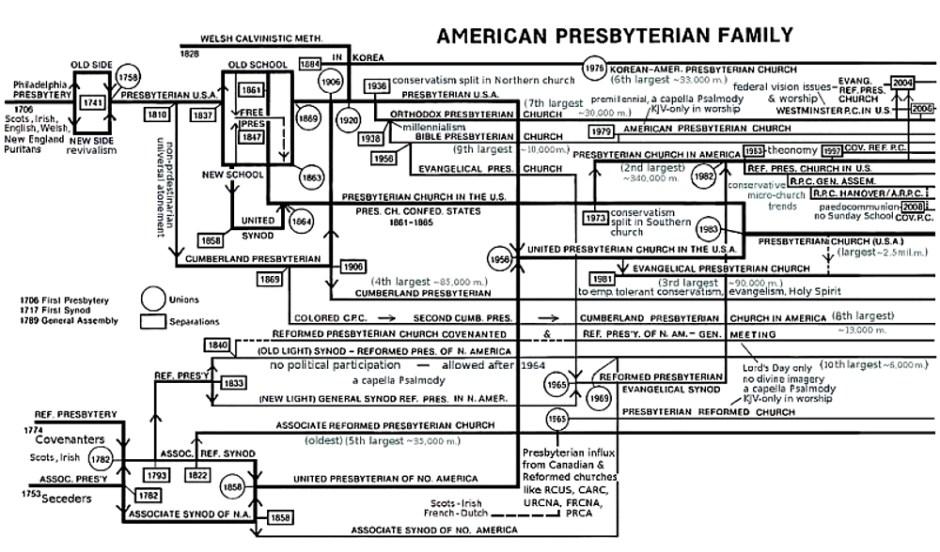
As our denomination has experienced recent tensions about confessional subscription, our mission, and worship, I have struggled to understand how we got here. My working hypothesis is that the PCA is a majority New Side/New School Presbyterian Church, with a substantial minority that is either New Side/Old School or Old Side/Old School.

The differences between the Old and New Side Presbyterians focused primarily on their differing views of revivals. The New Side believed the revivals or George Whitefield, which first disturbed and then converted sinners within and without the church and awakened and stirred to holiness and action true believers, had biblical precedents. Itinerant ordained and non-ordained speakers were often the instruments of revival. Religious experience was intensely personal and greatly concerned with whether or not one had been genuinely converted.

Old Siders had a higher view of the church as an institution, more confidence in the work of settled, ordained ministers carrying out the ordinary ministry of word and sacrament, and a greater emphasis on corporate religious life. Tensions over subscription pushed New Siders toward a looser view, with the Old Side arguing for strictness. Neither side was monolithic.

If the First Great Awakening balkanized the Old and New Sides, the Second Great Awakening returned the favor for the Old and New School Presbyterians. Despite this similarity, the major issue in the nineteenth century was not revivalism but confessionalism. Old Schoolers had differing appraisals of the earlier awakenings, but they shared a growing unease about the Second Great Awakening with its Arminian theology and its new measures.

In order to defend the theology of the Second Awakening New Schoolers had to take a broad view of the Westminster Standards and a much weaker view of what was involved in an officer’s ordination vows. The New School strongly favored mission over theology while the Old School held that theology defines and directs mission. Because of its emphasis on mission the New School favored working with parachurch societies to accomplish evangelism and missions, while the Old School believed the church alone was responsible for spreading the gospel and building up the saints. Part of the mission-orientation of the New School was its commitment to engage social issues, such as slavery and temperance, as part of an effort to Christianize America. Old Schoolers countered with the spirituality of the church. Not surprisingly, the New School had a low view of the church while the Old School maintained and defended jure divino Presbyterianism.

How does this explain the PCA? In my view, the majority of the PCA consists of three groups all of which share a New Side/New School orientation: the Columbia Seminary founding generation, the Reformed Presbyterian Church, Evangelical Synod (RPCES) influx, and the rising leadership consisting primarily of large urban/metropolitan church pastors and denominational executives.

Most of the founders of the PCA had been educated at the most conservative of the PCUS (Southern Presbyterian) seminaries in the 1950s and 1960s. While Columbia could trace her heritage all the way back to Thornwell, the most eloquent Southern Old School voice, little remained of Thornwell’s influence (William Childs Robinson being the exception) by the time PCA leaders received their training at Columbia. Students were considerably more conservative than the faculty at Columbia, but they were never much exposed to the old Confessional orthodoxy of the Southern Church. They believed in the Bible, in “the fundamentals,” in the gospel, and in evangelism and missions. They took their ordination vows with sincerity but they did not consider how those vows bound them to the Westminster Confession. In fact, many of these brothers were influenced by teachings that were inconsistent with Calvinism. I think of semi-Pelagianian, Invitation System revivalism, dispensationalism, and perfectionism. In addition, they were suspicious of church institutions and authority (having witnessed and experienced the corruption and abuse of the mainline Southern church) and were eager to cooperate with any evangelicals to win the world for Christ, maybe even “in this generation.”

It was not clear at the time of Joining and Receiving (J&R) in 1982 what the impact of the influx of the RPCES would be, but time has proved that it broadened and strengthened the New Side/New School segment of the PCA. The RPCES was the result of the union of the dwindling Reformed Presbyterian Church in North America, General Synod (a “new light” break-off from the Covenanters), and the larger Evangelical Presbyterian Church (from the McIntire wing of 1936.) Although RPCES was more Reformed and Presbyterian than McIntire’s Bible Presbyterians, its roots remained New School, and, though there was some indication the RPCES might move toward Princeton Old School positions, this did not materialize. The RPCES was and remains New Side/New School and so injected into the PCA another dose of New Side/New Schoolism.

What then of the rising leadership? The one word, which best catches the outlook and agenda of this group, consisting primarily of large urban pastors and denominational executives, is “missional.” In the New Side/New School tradition, mission is the church’s defining characteristic and responsible for its vitality and unity.

This “missional” orientation has been notably evident in recent worship services at the General Assembly. Mission requires us to rethink what it means to be church and to sit loose on doctrinal formulations, on polity issues, on how we worship, and on what the nature of the mission of the church is, so that as we understand more of this “post-everything” culture and figure out how to respond, we can make the necessary adjustments to further the church’s mission. This is decidedly the New Side/New School outlook, dressed in new clothes, but with the substance of the body unchanged.

This represents the majority of the PCA’ teaching and ruling elders. A majority holds to the New Side/New School type of Presbyterianism. At the same time a substantial minority in our church, with Old and New Side proclivities, holds to Old School Presbyterianism. This means that issues of doctrine, polity, subscription, worship, and mission remain live ones for the foreseeable future. The soul of the church is at stake for both the majority and minority.

William H. Smith is pastor of Covenant Presbyterian Church (PCA) in Louisville, Mississippi.

Mere Confessionalism

From the Archives: Nicotine Theological Journal, January 1999

Mere Confessionalism

“In essentials, unity; in non-essentials, liberty; in all things, charity.” This is the motto of the Evangelical Presbyterian Church. (The expression itself is of some antiquity, and it may date back as early as St. Augustine.) At its founding in 1981 the EPC adopted a modern language version of the Westminster Confession of Faith as its doctrinal standard. At the same time it also adopted an eight- point “Essentials of our Faith” summary statement. The latter contains boiler-plate evangelical affirmations on the Bible, God, Christ, sin, salvation, and eschatology, in language that is mildly and non-militantly Calvinistic.

Are these two documents competing doctrinal standards? An interesting debate is playing out in the EPC now regarding what confessional status, if any, its “Essentials” possess and how they relate to the Westminster Confession. The “Essentials” themselves end this way: “These Essentials are set forth in greater detail in the Westminster Confession of Faith.” But rather than solve the question, that ambiguous language only heightens the confusion. Does it mean that the WCF itself – taken as a whole – is the “Essentials” in fuller form, or merely that these eight affirmations can each be found there as well? Are the “Essentials,” in other words, what the church really believes? Should the emphasis fall on the first or second word in the denomination’s name, “Evangelical Presbyterian Church”?

MOST CONSERVATIVE Presbyterians would likely contend that the EPC has misidentified the essentials of the faith. After all, it is open to women in church office and the ongoing exercise of the charismatic gifts. At the same time, the EPC debate is instructive, because its conservative Presbyterian critics also tend to employ some form of what can be called the hermeneutic of essentials, of identifying what the church may or may not tolerate. Presbyterian theologian, John Frame, for example, in urging the creation of leg room within the confessions, laments that “the whole question of what is and what is not tolerable within the church has not been systematically analyzed.”

Frame’s quest is not new. Efforts to isolate the “essentials” within the confession are almost as old as Presbyterianism itself. Frequently, it has been the progressives who have been eager to speak of a “system of doctrine,” in order to permit their deviation from the Confession and catechisms of the church. By “system” they mean the Confession “in-as-much” as what the Confession teaches is biblical. In this fashion, Presbyterian officers hold line-item vetoes to the church’s Constitution, and the church had erected a Confession-within-the-Confession.

But it is not only progressives who speak this language. In efforts earlier in this century by conservative Presbyterians to preserve the essence of historic Christian orthodoxy, some upheld the minimal necessity of the “five fundamentals” of the faith. The unintended effect was to reduce the “essential and necessary” articles of the church’s constitution to just five.

Especially of late the rhetoric of essentials is invoked in order to separate the Bible from the Confession in the name of the Reformation principle of sola scriptura. (Indeed, often it is phrased in the language of liberating the Bible from the confession.) Increasingly Presbyterian officers seem to be declaring, “never mind the Confession, show me where that is taught in Scripture.” But for Presbyterians, an officer is committed to sola scriptura precisely to the extent that he is a Confessionalist. Confessionalism does not eclipse the doctrine of sola scriptura. Rather, a confession is the necessary means for the church to uphold Biblical authority. The Presbyterian way to point to the doctrine of Scripture is to refer to the Confession.

FRAME DESCRIBES THIS VIEW AS chauvinistic. “Although I am a Presbyterian,” he writes, “I confess that I do not share [the] desire for us always to ‘look like Presbyterians’ before the watching world.” In context, Frame’s concern is specifically about worship, but by implication his views bear upon the relationship between The Nicotine Theological Journal will likely be published four times a year. It is sponsored by the Old Life Theological Society, an association dedicated to recovering the riches of confessional Presbyterianism.

IN DESCRIBING HIS STUDENT days at Westminster Seminary (in the early 1960s), Frame recalls two features of that course of instruction: it lacked an overt “confessional or traditional focus” and there was a spirit of creativity and openness in theological reflection. He goes on to make a startling admission: “After graduation I became ordained in the Orthodox Presbyterian Church, and I confess I was rather surprised at the seriousness with which my fellow ministers took the confessional standards and the Presbyterian tradition. Eventually I became more like my fellow Orthodox Presbyterian . . . elders, but not without some nostalgia for the openness of theological discussion during my seminary years.”

Our point is not to critique WTS or any other seminary. And whether Frame has described with accuracy the curriculum of WTS in the 1960s is not our concern either. But what is revealing is the dichotomy that Frame creates between “perpetuat[ing] and recommend[ing] the confessional traditions” on the one hand (which is where he finds WTS’s education flawed), and a “flourishing of original and impressive theological thought” on the other (where he thinks WTS excelled). This difference he goes on to attribute to Westminster’s understanding of sola Scriptura, which liberated the school from traditionalism and confessionalism.

BUT FRAME’S DICHOTOMY WAS unknown to previous generations of Reformed theologians. Calvin Seminary’s Richard Muller writes the following on the harmony of Scripture and confession: “We need creeds and confessions so that we, as individuals, can approach Scripture in the context of the community of belief.” Confessions function as mediating structures, standing between Scripture and the “potentially idiosyncratic individual” as “churchly statements concerning the meaning of Scripture.” They are “normative declarations spoken from within by the church itself . . . as the expression of our corporate faith and corporate identity.”

Muller’s work on Reformed scholasticism reminds us that there was a time when confessional integrity did not compete with sola scriptura, nor did it impede theological creativity. For the scholastic mindset, Muller notes, “Once a churchly confession is accepted as a doctrinal norm, it provides boundaries for theological and religious expression, but it also offers considerable latitude for the development of varied theological and religious expressions within those boundaries.” According to the Reformers, there is no churchman and there is no theologian where there is no confession. Why is that so unimaginable today? Why has the Reformation confidence in the creeds of the church vanished?

AS WE PREVIOUSLY ARGUED (“Sectarians All,” NTJ 2.2), such anti-traditionalism only serves to locate one within a specific tradition, namely the Enlightenment, and its false claim that an individual Christian, armed with autonomous rationality can approach Scripture from a traditionless perspective. The Reformers, Muller claims, refused to approach Scripture with the false dilemma forced upon the church by its adoption of categories of Enlightenment thought.

Muller goes on to describe other pressures that our age brings to confessional integrity. He refers to the “noncredal, nonconfessional, and sometimes even anticonfessional and antitraditional biblicism of conservative American religion.” Enlightenment rationality and democratic populism combine to create what Robert Godfrey has diagnosed as the evangelical impulse toward theological minimalism. This minimalism seeks to get as many people to express everything they agree on, and preferrably on one side of one sheet of paper. These affirmations become the truly “essential truths,” and the hills for evangelicals to die on. Godfrey is echoing the thoughts of J. Gresham Machen, who in his essay, “The Creeds and Doctrinal Advance,” described this impulse in the following way:

There are entirely too many denominations in this country, says the modern ecclesiastical efficiency expert. Obviously, many of them have to be merged. But the trouble is, they have different creeds. Here is one church, for example, that has a clearly Calvinistic creed; here is another whose creed is just as clearly Arminian, let us say, and anti-Calvinistic. How in the world are we going to get them together? Why, obviously, says the ecclesiastical efficiency expert, the thing to do is to tone down that Calvinistic creed; just smooth off its sharp angles, until Arminians will be able to accept it. Or else we can do something better still. We can write an entirely new creed that will contain only what Arminianism and Calvinism have in common, so that it can serve as the basis for some proposed new “United Church” . . . . Such are the methods of modern church unionism.

This impulse stands in sharp contrast to what Godfrey calls the theological maximalism of the Reformed, which sought at least in the past to extend the boundaries of the church’s confession in pursuit of the “whole counsel of God.” Moreover, Reformed maximalism and evangelical minimalism differ not only in the size of their creeds but in the very purpose of their creeds. To quote Machen again:

These modern statements are intended to show how little of truth we can get along with and still be Christians, whereas the great creeds of the church are intended to show much of the truth God has revealed to us in His Word. Let us sink our differences, say the authors of these modern statements, and get back to a few bare essentials; let us open our Bibles, say the authors of the great Christian creeds, and seek to unfold the full richness of truth that the Bible contains. Let us be careful, say the authors of these modern statements, not to discourage any of the various tendencies of thought that find a lodgment in the church; let us give all diligence, say the authors of the great Christian creeds, to exclude deadly error from the official teaching of the church, in order that thus the Church may be a faithful steward of the mysteries of God.

BUT IS ALL OF THIS FAIR TO evangelicalism? After all, no less an evangelical icon than C. S. Lewis contended for a “mere Christianity.” Yet Lewis himself was not confused about his beliefs, which he said were found in the Anglican Book of Common Prayer. His search for a “mere” Christianity was not an alternative to the creeds of the church. Rather, he likened it to the difference between the halls and rooms of a mansion. “Mere” Christianity may bring one into the hall. “But it is in the rooms, not in the hall, that there are fires and chairs and meals.” The “worst of the rooms,” he went on to stress (perhaps thinking of a dimly lit and drearily decorated attic of Calvinistic horrors), is to be preferred over the hall.

Whatever Lewis intended, his words have been hijacked to serve unhealthy purposes. The ambiguities of the expression, “Mere Christianity,” can be found in many of Lewis’ disciples. And when it meets contemporary evangelicalism, there is a volatile mix that may prove lethal to the theological reflection and confessional identity of the church.

CONSIDER TOUCHSTONE magazine, which had recently changed its subtitle from “A Journal of Ecumenical Orthodoxy” to “A Journal of Mere Christianity.” Its editorial purpose is to “subordinate disagreements to the common agreement” because the crisis of our day is so grave. Here we must recognize the debilitating effects of the so-called culture wars on the confessional identity of the church. Abortion, Gay rights, women’s rights, funding for and legal protection of pornographic artists, evolution in the public schools — all of these are battle fronts in the increasingly rancorous struggle over the meaning and purpose of America. And these are the causes to which Christians should devote their energy.

“We need to identify the ‘real enemy’,” urges Touchstone, and that enemy is without, not within. What is said moderately in Touchstone can be found in more virulent form in Peter Kreeft’s Ecumenical Jihad. For Kreeft, mere Christianity may not even be recognizably Christian. The moral decay of America, with all of its leading indicators of spiritual decline, is creating new alliances, even among those of differing religious convictions. The old fashioned Protestant v. Catholic v. Jewish warfare is passe. So great is the threat of secular humanism and so united are we with former antagonists on the really crucial issues, that even evangelical Christians, Kreeft predicts, will eventually arrive at the conclusion that Muslims are on the right side. They may be murdering Christians in Sudan, but at least they are not massacring unborn children. Given the real crisis of our time – the decline of Western Civilization – this is “no time for family squabbles.” This is not merely cultural warfare but spiritual warfare that will unite Protestants, Catholics, Orthodox, Jews, Muslims, Buddhists, and maybe even an occasional natural-law-advocating atheist.

(Don’t be too alarmed by all this. The Holy Spirit is at work among pious Muslims, Kreeft assures Christian skeptics, and in heaven these Muslims will come to learn that the Allah they served was the God of the Scriptures. What is more, Kreeft goes on to comfort Catholics that Protestants will ultimately come to venerate the blessed Virgin Mary, if not in this life then in the next. So the very ecumenical Kreeft eventually emerges from the closet and is outed by the end of his own book as a good, confessional Catholic.)

TOUCHSTONE MAGAZINE ultimately appeals to experience over doctrine. “Mere Christianity,” it states, is found ultimately not in doctrine but lies in “the character of a man.” Similarly, Kreeft argues that beyond theological differences, we find mere Christianity where there is love. This privileging of experience over doctrine prompts us to wonder whether efforts to arrive at evangelical essentials owe less to C.S. Lewis than to Friedrich Schleiermacher, the 19th-century father of modern theological liberalism.

Fundamental to Schleiermacher’s method was his division between the kernel and husk of the Christian faith. The latter is the practice of Christianity, that which is culturally conditioned, and the former is the “essence of the Christian faith,” stripped of these acculturated accretions. It was this non-negotiable kernel that Schleiermacher desperately sought to preserve. The husk is what is offensive to unbelievers, specifically, 19th-century elites of Protestant Europe. The task of the church, therefore, is to remove the objectionable and make Christianity attractive and relevant.

SCHLEIERMACHER IS NOT alone in this methodology. In our century, Tillich’s “method of correlation” and Bultmann’s program of demythologization likewise restated biblical message in language free from pre-modern superstitions and categories more friendly to modernity. A little closer to home, seeker-sensitive worship owes much to 19th-century liberalism, in order to make church accommodating to unchurched Harry and Sally. All of these are efforts to repackage the Christian faith.

In his book, Rumor of Angels, sociologist Peter Berger says that whenever one engages in this method, one is making a cognitive adjustment to the worldview of modernity. In the case of liberalism, the result can be “a profound erosion of the traditional religious content, in extreme cases to the point where nothing is left but hollow rhetoric.” But however practiced, this adjustment or “bargaining” is always a process of “cultural contamination,” because in the encounter between the church and modernity, modernity always wins.

Berger’s point, of course, is that you cannot adjust the wrappings and leave the core unaffected. But is it a stretch to link contemporary evangelicals with a Schleiermacher? We may not see language like kernel or husk, much less something as ominous as demythologization. But substitute “message” and “method,” and it begins to sound familiar. How many times have you heard it said that we must maintain our message but we must change our method, because the world is changing, and at a dizzying pace at that. Or think about the churches that describe their “philosophy of ministry” in brochures for first-time visitors without reference to their theological standards. And then there is “worship style.” How is it that churches can offer two morning services that are “identical” except for the music? Let us not forget that Friedrich Schleiermacher was as desperate as Bill Hybels to present Christianity in relevant and meaningful ways to a skeptical culture.

IN DAVID WELLS’ TERMS theological liberalism and contemporary evangelicalism both quarantine theology from ministry. By dividing message from method, both permit theological convictions to play a diminishing role in the life of the church. On more and more matters, evangelicals are suggesting that theological considerations are irrelevant, overshadowed by the more urgent need for cultural relevance or evangelistic effectiveness. According to Wells,

It is not that the elements of the evangelical credo have vanished; they have not. The fact that they are professed, however, does not necessarily mean that the structure of the historic Protestant faith is still intact. The reason, quite simply, is that while these items of belief are professed, they are increasingly being removed from the center of evangelical life where they defined what that life was, and they are now being relegated to the periphery where their power to define what evangelical life should be is lost.

SCHLEIERMACHER’S METHOD should serve as ample warning that theological minimalism is a false messiah. It is sure to destroy what it claims to preserve, not only when it is in the hands of liberals, but also when it is practiced mildly by conservative evangelicals. A lowest common denominator is an ecumenical dead end. A Reformed church whose worship disguises its Reformed identity is simply not reformed.

Presbyterians would do better to affirm a “mere” Confessionalism, and regard, along with our ancestors, the standards of the church as liberating and not constrictive. Further, Presbyterians might want to acknowledge, however humbling it might be, that they stand to learn something here from the Lutherans. Our Lutheran counterparts seem far more vigilant in their confessional identity than Calvinists. At a recent gathering of the Alliance of Confessing Evangelicals, Missouri Synod theologian, David P. Scaer, struck at the heart of the evangelical dilemma:

Any survival and recovery of Reformation theology cannot be made to depend on a further compromise which identifies an essential core of agreement in order to save it. . . . This kind of agreement immediately puts Lutherans at a disadvantage, since they must concede what makes them Lutherans.

In observing the eager participation of the Reformed in such holy grail pursuits of essentials, Scaer wonders whether the Reformed have made such a suicidal concession. We can hardly improve on Scaer’s conclusion: “Distinctions between essential and non-essential do not belong in the confessional vocabulary.”

Which leads to the unpleasant conclusion that a “confessing evangelical” is a contradiction in terms. Perhaps then Reformed need to cultivate among themselves the same dis-ease for the term “evangelical” as Machen had for “fundamentalist” in his day. Although he reluctantly accepted the term, he couldn’t abide the artificial reduction of a full-orbed Calvinism into a list of fundamentals. So instead of asking what church officers can get away with and how churches can be innovative, Reformed should second Machen: “isn’t the Reformed faith grand!”

“IN ESSENTIALS UNITY; IN NON-essentials, liberty; in all things, charity.” This is a motto that the Presbyterians can embrace. We need not concede it either to charismatic Presbyterians or broad evangelicals, but only if we define essentials in a confessionally self-conscious way. In our standards, there is unity – mere confessionalism. The search for essentials ends when the church adopts her standards. Beyond our confession, there is liberty, and with it openness and even diversity, in theology, worship, and life. And what about charity? By worldly standards, confessionalism does not permit a hermeneutic of charity, for that is a charity of indifference and tolerance. But confessionalism does cultivate a biblical charity that rejoices in the truth, and believes all things.

JRM

How The Winners (Liberal Presbyterians) Write the History

What follows is an account of the modernist-fundamentalist controversy that used to be on the First Presbyterian Church (NYC) website. Thanks to the Wayback Machine, you can still find it. But now you have Old Life’s Cloud. You’re welcome.

On curious aspect of this piece is how central Harry Emerson Fosdick is to First Presbyterian’s understanding of the controversy. That editorial decision allows the First Church to end the story with a kind of “my bad.” “Yes, we got a little carried away with modernism. But no apologies to conservatives like Machen who the Presbyterian bureaucratic bus ran over.”

Another is the importance of Charles Briggs. B. B. Warfield was on to something. But by the 1890s strict Presbyterianism (doctrine or church polity) was on short supply any where in the trans-Atlantic world.

______________

The Fundamentalist / Modernist Conflict

Harry Emerson Fosdick and The Fundamentalist / Modernist Conflict

The 1890s saw great changes in society: The industrial revolution and the changing of the United States from an agrarian society to an urban one.

The 1890s were also a decade of intellectual upheaval. Between the depression of 1873 and the First World War, many of the time-honored suppositions were being questioned. Darwin’s theory of evolution was one of the most prominent new ideas, challenging the authority of the Bible and the presumption of its inerrancy.

A working definition of Modernism, Liberalism and Fundamentalism in the American Protestant context is necessary to understand the basics of the conflict.

Traditionalists, later known as Fundamentalists, adopted a five-point declaration at the 1910 General Assembly that all candidates for ordination had to affirm. These five points were of course a reaction to the growing acceptance within Protestantism and, specifically the Presbyterian Church, of a more liberal interpretation of the Bible.

The five Fundamental points are:

1.The inerrancy of the Bible
2.The virgin birth of Christ
3.Christ’s substitutionary atonement
4.Christ’s bodily resurrection
5.The authenticity of Christ’s miracles

Other Christian groups adapted the five points with point two often becoming the deity of Christ rather than his virgin birth.

Many lists ended with Christ’s premillennial second coming, instead of his miracles, as the fifth point.

By the 1920s the five points had become called the five fundamentals and had become a rallying cry for conservative Christians across a broad spectrum.

As Jack Rogers, in his book Presbyterian Creeds: A Guide to the Book of Confessions, states: “This was especially true for the growing movement of independent Bible conferences, Bible schools, and independent churches influenced by Dispensationalism. This movement majored in literalistic, futuristic, interpretation of biblical prophecy which announced Christ’s imminent return following a very specific and complex timetable of attendant events. Dispensationalists also taught that all the traditional institutional churches had grown worldly and denied fundamental doctrinal beliefs.”

Modernism may be defined as a method of interpreting Christian scripture and tradition, but not a particular set of beliefs. Modernizers can be found in every period of Church history and Christian Communions. But when we speak particularly of Protestantism in the late 19th to early 20th centuries, we see a conviction in the new scientific knowledge and the most recent Biblical historical research. An application of this new knowledge presents real issues for Christians. As a result, according to Modernism, the task of interpretation must be carried forward if the saving truth of the gospel is to be understood in its relevance to contemporary life.

As for Liberalism, Daniel D. Williams, former Professor of Systematic Theology at Union, says, “It might be said with some accuracy that all theological liberals were modernists; but not all those who used modernist methods of interpretation shared the faith of the liberal theology, especially its optimistic estimate of human nature.”

Further, he says: “Liberals have taken a positive attitude toward the achievements of democratic culture and have generally stressed the ethical imperatives in the gospel.”

Williams also quotes the German theologian Adolf Harnack, who, near the turn of the century, had this classic definition of Liberal theology: “Firstly, the Kingdom of God and its coming. Secondly, God the Father and the infinite value of the human soul. Thirdly, the higher righteousness and the commandment of love.”

In the social gospel movement Walter Rauschenbusch, who was professor of Church History at Rochester Theological Seminary in the early part of the century, became a chief interpreter and prophet. His concept of social sins involved society as a whole (e.g., poverty, child labor, poor working conditions, etc.), and held that these needed to be urgently addressed. To Rauschenbusch and his followers, Christian social activism and advocacy was a compelling Biblical ethic.

The Fundamentalist / Modernist conflict began with the Charles A. Briggs heresy trial. The trial was a reaction from conservative traditionalists to Briggs’s address on January 20, 1891, at Union Theological Seminary on, “The

Authority of the Holy Scriptures.” It was an address inaugurating the opening of the new Department of Biblical Theology.

Briggs was a professor of theology at Union, and he attacked “Traditionalism,” later known as Fundamentalism, and espoused an interpretation of the Bible in the light of the “Higher Criticism.” The Higher Criticism was a method of investigating facts based on scientific investigation, inductive research, and a relative system of values.

Carl E. Hatch, in his 1969 book The Charles A. Briggs Heresy Trial, lists three main factors that stand out as transforming American Protestant theology: Darwin’s theory of biological evolution, Higher Criticism, and the study of comparative religion. Hatch further makes the point that the impact of Darwin’s theory of evolution on American Theology is well known, but that of Higher Criticism and comparative religion much less so.

Briggs had studied in Germany where the methods of Higher Criticism had begun. Julius Wellhausen had perhaps the most influence upon American theologians. He is known as the Father of Higher Criticism. Briggs’s favorite teacher at the University of Berlin, which he attended, was A.I. Dorner, a disciple of Wellhausen.

Charles A. Briggs was born in New York City on January 15, 1841. He attended the University of Virginia, but in his Junior year, 1861, returned home because the Civil War was imminent. After joining the Union Army for about a year and helping defend Washington D.C., he was released to go home, for reasons not known. He entered Union Seminary and graduated in 1863. After graduation he tried helping his father in his merchandising firm in New York, but quickly decided it was not for him. Briggs then matriculated to the University of Berlin. It was a turning point in his life.

After completing his studies, he returned to New York and in 1870 was ordained a Presbyterian minister. He served for a time at a church in Roselle, NJ, but soon found that it, too, was not to his temperament. In 1874 an invitation came to teach at Union. He was professor of Hebrew and Cognate Languages. Although he found it much more rewarding to teach than be a pastor, the subject did not afford him much opportunity to approach Biblical criticism.

Briggs had wanted to forcefully introduce the German theology into this country, but “How to do it?” was his question.

Since Union was under the control of the General Assembly, and most Presbyterian clergy were conservative and therefore disposed against the German Higher Criticism, Briggs had to be careful in what he wrote in religious publications and what he taught in the classroom.

Briggs then maneuvered to create a new department, using the Higher Criticism. But instead of using that term, he used the euphemistic “Department of Biblical Theology.” Briggs, of course, was to be head of the department.

Little opposition was encountered from Union faculty or administration for the creation of the new department. For, despite generally conservative clergy within the Church, Union’s faculty and administration at the time were more progressive and favorably inclined toward the German theology. Charles Butler, chairman of Union’s board of directors, had been a boyhood friend of Briggs and supported the plan wholeheartedly. In April of 1890 Union received $100,000 in bequest money for the new department. The board voted in the new department unanimously in November of that same year.

On January 20, 1891, Briggs gave his address inaugurating the new department.

The speech cheered Briggs’s students. They enthusiastically applauded him at points, but it angered the invited conservative guests and clergy.

The speech is very much a polemic, attacking beliefs about the Bible that the Victorians held as eternal and inviolable.

Briggs began by asserting that there were three, not one, great sources of divine authority. The first was the institutional Church, the second was reason, and the third the Bible.

“But of all three ways,” Briggs said, “no one of these has been so obstructed as the Holy Bible.” He argued that the authority of the Bible had been so wrapped in dogma and protective creeds, that “The whole trouble with the Bible today is that it has been treated as if it were a baby, to be wrapped in swaddling clothes, nursed, carefully guarded lest it should be injured by heretics and skeptics.”

As Carl Hatch relates in his book, “The net effect of this,” according to Briggs, “was to shut out the light of God, to obstruct the life of God, and to fence in the Bible, thus rendering the Bible useless.”

Briggs next attacked superstition as keeping people from the Bible. “We are accustomed to attach superstition to the Roman Catholic Mariolatry and the use of images, and pictures and other external things in worship. But superstition is not less superstition if it takes the form of Bibliolatry.” Mariolatry is idolatry of the Virgin Mary. Bibliolatry is idolatry of the Bible.

“The second barrier,” said Briggs, “keeping men from the Bible is the dogma of verbal inspiration.” These comments, reports Hatch, were “extraordinarily incendiary because the doctrine of verbal inspiration was (and still is) one of the dearest tenets of evangelical Protestantism.”

In Briggs’s third barrier, he maintained that the idea that the Scripture is inerrant is false. “The Bible itself nowhere makes the claim that it is inerrant,” said Briggs.

The fourth barrier, said Briggs, was the assumption that the authenticity of the Bible was founded upon the belief that holy men of old had written the various books.

Said Briggs: “When such fallacies are thrust in the face of men seeking divine authority in the Bible, is it strange that so many turn away in disgust? It is just here that the Higher Criticism has proved such terror in our times. Traditionalists are crying out that it is destroying the Bible, because it is exposing their fallacies and follies. It may be regarded as the certain result of the science of the Higher Criticism that Moses did not write the Pentateuch or Job; Ezra did not write the Chronicles, Ezra or Nehemiah; Jeremiah did not write the Kings or Lamentations; David did not write the Psalter, but only a few of the Psalms; Solomon did not write the Song of Songs or Ecclesiastes, and only a portion of the Proverbs; Isaiah did not write half of the book that bears his name. The great mass of the Old Testament was written by authors whose names or connection with their writings are lost in oblivion.”

At last Briggs ended his shocking pronouncements with this vigorous exhortation:

“We have undermined the breastworks of Traditionalism; let us blow them to atoms. We have forged our way through the obstructions; let us remove them now from the face of the earth, criticism is at work everywhere with knife and fire! Let us cut down everything that is dead and harmful, every kind of dead orthodoxy, every species of effete ecclesiasticism, all mere formal morality, all those dry and brittle fences that constitute denominationalism, and are barriers to church unity.”

“Let us burn up every form of false doctrine, false religion, and false practice. Let us remove every incumbrance out of the way for a new life; the life of God is moving throughout Christendom, and the spring time of a new age is about to come upon us.”

With this blistering attack upon the traditionalists, Briggs faced considerable reaction from within the Church in the form of open theological warfare. Before this, the Higher Criticism posed only a vague threat to the traditional theology. Briggs, in one speech, had moved it full throttle into a formidable threat to upset the prevailing orthodoxy.

It is interesting to note the overwhelmingly positive reaction the students had to Briggs’s speech and theological position. His students were about the same age as Harry Emerson Fosdick was at that time, and as you may remember, Fosdick reports that as a student at Colgate he himself rebelled against the old orthodoxy.

The initial public reaction to Briggs and his theological outlook was cool, but in many newspaper editorials there was a sense of outrage and dismay.

In April of 1892 the Presbytery of Cincinnati petitioned the General Assembly to take action against Briggs. By the time of the General Assembly in May, over seventy presbyteries, mostly from the Midwest, registered disapproval with the Assembly over Briggs’s teachings.

Most wanted the Assembly to order Union to remove Briggs, a power the Assembly had by the Compact of 1870 which had adjoined Union to other Presbyterian seminaries. The Compact clearly stated that the Assembly had power over the accepting or rejecting of professors.

The Union Faculty was solidly behind Briggs. Most favored the German Higher Criticism and rallied behind Briggs. Union alumni were also invited to join in the defense of Briggs. A solid majority of them did. One thing this showed was how much the higher criticism had penetrated into certain circles of American religious thought, despite an era generally marked by conservatism.

At the May General Assembly in Detroit, the Committee on Theological Seminaries, made up entirely of conservatives opposed to Briggs, voted to recommend removing Briggs as chair of the new Department of Biblical Theology.

The Cincinnati Presbytery even tried to organize a boycott by forbidding students of the Midwest to enter Union. The ploy eventually failed because it helped Union gain even greater notoriety for its theological position, thereby attracting more students, especially from New England. Union was now seen at the level of Yale and Harvard Divinity Schools.

At the same time, the Midwestern Presbyteries in 1891 put pressure on the New York Presbytery to bring a heresy charge against Briggs. In May that year a committee of inquiry, involving both liberals and conservatives in the Presbytery, recommended prosecution of Briggs.

By November of 1891 a trial had started. Briggs acted as his own counsel, making a brilliant opening statement that shifted the focus of the trial away from him personally to focus on the new theology. The trial was seen publicly as a forum on this theology, not on the heresy of Briggs’s teaching. Briggs was acquitted of heresy by a 94-39 vote.

Briggs was retried on appeal of the Portland, Oregon Presbytery, and again acquitted. However, at the General Assembly of 1893 he was suspended from the Presbyterian Church.

Meanwhile, Union separated from the Presbyterian Church over this case and retained Briggs as professor until his death in 1913.

Carl Hatch writes, “Although Briggs’ inaugural address did not actually begin a new era in American theology, biblical study in this country has never been the same since that provocative discourse.”

Fundamentalists and Liberals lived in tension in the following years. Presbyteries mostly in the Midwest and West were conservative. Those in the East were more progressive.

One area of tension was in the field of foreign missions. It was in 1921 that Fosdick went to China to ease tensions between missionaries representing churches from both sides of the fence. It was apparently the Fundamentalists that primarily wanted to be separate from their more liberal counterparts.

Reinhold Niebuhr, as a Midwesterner, saw the old traditionalist religion as a kind of rough and ready theology for the American frontier of the 19th century that had hardened into a graceless one for the 20th century.

In May 21, 1922 Fosdick preached “Shall the Fundamentalists Win?” He writes in his autobiography, “It was a plea for tolerance, for a church inclusive enough to take in both liberals and conservatives without either trying to drive the other out.” Soon after the sermon, a man named Ivy Lee, a publicist and Presbyterian, asked Fosdick for permission to reprint the sermon in pamphlet form. Fosdick gave him permission and Lee mailed copies to every Presbyterian clergy in the country. A tremendous controversy ensued, with Fundamentalists within the Presbyterian Church, led by William Jennings Bryan, calling for Fosdick’s removal at the General Assembly of 1923.

In the meantime, Clarence E. Macartney, a minister from Philadelphia, preached a response to Fosdick, titled “Shall Unbelief Win?”

That General Assembly produced a resolution directing the New York Presbytery to direct First Church to conform to the Confession of Faith in its preaching and teaching. Fosdick handed in his resignation, but it was rejected by the Session. At the 1924 General Assembly, with Macartney as moderator and Bryan as vice moderator, Fosdick’s preaching remained an issue, and a compromise was finally struck between the two factions, asking Fosdick to regularize his position at First Church by becoming a Presbyterian minister. He refused, and in October of that year the Session accepted his resignation.

Also in that year, 13 percent of the ministers of the Presbyterian Church signed a document called the Auburn Affirmation. It stated that the Five Fundamentals, which the General Assembly had reaffirmed the previous year, went beyond the facts which the Scripture and the Westminster Confession obligated them.

Fosdick’s last sermon at First Church was on March 1, 1925. It was the same year as the Scopes trial in Dayton, Tennessee, in which William Jennnings Bryan came to national prominence.

In 1923, J. Gresham Machen’s book Christianity and Liberalism was published, adding fuel to the fire. It proclaimed that liberal Christianity was “a different religion” and he attempted to argue that it sprang from different roots. Consequently, he advocated a split within the Presbyterian Church along theological lines of ideology.

Machen was a professor at Princeton Theological Seminary. His aggressively militant view contrasted as polar opposite to the one to which Fosdick expressed.

As Jack Rogers says in Presbyterian Creeds, by 1925 “there were identifiable political parties within the Presbyterian Church. One was composed of theological liberals, who believed in an inclusive church, containing any who wished to belong. Opposed to them were doctrinal fundamentalists, who argued for an exclusivist church composed only of those who agreed with the five fundamental points. The largest group, though least well organized, was made up of moderates, who were theologically conservative but were inclusivists for the sake of the peace, unity, and mission of the church.”

Charles R. Erdman, a professor of practical theology at Princeton was elected Moderator of the General Assembly of 1925. Erdman was a moderate. He proposed a Special Theological Commission to study the state of the Church.

In 1927 the commission issued its final report, saying that no one, not even the General Assembly, had the right to single out doctrines such as the five points and determine a particular interpretation of them to be “essential and necessary” for all. They affirmed that only the Judicial process of the church – i.e., heresy trials – could determine points of doctrinal interpretation in specific cases.

Fundamentalist control of the Presbyterian Church was being diminished by altering the theological decision-making by the Presbyteries.

In 1929 the General Assembly approved a reorganization of the governing boards of Princeton Theological Seminary. As a result, exclusivist Fundamentalists were no longer in control.

J. Greshem Machen was outraged. With three other faculty members, he left to form Westminster Seminary in Philadelphia, and soon thereafter, an Independent Board of Foreign Missions. It was a counter to what he felt was a too-liberal influence in the denomination’s foreign missions program.

The General Assembly declared this competition with a denominational agency unconstitutional, and ordered all Presbyterians, including Machen, to desist from this activity. Machen refused and in 1935 he left the Presbyterian Church and formed, with some of his most militant followers, the Orthodox Presbyterian Church.

By the late 1930s, the public had become tired of the tensions between the left and right within the church. Liberal theology had prevailed, but a new wind was blowing. This time, again from Europe.

As Rogers states: “It was not a well-defined school of thought but a new movement variously called ‘dialectical theology,’ ‘neo-Calvinism,’ and ‘neo-Orthodoxy.’ Among its most prominent figures were the Swiss theologians Barth and Brunner and the American Reinhold Niebuhr.”

“Neo-Orthodoxy rejected,” says Rogers, “the evolutionary idealism of liberalism, which had taught that human beings were basically good and that, by cooperating with God, people would bring the kingdom of God on earth. In contrast, Barth and others preached about human sin and a God of judgment and grace who would have to break into human history.”

Neo-orthodoxy, which essentially came out of Liberalism, did not, however, reject the Higher Criticism concerning the Bible. According to Rogers: “The defining insight of early neo-orthodoxy was that God did not reveal information in an inspired book. God was revealed in the person of Jesus Christ. A person’s encounter with Christ in Scriptures was the work of the Holy Spirit.” By the late 1950s neo-orthodoxy was well established as the dominant theology within the Presbyterian Church.

Returning to Fosdick, in 1935 he preached a sermon at The Riverside Church called “The Church Must Go Beyond Modernism.”

In it he declared, “Fifty years ago the intellectual portion of western civilization had turned one of the most significant mental corners in church history and was looking out on a new view of the world. The church, however, was utterly unfitted for the appreciation of that view. Protestant Christianity had been officially formulated in pre-scientific days. Modernism, therefore, came as a desperately needed way of thinking. It insisted that the deep and vital experiences of the Christian soul, with itself, with its fellow, with its God, could be carried over into this new world and understood in the light of the new knowledge. We refused to live bifurcated lives, our intellect in the late 19th century and our religion in the early sixteenth century. God, we said, is a living God who has never uttered his final word on any subject.”

“The church thus had to go as far as modernism but now the church must go beyond it. Modernism is primarily an adaptation, an adjustment, an accommodation of Christian faith to contemporary scientific thinking. It started by taking the intellectual culture of a particular period as its criterion and then adjusted Christian teaching to that standard. Herein lies modernism’s shallowness and transiency: it arose out of a temporary intellectual crisis; it became an adaptation to, a harmonization with, the intellectual culture of, a particular generation. That, however, is no adequate religion to represent the Eternal and claim the allegiance of the soul. Let it be a modernist who says that to you!”

Fosdick goes on to say that modernism had been too preoccupied with intellectualism, too sentimental with the belief in the idea of human progress, that it had been too centered on the achievements of humanity, putting God in a kind of “advisory” position. And finally, that modernism had lost a moral standing-ground by being too accommodating to the prevailing culture.

“Harmonizing slips easily into compromising,” said Fosdick. “To adjust Christian faith to the new astronomy, the new geology, the new biology, is absolutely indispensable. But suppose that this modernizing process, well started, goes on and Christianity adapts itself to contemporary nationalism, contemporary imperialism, contemporary capitalism, contemporary racialism – harmonizing itself, that is, with the prevailing social status quo and the common moral judgments of our time.”

“We cannot harmonize Christ with modern culture,” said Fosdick at the end. “What Christ does to modern culture is to challenge it.”

In this sermon Fosdick never renounces Liberalism – many thought he had – or even mentions it by name. Fosdick still strongly believed in humanity and its possibilities in relation to God and still believed in the progress of Christianity as revealed by God. His 1938 book A Guide to Understanding the Bible demonstrates this. But his thinking and beliefs by this time had developed more like those of the emerging neo-orthodox theology.