How The Winners (Liberal Presbyterians) Write the History

What follows is an account of the modernist-fundamentalist controversy that used to be on the First Presbyterian Church (NYC) website. Thanks to the Wayback Machine, you can still find it. But now you have Old Life’s Cloud. You’re welcome.

On curious aspect of this piece is how central Harry Emerson Fosdick is to First Presbyterian’s understanding of the controversy. That editorial decision allows the First Church to end the story with a kind of “my bad.” “Yes, we got a little carried away with modernism. But no apologies to conservatives like Machen who the Presbyterian bureaucratic bus ran over.”

Another is the importance of Charles Briggs. B. B. Warfield was on to something. But by the 1890s strict Presbyterianism (doctrine or church polity) was on short supply any where in the trans-Atlantic world.

______________

The Fundamentalist / Modernist Conflict

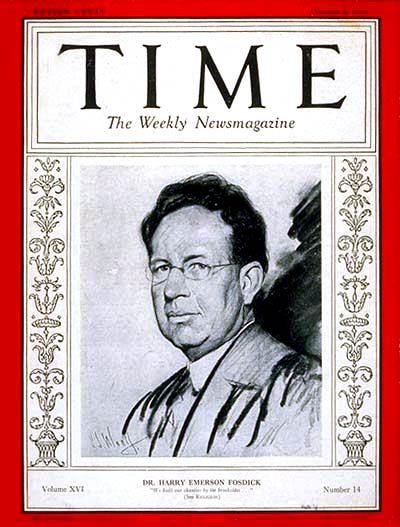
Harry Emerson Fosdick and The Fundamentalist / Modernist Conflict

The 1890s saw great changes in society: The industrial revolution and the changing of the United States from an agrarian society to an urban one.

The 1890s were also a decade of intellectual upheaval. Between the depression of 1873 and the First World War, many of the time-honored suppositions were being questioned. Darwin’s theory of evolution was one of the most prominent new ideas, challenging the authority of the Bible and the presumption of its inerrancy.

A working definition of Modernism, Liberalism and Fundamentalism in the American Protestant context is necessary to understand the basics of the conflict.

Traditionalists, later known as Fundamentalists, adopted a five-point declaration at the 1910 General Assembly that all candidates for ordination had to affirm. These five points were of course a reaction to the growing acceptance within Protestantism and, specifically the Presbyterian Church, of a more liberal interpretation of the Bible.

The five Fundamental points are:

1.The inerrancy of the Bible
2.The virgin birth of Christ
3.Christ’s substitutionary atonement
4.Christ’s bodily resurrection
5.The authenticity of Christ’s miracles

Other Christian groups adapted the five points with point two often becoming the deity of Christ rather than his virgin birth.

Many lists ended with Christ’s premillennial second coming, instead of his miracles, as the fifth point.

By the 1920s the five points had become called the five fundamentals and had become a rallying cry for conservative Christians across a broad spectrum.

As Jack Rogers, in his book Presbyterian Creeds: A Guide to the Book of Confessions, states: “This was especially true for the growing movement of independent Bible conferences, Bible schools, and independent churches influenced by Dispensationalism. This movement majored in literalistic, futuristic, interpretation of biblical prophecy which announced Christ’s imminent return following a very specific and complex timetable of attendant events. Dispensationalists also taught that all the traditional institutional churches had grown worldly and denied fundamental doctrinal beliefs.”

Modernism may be defined as a method of interpreting Christian scripture and tradition, but not a particular set of beliefs. Modernizers can be found in every period of Church history and Christian Communions. But when we speak particularly of Protestantism in the late 19th to early 20th centuries, we see a conviction in the new scientific knowledge and the most recent Biblical historical research. An application of this new knowledge presents real issues for Christians. As a result, according to Modernism, the task of interpretation must be carried forward if the saving truth of the gospel is to be understood in its relevance to contemporary life.

As for Liberalism, Daniel D. Williams, former Professor of Systematic Theology at Union, says, “It might be said with some accuracy that all theological liberals were modernists; but not all those who used modernist methods of interpretation shared the faith of the liberal theology, especially its optimistic estimate of human nature.”

Further, he says: “Liberals have taken a positive attitude toward the achievements of democratic culture and have generally stressed the ethical imperatives in the gospel.”

Williams also quotes the German theologian Adolf Harnack, who, near the turn of the century, had this classic definition of Liberal theology: “Firstly, the Kingdom of God and its coming. Secondly, God the Father and the infinite value of the human soul. Thirdly, the higher righteousness and the commandment of love.”

In the social gospel movement Walter Rauschenbusch, who was professor of Church History at Rochester Theological Seminary in the early part of the century, became a chief interpreter and prophet. His concept of social sins involved society as a whole (e.g., poverty, child labor, poor working conditions, etc.), and held that these needed to be urgently addressed. To Rauschenbusch and his followers, Christian social activism and advocacy was a compelling Biblical ethic.

The Fundamentalist / Modernist conflict began with the Charles A. Briggs heresy trial. The trial was a reaction from conservative traditionalists to Briggs’s address on January 20, 1891, at Union Theological Seminary on, “The

Authority of the Holy Scriptures.” It was an address inaugurating the opening of the new Department of Biblical Theology.

Briggs was a professor of theology at Union, and he attacked “Traditionalism,” later known as Fundamentalism, and espoused an interpretation of the Bible in the light of the “Higher Criticism.” The Higher Criticism was a method of investigating facts based on scientific investigation, inductive research, and a relative system of values.

Carl E. Hatch, in his 1969 book The Charles A. Briggs Heresy Trial, lists three main factors that stand out as transforming American Protestant theology: Darwin’s theory of biological evolution, Higher Criticism, and the study of comparative religion. Hatch further makes the point that the impact of Darwin’s theory of evolution on American Theology is well known, but that of Higher Criticism and comparative religion much less so.

Briggs had studied in Germany where the methods of Higher Criticism had begun. Julius Wellhausen had perhaps the most influence upon American theologians. He is known as the Father of Higher Criticism. Briggs’s favorite teacher at the University of Berlin, which he attended, was A.I. Dorner, a disciple of Wellhausen.

Charles A. Briggs was born in New York City on January 15, 1841. He attended the University of Virginia, but in his Junior year, 1861, returned home because the Civil War was imminent. After joining the Union Army for about a year and helping defend Washington D.C., he was released to go home, for reasons not known. He entered Union Seminary and graduated in 1863. After graduation he tried helping his father in his merchandising firm in New York, but quickly decided it was not for him. Briggs then matriculated to the University of Berlin. It was a turning point in his life.

After completing his studies, he returned to New York and in 1870 was ordained a Presbyterian minister. He served for a time at a church in Roselle, NJ, but soon found that it, too, was not to his temperament. In 1874 an invitation came to teach at Union. He was professor of Hebrew and Cognate Languages. Although he found it much more rewarding to teach than be a pastor, the subject did not afford him much opportunity to approach Biblical criticism.

Briggs had wanted to forcefully introduce the German theology into this country, but “How to do it?” was his question.

Since Union was under the control of the General Assembly, and most Presbyterian clergy were conservative and therefore disposed against the German Higher Criticism, Briggs had to be careful in what he wrote in religious publications and what he taught in the classroom.

Briggs then maneuvered to create a new department, using the Higher Criticism. But instead of using that term, he used the euphemistic “Department of Biblical Theology.” Briggs, of course, was to be head of the department.

Little opposition was encountered from Union faculty or administration for the creation of the new department. For, despite generally conservative clergy within the Church, Union’s faculty and administration at the time were more progressive and favorably inclined toward the German theology. Charles Butler, chairman of Union’s board of directors, had been a boyhood friend of Briggs and supported the plan wholeheartedly. In April of 1890 Union received $100,000 in bequest money for the new department. The board voted in the new department unanimously in November of that same year.

On January 20, 1891, Briggs gave his address inaugurating the new department.

The speech cheered Briggs’s students. They enthusiastically applauded him at points, but it angered the invited conservative guests and clergy.

The speech is very much a polemic, attacking beliefs about the Bible that the Victorians held as eternal and inviolable.

Briggs began by asserting that there were three, not one, great sources of divine authority. The first was the institutional Church, the second was reason, and the third the Bible.

“But of all three ways,” Briggs said, “no one of these has been so obstructed as the Holy Bible.” He argued that the authority of the Bible had been so wrapped in dogma and protective creeds, that “The whole trouble with the Bible today is that it has been treated as if it were a baby, to be wrapped in swaddling clothes, nursed, carefully guarded lest it should be injured by heretics and skeptics.”

As Carl Hatch relates in his book, “The net effect of this,” according to Briggs, “was to shut out the light of God, to obstruct the life of God, and to fence in the Bible, thus rendering the Bible useless.”

Briggs next attacked superstition as keeping people from the Bible. “We are accustomed to attach superstition to the Roman Catholic Mariolatry and the use of images, and pictures and other external things in worship. But superstition is not less superstition if it takes the form of Bibliolatry.” Mariolatry is idolatry of the Virgin Mary. Bibliolatry is idolatry of the Bible.

“The second barrier,” said Briggs, “keeping men from the Bible is the dogma of verbal inspiration.” These comments, reports Hatch, were “extraordinarily incendiary because the doctrine of verbal inspiration was (and still is) one of the dearest tenets of evangelical Protestantism.”

In Briggs’s third barrier, he maintained that the idea that the Scripture is inerrant is false. “The Bible itself nowhere makes the claim that it is inerrant,” said Briggs.

The fourth barrier, said Briggs, was the assumption that the authenticity of the Bible was founded upon the belief that holy men of old had written the various books.

Said Briggs: “When such fallacies are thrust in the face of men seeking divine authority in the Bible, is it strange that so many turn away in disgust? It is just here that the Higher Criticism has proved such terror in our times. Traditionalists are crying out that it is destroying the Bible, because it is exposing their fallacies and follies. It may be regarded as the certain result of the science of the Higher Criticism that Moses did not write the Pentateuch or Job; Ezra did not write the Chronicles, Ezra or Nehemiah; Jeremiah did not write the Kings or Lamentations; David did not write the Psalter, but only a few of the Psalms; Solomon did not write the Song of Songs or Ecclesiastes, and only a portion of the Proverbs; Isaiah did not write half of the book that bears his name. The great mass of the Old Testament was written by authors whose names or connection with their writings are lost in oblivion.”

At last Briggs ended his shocking pronouncements with this vigorous exhortation:

“We have undermined the breastworks of Traditionalism; let us blow them to atoms. We have forged our way through the obstructions; let us remove them now from the face of the earth, criticism is at work everywhere with knife and fire! Let us cut down everything that is dead and harmful, every kind of dead orthodoxy, every species of effete ecclesiasticism, all mere formal morality, all those dry and brittle fences that constitute denominationalism, and are barriers to church unity.”

“Let us burn up every form of false doctrine, false religion, and false practice. Let us remove every incumbrance out of the way for a new life; the life of God is moving throughout Christendom, and the spring time of a new age is about to come upon us.”

With this blistering attack upon the traditionalists, Briggs faced considerable reaction from within the Church in the form of open theological warfare. Before this, the Higher Criticism posed only a vague threat to the traditional theology. Briggs, in one speech, had moved it full throttle into a formidable threat to upset the prevailing orthodoxy.

It is interesting to note the overwhelmingly positive reaction the students had to Briggs’s speech and theological position. His students were about the same age as Harry Emerson Fosdick was at that time, and as you may remember, Fosdick reports that as a student at Colgate he himself rebelled against the old orthodoxy.

The initial public reaction to Briggs and his theological outlook was cool, but in many newspaper editorials there was a sense of outrage and dismay.

In April of 1892 the Presbytery of Cincinnati petitioned the General Assembly to take action against Briggs. By the time of the General Assembly in May, over seventy presbyteries, mostly from the Midwest, registered disapproval with the Assembly over Briggs’s teachings.

Most wanted the Assembly to order Union to remove Briggs, a power the Assembly had by the Compact of 1870 which had adjoined Union to other Presbyterian seminaries. The Compact clearly stated that the Assembly had power over the accepting or rejecting of professors.

The Union Faculty was solidly behind Briggs. Most favored the German Higher Criticism and rallied behind Briggs. Union alumni were also invited to join in the defense of Briggs. A solid majority of them did. One thing this showed was how much the higher criticism had penetrated into certain circles of American religious thought, despite an era generally marked by conservatism.

At the May General Assembly in Detroit, the Committee on Theological Seminaries, made up entirely of conservatives opposed to Briggs, voted to recommend removing Briggs as chair of the new Department of Biblical Theology.

The Cincinnati Presbytery even tried to organize a boycott by forbidding students of the Midwest to enter Union. The ploy eventually failed because it helped Union gain even greater notoriety for its theological position, thereby attracting more students, especially from New England. Union was now seen at the level of Yale and Harvard Divinity Schools.

At the same time, the Midwestern Presbyteries in 1891 put pressure on the New York Presbytery to bring a heresy charge against Briggs. In May that year a committee of inquiry, involving both liberals and conservatives in the Presbytery, recommended prosecution of Briggs.

By November of 1891 a trial had started. Briggs acted as his own counsel, making a brilliant opening statement that shifted the focus of the trial away from him personally to focus on the new theology. The trial was seen publicly as a forum on this theology, not on the heresy of Briggs’s teaching. Briggs was acquitted of heresy by a 94-39 vote.

Briggs was retried on appeal of the Portland, Oregon Presbytery, and again acquitted. However, at the General Assembly of 1893 he was suspended from the Presbyterian Church.

Meanwhile, Union separated from the Presbyterian Church over this case and retained Briggs as professor until his death in 1913.

Carl Hatch writes, “Although Briggs’ inaugural address did not actually begin a new era in American theology, biblical study in this country has never been the same since that provocative discourse.”

Fundamentalists and Liberals lived in tension in the following years. Presbyteries mostly in the Midwest and West were conservative. Those in the East were more progressive.

One area of tension was in the field of foreign missions. It was in 1921 that Fosdick went to China to ease tensions between missionaries representing churches from both sides of the fence. It was apparently the Fundamentalists that primarily wanted to be separate from their more liberal counterparts.

Reinhold Niebuhr, as a Midwesterner, saw the old traditionalist religion as a kind of rough and ready theology for the American frontier of the 19th century that had hardened into a graceless one for the 20th century.

In May 21, 1922 Fosdick preached “Shall the Fundamentalists Win?” He writes in his autobiography, “It was a plea for tolerance, for a church inclusive enough to take in both liberals and conservatives without either trying to drive the other out.” Soon after the sermon, a man named Ivy Lee, a publicist and Presbyterian, asked Fosdick for permission to reprint the sermon in pamphlet form. Fosdick gave him permission and Lee mailed copies to every Presbyterian clergy in the country. A tremendous controversy ensued, with Fundamentalists within the Presbyterian Church, led by William Jennings Bryan, calling for Fosdick’s removal at the General Assembly of 1923.

In the meantime, Clarence E. Macartney, a minister from Philadelphia, preached a response to Fosdick, titled “Shall Unbelief Win?”

That General Assembly produced a resolution directing the New York Presbytery to direct First Church to conform to the Confession of Faith in its preaching and teaching. Fosdick handed in his resignation, but it was rejected by the Session. At the 1924 General Assembly, with Macartney as moderator and Bryan as vice moderator, Fosdick’s preaching remained an issue, and a compromise was finally struck between the two factions, asking Fosdick to regularize his position at First Church by becoming a Presbyterian minister. He refused, and in October of that year the Session accepted his resignation.

Also in that year, 13 percent of the ministers of the Presbyterian Church signed a document called the Auburn Affirmation. It stated that the Five Fundamentals, which the General Assembly had reaffirmed the previous year, went beyond the facts which the Scripture and the Westminster Confession obligated them.

Fosdick’s last sermon at First Church was on March 1, 1925. It was the same year as the Scopes trial in Dayton, Tennessee, in which William Jennnings Bryan came to national prominence.

In 1923, J. Gresham Machen’s book Christianity and Liberalism was published, adding fuel to the fire. It proclaimed that liberal Christianity was “a different religion” and he attempted to argue that it sprang from different roots. Consequently, he advocated a split within the Presbyterian Church along theological lines of ideology.

Machen was a professor at Princeton Theological Seminary. His aggressively militant view contrasted as polar opposite to the one to which Fosdick expressed.

As Jack Rogers says in Presbyterian Creeds, by 1925 “there were identifiable political parties within the Presbyterian Church. One was composed of theological liberals, who believed in an inclusive church, containing any who wished to belong. Opposed to them were doctrinal fundamentalists, who argued for an exclusivist church composed only of those who agreed with the five fundamental points. The largest group, though least well organized, was made up of moderates, who were theologically conservative but were inclusivists for the sake of the peace, unity, and mission of the church.”

Charles R. Erdman, a professor of practical theology at Princeton was elected Moderator of the General Assembly of 1925. Erdman was a moderate. He proposed a Special Theological Commission to study the state of the Church.

In 1927 the commission issued its final report, saying that no one, not even the General Assembly, had the right to single out doctrines such as the five points and determine a particular interpretation of them to be “essential and necessary” for all. They affirmed that only the Judicial process of the church – i.e., heresy trials – could determine points of doctrinal interpretation in specific cases.

Fundamentalist control of the Presbyterian Church was being diminished by altering the theological decision-making by the Presbyteries.

In 1929 the General Assembly approved a reorganization of the governing boards of Princeton Theological Seminary. As a result, exclusivist Fundamentalists were no longer in control.

J. Greshem Machen was outraged. With three other faculty members, he left to form Westminster Seminary in Philadelphia, and soon thereafter, an Independent Board of Foreign Missions. It was a counter to what he felt was a too-liberal influence in the denomination’s foreign missions program.

The General Assembly declared this competition with a denominational agency unconstitutional, and ordered all Presbyterians, including Machen, to desist from this activity. Machen refused and in 1935 he left the Presbyterian Church and formed, with some of his most militant followers, the Orthodox Presbyterian Church.

By the late 1930s, the public had become tired of the tensions between the left and right within the church. Liberal theology had prevailed, but a new wind was blowing. This time, again from Europe.

As Rogers states: “It was not a well-defined school of thought but a new movement variously called ‘dialectical theology,’ ‘neo-Calvinism,’ and ‘neo-Orthodoxy.’ Among its most prominent figures were the Swiss theologians Barth and Brunner and the American Reinhold Niebuhr.”

“Neo-Orthodoxy rejected,” says Rogers, “the evolutionary idealism of liberalism, which had taught that human beings were basically good and that, by cooperating with God, people would bring the kingdom of God on earth. In contrast, Barth and others preached about human sin and a God of judgment and grace who would have to break into human history.”

Neo-orthodoxy, which essentially came out of Liberalism, did not, however, reject the Higher Criticism concerning the Bible. According to Rogers: “The defining insight of early neo-orthodoxy was that God did not reveal information in an inspired book. God was revealed in the person of Jesus Christ. A person’s encounter with Christ in Scriptures was the work of the Holy Spirit.” By the late 1950s neo-orthodoxy was well established as the dominant theology within the Presbyterian Church.

Returning to Fosdick, in 1935 he preached a sermon at The Riverside Church called “The Church Must Go Beyond Modernism.”

In it he declared, “Fifty years ago the intellectual portion of western civilization had turned one of the most significant mental corners in church history and was looking out on a new view of the world. The church, however, was utterly unfitted for the appreciation of that view. Protestant Christianity had been officially formulated in pre-scientific days. Modernism, therefore, came as a desperately needed way of thinking. It insisted that the deep and vital experiences of the Christian soul, with itself, with its fellow, with its God, could be carried over into this new world and understood in the light of the new knowledge. We refused to live bifurcated lives, our intellect in the late 19th century and our religion in the early sixteenth century. God, we said, is a living God who has never uttered his final word on any subject.”

“The church thus had to go as far as modernism but now the church must go beyond it. Modernism is primarily an adaptation, an adjustment, an accommodation of Christian faith to contemporary scientific thinking. It started by taking the intellectual culture of a particular period as its criterion and then adjusted Christian teaching to that standard. Herein lies modernism’s shallowness and transiency: it arose out of a temporary intellectual crisis; it became an adaptation to, a harmonization with, the intellectual culture of, a particular generation. That, however, is no adequate religion to represent the Eternal and claim the allegiance of the soul. Let it be a modernist who says that to you!”

Fosdick goes on to say that modernism had been too preoccupied with intellectualism, too sentimental with the belief in the idea of human progress, that it had been too centered on the achievements of humanity, putting God in a kind of “advisory” position. And finally, that modernism had lost a moral standing-ground by being too accommodating to the prevailing culture.

“Harmonizing slips easily into compromising,” said Fosdick. “To adjust Christian faith to the new astronomy, the new geology, the new biology, is absolutely indispensable. But suppose that this modernizing process, well started, goes on and Christianity adapts itself to contemporary nationalism, contemporary imperialism, contemporary capitalism, contemporary racialism – harmonizing itself, that is, with the prevailing social status quo and the common moral judgments of our time.”

“We cannot harmonize Christ with modern culture,” said Fosdick at the end. “What Christ does to modern culture is to challenge it.”

In this sermon Fosdick never renounces Liberalism – many thought he had – or even mentions it by name. Fosdick still strongly believed in humanity and its possibilities in relation to God and still believed in the progress of Christianity as revealed by God. His 1938 book A Guide to Understanding the Bible demonstrates this. But his thinking and beliefs by this time had developed more like those of the emerging neo-orthodox theology.

Summer 2022 Nicotine Theological Journal

It May Not be April, But it is Still Spring (in time for NTJ)

The second issue of the resurrected NTJ is out and available below. Lots of Presbyterianism and especially the PCA in this issue. Not to be missed are the parallels between objections to masks and jaywalking laws.

NTJ Is Risen!

The “journal” has not suffered another stroke but is simply delayed. The essay below appeared in the Winter 2012 issue and is a possible foretaste of what readers may enjoy in the next number. Consider this post the Old Life Theological Society variation on Advent.

More Scruton, Less Trueman

One of the advantages of reviewing a book several years after its publication is that the evaluation yields early returns on the test of time that book reviews written at the time of a title’s releases don’t. Which is to say, a new title demands attention simply because an author, editor, and publisher pooled resources to bring out a set of reflections that have not been seen before. After a couple of years when the newness wears off, perspective emerges on whether the author’s arguments were worthy of culling those resources. Obviously, since the marketing and publicity of books is tied to the review process, writing a book review three years after a book’s publication will not become a trend.

Still, Carl Trueman’s Republocrat may fail time’s test since it comes from an author who has increasingly collected thoughts originally produced on-line in books. In some ways, blogging and book writing is similar. Both use words, paragraphs, arguments, and depend on a measure of coherence. At the same time, blogs are to books what the sit-com “Friends” is to Shakespeare’s As You Like It. A blog post is like a letter to the editor of a magazine or newspaper. It is here today and though not necessarily gone tomorrow thanks to the comments that posts provoke, it does not achieve the coherence that comes with a series of reflections that an author determines to take the form of a book. Simply stringing together posts and slapping them together in a book would be even less satisfying than a collection of George F. Will columns since the former likely have many arguments that are closer to notes for a book than an example that an author might use for a portion of a chapter. In other words, blogging is ephemeral; book writing is substantial. Readers may go to an old blog post to understand an opinion, but they go to books generally expecting to find arguments that endure beyond the window of a month or two.

The genre and style of blogs are arguably worthwhile considerations for understanding Trueman’s book on evangelicals and American politics since it has the feel of his previous compilations of on-line essays (The Wages of Spin and Minority Report). The style is generally breezy. The tone is often cutting and sarcastic – the word bloggers use is snark. And the arguments feel more off the cuff than systematic. It is in other words, like his other short books, Republocrat is a collection of personal reflections about the way that evangelical Protestants politicize the Christian faith and baptize partisan politics. This may explain why a book that both criticizes evangelical Protestantism and resembles the two-kingdom theology – themes close to the heart of the Old Life Theological Society – does not please as much as it should have. To his credit, Trueman brings an Englishman’s perspective to American-style religion and politics and the chance to see ourselves as outsiders observe us is almost always valuable. Even so, if the book fails to engage even those who are sympathetic, the reason may be that Trueman has fallen prey to writing books based on on-line reflections. The usually personal and occasional arguments of a blog do not translate well into the less subjective and more measured medium of pages between book covers.

Obviously, this is a long-winded way of pointing out the personal nature of Republocrat. Despite his disavowal at the beginning – “Despite the title of this book [Confessions of a Liberal Conservative], I do not plan to spend much time talking about myself” – the book turns into a fairly long series of rants about the heavy-handedness of Fox News, the silliness of the Republican Party, and the scandalous political theology of the Religious Right. These are all subjects worthy of a blog post given its op-ed character and immediacy. But readers of books want sustained arguments. For that reason, Trueman struggles mightily to organize his observations into a coherent whole. The best he can do is by bringing similar topics within chapter designations. This is not to say that Trueman’s punchy and witty reflections on American politics lack merit. If Protestants in the United States had to consider more than we do how Christians from other parts of the world see us, and particularly whether the worries we have really stand up as matters about which Christians worldwide might agree in the name of Christ, American Protestant appeals to faith or doctrine in the public square might be much more circumspect.

Still, Republocrat is not without substance. For starters, Trueman is, as the title suggests, critical of both the Left and the Right. For instance, in the chapter on the Left, Trueman observes astutely how the New Left, particularly in the writings of Herbert Marcuse, shifted the notion of oppression from economic realities to psychological neediness. In the process, an older quest for greater equality among the classes morphed into the politics of identity and the demand for affirmation of race, gender, and sexual orientation. What is odd about Trueman’s discussion of the Left is how much it revolves around European (even British) categories of liberalism and conservatism without explaining what the Right and Left in Europe have to do with Democrats and Republicans in the United States.

Trueman also lands punches when he mocks the partisan nature of television cable news and wonders why evangelical Protestants are so loyal to Fox News and so suspicious of MSNBC when both networks manipulate politics to drive up ratings and generate advertizing revenue. Though again, part of what accounts for Trueman’s critical eye is the back story of his own experience as a British citizen and upbringing in England where Rupert Murdoch (the owner of Fox) has turned sensationalist journalism and raunchy programming into a highly lucrative formula. But Trueman’s point implicitly is that detecting Murdoch’s scheme should not take a European sensibility. American Protestants, especially Calvinists, should be able by virtue of what they know about human nature to see that the Fox media empire does not measure up well on the scale of family values and traditionalism.

A further useful point concerns the uncritical embrace of free market capitalism by American Protestants, a hug that for Trueman yields a piety that is not exactly characterized by the otherworldliness of the New Testament and that all too easily becomes a prosperity gospel, as in, wealth must be a sign of God’s blessing or favor. He argues effectively that capitalism creates wealth well but it is not a firm foundation for Christian morality or nurture. Capitalism, Trueman writes:

. . . can focus minds on economic prosperity in a way that is not biblical. Nobody wants to be poor — I certainly do not. There is no virtue in poverty considered in itself. But we need to be careful about simplistically identifying either wealth with divine blessing, or the impact of the gospel with economic prosperity. Neither is biblical. The story of Job makes it clear that there is no mechanistic connection between being right with God and enjoying earthly, material bounty. The life of Paul speaks to precisely the same thing. To read of his sufferings in the book of Acts, or his own description of his ministry, especially in 2 Corinthians, is to enter a world where it is not wealth and ease but rather hardship and poverty that flow from his fidelity to the cross.

Trueman also makes the point effectively that for all of political conservatives’ talk about ties between capitalism and personal virtues (such as responsibility, industry, thrift), market economies are also premised on the necessity of consumption. And reliance upon the desires of consumers communicates an ethic very different from, if not hostile to, the Christian religion:

. . . consumerism is good to the extent that it drives our economies and helps in the creation of wealth; but it is always going to tend toward the message that the meaning of life is found in the accumulation of property — a vain exercise, as the Preacher makes clear in Ecclesiastes 2. This is simply another form of idolatry — an ascribing of divine power to things that in themselves do not possess such power.

Yet, for all of these insights into the mind of the Religious Right, Trueman has little to say about an alternative outlook. The best he can do is to observe that Christians should not be so gullible. Trueman’s conclusion is littered with the words, “thoughtful,” “critical,” and “realistic.” He adds to these words the language of imperatives, as in Christians should be wise. This point is not wrong. It is actually correct. But it seems obvious, one that social conservatives would hardly dispute. Still, instead of offering an alternative political outlook, Trueman simply bases his shoulds on the notion that Christians have an obligation to model good citizenship. His biblical rationale for this is the idea that believers must maintain good reputations with outsiders:

. . . a basic New Testament requirement of church leadership, and that general principle should surely shape the attitude of all Christians in whatever sphere they find themselves. Indeed, I look forward to the day when intelligence and civility, not tiresome clichés, character assassinations, and Manichaean noise, are the hallmarks of Christians as they engage the political process.

Had Trueman written less about the conceits of the Religious Right and more about the authors from whom he has learned about politics (or added a section of political reflection), he might have produced a more substantial book. In the introduction, Trueman mentions William Hazlitt, George Orwell, Arthur Koestler, Edward Said, Alexander Solzhenitsyn, Terry Eagleton, Nat Hentoff, P. J. O’Rourke, Christopher Hitchens, John Lukacs, Charles Moore, and Roger Scruton as writers from whom he has learned how to think about the world of politics and economics. Exposing these authors and their political perspectives to an audience addicted to Fox News and Rush Limbaugh would have been a worthwhile endeavor. Unfortunately, Trueman missed his chance.

As it stands, that audience will likely dismiss Trueman as little more than a British contrarian, not someone to be taken seriously. In fact, the book’s foreword gives a good indication that this will be the response of American evangelicals addicted to Fox News and Glenn Beck. Written by Peter A. Lillback, to whom Trueman dedicates the book, the foreword attempts to be “suitably contemptuous” for a book with an “oxymoronic” title. First, Lillback notes with good natured glee the self-contradictory qualities of the author:

Here is a man who has memorized the lyrics of Bob Dylan and Led Zeppelin, but prefers to sing only the Psalms on the Lord’s Day. Here’s a dean who only under coercion reluctantly walks the 26.2 steps to the president’s office from the dean’s office for fear of being asked to do some extra work, but regularly delights in running 26.2 miles, even if it means there will be icicles hanging from his running shorts and oozing wounds from his ice-nicked ankles. Here is a scholar who relishes the writings of Karl Marx, but who is inherently, instinctively, and immutably committed to the Reformation spirit of Martin Luther and John Calvin. Here is a man who refuses to go to counseling to address these oxymoronic traits, but who nevertheless is soon psychoanalyzed by all who associate with him.

When Lillback turns to the substance of Trueman’s book, he concedes that the British historical theologian’s “unmasking of the well-camouflaged foolishness on all points of the political spectrum elicit chortles and deserve admiration.” But that does not mean that Trueman succeeds. According to Lillback, Trueman’s opponents may fall “to his wit, words, and wallop,” but just because “Bill O’Reilly is illogical at times and Glenn Beck’s histrionics are more stage than sage, that doesn’t mean there aren’t good reasons to avoid the socialization of medicine and the limitation of the Second Amendment rights.” So Lillback indicates that he will wait for another occasion to “tear apart the straw men” lurking in Trueman’s arguments and for the moment will pick up on a problem that stands out, namely, Trueman’s own admission that he uses “outrageous overstatement to make a point.”

In other words, evangelicals committed to the Republican Party and prone to be persuaded by Sean Hannity will likely react the way that Lillback does – dismissal. Perhaps if Trueman had avoided the popular writing he traffics in on-line and instead applied the considerable intellectual skills he reserves for theology and church history to the subject of politics in the United States, he might have engaged in a significant teaching moment. As it is, Republocrat will inflame more than it instructs, thus leaving the Reformed wing of the Religious Right confirmed in their prejudice that Europeans don’t get us because they are simply jealous of “the greatest nation on God’s green earth.”

Would Moderates Let Slavery Split the PCA?

Maybe it was a different time. It was at least before Mike Brown, Carter Paige, “both sides” in Charlottesville, Robert Mueller, Volodymyr Zelensky, Brett Kavanaugh, Nikole Hannah-Jones, and Anthony Fauci — June 2010 to be precise. But it is hard to imagine any moderate or progressive in the PCA today, after George Floyd, describing the place of slavery in the Old School vs. New School Presbyterian split (1837) the way Tim Keller does. This is from his essay about his positive regard for the PCA:

There is a third reason that we should learn to live together. Because we are brethren, we need each other. Let’s recount a sad case study that illustrates this–the issue of 19th century African slavery. The New Schoolers lacked doctrinal robustness but they were strongly abolitionist. The Old Schoolers saw the danger of the New School’s intense campaigns to reform society—they saw how they could distract from the ministry of the Word, evangelism, and the sacraments. They saw how the New School’s cultural accommodation was leading to doctrinal decline. As a consequence, much of the Old School, especially in the South refused to denounce African chattel slavery as being the evil that it was. Mark Noll has shown in The Civil War as a Theological Crisis and America’s God that the church’s inability to agree that slavery was evil directly led to the disaster of the Civil War and that was the reason that evangelicalism has never again had the cultural credibility in the U.S. that it had before the 1830s. Old School leader Charles Hodge was caught in the middle of this, perhaps because he was one of leaders who tried to achieve a balance of confessionalism and revivalism in the Presbyterian church. On the one hand, he saw what poor theological reasoning lay behind the arguments of the abolitionists and the New School. On the other hand, he rightly sensed the danger that ‘the spirituality of the church doctrine’ could lead to cultural captivity in the other direction—the conservative one. Noll points out that Hodge began to criticize slavery too late to have brought about unity within Presbyterianism on the subject. In short, the Old School’s fear of cultural engagement caused it to fail this great test. And yet the New School’s overinvolvement in politics and social reform did indeed lead it later to doctrinal compromise. So both schools were right in their criticism of the other.

Can anyone imagine a PCA pastor today arguing that opposition to slavery resulted in theological decline? For that matter, has anyone but a few conservatives recently worried out loud that Christian support for defunding police, wearing masks, or mocking elected officials could actually be at odds with biblical teaching and church conviction? To his credit, Tim Keller did.

But eleven years later, that same argument against splitting the PCA is part of the set of convictions that run along with Revoice. If slavery shouldn’t have split Presbyterians, surely Presbyterian pastors who identify as homosexual in orientation (not in practice) will never break up the PCA.

Broadening Churches Break, Will the PCA?

The Broadening Church was the word the title of Lefferts Loetscher’s book about the Presbyterian controversy of the 1920s and 1930s. It was not the epithet of conservatives like J. Gresham Machen. The question was whether a church should attempt to be broad. Perhaps, the better way to put it is whether the church should oppose breadth. Breadth happens. It may be tolerable (Loetscher’s position), it may be objectionable (Machen’s), or it may be welcome (various modernists’). Whatever you think of a broad church, it pretty much goes without saying that conservatives seek communions that maintain doctrinal, liturgical, and ecclesiastical standards, a desire that generally does not go with breadth. On the other hand, those who either accept passively or celebrate broad communions are not conservative.

To look for parallels between the PCUSA and the PCA and raise the question of whether PCA is following a similar set of trajectories as did the PCUSA during the so-called fundamentalist controversy is to assume that the PCA itself is a broad church. If someone leads with the idea that broad and trending liberal go together throughout church history, then some PCA folk who have spoken positively about the denomination’s breadth may pause their identification with a broad church. They want to be conservative. They also want to be broad. So how do you square breadth with conservatism? Maybe the best you can do is Tim Keller‘s “Why I Like the PCA,” an essay which concedes that the New York City pastor’s communion is broad:

I believe that the only way for the PCA to be a place where we own each other is for us to re-affirrm the original boundary markers that the founders set up.

The founders’ drew very specific boundaries at certain points. One that has always been very important has been a high view of Scripture, with a robust, traditional belief in inerrancy. Another has to do with the core of Reformed theology and soteriology—there are to be no “four point Calvinists” in our church. In many other areas where some Reformed denominations have drawn narrower lines—Sabbath observance, worship (e.g. Psalms-only,) eschatology—the founders left room for diversity.

That sounds very different from what happened in the PCUSA where the church actually tried to do an end run around the PCUSA’s boundary markers. Here it may be useful to recall that the controversy started in 1920 with a plan to unite all Protestant denominations into one American church, like the model that informed the formation of the Presbyterian Church of Canada (1925). The president of Princeton Seminary, J. Ross Stevenson, chaired the committee of Presbyterians who approved the plan Stevenson’s faculty opposed the plan strenuously (including B. B. Warfield during the last year of his life). It was a classic instance of “we should be broad” vs. “we want to maintain Presbyterian standards.”

The next phase of the controversy played out in 1922 when congregations in New York City were behaving very broadly. This became common knowledge when Harry Emerson Fosdick, a liberal Baptist preaching as stated supply in a Presbyterian pulpit, gave his famous sermon, “Shall the Fundamentalists Win?” For Fosdick, the church was divided between those who wanted the church to be narrow and intolerant and those who like himself wanted it to be broad and open to all good souls. Fosdick’s sermon launched judicial proceedings that forced Fosdick out of the Presbyterian pulpit and the New York Presbyterian to explain the anomaly of a Baptist pastor functioning as pulpit supply as a misunderstanding.

Meanwhile, that same presbytery was ordaining ministers would not affirm (nor did the reject) the doctrine of the Virgin Birth. New York’s breadth prompted overwhelming support from officers at the 1923 General Assembly to reaffirm the famous five points of essential and necessary doctrines — which included the virgin birth (which had been affirmed in 1910 and 1916). Some might construe them as boundary markers. But liberals in New York countered with the Auburn Affirmation, which was a plea for liberty in the church (breadth), an interpretation of the essential doctrines in a less than literal manner, and an assertion that the General Assembly lacked power to insist on essential doctrines.

From there it was largely downhill for liberals. The Special Commission of 1925, which had the task of explaining the tensions in the church, blamed conservatives for making unfounded assertions outside the orderly mechanisms of Presbyterian church government. Those un-Presbyterian activities included (by implication) writing books like Machen’s Christianity and Liberalism. The General Assembly followed up with an investigation of Princeton Seminary, again to discover the source of the controversy between Stevenson and his faculty, and between Charles Erdman and Machen. That committee found again that conservatives were the problem and in effect issued a warning that if conservatives continued to criticize liberalism in the denomination those critics could face church discipline. The committee also recommended administrative changes at Princeton that diluted conservative voices (which had been in the majority). Readers should remember that PTS was and remains an agency of the General Assembly (as opposed to independent ones like Westminster, Fuller, and Reformed, or Union Richmond which I believe was founded by a Synod).

Seven years later Machen led in the founding of an orthodox, narrow, and tiny church, the OPC (name to come in 1939). Meanwhile, the PCUSA had managed to remain unified even as it encompassed a spectrum of positions in the church.

Here is how the contemporary broadening of the PCA differs from the PCUSA. You could argue it begins with Good Faith Subscription. According to “Looking Forward – Together,” the determination of the General Assembly twenty years ago was pivotal:

Good Faith Subscription (GFS) was formalized into our Constitution almost twenty years ago to put an end to such unfounded assertions. Two back-to-back General Assemblies and two-thirds of our presbyteries came to a previously and since-unprecedented level of unity to make this Constitutional formulation that allows for meaningful and biblical adherence to our Standards (acknowledging where the Bible allows good men to differ according to a very careful system of checks and balances, where every difference is recorded, approved by entire presbyteries, and submitted for examination to the General Assembly)! The adoption of GFS made recording confessional exceptions mandatory for presbyteries, and has been extraordinarily effective in strengthening our confessional commitments.

Somehow this revision in church life allowed the PCA to do exactly what the denomination had done twenty-five years earlier without the advantages of GFS: “The latitude that our denomination has allowed for, within the bounds of our orthodoxy, protects us from the kind of centralized control or hidden compromise that brought peril to the denomination the PCA left in 1973.”

In other words, GFS accomplished what the PCA had always stood for — latitude (which is synonymous with breadth) even though the PCA in 1973 was formed precisely because the sort of broad church that the PCUSA had achieved in the 1930s was also occurring within the PCUS.

GFS is not what the Auburn Affirmation was. But it is a form of subscribing that is compatible with breadth. GFS is also an action of a General Assembly. The Auburn Affirmation was merely a statement in search of signatures. That is why “Faithfully” can sound sort of threatening to conservatives the way that PCUSA turned out to be with Machen and other critics of liberalism.

Online blogs, Facebook posts, online news agencies, and emails have generally been the modes of much attack, innuendo, and ridicule, with little or no personal interaction with those attacked and cited. In the process, specific brothers in good standing have been labeled – and hurt, but even more frequently, “straw men” are erected without proof. These communications assert that large segments of our church are abandoning Scripture and our Confessional standards. Every sin does violence to God’s world and forsakes his Word, whether the sin of homosexuality, the sin of slander, the sin of compromise, or the sin of divisiveness.

In fact, “Faithfully” implies that conservatives in the PCA are engaged in a power play:

We disagree with digital and social media characterizations that turn suspicions into speculations that become accusations without proof – to achieve political ends within our church. Where compromise or sin is true and can be proven, we have sessions, presbyteries, and judicial processes to engage. We are wrong to presume that all of these are populated by brothers who are less committed to our faith than those ringing alarm bells in internet discussions and news agencies.

That explains why this letter’s appeal to GFS is an important part of the argument. GFS is the law of the church. Anyone who challenges it is running contrary to the settled practice of the PCA. In which case, while the Auburn Affirmation was a plea for liberty in the church, “Faithfully” is a threat against those who challenge the existing breadth in the PCA.

One other important difference between the PCUSA’s becoming broad and the PCA’s current breadth is the degree to which the broadists talk about the relationship between church and society (or hint at a Social Gospel). The Auburn Affirmation was generally silent about society. Progressives in the PCUSA had to worry more about carving out space for themselves in the church than they did about their role in social reform. This is not the case for the PCA, at least by one reading of “Faithfully.” Here are some of the ways, according to the authors of the letter, the PCA has shown it’s commitment to “biblical integrity, ecclesiastical polity, and gospel focus” (none of which sounds very confessional or subscriptionist):

We are seeing a healthy, biblical consciousness for issues that were previously unaddressed in the denomination, including racial reconciliation, refugee care, domestic violence, the vital role of women in advancing the mission of the church, the gospel-centeredness of all Scripture, the importance of mercy ministries and crisis care in the advancement of Christ’s message of hope, and the precious power of God’s covenant care in a society of sexual and family brokenness. For example, without sacrificing our commitment to biblical integrity, the involvement of godly women has been sought for insight on difficult issues affecting children, churches, and families, as evidenced in the recent PCA study committees on the role of women and domestic violence.

Say what you will about those matters and whether the doctrine of the spirituality of the church, which is in the Westminster Confession (ch. 25), was part of the PCUS (and explains why it took until 1983 for the Southern and Northern churches to reunite), and was clearly part (not the whole) of the PCA’s founding, that is not a list of endeavors that would characterize a non-broad or strictly confessional Reformed church. For “Faithfully” to mention these as pretty much obvious signs of the PCA’s health is also to indicate a measure of confirmation bias that in turn construes one sector of a diverse church for the whole.

A similar confusion of broad consensus with actual disagreements is evident in “Faithfully”‘s discussion of the elephant in the PCA room — namely, Side B (or same-sex attracted) Christianity. To avoid that particular matter, “Faithfully” renders the issue as whether or not to ordain practicing homosexuals:

You may have heard that there are PCA pastors who desire to ordain practicing homosexuals This could not be further from the truth, and is an example of using extremes to ignite alarm and enflame passions among brothers. We agree that any unrepentant sinner or sinful lifestyle makes ordination not only impossible, but also reprehensible. We know of no pastors or elders in the PCA who in any way desire for practicing homosexuals to be ordained.

Fine. But what about pastors who identify as homosexual (though non-practicing) Christians? Would anyone object to a pastor calling himself an adulterous Christian because he is sometimes attracted to women other than his wife? Are these questions ones that agreeing on a basic set of “gospel” commitments while allowing for diversity on variety of indifferent matters will be easily answered? What if basic gospel commitments about sin, human nature, repentance, regeneration — all matters covered under Pastor Keller’s “Reformed theology and soteriology” — actually bubble up into questions about church and society? And what if Side B Christianity is a way to project that the PCA is a tolerant sort of place for residents of large metropolitan areas where people are generally uncomfortable expressing opposition to homosexuality?

Again, breadth seems to be afflicting the PCA. The affliction is certainly different from the broadening of the PCUSA roughly one hundred years ago. But in one way it is similar. “Evangelicals” like Charles Erdman, professor of practical theology at Princeton and opponent of Machen within the seminary and the church, believed a denomination could be broad and committed to the essentials of the gospel. The progressives in the PCA seem to be in a similar position. They are not making the church safe for pastors who question the Virgin Birth. But they, like Erdman, want to avoid being part of a restrictive church.

“Presbyterian” by definition means not Lutheran, not Anglican, not Baptist, not Congregationalist, not Quaker, not Methodist. Of course, someone can be not a Baptist in a disagreeable manner. But if the metric for offensiveness is calibrated to the ethos of cosmopolitan urban centers, the bar for giving offense was just set really low.

How Liberal Protestantism Happens (and it’s even worse when it claims to be conservative)

When you ask the church to do something that it can’t, you have a problem.

Here is the premise for Mark Tooley’s brief for churches building community: Matt Yglesias.

Left leaning commentator Matthew Yglesias, who’s Jewish, tweeted today: “Think I’m becoming a Straussian/Putnamist who instrumentally wants to get everyone to go to church again.” Columnist Ross Douthat, who’s Catholic, responded: “Be the change you seek.” Yglesias retorted: “Not gonna sell out the chosen people like that! But I’m gonna go neocon and root for the Christians vs the post-Christians.”

Tooley then goes on about how much Protestant churches civilized America:

Churches and denominations were central to building America’s democratic ethos. They civilized and socialized the early frontier. They created a wider civil society supporting politics, education, charity and community building. Regular church goers have never been a majority in America. But churches as institutions were foundations and pillars of wider society that benefitted all. Typically savvy non religious people have recognized their centrality to American culture and civic life.

He even defends civil religion:

What critics of civil religion fail to see is that Christianity has a duty to society to help create the language and architecture for constructive civil life that benefits all. Christianity wants all to be fed, clothed, housed, provided health care, treated with dignity, given security, and equipped with the political tools to live harmoniously in peace. Christians seek the common good for all society, not just what directly benefits themselves. But this promotion of the common good certainly benefits Christians and itself witnesses to the power, grandeur and truth of the Gospel.

This is out of the playbook of Tim Keller on the church and social capital.

Tooley thinks that evangelicals and secularists fail to see the value that churches add to civil society:

Nondenominational Christianity and evangelicalism often lack this long history and self-understanding as cultural stewards. They often focus more exclusively on individual faith and spiritual needs sometimes from a consumerist perspective. Sometimes their adherents see themselves more as a tribe or a subculture than as parcel to wider society with wider responsibilities.

That could be the reason for some. But for others, the problem is that the social mission of the church is not only hard to find in Peter or Paul or Jesus (is that bar too high?), but also that when Protestants were best at creating social capital, they forgot about Jesus and the world to come. That’s why Machen was important. He saw what the social purpose of the church was doing to stuff like doctrine, preaching, evangelism, and missions.

The rejection of the Christian hope is not always definite or conscious; sometimes the liberal preacher tries to maintain a belief in the immortality of the soul. But the real basis of the belief in immortality has been given up by the rejection of the New Testament account of the resurrection of Christ. And, practically, the liberal preacher has very little to say about the other world. This world is really the center of all his thoughts; religion itself, and even God, are made merely a means for the betterment of conditions upon this earth.

Thus religion has become a mere function of the community or of the state. So it is looked upon by the men of the present day. Even hard-headed business men and politicians have become convinced that religion is needed. But it is thought to be needed merely as a means to an end. We have tried to get along without religion, it is said, but the experiment was a failure, and now religion must be called in to help. (Christianity and Liberalism)

How does Tooley think the mainline churches went off the rails? Some conservatives believe it happened because pastors let this world become as important as the world to come, not to mention that talking about otherworldliness with members of Congress and professors at Yale produces cringe.

But if you want to see Tooley’s argument salvage a Protestant liberal as a conservative, look at Geoffrey Kabaservice’s rendering of William Sloane Coffin, Jr., who according to the New York Times combined the social gospel with 1960s activism (at Riverside Church, “an institution long known for its social agenda — he used his ministry to draw attention to the plight of the poor, to question American political and military power, to encourage interfaith understanding, and to campaign for nuclear disarmament”).  But liberal Protestantism can become conservative when it supplies social glue:

In doctrinal terms, Coffin was indeed a conservative, even an orthodox one. He retained the traditional Protestant liturgy, from the opening prayer to the confession to the benediction, resisting the wave of reform that swept over most denominations in the 1960s. His congregation sung the powerful old New England hymns. . . . The civil rights and antiwar activism of the 1960s seemed part of a much older American history when set to the hymn’s ominous, rolling cadences and the spine-tingling words of McGeorge Bundy’s ancestor, the nineteenth-century poet James Russell Lowell: “once to every man and nation / Comes the moment to decide, / In the strife of truth with falsehood, / For the good or evil side; / Some great cause goes by forever / ‘Twixt that darkness and that light.”

If social ministry can turn Coffin into a conservative, even doctrinally orthodox Protestant, Tooley has some work to do.

Here’s maybe not the but a thing: civil society does not depend on Christians. Believers often make good neighbors, though you’d never know from evangelical scholars these days. Invariably, Christians take out the trash, support Little League, donate books to the public library’s book sale fund raiser, approve of taxes to support police and fire departments. They also vote, which can be an anti-democratic form of social behavior if the ballot goes for the wrong candidate. If civil society has declined in America, it is not because of churches or their members. Rotary, the Elks, and Odd Fellows have also faded in the fabric of American society. For a host of reasons, Americans don’t join a host of voluntary organizations any more. One hunch is the social world that the internet has created. Another factor may be the outgrown size of national politics in the attention of journalists, teachers, and even radio talk show hosts.

But even if the path to a health America went through the social capital generated by churches, the question remains: is this what Scripture teaches?

Can The PCA Turn Back the Clock to 2001?

James Kessler doesn’t think so:

The PCA is not going back to 2001. Rewriting our constitution is not going to happen, not only because no party has sufficient numbers to accomplish that, but also because there are too many men and women committed to a biblically defined Confession and the great commission who are located in contexts that are more diverse, more agnostic and apathetic, more questioning and less steeped in a church tradition while being more hospitable to Gospel conversations than ever. Every year we plant dozens of new churches in an age of de-churching. When I began in ordained ministry in 2006, in Columbus Ohio, outside the traditional region of the PCA, we had three churches in a city of more than two million. Now we have seven, with more on the way. Every year RUF takes on scores of campus ministry interns seeking to learn how to minister the Gospel in a pluralistic society. The Unity Fund produced 48 minority ordination scholarships last year. Even the places where the PCA was born have been changing, and there is no going back because the harvesters in the white fields are not who they once were. Friends, this PCA is not going away as long as you are on mission. But preserving it will not only require your good will, it will require your work.

The odd thing is, the group responsible for that change in the PCA, the Presbyterian Pastoral Leadership Network, doesn’t seem to exist. It has zero assets and zero income.

But PPLN was responsible for the shift in the PCA that Pastor Kessler celebrates. This is how the Nicotine Theological Journal (July 2002) rendered the 2002 PCA General Assembly:

The defection of the Briarwood associate pastor [to First Baptist Birmingham] hardly reduced the ranks of its delegates to the 30th General Assembly of the PCA. Briarwood sent 21 delegates to the GA that met in Birmingham last month, more than many presbyteries sent. These commissioners were not merely availing themselves of a home court advantage, but they were on a mission, representing a portion of the Presbyterian Pastoral Leadership Network’s effort to stack the Assembly with votes. The PPLN voter turnout drive proved enormously successful. Though we did not attend the PCA Assembly, we have struggled to read some reports about its deliberations. Our struggle has mainly to do with working through the awful “TE”/“RE” nomenclature. (A compelling case against the two office view can be made simply on the basis of English prose.)

REPORTS WE READ HAVE varied from denial – “things went much better than anyone had ever expected,” gushed Clair Davis in pcanews.com – to disaster – “we were more than just defeated, we were routed,” wept Andy Webb on his Warfield elist. Of course, post mortem rhetoric of this sort is typical, and we should forgive exhausted commissioners who lapse into hyperbole.

But there is one aspect of PCA analysis that we cannot abide. It is the recurring habit to link the denomination’s fragmentation with the struggles of youth. The PCA is a young church, so goes this line of thinking, and its indiscretions will naturally accompany the awkwardness of childhood. World magazine displays the most recent example of this reasoning. Its July-August 2002 issue euphemistically described the victory of PPLN juggernaut under the heading, “Growing Pains in the PCA.” This toddler of a denomination is still growing, and the PPLN initiatives were helpful means of promoting further growth in the young church. As the old commercials put it for Wonder Bread, PPLN builds strong bodies.

HOWEVER ONE INTERPRETS THE struggles in the PCA, one cannot distort them into the pains of youth. Rather, they more closely resemble the symptoms of an old and dying church. Pre-Assembly caucusing, bussing in votes, stifling the voice of the minority, establishing competing websites – these are not the indiscretions of the young and the naïve. Indeed the actions of the last Assembly have even prompted some TE’s and RE’s (see, now we’re doing it) to propose that PCA presbyteries redesign themselves along ideological rather than geographical lines. This is not a novel idea within American Presbyterianism. It is generally floated as the desperate attempt to maintain a semblance of unity in worn out and creaky denominations, and ideological presbyteries are often predecessors of church divisions.

Curiously, Clair Davis argued, contrary to the claims of World magazine, that the PPLN initiatives were wise precisely because the PCA was not numerically growing. 80% of the PCA had not shown any growth during the previous year. Whether or not the church is growing numerically, at least this much is clear: the PCA is a thirty-something denomination that shows all the indications of premature aging.

Will the National Partnership to which Pastor Kessler belongs have a fait similar to PPLN? If the past is not as important as the current, if what Presbyterians used to fight about no longer make sense in pluralistic, urban, and socially aware settings, what will come of the National Partnership by 2040? Chances are they will be as relevant then as Charles Erdman is to the PCUSA today — not much.

That’s not the fault of Pastor Kessler or his colleagues. It is the function, though, of updating the church to contemporary developments. The flower fades. So do the headlines.

By the way, what does “good faith subscription” do to confessionalism? What is the point of having a long, scholastic, and elaborate confession when all you want are the fundamentals of the confession and catechisms? Why not switch from the Westminster Standards to the Gospel Coalition’s Confessional Statement? Presbyterian nostalgia?

Imagine if the Presbytery of New York Had Apologized for Fosdick

Readers may have heard that Max Lucado, who seems to have avoided controversy until now in the post-Ferguson state of American evangelicalism, preached at the National Cathedral. And then he became for the Cathedral was Tim Keller was for Princeton Seminary. Lucado had preached a sermon in 2004 in which he asserted that homosexuality was sinful. (The people who run the Cathedral don’t have computers with search engines?). He issued a clarification after this news came to light and apologized for hurtful words. (This is a fuller account.) But that was not enough and so the Dean of the Cathedral and the Episcopal Church’s D.C. bishop have issued an apology for letting this evangelical pastor preach in their pulpit:

I would like to apologize for the hurt caused in inviting Max Lucado to preach at Washington National Cathedral, and for not heeding the appeals that came to Dean Hollerith and me prior to Sunday, February 7 asking us to reconsider. I didn’t take the time to truly listen to your concerns. In a desire to welcome a wide variety of Christian voices to the Cathedral pulpit and on the assumption that Max Lucado no longer believed the painful things he said in 2004, I made you feel at risk and unwelcome in your spiritual home. I am sorry.  

In the days since, I have heard from those who were not only wounded by things Max Lucado has said and taught, but equally wounded by the decision to welcome him into the Cathedral’s pulpit. I didn’t realize how deep those wounds were and how unsafe the world can feel. I should have known better.

More than apology, we seek to make amends. As a beginning, we invite all who wish to speak of their experiences in the church as LGBTQ+ persons and their allies to join Dean Hollerith and me for a listening session on Sunday, February 21 at 7:00 p.m. EST. 

Back in the day, liberal Protestants were not so squeamish about giving offense:

In response to the assembly mandate of 1923, Coffin and his modernist allies in the New York Presbytery addressed the Fosdick situation. In February the Presbytery adopted a report that essentially exonerated Fosdick of any wrongdoing and proposed no change in his status. If this were not enough to ruffle conservative feathers, two other events further agitated the situation. First, in June 1923 the New York Presbytery voted to license two Union students, Henry P. Van Dusen and Cedric O. Lehman, who refused to affirm the truth of the virgin birth. Then, on 31 December 1923, Dr. Henry van Dyke, former pastor of the Brick street Church in New York and then a professor at Princeton University, publicly relinquished his pew at First Presbyterian Church, Princeton because of disagreement with the preaching of Machen, who was serving gas stated supply preacher of First Church. (Bradley J. Longfield, The Presbyterian Controversy, 100)

The rest is history. Van Dusen went on to preside over Union Seminary in New York City during the heady days of Reinhold Niebuhr’s greatness.

Thompson to Dreher: “Say it Better”

Greg Thompson’s review of Rod Dreher’s new book in the Neo-Calvinist publication, Comment, should be good news to those worried about progressive PCA pastors (if Thompson fairly qualifies as such). Thompson agrees with Dreher that America is undergoing a disturbing number of changes:

[Dreher’s] argument is this: The liberal order of America and of the West is currently under attack from a progressive, illiberal, and anti-religious ideology rooted in the Marxist tradition. While the core claims of this ideology have long menaced American culture, it is currently taking on a new and more dangerous shape. Cultivated in the classrooms of our universities, embraced by the elites of our institutions, enabled by the moral malaise of our therapeutic culture, and empowered by the technological ubiquity of surveillance capitalism, this ideology will harden—indeed has already begun to harden—into an entire cultural order. In this cultural order, best understood as “soft totalitarianism,” liberal ideals of individual freedom will give way to tribal collectivism, cultural memory will be replaced by utopian dogma, and civic dissent will be met with firm reprisal. Indeed, the evidence that this has already begun is everywhere around us, and of all citizens swept up into these waves of illiberalism, faithful Christians are among those most at risk. 

Thompson is also concerned:

I am, for instance, concerned about the illiberal ways in which cultural and political perspectives increasingly serve as justification for dehumanization and malice. I am concerned about our increasing default to exclusively identitarian accounts of ourselves and our neighbours, and the potent tribalism this nurtures. I am concerned about a preening civic moralism that feels more performative than principled, and for the plague of self-righteousness that blooms around it. I am concerned about the contradictions of a therapeutic culture that venerates self-expression even as it normalizes self-harm. I am concerned about the ways in which our extraordinary technologies invite exploitation and obstruct wisdom. I am concerned about economic and cultural actors whose power places them beyond the reach of any practicable form of accountability. I am concerned by the ubiquity with which each one of these tendencies manifests itself on both the cultural left and the cultural right and in so doing threatens the health, indeed the very possibility, of our common life.

So why does Thompson write that Dreher’s book is “egregious” and “dangerous”? The reason has to do with the way Dreher expresses his alarms:

While in the world of entertainment punditry such a transparently reductive manner of speaking about one’s cultural enemies may be indulged and even celebrated, in a work that claims the intellectual mantle of liberalism and the moral mantle of the Christian church, such an account is a disgrace. Why? Because in characterizing progressivism in this way, Dreher tacitly claims the powerful heritage of liberalism for himself and places his cultural enemies outside of it, all while either unaware of or indifferent to both the moral incoherence and social consequences of doing so.

Sweeping claims about good guys and bad guys may not be the first strike against a writer for anyone ministering in a communion that has some regard and attachment to Francis Schaeffer.

Observing the deficiency of Dreher’s (he is a journalist, after all) prose may also prompt a writer to think about lines like this:

Dreher’s gauzy invocation of liberalism is reflective not of the rigorous complexities of history but of the simplistic nostalgia of Cracker Barrel.

“Simplistic,” “nostalgia,” or “Cracker Barrel,” each on their own would have made the point. Throwing them all into the sentence is either redundant or piling on.