The Return of The PCA Back in the Day

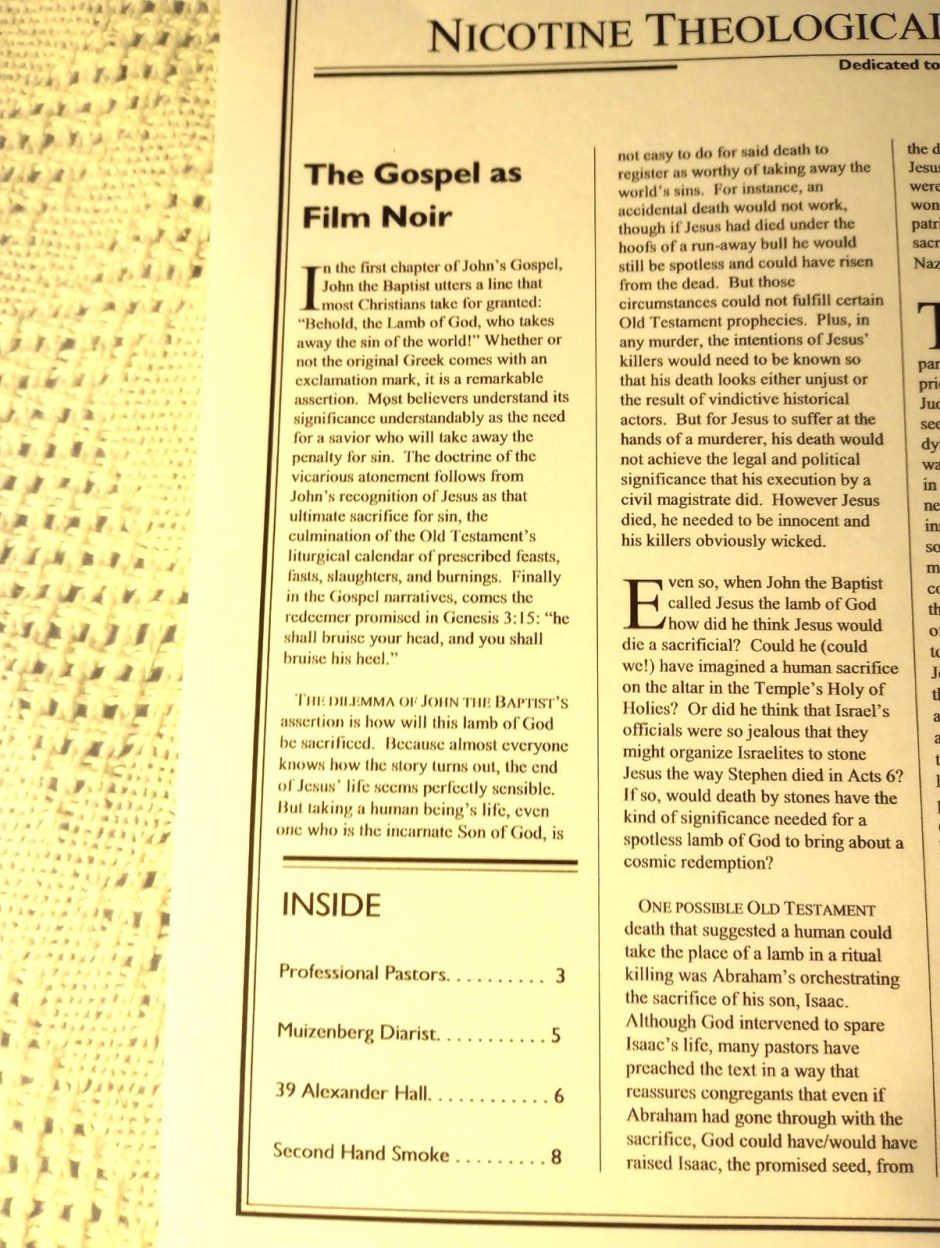
This is the third in a series of pieces – inspired by the PCA General Assembly assembling in Chattanooga – that appeared in the Spring 2010 issue of the Nicotine Theological Journal in light of the PCA’s approval of its Strategic Plan. This one comes from Wes White, who was then pastor at New Covenant Presbyterian Church in Spearfish, South Dakota.

Why I Voted “No”

How can you be against “civil conversations,” “more participation in General Assembly,” and “God’s global mission”? Many people have asked this question about the opponents of the PCA’s so-called SP. I believe that there are two ways in which we can view the PCA’s SP, either in the abstract, simply in terms of what the words say, or in the concrete in terms of what those who put the plan together actually want to accomplish. I think the latter way of viewing it is the more appropriate one, but, in either case, I would have voted “no” on every single point.

In the abstract, the SP may seem quite harmless. The problem is that we need to begin by asking, why do we need a strategic plan at all? What are we trying to accomplish? What the PCA calls “strategic planning” has been going on for a while. In the year 2000, the nine Coordinators of the Committees and Agencies of the PCA thought we needed a plan for the future. The result was a 24-person Strategic Planning Steering Committee. They reported at the 2003 GA with a booklet entitled Being Revived + Bringing Reformation. This report outlined the mission, vision, and strategic priorities of the committee.

The second phase of strategic planning began in 2004 with the re-constitution of the SP committee. Its task was three-fold: engaging ruling elders, preparing the next generation, and organizing resources to better serve our corporate mission. The re-constituted committee proposed to changes to church life. The first was the restructuring of General Assembly to limit parliamentary options on the floor of General Assembly and place a much greater emphasis on the committees of commissioners and especially the overtures committee. The second was the creation of the Cooperative Ministries Committee (CMC), a body where the various committees and agencies of the PCA could communicate with one another and “facilitate” further strategic planning. Both of these items were proposed at the 2005 General Assembly and passed at the 2006 General Assembly.

While I do believe that the changes to the PCA’s Rules of Assembly Operation (RAO) have been helpful, one thing is rather obvious. Little progress has been made on the major goals set forth by the 2004 committee. The proportion of Ruling to Teaching Elders is about the same as it was in 2006. The next generation is doing roughly the same thing as it was in 2006. Missions aren’t that much different either.

What have we really accomplished in these areas? Not much, it seems to me. What makes us think that this will be any different? We may feel good about passing these things, but I don’t see any evidence that it will make any difference.

One problem is that little to no research has assessed the perceived problems. In his talk to the Administrative Committee (AC), TE Bryan Chappell, president of Covenant Seminary and author of the informational part of the plan, noted that the number of candidates to the ministry had dropped from 599 in 2004 to 298 in 2008. I asked him in committee if anyone had conducted research to assess this drop. His answer was “no,” and, in his opinion, he didn’t think you could do research on who was not there, but he did suggested that the lack of civil conversations was responsible. This is precisely the problem. Until we figure out why these figures are the way they are, I do not know how good a plan can be. (By the way, in 2009, the numbers were back up to around 550 candidates for ministry. What happened? That would be a good study for strategic planners.)

In sum, I opposed this plan in the abstract because it will not accomplish anything. But two additional problems are worth mentioning.

First, the SP came to the floor in a way that was contrary to the RAO. The CMC cannot present anything directly to the General Assembly. According to 7.3.c. of the RAO, strategic planning must include matters that normally come under the work of our other committees and agencies. Any action must be presented through the “appropriate” committee, which clearly means the committee or agency that normally presents such matters to the Assembly. Instead, the CMC presented it all through the AC, even though the matters in the plan related to Covenant College and Seminary, Mission to North America, and other committees. This point was part of a protest against the Assembly’s action in passing the SP.

Second, the AC included a funding plan that basically involves of tax on congregations. They must pay and if they do not for one year, they will owe back taxes plus the current year’s assessment. They will also lose their vote at GA until the local church and all their pastors pay what they owe to AC. This funding scheme is being proposed through an amendment to Book of Church Order 14-1. The problem is that the amendment says that General Assembly may “require” contributions for the support of General Assembly; whereas, BCO 25:8 states, “The superior courts of the Church may receive monies or properties from a local church only by free and voluntary action of the latter.” The Amendment is contrary to other parts of the Constitution and should have been ruled out of order.

In the concrete, the trouble with the SP is that revisions to language at the Assembly may not actually change what the planners originally intended. I am not confident that CMC and AC have corrected for the errors of their first proposal.

For example, the first theme of the SP was “safe places.” They changed the wording to “civil conversations,” but does that really change what the authors intended when they wrote “safe places”? Moreover, in these safe places (and this is in the latest version of the SP), it says that one way that it will be safe is that there will be “nothing chargeable in this context.” This is clearly contrary to the discipline of the church.

Another example is the idea that our missions would focus on “Gospel eco-systems.” This is a term apparently invented by Tim Keller to describe his model for planting churches in “city centers.” According to the SP, this means not only planting PCA churches but that we will fund research on “how to multiply them beyond the PCA.” I believe that our goal should simply be to plant churches. We should do this wherever God leads us and not set a priority as to where we are to work. However, according to Tim Keller, “If you have an…effective, contextualized way of communicating the gospel and embodying the gospel for center city residents, you’re actually going to win large numbers of them, it’s just going to happen.” Thus, it should be the PCA’s priority to multiply Gospel eco-systems, since they are certain to work. The logic behind this model contradicts the sovereignty of the Holy Spirit.

It is interesting to note that one of the persons who spoke in favor of “God’s Global Mission” was a missionary to the Indians in northern Alberta, Canada. He argued passionately for the “global mission” part of the plan, and I appreciated much of what he said. However, he should realize that “Gospel eco-systems” was changed to “centers of influence.” Does he think that Atlanta will view northern Alberta as a “center of influence”?

So, of course, I am for God’s global mission but do not believe in Gospel eco-systems. I’m not interested in establishing “centers of influence.” I am interested in personal evangelism and church planting. I did not see that as an emphasis in this plan, and thus I voted against this whole section because it was clear to me that our “leaders” were leading us in a different direction.

Why did I vote against the SP? I voted against it because the SP lacks real strategy, because it was passed in a way that was contrary to our BCO and RAO, and because I do not agree with the priorities of those who put this plan together and who will be in charge of its implementation.

Son of The PCA Back in the Day

While American Presbyterians think more about Chattanooga than Tehran — thanks to the PCA General Assembly — here is the second installment from contributors to the Spring 2010 issue of the Nicotine Theological Journal on the denomination’s 2010 Strategic Plan.

This one comes from Lane Keister, who was then a PCA pastor serving in CRC and RCA congregations in North Dakota.

No doubt many in the upper echelons of the PCA were quite disturbed to find resistance to the ideas of the Strategic Plan (hereafter SP). After all, this was a plan designed to unify the denomination, and very little unification has happened as a result of this plan. Most of the action points of the plan passed with very significant minority opposition. Furthermore, the reasons for the majority vote were not always admirable. There were a fair number of people voting just in order to show confidence in the leadership, or because they liked certain people championing the cause of the plan. Many had not even read the plan. This tends to remind me of the way in which the government health care package was passed. In my opinion, this is a terrible way to do the business of the church. If people are going to go to General Assembly, they are responsible for knowing what is on the docket, and being prepared for the arguments, such that real debate can happen.

I was speaking with my brother-in-law, an OPC minister, and he mentioned that he had watched a good deal of the debate on the floor, and was frankly shocked at how little actual debate transpired. He immediately asked when we were going to arrive at our senses, and proceed to a delegated assembly (like the OPC). This point is profoundly relevant, since a great deal of the expenses that the Administrative Committee incurs have to do with the General Assembly, and one of the most controversial aspects of the SP was the funding proposal. There are too many delegates to have the GA at any regular church of the PCA, even our largest. The expense of renting a convention center in a major city is astronomical. Furthermore, the debates cannot be tight and to the point with so many delegates at the assembly. My brother-in-law added that the “debate” was little more than political posturing, with very little in the way of biblical, confessional, or church polity argumentation. This has been true of the PCA’s GA for many years now. Someone needs to propose a delegated model. The Administrative Committee no doubt needs to be funded (they foot the bills for the Standing Judicial Committee, among other things). However, it would lower expenses and allow for greater parity between the number of ruling and teaching elders conducting the church’s business. As Benjamin Shaw argued, the interests of the people who want “more seats at the table” (Shaw only mentions women, but probably this is true of the other groups mentioned; this certainly seems to be Shaw’s drift) would be served better by ruling elders than by teaching elders. Greater parity means they have a greater voice.

On the funding plan itself, I have been of two minds. On the one hand, Ligon Duncan’s arguments are very plausible. The Administrative Committee needs funding, and all too often, we have been going about things in a congregational way. On the other hand, critics who argue that the plan constitutes a violation of conscience have a point. Personally, I am not persuaded by the critics. Why would this arrangement violate a person’s conscience any more than the current registration fee does? The response is that the Administrative Committee is a denominational agency, and that we are setting a precedent by making funding of the hierarchy mandatory. This is plausible, but we still make funding of the denominational agency mandatory through registration fees for GA. This problem, again, would be alleviated through a delegated assembly. As many have said, connectionalism has to go both ways. It cannot only be a grass-roots movement from bottom up. Otherwise, we are just congregationalists with some Presbyterian tendencies.

Some of the more controversial wording of the SP was changed. Other NAPARC denominations will be happy to know that commissioners called early for eliminating language about leaving NAPARC (North American Presbyterian and Reformed Council). So also was the language that could implied a safe haven for heretics to propagate their errant views with no accountability. More “seats at the table” cannot be granted constitutionally, and so this language also dropped out.

I was pleased to see that the Northwest Georgia Presbytery’s proposal (calling for greater attention to the traditional ordinances) passed, although I was disconcerted to see that it did not function as a substitute for the SP. Very clearly, it was intended that way. The overture had everything to do with how one goes about doing God’s will in the church. Is it by some strategic plan, or is it by the means of grace God has instituted? So now the PCA has in effect said that we need the means of grace plus this strategic plan in order to succeed as a denomination.

Summer 2023 NTJ Available (pdf)

To repeat, this is not a typo. The Summer 2023 issue is now available at Oldlife.org. Huzzah? Maybe not.

In it, readers will find a case for shorter (8-10 years) pastorates as opposed to the increasingly common one of decades long tenures for pastors. Here is an excerpt:

In lengthy pastoral tenures a congregation becomes so comfortable with their minister (and vice versa) that the identity of the place has more to do with the people in this particular setting than with the denomination. Such a situation makes it harder to find a successor to the long-term pastor. A congregation might need to conduct a lengthy search to find that one person who has just the right gifts for this group of Christian. At that point, the congregation might well forget the nature of the ministry according to the common standards of the denomination. They might want “our guy” more than, for instance, a generic Presbyterian pastor who can do all the things that a man trained for the Reformed ministry is supposed to do. The congregation might forget what it means to belong to a certain communion because it functions largely within its own local context with its own pastor. A pastoral search could then depend more on personal qualities than on the demands of presbytery and the denomination’s corporate witness.

Conversely, expectations for relatively short pastorates, say from five to seven years, likely nurture a sense of belonging to a wider communion in which ideally all of the ministers should be able to serve in any congregation. Instead of building up a kind of co-dependency between minister and congregation thanks to a long tenure, a series of medium-term calls may encourage church members to deepen their membership in the broader communion beyond the congregation.

Spring 2023 NTJ Available (pdf)

The publishing plan – such as it is – is to make available recent issues (after three months) of the Nicotine Theological Journal to anyone by way of this website where a pdf will be posted. Subscribers (those who send an email address) will receive current issues as soon as they have been reformatted courtesy of Adobe’s wonder working powers.

Herewith is the Spring issue for 2023 — not a typo. That is why calling this a “publishing plan” could provoke snickers.

Summer 2023 NTJ (not a typo) Is Out

For those who have subscribed (simply by sending an email address), the Summer 2023 issue of the Nicotine Theological Journal is in their inbox. In that number readers will see the entire short piece that begins this way:

Idolatry in the Negative World

Aaron Renn says that American Christians now experience a culture that is hostile to the Christian faith in contrast to previous eras that either viewed Christianity positively or in which believing was neutral, neither offensive nor appealing. He argues the change came sometime around 2014.

Another change seems to have occurred that may say more about American Protestants than about the nation they inhabit. Somewhere in the mix of changing perceptions of American society and churches, conservative Protestants developed a different conception of sin. One sign of this change was a worship service recently broadcast from Moody Memorial Church in Chicago (Moody, of course, named after the urban evangelist, Dwight L. Moody). The broadcast included the prayer of confession. In it the pastor asked forgiveness on behalf of the congregation for desiring sex, money, and power.

That trilogy struck this listener as odd. . .

Reasons to Subscribe to the NTJ (other than sending an email address)

You might read something like this (from the Spring 2009 issue – a roundtable on the state of the Presbyterian Church in America):

Can This Marriage Be Saved?

Just to lay my cards on the table up front, I will admit that both my ecclesiastical background and my geographical location are very different from Mr. Dunahoo’s. Having been reared in megachurch evangelicalism in Southern California, and currently pastoring a PCA in the Seattle area, I have neither the broadness of perspective that Dunahoo enjoys, nor the memories of this denomination’s early days that he retains. Still, I’ll do my best to make some worthwhile remarks about the Presbyterian Church in America, both present and future.

Dunahoo lists five distinct groups within the PCA. In my four years as a member of the Pacific Northwest Presbytery, I can identify groups 1 and 2 (the “Reformed Fundamentalists” and the “Reformed Evangelicals”) in this neck of the ecclesiastical woods. That’s not to say the others don’t exist elsewhere, but as I said, my experience is limited to the fringe of the movement (“fringe” being used literally with respect to my presbytery’s location, and perhaps metaphorically with respect to its self-perception. More on this below). Now although I balk at the label affixed to me by Dunahoo (I happen to think of “Fundamentalist” as rather antithetical to “Reformed”), I do consider myself to fit squarely into his first category. I believe the Westminster Confession and Catechisms to be the most faithful articulation of biblical truth, and I believe that it is my calling and duty as a minister to expound Holy Scripture through the lens of the doctrinal standards to which I have submitted myself.

I would venture to say that Dunahoo’s second group, the Reformed Evangelicals, is the largest subgroup within the PCA. I may be wrong about this, but my excuse for such misperception is that the denomination’s official publications, as well as its seminary, all seem to presuppose the missional model, with hardly a paragraph being written in their literature that doesn’t remind the reader to redeem this or transform that. Words like “contextual” and “incarnational” are nearly as important in church planting circles as the phrases “Word and sacraments” or “the ordinary means of grace.” Apparently, word, water, and wine are all well and good provided they’re dispensed with sufficient cultural exegesis and social sensitivity. But I digress.

What I do find refreshing about Dunahoo’s perspective is, well, its perspective. In other words, he doesn’t simply draw a circle around himself and his friends and act as if there is no one else in the denomination besides his own subgroup. The reason I mention this is that I know what it is like to be treated like a virtual alien simply because I haven’t drunk the contextual Kool-Aid. I still feel the sting from the lashing I received at the PCA’s Church Planters’ Assessment when, in a certain exercise, I dared use the word “covenantal” while giving a mock church planting presentation to a pretend presbytery. Apparently it is a cardinal sin to assume that presbyters in the PCA understand the nomenclature used in chapter seven of the Westminster Confession (I’m not bitter anymore, really). My point here is that the sooner the confessionalists and transformationists (or, groups 1 and 2) recognize each other’s existence, the better. True, the two may never become one, but at least they’ll realize they are shacked up as roommates in the same house.

In the Pacific Northwest Presbytery where I am a member, the line dividing the Reformed Fundamentalists from, well, everyone else was recently made painfully apparent. At our stated meeting in October 2007, Rev. Peter Leithart and I jointly requested that presbytery appoint a study committee to evaluate Leithart’s Federal Visionist views and compare them with the Westminster Confession, with a particular emphasis on the nine “Declarations” of the previous summer’s General Assembly report on Federal Vision theology more broadly. The committee ended up split 4-3, with the majority concluding that Leithart’s views, though at times confusing and unhelpful, were nonetheless within the bounds of confessional orthodoxy, while the minority (of which I was a part) found his views to strike at the vitals of the Reformed system of doctrine.

When we met a year later to present the reports, the debate on the floor of presbytery was rather telling (to say the least) in that it largely ignored the narrow issues that the committee was charged to address and focused instead on the larger (and, strictly speaking, irrelevant) question, “What is the PCA?” The concerns voiced were primarily focused on self-identity instead of whether Leithart’s theology was Reformed or not. The greatest fear on the part of the members of presbytery was that by voting to depose one of our own we’d become, well, like the OPC. In other words, we already represent a mere fraction of Christian believers anyway, and now, by defrocking everyone who fails to cross their t’s and dot there i’s the way we’d like them to, we will just paint an even smaller circle around ourselves, eventually paling into utter obscurity and irrelevance.

It seems to me that the events of the Pacific Northwest Presbytery’s October 2008 meeting demonstrate, albeit microcosmically, the identity crisis of the PCA as a whole. As the “A” in our name would seem to suggest, we are perhaps unduly fixated on being big, noteworthy, and successful, and whatever stands in the way of such success must be viewed with a measure of suspicion. Hence the ho-hum attitude on the part of Dunahoo’s “Reformed Evangelicals” towards a simple, ordinary-means-of-grace ministry that dismisses the fanfare and obsession with how many artists show up at our wine- and cheese-tasting soirees, and gives attention rather to preaching Christ and administrating the Supper each Lord’s Day. As much as the OPC’s obvious irrelevance (ahem) stands as an ominous warning to the movers and shakers at Covenant Seminary and sends chills down the collective spine of the powers that be in Atlanta, the fact is that our older cousin, though a runt in the Presbyterian litter, enjoys the freedom of Mere Presbyterianism to a degree that the PCA cannot (at least not as long as we’re pining for the approval of the artsy-fartsy, the bohemian, the indy, and the soul-patched).

Not being prone to prognostication, I am loath to guess where the rocky marriage between the confessionalists and transformationists will take the PCA. If Tim Keller’s work with the Gospel Coalition is any indication, it is at least possible that the Reformed Evangelicals will continue to value cultural engagement and renewal more highly than confessional exactitude, perhaps to the point of secession. Or to look at it from the other direction, if the so-called Reformed Fundamentalists continue to be made to feel hopelessly irrelevant and out of touch when we settle for a Sabbath-oriented, means-of-grace-driven piety, a withdrawal could potentially occur. Then again, we could just continue with the live-and-let-live, quasi-congregationalism that we now enjoy, according to which I can be left alone to don my Geneva gown on Sunday provided I don’t hassle the PCA pastor in the next town over for using multimedia and drama to reach the “teenz.”

But either way, the Emergents are certainly right about one thing: the church, if not a mess, is nonetheless messy.

Jason Stellman is pastor of Exile Presbyterian Church (PCA) in Woodinville, Washington.

The Latest Issue of the Nicotine Theological Journal

If you would like to receive the entire issue, contact me on X @oldlife or via email and I will send a PDF. Here’s the introduction of the lead article by R. Scott Clark:

The Origins of 2-K Political Theology

Since David VanDrunen published, in 2010, the first volume in what has become a series of important volumes, Natural Law and the Two Kingdoms: A Study in the Development of Reformed Social Thought, Emory University Studies in Law and Religion (Grand Rapids: Eerdmans, 2010), there has been a certain degree of controversy in some quarters of the confessional Reformed world over the recovery of the “two kingdoms” as a way of thinking about Christ and culture and ethics. The qualifier some is important here because anyone who knows the history of Reformed theology knows that faithful, confessional theologians have been speaking of God’s “twofold government” (duplex regimen and duplex regnum) or “two kingdoms” since the 16th century. It is not a novelty but so divorced are enough contemporary Reformed Christians from their own tradition and heritage that when this way of speaking re-surfaced in 2010 it was taken, in some quarters as a radical departure from Reformed theology.

Why The Controversy?

That reaction, in some quarters, is part of a pattern. Because of the sad state of confessional Reformed covenant theology in the 20th century, when Richard Muller and others in his wake began to re-appropriate the historic Reformed way of distinguishing between theology as God knows it and theology as God has given us to know it, it was denounced as Barthian by one scholar (who should have known better). When some began to try to resurrect the teaching of, e.g., Zacharias Ursinus (1534–83) and the Westminster Divines (see WCF 7.2) on the prelapsarian (pre-fall) covenant of works, it was ridiculed as a deformation of Reformed theology. Similar reactions happened when some scholars began to try to recover the historic Reformed doctrine of the pre-temporal covenant of redemption, e.g., David VanDrunen and R. Scott Clark, “The Covenant Before the Covenants,” in R. Scott Clark ed., Covenant, Justification, and Pastoral Ministry (Phillipsburg: P&R Publishing, 2007). When some contemporary Reformed writers and historians began writing about and advocating the historic pan-Protestant (including the Reformed) distinction between law and gospel they were denounced as “antinomians” and “Lutherans.” E.g., some of the reviews and reactions to R. Scott Clark, “Letter and Spirit: Law and Gospel in Reformed Preaching,” in Clark, ed., Covenant, Justification, and Pastoral Ministry. These are analogous cases illustrating the decay of historic Reformed theology in the twentieth century. Doctrines which were nigh-well universally held and taught in the classical period of Reformed theology, when uncovered and dusted off in the late 20th and early 21st centuries were regarded with suspicion. For more on the project of recovery of the older Reformed theology, see R. Scott Clark, Recovering the Reformed Confession (Phillipsburg: P&R Publishing, 2008). . . .

Just Grow Up

From the Archives: Nicotine Theological Journal (January, 1999)

Just Grow Up

A recent visit to Yale, complete with watching a Yale-Princeton hockey game, reminded us of the suffocating ubiquity of post-1950s popular culture. Being some twenty years removed from college life it was curious to see Yale undergraduates participating in the rah-rah spirit that college students of our generation studiously avoided in the name of being independently cool. Even more surprising was to see the overwhelming support for the Yale band, an extracurricular activity that certain boomers associated with losers and nerds. But here we were, in 1998, watching kids supposedly indoctrinated in the dogma of political correctness and postmodernism not just playing in but singing along with the band. Perhaps even more remarkable was that these nineteen- and twenty-year olds knew the words to the songs the band played. The Rolling Stones, the Beatles and Credence Clearwater Revival – it didn’t matter. These students sang along. The scene was almost surreal. These college students were joining in the singing of music that in our generation was supposed to be a pronounced statement against joining anything. Of course, one of the great myths of popular culture is that of the solitary individual who does his own thing, even while two-thirds of the teenage population are doing exactly the same thing.

BUT ASIDE FROM REVEALING the conformist side of pop culture’s individualism, this scene also spoke volumes about the triumph of rock ‘n roll. Who could have imagined college students in the 1960s and 1970s singing with the college band to popular songs three decades old? Would any of us have known the words to the songs of Frank Sinatra or the Andrews Sisters? So why then won’t John, Paul, Ringo and Mick just go away? Perhaps, an even more pressing question is why people are not embarrassed to continue to live like teenagers even when they are in their forties and fifties?

One way of considering this question is to contrast the Rolling Stones’ relatively recent tour (lots of 1970s bands are doing retrospective treks, we understand) with what Frank Sinatra did for almost all of his life and with what Tony Bennett continues to do – that is, sing the songs that made them stars. It was not the least embarrassing for Sinatra to sing his kind of music because it was and is adult (don’t ask for a definition; it’s like pornography). It may not be Mozart or Vaughn Williams, but the way of singing, combined with the ethos such songs create, do not require listeners or adoring fans to act like teenagers. In other words, no one thought Frank silly singing his songs into his eighties. The same cannot be said for Mick Jagger. In fact, one cannot think of a more laughable sight than a man who is a grandfather acting like he is still the high-school deviant whose only care seems to be questioning all forms of authority.

WHICH RAISES A FURTHER question – why the triumph of rock ‘n roll in most sectors of Christian worship? Why has perpetually adolescent music become appropriate for expressing praise and adoration to the God of Abraham, Isaac and Jacob? This is not to suggest that ballads like those made popular by Sinatra would be fitting. Our preference runs to the Psalms of the Old Testament set to tunes that are either singable by all generations or chanted. But the triumph of rock ‘n roll, whether soft or not, seems to run contrary to the apostle Paul’s instructions in Titus where he told older men to be temperate, serious, and sensible, and older women to be sensible, chaste, and domestic. If this is indeed conduct fitting sound doctrine, in fact, if gravity and self-control are virtues that sound doctrine is supposed to produce, then why has Christian worship become the arena where the musical forms of the Stones, Beatles and CCR, already domesticated, are now baptized?

Of course, our culture has many problems, but it does not say good things about our churches that by failing to see any difference between serious and frivolous music they are also in danger of losing the ability to distinguish adolescence from maturity. Of course, churches who follow the lead of pop culture may become as mainstream and as ubiquitous as the Stones, but they are likely to look just as silly when they turn fifty.

The Last Time a Pope Died (II)

From the October 2005 issue of the Nicotine Theological Journal

Where’s the Pope?

The question of pope John Paul II’s present location is, to say the least, a controversial one, not so much between Protestants and Roman Catholics as among Protestants. Has his soul been “made perfect in holiness and immediately pass(ed) into glory” while his body “being still united to Christ – rests in (its) (grave) till the resurrection”? (WSC 37). Or, has his soul been “cast into hell, where (he) remain(s) in torments and utter darkness, reserved to the judgment of the great day”? (WCF 32.1) We are shut up to these two possibilities because “Besides these two places, for souls separated from their bodies, the Scripture acknowledgeth none” (WCF 32.1).

Even to entertain the possibility that the pope is not in heaven can get you fired. Pittsburgh Christian talk radio host (WORD- 101.5FM) Marty Mintor found that out on Friday, April 8, when he was called into general manager Chuck Gratner’s office after his 3:00 to 6:00 P.M. show and told he was being let go. His offense? Innocuous enough. In response to a caller’s question about whether the pope was in heaven, he said that many evangelical Christians believe that one must be a “born-again believer” to go to heaven, but added that “the question of whether a person is born again is something personal, something between an individual and the Creator.” He also “made it clear that the discussion was not an attack on the character of the pope but, rather, a look at the teachings — not only of John Paul, but the Catholic Church in general.” No Knox or Calvin (or Ian Paisley or Bob Jones) he. But he had to go because he was “alienating the listeners.” Gratner said, “We ended our relationship” with Mintor because of differences in how he conducted his show. WORD-FM needs to function in this city in support of the entire church — that means everybody — and not focus on “denominational issues.”

One must resist the temptation to engage Mr. Mintor and Mr. Gratner’s soteriology and ecclesiology, which reflect much that is wrong with evangelicalism, and confine oneself to the fact that these two evangelicals disagreed about whether one could, as a talk radio host, even allow for the possibility that the pope is not in heaven. Not even Al Mohler, for all his excellent analysis of the pope’s and the Church’s errors, noting that John Paul II was a vigorous proponent of the cult of Mary and that he taught that the work of Christ made up for what was lacking in human merit and that he rejected justification by faith, could summon up the strength to say, “The pope, having held these errors, is not in heaven.”

Of course, in one sense no one can know with absolute certainty about anyone’s eternal destiny. We must of necessity leave those ultimate judgments in the hands of an all-knowing God. Nevertheless, we as individuals do make such measured judgments. (Anybody uncomfortable with saying that Hitler is in hell and that Calvin is in heaven?) And the church is given the power of the keys by which she excludes or includes in the kingdom of heaven applying, the standards given by the king of the church.

In my Presbyterian denomination we have standards of admission into membership in the visible church (“out of which there is no ordinary possibility of salvation”) that are consistent with historic Presbyterianism’s commitment to exclude from the church none that Christ includes. Thus we ask for a credible profession of faith. We do not claim that all who make credible professions will be in heaven (we are fallible even in the use of our lawful powers), but we do treat them as such so long as they are communicants in good standing (their professions remain credible). Moreover, we do not regard as unbelievers those who are members of erring churches of Christ. Again, it is the gospel (whether the church is evangelical) and the credible profession (communicants in good standing) that determine whom we invite to share in the common Table of our Lord.

Now a simple question: could the pope have been received into a Presbyterian church holding to the historic Reformed standards of communicant membership? Could he have been invited to the Lord’s Table (where the Lord Himself welcomes and feeds His people) in a Presbyterian church practicing the Reformed fencing of table? Hence, if we regard as heaven-bound those whom we receive into communicant membership and those whom other evangelical churches receive, then do we not regard the others to be, so far as we know, hell-bound? When we apply the liberal and charitable standards by which Presbyterian churches have judged who are Christians, the pope was not one. He did not “acknowledge himself to be a sinner in the sight of God justly deserving his displeasure and without hope save in his sovereign mercy.” He did not “acknowledge Jesus Christ to be the son of God and Savior of sinners and receive and rest upon him alone as he is offered in the Gospel.” He held no membership in an evangelical church on earth.

He was a good man, a courageous man, a pious man, an admirable man, a man who did much good in his lifetime. But do we not agree that such things are not sufficient to make one acceptable to God? Do we not still believe “nothing in my hand I bring, simply to thy cross I cling”? Do we not still believe that a man is justified by faith apart from all human righteousness, or devotion, accomplishment?

A little Protestant girl and a little Roman Catholic boy found themselves walking together toward their homes wearing their Sunday best (yes, I know that is now a meaningless description, but bear with me). They came to a low spot in the road where spring rains had partially flooded the road. There was no way that they could get across to the other side without getting wet. “If I get my new Sunday dress wet my Mom’s going to skin me alive,” said the little girl. “My Mom’ll tan my hide too if I get my new Sunday suit wet,” replied the little boy. “I tell you what I think I’ll do,” said the little girl. “I’m gonna pull off all my clothes and hold them over my head and wade across.” “That’s a good idea,” replied the little boy. “I’m going to do the same thing with my suit.”

So they both undressed and waded across to the other side without getting their clothes wet. They were standing there in the sun waiting to drip dry before putting their clothes back on when the little boy finally remarked, “You know, I never did realize before just how much difference there really is between a Protestant and a Catholic.” Yep. I wish the pope were in heaven, but I have reasons for fearing otherwise.

William H. Smith is a minister in the Presbyterian Church in America

Sectarians All (NTJ April 1998)

(The Fall 2022 issue is in production.)

SUPPOSE A HISTORY PROFESSOR at an evangelical liberal arts college were teaching a course on American church history. His course did not follow the world religions approach but instead covered the religious traditions most numerous and most influential in America (though those are not synonymous) and so slanted the course to Protestants, Catholics and Jews. For the final exam the professor asked students to describe the teaching and practice of the average observant Catholic before Vatican II. If a student answered the question by ignoring Roman Catholic worship (the Mass), customs (fish on Fridays) , institutions (parochial schools), and teaching on justification, but answered instead with a description of an Irish immigrant in Boston who bucked the repressive pedagogy of local nuns, complained about never understanding the Mass, then went to Boston University, joined InterVarsity, attended Park Street Church, and read his Protestant Bible daily during his “quiet time,” should the professor give the student a passing grade? Such an answer would not be surprising given the historic anti-Catholic bias among Anglo-American Protestants. But wouldn’t the professor be delinquent in his duties as a professor of history to approve such an answer? In other words, is it possible for a Protestant to hold that a Catholic is “good” even if he believes his practices idolatrous?

LET’S TAKE ANOTHER EXAMPLE. This one from real life. J.I. Packer was one of the original Protestant signers of “Evangelicals and Catholics Together,” the first statement (1994) that called for a joint mission of Roman Catholics and evangelical Protestants in a limited number of endeavors. In an article he wrote explaining his decision (Christianity Today, Dec. 12, 1994), Packer applied the very language of “good Catholic” to those with whom Protestants ought to cooperate. Now Packer does not spell out exactly what such a good Catholic looks like. But the reasons he gives for not being able to become a Roman Catholic are helpful. For instance, Rome has a “flawed” understanding of the church, its sacramental theology “cuts across” the Pauline doctrine of justification by faith, the “Mary cult,” the doctrine of purgatory, and the “disbursing” of indulgences all “damp down” biblical teaching about assurance of salvation. What is more, papal claims to infallibility make the “self-correction” of the church impossible. So the communion of Rome is still “unacceptable” to Packer. But the Catholics who are willing to sign a declaration with Packer, despite his reservations and objections, are “good” Catholics. These Catholics most likely are ones who do not observe the faith in ways that Packer deems flawed or, at least, are not strict about them. Ironically, then, Packer’s assessment of Catholicism should fail to earn an A-grade on an undergraduate American church history final exam but is supposed to be persuasive to evangelical Protestants and Roman Catholics as the first step in ecumenicity.

WHY DOESN’T SUCH AN understanding of Catholicism earn the strong rebukes of condescension and paternalism? Isn’t Packer saying, in effect, that a good Catholic is one who has given up distinctively Catholic teachings and practice? What is more, why isn’t Packer criticized for harboring the kind of anti-Catholic sentiments that used to inform America’s progressive reformers who desired the assimilation of all immigrants to the United States into WASP culture? Liberal Protestants have a long history of including Roman Catholics at their gatherings and institutions who resemble themselves, that is, believers who have given up the more particular aspects of their tradition in order to fit in to American Protestant norms. That kind of treatment used to be called “illiberal” by Roman Catholics, such as when John Gilmary Shea in the 1880s accused the Puritan tradition of being “narrow-minded, tyrannical, and intolerant” of those who “refused to submit to their ruling.” But now, thanks to the wonders of modern ecumenism, Catholics who are not concerned about Rome’s historic teachings and practice are considered “good.”

THE POINT HERE IS NOT SO much the problems of recent Catholic and evangelical statements (though we do dissent from those affirmations). Rather our concern is with the understanding of religious traditions and their truth claims that undergirds not simply such statements as “Evangelicals and Catholics Together” but also Bible-only evangelicalism, New Life Presbyterianism, and proponents of “mere Christianity.” Underneath all of these expressions of Christian faith is, it seems to us, is the Enlightenment’s hostility to tradition, history, and particularity.

This an especially important concern to the editors of the NTJ because we have been accused of narrowness, rigidity, and sectarianism in our effort to defend not simply the theological truths of the Reformed creeds and confessions (specifically the Westminster Standards) but also the Reformed practices articulated in our creedal statements. In other words, from Packer’s perspective, or that of the evangelical undergraduate, we here at the NTJ are “bad” Presbyterians because we are unwilling to let go of such practices as Reformed liturgy (it does exist — just see Evelyn Underhill’s discussion in Worship [1937]), the sanctification of the Lord’s Day, Reformed sacramental theology, Presbyterian polity, and the avoidance of the liturgical calendar. We feel like ethnic Americans who are being forced to assimilate to the demands of a melting-pot Christianity. If we retain our distinctive ways we will be un-American or, worse, Amish.

ON THE ONE HAND, OUR CLAIMS are very modest and have to do with the simple methods used by historians (when not under the influence of modern literary theory that turns the meaning of words into jello). Presbyterianism may be historically defined as arising at a particular time and standing for certain convictions (predestination) and practices (infant baptism). Like it or not, the first proponents of any group, whether religious, political, or educational, set the standards for all who will follow in their name. So, if a later group bearing the name Presbyterian no longer believes in predestination and no longer baptizes their infants, do we still call them Presbyterian, or might we conclude that something akin to denial or stupidity is underway? The same goes for Agrarians or Unitarians. If someone claims to be an Agrarian and yet promotes the Internet and invests heavily in Texaco, calling into question his claim would not be irresponsible. Or if you find a Unitarian who believes Jesus Christ is the second person of the Trinity we might have some reasonable justification for concluding this person has departed from the teaching of William Ellery Channing, no matter how much we might be heartened by the expression of orthodox belief. In other words, tradition in a historical sense matters for Protestants as much as it does for Catholics. We may not believe in a magisterium but we do believe that Protestants may not rewrite the past.

ON THE OTHER HAND, WE WANT to make the immodest claim that the doctrine of sola scriptura is dangerous and not a separate doctrine in the Reformed tradition. By this we do not mean that we deny what the Westminster Confession says (and what was the formal principle of the Reformation) that “the Supreme Judge, by which all controversies of religion are to be determined” is “the Holy Spirit speaking in Scripture.” Our problem is with those who isolate the doctrine of sola scriptura from all other doctrines, as if the Bible exists without any interpretation, or apart from all confessional or creedal statements. In other words, we deny the biblicism that often masquerades under the banner of “the Bible only.” Technically speaking, which is the way the proof-text-approach to the Bible usually runs, “the Bible only” will not give us the Bible only since Scripture itself does not list its own table of contents. This means that even sola scriptura requires some human effort and interpretation. That is why Zacharis Ursinus wanted the Heidelberg Catechism bound at the front of Bibles published for the laity, and why the Geneva Bible came with notes (not unlike the NIV Bible for Women). Proponents of “the Bible only” want to protect God’s word from human hands, and so want to avoid going through any human tradition before arriving at the pure teaching of Scripture. But such a desire for a direct communication from God, which “the Bible only” appears to give, will not settle what the Bible only means. As George Marsden remarked several years ago, the doctrine of inerrancy might preserve the authority of the Bible but it could not even settle the question of the Trinity since, for example, some nineteenth-century Unitarians believed an inerrant Bible revealed an Arian Christ.

CHRISTIAN HISTORY IS littered with Protestant groups who have pitted the Bible against man-made creeds. Pietism was arguably the first to do serious damage to the necessity of confessions for the health of the church. Pietists argued that the gospel had atrophied and died because the doctrinal precision advocated by scholastics extinguished real piety. They also believed that bickering over church polity had vitiated the body of Christ, and that ritualism and clericalism were stifling worship. “Back to the Bible” became the pietist slogan (and continues to be a reliable index to extant Pietists). As James Tunstead Burtchaell observes in a forthcoming book on Christian higher education in America, “by turning from the cumulative tradition of biblical commentaries, symbolic definitions and theological disputation, and by drawing upon Scripture as a basis for doctrine and morality, the adherents of reform did not successfully set aside the thoughts of man in favor of the thoughts of God” (as if such a Gnostic denial of creation is ever possible by creatures). Instead, Pietists “simply exchanged the agenda of the sages of the past for the agenda of the preachers of the present.” Untethered to the wisdom of the past, Pietism quickly degenerated – SURPRISE! – into rationalism, which is simply another tradition, but one which interprets the Bible according to the lights of what is reasonable and responsible, rather than one cultivated and sustained by an interpretive community (i.e. the church). According to Burtchaell, “Pietism was surely not an early, soft variant of the heathen gentility of the later rationalism which followed close upon it, but there was a kinship between them.” Pietism and rationalism both “deplored the confessional particularities of the churches, referring to them contemptuously as ‘sectarian.’”

Church history of full of the same pattern. The no-creed-but-the-Bible mentality that Nathan O. Hatch documents so well (Democratization of American Christianity) within two or three generations gave way to liberal Protestantism. Conservative Protestants are prone to think that liberal Protestants were wicked men who drank, danced, chewed and denied Christ and the Bible openly. But much like evangelicals, Protestant liberals were guardians of middle-class respectability and morality. What is more, they gained considerable leverage against their confessional rivals by trumpeting the slogans of “Back to Christ” and “Back to the Bible.” This genteel variety of primitivism (Pentecostalism was a less genteel form) not only freed liberal Protestants from the creeds to which they had subscribed but also gave room to maneuver in the wider world of modern science and learning. Gone was the Christ of Chalcedon and the imputation of Christ’s righteousness. In their place came the Christ who stood at the apex of evolutionary development and the righteousness secured by following Christ’s Golden Rule.

AMERICAN PRESBYTERIANS have been big suckers for Bible-onlyism because of their embrace of the Enlightenment. Unlike their counterparts in the Netherlands, American Calvinists developed no anti-revolutionary ideology. They not only endorsed Enlightenment politics when advocating the valuable principle of limited government. But in the euphoria of the American Revolution, a revolt inspired by the Enlightenment (of a the moderate Scottish sort), Presbyterian clergy also endorsed an Enlightenment view of history. According to the American Protestant reading of Christian history the Reformation was a forerunner to the Enlightenment; both Protestantism and science were responsible for dispelling ignorance, superstition, bigotry and intolerance and for advancing the cause of truth, reason, knowledge and progress. In this unfolding of western civilization, Catholicism, which was responsible for the “Dark Ages,” was the villain. For that reason, American Protestants had no trouble including a tepid version of their religion in public schools but objected vigorously to either parochial schools receiving tax funds or granting Catholics privileges in the common school. In The Soul of the American University George Marsden identifies this outlook as “the Whig Ideal.” Protestantism was synonymous with “the advances of civilization and the cause of freedom,” that is, freedom not only for civil liberty but also for scientific inquiry. In contrast, Catholicism “represented absolutism, suppression of individual development, and suppression of free inquiry.”

UP TO THE FUNDAMENTALIST controversy confessional Presbyterians perpetuated this Whig outlook. But thanks to contacts with Dutch Calvinists, who knew the downside of enlightened politics, and owing to the leaven of Cornelius Van Til’s apologetics, conservative Presbyterians and some evangelicals saw the incompatibility between the Enlightenment ideal of autonomous inquiry and the Christian notion of submission to revealed truth. It became much easier to admit that “nothing is neutral.” The lone natural scientist or scholar, many conceded, was just as prone to a prejudiced reading of the facts as any cleric, Roman Catholic or not.

STILL, THE ENLIGHTENMENT lives on. Van Til’s insights about presuppositions and the bias of the human heart have only penetrated so far into the American Presbyterian brain. Some Van Tillians continue to appeal to the doctrine of sola scriptura in Whig fashion and pit traditionalism (i.e. “rigid” and “sectarian” adherence to the Presbyterian creeds and directories for worship) against the Bible only. It is as if once the mysterious work of the Holy Spirit has regenerated the blind and prejudiced human heart the regenerated individual, in autonomous and rational fashion, can plumb the depths of the Bible and do so free from the prejudice and bigotry of strict subscription. So much for the contamination of the human soul that continues after conversion.

Even worse, so much for the naivete, blindness and pride of the Enlightenment’s faith in reason and the possibility of arriving at objective, global, cosmopolitan truths to which everyone in the world agrees once the right methods of inquiry have been adopted. Some Van Tillians make it seem that once the switch of regeneration is flicked on everyone who picks up the Bible will read it the same way. Which is another way of denying the history of the Christian church in all its variety and the claims of all those professing Christians throughout the ages who believe they are biblical. The Bible-only approach, in good Enlightenment fashion, presumes the possibility of escaping all the prejudice, bigotry and darkness of the past and arriving at an unprejudiced understanding of the Christian religion. In effect, nothing is neutral except for the Bible, which is an ironic twist considering how divisive the Bible is compared to the homogenous assessment given by some conservative Presbyterians to such human sciences crying out for Christian interpretation as history, chemistry and even politics. And without the aid of the past the regenerated individual may now sit down with his Bible alone (no notes, please) and figure out the two natures of Christ, the bondage of the will, the nature of the atonement, and the imputation of Adam’s sin, for starters.

OF COURSE, ONE PROBLEM WITH the anti-traditionalist outlook of “no creed but the Bible” is that it is itself an interpretive tradition. The desire to return to a pure gospel unadulterated by creeds or human authorities is about 300 years old and has demonstrated a remarkable consistency through the years. But because of Bible-only Christians’ hostility to tradition they can’t spot the one they follow. The result is an uncritical and unaware outline that functions as trump in any card-game of rival traditions. According to Bible-only logic, if it comes from man then it can’t come from God and so must be a tradition. Never mind that God sets up men with legitimate authority to rule over others, such as those found in the visible church. The Westminster Divines are just as fallible as the Pope and so must not be obeyed uncritically, an interesting and no doubt uncomfortable position for anyone who has subscribed to the Westminster Standards.

The other problem is that Bible-onlyism never delivers what it promises. It is supposed to provide an unprejudiced reading of the Bible that will unite all true believers on the essentials of the faith. Does it not seem a tad audacious and perhaps a bit prejudicial for some individuals, freed from the interpretive constraints of ecclesiastical accountability, to sit down and determine just what is essential in the Bible? Where would we find those essentials? In the Epistle to Jude or maybe one of the Synoptic Gospels? Isn’t this exactly what Marcion and Thomas Jefferson had in mind when they cut and pasted the Bible according to their understanding of what was essential and genuine? Aside from its audaciousness, the effort of Bible-only believers to arrive at a “mere” expression of the gospel nurtures its own form of rigidity, narrowness and intolerance. The inclusive center is never sufficiently broad to include Mormons and Unitarians, suggesting that some intolerance is worthwhile. Meanwhile, the Bible- only creed excludes those believers whom professors of history might describe as “good” Presbyterians, “good” Lutherans, “good” Anglicans, “good” Catholics, and, yes, “good” Amish. When liberal Protestants told fundamentalists that all Christians were one in the Lord, Walter Lippmann observed that the liberal approach was akin to telling fundamentalists, “smile and commit suicide.” Which only proves the rule that those who live by the ideals of tolerance and sensitivity are generally intolerant and insensitive. Or to borrow Richard John Neuhaus’ rule, when orthodoxy is optional, orthodoxy is soon proscribed.

The Bible never exists, then, in an “only” state. It must always be interpreted. At which point the interpretation of the “Bible only” needs to be held up against the Bible as interpreted by the various Christian communions. But the Bible as understood by those communions, we believe, will always be superior to the interpretive strategy of the Bible-only Christians because the former recognize the importance and necessity of the visible church while the latter places all authority and wisdom in the autonomous individual. Though liberal economic and political thought lauds the virtues of the individual, Christians who confess the doctrine of original sin should be wary of modernity’s handling of ancient texts. Christ gave to his people the church and her ministry for a reason, not simply to edify but also to restrain. The church is necessary for rightly understanding the Bible. Despite her divided state, she is an interpretive community that checks and balances the excesses of private interpretations (including Quiet Times). This may sound like a Roman Catholic sentiment. We would deny this. We still believe that churches err and have erred. And we believe that the Bible is the place to go to resolve religious controversies. Quoting the Shorter Catechism will not. But this does not mean that each generation has to start from scratch, as if the history of the church, her controversies, her various creeds and varying communions do not exist. Nor does it mean that the church as an interpretive community has no authority because it is human while the Bible is divine. As the Confession of Faith puts it, the “decrees and determinations” of the church should be received with “reverence and submission” not simply because they agree with the Bible but also because the “power” of the church is “an ordinance of God, appointed thereunto in his word” (31.ii).

IN THE END THE CHOICE IS not between the Bible and tradition. Rather it is between traditions accountable to the visible church or those of either individualistic (e.g. private) or parachurch origins. We can never escape tradition, the dogma of the Enlightenment to the contrary. So which will it be, the Bible interpreted self-consciously by communions shaped by the history of the Christian church, or the Bible as understood by collections of autonomous individuals being swept along by the flood of Enlightenment innocence? Which is better, an observant Catholic or a “Bible-only” Protestant? As much as we disagree with Rome and as rigidly Presbyterian as we are, we will take our chances with Packer’s “bad” Catholics any day. At least with them we can agree to disagree. But with creedless Protestants, whether evangelical or liberal, we will always be disagreeably forced to agree.