Eschatology Matters

Neo-Calvinists share with theonomists a post-millennial outlook. David Koyzis illustrates:

Yet the call to holiness and to living for the kingdom is as extensive as creation itself. Farmers, manufacturers, labour union stewards, musicians, artists, journalists, electricians and sewage line workers are not obviously preaching the gospel or attempting social reform. Yet if they are in Christ, they are agents of his kingdom in every walk of life.

It is telling that the authors of the statement neglect the eschatological dimension of the faith. Eschatology, or the doctrine of the last things, is not a mere add-on to our Christian walk. Rather, it gives us direction for the future. At the end of the present age are we to be removed from this world to spend eternity in a blissful ethereal realm of floating spirits? Or will the whole creation be renewed when Christ returns? Perhaps the authors are not in agreement on this, which could account for their silence. Nevertheless, the Bible itself is not so reticent: “For we know that the whole creation has been groaning together in the pains of childbirth until now. And not only the creation, but we ourselves, who have the firstfruits of the Spirit, groan inwardly as we wait eagerly for adoption as sons, the redemption of our bodies” (Romans 8:22-24). “For in him [Jesus Christ] all the fullness of God was pleased to dwell, and through him to reconcile to himself all things, whether on earth or in heaven, making peace by the blood of his cross” (Colossians 1:19-20). “And he who sat upon the throne said, ‘Behold, I make all things new'” (Revelation 21:5, emphases mine).

We live in the hope of the resurrection of the dead in a renewed creation, which awaits its final fulfilment at Christ’s return. In the meantime we are heirs of this promise in everything we do in God’s world.

That quotation has the classic marks of neo-Calvinism, a view of the kingdom of God that blurs distinctions between holy and ordinary vocations, between church and secular matters, regards growth in holiness as something that applies to non-Christian affairs. Above all, the classic way of seeing continuity between this world and the world to come.

Neo-Calvinism is especially defective about the nature of the saeculum, which is the age between the advents of Christ. Greenbaggins invoked Vos to explain the peculiar character of the period when the ministry of word and sacrament defines the church, in the words of the Confession of Faith, as “the kingdom of the Lord Jesus Christ, the house and family of God” (which means the kingdom of Jesus is not Hollywood, New York City, Grand Rapids, or the Department of Health and Human Services:

Here is Vos (a Dutch Calvinist, mind you):

The significance of the unique organization of Israel can be rightly measured only by remembering that the theocracy typified nothing short of the perfected kingdom of god, the consummate state of Heaven. In this ideal state there will be no longer any place for the distinction between church and state. The former will have absorbed the latter.

Greenbaggins explains:

In other words, the present state of distinction between church and state is a parenthesis. One day in the future, a perfect theocracy (with no possibility of the people’s apostasy) will come into being in its fully ineradicable, eschatologically perfect state.

That parenthesis, the interadvental period, is the age of the secular. It is the time when church and state are distinct, when Christ’s reign as king is divided between ruling creation and reigning over the redeemed.

Those who deny that distinction, those who see a progression from Israel (good), to church (better), to glory (best) fail to acknowledge the difference that the interadvental period makes. It is a time when all efforts to immanentize the eschaton, either by bringing the past (Israel) into the present, or bringing the future (new heavens and new earth) into the now, are flawed because Jesus’ spiritual kingdom is not of this world.
If You Think 2k is Dangerous, Imagine 1k

John Fea is upset with Jerry Falwell the younger for adopting a 2k position to defend his support for Donald Trump. Here is what Falwell said:

It’s such a distortion of the teachings of Jesus to say that what he taught us to do personally — to love our neighbors as ourselves, help the poor — can somehow be imputed on a nation. Jesus never told Caesar how to run Rome. He went out of his way to say that’s the earthly kingdom, I’m about the heavenly kingdom and I’m here to teach you how to treat others, how to help others, but when it comes to serving your country, you render unto Caesar that which is Caesar’s. It’s a distortion of the teaching of Christ to say Jesus taught love and forgiveness and therefore the United States as a nation should be loving and forgiving, and just hand over everything we have to every other part of the world. That’s not what Jesus taught. You almost have to believe that this is a theocracy to think that way, to think that public policy should be dictated by the teachings of Jesus.

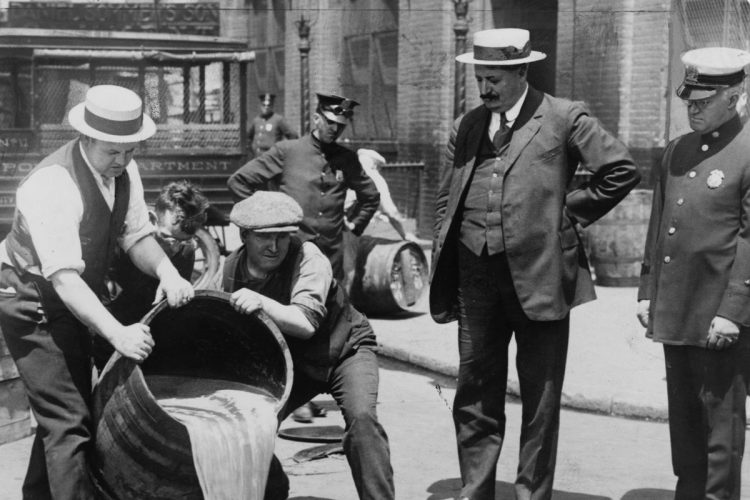
I am not sure I trust Mr. Falwell to capture all the intricacies of 2k political theology, but his rendering here seems quite sensible. You can have a theocracy of the Old Testament or a theocracy of the Sermon on the Mount. Modern sentimentality inclines more people to favor implementing New Testament laws than Israel’s political and civil codes (ouch!). But either way, if you require the government and rulers to conform to the Bible, you are a theonomist. Mind you, conducting war’s in God’s name or abolishing the sale of alcohol are not items you want on your resume if you are a government-should-conform-to-Christianity advocate, which John Fea is every time he uses the Bible, not the Constitution, against Trump.

So why is Falwell’s view dangerous? Fea explains:

Luther’s Two Kingdom belief, as I understand it, is more nuanced and complex than what Falwell Jr. makes it out to be. (I am happy to be corrected here by Lutheran theologians). In fact, I don’t think Luther would have recognized Falwell Jr.’s political theology.

That really doesn’t explain why Falwell is dangerous.

Turn’s out, what’s dangerous is a 2k person who won’t condemn Trump and that’s why John looks for help from a Lutheran who explains that 2k allows you fret about presidents like Trump:

Lutherans must avoid the mistake of the Reformation leaders who failed to cry out against the sins of monarchs. We must exhort all “sword-bearers,” that is, all agents of the state and public servants, from schoolteachers to the president, to live up to the demands of their vocations. Our Lutheran forefathers failed in this task; all the more reason Lutherans today must not.

Conservatives who fear that President Trump may be more like the decadent Belshazzar, feasting while the kingdom falls, than like the liberating Cyrus must pray that Lutherans remember the Two Kingdoms Doctrine. How we discharge the duties of citizenship—whether by accepting the creeping authoritarianism of the last two decades, or by raising our voices on behalf of the laws and democratic norms of our country—is a question of moral conscience, suitable for confession, and demanding repentance if we err.

Even if Lutherans call down God’s wrath on Trump, though, it’s still a judgment call, a question of moral conscience. It does not permit the kind of condemnation that John cites approvingly from Ruth Graham:

At one point, reporter Joe Heim asked Falwell whether there is anything Trump could do that would endanger his support from Falwell and other evangelical leaders. He answered, simply, “No.” His explanation was a textbook piece of circular reasoning: Trump wants what’s best for the country, therefore anything he does is good for the country. There’s something almost sad about seeing this kind of idolatry articulated so clearly. In a kind of backhanded insult to his supporters, Trump himself once said that he could “stand in the middle of Fifth Avenue and shoot somebody” without losing his base. It’s rare to see a prominent supporter essentially admit that this was true.

A reporter for a secular magazine used the I-word? Idolatry? Why that’s a biblical idea, even in the Old Testament, the same portion of Scripture that calls for the execution idolaters.

Why John Fea doesn’t find the use of that word dangerous, I do not know (though again Trump explains a lot). Falwell’s point is that we should not expect the United States to conform to the rules for church members. Among the errors that churches try to avoid (I wish they did it more) are idolatry and blasphemy. But in the United States, thanks to political liberalism, errors like blasphemy and idolatry have rights, or people who worship false gods receive protection from the government to do so.

Once upon a time, Americans thought dangerous governments that required one form of worship and denied rights to people of other faiths. To see Falwell, son of a man who regularly blurred the kingdoms, recognize that the church has different norms from the state is not dangerous but a breakthrough.

How We Could Have Avoided Christendom

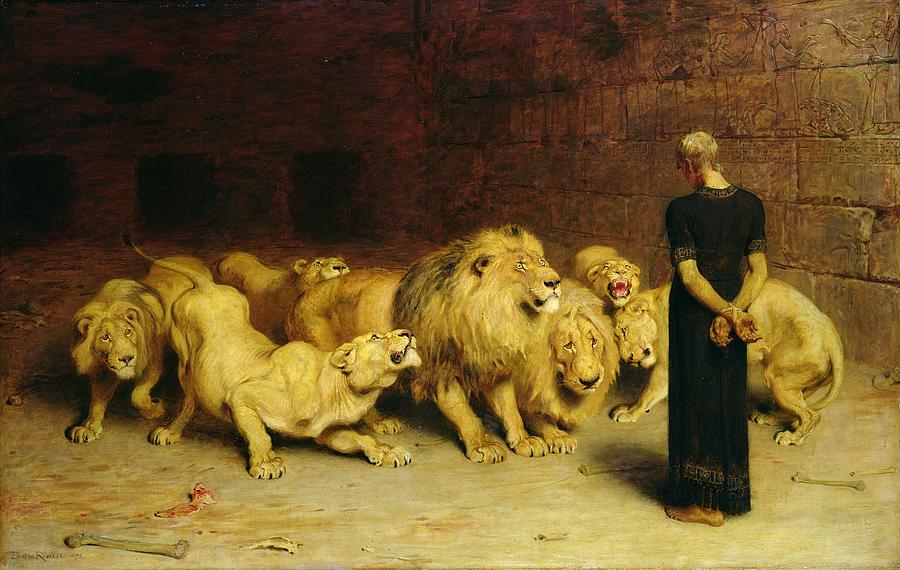
We could have dared to be a Daniel:

Again, Daniel gained the esteem of his irreligious superiors, the Persian king Darius, who determined to make him prime minister of the realm. Members of the Persian royal court were jealous of Daniel, and sought some justification to attack his character—yet none could be found “because he was faithful, and no error or fault was found in him.” Since there was no impugning Daniel’s character, it was again the Jewish religion that became the focal point of the problem. Daniel refused to stop giving thanks to God despite a royal decree that the Persian king must be worshipped. He practiced his religion quietly in the upper chamber of his house to avoid conflict. Still, his detractors discovered him and used his piety as a pretext for destroying him. Despite Darius’s best efforts to reverse his royal edict, Daniel was thrown into the lions’ den. We all know how that turns out.

Thing is, this was not how certain bishops in THE eternal city viewed civil authority:

If princes and magistrates duly elected are filled with the persuasion that they rule, not by their own right, but by the mandate and in the place of the Divine King, they will exercise their authority piously and wisely, and they will make laws and administer them, having in view the common good and also the human dignity of their subjects. The result will be a stable peace and tranquillity, for there will be no longer any cause of discontent. Men will see in their king or in their rulers men like themselves, perhaps unworthy or open to criticism, but they will not on that account refuse obedience if they see reflected in them the authority of Christ God and Man. Peace and harmony, too, will result; for with the spread and the universal extent of the kingdom of Christ men will become more and more conscious of the link that binds them together, and thus many conflicts will be either prevented entirely or at least their bitterness will be diminished.(Pius XI, Quas Primas)

The long history of the papacy up until John XXIII was one of daring to be a prince who could play power politics and maintain Christendom. Work with the Ottomans and dare to be a Daniel? Are you kidding me?

Hyphenated, Not Integrated

Peter Meilaender enhances the Lutheran reputation for thinking clearly about two kingdoms. In this particular case, Meilaender connects the dots between two kingdoms and vocation. But first, he has to clear the deck of modernity-phobia:

In a pre- or early modern world, most people still lived in stable communities that structured their lives, providing shared norms and a sense of place in an intelligible world. Their local communities, their work, their families and kinship networks, and their religious practices all overlapped and fit neatly inside one another, creating reinforcing structures of meaning. But the accelerating processes of modernity, especially over the last three centuries, gradually broke apart this coherent world. Political authority and structures of governance grew larger, more powerful, and more centralized; the decisions shaping people’s lives came to be made far away, by unknown strangers, even as their consequences reached deeper into one’s life. Workers became more mobile, and work moved out of the home, losing its connection to family structure and the rhythms of daily life. Employers, like states, became large, faceless powers, and urbanization took more and more men and women off the land and away from their traditional customs into massive, strange, and anonymous cities. Religion became an increasingly private affair, and in a mobile and diverse world, neighbors could no longer assume a set of shared norms. People were left alienated, powerless, and lost, their lives fragmented among different spheres of family, leisure, work, faith, and citizenship (or subjecthood) that they no longer knew how to integrate. Over time these processes have accelerated and have become even more acute in the post-Cold War world, with its intense globalization and rapid technological change.

You could add Patrick Deneen to this list. This understanding of modernity also increasingly informs Ken Myers’ interviews at Mars Hill Audio.

Then Meilaender uses Michael Walzer to show that modernity is more bark than bite:

Walzer briefly sketches several more such separations or differentiations. The “separation of civil society and political community creates the sphere of economic competition and free enterprise, the market in commodities, labor, and capital” (Walzer 1984, 316). It is true, of course, that “market freedom entails certain risks for consumers,” but, as Walzer points out, “so does religious freedom” (Walzer 1984, 316). Similarly, the “abolition of dynastic government separates family and state” and in this way creates the possibility for people to pursue careers according to their talents, opening up the “sphere of office and then the freedom to compete for bureaucratic and professional place, to lay claim to a vocation, apply for an appointment, develop a specialty, and so on” (Walzer 1984, 316-17). Finally, Walzer writes, the same process, by separating “public and private life” (Walzer 1984, 317), enables new forms of domestic intimacy that are profoundly important to most of us. In the privacy of our homes we become free to pursue “a very wide range of interests and activities…: reading books, talking politics, keeping a journal, teaching what we know to our children, cultivating (or, for that matter, neglecting) our gardens” (Walzer 1984, 317). Raising our own chickens, we might add, or not raising them! “Our homes are our castles, and there we are free from official surveillance” (Walzer 1984, 317).

The virtue of Walzer’s analysis is to correct the one-sided portrayal of modernity as a story of decay, fragmentation, and alienation, the loss of a pre-modern, pre-liberal Eden. The story of modernity is also one of increasing richness and diversity, of freedom and pluralism, of a world in which, to borrow a line from C. S. Lewis, “Everything is getting more itself and more different from everything else all the time” (Lewis 2003, 281).

The loss of integration is not bad but actually good (and of course, something that even the complainers take for granted, from indoor plumbing to civil rights).

Lutherans, according to Meilander, understand this differentiation better than most, thanks at least to Luther’s own recognition of the paradox that goes to the heart of Christian experience this side of glory (before real integration happens). He quotes Luther:

Two propositions are brought into harmony with one another: at one and the same time you satisfy God’s kingdom inwardly and the kingdom of the world outwardly. You suffer evil and injustice, and yet at the same time you punish evil and injustice; you do not resist evil, and yet at the same time, you do resist it. In the one case, you consider yourself and what is yours; in the other, you consider your neighbor and what is his. In what concerns you and yours, you govern yourself by the gospel and suffer injustice toward yourself as a true Christian; in what concerns the person or property of others, you govern yourself according to love and tolerate no injustice toward your neighbor.

This understanding of Christian identity, as one caught between (at least) two realities, is the basis for the doctrine of vocation and juggling all of the duties that a modern person has:

As a husband and father, I have obligations to love, cherish, and be faithful to my wife and children, to maintain, together with my wife, the good order and discipline of the household, and to provide for the religious education of my children. In the same fashion, I also fill other offices with their own corresponding duties. As a citizen, I must support the governing authorities, uphold the rule of law, and assist my fellow citizens in need. As a professor, I must help my students learn, expose them to important works and thinkers in my discipline, and help them develop their intellects. As a member of my parish, I have duties to support it financially and in other ways according to my talents—perhaps by caring for the church grounds or teaching Sunday school or singing in the choir. “There is no getting around it,” says Luther, “a Christian has to be a secular person of some sort….[For] now we are talking about a Christian-in-relation: not about his being a Christian, but about this life and his obligation in it to some other person, like a lord or a lady, a wife or children or neighbors, whom he is obliged, if possible, to defend, guard, and protect” (Luther 1956, 109).

An upside that Meilaender does not mention is that hyphenation would spare us the social justice warriors whose desire to immanentize the eschaton is the most obvious recent example of seeking integration.

Luxury Denominations

Paul Helm took time to review/respond to On Being Reformed, the public debate between some Baptists (and others who aspire to be Reformed) Reformed Protestants who still hold either to the Three Forms of Unity or the Westminster Standards (yes, with revisions about the magistrate ALREADY!). Along the way, Helm makes an observation that has something to do with differences between the US and the UK.

This debate has smothered a different approach, that of verstehen, of ‘smelling the coffee’. It is one thing to argue the (false) claim that our confessions of faith have remained unchanged since the Reformation, another wonderful thing to live by their gracious doctrines. With others, to rejoice in the privilege of being ‘in Christ’. As already stated, it is a singular, remarkable providence that three of our English confessions are word for word almost identical in Reformed soteriology, including the classic catholic trinitarian and incarnational positions. We could therefore unite here, and encourage each other thereby, even strengthening our grasp of our respective confessions, like ironing sharpening iron. Is that not a distinctive form of Reformed religion, whether or not we are credobaptist or paedobaptist, even if different in our ecclesiology and in the administration of baptism. At a time when the faith is increasingly under threat, and our family life as Christians is being undermined, and as there are various popular distortions as well as ancient heresies freely peddled, to have the strengthening of distinctive Christian fellowship is a traditional activity that should outweigh our marginal confessional differences. Perhaps fostering such fellowship requires a little more social ostracism, and perhaps that will come.

As I understand it, in the UK, Calvinistic Protestants don’t have the luxury of forming separate denominations the way American Protestants do. Whether it stems from laws having to do with the established church and dissenting groups, or the small number of serious minded Protestants who regard John Calvin, John Knox, and John Owen highly, British Protestantism has fewer possibilities and resources than Protestants in the land of the free and home of the brave. Here, despite the OPC’s tiny size (don’t snicker), the United States has made Christians (and other believers) wealthier and has provided structures (or lack of them) that makes easier the challenge of establishing new institutions (congregations, denominations, schools, colleges, seminaries).

That may not make America great, but it does indicate that the US is different from the UK and the old world.

The difference that the United States makes for religion is even evident among American Jews. The Pew Research Forum conducted a survey of Jews in the US and Israel that indicates some of the differences that place and nation make for religion. Consider the following:

American Jews are a highly educated and, on the whole, warmly regarded religious minority in a very large, Christian-majority country. Jews represent about 2% of the U.S. adult population of roughly 300 million people. Only about one-third of American Jews say that either “all” (5%) or “most” (27%) of their close friends are Jewish. A substantial proportion (44%) of U.S. Jews who are married say their spouse is not Jewish – including a majority of those who have gotten married since 2000.

By contrast, Jews make up about 80% of Israel’s adult population of 8 million. The vast majority of Israeli Jews say that either all (67%) or most (31%) of their close friends are Jewish, and nearly all married Jews in Israel have Jewish spouses. There’s also very little conversion between major religious groups in Israel, while in the United States, religious switching is remarkably common, including many U.S. adults who have drifted away from organized religion altogether. In our 2013 survey, one out of every five Jewish Americans said they do not identify with any religion, even though they also said they had at least one Jewish parent or were raised Jewish, and they consider themselves Jewish in other ways aside from religion (such as culturally or ethnically). In Israel, by contrast, nearly all Jews say their religion is Judaism.

Or this:

Most American Jews are part of organized Jewish denominations or “streams,” which include the relatively large Reform and Conservative movements as well as Orthodox Judaism. In Israel, only about 5% of Jews identify as either Reform or Conservative. Instead, Jews in Israel generally place themselves into one of four informal categories of Jewish religious identity. These labels – Haredi (ultra-Orthodox), Dati (religious), Masorti (traditional) and Hiloni (secular) – are not connected to formal Jewish organizations or denominations, but instead are loose identity groups (similar, for example, to an American Christian calling herself an “evangelical” rather than a “Southern Baptist”).

Even better, watch part of the short interview with the Israeli woman who married an American Orthodox rabbi.

America is weird and that means we have the luxury of reading the confessions in ways that other Protestants do not or cannot.

Birthright Sport

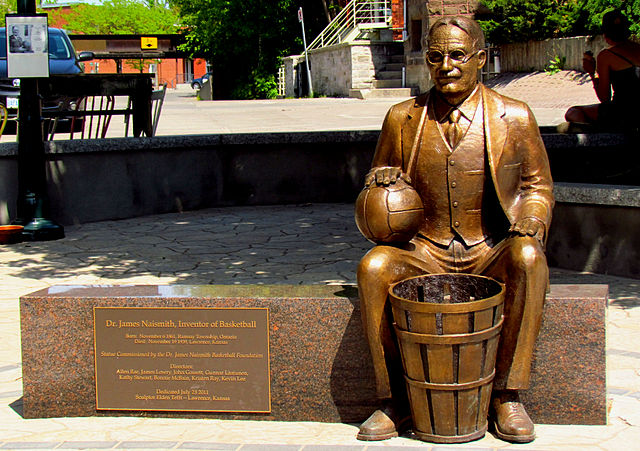
With all the recent talk about birthright citizenship, one that has bearings on infant baptism, I am at a loss about basketball. Is it Canadian, Presbyterian, or American? It depends on how we categorize the game’s creator.

But do you know that the inventor of basketball was a Presbyterian?

His name was James Naismith. Born in Canada on November 6, 1861 in a town no longer in existence, James and his four brothers and sisters grew up in difficult circumstances. His Scotch parents had emigrated from Scotland to Canada, but died after a few years in their new country, leaving James and his brothers and sisters to be reared by a strict uncle. They moved a few times, with James always being involved in sports, like rugby, soccer, football, lacrosse and gymnastics. He would graduate from McGill University in Montreal as well as earning a diploma from the Presbyterian seminary in Montreal in 1890. While never did he become ordained, he did minister in the pulpits of Canadian Presbyterian Churches.

It was while he was working at the YMCA International Training School in Springfield, Massachusetts that James Naismith was given the task by his employer to “come up with” an indoor game which would help the youths of the district to mature into young adults. The assignment, which was given a fourteen day limit, resulted in what we know as basketball.

Granted the ten rules which he wrote down were changed as the new sport developed. For example, the first basket at either end was a peach basket! When the soccer ball, which was first used, would be shot into it, it stayed there until someone climber a ladder at either end of the court to remove it. Time was lost in that exercise until a net and a “basketball” was used.

James and his wife moved to the United States and became citizens. Eventually, he was hired by the University of Kansas to be its basketball coach. Interestingly, he had more losses than wins in the university at Lawrence, Kansas. But others, including some he had trained, became more proficient in the sport, and today . . . it is found the world over.

Here’s the problem. Naismith invented the game when he was 30 years old. He did not become a citizen of the U.S. until he was 55.

That means basketball started on U.S. soil — good news for the birthright folks. But the man inventing the game was still Canadian.

If citizenship matters, basketball is Canadian.

The Spirituality of Social Justice

Here’s what it feels like to be pro-social justice without actually risking anything:

Christians cannot pretend they can transcend politics and simply “preach the Gospel.” Those who avoid all political discussions and engagement are essentially casting a vote for the social status quo. American churches in the early 19th century that did not speak out against slavery because that was what we would now call “getting political” were actually supporting slavery by doing so. To not be political is to be political.

The Bible shows believers as holding important posts in pagan governments — think of Joseph and Daniel in the Old Testament. Christians should be involved politically as a way of loving our neighbors, whether they believe as we do or not. To work for better public schools or for a justice system not weighted against the poor or to end racial segregation requires political engagement. Christians have done these things in the past and should continue to do so.

Nevertheless, while believers can register under a party affiliation and be active in politics, they should not identify the Christian church or faith with a political party as the only Christian one. There are a number of reasons to insist on this.

One is that it gives those considering the Christian faith the strong impression that to be converted, they need not only to believe in Jesus but also to become members of the (fill in the blank) Party. It confirms what many skeptics want to believe about religion — that it is merely one more voting bloc aiming for power.

Another reason not to align the Christian faith with one party is that most political positions are not matters of biblical command but of practical wisdom. This does not mean that the church can never speak on social, economic and political realities, because the Bible often does. Racism is a sin, violating the second of the two great commandments of Jesus, to “love your neighbor.” The biblical commands to lift up the poor and to defend the rights of the oppressed are moral imperatives for believers. For individual Christians to speak out against egregious violations of these moral requirements is not optional.

However, there are many possible ways to help the poor. Should we shrink government and let private capital markets allocate resources, or should we expand the government and give the state more of the power to redistribute wealth? Or is the right path one of the many possibilities in between? The Bible does not give exact answers to these questions for every time, place and culture.

Christians should be involved in government, but most preachers telling you that won’t be involved. Why? It violates the spirituality of the church and confuses the two kingdoms, if church officers to serve in government or testify before legislative bodies.

Churches should encourage political engagement but they won’t take a side between the parties because that would be partisan. And which policies and legislation allow for bi-partisan moderation? If you want police or prison reform you are going to have to work with real politicians who belong to real political parties.

And Christians, including ministers, should speak to matters of injustice even though the Bible doesn’t address social or political realities. “Lift up the poor” and “defend the rights of the oppressed” but don’t ask me how to do it (or also ask why I’m stressing this right now when I wasn’t preaching about this twenty-five years ago).

“Christians cannot pretend.”

Keller’s editorial is part of a pose. He can present himself as one on the side of social justice without ever having to dirty his hands with support for a specific policy or legislator. At least the PCUSA actually passed resolutions in favor of the Eighteenth Amendment and Volstead Act. They didn’t do what J. Gresham Machen recommended, which was saying, “yes, drunkenness is a sin, but the church doesn’t have the biblical warrant for declaring federal or state policy.” Keller apparently agrees with Machen about that. He doesn’t agree with Machen’s reluctance to line up behind the crowd.

And speaking of policy, while many are sizing up (some in installments!!!) the MacArthur inspired statement on social justice, practically all the #woke evangelicals have forgotten about the Justice Declaration. That was a 2017 statement about prison reform, co-sponsored by Prison Fellowship and the SBC’s Ethics and Religious Liberty Commission. (By the way, the Justice Declaration attracted about 3,300 signatures, MacArthur’s about 9,500.)

If you want to pursue social justice, maybe you identify one issue, like prison reform, promote it, stick with it, and keep at it.

Or if you want to look like you are on the right side of social justice, you affirm it but leave the details to practically everyone else who already knows, thanks to the media, politicians, news networks, ESPN, that social justice is a problem.

What value have you added?

When Social Justice is not Gospelly but Theocratickey

Andrew Sullivan via Rod Dreher reveals the categories of liberal society and by implication shows that the Christian advocates of social justice are opposed to sorts of norms and privileges that attend the American system of law and government.

When public life means the ransacking of people’s private lives even when they were in high school, we are circling a deeply illiberal drain. A civilized society observes a distinction between public and private, and this distinction is integral to individual freedom. Such a distinction was anathema in old-school monarchies when the king could arbitrarily arrest, jail, or execute you at will, for private behavior or thoughts. These lines are also blurred in authoritarian regimes, where the power of the government knows few limits in monitoring a person’s home or private affairs or correspondence or tax returns or texts. These boundaries definitionally can’t exist in theocracies, where the state is interested as much in punishing and exposing sin, as in preventing crime. The Iranian and Saudi governments — like the early modern monarchies — seek not only to control your body, but also to look into your soul. They know that everyone has a dark side, and this dark side can be exposed in order to destroy people. All you need is an accusation.

The Founders were obsessed with this. They realized how precious privacy is, how it protects you not just from the government but from your neighbors and your peers. They carved out a private space that was sacrosanct and a public space which insisted on a strict presumption of innocence, until a speedy and fair trial. Whether you were a good husband or son or wife or daughter, whether you had a temper, or could be cruel, or had various sexual fantasies, whether you were a believer, or a sinner: this kind of thing was rendered off-limits in the public world. The family, the home, and the bedroom were, yes, safe places. If everything were fair game in public life, the logic ran, none of us would survive.

And it is the distinguishing mark of specifically totalitarian societies that this safety is eradicated altogether by design. There, the private is always emphatically public, everything is political, and ideology trumps love, family, friendship or any refuge from the glare of the party and its public. Spies are everywhere, monitoring the slightest of offenses. Friends betray you, as do lovers. Family members denounce their own mothers and fathers and siblings and sons and daughters. The cause, which is usually a permanently revolutionary one, always matters more than any individual’s possible innocence. You are, in fact, always guilty before being proven innocent. You always have to prove a negative. And no offense at any point in your life is ever forgotten or off the table.

Perhaps gay people are particularly sensitive to this danger, because our private lives have long been the target of moral absolutists, and we have learned to be vigilant about moral or sex panics. For much of history, a mere accusation could destroy a gay person’s life or career, and this power to expose private behavior for political purposes is immense.

Compare that to Timothy Cho’s use of Machen’s private correspondence:

While this is a private letter between Machen and his mother, the events and actions mentioned in the letter are anything but private. Machen’s stance on segregation is perfectly clear, and this adds an entirely new layer to the narrative about him. He was not simply a stalwart of Reformed and conservative theology, but also a vocal and public defender of segregation and thought negatively of the civil rights of an entire group of fellow image-bearers. His actions had broad institutional and systemic impacts in the seminary and beyond.

When you read Cho and Sullivan side by side, you do understand that Christian social justice advocates are not remotely liberal, not to mention that going out of your way to make someone look bad is not exactly charitable. But when you have a cause just like when you have the Spirit (think Gilbert Tennent), laws and etiquette be damned.

Selective 2k

Readers may remember an exchange between John Fea and me about religion and politics from last summer. In the course of that exchange, Fea quoted favorably from President Obama’s welcome to Pope Francis:

You call on all of us, Catholic and non-Catholic alike, to put the “least of these” at the center of our concern. You remind us that in the eyes of God our measure as individuals, and as societies, is not determined by wealth or power or station or celebrity, but by how well we hew to Scripture’s call to lift up the poor and the marginalized, to stand up for justice and against inequality, and to ensure that every human being is able to live in dignity – because we are all made in the image of God.

You remind us that “the Lord’s most powerful message” is mercy. That means welcoming the stranger with empathy and a truly open heart – from the refugee who flees war torn lands, to the immigrant who leaves home in search of a better life. It means showing compassion and love for the marginalized and the outcast, those who have suffered, and those who seek redemption.

This is a blatant effort to use Christianity for political ends. Because Fea found it agreeable to his own understanding of government, he wrote that if such views made him a Christian nationalist, “then call me a Christian nationalist.”

But when Mike Horton wrote critically about the hobby horse of Fea, the so-called “court evangelicals,” Fea liked the kind of 2k that had originally led me to call him a Christian nationalist. According to Horton:

Liberal and conservative, Catholic and Protestant, have courted political power and happily allowed themselves to be used by it. This always happens when the church confuses the kingdom of Christ with the kingdoms of this present age. Jesus came not to jump-start the theocracy in Israel, much less to be the founding father of any other nation. Even during his ministry, two disciples—James and John—wanted to call down judgment on a village that rejected their message, but “Jesus turned to them and rebuked them” (Luke 9:54–55). He is not a mascot for a voting bloc but the savior of the world. He came to forgive sins and bring everlasting life, to die and rise again so that through faith in him we too can share in his new creation.

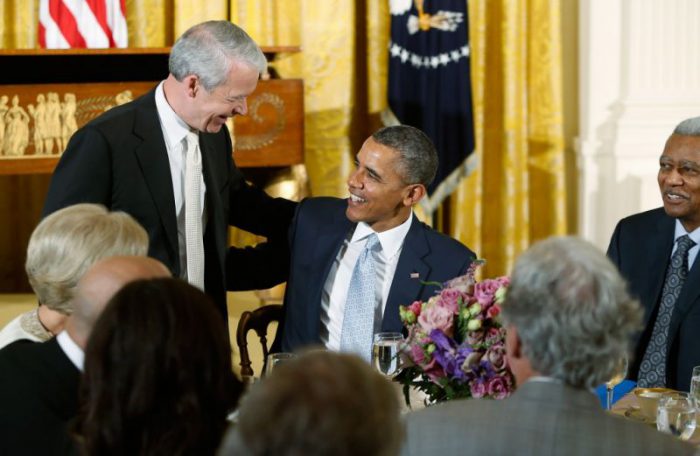
Sorry, but President Obama was confusing the kingdom of Christ with the United States when he welcomed the pope. John Fea apparently suffers from the same confusion when approving Obama and then approving Horton.

It’s hard keeping selectivity straight.

A Wrestling Match Over the Resurrection

Chris Gehrz thinks a belief in the resurrection will produce activist evangelicals (maybe even social justice types):

What would happen if evangelicals let the reality of the resurrection penetrate into our hearts and give us the vitality and power of Christ’s victory over death?

First, it would cause us to value life all the more. Yet many “pro-life” evangelicals seem to care little when their preferred presidential administration closes this country to those seeking refuge from war and gang violence. Or when it ignores the deaths of thousands of Americans in Puerto Rico. Or when it leaves unaddressed (or worsens) problems with health care, drug abuse, poverty, and climate change that threaten the lives of millions.

Second, a living orthodoxy of resurrection would leave us evangelicals more hopeful and less fearful. Instead, as I observed in our book, “The same people who argue most strenuously for the historicity of the resurrection can seem the least likely to live as if Jesus Christ has actually conquered the grave.”

The resurrection as the basis for social policy and legislation — I have not seen that one before. But Gehrz thinks this corresponds with what Paul says in 1 Cor 15:58: “Therefore, my beloved brothers, be steadfast, immovable, always abounding in the work of the Lord, knowing that in the Lord your labor is not in vain.”

That is not the way I typically think about the resurrection, especially after what Paul writes just before that verse:

… flesh and blood cannot inherit the kingdom of God, nor does the perishable inherit the imperishable. 51 Behold! I tell you a mystery. We shall not all sleep, but we shall all be changed, 52 in a moment, in the twinkling of an eye, at the last trumpet. For the trumpet will sound, and the dead will be raised imperishable, and we shall be changed. 53 For this perishable body must put on the imperishable, and this mortal body must put on immortality. 54 When the perishable puts on the imperishable, and the mortal puts on immortality, then shall come to pass the saying that is written:

“Death is swallowed up in victory.”
55 “O death, where is your victory?
O death, where is your sting?”

Instead of turning Christians into transformationalistizationers of culture, the reality of death and the hope of the resurrection would seem to teach believers that this world is inconsequential to the world to come, that as Paul writes elsewhere, “to live is Christ, to die is gain.” We may not labor in vain. But we die and we receive glory, and that puts the affairs of this life in a different perspective, as it seemed to for Paul:

16 So we do not lose heart. Though our outer self is wasting away, our inner self is being renewed day by day. 17 For this light momentary affliction is preparing for us an eternal weight of glory beyond all comparison, 18 as we look not to the things that are seen but to the things that are unseen. For the things that are seen are transient, but the things that are unseen are eternal. (2 Cor 4)

Gerhz even seems to agree with this when he writes, “a lived belief in literal resurrection should lessen our fear of both literal and metaphorical death.” If true, then it would less our fears of inequality and injustice since Christians will have a life to come.

But by trying to appropriate the resurrection for social justice, Gehrz seems to be guilty of what Paul warned against:

20 Where is the one who is wise? Where is the scribe? Where is the debater of this age? Has not God made foolish the wisdom of the world? 21 For since, in the wisdom of God, the world did not know God through wisdom, it pleased God through the folly of what we preach to save those who believe. 22 For Jews demand signs and Greeks seek wisdom, 23 but we preach Christ crucified, a stumbling block to Jews and folly to Gentiles, 24 but to those who are called, both Jews and Greeks, Christ the power of God and the wisdom of God. 25 For the foolishness of God is wiser than men, and the weakness of God is stronger than men.

Christian teaching on salvation transcends the politics and economics, which likely explains why Paul had so little to say about the social injustice of the Roman Empire. Christianity is an otherworldly faith because Christians await the resurrection of the dead when Christ returns.

Does this mean Christians should eschew politics of only vote for Republicans? Probably not on politics, it’s a free church when it comes to the ballot box. Which is to say that Christians have all sorts of material for sorting out the social and political problems that come with a fallen world.

We don’t need to baptize them in the miracles of redemption.