The Politics of the Holy Spirit

Michael Sean Winters first argues that the Second Vatican Council was revolutionary:

Douthat also insists that there was nothing revolutionary about Vatican II. I do not want to get hung up on semantics. If he wishes to make a Burkean point, that there is a difference between reform and innovation, and revolutionaries innovate, I am mostly in agreement, but while the Council did not itself innovate per se, it reformed a lot. Through much of the nineteenth and the first-half of the twentieth century, Rome carried on an extensive correspondence with the American hierarchy on the subject of interreligious events. The officials in Rome did not like the idea of a Catholic priest saying a prayer at a civic event alongside ministers of other religions. What caused Rome to change its mind? In the postwar era, they recognized that the needed America as a bulwark against communism and that non-Catholics would be needed too. Now, interreligious events characterize all local churches and all papal trips. If that is not a revolution, I am not sure what is and, I dare say, it might even qualify as an innovation, a necessary one to be sure and novel only because previously no country, like the U.S. had experienced the admixture of religious groups to the extent that we did.

And among confessional Protestants like Missouri Synod Lutherans and Presbyterians, participating in interreligious services can still get a pastor in trouble. Separated brothers or more like distant cousins seven times removed.

But Winters thinks the Holy Spirit was responsible for the revolution:

Most egregiously, not once does one grasp in his analysis of Vatican II that the Holy Spirit was active in the deliberations of the Council, and that this is not only testified to by those who participated in it, but by our Catholic beliefs about the Spirit’s presence in the Church. If the Spirit was not active at Vatican II, why should we think it was active at Trent or Nicaea? One can deride, as Douthat does, those who invoked “the spirit of the Council” to justify positions that were actually in conflict with the texts of the Council, but there really was a “spirit of the Council” and Pope Francis is not wrong to invoke it. Yes, the “spirit of the Council” was invoked to justify silly things but not by Pope Francis or Cardinal Kasper.

So will Winters allow that the Holy Spirit was also behind the U.S. Constitutional Convention or England’s Really Exceptional Glorious Revolution? Lots of churches adjusted to liberalism. American Presbyterians did in 1789. It took the Vatican longer. But why invoke the third person of the Trinity for something so ordinary?

The dangers of exceptionalism are everywhere.

The Liturgical Calendar Jesus Founded

Maureen Mullarkey confirms Puritans’ objections (via Rorate Caeli):

It is easy to forget that Christmas as we know it is something of a latecomer. It was not celebrated in the early Church. Christians in the first two or three centuries understood themselves to be an Easter people, persecuted inheritors of the promise of the Resurrection. The death and resurrection of Jesus was the heartsblood of the faith. Within a community marked for martyrdom, it was the death date that earned commemoration. Death marked the day of initiation into eternal life, into the stunning mystery of Christ’s victory over death.

Absent the Resurrection, there was no counter to the words of Jeremiah: “Cursed be the day on which I was born.” Origen was emphatic on the matter:

Not one from all the saints is found to have celebrated a festive day or a great feast on the day of his birth. No one is found to have had joy on the day of the birth of his son or daughter. Only sinners rejoice over this kind of birthday.

Prior to the fourth century, there is scarce, if any, written evidence of an annual celebration of the Nativity on December 25th. Not until the fourth century—as newly unshackled Christianity spread northward from Jerusalem, north Africa, and the Mediterranean, into central and northern Europe—did popular custom ingest facets of those pre-Christian winter festivals that greeted its arrival.

No, Not One

Jesus founded only one church and no other communion in the world is a church, not even the Eastern churches which actually came before Peter and Paul died in Rome.

Now, in this apologetics series we have seen that none of the Protestant churches (among the thousands of them) is the Church of Jesus Christ, and none can be. Neither can Anglicanism be, nor the Orthodox churches. There is only one left to fit in the marks of being One, Holy, Catholic, Apostolic, etc. And you will get not a single brownie point for guessing which one I am referring to.

Why is the Roman Catholic Church the Church founded by Jesus Christ? Not merely because it is the last one left in the list of our considerations, not at all.

First of all, she is one in faith: Faithful Catholics the world over — whether they live in America, Europe, Africa, Asia, or Oceania — share the same Creed, and believe the same articles of faith. (Please note: I mean the faithful Catholics, not the superficial, relativistic, modernist folks you find in many places today. They do not represent the Catholic Church, only themselves. An organization is properly represented by its faithful members, not by its unfaithful ones.)

The faithful ministers of the Catholic Church bear the message of Christ in its entirety, without any adaptations to the worldly culture of our days.

Does that apply to the German bishops?

She is one in government. Faithful Catholic people are joined to their priests, the priests and people to their bishops, and all are subject to the Pope, the center of authority, the bond of apostolic unity, the Successor of St. Peter, and the Vicar of Christ. The Code of Canon Law acts like a “constitution” for the Catholic Church, and all are subject to its ordinances. There is unity in government.

Does that include the Vatican curia who leak documents and information to Italian reporters?

The Catholic Church bears the message of Christ, and her faithful members, courageous and plain-spoken as Christ Himself, insist that it be received in its integrity. She shuts her ears to the sensual who look to her in vain for an accommodation in her moral doctrine; those unfaithful members of the Church at times attempt to change her moral doctrine, but always without success. They either leave the Church in a schism or deny her truth as a new heresy.

What about Cardinal Law?

Since Luther’s revolution, countless new Protestant groups, as well as semi-Christian sects, have arisen. Some of them, e.g., Assembly of God, Jehovah’s Witnesses, Worldwide Church of God, are not named after any particular person, place, or doctrine — but one thing they, and all Protestant bodies, have in common is that the date of their foundation can be given. Before Luther there was no Lutheranism, before Calvin there was no Calvinism, before Henry VIII there was no Anglicanism, before Ellen White there were no Seventh-day Adventists, before Joseph Smith there were no Mormons. And so on and so forth.

The Catholic Church — it is a fact of history — was founded by Jesus Christ in the year 33. Only the Catholic Church goes back in every respect of her foundation to Jesus Christ Himself. No other person can be adduced as her founder.

So why not relocate and call the church, the Jerusalem Catholic Church?

Here I thought Lutherans and Calvinists were separated brethren and sistren.

Postscript: Program Notes on the Church Jesus Founded

Acts 1: Then the apostles returned to Jerusalem from the hill called the Mount of Olives, a Sabbath day’s walk from the city. 13 When they arrived, they went upstairs to the room where they were staying. Those present were Peter, John, James and Andrew; Philip and Thomas, Bartholomew and Matthew; James son of Alphaeus and Simon the Zealot, and Judas son of James. 14 They all joined together constantly in prayer, along with the women and Mary the mother of Jesus, and with his brothers.

15 In those days Peter stood up among the believers (a group numbering about a hundred and twenty) 16 and said, “Brothers and sisters, the Scripture had to be fulfilled in which the Holy Spirit spoke long ago through David concerning Judas, who served as guide for those who arrested Jesus. 17 He was one of our number and shared in our ministry.”

Acts 2: When the day of Pentecost came, they were all together in one place. 2 Suddenly a sound like the blowing of a violent wind came from heaven and filled the whole house where they were sitting. 3 They saw what seemed to be tongues of fire that separated and came to rest on each of them. 4 All of them were filled with the Holy Spirit and began to speak in other tongues as the Spirit enabled them. 5 Now there were staying in Jerusalem God-fearing Jews from every nation under heaven.

Jerusalem envy, anyone?

Some Days You Eat the Bar

And some days the bar eats you.

That equivocation is readily apparent in Father Dwight’s on-again-off-again regard for the papacy.

He recently warned conservatives about being too hard on Pope Francis:

Conservatives, for their part, should take a deep breath, avoid extremist language and disloyalty to the Successor of Peter. If they don’t like their pastor they should thank God that they were never supposed to put their faith in the Pope in the first place and take the opportunity to draw closer to Jesus and Mary, grow deeper in their faith and live out that faith more joyfully in the world.

But wasn’t this the same South Carolina priest who three months ago waxed a tad triumphalist?

Divisions and chaos in church result because of a plethora of questions both small and great, theological, moral, political, economic, cultural, liturgical—you name it.

The Protestants have two ways of coping with this conundrum: schism and heresy. The schism solution means when Christians disagree they simply agree to disagree, split up and form yet another new church. The heresy solution is to sacrifice the unchanging truths in some way, and increasingly that way its to dispense with dogma altogether because, “Dogma divides.”

The Catholic solution is to have an infallible authority. The catechism teaches that Christ is the infallible authority, and that he grants a measure of his infallibility to his church with the successor of St Peter at her head.

We constantly see the Catholic Church exercising this authority to preserve dogma on the one hand and adapt to changing circumstances on the other. The authority is often exercised through conflict in the church. Catholics quarrel over what can be changed and what cannot. Then they discuss further and finally the referee—in the form of the Pope—makes the final call.

Which is it? Or is this an example of “development”?

The Elephant in the Room

Imagine (and you don’t need to try too hard) how some Christian communions might promote their accomplishments and uniqueness.

The hipsters might say something like, “we are the church of the city and for the city.”

Doctrinalists might come up with something like, “we put the strict in confessional subscription.”

The transformationalists (not quite as urban as the hipsters) might talk about “a gospel for all — here Stephen Coulbert’s deep gravelly voice when you read “all” — of life.”

And the social gospelers might promote a communion that is “ushering in Christ’s loving and just reign.”

But what would you say about a communion that touted, “we know how to make effective and gracious use of gay clergy”? I’m suspecting that this would not be the best Call to Communion.

And yet, for all of the Roman Catholic complaint about the sexual laxity of the mainline Protestant denominations, and for all of the teaching about marriage, celibacy, and theology of the body, Roman Catholics ordain homosexuals in what seems to be record numbers.

Please, dear reader, keep in mind that I really dislike cheap shots based on below-the-belt issues. Sex is such an easy way to push the outrage-porn button. So I am not trying — really really trying not to — play any kind of homophobia card. Nor am I knowingly playing on anti-Catholic bigotry. I am seriously curious about how a conservative church reconciles its teaching about sex with knowingly ordaining homosexuals. Not to mention infallibility and certain knowledge. This is a conversation that has been public. It is out of the closet. And yet Bryan and the Jasons went right along — nothing here to see.

How is it, then, that you can promote your communion’s wonderful views of marriage and celibacy, and look to your church as the sensible and chaste alternative to mainline Protestantism, but don’t comment on the numbers of priests that are pretty staggering (even while accusing mainline churches of ordaining lesbians).

Here are a few, scattered and old discussions of the phenomenon (which some might call a problem):

From 2002:

For more than a decade, now, voices have been heard expressing concern about the growing numbers of gay priests and seminarians. Vicars of priests and seminary administrators who have been around awhile speak among themselves of the disproportionate number of gay men that populate our seminaries and presbyterates. They know that a proportionate number of gay priests and seminarians would fall between 5 and 10 percent. The extent of the estimated disproportion, naturally enough, will vary depending on general perceptions, personal experiences, and the frequency of first-hand encounters with self-acknowledged gay priests.

The general perceptions, in turn, are often shaped by various studies and surveys which attempt to measure the percentage of priests who are gay. An NBC report on celibacy and the clergy found that “anywhere from 23 percent to 58 percent” of the Catholic clergy have a homosexual orientation. Other studies find that approximately half of American priests and seminarians are homosexually oriented. Sociologist James G. Wolf in his book Gay Priests concluded that 48.5 percent of priests and 55.1 percent of seminarians were gay. The percentage appears to be highest among priests under forty years of age. Moreover, the percentage of gay men among religious congregations of priests is believed to be even higher. Beyond these estimates, of course, are priests who remain confused about their orientation and men who have so successfully denied their orientation, that in spite of predominantly same-sex erotic fantasies, they insist that they are heterosexual.

Here’s an attempt to turn gay priests into an asset:

Traditional Catholic theology as summarized in the catechism (No. 1578) states that men are called to the priesthood by God. So despite statements that homosexual priests are either a scandal or embarrassment, Catholic belief is that all men called to holy orders are responding to a divine call. (As an aside, it is perhaps unsurprising that in a church that enjoins celibacy on homosexuals, some gay men would choose the celibate life of the priest.) Some have argued that the ordination of homosexuals somehow represents the church in error. But homosexual priests, like heterosexual priests, are ordained through the divine authority of the church, which has that responsibility and right (No. 1578) and, according to traditional Catholic theology, imprints on the priest an indelible spiritual character (No. 1582).

Therefore, one can state that God has called, and is continuing to call, homosexuals to serve as priests in the church and that the church confirms this call through ordination. The question, then, is not whether God is calling homosexual men to the priesthood, but why. Theologically, how might one understand these signs of the times?

The school of suffering. The vast majority of homosexuals in the United States are acquainted with the suffering that comes from being a misunderstood and often persecuted minority. This commences from early adolescence and can continue for the remainder of one’s life. Homosexuals are frequent targets of prejudice, ridicule, rejection from their own families and, sometimes, violence. Here, therefore, are men who understand suffering, stigma and frustrationthe very types of experiences that Christian theology teaches can lead one closer to companionship with the Christ who suffers. To use the words heard during Lent, the homosexual is often despised and rejected by others, a man of suffering…one from whom others hide their faces (Isa. 53:3).

Being schooled in this unique experience of suffering can result in a profound sense of compassion and identification with the most marginalized in society: the sick, the lonely, the refugee, the materially poor, the outcast, the least of my brothers and sisters (Mt. 25).

Then some challenge the statistics:

Fr. Cozzens claims that statistics show that 50 percent of priests and seminarians are homosexually oriented. A gay culture in the priesthood or seminary, he says, makes it very awkward for heterosexuals, who as a consequence doubt their vocations and withdraw. Seminaries must therefore consider the kind of support that is needed for heterosexual seminarians in a gay culture. We are not told whether the prevalence of homosexual orientation and gay expression is bad or good. Fr. Cozzens seems to suggest that it is simply a fact of life with which we must learn to live. This is very unpersuasive on a number of scores.

First, I do not believe the statistics. The very few surveys and studies that have been done on homosexuality among priests are almost certainly flawed by the factor of self“selection. Those who, for whatever reason, are interested in homosexuality among priests respond at a far higher rate than others. Had I received a questionnaire in such a survey, I would not have responded. As for Fr. Cozzens’ depiction of seminarians, I can only say that they must be very different from those whom I have known during fourteen years of seminary work. Are there seminarians who identify themselves as homosexual? Certainly. Are there some who are sexually confused and in need of counseling and spiritual direction? Absolutely. But is there a dominant homosexual culture in seminaries that makes life difficult, if not impossible, for heterosexuals? That does not jibe with my experience.

It is very possible that in the 1970s and ’80s there were a significant number of seminarians who were sexually confused, and were encouraged in that confusion by a sexually charged society. They were not challenged to harmonize their ideas and their lives with the teaching of the Church, and today some of them are priests. Some are effective and faithfully celibate, while some are actively involved in the gay subculture. The latter pose a very real problem, but the incidence of the problem, I am convinced, is nowhere near the figure proffered by Fr. Cozzens. His claims are both unsupported and irresponsible.

I understand that a clergy shortage might be one explanation for these figures and reflections. I also can comprehend that someone who is gay but doesn’t practice may be capable of executing priestly duties. But what is odd is conceiving of the convert to Roman Catholicism who might think first about joining the Christian Reformed Church because of the denomination’s position on homosexualism and homosexuality.
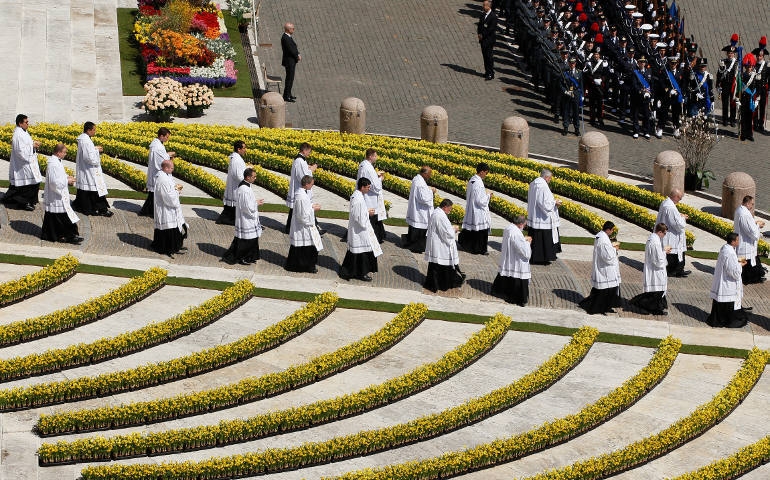
See?

What Bryan and the Jasons fail to cover in their call to Protestants obsessed by modernism (read Machen’s warrior children):

Recently The Catholic Herald, one of our most reliable English Catholic weeklies, recently published an article by George Weigel on Vatican II and the subsequent fifty years called “Mission Abandoned” and carrying on the cover the phrase “George Weigel says we’ve wasted the last 50 years on infighting.”

Professor Weigel is one of our most distinguished Catholic writers who over the years has done great work in the service of the Church. This in itself makes me hesitate to take issue with him. But in addition to that is the fact that if I do I shall expose myself to the charge of carrying on the “infighting.”

However, there is one serious omission in his article which, if it remains unmentioned, will do a serious injustice to all those Catholics, like writers and readers of The Wanderer, who, over a period of fifty years, have done their best to uphold the faith and authentic magisterial teaching often in far from easy circumstances.

The omission is the word “modernism.” The impression is given that the “infighting” has all been between two groups equally Catholic in belief and practice, one labeled “conservative” or “traditionalist,” the other “liberal” who, like political parties, comprise the totality of the Catholic body and whose conflicts have been equally useless and destructive. It is as though Blessed John Henry Newman had tried to explain the Arian crisis after the Council of Nicaea in terms of useless infighting between “liberals” and “conservatives” with Arius representing the former, and Athanasius the latter, and coming to the conclusion that they should have reached a compromise.

Responses from the Protestant focus group continue to be received.

Is This A Good Way to Think about the Incarnation?

Is it true much less infallible?

What did Jesus actually bring, if not world peace, universal prosperity, and a better world? What has he brought?

The answer is very simple: God. He has brought God. He has brought the God who formerly unveiled his countenance gradually, first to Abraham, then to Moses and the Prophets, and then in the Wisdom Literature – the God who revealed his face only in Israel, even though he was also honored among the pagans in various shadowy guises. It is this God, the God of Abraham, Isaac, and Jacob, the true God, whom he has brought to the nations of the earth.

He has brought God, and now we know his face, now we can call upon him. Now we know the path that we human beings have to take in this world. Jesus has brought God and with God the truth about our origin and destiny: faith, hope, and love. It is only because of our hardness of heart that we think this is too little. Yes, indeed, God’s power works quietly in this world, but it is the true and lasting power. Again and again, God’s cause seems to be in its death throes. Yet over and over again it proves to be the thing that truly endures and saves.

Another Case for the Gateway Drug

Once again comes a suggestion that neo-Calvinism in its desire for comprehensiveness paves the way for Roman Catholicism:

As it happened, the young pastor Abraham Kuyper found something to like in the “Syllabus [of Errors]” too, and said so on no less an occasion than his Reformation Day sermon in 1865! The pope went too far, Kuyper quickly assured his startled (if not outraged) congregation; the document was not to be affirmed in all its details. But its intention was correct. The rising philosophy of naturalism and ethical materialism which the pope was condemning was exactly the enemy that needed to be opposed, Kuyper said, and that opposition would mark his work in church, state, and cultural commentary across the 50+-year career upon which he was just embarking. In fact, this philosophical challenge—this rise of a cruel worldview antithetical to Christianity—is what motivated Kuyper’s turn to strict Calvinism from the more nebulous piety in which he had started out his ministry a few years before. A much older Brownson, now near the end of his career, held much the same sentiments.

If I understand the implications of James Bratt’s argument, reasoning about politics, society, economics, and education apart from first principles (read revealed truth) — one of the building blocks of modern liberalism (and secularism) — is an indication of naturalism, and the enemy of Christians. Thus the antithesis between Christianity and secularism, between 1689 (the Glorious Revolution) and 1789 (the Inglorious French Revolution), between Christian schools, labor unions, and political parties and secular schools, labor unions and political parties.

I can understand that. But if the antithesis is right and if Christians live in societies with unbelievers, on what basis are non-Christians supposed to operate in their social endeavors? If Christians alone have the true w-w, then should they allow those with false w-w’s to “run things?” Or if unbelievers do have access to positions of authority, wouldn’t they need to rely on what they know which does not include revealed truth?

Separating church and state was a long and difficult struggle for Roman Catholics. Distinguishing the differences between neo-Calvinist and theonomic arguments is also difficult. Of course, it needs to be noted that Kuyper did affirm social pluralism and found remarkable ways to include Roman Catholics in Dutch society. Still, when you start with opposition to naturalism and the antithesis between Christians and unbelievers, how you avoid winding up in theonomy or church-above-the-state (e.g. Roman Catholicism) is not at all obvious.

Saving the World

One light show at a time.

In case you missed it, the Vatican celebrated the Feast of the Immaculate Conception (yesterday) with a light show:

A mixture of fascination, curiosity and consternation is greeting a light show to be projected onto St. Peter’s basilica tomorrow — the Feast of the Immaculate Conception and the opening day of the Jubilee of Mercy.

A coalition of non-Catholic humanitarian, philanthropic and conservation groups along with the World Bank are staging the event. It will be the first time ever that images will be projected onto the 17th century basilica’s façade and Michelangelo’s cupola.

The organizers say the three hour event, called “Fiat Lux, Illuminating Our Common Home”, will tell the “visual story of the interdependency of humans and life on earth with the planet, in order to educate and inspire change around the climate crisis across generations, cultures, languages, religions and class.”

Archbishop Rino Fisichella, president of the Pontifical Council for the New Evangelization, called the event “unique” and said the illumination show “will present images inspired of Mercy, of humanity, of the natural world, and of climate changes.”

He added that the light show, whose images have been shown on various landmarks around the world, is meant to link Pope Francis’ environment encyclical Laudato Si’ with the United Nations Climate Change Conference (COP21) currently underway in Paris until Friday.

“It is our hope that this beautiful and contemporary work of public art will inspire citizens of the world to join together in a moment of compassion and to activate a global movement to protect humankind, our common home and precious endangered species,” said Carole Tomko, vice president of Vulcan, Inc., one of the groups sponsoring the event and which promotes initiatives to “change and improve the way people live, learn, do business and experience the world.”

Some conservative Roman Catholics have taken a page from Protestant iconoclasm and regard such a use of holy buildings as sacrilege:

The sense that St. Peter’s Basilica has been profaned is strong. The symbolic significance of the event is a Church immersed in darkness, but illuminated by the world, by the new climatist-religion-ideology (all financed by the World Bank Group which will now have to explain to us what politics compatible with the teaching of the Church it is promoting..)

The holy place par excellence, the heart of Christianity transformed on a maxi-screen for the show of the New World Power Ideology …and the Nativity Crib was left in darkness.

It does make you wonder what salvation means. If improving the environment can save the world, then what happened to the cross of Christ and the sacraments? Could it be that hell is empty (and will remain so) and so the church can now devote itself to more humanitarian and less heavenly causes? Did Balthasar really win at Vatican 2 as Commonweal suggests? Before Vatican 2, Rome was pretty clear where unbelievers went at death:

Any sin, for Augustine, is an unspeakable offense against God; particularly offensive was the sin of the first man who was singularly graced with an intimate “enjoyment of God” and who stood as the progenitor of the human race. His impiety in abandoning God was so great that it “merited eternal evil” in consequence of which “the whole of mankind is a ‘condemned mass’ [massa damnata]; for he who committed the first sin was punished, and along with him all the stock which had its roots in him.” According to Augustine, no one has the right to criticize that retribution as unjust, and the fact that some are released from it through the free bounty of God is ground for heartfelt thanksgiving.

The same severe doctrine of hell has been affirmed time and again in official church documents. The Fourth Lateran Council in 1215 declared that, at the end of time, “all will receive according to their deeds, good or evil, the former to their everlasting glory with Christ, the latter to perpetual punishment with the devil.” In his constitution of 1336, Benedictus Deus, Benedict XII solemnly defined that “the souls of those who die in actual mortal sin go down immediately after death into hell and suffer the pain of hell.” The Council of Florence in 1442 maintained that “not only pagans, but also Jews, heretics and schismatics” are precluded from salvation for they “will enter into eternal fire” unless they embrace the Catholic Church before their death. Similar declarations on hell and salvation were issued by the Council of Trent in the sixteenth century. Vatican I reinforced them in the nineteenth century. Vatican II did not revisit the solemn definitions of hell by earlier councils, but it did at least affirm that, yes, atheists can be saved.

But that changed when Balthasar and Kung met Barth:

Like Barth and Balthasar, Hans Küng too comes close to proposing universal salvation. And like them, he enlists the virtue of hope to support the idea. In his book Eternal Life, Küng’s critical discussion of hell begins with Jesus’s own words about hell, which, according to Küng, were figurative rather than literal: terms in the New Testament pertaining to final judgment—words like “hell,” “eternal,” ‘fire”—are to be taken as metaphors warning sinners of the delicate edge they’re dancing on. They are “meant to bring vividly before us here and now the absolute seriousness of God’s claim and the urgency of conversion in the present life,” Küng writes. No one should dismiss his or her responsibility to meet the demands of conversion, but how each of us meets them “remains a matter for God as merciful judge” in his “all-embracing final act of grace.” Like Balthasar, Küng maintains that judgment of the individual is in God’s hands; it would be “presumptuous for a person to seek to anticipate the judgement of this absolutely final authority. Neither in the one way nor in the other can we tie God’s hands or dispose of him. There is nothing to be known here, but everything to be hoped.”

Barth, Balthasar, and Küng all agonize over the question of universal salvation, which they treat not just as a theological puzzle but as a genuine mystery. Because we cannot answer the question with absolute certainty, it finally has to be left—in humility and hope—to the judgment of a loving God. This is as much of an affirmation as they dare to make.

What these three theologians show us, however, is that hope is a powerful virtue and not just a matter of wishful thinking. Hope always has its reasons, even earthly hopes. In the everyday sense of the word, a doctor’s skill is reason for his patient to hope for a cure, a worker’s good job performance a reason for her to hope for a promotion—though such hopes, subject to human limitations, can be disappointed. In the economy of salvation, however, the reason for hope is nothing less than the divine will—profoundly declared in the passion, death, and resurrection of Jesus: “For God sent the Son into the world, not to condemn the world, but that the world might be saved through him” (John 3:17). The clarity of this scriptural passage on God’s will reassures not only Christians but all mankind that our hope for salvation will be fulfilled—without exceptions.

But if U.S. parochial schools can reconsider their mission, maybe the Vatican can find it’s pre-Vatican 2 self:

“We don’t open Catholic schools to get kids into college,” Guernsey said. “We open Catholic schools to get them into heaven.”

Bringing Up the Rear

If Islam is going to develop into a religion of peace and tolerance, it doesn’t need either a Reformation or an Enlightenment, according to Daniel Philpott. Instead it needs a Vatican Council — preferable Vatican Council 2.0 since the first council was a tad militant and intolerant.

Here are the limitations of Protestantism and philosophy:

Protestant reformers enforced their orthodoxy with every bit the deadliness that Catholics employed. While England’s Queen Mary acquired the sobriquet “bloody” for her brutal restoration of Catholicism, her little sister Elizabeth was equally violent in reestablishing the Anglican Church.

The 18th century Enlightenment advanced individual religious freedom but was skeptical towards religion. The French Revolution, the Enlightenment’s political enactment, asserted the rights of man but severed the heads of men and women of faith.

Yes, lots of blood before 1800. But where’s the American exceptionalism? Where’s John Courtney Murray arguing for the Enlightenment tradition of natural law that shaped the founding of the United States? Maybe Philpott’s editor didn’t give him enough words to embrace the religious freedom that his bishops celebrate every fortnight for freedom:

Catholics must fight against forces seeking to remove the influence of religion from American culture, Archbishop William E. Lori of Baltimore told over 1,000 Catholics at a Mass beginning a 14-day campaign for religious freedom.

“In differing ways, both the Church’s teaching and our nation’s founding documents acknowledge that the Creator has endowed individuals with freedom of conscience,” said Archbishop Lori. “Such freedom goes to the heart of the dignity of the human person.”

The archbishop delivered the opening homily for the Fortnight for Freedom, the two-week period leading up to the Fourth of July that the bishops have dedicated as a time for prayer, education and advocacy for religious liberty.

That was 1776. But the real lesson of religious freedom, for Philpott, comes in 1965 (for the historically minded, notice the chronology and the Roman-centric w-w paradigm):

. . . western history contains a more promising pathway, ironically one found in the very religious body that the Reformation and the Enlightenment considered freedom’s greatest enemy: the Catholic Church.

It was in Second Vatican Council’s declaration, Dignitatis Humanae, on Dec. 7, 1965 — a date whose 50th anniversary is right around the corner — that the Church finally and authoritatively endorsed the human right to religious freedom.

While the Catholic Church’s road to religious freedom will not suit Islam in every respect, it shows how a religious community that for many centuries did not teach religious freedom could discover grounds for the principle that were rooted in its own teachings rather than in modern secularism.

Like Islam, Catholicism long predates the modern world. The period from which Dignitatis Humanae most dramatically departs is medieval Christendom, when the integrity of the Catholic faith was regarded as crucial for social order. Heresy was not merely a sin but an act of sedition.

Not the point of the post, but notice how this booster also notices what the rest of us without a dog in the fight of papal supremacy notice — namely, that Roman Catholicism changed from medieval to modern at the Second Vatican Council. Everyone sees this except for those who put their trust in ecclesiastical princes.

What is the point here, though, is how Rome is an example to Islam. Was it not the case that modern developments in Europe and North American finally forced bishops to open the church’s windows to modernity? In which case, it was not that the church embraced religious freedom on its own but “finally” — Philpott’s word — caught up to religious freedom in trails blazed by Americanists (and others). Of course, Protestantism did not usher in freedom of conscience. But Protestants did adjust much earlier than Rome. And Philpott gives Protestants no credit.

Instead, he thinks Muslims should look to Roman Catholics — who still celebrate the Battle of Lepanto.

Yup.