Two Kingdom Tuesday: Machen Was All Wet

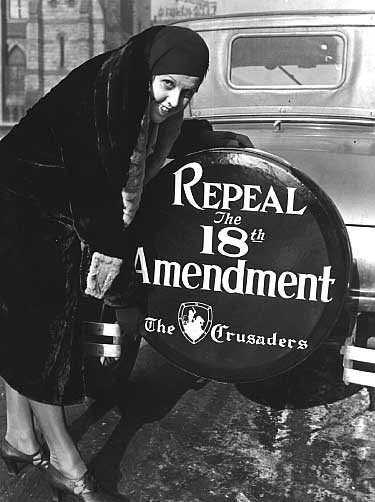
The resolution endorsing the Eighteenth Amendment or the Volstead Act was introduced to the Presbytery of New Brunswick at the very end of the meting on April 13, 1926. The attendance, which had been large during the early part of the session, had dwindled until only a very few persons were present – y estimate would be ten or twelve, exclusive of the officers, though I believe someone else estimates the number at about five. Under these conditions, the resolution was put to a viva voce vote. I voted “No”; but I did not speak to the motion or in any way ask that my vote should be recorded. . . .

It is a misrepresentation to say that by this vote I expressed any opinion on the merits of the Eighteenth Amendment or the Volstead Act – and still less on the general question of Prohibition. On the contrary, my vote was directed against a policy which places the church in its corporate capacity, as distinguished from the activities of its members, on record with regard to such political questions. And I also thought it improper for so small a group of men as were then in attendance to attempt to express the attitude of a court of the church with regard to such an important question. . . .

Such are the facts about my vote. I desire now to say one or two things about my attitude regarding the issues involved.

In the first place, no one has a greater horror of the evils of drunkenness than I or a greater detestation of any corrupt traffic which has sought to make profit out of this terrible sin. It is clearly the duty of the church to combat this evil

With regard to the exact form, however, in which the power of civil government is to be used in this battle, there may be different of opinion. Zeal for temperance, for example, would hardly justify an order that all drunkards should be summarily butchered. The end in that case would not justify the means. Some men hold that the Eighteenth Amendment and the Volstead Act are not a wise method of dealing with the problem of intemperance, and that indeed those measures, in the effort to accomplish moral good, are really causing moral harm. I am not expressing any opinion on this question now, and did not do so by my vote in the Presbytery of New Brunswick. But I do maintain that those who hold the view that I have just mentioned have a perfect right to their opinion, so far as the law of our church is concerned, and should not be coerced in any way by ecclesiastical authority. The church has a right to exercise discipline where authority for condemnation of an act can be found in Scripture, but it has no such right in other cases. And certainly Scripture authority cannot be found in the particular matter of the Eighteenth Amendment and the Volstead Act.

Moreover, the church, I hold, ought to refrain from entering, in its corporate capacity, into the political field. Chapter XXXI, Article iv, of the Confession of Faith reads as follows:

Synods and councils are to handle, or conclude nothing, but that which is ecclesiastical: and are not to intermeddle with civil affairs which concern the commonwealth, unless by way of humble petition in cases extraordinary; or, by way of advice, for satisfaction of conscience, if they be thereunto required by the civil magistrate.

This section, I think, established a very great principle which was violated by the Presbyter of New Brunswick. . . .

In making of itself, moreover, in so many instances primarily an agency of law enforcement, and thus engaging in the duties of the police, the church, I am constrained to think, is in danger of losing sight of its proper function, which is that of bringing to bear upon human soul the sweet and gracious influences of the gospel. Important indeed are the function of the police, and members of the church, in their capacity as citizens, should aid by every proper means within their power in securing the discharge of those functions. But the duty of the church in its corporate capacity is of quite a different nature. (J. Gresham Machen, “Statement on the Eighteenth Amendment”)

To Ask and Tell, or Not to Ask and Tell: This is the Contradiction

Rabbi Bret is baaaaaaack from vacation (apparently) and he didn’t waste anytime piling on his favorite virus – the infectious disease known as Radical 2K. He reports that the URCNA Synod has decided to send a letter to the U.S. Armed Services official, drafted by the Presbyterian and Reformed Joint Commission on Chaplains and Miltary Personnel (PRJC), that petitions the Pentagon to to hold the line on the current military policy – “don’t ask, don’t tell.”

In the current state of affairs, the various branches of the military do not inquire about the sexual orientation of personnel. But if the Obama administration has its way, “don’t ask, don’t tell” will cease and instead gays and lesbians will be able to come out of the closet. According to the PJRC letter, such a change of policy might force conservative Protestant chaplains to resign because their teaching and preaching of God’s word, especially on homosexuality, will open them to the charge of discrimination. The new policy might even force chaplains those passages in Scripture where God condemns homosexuality.

Bret interprets this URCNA decision as a major smack down of two-kingdom theology.

Despite the ongoing assault against Biblical Christianity from Westminster West Seminary and it’s specious Radical Two Kingdom Theology the URCNA rightly voted to weigh in on a “common realm” issue with an almost unanimous vote to resist, by way of appeal, the US Military’s overturning of “don’t ask, don’t tell.” Apparently the Synodical body was not persuaded by the R2Kt ratiocination and argumentation that the Church has no business speaking beyond the realm of the Church. With this vote there can be no doubt that the URCNA has implicitly rejected, root and branch, the foreign theology now commonly referred to as “R2K.”

One would have thought that after a well-deserved break from pastoral duties and service at Synod the good rabbi would not be so quick to hyperventilate about the meaning of this news. I can think of any number of better indications than this letter that the URC has repudiated 2k. Do the formation of a study committee or an actual report with recommendations against 2k come to mind? But if this gets Bret through the night without having to use his inhaler, so be it.

At the same time, Bret may want to regroup and consider that the policy that PRC now favors – “don’t ask, don’t tell” – was precisely the one they opposed back when President Clinton introduced it during his first weeks in office. Maybe Bret was running for Senate or doing something time consuming like that, but Reformed communions like the OPC and PCA both sent letters in 1993 informing the president of the Bible’s teaching about homosexuality. These communications were supposed to provide the official cover for Reformed and Presbyterian chaplains whose consciences might be violated by openly gay soldiers and officers taking up duties under their charge. In a contest between church and state, supposedly, the chaplains could now appeal to the explicit teaching of their own communions.

What is important to remember, though, is that these letters, also hatched by the Presbyterian and Reformed chaplains, came in reaction to the policy that the PRJC now supports. In which case, in the name of biblical Christianity, the PRJC has reversed course and determined that “don’t ask, don’t tell” is just fine and that Obama will damage the military and the nation if he tinkers with allowing gays now in the closet, to come out.

So the question for Bret and supporters of the PRJC is this: is this what healthy 1k looks like? Can the church really change its mind about the policies the Bible requires? Or is it simply the case that the Bible opposes whatever a Democratic president proposes? (Could a GOP Study Bible be in the offing?)

Even more troubling is the propensity for the chaplains from Reformed communions to manifest their opposition to homosexuality to the exclusion of other sins that the Bible also condemns. I wonder why PRJC doesn’t instruct the president about the idolatry of Mormon worship or the blasphemy of the Roman Catholic Mass? Surely there are Mormons and Roman Catholics out of the closet in the military. Some of them are likely chaplains. Does PRJC think that Clinton and Obama understand the regulative principle of worship but need help with the seventh commandment? Or is it that PRJC thinks sexual sins are more eggregious than false worship?

It could be a tough call since the Westminster Standards allow that not all sins are equally offensive. But if sexual sins are more objectionable than liturgical infidelity (you’d have trouble proving that from Israel’s experience), then why not go after porn in the military, or divorce, or adultery among heteros? I personally don’t buy the logic – on display in spades in American Beauty – that the biggest homophobes are really gay. But if PRJC wanted to avoid that sort of canard from the Hollywood left, why not send a letter or two to the president about stealing and lying?

Mind you, I understand at least some of the difficulties that gay rights create for our society and the Armed Services. Rabbi Bret is well within his duties as a citizen to register his concerns. But I sure wish he’d get his facts straight (no pun intended) about biblical teaching and the PRJC’s flip-flop on don’t ask, don’t tell.

Two Kingdom Tuesday: Remonstrants

If the Arminian controversy began as a disagreement about predestination, the call to examine the orthodoxy of a professor added levels of complication, for it reawakened all of the unresolved disputes over the control of church affairs that had troubled the Dutch church in its early years: Who had the authority to examine and remove an unorthodox teacher? Who should assemble and set the agenda for a national synod? Arminius’s wife belonged to an influential Amsterdam regent family. When summoned before the Amsterdam consistory, Arminius refused to appear unless the burghermasters or their representatives attended as well, aligning himself with the view that civil authorities rightfully oversaw the church. In subsequent actions and petitions, he and his supporters defended the ability of city governments to control ecclesiastical appointments without interference from local classes or synods. They argued that the States should set the form and agenda for a national synod. The fullest and most extreme exposition of the political theories of the pro-Arminius party, Johannes Uytenbogaert’s On the Office and Authority of a Higher Christian Government in Church Affairs of 1610, was judged by the like-minded Hugo Grotius to stand directly in the tradition of Wolfgang Musculus. Against this, Arminius’s opponents insisted on the autonomy of the church and its competence in all matters regarding the setting and oversight of doctrine. (Philip Benedict, Christ’s Churches Purely Reformed, p. 306)

Is it merely coincidental providential that Arminians also opposed two-kingdom teaching?

Two Kingdom Tuesday: Macadam or Concrete?

Does Christianity involve a conviction about roads and their construction? To hear some critics of 2k, the problem with distinguishing between a spiritual and an earthly kingdom is that it creates a vacuum of neutrality. Something is either sacred/religious or secular/non-religious. By granting a sphere that is not religious is to create a bogey that leaves neo-Calvinists, pietists, and theonomists spooked. Dualism (boo!) is scary enough. But to think of a sphere of human existence that doesn’t have religious meaning! It’s worse than making an appointment with the dentist.

This is why road construction – or at least choosing the surface of roads – is an interesting test case for the 2k critic. If nothing is neutral, if every square inch is Christ’s, if the Bible speaks to all of life, what is God’s will for road surfaces? Should a Christian always use macadam? Or is concrete okay? And if concrete is God’s will, should Christians and their congregations picket alongside roads that are being paved with macadam? Again, the basic premise of the anti-2k critique is that nothing is neutral and everything is religious. So do anti-2kers really want to hang the plausibility of their theory on a matter like road surfaces?

Most 2k critics never really consider road construction. They have their sights set on bigger targets. Politics, economics, art, medicine – those are outlets fitting for a healthy and vigorous worldview. And to suggest that Christianity doesn’t have the answers to these areas of human endeavor is to commit worldview antinomianism. Rabbi Bret is again useful for illustrating the point:

Dr. Darryl’s problem is that he honestly believes that Christianity, as promulgated in the Church, neither asks nor answers the question, “How shall than we live.” Dr. Darryl’s worldview believes that all attempts by the Church to speak God’s mind on this question for the public square is sinful. The consequence of Dr. Darryl’s worldview is that the Gospel’s impact in saving individual lives reaches no further than those individual personal lives. For Dr. Darryl, a medical doctor is saved by the Gospel but after being saved by the Gospel, Christianity, as promulgated by the church, has no word for the medical doctor on how he should speak about medical ethics. For Dr. Darryl, a public square Economist is saved by the Gospel but after being saved by the Gospel, Christianity, as promulgated by the church, has no word for the Economist on whether Keynesianism is consistent with the 7th commandment. For Dr. Darryl, a civil magistrate is saved by the Gospel but after being saved by the Gospel, Christianity, as promulgated by the church, has no answer for the civil magistrate on whether political or cultural Marxism is consistent with the 1st commandment. For Dr. Darryl the third use of the law, as it pertains to the public square, completely disappears. For Dr. Darryl God speaks clearly on how individuals get saved but God speaks only a incredibly contested word (i.e. – Darryl’s appeal to Natural Law) on how Christians as Christians should live.

Dr. Darryl has not escaped the fact that his worldview for the public square antinomianism that he would have the Church embrace, if pursued for the wrong reasons, is as much a form of works righteousness as is adopting a mandate on global warming or as adopting legislation that is pro-life.

So I’ll take Bret’s challenge and raise him one. Is road paving part of a Christian worldview? If not, then isn’t every 2k critic guilty of worldview antinomianism when it comes to paving streets? Doesn’t some level of reality exist that cannot be claimed as black or white, God’s kingdom or Satan’s? And if that’s the case, then why give 2kers such a hard time for worldview antinomianism when every Christian practices it at some level?

Now, the critics of 2k may be willing to concede this point but then counter that some areas of human endeavor still require a Christian worldview – especially those important arenas like public life. Here the logic seems to be that the important stuff needs a worldview of equal importance. We may be indifferent to the little things in life – though agrarians are rarely willing to concede that the things industrialists consider little really are – but we need Christianity to speak to the important matters.

What anti-2kers cannot seem to grasp is that as much as they would like Christianity to speak to all the important stuff, the Bible does not. Here it is useful to keep in mind Charles Hodge’s reasoning at the time when the Old School Presbyterian Church was being asked to support the Federal government in the emerging struggle between North and South — a time in the life of the U.S. that was a big deal. Hodge was a Republican. Hodge voted for Lincoln. Hodge wept when Lincoln was assassinated. Hodge believed in maintaining the union. He even called secession “a ruinous political heresy.” And yet, Hodge could find no reason for the church to remain anything but neutral on the political question of 1861. He wrote:

The church can only exercise her power in enforcing the word of God, in approving what it commands, and condemning what it forbids. A man, in the exercise of his liberty as to things indifferent, may be justly amenable to the laws of the land; and he may incur great guilt in the sight of God, but he cannot be brought under the censure of the church.

Eating meat sacrificed to idols was, the apostle tells us, a matter of indifference. To eat it, however, under the circumstances in which the Corinthians were placed, was a sin not only against their brethren, but against Christ. He [Paul] however expressly forbids the church interfering in the matter. To his own Master, in such cases, a man must stand or fall. Drinking wine, under some circumstances, may be a great sin, but it can never be made a ground of censure at the bar of the church. In like manner, an adherent of the Stuarts may have committed a great sin in refusing allegiance to the house of Hanover, and be justly punished by the state; but he could not be justly censured by the church. . . .

The government of South Carolina is in conflict with the government of the United States; and the Assembly decided that Presbyterians in that State, and everywhere else in this country, are under obligations to strengthen, support, and encourage the Federal Government. If the public mind were not so excited, and, therefore, prone to misapprehension and injustice, it would not be necessary for us to say again that we agree with this decision of the Assembly; we only deny their right to make it. We fully believe that the allegiance of the American citizen is to the Union, . . . . but we have no right to call upon the Assembly to adopt our interpretation of the Constitution, nor to make that interpretation the ground of its official action. (“State of the Country,” 1861)

So to make it clear, Hodge does not believe the Bible lays down a Christian position on a momentous matter such as the unity of a federal republic. He also believes that Christians have liberty to be on both sides of the issue, as long as they recognize and accept the civil penalties that may come with their position. But to condemn other Christians for their political convictions, when the Bible does not reveal a Christian position, is to bind their consciences illegitimately.

Of course, many 2k critics suffer from a depleted view of the church and are not clamoring for church censures against 2k indifference to the nickels and dimes of cultural and political life that need to be redeemed. But they do act as if such indifference is sin, when in fact they are doing exactly what fundamentalists do – claiming something to be divinely revealed as good or evil that Scripture itself does not reveal. In other words, the critics of 2k high-brow pietists – for them, everything is either holy or worldly; nothing exists in between.

So if worldview antinomianism is the charge, then let’s see the worldviewers swallow some macadam. Though it seems like an amazingly minor matter on which to hang an all encompassing world view.

Koyzis Sees the Light?

At the First Things blog for evangelicals (is this a form of putting born-agains in a ghetto?) — Evangel — David Koyzis, frequent critic of 2k theology, raised objections about celebrating July 4th in church.

More than two decades ago I walked into the building of a megachurch near Chicago on the Sunday nearest the Independence Day holiday. I sat down prepared to worship the God who revealed himself uniquely in Jesus Christ, but I was disappointed by what I saw when I opened the bulletin. Every “hymn” was a national song of some sort, including the Star-Spangled Banner, America the Beautiful and My Country ‘Tis of Thee. At one point in the service the congregation was expected to recite the Pledge of Allegiance to the Flag, apparently substituting for the Creed, which was nowhere in sight. I chose not to remain for the service, got up and left, feeling somewhat cheated.

I am not opposed to expressions of patriotic loyalty, which have their place and time. But I strenuously object to devoting an entire Sunday liturgy to what in effect is a glorification of nation. Nor am I keen on the presence of a national flag in the sanctuary and other symbols of nationhood.

Koyzis goes on to suggest that churches should turn these holidays into a call for and celebration of justice. (Psst. Be careful lest Glenn Beck find out.)

The point of mentioning Koyzis discomfort with celebrations of the U.S. (he is a Canadian) in worship is that if he can feel such unease, then it is possible for him to imagine the discomfort that Reformed confessionalists experience when neo-Cal’s like Koyzis glorify plumbing, banking, or nation-governing (i.e., political theory) into full-time Christian service or kingdom work. I mean, if you can see that Christ’s kingdom transcends the boundary dividing upper and lower North America, can’t you consider that the activities in which Christians engage on the holy day is categorically different from their work on common days? Or is Koyzis the only one allowed to think that equating the work of redemption with the work of creation and providence is a function of flawed theology?

Two-Kingdom Tuesday: The Gospel Makes the State Liberal

I have been kicking around for a while the way that some have kicked around the doctrine of the two kingdoms. (I myself prefer to call it the spirituality of the church, following the Old School Presbyterian tradition, which receives constitutional status, for instance, in the OPC’s Form of Government (3.4), which reads: “All church power is wholly moral or spiritual. No church officers or judicatories possess any civil jurisdiction; they may not inflict any civil penalties nor may they seek the aid of the civil power in the exercise of their jurisdiction further than may be necessary for civil protection and security.”) What still leaves me strangely intrigued is the Bayly Bros. kvetch that 2k (read: the spirituality of the church) leaves the resurrection without policy implications. Does this mean that states, counties and townships should establish new policies for burial procedures so that mourning visitors to cemeteries will not be injured when headstones suddenly pop out of the earth?

What it seems to mean is that the gospel must have direct bearing on government, particularly on the rule of law, what conservative politicians usually call, law and order. Here is how the Baylys put it:

How does a pastor preach the Law to Christ’s Kingdom without spillover into other kingdoms? How are we to preach God’s Law so that the Christian understands God’s demands without leading the unconverted to think he can keep the Law as well? How do we preach on cultural sins to Christians without addressing any kingdom beyond Christ’s? How do we parse the person, dividing earthly citizenship from citizenship in the Kingdom of Christ? How do we parse the Law, applying it carefully in Christ’s Kingdom yet avoiding its implications for the kingdom of man?

The two-kingdom concept seems simple enough initially. Two kingdoms: the kingdoms of earth and the Kingdom of our God and of His Christ. Two forms of authority: divine and eternal; human and temporal.

In one sense it’s elementary, so basic I doubt any Christian would deny it. There are human kings and the King of Glory, kingdoms of earth and the Kingdom of God.

The problem comes in knowing how to deal with the inevitable collisions between kings and kingdoms.

If Christianity is about law, morality, and uprightness, then this view of the state and its functions, combined with a desire for a faith-based political activism that goes in the public square and takes no prisoners makes perfect sense.

What is baffling about this understanding of the gospel, however, is that it is all law and no forgiveness. And without forgiveness the gospel is not good news – a gospel of law, human righteousness, and condemnation of sin is not a gospel.

I was reminded of this point quite poignantly during a recent worship service where the New Testament lesson came from the Parable of the Unforgiving Servant. Matthew 18 reads:

23 “Therefore the kingdom of heaven may be compared to a king who wished to settle accounts with his servants. 24 When he began to settle, one was brought to him who owed him ten thousand talents. 25 And since he could not pay, his master ordered him to be sold, with his wife and children and all that he had, and payment to be made. 26 So the servant fell on his knees, imploring him, ‘Have patience with me, and I will pay you everything.’ 27 And out of pity for him, the master of that servant released him and forgave him the debt. 28 But when that same servant went out, he found one of his fellow servants who owed him a hundred denarii, and seizing him, he began to choke him, saying, ‘Pay what you owe.’ 29 So his fellow servant fell down and pleaded with him, ‘Have patience with me, and I will pay you.’ 30 He refused and went and put him in prison until he should pay the debt. 31 When his fellow servants saw what had taken place, they were greatly distressed, and they went and reported to their master all that had taken place. 32 Then his master summoned him and said to him, ‘You wicked servant! I forgave you all that debt because you pleaded with me. 33 And should not you have had mercy on your fellow servant, as I had mercy on you?’ 34 And in anger his master delivered him to the jailers, until he should pay all his debt. 35 So also my heavenly Father will do to every one of you, if you do not forgive your brother from your heart.”

It is hard to listen to this passage and not worry that the world will hear contemporary Christian activists as unforgiving scolds. What is more pressing is whether our heavenly father thinks of such law-and-order believers? Will he look at them as unforgiving servants? Is it not possible that all the faith-based hectoring and finger-pointing in the public square is unbecoming of those who have been forgiven? Isn’t the point of this passage that the Christian’s public face should be one of forgiveness and acceptance?

Does this mean that the state, to be truly Christian, should be like the church, doling out forgiveness for sin? Should the state have mercy on repentant doctors and mothers guilty of abortion? Is that really what faith-based activists want? Isn’t this what the Democrats for the most part give us? In fact, the idea that the state should conform to the church is the way that many evangelicals wind up on the political Left. They believe that the ministry of mercy and compassion will fix the halls of power; the state should be about love, forgiveness, and compassion.

To counter the left, Rightist evangelicals invariably respond with a Christian message of law and order and thereby give the impression that the gospel is one of making people moral (or the world safe for Mormonism – thank you, Ken Myers for that bon mot).

In which case, the Religious Right is right to think that the state should execute justice rather than mercy. But they are wrong to think that the state’s functions are the fundamental building blocks of Christianity.

The problem we face today is that in so wanting the state to uphold standards of law and justice, and in trying to make a Christian case for this, we have turned the church into the state. That is, Americans have generally come to associate the conservative Protestant churches with those believers who advocate law and order (i.e., social conservatism) because the message these Christians invariably promote in public is not one of gospel but of law.

What we are now living through is a crisis of justification, not only within the churches who have members who should know better, but also one within the state, where Christian citizens have disregarded 2k in pursuit of a righteous society. Which came first, the chicken of moralism in the church or righteous activism in the state? It is hard to tell. But in both cases, the opposition to antinomianism has produced the over compensation of neo-nomianism. In both cases as well, sanctification precedes justification, good works and personal righteousness precede forgiveness and imputed righteousness. It is any wonder that justification-priority folks think the sky is falling?

What critics of 2k need to remember is that the doctrine is not about liberal or conservative politics. It is is essentially an effort to preserve the good news that Jesus Christ died to save sinners from the guilt of sin and the penalty of the law.

Two Kingdom Tuesday: Doug Wilson Gets It More Than Chuck Colson

The latter has written a piece for Christianity Today in which he argues that Christian creeds should inform the U.S. search for a national identity:

I believe, then, that for national identity to be salient in the midst of our changing society, we need to promote a recommitment to our creeds, a respect for American history, and a proper role of patriotism, rooted in love of neighbor. Our founders’ Judeo-Christian heritage helped produce a culture in which moral responsibility, transcendent ethical principles, and the dignity of all people could flourish—a culture in which our creedal values made sense. This is why our role as leaven within society is so important, and why we must continue to bring a biblical influence to the public square, reinvigorating society.

As we do so, we must guard against the easy tendency to embrace xenophobic notions or fall into the equally perilous trap of promoting subcultural identities over national identity. People will not live with, let alone die for, a nation that has abandoned its religious moorings and adopted a creed that suggests we simply live together in cosmopolitan bliss. Millions of us, however, have been willing to live and die for beliefs rooted in our deepest convictions about God and man—convictions that were expressed so well in the stirring words of our national creed, the Declaration of Independence.

So where exactly does this leave Mormons and Jews? I understand why Colson, one of the co-hatchers of Evangelicals and Catholics Together, would not think that Protestant creeds might make life difficult for Roman Catholics. But are our creeds so generic that the U.S. can use them for a political identity that embraces all faith? I don’t think so!

Meanwhile, Doug Wilson shows that he understands one of the reasons for a 2k theology. In this video he answers a question about the propriety of having a U.S. flag in church or reciting the Pledge of Allegiance.

Ask Doug: American Flag and the Pledge of Allegiance in Church? from Canon Wired on Vimeo.

I guess Wilson is not fully comfortable with 2k theology. Given what he’s said in defense of Christendom, I suspect that if Christendom or Constantinople had flags he might allow them in church – these are empires big enough to reflect the bigness of Jesus’ reign. So he is likely still unwilling to accept a spiritual rule for Christ’s redemptive kingship in this age of redemptive history. But this is a step in the right direction.

Hard or Soft, The Anti-2K Position Displays the Judaic Folly

(Or, how to blow Dr. Ortlund’s mind.)

The hits keep coming. The line grows of people wanting to take a swipe at the two kingdom doctrine (while the silence on Lillback’s strange fire of Sacred Fire is deafening).

A while back, Comment magazine published a piece by David Koyzis that critiques the 2k position, and is now available online. (Koyzis also refers to Wedgeworth’s essay on VanDrunen’s new book as “trenchant.”)

As Koyzis has it, the 2k position is not faithful because of its defective view of creation. He writes:

There are, finally, good reasons why we cannot join the cause of the two-kingdoms Calvinists. Most basically, creation is much more than a provisional, probationary order with no enduring significance, as they appear to believe. It is rather God’s good handiwork (Genesis 1), which has fallen into sin through man’s disobedience, but that God has promised not to abandon but to restore and redeem through Jesus Christ in the new heaven and new earth (Isaiah 65, Revelation 21). An implication of this creation is that God has shaped human beings to shape culture. With every breath we take and with everything we do, we cannot avoid fashioning culture, as Andy Crouch has perceptively recognized in his recent book Culture Making: Recovering Our Creative Calling. Far from being extinguished at the Second Advent, the works of culture will eventually be redeemed and brought into the service of God (Isaiah 60).

Of course, this creation has been marred by the fall into sin of our first parents (Genesis 3), which inevitably affects the exercise even of human reason in the nonecclesiastical spheres. It is naïve to assume that we are capable of reasoning in the various social and cultural fields free from the destructive impact of the fall. If the effects of the fall are complete, then in principle the whole of life, including the cultural pursuits for which we were created, are included in redemption as well. As Paul puts it, the whole creation groans in anticipation of what is to come, but it will one day “be liberated from its bondage to decay and brought into the glorious freedom of the children of God” (Romans 8:21-22). In the meantime, however, this groaning is accompanied by an awareness that the kingdom is, in some measure, a present reality, even if its final consummation lies ahead. Thus, as agents of this kingdom, we must continually test the spirits in every field of endeavour. How much simpler it would be if vigilance were required only in matters of church and liturgy and we could safely ignore everything else! But God has hard words for those who think that proper cultic observance alone will substitute for a lack of obedience in the rest of life (Isaiah 1:11-17, 10:1-4; Amos 5:21-4).

2k advocates fail, then, to manifest a “ whole-hearted devotion to God in Christ.” This devotion, according to Koyzis:

can be pursued only in the context of the church, understood as corpus Christi, the body of Christ. The corpus Christi certainly manifests itself in the institutional church, but also in marriages, families, schools, universities, labour unions and businesses, in so far as they are directed towards the glory of God and service of neighbour. In this respect, the body of Christ is not undertaking to bring heaven to earth, but is merely seeking to fulfill the central command to love God and neighbour in all of life’s activities. This is a vision worth giving up one’s life for—as numerous martyrs have done through the ages—but in the meantime, it is definitely worth living for as well. May God prosper the work of our hands and use it for his glory (Psalm 90:17).

Then comes Rabbi Bret’s response to the recent post here about the collision of worldviews at the worldview weary Christian Reformed Church Synod. According to Bret:

It is only Darryl’s strange worldview that is pushing him to say that “worldviewism” cost the church its heritage of Reformed confessionalism. . . . By Darryl’s own words it is not worldviewism that is costing the CRC its heritage. By his own admission it is the worldview of progressivism that is costing it, its heritage. This progressivism will not be turned back by a worldview (R2Kt) that can’t authoritatively say that progressivism is un-biblical. This worldview progressivism can only be turned back by a Christian worldview that recognizes the progressivism for what it is and offers Biblical answers. Darryl wants to damn the night but refuse to light a candle.

Bret concludes:

Look … in the end you can ride the rails to destruction on the train of progressivism or you can ride the rails to destruction on the train of R2Kt Gnosticism / Dualism. No matter which ride you choose you’re going to have to eventually pay the conductor. There is, after all, a thousand different ways to achieve destruction.

Not to be missed at Bret’s site is the comment from one Mark Chambers – women hide the children; you may want to hide yourselves while you’re at it. In response to Bret’s point that Hart’s problem with the CRC is “the disagreement that occurs between those who will transform culture actively in a liberal direction and those who will transform culture passively in a liberal direction by allowing the anti-Christ theology that informs the culture to go unaddressed,” Chambers writes:

Well I’d rather describe it a bit more graphically. Both the agressive and passive methods end in cultural rape. The liberal is an agressive rapist. The passive R2Kers on the other hand, like Hart and his ilk, strip naked, lay on their backs and say “take me”.

Kowabunga, dude! I’m assuming if Bret’s earthly kingdom will not do movie ratings.

Let me see if I can briefly identify the major difference between the 2kers and the anti-2kers, and why the anti-2k theonomic leaning position distorts the gospel of Jesus Christ. The bone of contention is the kingdom of heaven. What Prof. Koyzis and Pastor Bret fail to recognize is a teaching that they themselves profess when the subscribe the Heidelberg Catechism. According to Heidelberg, the keys of the kingdom are preaching and discipline:

83. Q. What are the keys of the kingdom of heaven?

A. The preaching of the holy gospel and church discipline. By these two the kingdom of heaven is opened to believers and closed to unbelievers.

84. Q. How is the kingdom of heaven opened and closed by the preaching of the gospel?

A. According to the command of Christ, the kingdom of heaven is opened when it is proclaimed and publicly testified to each and every believer that God has really forgiven all their sins for the sake of Christ’s merits, as often as they by true faith accept the promise of the gospel. The kingdom of heaven is closed when it is proclaimed and testified to all unbelievers and hypocrites that the wrath of God and eternal condemnation rest on them as long as they do not repent. According to this testimony of the gospel, God will judge both in this life and in the life to come.

85 Q. How is the kingdom of heaven closed and opened by church discipline?

A. According to the command of Christ, people who call themselves Christians but show themselves to be unchristian in doctrine or life are first repeatedly admonished in a brotherly manner. If they do not give up their errors or wickedness, they are reported to the church, that is, to the elders. If they do not heed also their admonitions, they are forbidden the use of the sacraments, and they are excluded by the elders from the Christian congregation, and by God Himself from the kingdom of Christ. They are again received as members of Christ and of the church when they promise and show real amendment.

Since Koyzis likes to talk about implications of biblical teaching, the implication of this doctrine is that the church has the keys of the kingdom, and it is the work of the church, not schools, hospitals, economic associations, labor unions, or political parties, to open and close the kingdom of heaven because the church alone has the keys.

A further implication is what possible redemption do schools, hospitals, economic associations, labor unions, or political parties minister? Yes, I understand that they are fruitful for loving God and neighbor. But the last I checked, loving God and neighbor are the law, not the gospel. (Is it just me, or does the phrase, “cultural obedience” connote law more than gospel?) And it is only the gospel, the good news of Jesus Christ’s righteousness, freely given to those who trust on him, that gets anything or anyone into the kingdom of heaven or heaven itself. What exactly am I missing here?

At the same time, to suggest that the work of schools, hospitals, economic associations, labor unions, or political parties is kingdom work is to distort the gospel of Jesus Christ. The reason, as Koyzis well explains it, is that the works of the law (love of God and neighbor) become synonymous with redemption. In other words, to expand the heavenly kingdom by blurring the two kingdoms is to add a works righteousness to Christ’s righteousness.

So, to respond to Rabbi Bret, my beef with the CRC and its worldview is not only that it is progressive. I also object to worldviews like Rabbi Bret’s that are politically or culturally conservative because opposing abortion, if done for the wrong reasons, is as much a form of works righteousness as is adopting a mandate on global warming. If Rabbi Bret wants evidence of the way that a right-wing worldviewitis leads to churches fudging the gospel, he only needs to say, “Federal Vision.” Can he do that? Sure he can.

When Tranformationalisms Collide

Our friendly but misguided theonomic sparring partner, Rabbi Bret, is a delegate to the Christian Reformed Church’s Synod. Let that sink in.

Amazing!

True to his voluble ways, Bret is peppering his blog with updates on the affairs of Synod. Having spent four years in the CRC and seen how Reformed-world-and-life-viewism of a left-leaning sort transformed that once vigorous church into a communion that ordained women, sponsored contemporary worship, and shied away from TULIP, I was wondering when Bret’s views on women, American politics, and the Christian magistracy would catch up with him in the progressive CRC. Now we know. It is not going so well.

Here is part of Bret’s post from Day 1 of Synod.

Question

Is our goal to be a Christian nation?

Answer – No, Our Kingdom is not of this world.”

Bret

Observation – Then if our goal is to not be a Christian nation therefore all that is left is a goal that our nation would be non-Christian, right?

Answer – “No.”

Bret

Huh?

Now this is coming from people whose motto is …. “Transforming lives and communities worldwide.”

So, we are for “Transforming lives and communities worldwide,” but we are against the goal of a nation being transformed from non-Christian to Christian?

Now, some contended, “Well, we only want to speak as the Church to these issues.” I quite understand that but it should still be the goal of every Christian that the Gospel would have such impact among his countrymen that the nation itself could be rightly considered Christian.

I then asked … “If our goal is to be a Christian nation then what is that Christian nation modeled on except Ancient Israel? What other theocracy do we model a Christian nation on if not the theocracy of ancient Israel?:

Answer,

The laws of Old Testament Israel are not for today.

I also learned that the metaphors of salt and light are soft metaphors that indicate that we should not be to belligerent in our contending for Christ. I thought … “you know … I’m not to sure how soft and non-belligerent darkness considers light to be when the light is beating the stuffing out of darkness’s attempt to smother everything.

I guess soft people discover soft metaphors.

I can certainly sympathize with Bret’s confusion about the CRC’s understanding of transformationalism. It is the classic difference between soft and hard theonomy. Both want a Christian society/nation/culture, but go to different parts of the Bible (or mind, as in worldview) for it.

Today comes word that Bret has been misquoted in different Michigan newspapers’ coverage of Synod. However accurate those reports or Bret’s denials may be, one thing is clear: Bret will not be silent. (Not to be missed is that the CRC is doing its best impersonation of the U.S. Senate by debating global warming and illegal immigration.)

I am all for Bret’s causing a little commotion at Synod. As much as I benefitted from the CRC during our sojourn, I am also saddened that worldviewism cost the church its heritage of Reformed confessionalism.

At the same time, I’m not all that bothered to see Bret struggling with his left-leaning communion. If he had bothered to heed the teaching of his two-kingdom targets at Westminster California, many of whom had experience opposing the liberal drift of the CRC, he would have known where transformationalism leads.

What Glenn Beck and Peter Lillback Need to Know about the Church and Social Justice

The church’s mission is not social justice if, by such equity we mean the punishment of wickedness and the reward of virtue. One way to substantiate this assertion is by looking for the word “justice” in the church’s corporate witness. A word search reveals in the Belgic Confession, for instance, that justice appears in the discussion of God’s treatment of sin and the remedy in Christ (Article 20) and in the work of the magistrate (Article 36). A similar use of the word occurs in Calvin’s catechism where he talks about the justice of God in punishing sin (Q. 154), and penalties for stealing (Q. 205). Calvin also speaks of justice in connection with the second petition of the Lord’s prayer (Q. 269), and the respect for justice that accompanies sanctification (Q. 290). In the Westminster Confession, “justice” appears only in chapter three on the eternal decree (3.7), providence (5.1), the work of Christ (8.5), justification (11.3), the function of the civil magistrate (23.2), and the last judgment (33.2). If the earliest Reformed Protestants believed the church should promote social justice, they were remarkably silent both about that part of ecclesiastical duty and the very idea itself.

If by social justice, like the way that Peter Lillback used it on the Glenn Beck show, one means various ways to improve a person’s material circumstances, such as education for the ignorant, relief for orphans, welfare for the poor, food for the hungry, and medicine for the sick, the matter of the church’s duties is contested. Word and deed advocates insist that the church carries out such work indiscriminately, that is, it provides welfare to everyone irrespective of their standing within the church (no matter whether a given congregation has the capacity to provide medical or educational assistance). Word and sacrament advocates in contrast hold that diaconal work is an important and necessary ministry but that the church’s role in alleviating misery extends only to the saints (except in extraordinary circumstances). Even then, the diaconate’s commission is not nearly as broad as the welfare state’s. Diaconal work is not an excuse, then, for the church to establish hospitals, orphanages, schools, and kitchens under the oversight of the church. The doctrine of sphere-sovereignty has long put limits on the church and given many of these functions to the family.

By the way, why exactly should the church be involved in the work of humanitarian relief or social justice when a perfectly good nation exists – in the United States, anyway – for carrying out such functions? Political conservatives may well object to the idea that the American government is perfectly good or whether the state should have nanny-like responsibilities. The Bible may not vindicate the political conservative position, but given the affinity of Mr. Beck and Dr. Lillback to the Republican party, and hence to some form of conservatism, one might think that objections to the culture of dependence fostered by the welfare state (one of the many unintended consequences of good intentions) might occur to anyone who thinks the church should give out aid as freely as the state. In fact, Paul’s counsel to Timothy in his first letter (chapter five) indicates that the apostle himself was well aware of the problem of giving assistance to the undeserving poor (in this case, widows).

So if the church’s mission is not social justice or material welfare (beyond the work of the diaconate), then why is the church constantly tempted to pursue social justice? In his interview with Beck, Lillback implied that the problem of social justice comes when it is part of a liberal theological package. What he fails to see is that the church’s involvement in social reform and political activism is the way by which churches become liberal. In other words, no good form of ecclesial social justice exists. Even if the church still preaches the gospel, social justice is the means by which the church loses sight of her purpose and the significance of her message. The reason is that to argue that the church has an obligation to pursue a political or social agenda (or even a program of material welfare), the church has already become confused about the gospel and its benefits. In the words of the sociologist, Peter Berger, social justice is a form of “works righteousness.”

Three historical examples might help to make this point plausible. The first comes from the reunion of the Old and New School Presbyterians in 1869. The language of the plan for reunion was lush with references to the political circumstances of the United States after a grueling Civil War. The implicit logic was that the nation needed a Presbyterians to unite as much as it had needed to avert southern secession. Here is how the report put it:

The changes which have occurred in our own country and throughout the world, during the last thirty years – the period of our separation – arrest and compel attention. Within this time the original number of our States has been very nearly doubled. . . . And all this vast domain is to be supplied with the means of education and the institutions of religion, as the only source and protection of our national life. The population crowding into this immense area is heterogeneous. Six millions of emigrants, representing various religious and nationalities, have arrived on our shores within the last thirty years; and four millions of slaves, recently enfranchised, demand Christian education. It is no secret that anti-Christian forces – Romanism, Ecclesiasticisim, Rationalism, Infidelity, Materialism, and Paganism itself – assuming new vitality, are struggling for the ascendency. Christian forces should be combined and deployed, according to the new movements of their adversaries it is no time for small and weak detachments, which may easily be defeated in detail. . . .

Before the world we are no engaged, as a nation, in solving the problem whether it is possible for all the incongruous and antagonistic nationalities thrown upon our shores, exerting their mutual attraction and repulsion, to become fused in one new American sentiment. If the several branches of the Presbyterian Church in this country, representing to a great degree ancestral differences, should become cordially united, it must have not only a direct effect upon the question of our national unity, but reacting by the force of a successful example on the old World, must render aid in that direction, to all how are striving to reconsider and readjust those combinations, which had their origin either in the faults or the necessities of a remote past.

Now this reunion had not addressed the theological problems that had created the Old School-New School split in the first place, namely the teaching of the New Haven Theology and the denial of the federal theology on which the Presbyterian Church’s confession depended. By the 1860s those doctrinal problems seemed to be insignificant compared to the pressing needs of the nation. This was the church of Charles Hodge, by the way.

Only four decades later, the ecumenical spirit that led Old and New School Presbyterians to lay aside differences prompted American Protestants more generally to join hands to form the Federal Council of Churches. And the reason for this amazing act of ecclesial generosity was not a church synod or council that had steered a path through the polity, sacramental, and doctrinal divisions among American Protestants. Instead, the reason for unity was social justice, namely, the need for the churches to address antagonisms within the American economy and the nation’s politics that were dividing citizens of the United States along class lines. So the Federal Council’s first act was to write a new creed, a social one:

We deem it the duty of all Christian people to concern themselves directly with certain practical industrial problems. To us it seems that the churches must stand —

For equal rights and complete justice for all men in all stations of life.

For the right of all men to the opportunity for self-maintenance, a right ever to be wisely and strongly safeguarded against encroachments of every kind.

For the right of workers to some protection against the hardships often resulting from the swift crises of industrial change.

For the principle of conciliation and arbitration in industrial dissensions.

For the protection of the worker from dangerous machinery, occupational disease, injuries and mortality.

For the abolition of child labor.

For such regulation of the conditions of toil for women as shall safeguard the physical and moral health of the community.

For the suppression of the “sweating system.”

For the gradual and reasonable reduction of the hours of labor to the lowest practicable point, and for that degree of leisure for all which is a condition of the highest human life.

For a release from employment one day in seven.

For a living wage as a minimum in every industry, and for the highest wage that each industry can afford.

For the most equitable division of the products of industry that can ultimately be devised.

For suitable provision for the old age of the workers and for those incapacitated by injury.

For the abatement of poverty.

To the toilers of America and to those who by organized effort are seeking to lift the crushing burdens of the poor, and to reduce the hardships and uphold the dignity of labor, this Council sends the greeting of human brotherhood and the pledge of sympathy and of help in a cause which belongs to all who follow Christ.

Mind you, this statement, approved by the Presbyterian Church in which Benjamin Warfield was a minister, failed to supply proof texts for these proposals, thereby avoiding the “thus, sayeth the Lord” motivation that social justice needs. Even more telling was that these churches believed they could unite on points of public policy even while divided on liturgical, polity, and doctrinal matters that the Lord had indeed commanded. In other words, the social and political problems of the hour were obscuring the church’s basic teachings and practices.

A similar understanding of the relationship between the religious and the social, or the theological and political is at work recently in the Manahattan Declaration, the very statement that Lillback recommended to Beck at the end of their interview, when he said:

I would like to tell all of your listeners and Glenn, you personally, that you need to put your signature on the Manhattan Declaration. Chuck Colson spoke to me about this some months ago and he said, “Would you help me sign it?”

And I had the privilege of being one of the first 100 signatories. And basically, he said this — we need to bring together the movement of people across this country who are willing to die for what they believe in. And the things that are being challenged where the government is going to come to force us out of the convictions are the sanctity of life, our definition of historic marriage and our resounding commitment to protect rights of conscience of religious liberty.

In the Manhattan Declaration, not only have the differences among Protestant denominations been placed in the background compared to the pressing social demands of the sanctity of human life and religious liberty. Also Roman Catholics, Protestants, and Eastern Orthodoxy are now united in the name of Christ and for the sake of the gospel to advocate certain moral and social causes in the public sphere. One paragraph from the Declaration supplies the “thus, sayeth the Lord” part that the Federal Council missed:

We, as Orthodox, Catholic, and Evangelical Christians, have gathered, beginning in New York on September 28, 2009, to make the following declaration, which we sign as individuals, not on behalf of our organizations, but speaking to and from our communities. We act together in obedience to the one true God, the triune God of holiness and love, who has laid total claim on our lives and by that claim calls us with believers in all ages and all nations to seek and defend the good of all who bear his image. We set forth this declaration in light of the truth that is grounded in Holy Scripture, in natural human reason (which is itself, in our view, the gift of a beneficent God), and in the very nature of the human person. We call upon all people of goodwill, believers and non-believers alike, to consider carefully and reflect critically on the issues we here address as we, with St. Paul, commend this appeal to everyone’s conscience in the sight of God.

The specific public questions that demand a Christian response are as follows:

Because the sanctity of human life, the dignity of marriage as a union of husband and wife, and the freedom of conscience and religion are foundational principles of justice and the common good, we are compelled by our Christian faith to speak and act in their defense. In this declaration we affirm: 1) the profound, inherent, and equal dignity of every human being as a creature fashioned in the very image of God, possessing inherent rights of equal dignity and life; 2) marriage as a conjugal union of man and woman, ordained by God from the creation, and historically understood by believers and non-believers alike, to be the most basic institution in society and; 3) religious liberty, which is grounded in the character of God, the example of Christ, and the inherent freedom and dignity of human beings created in the divine image.

Meanwhile, these Christians who disagree on the gospel – and hence worship God in different communions – are agreed that the matters they address are on the order of the very gospel that divides them. The Declaration states:

We are Christians who have joined together across historic lines of ecclesial differences to affirm our right—and, more importantly, to embrace our obligation—to speak and act in defense of these truths. We pledge to each other, and to our fellow believers, that no power on earth, be it cultural or political, will intimidate us into silence or acquiescence. It is our duty to proclaim the Gospel of our Lord and Savior Jesus Christ in its fullness, both in season and out of season. May God help us not to fail in that duty.

These examples indicate that when churches engage in social or political programs invariably they lose their theological bearings and become liberal – as in, they lose sight of what is orthodox. (I personally do not think that everyone who signed the Declaration sees the tension between their own church’s faith, and the problems of cooperating with Christians who are not in fellowship with their communion. I also don’t know why they could not have formed a committee or association to pursue these matters without appealing to Christ or the gospel. One obvious reason is that a non-religious appeal lacks urgency and purposefulness.)

Conceivably, a historical example might be found that disproved this rule about social and political involvement generating liberalism – though the state churches of Europe would seem to vindicate this point in spades. But behind the historical record is a theological principle, namely, that when a church confuses the benefits of redemption with the comforts of a better life or the equitable workings of the state it has misunderstood the significance of the message it proclaims. Calvin, for what it’s worth, called such confusion, a “Judaic folly,” as in confusing the earthly Jerusalem with the heavenly one.

So what Beck needs is a better account of why social justice is code for liberal theology. Lillback missed a golden opportunity when he failed to tell Beck what the confession of his own denomination teaches about the mission of the church:

Unto this catholic visible church Christ hath given the ministry, oracles, and ordinances of God, for the gathering and perfecting of the saints, in this life, to the end of the world: and doth, by his own presence and Spirit, according to his promise, make them effectual thereunto. (WCF 23.3)

P.S. Apologies to NORM! if this is more scholarly than blogs tend to be.