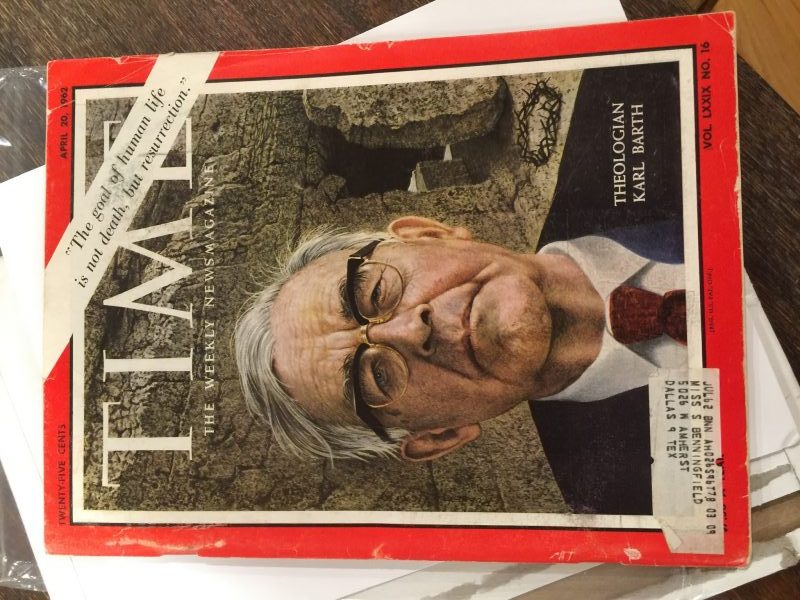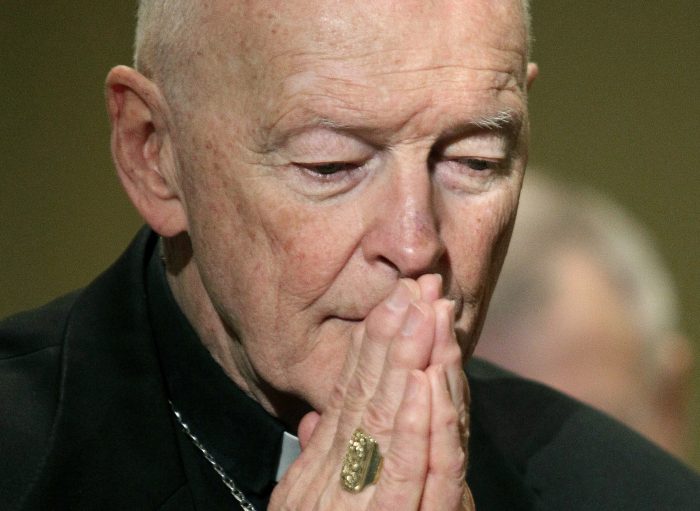
A Troubling Perspective on The Gospel Coalition (but what a lot of people have been saying)

Dane Ortland is very positive on the recent Gospel Coalition conference, especially his dad:

Really appreciated Matt Boswell’s leadership of the singing. That was one of my favorite things about the event. Don Carson on John 11 was rich indeed. Tim Keller on the new birth: typically insightful. Paul Tripp on suffering: deep wisdom. The best thing I heard all week was my dad’s talk ‘Pastor, Your Church Can Become Healthy Again.’ I wish everyone at the conference could have heard it. Searching, deepening, eye-opening, emboldening.

Scorecard results:

Carson – rich
Keller – typical
Tripp – deep
Ortland – bold

Then this:

I wonder what all of us who support TGC can do to consciously work against this great enterprise being quietly taken down by the flesh. Human nature being what it is, it seems to me virtually inevitable that an event such as this, with well-known speakers, and a big crowd, and a green room, and preachers quickly and quietly escorted around, provides a unique venue for venting the flesh, for schmoozing, for preening and parading–unless we deliberately fight against it. Left in neutral, we will slide toward worldliness; church history, the Bible, and honest self-knowledge all confirm this, unpleasant as the thought is.

Green room for celebrity preachers? Not standing in line with the hordes for donuts? Preening and parading? Sounds like the slide is already happening.

Hint: it has a lot to do with celebrity.

Why Calvinism Matters

When you need a check on virtue signaling (also known as brummagem moral grounds), where do turn but to Calvin or Mencken? The following (by a Dutch-American Reformed Protestant turned Roman Catholic, of all things) is a warning about reading charity as a sign of virtue:

Growing up Calvinist, we took great pride in our doctrines, and none more so than the idea of the total depravity of man. Even if we could take comfort in irresistible grace, we never lost our sense that we were sinful by nature and to the core. Regardless of our many merits, which we were ashamed to admit, we were but worms in the eyes of God.

One way to view the doctrine is that we are incapable of doing good without divine help. I am interested here, however, in the idea that everything we do is touched in some sense by our depravity.

Maybe another way of saying this is that everything we do, short of attaining the kind of theosis emphasized in Eastern Christianity, bears the stains of selfishness and the full range of human vices. Naturally, none of us like to believe this about ourselves. We like to think we are good, moral people. So a lot of time our actions carry an accompaniment of performance: we convince ourselves we are good when other people treat us as if we are so. We need their validation. Doing “good deeds” requires the recognition of others as a way of reinforcing our sense that we are good persons.

In Robert Penn Warren’s novel All The King’s Men, the central character, Jack Burden, is directed by the main political figure, Willie Stark, to dig up dirt on a political opponent. Responding to Jack’s protestations that there will be nothing to find, that the man in question is clean and can’t be intimidated, Wille responds: “Man is conceived in sin and born into corruption, from the didie to the shroud.” That is to say: every person who has walked this earth has something in their past, or in their present, that they are carrying around in shame, because that is the sort of creatures we are.

Surely this is part of what Madison meant when he said that government is the greatest of all reflections on human nature, and that whatever else is true of human beings, we are not angels. Nothing we do is untouched by our depravity.

…My point is not that human beings are incapable of doing good, nor that they are never what they claim to be. Rather, it’s to reemphasize that our actions are typically touched and tainted by self-interest, by hypocrisy, by a need to be thought well of. Thus, action must be attended by confession.

I’m not suggesting only religions which have ritualized confessions produce persons capable of doing good. I’m suggesting that moral action has as part of its equation serious introspection. Why am I doing this? Who benefits? How genuinely concerned am I about the well-being of the person who receives my help? How much does it matter to me that my acts receive recognition from others? Am I motivated by love? Power? My own sense of my superior knowledge?

There are no shortcuts on introspection, there is no cheap grace, and there is no “letting yourself off the hook” by convincing yourself that you are, after all, “doing good.”

If sinfulness still resides in worthwhile endeavors, imagine the dirt attached to hedonism.

Was Calvin’s Return to Geneva in 1541 a Miracle?

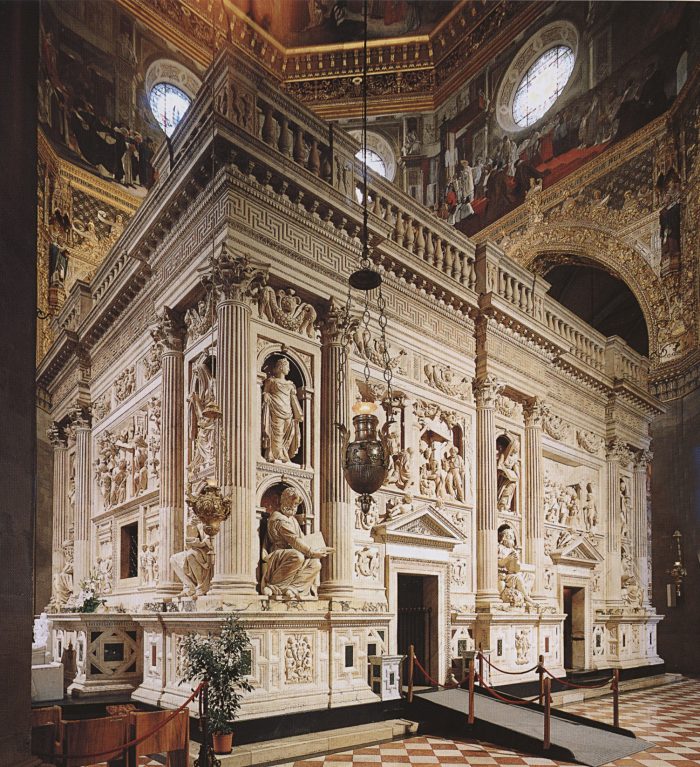
How much do Protestants associate the greatest hits of their churches’ history with anything like what Roman Catholics sometimes teach and believe about the House of Loreto. According to the Catholic Encyclopedia:

Since the fifteenth century, and possibly even earlier, the “Holy House” of Loreto has been numbered among the most famous shrines of Italy. Loreto is a small town a few miles south of Ancona and near the sea. … this building is honoured by Christians as the veritable cottage at Nazareth in which the Holy Family lived, and the Word became incarnate. … Angels conveyed this House from Palestine to the town Tersato in Illyria in the year of salvation 1291 in the pontificate of Nicholas IV. Three years later, in the beginning of the pontificate of Boniface VIII, it was carried again by the ministry of angels and placed in a wood near this hill, in the vicinity of Recanati, in the March of Ancona; where having changed its station thrice in the course of a year, at length, by the will of God, it took up its permanent position on this spot [six] hundred years ago. Ever since that time, both the extraordinary nature of the event having called forth the admiring wonder of the neighbouring people and the fame of the miracles wrought in this sanctuary having spread far and wide, this Holy House, whose walls do not rest on any foundation and yet remain solid and uninjured after so many centuries, has been held in reverence by all nations.”

Got that? The house where Mary and Joseph lived in Nazareth is now in Italy. No construction company performed the move. No, angels did. They moved the house not once but three — COUNT ‘EM THREE!! — times (or is it four?).

Are these miracles merely the outworking of local traditions and pious cults in southern Italy? No. Popes have approved these stories as true.

More than forty-seven popes have in various ways rendered honour to the shrine, and an immense number of Bulls and Briefs proclaim without qualification the identity of the Santa Casa di Loreto with the Holy House of Nazareth. As lately as 1894 Leo XIII, in a Brief conceding various spiritual favours for the sixth centenary of the translation of the Santa Casa to Loreto, summed up its history in these words: “The happy House of Nazareth is justly regarded and honoured as one of the most sacred monuments of the Christian Faith; and this is made clear by the many diplomas and acts, gifts and privileges accorded by Our predecessors. No sooner was it, as the annals of the Church bear witness, miraculously translated to Italy and exposed to the veneration of the faithful on the hills of Loreto than it drew to itself the fervent devotion and pious aspiration of all, and as the ages rolled on, it maintained this devotion ever ardent.”

Then the Catholic Encyclopedia’s authors go on to list the reasons for the authenticity of these miracles:

(1) The reiterated approval of the tradition by many different popes from Julius II in 1511 down to the present day. This approval was emphasized liturgically by an insertion in the Roman Martyrologium in 1669 and the concession of a proper Office and Mass in 1699, and it has been ratified by the deep veneration paid to the shrine by such holy men as St. Charles Borromeo, St. Francis de Sales, St. Ignatius Loyola, St. Alphonsus Liguori, and many other servants of God.

(2) Loreto has been for centuries the scene of numerous miraculous cures. Even the skeptical Montaigne in 1582 professed himself a believer in the reality of these (Waters, “Journal of Montaigne’s Travels”, II, 197-207).

(3) The stone on which the original walls of the Santa Casa are built and the mortar used in their construction are not such as are known in the neighbourhood of Loreto. But both stone and mortar are, it is alleged, chemically identical with the materials most commonly found in Nazareth.

(4) The Santa Casa does not rest and has never rested upon foundations sunk into the earth where it now stands. The point was formally investigated in 1751 under Benedict XIV. What was then found is therefore fully in accord with the tradition of a building transferred bodily from some more primitive site.

To their credit, the authors also acknowledge that this historical whopper of a story has not held up to scrutiny even from Roman Catholic historians:

It must be acknowledged, however, that recent historical criticism has shown that in other directions the Lauretan tradition is beset with difficulties of the gravest kind. These have been skilfully presented in the much-discussed work of Canon Chevalier, “Notre Dame de Lorette” (Paris, 1906). …The general contention of the work may be summarized under five heads: (1) From the accounts left by pilgrims and others it appears that before the time of the first translation (1291) there was no little cottage venerated at Nazareth which could correspond in any satisfactory way with the present Santa Casa at Loreto. … (2) Oriental chronicles and similar accounts of pilgrims are absolutely silent as to any change which took place in 1291. There is no word of the disappearance at Nazareth of a shrine formerly held in veneration there. … (3) There are charters and other contemporary documents which prove that a church dedicated to the Blessed Virgin already existed at Loreto in the twelfth and thirteenth centuries, that is to say, before the epoch of the supposed translation. (4) When we eliminate certain documents commonly appealed to as early testimonies to the tradition, but demonstrably spurious, we find that no writer can be shown to have heard of the miraculous translation of the Holy House before 1472, i.e., 180 years after the event is supposed to have taken place. … (5) If the papal confirmations of the Loreto tradition are more closely scrutinized it will be perceived that not only are they relatively late (the first Bull mentioning the translation is that of Julius II in 1507), but that they are at first very guarded in expression, for Julius introduces the clause “ut pie creditur et fama est”, while they are obviously dependent upon the extravagant leaflet compiled about 1472 by Teramano.

It is clearly impossible to review here at any length the discussions to which Canon Chevalier’s book has given rise….the balance of recent Catholic opinion, as represented by the more learned Catholic periodicals, is strongly in his favour.

And yet, over one hundred years later, popes still use the site of the house to inspire the faithful and stories from journalists include explanations like this:

The Basilica of the Holy House in Loreto contains the walls of what tradition holds to be the house in which the Virgin Mary lived when the Angel Gabriel announced that she was to give birth to Jesus.

Which of course raises several questions:

1) Isn’t belief in the virgin birth hard enough? Why add a unit of angels with “Wide Load” banners attached below their wings?

2) If Popes can lead the laity astray on historical details like this, are they all that trustworthy on wayward priests, at the low end, or on what Jesus said (by way of oral tradition), at the high end?

3) But let’s not blame the hierarchy entirely. Why are Roman Catholic laity so willing to go along with such myths, legends, and fabrications?

Instances like this make plausible lines like the following from Lyman Beecher, a (trigger warning) New School Presbyterian who was not sure how Roman Catholics would do in a republic:

If [Roman Catholics] could read the Bible, and might and did, their darkened intellect would brighten, and their bowed down mind would rise. If they dared to think for themselves, the contrast of protestant independence with their thralldom, would awaken the desire of equal privileges, and put an end to an arbitrary clerical dominion over trembling superstitious minds. If the pope and potentates of Europe held no dominion over ecclesiastics here, we might trust to time and circumstances to mitigate their ascendance and produce assimilation. But for conscience sake and patronage, the are dependent on the powers that be across the deep, by whom they are sustained and nurtured; and receive and organize all who come, and retain all who are born, while by argument, and a Catholic education, they beguile the children of credulous unsuspecting protestants into their own communion. (Lyman Beecher, Plea for the West, 1834)

So You Don’t like Cultural Marxism, How Does Social Gospel Work Then?

Carl Trueman is not convinced that #woke Christians are cultural Marxists. That is to give them too much credit:

Christians enamored with social transformation and who bristle at any notion that the gospel is more to do with things above than things below, would do well to ask whether they’re allowing the tastes of this culture-is-always-political world to intrude inappropriately on their own theology. To deny the pre-political, to focus on institutions, to condemn anyone whose church isn’t constantly addressing the latest fad of the 24-hour news cycle as somehow sinning—that is to mimic the world’s values, the world’s practices, and the world’s cheap outrage. In fact, calling that kind of behavior cultural Marxism is to flatter it far too highly, implying a sophistication that half-baked cheap shots simply do not possess.

I’m not so sure that some of the current “social” ministry among social justice Christians is distinct from cultural Marxism. After all, Trueman’s essay concedes that Marx has won:

We live in Marx’s world—a world where the cultural imagination is gripped by the idea that everything is political. Silence in today’s climate on any issue by anybody in any institution is unacceptable, for to take no political stand on anything in our world is in fact to take a political stand—a stand for the status quo.

Heck, cultural Marxism may be simply the air we breath, even another lever in the systemic powers that oppress, a force on the order of climate change. Who can withstand that great intellectual tsunami?

But if we must abandon the charge of cultural Marxism, that’s fine. Another is just as handy and even more accurate. It is the Social Gospel. Washington Gladden was the granddaddy of social ministry and he wrote many books and essays about the Social Gospel.

Does this sound familiar?

Every department of human life – the families, the schools, amusements, art, business, politics, industry, national politics, international relations – will be governed by the Christian law and controlled by Christian influences. When we are bidden to seek first the kingdom of God, we are bidden to set our hearts on this great commission; to keep this always before us as the object of our endeavors; to be satisfied with nothing less than this. The complete Christianization of all life is what we pray and work for, when we work and pray for the coming of the kingdom of heaven. (Applied Christianity 1894)

If only Gladden had used the adverb, gospelly.

Historians’ Lanes and When to Change Them

John Fea declares he is not going to believe William Barr’s evaluation of the Mueller report until he sees it for himself. Why? Because John is a historian:

Why? Because Barr’s letter is a secondary source. It is his own interpretation of the complete Mueller report. I have no idea if Barr’s summary is accurate until I read the entire Mueller’s entire report. This is how historians work. We go to the source. (Of course, future historians will also need to examine Mueller’s sources as well).

At this point, we know that Barr wrote the letter. One of the first things historians do when they read a document is “source” it. In other words, we take into consideration the author of the document.

We know, for example, that Barr is the Attorney General of the United States. This gives him some degree of authority. On the other hand, Barr is a Donald Trump appointee. This should also factor-in to how we interpret the document.

Barr quotes Mueller’s report in the document, but we do not know the larger context from which he pulled the quotes. (For example, some outlets are reporting that Barr did not quote an entire sentence from the Mueller report). This is just like when pseudo-historians like David Barton quote John Adams out of context and conclude that the United States was founded as a Christian nation.

Again, until I can read the document and do my best to interpret for myself (perhaps with the help of the writings of experts) I do not trust it. Check back with me later.

The problem here is that Fea’s identity does not go all the way down. He regularly links to journalists‘ and op-ed writers’ pieces without ever checking the sources that these other writers used. In which case, using the Barr summary to teach a lesson about the ways historians work seems like a way to avoid revealing political loyalty.

Other times, John has seemed to do history the way moralizers moralize. That was particularly the case in a recent post by Marie Griffith about the responsibilities of scholars at a university department dedicated to the study (not advocacy) of religion and politics:

At Religion & Politics, we have repeatedly pointed out that white supremacist and anti-Muslim ideologies are being energized by the speech and actions of Trump, along with the highest levels of his administration. It is not simply that Trump is hateful or seems worrisomely unwell, as many commentators have pointed out; it’s that the form of hatred he emboldens is deadly. . . .

Observers who deplore the violence will perhaps do small but important things, like donate money to fundraising efforts for the victims’ families or vow to help Muslims in their local communities feel safe. We’ve done it before; we’ll do it again. Having been through things like this so many times before, many despair that anything will change.

Pursuing big goals, however, is a marathon, not a sprint; and there will be no finish line in the race to end hate in the world. If the long history of clashes, collusions, and other interactions between religion and politics teaches us anything, it’s that. Once more, we grieve; once more, we resolve to do what we can—all that we can—to quell the fires of racism, anti-Semitism, and anti-Muslim bigotry that burn ferociously today.

Those are undoubtedly worthwhile goals but they sound more like the work of a humanitarian NGO than the task of the university.

Let the historical profession be historical.

Methodists for Machen

Machen may have been ahead of his time, even before Barth and Brunner:

Half a century ago it seemed to many that the Protestant theological movement usually designated as “modernism” or “liberalism” was finally being overcome and that the only liberals remaining were relics of nineteenth or early twentieth century thought. Of course, many lay persons who had been nurtured on modernism by their pastors and Sunday School curricula had not been exposed to serious critiques of liberalism by younger or more theologically enlightened pastors. Nevertheless, it seemed that the tide had turned. Despite their differences, continental European theologians like Karl Barth and Emil Brunner were giant slayers of liberalism, and it seemed that no one with a sound knowledge of biblical theology and Christian doctrine would take seriously the nostrums of liberalism. Nor did this mean the triumph of fundamentalism, a reaction to liberalism which had begun in the United States of America. The errors of both liberalism and fundamentalism were exposed, and serious Christians were engaged in a recovery of the apostolic and catholic faith albeit according to their own heritage—Lutheran, Reformed, Anglican, Methodist, etc.

Today it seems that many so-called mainline Protestants somehow missed the overcoming of liberalism. They consider themselves to be “progressives,” and while their terminology, themes, and concerns are not exactly the same as those of liberals a hundred years ago, progressives are direct descendants of liberals. Their self-chosen moniker of “progressive” indicates a belief in an ideology of “progress” (a predestined future of human aims by human means), which is descended from liberalism. Because of the chastening of liberal thought by the Neo-Reformation theologians like Barth, perhaps many progressives are anxious to profess their allegiance to the authority of scripture and doctrines of the church, but their profession of orthodoxy is belied by key interpretations which convert the meaning of scripture and doctrine which have been characteristic of Christianity from the beginning.

Because of a potential similarity between liberalism and progressivism, it is worthwhile to revisit some of the critiques of liberalism. One of the most famous was Christianity & Liberalism by J. Gresham Machen (1881-1937) published by Macmillan Company in 1923 when Gresham was a New Testament scholar at Princeton University. While Machen was a sophisticated scholar who published many books and articles for peer review, this book was written for the general reader. It was intended to be a manifesto against the dangers of liberalism in order to persuade clergy and laity to defend historic Christianity.

While this book is still well-known in Reformed evangelical circles, it has been largely overlooked by Protestants in mainline Protestant churches. Because Machen was a ecclesiastical activist who was an ally of fundamentalists in the battle against liberals, many Protestants assume that Machen himself was a fundamentalist. He was a conservative Reformed scholar who adhered to the theological school of thought known as the “Princeton theology,” but he was no fundamentalist. The “Princeton theology” is represented by the systematic theology of Charles Hodge and his son and the views of Benjamin Warfield who adhered to the teaching of John Calvin and who advocated for a doctrine of the ‘plenary inspiration” of the scriptures. Machen was critical of most of the features of fundamentalism, such as its millennialism and its advocacy of a few selected ideas they regarded as “fundamentals” rather than a robust adherence to the full Christian creed. While Machen adhered to a particular Reformed version of the faith, in this book he primarily defends the apostolic and catholic faith—or what C.S. Lewis would call “mere Christianity”—against liberalism. It is instructive that he book is titled Christianity & Liberalism, not “Fundamentalism & Liberalism.”

Perhaps one reason that this book has caused offense to mainline Protestants, who think of themselves as broad-minded, is because Machen contends that Christianity and liberalism are two different faiths. Some of the theologians who were roughly contemporary with Machen also strongly attacked the errors of theological liberalism, but they did not say bluntly that liberalism is contrary to Christianity. In 1907, the Scottish Reformed theologian P. T. Forsyth, in Positive Preaching and the Modern Mind, viewed liberal theology, “the theology that begins with some rational canon of life or nature to which Christianity has to be cut down or enlarged,” as a kind of theology which “works against the preaching of the Gospel.” In 1936, Karl Barth, in Church Dogmatics, I.1, The Doctrine of the Word of God, e.g. pp. 30-36, declares that “modernism” (or what he came to denote as “Neo-Protestantism”) is a “heresy” which is based on a false foundation but which still has the “form” of Christianity. Machen drew a harder line against liberalism as being in a different category altogether from Christianity. In the first sentence of his book Machen acknowledges that he takes the approach of making a sharp distinction between Christianity and liberalism so that the reader may be aided in deciding for himself between the claims of historic Christianity and liberalism. In all great contests of thought, there is always room for contestants to draw the lines as sharply as possible. After all, the most famous American liberal preacher, Harry Emerson Fosdick, had already taken the same approach in his polemical speech, “Shall the Fundamentalists Win?”…

Correcting liberalism takes more than Barthianism.

Orthodox Presbyterian Lady

At one point in our church life the missus and I were part of a missional work whose name we might have a hand in choosing. To avoid the common and somewhat tired names such as Redeemer or Calvary, I wanted to invoke the name of saints and was thinking especially of a set of Presbyterians with the name John — Muether, Machen, Witherspoon, Knox, and Calvin. To claim their names, I wanted to use Sts. Johns Church, a name that reflected a debt to these Presbyterians and that also acknowledged the Protestant conviction of the sainthood of all believers.

Needless to say, Sts. Johns was an epic fail.

A recent sermon on 2 (two?) John reminded me of this old idea. The epistle begins with this odd construction:

The elder to the elect lady and her children, whom I love in truth, and not only I, but also all who know the truth, 2 because of the truth that abides in us and will be with us forever

Our pastor plausibly argued that this was not an individual communication between the apostle John and a certain woman in the early church. Instead, “lady” was a word synonymous with a congregation or set of congregations in a city. (I also perked up that John referred to himself as an elder — “hey, that’s my office!”)

The last two verses of the epistle also make sense of this rendering of “lady”:

12 Though I have much to write to you, I would rather not use paper and ink. Instead I hope to come to you and talk face to face, so that our joy may be complete.

13 The children of your elect sister greet you.

If John were simply writing to one person, then this would be an odd communication to reach the status of canonical writing. And if it were also about one lady, then John was apparently writing to a set of sisters akin to Jane and Cassandra Austen.

So if lady does refer to a church, then it’s time (#metoo) that we put the word to ecclesiastical use.

If Not Imprecatory Psalms, What About the Lord’s Prayer?

Even Psalms that don’t register on the list of imprecatory ones can be a challenge to use if only because of their depiction of the death of God’s enemies. Some advise against their use and this was one of the reasons for not producing, as the OPC and URC did, a complete Psalter:

The psalmist was praying against those who persecuted him. The theocracy, God’s reign in Israel from the time of Moses to the time of Christ, was a shadow of future events (Heb. 10:1). One of those events is the final judgment of God. The destruction of the Canaanites in the days of Joshua was a shadow of the final judgment and not, therefore, normative for how we are to deal with our neighbors who do not believe in Jesus. The imprecations against the wicked in the book of Psalms were also shadows of the final judgment—appropriate for the era of the theocracy, but not for this present age. The gospel era is one of kindness, tolerance, and patience—intended to bring people to repentance and faith (Rom. 2:4). This is the day of salvation (2 Cor. 6:2). And this is why Jesus taught us to love our enemies and to pray for them, not against them. This is why Paul taught us to pray that God would bless our enemies (Rom. 12:14; 1 Cor. 4:12). Like the psalmist we leave vengeance to God, but unlike the psalmist we pray that God would bless those who bring pain into our lives. (Cornerstone Biblical Commentary, Psalms and Proverbs, pp. 348–49)

Others, though, notice that Christians still pray for God’s judgment upon his enemies even in the New Testament:

We need to be very conscious of trying—that part of what we’re called to be as the light of the world is people who love our enemies. Paul talks about how loving your enemies will further increase their punishment. So setting love of enemy radically over against judgment is not biblical.

I think it is not illegitimate to use the imprecations of the psalter to pray for judgment on God’s enemies. Every time we pray, “Come quickly Lord Jesus,” we’re praying an imprecation on God’s enemies. When Jesus comes again, there will be judgment for God’s enemies.

In other words, when Jesus taught his disciples to pray, he included the petition, “Thy kingdom come,” which as the Larger Catechism explains involves praying for the “hastening” of the kingdom of glory:

that Christ would rule in our hearts here, and hasten the time of his second coming, and our reigning with him forever

Not to be missed is the nature of the office that Christ executes as king:

Christ executeth the office of a king, in calling out of the world a people to himself, … restraining and overcoming all their enemies, and powerfully ordering all things for his own glory, and their good; and also in taking vengeance on the rest, who know not God, and obey not the gospel.

In which case, the anti-imprecatory Psalm position implies editing the Lord’s Prayer.

That does not mean that prayers for judgment day are easy to pray. The image of that great separation of the saved and the lost is haunting. At the same time, the thought of the end of the world is never absent from Christian devotion and worship.

On the upside, at least Protestants debate something that Roman Catholics don’t anymore thanks to an effort to manage less than good acts and desires with procedural standards and practices.

Who Sounds Protestant?

Another upgrader to Rome marvels about continuity between the ancient church and contemporary Roman Catholicism (were the church fathers as sexually confused as today?):

I haven’t officially tweeted this yet, but for the last 5-6 months, I’ve been struggling through a very unexpected twist in my Christian life: the Catholic Church. If you knew me before, you would know that this was the farthest thing from my mind for the past 30 years.

I was as anti-Catholic as they come (James White probably had me beat). The problem was, I knew NOTHING about their actually teachings. All I knew came from other anti-Catholic polemicists. Until I started a class on Church History (via a Reformed grad school). I was blown away.

In addition, I started to read the Church Fathers. Not what people say about the Fathers, but their actual letters and writings. This was HUGE in my dealings with the claims of Catholicism. They actually sounded Catholic and not Protestant.

Along with many, many pages of books, debates, and conversion stories, I started to really think that the Catholic Church is the Church that Christ founded 2000+ years ago. Now I am on the path towards full-communion with the Catholic Church. Crazy!

Have people like this never read Paul? What that apostle recommended to Titus does not sound like Roman Catholicism — eh veh:

1 Paul, a servant of God and an apostle of Jesus Christ, for the sake of the faith of God’s elect and their knowledge of the truth, which accords with godliness, 2 in hope of eternal life, which God, who never lies, promised before the ages began 3 and at the proper time manifested in his word through the preaching with which I have been entrusted by the command of God our Savior;

4 To Titus, my true child in a common faith:

Grace and peace from God the Father and Christ Jesus our Savior.

5 This is why I left you in Crete, so that you might put what remained into order, and appoint elders in every town as I directed you— 6 if anyone is above reproach, the husband of one wife, and his children are believers and not open to the charge of debauchery or insubordination. 7 For an overseer, as God’s steward, must be above reproach. He must not be arrogant or quick-tempered or a drunkard or violent or greedy for gain, 8 but hospitable, a lover of good, self-controlled, upright, holy, and disciplined. 9 He must hold firm to the trustworthy word as taught, so that he may be able to give instruction in sound doctrine and also to rebuke those who contradict it.

10 For there are many who are insubordinate, empty talkers and deceivers, especially those of the circumcision party. 11 They must be silenced, since they are upsetting whole families by teaching for shameful gain what they ought not to teach. 12 One of the Cretans, a prophet of their own, said, “Cretans are always liars, evil beasts, lazy gluttons.” 13 This testimony is true. Therefore rebuke them sharply, that they may be sound in the faith, 14 not devoting themselves to Jewish myths and the commands of people who turn away from the truth. 15 To the pure, all things are pure, but to the defiled and unbelieving, nothing is pure; but both their minds and their consciences are defiled. 16 They profess to know God, but they deny him by their works. They are detestable, disobedient, unfit for any good work.

Notice Paul says God reveals himself by preaching. He never mentions the sacraments in his instructions to a man who is planting a church. Odd. Though the shot at Jewish myths might make you want to check what you are doing with an altar and sacrifice in worship.

He also says overseers (bishops or presbyters) should be married to only one wife. So much for clerical celibacy.

In chapter two, Paul goes on to bang the gong for doctrine — the meat and drink of logocentric Protestants.

Then in chapter three, Paul tells Titus to be subject to the ruling authorities and to teach Christians to do the same. Let’s just say that the papacy has had a little trouble thinking such instruction applied to them. Heck, they still have a Vatican jail and mete out temporal justice.

But the church fathers don’t sound Protestant. Whatehveh.

Flexible on Lent but not The Wire

Tim Challies thinks Trevin Wax is sensibly moderate about observing Lent:

This much is beyond dispute: Nowhere in the Bible are we commanded to observe Ash Wednesday, Lent, Good Friday, Easter, or any other holy day. Nowhere are we forbidden. For that reason, these are holidays that some Christians may choose to observe while others may choose not to, and both are free to do so according to desire and conscience. “One person esteems one day as better than another, while another esteems all days alike. Each one should be fully convinced in his own mind,” says Paul (Romans 14:5). If it’s your conviction that observing these days is consistent with the Bible, then by all means do so. If it’s your conviction that observing them is inconsistent with the Bible, then by all means refrain. And as you celebrate or refrain, be careful not to judge or condemn those who choose the opposite. (You couldn’t go wrong reading Romans 14 this time of year.)

I believe Trevin Wax does a good job of cautioning both camps. To his friends who observe Lent he cautions “to not give off the impression that their brothers and sisters who refrain are ‘missing out,’” since if the practice was that beneficial to spiritual growth, God’s Word would have commanded it. He also warns against inadvertently offending “a weaker brother who found their former Catholicism or Anglicanism or whatever high-church tradition they were a part of to be life-draining, rather than life-giving.” Those who observe these days have a loving responsibility toward those who do not. To his friends who do not observe Lent he cautions “don’t impugn the motives of those who have found spiritual benefit in setting aside a time of the year for reflection on Christ’s passion.” I appreciate Wax’s concern and wisdom. Again this is Romans 14 stuff—basic, not advanced, Christianity.

Of course, part of the problem is that Lent used to be more like what Judaizers promoted — a sin that could keep you from heaven. As Philip Jenkins reminds those who practice Lent-lite:

To see just what Lent meant in earlier times – between about 500 and 1600 – we can also look at some ancient churches around the world, like in Christian Ethiopia: “This fast follows the old law, for they do not eat at midday, and when the sun is setting they go to church and confess and communicate and then go to supper.” Even when allowed to eat, “they eat nothing that has suffered death, nor milk, nor cheese, nor eggs, nor butter, nor honey, nor drink wine. Thus during the fast days they eat only bread of millet, wheat and pulse, all mixed together, spinach and herbs cooked with oil.” A Western observer noted that “The severity of their fasts is equal to that of the primitive church. In Lent they never eat till after sunset.” They kept that up for forty tough days.

In medieval times, European Christians also behaved much like that. Some accounts suggest that, especially in Holy Week, Christians were expected to get by on two or three meals in the entire week, never mind in any given day.

Imagine Paul saying, “don’t impugn the motives of the Judaizers,” just use your discernment about additions to the simplicity of trusting Christ alone.

At the same time, why is Challies generally of the conviction that Christians should not watch television shows and movies that include sexual content? How do you recommend moderation for the liturgical calendar but draw clear lines for artistic productions that contain sinful situations?