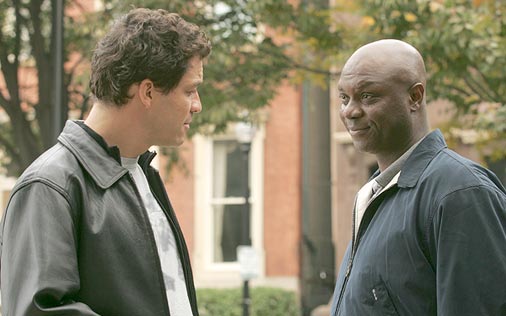
Is Tony Soprano in Hell?

That is the question that Ross Douthat uses to respond to Rob Bell’s query about whether Christians must believe that Ghandi is in hell for being Hindu (probably not the best way of putting it since the eternal destiny of any human, aside from Christ, has not been part of Protestant church dogma).

Here is part of Douthat’s reasoning:

Atheists have license to scoff at damnation, but to believe in God and not in hell is ultimately to disbelieve in the reality of human choices. If there’s no possibility of saying no to paradise then none of our no’s have any real meaning either. They’re like home runs or strikeouts in a children’s game where nobody’s keeping score.

In this sense, a doctrine of universal salvation turns out to be as deterministic as the more strident forms of scientific materialism. Instead of making us prisoners of our glands and genes, it makes us prisoners of God himself. We can check out any time we want, but we can never really leave.

The doctrine of hell, by contrast, assumes that our choices are real, and, indeed, that we are the choices that we make. The miser can become his greed, the murderer can lose himself inside his violence, and their freedom to turn and be forgiven is inseparable from their freedom not to do so.

As Anthony Esolen writes, in the introduction to his translation of Dante’s “Inferno,” the idea of hell is crucial to Western humanism. It’s a way of asserting that “things have meaning” — that earthly life is more than just a series of unimportant events, and that “the use of one man’s free will, at one moment, can mean life or death … salvation or damnation.”

If there’s a modern-day analogue to the “Inferno,” a work of art that illustrates the humanist case for hell, it’s David Chase’s “The Sopranos.” The HBO hit is a portrait of damnation freely chosen: Chase made audiences love Tony Soprano, and then made us watch as the mob boss traveled so deep into iniquity — refusing every opportunity to turn back — that it was hard to imagine him ever coming out. “The Sopranos” never suggested that Tony was beyond forgiveness. But, by the end, it suggested that he was beyond ever genuinely asking for it.

The entire piece is worth reading not only for its explicit point but also to show that as supposedly debased and secular as American society is, it still permits arguments like Douthat’s – at the New York Times no less. Way to go, Ross. Way to go, light of nature.

Al Mohler, the Gospel Coalition, and Me (about whom it always is)

Name-dropper alert: Al Mohler and I have been friends for over two decades. (The Harts used to be on the Mohler’s Christmas card list until the former’s nomadic way of life prompted USPS to stop forwarding those attractive greetings from the president’s house in Louisville.) Al and I met when we were participants in a Lilly Endowment project for young Protestant leaders. Because Lilly has historically been most interested in mainline Protestant communions, the religious leaders in Al’s and my group were mainly from the mainline. But because Lilly was aware of the growing prominence of evangelicalism in the United States, they included so-called conservative Protestants, which left Al and me the beneficiaries of mainline Protestant affirmative action. We held hands (not literally) and commiserated over the social justice orthodoxy that continued to prevail among mainliners, and we expressed mutual surprise at how little the Trinity of race-class-gender had come in for revision among those Protestants ever looking for excuses to revise. When a couple years later I was looking for a co-editor for a book on evangelical theological education, Al who had been recently appointed president of Southern Baptist, the flagship seminary of the Southern Baptist Convention, was a natural for the book project.

All of this is to say that Al and are friends, we are co-authors, and we also affirm the five points of Calvinism.

But all of this coalition potential would not generate a second look at my candidacy if Southern Seminary had an opening in church history and I applied for the job. As Calvinistic as SBTS may be, it is also an agency of one of the conventions (Southern Baptist polity is so Byzantine) within the SBC. That means that my membership and identity as an Orthodox Presbyterian is a non-starter at Southern Seminary. What may be strike-two against me is my disbelief in evangelicalism. Strike three is a less than winning personality (though the Harts’ felines, Cordelia and Isabelle seem to enjoy my ornery companionship). Even aside from these other drawbacks, not being Southern Baptist is enough of a strike to count me out – like those backyard wiffle ball versions of home run derby which dispense with all three strikes.

So big an obstacle is my ecclesiastical identity that even if I joined the Gospel Coalition Al would still not have enough approving material in my dossier to recommend me to his board for a faculty appointment. Indeed, joining TGC would arguably deconstruct my efforts to deconstruct evangelicalism, and might even send the message that I am a kinder and gentler warrior child of J. Gresham Machen. But Gospel Coalition status still would not be enough for me to clear the hurdle of Southern Seminary’s faculty requirements.

For what it’s worth, when I was academic dean of Westminster California, if we had had an opening in theology and if Al had been interested in a change of scenery, his Calvinism and courageous and commendable stands against various theological and cultural ills would not have been enough to get him to the interview stage. His Southern Baptist credentials would have failed to meet the requirements for Westminster faculty. And in case this is not obvious by now, Al’s identity as a Southern Baptist would also disqualify him from holding office in the Orthodox Presbyterian Church.

This leaves us with the following set of memberships and identities:

The Southern Baptist Convention rejects D. G. Hart because he is Orthodox Presbyterian.

The Orthodox Presbyterian Church rejects Al Mohler because he is Southern Baptist.

The ‘Gospel Coalition accepts Al Mohler and D. G. Hart no matter what their ecclesial identities (if they choose to join).

This picture would seem to make the Gospel Coalition a commendable organization in that it looks aside from seemingly petty ecclesiastical differences in order to unite seemingly conservative Protestants together in promotion of Christ as revealed in the gospel. And set of allegiances would also seem to depict the Southern Baptist Convention and the Orthodox Presbyterian Church as narrower and more divisive than the simple gospel of Jesus Christ and its proclamation.

Beneath this picture’s warm and alluring hues is the downside of the Gospel Coalition, namely, that they run their affairs as if the church does not matter, as if the gospel is independent of every church affiliation and membership (Protestant, that is). That may sound strong but ecclesiastical membership and ordination pose no apparent barrier to working with, attending, or speaking at the Coalition. The reason for setting up an organization free from denominational norms apparently is to get around the difficulty that confronts administrators at denominational seminaries and officers in churches: ecclesiastical standards are divisive and the creators of the Coalition seem to think that the gospel should not nurture such separation. For a confessional Protestant, this logic is a huge problem since confessionalists believe that the gospel not only inevitably produces good works but also is inevitably embodied in a disciplined ecclesiastical body. This is not, by the way, simply the oddity of hard-core Missouri Lutherans or vinegary Orthodox Presbyterians. It is also the outlook of Southern Baptist institutions like Southern Seminary (such as I understand it).

But an even deeper problem for the Gospel Coalition is that its cultivates its appeal through religious stars who have established their reputations not in parachurch ministries but through the churches themselves. In which case, the Gospel Coalition wants the results of the hard work of ordination and pastoral ministry in church settings without the baggage that comes in those ecclesiastical institutions. (And as long as the Gospel Coalition is an exclusively Protestant outfit, it will implicitly rely on differences that divided the Eastern and Western branches of the church, and on the churches that broke with Rome in the sixteenth century. Short of the new heavens and new earth, we can’t have Christianity in this world apart from the visible churches who translated the Bible, interpreted its teaching, established forms of worship, and determined qualifications for membership and office.)

Most if not all of the figures who attract the hearers and viewers of TGC materials and events are ministers. Their credentials come either from denominations or congregations. These communions are responsible for creating the spiritual capital that gives credibility to the Coalition’s speakers and authors. These pastors in turn add value to this capital by conducting successful ministries (leaving aside that thorny question of what constitutes success in the kingdom of God). The Coalition then assembles the most successful pastors, shorn of their denominational or congregational ties, either during the minutes it takes to conduct a Youtube video or over the course of several days at a conference. The Gospel Coalition adds no inherent value to the capital that these pastors and their churches have created and invested. No offense to Justin Taylor or Colin Hansen, but American evangelicals are not signing up to attend the Coalition conference because those young and restless editors and bloggers are speaking.

This leaves the Coalition with a product that is worth only a percentage of the ecclesiastical currency that the ministers (and the communions they represent) have created. To be sure, the gospel is of incomparable value. But Christ did not complete the gospel merely by his death, resurrection, and ascension. The last I checked, he commissioned apostles, inspired authors of sacred writings, ordained means of grace, gave instructions for planting churches, and included rules for those churches’ government and discipline. The reason would apparently be that sheep need shepherds, that believers need to hear the gospel longer than an evangelistic sermon lasts and learn of its implications for a longer time than at a two-day conference. They need to hear the gospel their entire life, and that means they need pastors and overseers who will be faithful, hence all the mechanisms to insure the creation and maintenance of sound pastoral ministry, and the rules governing how those ministers conduct worship and oversight.

Yet, the Gospel Coalition seems to regard all of this ecclesiastical work as incidental to the gospel, as a mere appurtenance. How else can one explain the indifference to the communions from which their speakers and leaders come? How else to explain that those speakers and leaders could not hold jobs or receive calls in the other speakers and leaders’ communions? For the sake of the Gospel Coalition’s gospel, those differences and separations are unimportant compared to the gospe.

But at institutions like Al Mohler’s Southern Baptist Seminary they do. For that reason, I’d rather live in the real world of respectful differences between the SBC and the OPC in their diverse efforts to follow all of Christ’s Great Commission (word, sacrament, and discipline) rather than the la la land of the Gospel Coalition where speakers and audiences act as if such differences don’t matter and where members of different communions are tempted to forget about the ecclesiastical vows and think that what happens in Chicago stays in Chicago.

Postscript on fellowship: Readers may be thinking that the point here about the church and the parachurch here make sense, but is there no room for pastors and members from different churches and denominations to fellowship together? Should the Banner of Truth stop offering conferences?

Part of the answer depends on what we mean by fellowship. If a Southern Baptist pastor cannot minister in the OPC without rejecting his former views on baptism and polity (for starters) and subscribing the OPC’s confession of faith, then it is fair to conclude that the OPC and the SBC are not in fellowship. And if a Southern Baptist transferring his membership into the OPC has to go through the same examination as someone who is a recent convert, then again fellowship is not the word we would use to describe this relationship.

Was it fellowship that I had with my parents when we prayed before meals, even though they were Baptists and I an Orthodox Presbyterian? Probably, but not in an ecclesial sense.

In which case, why do paraecclesial ideas about fellowship trump ecclesial ones? Why is a gathering of ministers at a Banner of Truth Conference more “sweet” than the relations among pastors and elders at a presbytery meeting? Or why is a Gospel Coalition conference (or a Philadelphia Conference on Reformed Theology, for that matter) more moving and invigorating than an ordinary Lord’s Day sandwiched by two preaching services?

It could be that the conferences are subjectively more moving than worship. Or it could be that spiritual standards, like the decline of cultural standards from watching too much television, have declined thanks to the prevalence of revivals, conferences, and retreats – all of those man-made devices for generating devotional excitement.

Of course, it is a free country. We do not have a federal agency regulating spiritual life (I don’t think they have one even in Moscow, Idaho). So parachurch agencies are free to have their conferences and American evangelicals are free to flock to them and feel warm and filled. At the same time, confessional Protestants are free to wonder what good these extra-ecclesial forms of fellowship are doing to the means that we do know God ordained through the clear teaching of his word. If the experiential Protestants are really serious about biblical inerrancy, wouldn’t you think they would want to be faithful to what God has inerrantly revealed about the means he has promised to use to save his people (even when they don’t feel “it”)?

Luther Answers the Question

Such justification is hidden not only from reason and the world but also from the saints. For it is not a thought, word, or work in us, but it is quite outside and above us, for it is Christ’s going to the Father, which means His suffering, Resurrection, and Ascension. And this does not take place within the range of our senses, so that we might see or feel it; but we can grasp it through faith alone.

And this is a remarkable justification, that we should be called just or possess a righteousness which is no work or thought of ours, and is nothing in us, but is completely outside of us, in Christ, and yet is truly made ours through His gracious gift and as completely our own as if it had been attained and merited by our own selves. No reason could understand this language which gives the name justification to me where I neither do or suffer anything, neither think, sense, or feel anything, and there is nothing in me by reason of which I could be saved and made well-pleasing to God; but apart from myself and all man’s thoughts, works, and powers, I hold on to Christ (seated on high at the right hand of the Father), although I cannot see Him.

But faith can grasp it and build upon it and find strength through it in the midst of temptation. (Exposition of John 16)

Speaking Truth to Fame

Carl Trueman has some provocative thoughts on the difference between American and British evangelicalism and the conferences that sustain them. He was speaking at an event in Wales:

First, the conference was built around content not speakers. In fact, I was almost refused entry to my own final seminar because I could not find my armband. I was unrecognized by the steward even after speaking three times. Fantastic. In the UK, people come to hear what is said; they do not particularly care for who is saying it. This is subtly evident in the way events are marketed in the two countries. It also points to a major cultural difference. In the US in general, there is great suspicion of institutions yet huge and often naïve confidence placed in individuals. This is part of what makes celebrity culture so important, from politics to the church. In the UK, there is an often naïve trust in institutions but far more suspicion of individuals. I make this point as an observation; but also to flag the fact that US culture lends itself more readily to the problems Paul highlights in 1 Corinthians.

That would seem like a point that folks at the Gospel Coalition, Together for the Gospel, RCA Annual Integrity Leadership Conference organizers, and even the Alliance of Confessing Evangelicals might want to consider.

And it may point to another difference between American and British evangelicals: born-again Americans are suckers for an English accent, even if it expresses thoughts disagreeable.

Look At All the Detail (and Beware the Adverbs)

When teaching on the historical development of Reformed Protestantism I have been struck lately by the greater and greater amounts of detail into which the Reformed churches went in descriptions of the Holy Spirit’s work. If you look (see below) at the Heidelberg Catechism (1563) you don’t see much beyond affirmations of faith, regeneration, and the work of the Holy Spirit. (I don’t think I have been overly selective.) And if you look at the nature of conversion, as sixteenth-century Protestants understood it, you see a notion much closer to Nevin’s idea of organic and life-long development than to the First Pretty Good Awakening’s standard of a moment of crisis of existential proportions.

When it comes to the Shorter Catechism (1647), you see much more detail (see below) about the layers and stages of the work of the Holy Spirit, not to mention the ordo salutis. You still don’t see any modern conception of conversion. The Divines were still thinking in terms of mortification and vivification over the course of a saint’s life. But effectual calling receives attention in a detailed way, and faith and repentance have descriptions that go beyond what the sixteenth-creeds or catechisms. (I suspect the influence here of Puritan practical or experimental divinity.)

Which then brings us to the American Presbyterian Church’s Plan of Union from 1758, a document that brought the Old Side (anti-revival) and New Side (pro-revival) back together in a hodge-podge of objective and subjective formula. What you see is even more detail regarding the inner workings of the Spirit than in the Shorter Catechism. Which is a puzzle to me. These Presbyterians already affirmed the Shorter Catechism. If they had only subscribed Heidelberg, they might have wanted a fuller statement of the Spirit’s work. But they had one. And they felt compelled to add girth to the Shorter Catechism’s already full figure. I suspect the influence of pietism and revivalism where the quest for spiritual authenticity requires ever greater levels of specifying the Spirit’s work.

Heidelberg Catechism
Q.21. What is true faith?
A: True faith is not only a certain knowledge, whereby I hold for truth all that God has revealed to us in his word, but also an assured confidence, which the Holy Ghost works by the gospel in my heart; that not only to others, but to me also, remission of sin, everlasting righteousness and salvation, are freely given by God, merely of grace, only for the sake of Christ’s merits.

Question 65. Since then we are made partakers of Christ and all his benefits by faith only, whence does this faith proceed?
Answer: From the Holy Ghost, (a) who works faith in our hearts by the preaching of the gospel, and confirms it by the use of the sacraments. (b)

Q 88. Of how many parts does the true conversion of man consist?
A: Of two parts; of the mortification of the old, and the quickening of the new man.

Q 89. What is the mortification of the old man?
A: It is a sincere sorrow of heart, that we have provoked God by our sins; and more and more to hate and flee from them.

Q 90. What is the quickening of the new man?
A: It is a sincere joy of heart in God, through Christ, and with love and delight to live according to the will of God in all good works.

Shorter Catechism
Q. 30. How doth the Spirit apply to us the redemption purchased by Christ?
A. The Spirit applieth to us the redemption purchased by Christ, by working faith in us, and thereby uniting us to Christ in our effectual calling.

Q. 31. What is effectual calling?
A. Effectual calling is the work of God’s Spirit, whereby, convincing us of our sin and misery, enlightening our minds in the knowledge of Christ, and renewing our wills, he doth persuade and enable us to embrace Jesus Christ, freely offered to us in the gospel.

Q. 85. What doth God require of us that we may escape his wrath and curse due to us for sin?
A. To escape the wrath and curse of God due to us for sin, God requireth of us faith in Jesus Christ, repentance unto life, with the diligent use of all the outward means whereby Christ communicateth to us the benefits of redemption.

Q. 86. What is faith in Jesus Christ?
A. Faith in Jesus Christ is a saving grace, whereby we receive and rest upon him alone for salvation, as he is offered to us in the gospel.

Q. 87. What is repentance unto life?
A. Repentance unto life is a saving grace, whereby a sinner, out of a true sense of his sin, and apprehension of the mercy of God in Christ, doth, with grief and hatred of his sin, turn from it unto God, with full purpose of, and endeavor after, new obedience.

Plan of Union (1758)
. . . all mankind are naturally dead in trespasses and sins, an entire change of heart and life is necessary to make them meet for the service and enjoyment of God; that such a change can be only effected by the powerful operations of the Divine Spirit; that when sinners are made sensible of their lost condition and absolute inability to recover themselves, are enlightened in the knowledge of Christ and convinced of his ability and willingness to save, and upon gospel encouragements do choose him for the Saviour, and renouncing their own righteousness in point of merit, depend upon his imputed righteousness for their justification before God, and on his wisdom and strength for guidance and support; when upon these apprehensions and exercises their souls are comforted, notwithstanding all their past guilt, and rejoice in God through Jesus Christ; when they hate and bewail their sins of heart and life, delight in the laws of God without exception, reverentially and diligently attend his ordinances, become humble and self denied, and make it the business of their lives to please and glorify God and to do good to their fellow-men, – this is to be acknowledge as a gracious work of God, even though it should be attended with unusual bodily commotions or some more exceptionable circumstances, by means of infirmity, temptations or remaining corruptions; and wherever religious appearances are attended with the good effects above mentioned, we desire to rejoice in and thank God for them.

Act Two, Scene Four: If the Bible Is the Standard, Are Faith and Repentance Required for Citizenship?

I haven’t been keeping up with Dr. Kloosterman’s serialized review of VanDrunen’s Natural Law and the Two Kingdoms. The series is reminiscent of the way that George Eliot and Charles Dickens wrote novels – you put together enough stories and episodes over a half-year in a magazine and you finally have one Home Depot of a novel. By going chapter by chapter, Kloosterman was pointing toward a review of novel-sized proportions. (It surely has its fictional elements.)

The last I noticed, when he came to VanDrunen’s chapter on Kuyper, Kloosterman indicated that he might need to back off lest the length of the series seem like a personal vendetta (ya think?):

First, institutional friends and defenders of NL2K are mistakenly characterizing this extended review as a personal attack or worse, an institutional polemic, neither of which has ever been the case. I have been writing this review as a Reformed theologian and ethicist who for several years has been vigorously and publicly disagreeing with the project and analysis being promoted by NL2K representatives, during which time I have never written as an institutional representative. Until now I had failed to realize that, as one respondent has put it, in criticizing Dr. VanDrunen’s views I would be perceived to be criticizing his school. Are we to conclude, then, that his NL2K project is that of an entire seminary? Moreover, the refusal of these friends and defenders to engage the substance of my observations in this review, which have been supported by contextual citations, numerous source references, and sustained argument, seems to suggest that there is more interest in securing turf than in seeking truth.

So it seemed in this fifth installment that Kloosterman was going to wrap up this review. Well, lo and behold, I now see that he has two reviews of the Kuyper chapter alone, and has since written three installments on the neo-Calvinist section of VanDurnen’s book (it is, of course, all Dutch all the time with Dr. K).

So here we go back to his first response to VanDrunen on Kuyper. Kloosterman boils down his entire objection to 2k in one simple point:

The very point of debate involves our use of and appeal to Scripture in public moral discourse, the authority of Scripture and the rule of Jesus Christ over Christian living in the world, involving issues like education, sexual ethics, marriage, euthanasia, and the like. We have just seen how Kuyper insisted on the need for, and priority of, Scripture for rightly interpreting and applying the natural law concretely.

So this is it — may we appeal to Scripture in public debates or not? Is the Bible the standard for public life or not? For Kloosterman it must be Scripture before natural law. Otherwise, sinful human beings will misinterpret natural law. Scripture is the only sure foundation.

I know I have said this before, but I do wonder if Dr. K. has actually considered where his logic leads him.

First, only the regenerate can interpret the Bible correctly because they have been illuminated by the Holy Spirit.

Second, only the regenerate have the capacity to interpret natural law correctly.

Third, unbelieving citizens have no possibility of participating in public life because they are unregenerate and cannot interpret the Bible correctly. Scripture cannot be a standard for them.

Fourth, unbelievers may not hold public office for the same reasons as the third point.

Fifth, Dr. K. is advocating a theocracy even though he doesn’t know it. He has no place in his scheme for unbelievers. If the Bible is the standard, the only people who submit to and read the Bible faithfully are those upon whom the Holy Spirit has worked.

So in his effort to bring the Bible back to the public square, Dr. K. has just vacated the square of all who cannot submit to Scripture.

Now, this is one possible solution to our predicament as Dr. K. understands it. All Christians can gather together in one nation (the Netherlands), or several Christian nations (the United States, Canada, and Scotland), and unbelievers can scatter to their nations. But haven’t we been here before? And isn’t that really the theocratic arrangement of the Old Testament?

Or we can affirm that every person has the capacity, though flawed, to perceive the moral law that God has written on the human heart and that is writ large in the book of nature. This morality is not sufficient for salvation. And it won’t see justice roll down like a river, maybe only like a faucet leak. But it is sufficient for the magistrates whom God has ordained to do their jobs in pursuing a measure of justice and establishing social order.

But if Dr. K. wants the Bible to be the standard without a Christian Taliban in power, how is it possible for non-believers to submit to the standard of Scripture for righteousness? That standard, the last I checked the creeds of the Reformed churches, includes saving faith and repentance for people to have any hope of complying with God’s law.

The only way, then, that divinely revealed law could be used as a standard for the United States, which included Christians and non-believers, might be for Dr. K. to revise what Scripture requires as its standard for goodness. Maybe he has in mind merely outward conformity to the norms of Scripture, but not a love of God with all one’s heart, soul, strength, and mind. But that would mean that Dr. K. had adopted an Arminian standard for public life. In which case his standard is no longer biblical.

Amazing the contortions we go through when we try to make the Bible speak to what we think is most important.

Advantages of Not Going to the Gospel Coalition Conference

Inspired by Darryl Dash’s (no relation) post on how to cope with not attending the Gospel Coalition conference (pointed out to me by one of our southern correspondents), I decided to use the theme to explore further differences between pietism and confessionalism.

Dead Orthodox

1) Save money for trip to Vegas

2) See more hot women at Happy Hour than at the Conference

3) Won’t miss appointment to have tattoo of Heidelberg Q&A 1 imprinted on my rear end (right cheek if you must know) at the parlor linked from the Acts 29 website

Confessional

1) Won’t miss cigars and single-malt night with the guys from the office

2) Won’t miss catechizing children

3) Won’t miss son’s first Little League practice (where the shortstop’s mother is rather attractive)

4) Get to finish first season of Treme

5) Won’t miss meeting with boss on opening the new facility in Richmond

Pietist

1) Can catch up on missed readings in M’Cheyne’s schedule

2) Won’t miss mid-week prayer meeting

3) Can finish Dallimore’s biography of Whitefield

4) Won’t miss watching American Idol with wifey and kids (J Lo is so funny)

5) Won’t have to listen to Julius Kim or any other professor from Westminster California

Nevin: Why Revivals Aren't the Answer

This is an account of Nevin’s experience as an undergraduate at Union College. It shows what happens to children of the covenant, away at college, when confronted with the modern revival system. And this was only 1819. Yikes!

Being of what is called Scotch-Irish extraction, I was by birth and blood also, a Presbyterian; and as my parents were both conscientious and exemplary professors of religion, I was, as a matter of course, carefully brought up in the nurture and admonition of the Lord, according to the Presbyterian faith as it then stood. I say with purpose as it then stood; for I cannot help seeing and feeling, that as a very material change has come upon since, and this in a way not without serious interest for my own religious life.

What I mean, will appear at once, when I state, that the old Presbyterian faith, into which I was born, was based throughout on the idea of covenant family religion, church membership by God’s holy act in baptism, and following this a regular catechetical training of the young, with direct reference to their coming to the Lord’s table. In one word, all proceeded on the theory of sacramental, educational religion, as it had belonged properly to all the national branches of the Reformed Church in Europe from the beginning. In this respect the Reformed Churches of Switzerland, France, Germany, Holland and Scotland were of one mind; and this mind still ruled, at the time to which I now refer, the Presbyterianism of this country. True, there was no use here of the rite of confirmation in admitting catechumens to full communion with the Church; but there was, what was considered to be substantially the same thing, in the way they were solemnly received by the church session. The system was churchly, as holding the Church in her visible character to be the medium of salvation for her baptized children, in the sens of that memorable declaration of Calvin (Inst 4.1.4), where, speaking of her title, Mother, he says: “There is no other entrance into life, save as she may conceive us in her womb, give us birth, nourish us from her breasts, and embrace us in her loving care to the end” . . . .

We had no religion in college, so far at least as morning and evening prayers went; and we were required, on Sundays, to attend the different churches in town. But there was no real church life, as such, in the institution itself. . . . . All this involved, of course — although, alas, I knew it not then — a very serious falling away from the educational and churchly scheme of religion, in which I had been previously born and bred. It was my very first contact with the genius of New-England Puritanism, in its character of contradiction to the old Reformed faith, as I had been baptized into it, in its Presbyterian form. . . . It is hardly necessary to say, that circumstanced as I then was, I had no power to withstand the shock. It brought to pass, what amounted for me, to a complete breaking up of all my previous Christian life. For I had come to college, a boy of strongly pious dispositions and exemplary religious habits, never doubting but that I was in some way a Christian, though it had not come with me yet (unfortunately) to what is called a public profession of religion. But now one of the first lessons inculcated on me indirectly by this unchurchly system, was that all this must pass for nothing, and that I must learn to look upon myself as an outcast from the family and kingdom of God, before I could come to be in either in the right way. Such, especially, was the instruction I came under, when a ‘revival of religion,’ as it was called, made its appearance among us, and brought all to a practical point. . . . For I, along with others, came into their hands in anxious meetings, and underwent the torture of their mechanical counsel and talk. One after another, however, the anxious obtained ‘hope;’ each new case, as it were stimulating another; and finally, among the last, I struggled into something of the sort myself, a feeble trembling sense of comfort — which my spiritual advisers, then, had no difficulty in accepting as all that the case required. In this way I was converted, and brought into the Church — as if I had been altogether out of it before — about the close of the seventeenth year of my age. My conversion was not fully up to my own idea, at the time, of what such a change should be; but it was as earnest and thorough, no doubt, as that of any of my fellow-converts. . . . It was based throughout on the principle, that regeneration and conversion lay outside of the Church, had nothing to do with baptism and Christian education, required rather a looking away from all this as more a bar than a help to the process, and were to be sought only in the way of magical illapse or stroke from the Spirit of God;. . . An intense subjectivity, in one word — which is something always impotent and poor — took the place of a proper contemplation of the grand and glorious objectivities of the Christian life, in which all the true power of the Gospel at last lies. My own ‘experience’ in this way, at the time here under consideration, was not wholesome, but very morbid rather and weak.

Alas, where was mother, the Church, at the very time I most needed her fostering arms? Where was she, I mean, with her true sacramental sympathy and care? How much better it had been for me, if I had only been properly drawn forth from myself by some right soul-communication with the mysteries of the old Christian Creed. (My Own Life, 1870)

Having His Confession and Feeling It Too

Whether he has too much time on his hands or is an outlier in the Gospel Coalition, Kevin DeYoung deserves kudos for reading books by Reformed confessionalists. Whether more reading will be sufficient to wean DeYoung off pietism is another matter. But he will have to spend more time on the topic if he is going to understand that leavening confessionalism with a dose of pietism will not result in healthy churches and grounded Christians. In the history of Protestanism, pietism has been the solvent rather than the medicine of Reformed churches.

Obviously, I agree with DeYoung when he agrees with me (it is often usually about ME!). So I was glad to read in his post the following reflection based on Lost Soul:

I am sympathetic with much of this critique of evangelical pietism. I agree with Darryl Hart’s contention in The Lost Soul of American Protestantism that American evangelicalism has tried too hard to be relevant, has largely ignored organic church growth by catechesis, has too often elevated experience at the expense of doctrine, has minimized the role of the institutional church, and has worn out a good number of Christians by assuming that every churchgoer is an activist and crusader more than a pilgrim. Confessionalism would be good tonic for much of what ails the evangelical world.

Of course, I agree that confessionalism is good. But it is way more than a tonic. It is the cure for evangelicalism. As chauvinistic as it sounds, the Reformers who established confessional churches were following carefully the teaching of Scripture. For that reason, confessionalism is biblical and to depart from it is to be – well – unbiblical. If confessionalism is simply an option, an item on column A of the Chinese menu of Christian devotions, then it could be a nice side dish to accompany a large helping of evangelicalism, or maybe the sour to add to evangelical piety’s sweet. That is not the way confessionalists look at confessionalism. It is the right way and to depart from confessionalism is just plain wrong.

From this perspective, I wonder if DeYoung notices the way that evangelicalism has tinkered with confessionalism. Confessionalism came first, pietism and revivalism came later, and they were efforts to correct the confessional churches. In which case, if I embrace DeYoung’s effort to combine the best of confessionalism and pietism, I am in the odd situation of accepting that confessionalism has defects that need correction. I don’t see it that way. Of course, I am not going to say that confessionalism was perfect. But I’m not sure of its defects and I don’t recognize the ones that DeYoung thinks are there. And this is where the antagonism between confessionalism and pietism resides. What are the Reformed churches’ defects? Is pietism a remedy?

Consequently, a “but” is hovering near DeYoung’s agreement with Lost Soul:

And yet, I worry that confessionalism without a strong infusion of the pietism it means to correct, can be a cure just as bad as the disease. Is there a way to reject revivalism without discounting genuine revival in the Great Awakening? Can I like Machen and Whitefield? Is there a way to say, “Yes, the church has tried too hard to Christianize every area of life” while still believing that our private faith should translate into public action? Hart argues that after revivalism Christian devotion was no longer limited to “formal church activities on Sunday or other holy days,” but “being a believer now became a full-time duty, with faith making demands in all areas of life” (13). Given the thrust of the book, I think it’s safe to say Hart finds this troubling.

Ya thnk?

Again, if you look at the history of Protestantism, it is hard to see how evangelicalism has anywhere retained confessionalism. Wherever revival fires have burned, within a generation a high view of the means of grace, church office, sober and ordered worship, and church teaching has gone the way of smoke. If you look at revivals – you better not look too closely. Notice the shrieks, the fainting, the tears, the laughing, the revivalists’ egos (Whitefield was quite the self-promoter and Ban Franklin profited from that publicity) – they have always been there. These antics led critics to charge revivalism with enthusiasm. Let me be clear: pietism and revivalism are enthusiastic. Edwards tried to give enthusiasm a philosophical gloss. But some philosophers aren’t buying.

But what about the problem of dead orthodoxy? This would appear to be the major defect of confessionalism. According to DeYoung:

While I agree wholeheartedly that experience does not a Christian make, I wish the strong confessional advocates would do more to warn against the real danger of dead orthodoxy. It is possible to grow up in a Christian home, get baptized as an infant, get catechized, join the church, take the Lord’s Supper, be a part of a church your whole life and not be a Christian. It is possible to grow up in an Old World model where you inherit a church tradition (often along ethnic lines), and stay in that church tradition, but be spiritually dead. There are plenty of students at Hope College and Calvin College (just to name two schools from my tradition) who are thoroughly confessional as a matter of form, but not converted.

I know DeYoung didn’t mean it this way, but his reference to Calvin and Hope is a bit of a cheap shot against confessionalism. As if the CRC and the RCA are beacons of confessionalism. As if anyone in Reformed circles these days associates these communions with Reformed orthodoxy, dead or alive. I don’t write these words with glee. I was ordained in the CRC during the women’s ordination imbroglio and still have fond memories and good friends among the Dutch-American Reformed. I wish the CRC were not what it is, and that the RCA had retained its seventeenth-century confessionalism, like when its pastors in New Netherland petitioned the colony’s governor to keep out the Lutherans (sorry Lily and John) and the Quakers.

Instead, and unfortunately, the CRC and RCA are examples not of dead orthodoxy but of communions that lost touch with confessionalism. The cure for those students at Calvin and Hope is not revival. John Williamson Nevin’s own account of his encounter with revivalism at Union College should give anyone pause in recommending revival to children of the covenant. The cure for those students is a consistory that doesn’t admit children to full communion until they have made a credible profession of faith – that is, a consistory that looks past the blonde hair and Queen Wilhelmina mints and recognizes these as children of Abraham who need to own their baptism by professing faith in Christ and living a life of repentance.

Plus, does DeYoung really pretend to think that pietistic churches don’t have unconverted in their midst, even those who have walked the aisle? Even Edwards thought the revival hadn’t taken. That’s part of the reason he came out with David Brainerd’s life and journals in 1749. Edwards’ church needed another dose of revival. So revival doesn’t cure. Or if it does cure, how do we know? How do we know that the folks walking down front during the altar call – what hip technique has replaced the altar call – are genuine? Isn’t it possible to fake a conversion experience?

The question, then, is whether revival is the means that God has appointed to save his people. I look in the pastoral epistles, and I look, and I look, and I don’t see it. What I see is Paul telling Timothy to discharge his ministerial duties faithfully in good seasons and bad. The pastor’s work – unlike the itinerant evangelist’s – is long, routine and sometimes boring that doesn’t have the lights, camera, and action of pietism and revivalism. But it may be the way that God actually saves a people for himself. And he has a history of using ordinary means to accomplish invisibly extraordinary ends.

So while DeYoung thinks confessionalists need to keep an eye out for dead orthodoxy, why don’t pietists or their enablers spend much time worried about live frivolity? When it comes to dead or alive, I get it. I’ll take life, thank you (though Paul is sitting on my shoulder telling me it is gain to be with the Lord – while Homer is yelling from the other shoulder – Doh!). But when it comes to orthodoxy and frivolity, it’s also a no-brainer. In which case, why do pietists so identify with life that they sacrifice orthodoxy for triviality, depth for breadth, teaching for feeling, sobriety for earnestness?

Maybe the problem is the way pietists view being alive. I don’t know of too many people these days who are orthodox but don’t believe. I don’t even know of too many in the heyday of orthodoxy, when it had the imprimatur of the state, who were orthodox and dead. Orthodoxy has never been an appealing position – you know, abominate yourself because of sin, look solely to Christ who is now your master and deserves your loyalty and obedience, submit to the oversight of undershepherds God has appointed for your good. Those are not ideas readily advantageous to anyone.

DeYoung does, however, indicate what he means by life. And it sets up a contrast with the kind of piety that confessionalism nurtures (this is not confessionalism against piety but against pietism):

But I want a certain kind of confessionalism. I want a confessionalism that believes in Spirit-given revival, welcomes deep affections, affirms truth-driven experience, and understands that the best creeds should result in the best deeds. I want a confessionalism that believes in the institutional church and expects our Christian faith to impact what we do in the world and how we do it. I want a confessionalism that is not ashamed to speak of conversion—dramatic conversion for some, unnoticed conversion for many.

So while DeYoung wants revival, confessionalists want the weekly observance of the means of grace.

DeYoung wants deep affections but confessionalists want sobriety and self-control.

DeYoung wants truth-driven experience and confessionalists want children to grow up and understand what they have memorized in the catechism (the way that children eventually learn the grammar of the language they grow up speaking).

DeYoung wants the best creeds to result in the best deeds while confessionalists want believers to live out their vocations so that plumbers will plumb like every other plumber to the best of their ability.

DeYoung wants the belief in the institutional church but confessionalists ask what’s up with the Gospel Coalition?

DeYoung expects our Christian faith to impact what we do in the world and how we do it while confessionalists believe in the spirituality of the church.

And DeYoung wants dramatic conversion while confessionalists want lifelong mortification and vivification (that is, the original Protestant meaning of conversion).

In sum, confessionalists are content with the Shorter Catechism’s description of the Christian life when it answers the question, “What does God require of us that we may escape his wrath and curse due to us for sin?”

A. To escape the wrath and curse of God due to us for sin, God requires of us faith in Jesus Christ, repentance unto life, with the diligent use of all the outward means whereby Christ communicates to us the benefits of redemption.

That is not all that fancy or elaborate a way of putting the Christian life but it has enough work for even the best of Christians. To trust Jesus daily and believe God’s promise that Christ is for me and that God is not faking it in the gospel, to repent daily of sin, and to attend weekly to the means of grace and order my affairs so that my attention is focused on the day of rest – that is a pretty full plate. Why pietists want to pile on is a mystery. It seems down right glutinous.

The Gospel Coalition's Thin-Skinned Long Arm

I did not see Kevin DeYoung’s post at his Gospel Coalition blog about confessionalism and pietism — and for good reason. Between the time you opened the page and blinked it was gone. (And it promised to be the first of a three-part series.)

(UPDATE: For those old enough to remember the Tonight Show when Johnny Carson was the host, and Doc Severinson was the band leader, Doc was not always present, often playing other gigs. Johnny regularly said to Ed McMahon, “Doc is here? Doc is not here.” In that same vein, Kevin’s post was not here. It is now here.)

Why it vanished from the Gospel Coalition website is a mystery. At the risk of shameless self-promotion, the reason may have to do with DeYoung’s decision to interact with The Lost Soul of American Protestantism, a book written by this blogger. Seemingly, any attention given to the Old Life case for confessionalism is improper at the Gospel Coalition because that case has uncomfortable implications for the gospel Allies.

And at the risk of seeing the Gospel Coalition administrators purge DeYoung’s thoughtful comments altogether from the Internet (they are currently available at his Facebook page), I am preserving his piece here below. Unlike the Gospel Coalition, where disagreements about polity, the sacraments, and even the eternal decrees, are not permitted to surface for the sake of fighting the Axis powers of inauthentic Christianity, I regard a blog as simply a place to discuss and kvetch. (I imagine that several days worth of Prozac and Prilosec comes with the registration packet at the Gospel Coalition conference to keep the conferees in good humor and free from indigestion.)

Here is DeYoung’s post (reaction to follow):

Can Pietism and Confessionalism Be Friends? (Part 1 of 3)

by Kevin DeYoung on Friday, April 8, 2011 at 12:27pm

Those outside Presbyterian circles may not be aware (and may not care), but there has been a lot of discussion over the past few years about the dangers of pietism and how it differs radically from the older (read: better) model of confessionalism. Pietism, it is said, emphasizes dramatic conversions, tends toward individualism, pushes for unity based on shared experience, and pays little attention to careful doctrinal formulation. Confessionalism, on the other hand, is a more churchly tradition, with creeds and catechisms and liturgy. It emphasizes the ordinary means of word and sacrament and prizes church order and the offices. It is pro-ritual, pro-clergy, and pro-doctrine, where pietism, it is said, stands against all these things.

I am sympathetic with much of this critique of evangelical pietism. I agree with Darryl Hart’s contention in The Lost Soul of American Protestantism that American evangelicalism has tried too hard to be relevant, has largely ignored organic church growth by catechesis, has too often elevated experience at the expense of doctrine, has minimized the role of the institutional church, and has worn out a good number of Christians by assuming that every churchgoer is an activist and crusader more than a pilgrim. Confessionalism would be good tonic for much of what ails the evangelical world.

Concern for Confessionalism

And yet, I worry that confessionalism without a strong infusion of the pietism it means to correct, can be a cure just as bad as the disease. Is there a way to reject revivalism without discounting genuine revival in the Great Awakening? Can I like Machen and Whitefield? Is there a way to say, “Yes, the church has tried too hard to Christianize every area of life” while still believing that our private faith should translate into public action? Hart argues that after revivalism Christian devotion was no longer limited to “formal church activities on Sunday or other holy days,” but “being a believer now became a full-time duty, with faith making demands in all areas of life” (13). Given the thrust of the book, I think it’s safe to say Hart finds this troubling.

Further, Hart clearly sides with the Old Side in New England that opposed the Great Awakening, its emphasis on inner experience, and the insistence that ministers be able to give an account of God’s work in their hearts (32-42). While I agree wholeheartedly that experience does not a Christian make, I wish the strong confessional advocates would do more to warn against the real danger of dead orthodoxy. It is possible to grow up in a Christian home, get baptized as an infant, get catechized, join the church, take the Lord’s Supper, be a part of a church your whole life and not be a Christian. It is possible to grow up in an Old World model where you inherit a church tradition (often along ethnic lines), and stay in that church tradition, but be spiritually dead. There are plenty of students at Hope College and Calvin College (just to name two schools from my tradition) who are thoroughly confessional as a matter of form, but not converted.

I have no hesitation in commending confessionalism. My concern is that pietism–with its private Bible study, small group prayer, insistence on conversion, and the cultivation of “heart” religion–is frequently set against confessionalism. For example, Hart agues, “Confessional Protestantism invites another way of evaluating the making of believers. Its history demonstrates the importance of inheritance and the way that believers appropriate faith over a lifetime through the sustained ministry and counsel of pastors as opposed to the momentary crisis induced by the itinerant evangelist or the pressures of sitting around a fire at summer camp” (184). I like the first sentence, but why so negatively caricature the work of itinerant evangelists and the real conversions that may come at summer camp? I could be misreading Hart. Maybe he has no problem with any of these things. But when he says, “the central struggle throughout Protestantism’s history has been between confessionalism and pietism, not evangelicalism and liberalism” (183), I worry that committed Presbyterians will steer clear of anything that gets painted with a broad brush as “pietism.”

A Confessionalism with Deep Piety

We all feel and respond to different dangers (for example, see Ligon Duncan’s post and William Evans’ post, both of which I like). No doubt, revivalistic, hyper-experiential, adoctrinal, deeds-not-creeds, tell-me-the-exact-moment-you-were-born-again, go-conquer-the-world-for-Christ Christianity has a load of problems. If that’s pietism, then I want no part of it.

But I want a certain kind of confessionalism. I want a confessionalism that believes in Spirit-given revival, welcomes deep affections, affirms truth-driven experience, and understands that the best creeds should result in the best deeds. I want a confessionalism that believes in the institutional church and expects our Christian faith to impact what we do in the world and how we do it. I want a confessionalism that is not ashamed to speak of conversion—dramatic conversion for some, unnoticed conversion for many.

I want a confessionalism that preaches and practices deep piety. Whether this is labeled “pietism” or just part of our rich confessional tradition doesn’t matter to me. What matters is that we have ministers and parishioners who realize there is an external and internal dimension to the faith. I want Christians to know that going to church, hearing the word, reciting the creeds, singing the hymns, and partaking of the sacraments is not peripheral to the Christian life; it our lifeblood. And I also want Christians who do all those things every week to pray in “their closets,” look for opportunities to share the gospel with the lost, submit to Christ’s lordship in every area of life, and understand that true faith is not only a knowledge and conviction that everything God reveals in his Word is true; it is also a deep-rooted assurance” that not only others, but they too “have been made forever right with God, and have been granted salvation” (Heidelberg Catechism Q/A 21).

Okay, I can’t resist one quick comment. Why does piety have to be “deep”? I understand that deep piety is good, and better than shallow piety. But what company makes the piety meter to detect whether it is deep or shallow? And what about those days when my piety is shallow? Am I less elect or justified? In other words, the word “deep” encourages an interest in me, not the gospel or God’s saving work.

This is not a reason to say, let’s have more shallow piety. But it may be a reason to be careful about the words we use lest we fall prey to the pride of thinking our own piety is deep. You’d think that folks who desire God and his glory might see how their piety standards nurture desires less theocentric and glorious.