Mere Confessionalism

From the Archives: Nicotine Theological Journal, January 1999

Mere Confessionalism

“In essentials, unity; in non-essentials, liberty; in all things, charity.” This is the motto of the Evangelical Presbyterian Church. (The expression itself is of some antiquity, and it may date back as early as St. Augustine.) At its founding in 1981 the EPC adopted a modern language version of the Westminster Confession of Faith as its doctrinal standard. At the same time it also adopted an eight- point “Essentials of our Faith” summary statement. The latter contains boiler-plate evangelical affirmations on the Bible, God, Christ, sin, salvation, and eschatology, in language that is mildly and non-militantly Calvinistic.

Are these two documents competing doctrinal standards? An interesting debate is playing out in the EPC now regarding what confessional status, if any, its “Essentials” possess and how they relate to the Westminster Confession. The “Essentials” themselves end this way: “These Essentials are set forth in greater detail in the Westminster Confession of Faith.” But rather than solve the question, that ambiguous language only heightens the confusion. Does it mean that the WCF itself – taken as a whole – is the “Essentials” in fuller form, or merely that these eight affirmations can each be found there as well? Are the “Essentials,” in other words, what the church really believes? Should the emphasis fall on the first or second word in the denomination’s name, “Evangelical Presbyterian Church”?

MOST CONSERVATIVE Presbyterians would likely contend that the EPC has misidentified the essentials of the faith. After all, it is open to women in church office and the ongoing exercise of the charismatic gifts. At the same time, the EPC debate is instructive, because its conservative Presbyterian critics also tend to employ some form of what can be called the hermeneutic of essentials, of identifying what the church may or may not tolerate. Presbyterian theologian, John Frame, for example, in urging the creation of leg room within the confessions, laments that “the whole question of what is and what is not tolerable within the church has not been systematically analyzed.”

Frame’s quest is not new. Efforts to isolate the “essentials” within the confession are almost as old as Presbyterianism itself. Frequently, it has been the progressives who have been eager to speak of a “system of doctrine,” in order to permit their deviation from the Confession and catechisms of the church. By “system” they mean the Confession “in-as-much” as what the Confession teaches is biblical. In this fashion, Presbyterian officers hold line-item vetoes to the church’s Constitution, and the church had erected a Confession-within-the-Confession.

But it is not only progressives who speak this language. In efforts earlier in this century by conservative Presbyterians to preserve the essence of historic Christian orthodoxy, some upheld the minimal necessity of the “five fundamentals” of the faith. The unintended effect was to reduce the “essential and necessary” articles of the church’s constitution to just five.

Especially of late the rhetoric of essentials is invoked in order to separate the Bible from the Confession in the name of the Reformation principle of sola scriptura. (Indeed, often it is phrased in the language of liberating the Bible from the confession.) Increasingly Presbyterian officers seem to be declaring, “never mind the Confession, show me where that is taught in Scripture.” But for Presbyterians, an officer is committed to sola scriptura precisely to the extent that he is a Confessionalist. Confessionalism does not eclipse the doctrine of sola scriptura. Rather, a confession is the necessary means for the church to uphold Biblical authority. The Presbyterian way to point to the doctrine of Scripture is to refer to the Confession.

FRAME DESCRIBES THIS VIEW AS chauvinistic. “Although I am a Presbyterian,” he writes, “I confess that I do not share [the] desire for us always to ‘look like Presbyterians’ before the watching world.” In context, Frame’s concern is specifically about worship, but by implication his views bear upon the relationship between The Nicotine Theological Journal will likely be published four times a year. It is sponsored by the Old Life Theological Society, an association dedicated to recovering the riches of confessional Presbyterianism.

IN DESCRIBING HIS STUDENT days at Westminster Seminary (in the early 1960s), Frame recalls two features of that course of instruction: it lacked an overt “confessional or traditional focus” and there was a spirit of creativity and openness in theological reflection. He goes on to make a startling admission: “After graduation I became ordained in the Orthodox Presbyterian Church, and I confess I was rather surprised at the seriousness with which my fellow ministers took the confessional standards and the Presbyterian tradition. Eventually I became more like my fellow Orthodox Presbyterian . . . elders, but not without some nostalgia for the openness of theological discussion during my seminary years.”

Our point is not to critique WTS or any other seminary. And whether Frame has described with accuracy the curriculum of WTS in the 1960s is not our concern either. But what is revealing is the dichotomy that Frame creates between “perpetuat[ing] and recommend[ing] the confessional traditions” on the one hand (which is where he finds WTS’s education flawed), and a “flourishing of original and impressive theological thought” on the other (where he thinks WTS excelled). This difference he goes on to attribute to Westminster’s understanding of sola Scriptura, which liberated the school from traditionalism and confessionalism.

BUT FRAME’S DICHOTOMY WAS unknown to previous generations of Reformed theologians. Calvin Seminary’s Richard Muller writes the following on the harmony of Scripture and confession: “We need creeds and confessions so that we, as individuals, can approach Scripture in the context of the community of belief.” Confessions function as mediating structures, standing between Scripture and the “potentially idiosyncratic individual” as “churchly statements concerning the meaning of Scripture.” They are “normative declarations spoken from within by the church itself . . . as the expression of our corporate faith and corporate identity.”

Muller’s work on Reformed scholasticism reminds us that there was a time when confessional integrity did not compete with sola scriptura, nor did it impede theological creativity. For the scholastic mindset, Muller notes, “Once a churchly confession is accepted as a doctrinal norm, it provides boundaries for theological and religious expression, but it also offers considerable latitude for the development of varied theological and religious expressions within those boundaries.” According to the Reformers, there is no churchman and there is no theologian where there is no confession. Why is that so unimaginable today? Why has the Reformation confidence in the creeds of the church vanished?

AS WE PREVIOUSLY ARGUED (“Sectarians All,” NTJ 2.2), such anti-traditionalism only serves to locate one within a specific tradition, namely the Enlightenment, and its false claim that an individual Christian, armed with autonomous rationality can approach Scripture from a traditionless perspective. The Reformers, Muller claims, refused to approach Scripture with the false dilemma forced upon the church by its adoption of categories of Enlightenment thought.

Muller goes on to describe other pressures that our age brings to confessional integrity. He refers to the “noncredal, nonconfessional, and sometimes even anticonfessional and antitraditional biblicism of conservative American religion.” Enlightenment rationality and democratic populism combine to create what Robert Godfrey has diagnosed as the evangelical impulse toward theological minimalism. This minimalism seeks to get as many people to express everything they agree on, and preferrably on one side of one sheet of paper. These affirmations become the truly “essential truths,” and the hills for evangelicals to die on. Godfrey is echoing the thoughts of J. Gresham Machen, who in his essay, “The Creeds and Doctrinal Advance,” described this impulse in the following way:

There are entirely too many denominations in this country, says the modern ecclesiastical efficiency expert. Obviously, many of them have to be merged. But the trouble is, they have different creeds. Here is one church, for example, that has a clearly Calvinistic creed; here is another whose creed is just as clearly Arminian, let us say, and anti-Calvinistic. How in the world are we going to get them together? Why, obviously, says the ecclesiastical efficiency expert, the thing to do is to tone down that Calvinistic creed; just smooth off its sharp angles, until Arminians will be able to accept it. Or else we can do something better still. We can write an entirely new creed that will contain only what Arminianism and Calvinism have in common, so that it can serve as the basis for some proposed new “United Church” . . . . Such are the methods of modern church unionism.

This impulse stands in sharp contrast to what Godfrey calls the theological maximalism of the Reformed, which sought at least in the past to extend the boundaries of the church’s confession in pursuit of the “whole counsel of God.” Moreover, Reformed maximalism and evangelical minimalism differ not only in the size of their creeds but in the very purpose of their creeds. To quote Machen again:

These modern statements are intended to show how little of truth we can get along with and still be Christians, whereas the great creeds of the church are intended to show much of the truth God has revealed to us in His Word. Let us sink our differences, say the authors of these modern statements, and get back to a few bare essentials; let us open our Bibles, say the authors of the great Christian creeds, and seek to unfold the full richness of truth that the Bible contains. Let us be careful, say the authors of these modern statements, not to discourage any of the various tendencies of thought that find a lodgment in the church; let us give all diligence, say the authors of the great Christian creeds, to exclude deadly error from the official teaching of the church, in order that thus the Church may be a faithful steward of the mysteries of God.

BUT IS ALL OF THIS FAIR TO evangelicalism? After all, no less an evangelical icon than C. S. Lewis contended for a “mere Christianity.” Yet Lewis himself was not confused about his beliefs, which he said were found in the Anglican Book of Common Prayer. His search for a “mere” Christianity was not an alternative to the creeds of the church. Rather, he likened it to the difference between the halls and rooms of a mansion. “Mere” Christianity may bring one into the hall. “But it is in the rooms, not in the hall, that there are fires and chairs and meals.” The “worst of the rooms,” he went on to stress (perhaps thinking of a dimly lit and drearily decorated attic of Calvinistic horrors), is to be preferred over the hall.

Whatever Lewis intended, his words have been hijacked to serve unhealthy purposes. The ambiguities of the expression, “Mere Christianity,” can be found in many of Lewis’ disciples. And when it meets contemporary evangelicalism, there is a volatile mix that may prove lethal to the theological reflection and confessional identity of the church.

CONSIDER TOUCHSTONE magazine, which had recently changed its subtitle from “A Journal of Ecumenical Orthodoxy” to “A Journal of Mere Christianity.” Its editorial purpose is to “subordinate disagreements to the common agreement” because the crisis of our day is so grave. Here we must recognize the debilitating effects of the so-called culture wars on the confessional identity of the church. Abortion, Gay rights, women’s rights, funding for and legal protection of pornographic artists, evolution in the public schools — all of these are battle fronts in the increasingly rancorous struggle over the meaning and purpose of America. And these are the causes to which Christians should devote their energy.

“We need to identify the ‘real enemy’,” urges Touchstone, and that enemy is without, not within. What is said moderately in Touchstone can be found in more virulent form in Peter Kreeft’s Ecumenical Jihad. For Kreeft, mere Christianity may not even be recognizably Christian. The moral decay of America, with all of its leading indicators of spiritual decline, is creating new alliances, even among those of differing religious convictions. The old fashioned Protestant v. Catholic v. Jewish warfare is passe. So great is the threat of secular humanism and so united are we with former antagonists on the really crucial issues, that even evangelical Christians, Kreeft predicts, will eventually arrive at the conclusion that Muslims are on the right side. They may be murdering Christians in Sudan, but at least they are not massacring unborn children. Given the real crisis of our time – the decline of Western Civilization – this is “no time for family squabbles.” This is not merely cultural warfare but spiritual warfare that will unite Protestants, Catholics, Orthodox, Jews, Muslims, Buddhists, and maybe even an occasional natural-law-advocating atheist.

(Don’t be too alarmed by all this. The Holy Spirit is at work among pious Muslims, Kreeft assures Christian skeptics, and in heaven these Muslims will come to learn that the Allah they served was the God of the Scriptures. What is more, Kreeft goes on to comfort Catholics that Protestants will ultimately come to venerate the blessed Virgin Mary, if not in this life then in the next. So the very ecumenical Kreeft eventually emerges from the closet and is outed by the end of his own book as a good, confessional Catholic.)

TOUCHSTONE MAGAZINE ultimately appeals to experience over doctrine. “Mere Christianity,” it states, is found ultimately not in doctrine but lies in “the character of a man.” Similarly, Kreeft argues that beyond theological differences, we find mere Christianity where there is love. This privileging of experience over doctrine prompts us to wonder whether efforts to arrive at evangelical essentials owe less to C.S. Lewis than to Friedrich Schleiermacher, the 19th-century father of modern theological liberalism.

Fundamental to Schleiermacher’s method was his division between the kernel and husk of the Christian faith. The latter is the practice of Christianity, that which is culturally conditioned, and the former is the “essence of the Christian faith,” stripped of these acculturated accretions. It was this non-negotiable kernel that Schleiermacher desperately sought to preserve. The husk is what is offensive to unbelievers, specifically, 19th-century elites of Protestant Europe. The task of the church, therefore, is to remove the objectionable and make Christianity attractive and relevant.

SCHLEIERMACHER IS NOT alone in this methodology. In our century, Tillich’s “method of correlation” and Bultmann’s program of demythologization likewise restated biblical message in language free from pre-modern superstitions and categories more friendly to modernity. A little closer to home, seeker-sensitive worship owes much to 19th-century liberalism, in order to make church accommodating to unchurched Harry and Sally. All of these are efforts to repackage the Christian faith.

In his book, Rumor of Angels, sociologist Peter Berger says that whenever one engages in this method, one is making a cognitive adjustment to the worldview of modernity. In the case of liberalism, the result can be “a profound erosion of the traditional religious content, in extreme cases to the point where nothing is left but hollow rhetoric.” But however practiced, this adjustment or “bargaining” is always a process of “cultural contamination,” because in the encounter between the church and modernity, modernity always wins.

Berger’s point, of course, is that you cannot adjust the wrappings and leave the core unaffected. But is it a stretch to link contemporary evangelicals with a Schleiermacher? We may not see language like kernel or husk, much less something as ominous as demythologization. But substitute “message” and “method,” and it begins to sound familiar. How many times have you heard it said that we must maintain our message but we must change our method, because the world is changing, and at a dizzying pace at that. Or think about the churches that describe their “philosophy of ministry” in brochures for first-time visitors without reference to their theological standards. And then there is “worship style.” How is it that churches can offer two morning services that are “identical” except for the music? Let us not forget that Friedrich Schleiermacher was as desperate as Bill Hybels to present Christianity in relevant and meaningful ways to a skeptical culture.

IN DAVID WELLS’ TERMS theological liberalism and contemporary evangelicalism both quarantine theology from ministry. By dividing message from method, both permit theological convictions to play a diminishing role in the life of the church. On more and more matters, evangelicals are suggesting that theological considerations are irrelevant, overshadowed by the more urgent need for cultural relevance or evangelistic effectiveness. According to Wells,

It is not that the elements of the evangelical credo have vanished; they have not. The fact that they are professed, however, does not necessarily mean that the structure of the historic Protestant faith is still intact. The reason, quite simply, is that while these items of belief are professed, they are increasingly being removed from the center of evangelical life where they defined what that life was, and they are now being relegated to the periphery where their power to define what evangelical life should be is lost.

SCHLEIERMACHER’S METHOD should serve as ample warning that theological minimalism is a false messiah. It is sure to destroy what it claims to preserve, not only when it is in the hands of liberals, but also when it is practiced mildly by conservative evangelicals. A lowest common denominator is an ecumenical dead end. A Reformed church whose worship disguises its Reformed identity is simply not reformed.

Presbyterians would do better to affirm a “mere” Confessionalism, and regard, along with our ancestors, the standards of the church as liberating and not constrictive. Further, Presbyterians might want to acknowledge, however humbling it might be, that they stand to learn something here from the Lutherans. Our Lutheran counterparts seem far more vigilant in their confessional identity than Calvinists. At a recent gathering of the Alliance of Confessing Evangelicals, Missouri Synod theologian, David P. Scaer, struck at the heart of the evangelical dilemma:

Any survival and recovery of Reformation theology cannot be made to depend on a further compromise which identifies an essential core of agreement in order to save it. . . . This kind of agreement immediately puts Lutherans at a disadvantage, since they must concede what makes them Lutherans.

In observing the eager participation of the Reformed in such holy grail pursuits of essentials, Scaer wonders whether the Reformed have made such a suicidal concession. We can hardly improve on Scaer’s conclusion: “Distinctions between essential and non-essential do not belong in the confessional vocabulary.”

Which leads to the unpleasant conclusion that a “confessing evangelical” is a contradiction in terms. Perhaps then Reformed need to cultivate among themselves the same dis-ease for the term “evangelical” as Machen had for “fundamentalist” in his day. Although he reluctantly accepted the term, he couldn’t abide the artificial reduction of a full-orbed Calvinism into a list of fundamentals. So instead of asking what church officers can get away with and how churches can be innovative, Reformed should second Machen: “isn’t the Reformed faith grand!”

“IN ESSENTIALS UNITY; IN NON-essentials, liberty; in all things, charity.” This is a motto that the Presbyterians can embrace. We need not concede it either to charismatic Presbyterians or broad evangelicals, but only if we define essentials in a confessionally self-conscious way. In our standards, there is unity – mere confessionalism. The search for essentials ends when the church adopts her standards. Beyond our confession, there is liberty, and with it openness and even diversity, in theology, worship, and life. And what about charity? By worldly standards, confessionalism does not permit a hermeneutic of charity, for that is a charity of indifference and tolerance. But confessionalism does cultivate a biblical charity that rejoices in the truth, and believes all things.

JRM
Machen Day 2023

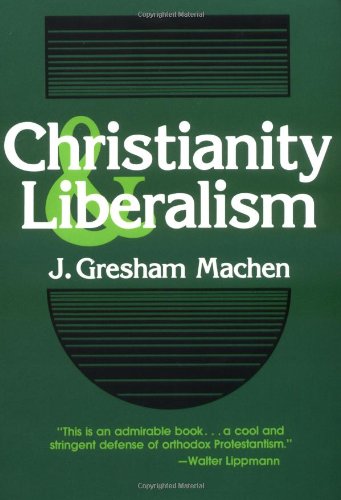
From the book that kind of made him famous, the reason for being worried about liberal Protestantism:

The plain fact is that liberalism, whether it be true or false, is no mere “heresy”–no mere divergence at isolated points from Christian teaching. On the contrary it proceeds from a totally different root, and it constitutes, in essentials, a unitary system of its own. That does not mean that all liberals hold all parts of the system, or that Christians who have been affected by liberal teaching at one point have been affected at all points. There is sometimes a salutary lack of logic which prevents the whole of a man’s faith being destroyed when he has given up a part. But the true way in which to examine a spiritual movement is in its logical relations; logic is the great dynamic, and the logical implications of any way of thinking are sooner or later certain to be worked out. And taken as a whole, even as it actually exists today, naturalistic liberalism is a fairly unitary phenomenon; it is tending more and more to eliminate from itself illogical remnants of Christian belief. It differs from Christianity in its view of God, of man, of the seat of authority and of the way of salvation. And it differs from Christianity not only in theology but in the whole of life. It is indeed sometimes said that there can be communion in feeling where communion in thinking is gone, a communion of the heart as distinguished from a communion of the head. But with respect to the present controversy, such a distinction certainly does not apply. On the contrary, in reading the books and listening to the sermons of recent liberal teachers–so untroubled by the problem of sin, so devoid of all sympathy for guilty humanity, so prone to abuse and ridicule the things dearest to the heart of every Christian man–one can only confess that if liberalism is to return into the Christian communion there must be a change of heart fully as much as a change of mind. God grant that such a change of heart may come! But meanwhile the present situation must not be ignored but faced.

Christianity is being attacked from within by a movement which is anti-Christian to the core. (Christianity and Liberalism, 160)

Christian Patriotism Afterglow

Sparring about Christian nationalism appears to have wound down but since we continue to live in this great land of political liberty — bruised and bloody as it may be — another post about the American Founding may keep the fires of freedom burning. This post also has a Christian connection since it relates to recent debates at the Orthodox Presbyterian Church’s General Assembly about a modern English version of the Westminster Confession and Catechisms. If the Standards may be updated, what about the Declaration of Independence?

The man who led the charge (as pointed out here a few years ago) was H. L. Mencken. The reasons he gave had to do with the severe abridgements of freedom during the reign of the Presbyterian President, Woodrow Wilson thanks to World War I. (Christian nationalists, beware of what you wish.)

Mencken explained his modern version this way:

The following attempt to translate the Declaration of Independence into American was begun eight or ten years ago, at the time of of my first investigations into the phonology and morphology of the American vulgate. I completed a draft in 1917, but the publication was made impossible by the Espionage act, which forbade any discussion, however academic, of proposed changes to the canon of the American Koran. In 1920 I resumed the work and have since had the benefit of the co-operation of various other philologists, American and European. But the version, as it stands, is mine. That such a translation has long been necessary must be obvious to every student of philology. And this is Better Speech Week.

The great majority of Americans now speak a tongue that differs materially from standard English, and in particular from the standard English of the eighteenth century. Thus the text of the Declaration has become, in large part, unintelligible to multitudes of them. What, for example, would the average soda-fountain clerk, or City Councilmen, or private soldier, or even the average Congressman make of such a sentence as this one: “He has called together legislative bodies at places unusual, uncomfortable and distant from the depository of their public records, for the sole purpose of fatiguing them into compliance with his measures”? Or this one: “He has refused for a long time, after such dissolutions, to cause others to be elected, whereby the legislative powers, incapable of annihilation, have returned to the people at large for their exercise”? Obviously, such sonorous Johnsonese is as dark to the plain American of 1921 as so much Middle English would be, or Holland Dutch. He may catch a few words, but the general drift is beyond him.

So Mencken figured that if he produced a modern version of the Declaration, the American people might become more concerned about encroachments by the government on their freedoms. Here is a portion of that revision:

When things get so balled up that the people of a country have to cut loose from some other country and go it on their own hook, without asking no permission from nobody, excepting maybe God Almighty, then they ought to let everybody know why they done it, so that everybody can see they are on the level, and not trying to put nothing over on nobody.

All we got to say on this proposition is this: First, you and me is as good as anybody and maybe a damn sight better; second, nobody ain’t got no right to take away none of our rights; third, every man has got a right to live, to come and go as he pleases, and to have a good time however he likes, so long as he don’t interfere with nobody else. That any government that don’t give a man these rights ain’t worth a damn; also people ought to choose the kind of government they want themselves, and nobody else ought to have no say in the matter. That whenever any government don’t do this, then the people have got a right to can it and put in one that will take care of their interests. Of course, that don’t mean having a revolution every day, like them South American coons and Bolsheviki, or every time some jobholder does something he ain’t got no business to do. It is better to stand a little graft, etc., than to have revolutions all the time, like them coons, Bolsheviki, etc., and any man that wasn’t a anarchist or one of them I. W. W.s would say the same. But when things gets so bad that a man ain’t hardly got no rights at all no more, but you might almost call him a slave, then everybody ought to get together and throw the grafters out, and put in new ones who won’t carry on so high and steal no much, and then watch them. This is the proposition the people of these Colonies is up against, and they have got tired of it, and won’t stand it no more. The administration of the present King, George III, has been rotten from the jump-off, and when anybody kicked about it he always tried to get away with it by strong-arm work. Here is some of the rough stuff he has pulled…

Reading Independence with Lincoln or Jefferson

I did a little digging through old posts about Independence Day and found something that contrasts significantly with Bret Stephen’s appreciation of the Declaration of Independence. (Jefferson had his problems, but Lincoln does not make the USA holy.)

Bonus content: this is H. L. Mencken on Jefferson:

[Jefferson] was less the foe of the Federalists than of government in general. He believed that it tended inevitably to become corrupt — that it was the common enemy of all well-disposed, industrious and decent men. The less there was of it, the better he liked it, and the more he trusted it. Well, that was a century ago, and wild doctrines from the barricades were still in the air. Government has now gone far beyond anything dreamed of it in Jefferson’s day. It has taken on a vast mass of new duties and responsibilities; it has spread out its powers until they penetrate to every act of the citizen, however secret; it has begun to throw around its operations the high dignity and impeccability of a state religion; its agents become a separate and superior caste, with authority to bind and loose, and their thumbs in every pot. But it still remains, as it was in the beginning, the common enemy of all well-disposed, industrious and decent men. (Mencken, Prejudices: Fourth, Fifth, and Sixth Series, 448-49)

It could be that the Declaration was less about an idea or a proposition than the excesses of government. Perhaps it was both. But if you stress the idea over the nature and extent of government power, you may well wind up with “follow the science” or “trans rights are human rights.”

How The Winners (Liberal Presbyterians) Write the History

What follows is an account of the modernist-fundamentalist controversy that used to be on the First Presbyterian Church (NYC) website. Thanks to the Wayback Machine, you can still find it. But now you have Old Life’s Cloud. You’re welcome.

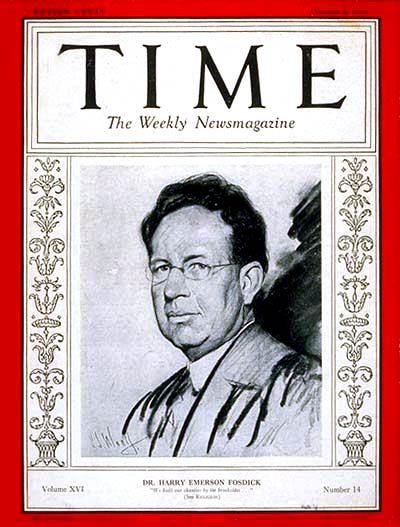
On curious aspect of this piece is how central Harry Emerson Fosdick is to First Presbyterian’s understanding of the controversy. That editorial decision allows the First Church to end the story with a kind of “my bad.” “Yes, we got a little carried away with modernism. But no apologies to conservatives like Machen who the Presbyterian bureaucratic bus ran over.”

Another is the importance of Charles Briggs. B. B. Warfield was on to something. But by the 1890s strict Presbyterianism (doctrine or church polity) was on short supply any where in the trans-Atlantic world.

______________

The Fundamentalist / Modernist Conflict

Harry Emerson Fosdick and The Fundamentalist / Modernist Conflict

The 1890s saw great changes in society: The industrial revolution and the changing of the United States from an agrarian society to an urban one.

The 1890s were also a decade of intellectual upheaval. Between the depression of 1873 and the First World War, many of the time-honored suppositions were being questioned. Darwin’s theory of evolution was one of the most prominent new ideas, challenging the authority of the Bible and the presumption of its inerrancy.

A working definition of Modernism, Liberalism and Fundamentalism in the American Protestant context is necessary to understand the basics of the conflict.

Traditionalists, later known as Fundamentalists, adopted a five-point declaration at the 1910 General Assembly that all candidates for ordination had to affirm. These five points were of course a reaction to the growing acceptance within Protestantism and, specifically the Presbyterian Church, of a more liberal interpretation of the Bible.

The five Fundamental points are:

1.The inerrancy of the Bible
2.The virgin birth of Christ
3.Christ’s substitutionary atonement
4.Christ’s bodily resurrection
5.The authenticity of Christ’s miracles

Other Christian groups adapted the five points with point two often becoming the deity of Christ rather than his virgin birth.

Many lists ended with Christ’s premillennial second coming, instead of his miracles, as the fifth point.

By the 1920s the five points had become called the five fundamentals and had become a rallying cry for conservative Christians across a broad spectrum.

As Jack Rogers, in his book Presbyterian Creeds: A Guide to the Book of Confessions, states: “This was especially true for the growing movement of independent Bible conferences, Bible schools, and independent churches influenced by Dispensationalism. This movement majored in literalistic, futuristic, interpretation of biblical prophecy which announced Christ’s imminent return following a very specific and complex timetable of attendant events. Dispensationalists also taught that all the traditional institutional churches had grown worldly and denied fundamental doctrinal beliefs.”

Modernism may be defined as a method of interpreting Christian scripture and tradition, but not a particular set of beliefs. Modernizers can be found in every period of Church history and Christian Communions. But when we speak particularly of Protestantism in the late 19th to early 20th centuries, we see a conviction in the new scientific knowledge and the most recent Biblical historical research. An application of this new knowledge presents real issues for Christians. As a result, according to Modernism, the task of interpretation must be carried forward if the saving truth of the gospel is to be understood in its relevance to contemporary life.

As for Liberalism, Daniel D. Williams, former Professor of Systematic Theology at Union, says, “It might be said with some accuracy that all theological liberals were modernists; but not all those who used modernist methods of interpretation shared the faith of the liberal theology, especially its optimistic estimate of human nature.”

Further, he says: “Liberals have taken a positive attitude toward the achievements of democratic culture and have generally stressed the ethical imperatives in the gospel.”

Williams also quotes the German theologian Adolf Harnack, who, near the turn of the century, had this classic definition of Liberal theology: “Firstly, the Kingdom of God and its coming. Secondly, God the Father and the infinite value of the human soul. Thirdly, the higher righteousness and the commandment of love.”

In the social gospel movement Walter Rauschenbusch, who was professor of Church History at Rochester Theological Seminary in the early part of the century, became a chief interpreter and prophet. His concept of social sins involved society as a whole (e.g., poverty, child labor, poor working conditions, etc.), and held that these needed to be urgently addressed. To Rauschenbusch and his followers, Christian social activism and advocacy was a compelling Biblical ethic.

The Fundamentalist / Modernist conflict began with the Charles A. Briggs heresy trial. The trial was a reaction from conservative traditionalists to Briggs’s address on January 20, 1891, at Union Theological Seminary on, “The

Authority of the Holy Scriptures.” It was an address inaugurating the opening of the new Department of Biblical Theology.

Briggs was a professor of theology at Union, and he attacked “Traditionalism,” later known as Fundamentalism, and espoused an interpretation of the Bible in the light of the “Higher Criticism.” The Higher Criticism was a method of investigating facts based on scientific investigation, inductive research, and a relative system of values.

Carl E. Hatch, in his 1969 book The Charles A. Briggs Heresy Trial, lists three main factors that stand out as transforming American Protestant theology: Darwin’s theory of biological evolution, Higher Criticism, and the study of comparative religion. Hatch further makes the point that the impact of Darwin’s theory of evolution on American Theology is well known, but that of Higher Criticism and comparative religion much less so.

Briggs had studied in Germany where the methods of Higher Criticism had begun. Julius Wellhausen had perhaps the most influence upon American theologians. He is known as the Father of Higher Criticism. Briggs’s favorite teacher at the University of Berlin, which he attended, was A.I. Dorner, a disciple of Wellhausen.

Charles A. Briggs was born in New York City on January 15, 1841. He attended the University of Virginia, but in his Junior year, 1861, returned home because the Civil War was imminent. After joining the Union Army for about a year and helping defend Washington D.C., he was released to go home, for reasons not known. He entered Union Seminary and graduated in 1863. After graduation he tried helping his father in his merchandising firm in New York, but quickly decided it was not for him. Briggs then matriculated to the University of Berlin. It was a turning point in his life.

After completing his studies, he returned to New York and in 1870 was ordained a Presbyterian minister. He served for a time at a church in Roselle, NJ, but soon found that it, too, was not to his temperament. In 1874 an invitation came to teach at Union. He was professor of Hebrew and Cognate Languages. Although he found it much more rewarding to teach than be a pastor, the subject did not afford him much opportunity to approach Biblical criticism.

Briggs had wanted to forcefully introduce the German theology into this country, but “How to do it?” was his question.

Since Union was under the control of the General Assembly, and most Presbyterian clergy were conservative and therefore disposed against the German Higher Criticism, Briggs had to be careful in what he wrote in religious publications and what he taught in the classroom.

Briggs then maneuvered to create a new department, using the Higher Criticism. But instead of using that term, he used the euphemistic “Department of Biblical Theology.” Briggs, of course, was to be head of the department.

Little opposition was encountered from Union faculty or administration for the creation of the new department. For, despite generally conservative clergy within the Church, Union’s faculty and administration at the time were more progressive and favorably inclined toward the German theology. Charles Butler, chairman of Union’s board of directors, had been a boyhood friend of Briggs and supported the plan wholeheartedly. In April of 1890 Union received $100,000 in bequest money for the new department. The board voted in the new department unanimously in November of that same year.

On January 20, 1891, Briggs gave his address inaugurating the new department.

The speech cheered Briggs’s students. They enthusiastically applauded him at points, but it angered the invited conservative guests and clergy.

The speech is very much a polemic, attacking beliefs about the Bible that the Victorians held as eternal and inviolable.

Briggs began by asserting that there were three, not one, great sources of divine authority. The first was the institutional Church, the second was reason, and the third the Bible.

“But of all three ways,” Briggs said, “no one of these has been so obstructed as the Holy Bible.” He argued that the authority of the Bible had been so wrapped in dogma and protective creeds, that “The whole trouble with the Bible today is that it has been treated as if it were a baby, to be wrapped in swaddling clothes, nursed, carefully guarded lest it should be injured by heretics and skeptics.”

As Carl Hatch relates in his book, “The net effect of this,” according to Briggs, “was to shut out the light of God, to obstruct the life of God, and to fence in the Bible, thus rendering the Bible useless.”

Briggs next attacked superstition as keeping people from the Bible. “We are accustomed to attach superstition to the Roman Catholic Mariolatry and the use of images, and pictures and other external things in worship. But superstition is not less superstition if it takes the form of Bibliolatry.” Mariolatry is idolatry of the Virgin Mary. Bibliolatry is idolatry of the Bible.

“The second barrier,” said Briggs, “keeping men from the Bible is the dogma of verbal inspiration.” These comments, reports Hatch, were “extraordinarily incendiary because the doctrine of verbal inspiration was (and still is) one of the dearest tenets of evangelical Protestantism.”

In Briggs’s third barrier, he maintained that the idea that the Scripture is inerrant is false. “The Bible itself nowhere makes the claim that it is inerrant,” said Briggs.

The fourth barrier, said Briggs, was the assumption that the authenticity of the Bible was founded upon the belief that holy men of old had written the various books.

Said Briggs: “When such fallacies are thrust in the face of men seeking divine authority in the Bible, is it strange that so many turn away in disgust? It is just here that the Higher Criticism has proved such terror in our times. Traditionalists are crying out that it is destroying the Bible, because it is exposing their fallacies and follies. It may be regarded as the certain result of the science of the Higher Criticism that Moses did not write the Pentateuch or Job; Ezra did not write the Chronicles, Ezra or Nehemiah; Jeremiah did not write the Kings or Lamentations; David did not write the Psalter, but only a few of the Psalms; Solomon did not write the Song of Songs or Ecclesiastes, and only a portion of the Proverbs; Isaiah did not write half of the book that bears his name. The great mass of the Old Testament was written by authors whose names or connection with their writings are lost in oblivion.”

At last Briggs ended his shocking pronouncements with this vigorous exhortation:

“We have undermined the breastworks of Traditionalism; let us blow them to atoms. We have forged our way through the obstructions; let us remove them now from the face of the earth, criticism is at work everywhere with knife and fire! Let us cut down everything that is dead and harmful, every kind of dead orthodoxy, every species of effete ecclesiasticism, all mere formal morality, all those dry and brittle fences that constitute denominationalism, and are barriers to church unity.”

“Let us burn up every form of false doctrine, false religion, and false practice. Let us remove every incumbrance out of the way for a new life; the life of God is moving throughout Christendom, and the spring time of a new age is about to come upon us.”

With this blistering attack upon the traditionalists, Briggs faced considerable reaction from within the Church in the form of open theological warfare. Before this, the Higher Criticism posed only a vague threat to the traditional theology. Briggs, in one speech, had moved it full throttle into a formidable threat to upset the prevailing orthodoxy.

It is interesting to note the overwhelmingly positive reaction the students had to Briggs’s speech and theological position. His students were about the same age as Harry Emerson Fosdick was at that time, and as you may remember, Fosdick reports that as a student at Colgate he himself rebelled against the old orthodoxy.

The initial public reaction to Briggs and his theological outlook was cool, but in many newspaper editorials there was a sense of outrage and dismay.

In April of 1892 the Presbytery of Cincinnati petitioned the General Assembly to take action against Briggs. By the time of the General Assembly in May, over seventy presbyteries, mostly from the Midwest, registered disapproval with the Assembly over Briggs’s teachings.

Most wanted the Assembly to order Union to remove Briggs, a power the Assembly had by the Compact of 1870 which had adjoined Union to other Presbyterian seminaries. The Compact clearly stated that the Assembly had power over the accepting or rejecting of professors.

The Union Faculty was solidly behind Briggs. Most favored the German Higher Criticism and rallied behind Briggs. Union alumni were also invited to join in the defense of Briggs. A solid majority of them did. One thing this showed was how much the higher criticism had penetrated into certain circles of American religious thought, despite an era generally marked by conservatism.

At the May General Assembly in Detroit, the Committee on Theological Seminaries, made up entirely of conservatives opposed to Briggs, voted to recommend removing Briggs as chair of the new Department of Biblical Theology.

The Cincinnati Presbytery even tried to organize a boycott by forbidding students of the Midwest to enter Union. The ploy eventually failed because it helped Union gain even greater notoriety for its theological position, thereby attracting more students, especially from New England. Union was now seen at the level of Yale and Harvard Divinity Schools.

At the same time, the Midwestern Presbyteries in 1891 put pressure on the New York Presbytery to bring a heresy charge against Briggs. In May that year a committee of inquiry, involving both liberals and conservatives in the Presbytery, recommended prosecution of Briggs.

By November of 1891 a trial had started. Briggs acted as his own counsel, making a brilliant opening statement that shifted the focus of the trial away from him personally to focus on the new theology. The trial was seen publicly as a forum on this theology, not on the heresy of Briggs’s teaching. Briggs was acquitted of heresy by a 94-39 vote.

Briggs was retried on appeal of the Portland, Oregon Presbytery, and again acquitted. However, at the General Assembly of 1893 he was suspended from the Presbyterian Church.

Meanwhile, Union separated from the Presbyterian Church over this case and retained Briggs as professor until his death in 1913.

Carl Hatch writes, “Although Briggs’ inaugural address did not actually begin a new era in American theology, biblical study in this country has never been the same since that provocative discourse.”

Fundamentalists and Liberals lived in tension in the following years. Presbyteries mostly in the Midwest and West were conservative. Those in the East were more progressive.

One area of tension was in the field of foreign missions. It was in 1921 that Fosdick went to China to ease tensions between missionaries representing churches from both sides of the fence. It was apparently the Fundamentalists that primarily wanted to be separate from their more liberal counterparts.

Reinhold Niebuhr, as a Midwesterner, saw the old traditionalist religion as a kind of rough and ready theology for the American frontier of the 19th century that had hardened into a graceless one for the 20th century.

In May 21, 1922 Fosdick preached “Shall the Fundamentalists Win?” He writes in his autobiography, “It was a plea for tolerance, for a church inclusive enough to take in both liberals and conservatives without either trying to drive the other out.” Soon after the sermon, a man named Ivy Lee, a publicist and Presbyterian, asked Fosdick for permission to reprint the sermon in pamphlet form. Fosdick gave him permission and Lee mailed copies to every Presbyterian clergy in the country. A tremendous controversy ensued, with Fundamentalists within the Presbyterian Church, led by William Jennings Bryan, calling for Fosdick’s removal at the General Assembly of 1923.

In the meantime, Clarence E. Macartney, a minister from Philadelphia, preached a response to Fosdick, titled “Shall Unbelief Win?”

That General Assembly produced a resolution directing the New York Presbytery to direct First Church to conform to the Confession of Faith in its preaching and teaching. Fosdick handed in his resignation, but it was rejected by the Session. At the 1924 General Assembly, with Macartney as moderator and Bryan as vice moderator, Fosdick’s preaching remained an issue, and a compromise was finally struck between the two factions, asking Fosdick to regularize his position at First Church by becoming a Presbyterian minister. He refused, and in October of that year the Session accepted his resignation.

Also in that year, 13 percent of the ministers of the Presbyterian Church signed a document called the Auburn Affirmation. It stated that the Five Fundamentals, which the General Assembly had reaffirmed the previous year, went beyond the facts which the Scripture and the Westminster Confession obligated them.

Fosdick’s last sermon at First Church was on March 1, 1925. It was the same year as the Scopes trial in Dayton, Tennessee, in which William Jennnings Bryan came to national prominence.

In 1923, J. Gresham Machen’s book Christianity and Liberalism was published, adding fuel to the fire. It proclaimed that liberal Christianity was “a different religion” and he attempted to argue that it sprang from different roots. Consequently, he advocated a split within the Presbyterian Church along theological lines of ideology.

Machen was a professor at Princeton Theological Seminary. His aggressively militant view contrasted as polar opposite to the one to which Fosdick expressed.

As Jack Rogers says in Presbyterian Creeds, by 1925 “there were identifiable political parties within the Presbyterian Church. One was composed of theological liberals, who believed in an inclusive church, containing any who wished to belong. Opposed to them were doctrinal fundamentalists, who argued for an exclusivist church composed only of those who agreed with the five fundamental points. The largest group, though least well organized, was made up of moderates, who were theologically conservative but were inclusivists for the sake of the peace, unity, and mission of the church.”

Charles R. Erdman, a professor of practical theology at Princeton was elected Moderator of the General Assembly of 1925. Erdman was a moderate. He proposed a Special Theological Commission to study the state of the Church.

In 1927 the commission issued its final report, saying that no one, not even the General Assembly, had the right to single out doctrines such as the five points and determine a particular interpretation of them to be “essential and necessary” for all. They affirmed that only the Judicial process of the church – i.e., heresy trials – could determine points of doctrinal interpretation in specific cases.

Fundamentalist control of the Presbyterian Church was being diminished by altering the theological decision-making by the Presbyteries.

In 1929 the General Assembly approved a reorganization of the governing boards of Princeton Theological Seminary. As a result, exclusivist Fundamentalists were no longer in control.

J. Greshem Machen was outraged. With three other faculty members, he left to form Westminster Seminary in Philadelphia, and soon thereafter, an Independent Board of Foreign Missions. It was a counter to what he felt was a too-liberal influence in the denomination’s foreign missions program.

The General Assembly declared this competition with a denominational agency unconstitutional, and ordered all Presbyterians, including Machen, to desist from this activity. Machen refused and in 1935 he left the Presbyterian Church and formed, with some of his most militant followers, the Orthodox Presbyterian Church.

By the late 1930s, the public had become tired of the tensions between the left and right within the church. Liberal theology had prevailed, but a new wind was blowing. This time, again from Europe.

As Rogers states: “It was not a well-defined school of thought but a new movement variously called ‘dialectical theology,’ ‘neo-Calvinism,’ and ‘neo-Orthodoxy.’ Among its most prominent figures were the Swiss theologians Barth and Brunner and the American Reinhold Niebuhr.”

“Neo-Orthodoxy rejected,” says Rogers, “the evolutionary idealism of liberalism, which had taught that human beings were basically good and that, by cooperating with God, people would bring the kingdom of God on earth. In contrast, Barth and others preached about human sin and a God of judgment and grace who would have to break into human history.”

Neo-orthodoxy, which essentially came out of Liberalism, did not, however, reject the Higher Criticism concerning the Bible. According to Rogers: “The defining insight of early neo-orthodoxy was that God did not reveal information in an inspired book. God was revealed in the person of Jesus Christ. A person’s encounter with Christ in Scriptures was the work of the Holy Spirit.” By the late 1950s neo-orthodoxy was well established as the dominant theology within the Presbyterian Church.

Returning to Fosdick, in 1935 he preached a sermon at The Riverside Church called “The Church Must Go Beyond Modernism.”

In it he declared, “Fifty years ago the intellectual portion of western civilization had turned one of the most significant mental corners in church history and was looking out on a new view of the world. The church, however, was utterly unfitted for the appreciation of that view. Protestant Christianity had been officially formulated in pre-scientific days. Modernism, therefore, came as a desperately needed way of thinking. It insisted that the deep and vital experiences of the Christian soul, with itself, with its fellow, with its God, could be carried over into this new world and understood in the light of the new knowledge. We refused to live bifurcated lives, our intellect in the late 19th century and our religion in the early sixteenth century. God, we said, is a living God who has never uttered his final word on any subject.”

“The church thus had to go as far as modernism but now the church must go beyond it. Modernism is primarily an adaptation, an adjustment, an accommodation of Christian faith to contemporary scientific thinking. It started by taking the intellectual culture of a particular period as its criterion and then adjusted Christian teaching to that standard. Herein lies modernism’s shallowness and transiency: it arose out of a temporary intellectual crisis; it became an adaptation to, a harmonization with, the intellectual culture of, a particular generation. That, however, is no adequate religion to represent the Eternal and claim the allegiance of the soul. Let it be a modernist who says that to you!”

Fosdick goes on to say that modernism had been too preoccupied with intellectualism, too sentimental with the belief in the idea of human progress, that it had been too centered on the achievements of humanity, putting God in a kind of “advisory” position. And finally, that modernism had lost a moral standing-ground by being too accommodating to the prevailing culture.

“Harmonizing slips easily into compromising,” said Fosdick. “To adjust Christian faith to the new astronomy, the new geology, the new biology, is absolutely indispensable. But suppose that this modernizing process, well started, goes on and Christianity adapts itself to contemporary nationalism, contemporary imperialism, contemporary capitalism, contemporary racialism – harmonizing itself, that is, with the prevailing social status quo and the common moral judgments of our time.”

“We cannot harmonize Christ with modern culture,” said Fosdick at the end. “What Christ does to modern culture is to challenge it.”

In this sermon Fosdick never renounces Liberalism – many thought he had – or even mentions it by name. Fosdick still strongly believed in humanity and its possibilities in relation to God and still believed in the progress of Christianity as revealed by God. His 1938 book A Guide to Understanding the Bible demonstrates this. But his thinking and beliefs by this time had developed more like those of the emerging neo-orthodox theology.

Something Fishy about Moore

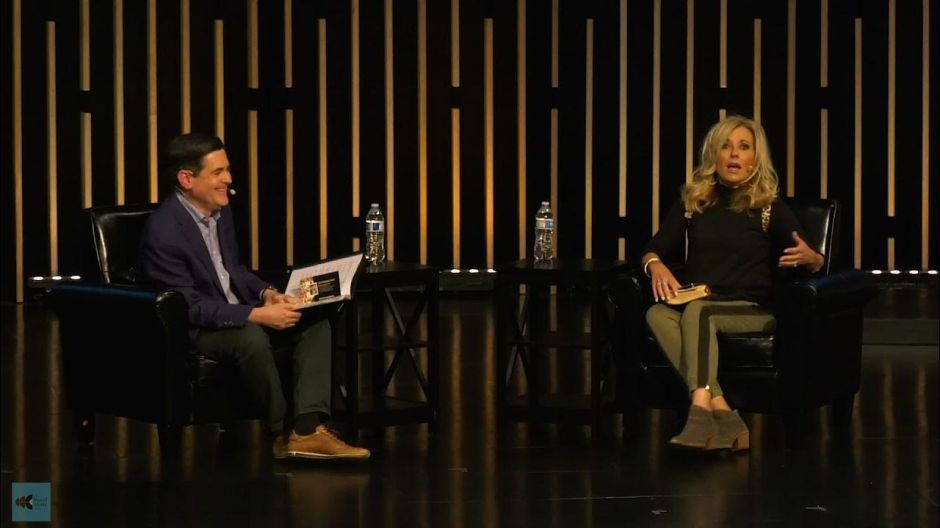
Russell Moore’s interview with Beth Moore got me thinking. Why is her experience with abuse such a big deal right now? And why didn’t Russell Moore do more (along with editors at Christianity Today) to push Beth Moore to be fully candid about her past?

The interview comes after a story about her memoir in which she acknowledges her father’s abuse. According to one summary, Moore writes of her father that “No kind of good dad does what my dad did to me.” She also explains how she and her sister saved their parent’s marriage even when they suspected their father was cheating on their mother.

For someone for whom the abuse of women is a reason to drop what you’re doing, isn’t Moore here guilty of what she faulted the SBC leadership for doing — enabling an abusive father and husband in a co-dependent relationship?

Russell Moore generally plays along and interviews Beth Moore delicately all the while underscoring how badly Southern Baptists treated her. It does work to Russell Moore’s advantage to portray the SBC this way since his outspokenness about politics during the Trump presidency cost him support from various sectors of the Convention.

Two aspects of this recent media attention to Beth Moore are odd. Although her revelations about an abusive father position Moore to receive empathy and support as the object of masculine toxicity, in an earlier brush with greatness (2010) in the pages of Christianity Today, coverage of a recent book on insecurity also revealed that she had been abused as a child.

For example, Moore says, her own insecurity largely stemmed from the sexual abuse she experienced as a child. “Any time something huge like that has happened to you, there really is not a lot of gray for people like us,” Moore says. “I have to have a daily, vibrant relationship with Jesus in order to survive that process toward healing.”

Back then she wanted to keep the abuse as private as possible.

The abuse, which Moore references regularly in her work, came from outside the immediate family, but Moore is as deliberately nebulous about describing it in interviews as she is in books and videos.

“I have found, especially in the area of sexual abuse, details do not really bless and edify. I try as hard as I know how to keep my reader relating on a broad level so I don’t lead her someplace where she thinks that’s the only thing that could cause insecurity,” Moore tells Christianity Today. “I also owe my family some safety and my extended family some safety, so I am careful to stay vague.” (Her office has said that the family did not turn the offender over to police.)

Remember how outrageous it was that the president of Southwestern Baptist Theological Seminary, Paige Patterson, did not report alleged instances of abuse to legal authorities?

By the way, the old Christianity Today story about Beth Moore is a reminder of what journalism looked like in the days of the Obama administration — even religious journalism. The writer, Sarah Pulliam Bailey, seemed to indicate frustration at the limited access she had to the highly protected celebrity Bible teacher:

Just as Moore’s stories are at once personal and private, Moore in person is intensely friendly—and closely protected by assistants who allow very few media interviews. After several interview requests from CT, her assistants allocated one hour to discuss her latest book and ask a few questions about her personal life. Each question had to be submitted and approved beforehand, I was told, or Moore would not do the interview. Follow-up interview requests were declined. I was permitted to see the ground level of her ministry, where workers package and ship study materials. But Moore’s third floor office, where she writes in the company of her dog, was off limits.

Also to Bailey’s credit as a reporter were her quotations of women who had used Moore’s materials and found them wanting:

Bible study is more than application, says Leunk, who found the fill-in-the-blank workbook simplistic. Moore occasionally cites a theologian or a Greek lexical aid, but “you’re not being a serious student of how it fits in the Galatian church or why Paul was writing the letter,” Leunk says.

Still, she acknowledges, Moore’s approach is not unusual among popular Bible teachers. “A lot of people are looking for a Bible study where they can say, ‘I learned something about myself, I learned how to deal with my mother-in-law,'” Leunk says. “There’s definitely this pop-psychology aspect to what she does that’s found in evangelical Christianity.”

Imagine that sort of critique from evangelical professors who rallied to Beth Moore’s side because John MacArthur was critical of her.

The other curious piece of the recent attention to Beth Moore is the explanation for leaving the SBC. Although Southern Baptists were more than adequate to support Moore for the better part of a decade after her revelations about being abused as a child, somehow opposition to her views on women in ministry forced her to find comfort among Anglicans.

The Last Time a Pope Died (III)

From the October 2005 issue of the Nicotine Theological Journal

The Pastor with the Funny Hat

With the passing of John Paul II Protestants might be able to breathe a sigh of relief. For at least fifteen years, the papacy, through John Paul’s skillful handling of his responsibilities, has emerged as arguably the most prominent voice opposing the sins of modernity. As the veteran evangelical apologist, Norman Geisler, put it, John Paul stood up to the three main foes of evangelicalism, namely, “relativism, pluralism, and naturalism.” The best evidence of this opposition was the pope’s defense of the culture of life, which in the words of Southern Baptist theologian, Timothy George, “provided a moral impetus that [evangelicals] didn’t have internally within our community.” The papacy’s understanding of the sacredness of human life, its teaching on sexual ethics, in addition to any number of other declarations or encyclicals affirming the absolute truth of Christianity, made Roman Catholicism an attractive option for young (and sometimes old) Protestants in search of a church that would stand up for the truth, for what Francis Schaeffer used to call “true truth.” While mainline Protestant denominations descended farther into the abyss of moral relativism thanks to their fear of giving offense, and while evangelicals floundered about trying to find hipper ways to super-size their churches, John Paul II was a popular figure, seemingly approachable like the affectionate grandfather, who also refused to equivocate on some of the most important fronts of the culture war.

At his death, several pundits and journalists assessed the way in which John Paul II changed the face of Christianity around the world, improved the health of Roman Catholicism in the United States, and fundamentally altered the relations between Protestants and Roman Catholics, at least in America. Seldom mentioned is how little the Vatican changed during the deceased pope’s tenure and how much the surrounding situation did, thus significantly altering perceptions of the pope and his accomplishments. Back in 1979 during the pope’s first visit to the United States, evangelicals were still worked up about the doctrine of biblical inerrancy, even having the Roman Catholic conservative, William F. Buckley, give the opening address at one of the assemblies of the International Council on Biblical Inerrancy. The Bible was then thought to be the bulwark against relativism, materialism, and atheism, and its cultural significance was such that a prominent conservative spokesman, even from the wrong church, could offer encouraging words to conservative evangelicals.

But in the quarter of a century since then, the Bible seems to have run out of gas for Protestants as an authoritative guide to truth. Instead, the imposing voice of one person in a high-profile office (which happens to be in Vatican City) appears to be more effective in countering the drift of secularism and relativism. After all, the Bible’s truth can be fairly relative depending on the eye of the beholder. Much harder is it for one person to equivocate. This has always been the dilemma of Protestantism – its tendency to speak in multiple and conflicting voices compared to the relative unity of the papacy (some of us still remember church history lectures on the difficulties of Avignon and Rome). Before, Protestants would band together in either the National Association of Evangelicals or the National Council of Churches to try to achieve clarity. Today, the conservative ones seem to be willing to rely on the extraordinary ability and connections of the bishop of Rome.

Yet, for all of John Paul II”s gifted use of his bully pulpit, was he opposing secularism and relativism any more than my local Orthodox Presbyterian pastor? My minister has been no less clear over the course of his ten-year (and still counting) tenure in denouncing relativism and secularism. Nor was he any less forthright in condemning sexual immodesty or immorality. In fact, if anyone in our congregation had slept around or received (or performed) an abortion, discipline would definitely have followed. My pastor may not have had Continental philosophy informing his sermons or speeches at session, presbytery, or General Assembly meetings, but this may have made him even more accessible and clear than John Paul II.

Equally important to consider is whether the pope’s courage in opposing relativism, secularism and sexual license was any more effective than my pastor’s. To be sure, the local Orthodox Presbyterian minister never attracts the front pages of the New York, London, Paris, Rome or even Glenside, Pa. dailies. But that may be a blessing. It may also be a lesson that the much vaunted Roman Catholic doctrine of subsidiarity teaches. That idea says that authorities of higher rank should not do what is necessary for lesser authorities to perform. This is partly an argument, for instance, against a federal welfare system that is inefficient, impersonal, and creates a culture of dependence by either upending the work of local charities and government social programs, or by taking over duties that families and individuals themselves should perform.

The doctrine of subsidiarity, likewise, should warn against becoming dependent on the worldwide, highly orchestrated statements of one church official when what is needed is the week-in-week-out teaching and counsel of local pastors who minister to their flocks. Indeed, it is ironic to this Protestant that many young evangelicals convert to Rome because of the pope’s moral stature and careful reflection and yet find themselves in parishes and dioceses where the application of his moral teaching is very often lacking. Without wanting to beat a proud denominational breast, it does seem probable that any number of small, insignificant and seemingly sectarian denominations like the OPC or the Presbyterian Church in America or the Lutheran Church Missouri Synod or the Reformed Episcopal Church (to try to be ecumenical) are more disciplined in their sexual practices than American Roman Catholics despite those Protestant denominations’ meager public statements or formal teachings. This is not to say that John Paul II’s encyclicals are without merit – far from it. But the point stands that an encyclical is only as effective as the willingness of the local priest or bishop to apply such truth.

Golfers have a saying that you drive for show and putt for dough, which is the duffer’s way of saying that the church universal may be great on paper but is only as faithful as the local church. John Paul II used his powers as the head of the Roman Catholic church to raise the visibility of the universal church’s power and wisdom. Seldom noticed is the unintended consequence of making local clergy, church members and even Protestants dependent on a universal voice when what is most needed is the fidelity of local clergy and church members. The Protestant Reformation was partly a reaction by local churches against religious dependence on Rome. If only evangelicals were more concerned about their ecclesiological heritage and the difficult responsibilities it includes than they seem to be in seeking encouragement and affirmation from a pastor who is as far removed from their churches as Tiger Woods’ drives are from mine.

DGH

The Last Time a Pope Died (II)

From the October 2005 issue of the Nicotine Theological Journal

Where’s the Pope?

The question of pope John Paul II’s present location is, to say the least, a controversial one, not so much between Protestants and Roman Catholics as among Protestants. Has his soul been “made perfect in holiness and immediately pass(ed) into glory” while his body “being still united to Christ – rests in (its) (grave) till the resurrection”? (WSC 37). Or, has his soul been “cast into hell, where (he) remain(s) in torments and utter darkness, reserved to the judgment of the great day”? (WCF 32.1) We are shut up to these two possibilities because “Besides these two places, for souls separated from their bodies, the Scripture acknowledgeth none” (WCF 32.1).

Even to entertain the possibility that the pope is not in heaven can get you fired. Pittsburgh Christian talk radio host (WORD- 101.5FM) Marty Mintor found that out on Friday, April 8, when he was called into general manager Chuck Gratner’s office after his 3:00 to 6:00 P.M. show and told he was being let go. His offense? Innocuous enough. In response to a caller’s question about whether the pope was in heaven, he said that many evangelical Christians believe that one must be a “born-again believer” to go to heaven, but added that “the question of whether a person is born again is something personal, something between an individual and the Creator.” He also “made it clear that the discussion was not an attack on the character of the pope but, rather, a look at the teachings — not only of John Paul, but the Catholic Church in general.” No Knox or Calvin (or Ian Paisley or Bob Jones) he. But he had to go because he was “alienating the listeners.” Gratner said, “We ended our relationship” with Mintor because of differences in how he conducted his show. WORD-FM needs to function in this city in support of the entire church — that means everybody — and not focus on “denominational issues.”

One must resist the temptation to engage Mr. Mintor and Mr. Gratner’s soteriology and ecclesiology, which reflect much that is wrong with evangelicalism, and confine oneself to the fact that these two evangelicals disagreed about whether one could, as a talk radio host, even allow for the possibility that the pope is not in heaven. Not even Al Mohler, for all his excellent analysis of the pope’s and the Church’s errors, noting that John Paul II was a vigorous proponent of the cult of Mary and that he taught that the work of Christ made up for what was lacking in human merit and that he rejected justification by faith, could summon up the strength to say, “The pope, having held these errors, is not in heaven.”

Of course, in one sense no one can know with absolute certainty about anyone’s eternal destiny. We must of necessity leave those ultimate judgments in the hands of an all-knowing God. Nevertheless, we as individuals do make such measured judgments. (Anybody uncomfortable with saying that Hitler is in hell and that Calvin is in heaven?) And the church is given the power of the keys by which she excludes or includes in the kingdom of heaven applying, the standards given by the king of the church.

In my Presbyterian denomination we have standards of admission into membership in the visible church (“out of which there is no ordinary possibility of salvation”) that are consistent with historic Presbyterianism’s commitment to exclude from the church none that Christ includes. Thus we ask for a credible profession of faith. We do not claim that all who make credible professions will be in heaven (we are fallible even in the use of our lawful powers), but we do treat them as such so long as they are communicants in good standing (their professions remain credible). Moreover, we do not regard as unbelievers those who are members of erring churches of Christ. Again, it is the gospel (whether the church is evangelical) and the credible profession (communicants in good standing) that determine whom we invite to share in the common Table of our Lord.

Now a simple question: could the pope have been received into a Presbyterian church holding to the historic Reformed standards of communicant membership? Could he have been invited to the Lord’s Table (where the Lord Himself welcomes and feeds His people) in a Presbyterian church practicing the Reformed fencing of table? Hence, if we regard as heaven-bound those whom we receive into communicant membership and those whom other evangelical churches receive, then do we not regard the others to be, so far as we know, hell-bound? When we apply the liberal and charitable standards by which Presbyterian churches have judged who are Christians, the pope was not one. He did not “acknowledge himself to be a sinner in the sight of God justly deserving his displeasure and without hope save in his sovereign mercy.” He did not “acknowledge Jesus Christ to be the son of God and Savior of sinners and receive and rest upon him alone as he is offered in the Gospel.” He held no membership in an evangelical church on earth.

He was a good man, a courageous man, a pious man, an admirable man, a man who did much good in his lifetime. But do we not agree that such things are not sufficient to make one acceptable to God? Do we not still believe “nothing in my hand I bring, simply to thy cross I cling”? Do we not still believe that a man is justified by faith apart from all human righteousness, or devotion, accomplishment?

A little Protestant girl and a little Roman Catholic boy found themselves walking together toward their homes wearing their Sunday best (yes, I know that is now a meaningless description, but bear with me). They came to a low spot in the road where spring rains had partially flooded the road. There was no way that they could get across to the other side without getting wet. “If I get my new Sunday dress wet my Mom’s going to skin me alive,” said the little girl. “My Mom’ll tan my hide too if I get my new Sunday suit wet,” replied the little boy. “I tell you what I think I’ll do,” said the little girl. “I’m gonna pull off all my clothes and hold them over my head and wade across.” “That’s a good idea,” replied the little boy. “I’m going to do the same thing with my suit.”

So they both undressed and waded across to the other side without getting their clothes wet. They were standing there in the sun waiting to drip dry before putting their clothes back on when the little boy finally remarked, “You know, I never did realize before just how much difference there really is between a Protestant and a Catholic.” Yep. I wish the pope were in heaven, but I have reasons for fearing otherwise.

William H. Smith is a minister in the Presbyterian Church in America

The Last Time a Pope Died

From the October 2005 issue of the Nicotine Theological Journal

The Faith of Modernism

When John Paul II was elected pope in 1978, some American evangelical observers of Rome referred to him as “J2P2.” About ten years later that nickname receded, an indication of a significant transition in his pontificate: this pope was becoming even more popular than Star Wars. It is easy to see now why American evangelicals fell in love with pope John Paul II. He was instrumental in the defeat of Communism, courageous in defense of traditional marriage, and relentless in his advocacy of the culture of life.

Why didn’t Paul VI a enjoy similar press? After all, a re-reading of his widely lampooned Humanae Vitae reveals it to be a brilliant, if flawed, critique of our technological age. But Paul VI’s tired and melancholy demeanor lacked the vigorous and telegenic charisma of John Paul II, a master of modern media.

Timothy George compared the winsome attractiveness of John Paul II to the ultimate American evangelical icon, Billy Graham. “Many of the things said of the pope you’d say of Billy Graham,” George recently told Christianity Today. “From an evangelical base he’s tried to reach out and be embracing and yet be faithful to the gospel. And you put those two together, Billy Graham and the pope, you have there the winsome, visible face of world Christianity in the last half century.”

Again, this is understandable, and there is much for Protestants to be thankful for in this remarkable 25-year pontificate. But can it be said from a Protestant perspective that John Paul II’s legacy was marked by theological progress? How ought we to evaluate what Mark Noll described as Roman Catholicism’s “dramatically altered relations with Protestant evangelicals”? Are we led to imagine that the Reformation is over? There are reasonable grounds for skepticism on the part of Protestant confessionalists.

This is not to question the pope’s openness to the theory of evolution, as some Protestant fundamentalists and Roman Catholic traditionalists have. John Paul II hardly endorsed Darwinism; he merely invited Christians to engage in legitimate scientific inquiry without succumbing to scientism. No, John Paul II was clean here, although it was left for his successor, Benedict XVI, to state the matter with greater theological precision when he emphasized that “we are not some casual and meaningless product of evolution.”

In following through with the work of Vatican II, John Paul proclaimed the church’s openness to the future. But should Protestants be encouraged when “aggiornamento” replaces the take-no-prisoners exclusivism of pre-Vatican II Rome with the universalism of Vatican II? A perusal of Crossing the Threshold of Hope should dispel any doubt that John Paul II is a modernist, especially with regard to his attitude toward other religions. John Paul II seems to articulate his own version of Open Theism here: salvation is open to all “people of good will” (though only Rome possesses the fullness of that salvation). Jews are older brothers in this vague and universal faith, and he goes on to make frightening concessions to the “deep religiosity” of Buddhists, Hindus, and Moslems, reserving his criticism of the latter to the “fundamentalists” among them. “It will be difficult to deny that this doctrine is extremely open,” he writes. “It cannot be accused of an ecclesiastical exclusivism” (emphasis original).

The old-style Protestant modernist Shailer Mathews insisted that Modernism was not liberalism. Modernists, he wrote, were evangelicals who use the scientific, historical, social method in understanding and applying evangelical Christianity to the needs of living persons. Mathews’ call for Christian accommodation to modern times reads much like John Paul II’s. Perhaps there is no American Protestant he may resemble so much as Charles Briggs, who though conservative by inclination and committed to traditional doctrines such as the virgin birth, sought to bring American Presbyterians into the modern world, introducing them to confessional revision, higher criticism and doctrinal tolerance.

Another similarity between the recent pope and Protestant modernism was his reticence to apply church discipline to Roman Catholic dissenters. Rising to his defense, many have pointed out how imprudent excommunication would have been. Dissent was far too entrenched in the American Roman Catholic higher education, which had become a barren wasteland beyond correction. A crackdown would involve not just the prominent – he could not limit it to the likes of Hans Küng – but would have involved tens of thousands. So the pope was between a rock and a hard place, and his hands were tied.

Somehow that rings hollow for a pope credited with dismantling communism. Where is the sign of contradiction? And whatever happened to his slogan, “Be not afraid”? He’s the POPE, for crying out loud. A more plausible explanation seems to be that discipline was less beyond his power than contrary to his style. So the dirty work was inherited by his successor, Benedict XVI, and Roman Catholic conservatives have already appealed to him to take serious disciplinary action.

Where Noll’s “dramatically altered relations” is most evident is in ways John Paul II’s papacy has encouraged American evangelicals to collapse spiritual warfare into cultural warfare. Under the pope’s leadership and example American Roman Catholics and evangelicals have found common cause in lobbying for the culture of life. This has led to the confusing and divisive work of “Evangelicals and Catholics Together” in 1994 and its successors. To be sure, evangelicals argue that theological differences remain – there’s the whole Mary thing – but these are relegated to the theological periphery. “The disagreements that Protestants have with John Paul II are things that are in addition to the foundations of the faith,” said Southern Baptist Richard Land. In a more theologically literate age, confessional Protestants would call that doctrinal indifference.

In a commonly misunderstood section in his book, Christianity and Liberalism, J. Gresham Machen suggested that Presbyterian orthodoxy had more in common with Rome than with Protestant liberalism. Machen’s predicament was that if forced to choose between Protestant modernism, which had all but abandoned the exclusivity of the Christian religion, and Roman Catholicism, a faith that in the 1920s was still affirming that outside the church there is no ordinary possibility of salvation, the decision would have been to side with the Christian though flawed expression. That choice took on a different dimension after Vatican II when in its effort to engage the modern world the Roman Catholic hierarchy embraced modernism. So with the magisterium of John Paul II, who fleshed out Vatican II’s modernism, Machen would not have been confronted with a choice. For all of his gifts and virtues, John Paul II was a theological modernist. Evangelical adulation of his papacy gives every suggestion of a dance with modernism.

JRM

Machen Death Day 2023

A little tide me over for post-Christmas blues:

Would our knowledge of our Saviour be essentially complete if the New Testament did not contain the passages which narrate the virgin birth?

That question, we think, should be answered with an emphatic negative; without the story of the virgin birth our knowledge of our Saviour would be impoverished in a very serious way. Exaggerations, indeed, should be avoided at this point. Even without the infancy narratives we should have much upon which to rest our faith. Christ would still be presented in the New Testament as both God and man in two distinct natures and one person forever; the significance of His Cross would still stand out in all its glorious clearness; He would still be offered to us in the gospel as our Saviour.

Yet there would be a serious gap in our knowledge of Him, and questions would arise which would be full of menace for the souls of men. How did this eternal Son of God enter into the world? Did the Son of God unite with the man Jesus at the baptism as the Gnostics supposed; was the man Jesus received up gradually into union with the eternal Son? Erroneous answers to such questions would, without the story of the virgin birth, be all too ready to hand. No doubt those erroneous answers would still be capable of refutation to a mind ideally logical and really filled with the convictions which all the Gospels and Epistles would provide. Yet they would be only too natural to the minds of men as they actually are. Without the story of the virgin birth we should be living constantly in a region of surmises like the errors of the heresiarchs in the ancient Church.

Such surmises would deprive us of the full doctrine of the incarnation upon which our souls can rest. To that doctrine it is essential that the Son of God should live a complete human life upon this earth. But the human life would not be complete unless it began in the mother’s womb. At no later time, therefore, should the incarnation be put, but at that moment when the babe was conceived. There, then, should be found the stupendous event when the eternal Son of God assumed our nature, so that from then on He was both God and man. Our knowledge of the virgin birth, therefore, is important because it fixes for us the time of the incarnation. And what comfort that gives to our souls! Marcion, the second-century dualist, was very severe upon those who thought that the Son of God was born as a man; he poured out the vials of his scorn upon those who brought Christ into connection with the birth-pangs and the nine months’ time. But we, unlike Marcion and his modern disciples, glory just in the story of those things. The eternal Son of God, He through whom the universe was made, did not despise the virgin’s womb! What a wonder is there! It is not strange that it has always given offence to the natural man. But in that wonder we find God’s redeeming love, and in that babe who lay in Mary’s womb we find our Saviour who thus became man to die for our sins and bring us into peace with God.

Moreover, the knowledge of the virgin birth is important because of its bearing upon our view of the solidarity of the race in the guilt and power of sin. If we hold a Pelagian view of sin, we shall be little interested in the virgin birth of our Lord; we shall have little difficulty in understanding how a sinless One could be born as other men are horn. But if we believe, as the Bible teaches, that all mankind are under an awful curse, then we shall rejoice in knowing that there entered into the sinful race from the outside One upon whom the curse did not rest save as He bore it for those whom He redeemed by His blood.

How, except by the virgin birth, could our Saviour have lived a complete human life from the mother’s womb, and yet have been from the very beginning no product of what had gone before, but a supernatural Person come into the world from the outside to redeem the sinful race? We may not, indeed, set limits to the power of God; we cannot say what God might or might not have done. Yet we can say at least that no other way can be conceived by us. Deny or give up the story of the virgin birth, and inevitably you are led to evade either the high Biblical doctrine of sin or else the full Biblical presentation of the supernatural Person of our Lord. A noble man in whom the divine life merely pulsated in greater power than in other men would have been born by ordinary generation from a human pair; the eternal Son of God, come by a voluntary act to redeem us from the guilt and power of sin, was conceived in the virgin’s womb by the Holy Ghost. (The Virgin Birth of Christ [1930], 394-395)