David Robertson is What’s the Matter with Tim Keller

Amy Mantravadi wanted to know what’s the matter with Tim Keller around the same time that David Robertson decided to make Keller the test for loyalty to gospel ministry. Amy makes careful evaluations (charitable) of Keller. Robertson sneers at anyone who takes issue with Keller.

And that is the problem. Keller is merely one pastor whose foibles would be unknown to any outside his congregation if he had not allowed himself to be a poster-boy for urban, transformationalist, pastor-to-(some of)-the-intelligentsia ministry.

Lots of pastors in the Reformed world do not follow the rules of polity, liturgy, and confessional austerity. They likely face their own sets of critics whether from within the congregation or at presbytery. But these pastors do not pretend to have written the book for successful ministry or allow fans to crow about their success.

Keller, however, has become a brand and pastors like David Robertson have gladly wrapped themselves in it. In fact, when Keller says something that so patently needs qualification, Robertson is there to dare anyone who would question Keller’s devotion, wisdom, and truth.

Keller is too big to fail and defenders like Robertson made him so.

Here is what Keller said about art:

The Church needs artists because without art we cannot reach the world. The simple fact is that the imagination ‘gets you,’ even when your reason is completely against the idea of God. ‘Imagination communicates,’ as Arthur Danto says, ‘indefinable but inescapable truth.’ Those who read a book or listen to music expose themselves to that inescapable truth. There is a sort of schizophrenia that occurs if you are listening to Bach and you hear the glory of God and yet your mind says there is no God and there is no meaning. You are committed to believing nothing means anything and yet the music comes in and takes you over with your imagination. When you listen to great music, you can’t believe life is meaningless. Your heart knows what your mind is denying. We need Christian artists because we are never going to reach the world without great Christian art to go with great Christian talk.

If you are a minister devoted to the sufficiency of Scripture, maybe you qualify this a little? You put yourself in the situation — wouldn’t all that reading of Charles Taylor help you? — of Christ and the apostles and maybe remember that art did not seem to be high on the apostles agenda.

Instead, Robertson doubles down and does for Keller what so many Roman Catholic apologists do for Pope Francis — spin:

Now there is a narrower sense in which art is used – I guess the sense in which it is studied in art colleges. And if Keller was saying without painting we can’t communicate the Gospel then he would deserve the ridicule that comes his way. But do you think Keller is restricting ‘art’ to the narrower sense of painting only (or perhaps ballet?). Can’t you be a little more charitable and assume that a bible believing teacher such as Keller might actually know something about the bible, church history and evangelism? At least enough to prevent him accusing Paul and Jesus of not knowing how to proclaim the Gospel?

The truth is that Keller and the upcoming downgrade in the PCA is not the problem. He is not a heretic and his views on art are not heretical – they are basic Kuyperian Calvinism. No, it is the ugliness of some who profess the Reformed Faith, those macho keypboard warriors who think that putting the adjective effeminate in front of anything is enough to damn it; seeking their own niche and identity by dissing others who are the real heretics. Why? Because although they profess orthodox faith in Christ – it’s not enough. We must reflect the glory and beauty of Christ. To turn beauty into ashes is anti-Christ and the real heresy.

You mean, all that time in the city has not in the least influenced Keller and how he presents? You mean, Robertson has never studied the history of how Presbyterians are like frogs in the kettle and become used to the cultural temperature around them? You mean, that a minister in the Free Church cannot ever fathom how liberal Presbyterianism happens?

That’s a problem.
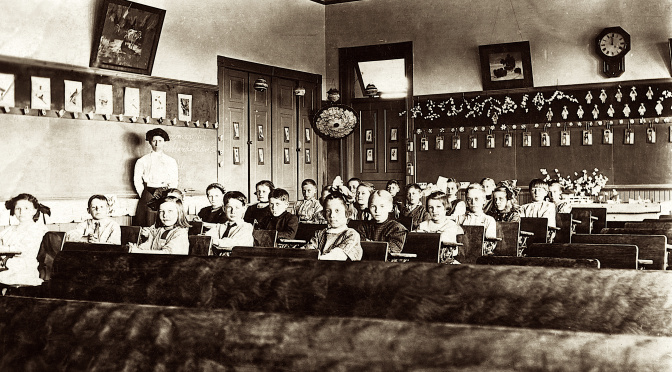
More of Those (were the) Days

And we think contemporary public schools suffer. They had challenges even before Richard Nixon:

The super-science of pedagogy, that fairest flower of the New Thought, has achieved its greatest triumphs in the reclamation of the erring, or, as the old-time schoolmasters had it, the bad. Those old-time schoolmasters knew nothing about scientific pedagogy. They were not experts. When, for example, a boy hooked school they had no remedy for his error save the application of the birch to his pantaloons, and this barbarous remedy they kept on applying, in more and more heroic doses, until he abandoned the practice or graduated into long trousers and a political job. Such was pedagogy in its Gothic days, before it began to mellow and expand. Such were the dark ages before psychotherapy and raffia work.

Today, as everyone knows, the birch is under the ban of all recognized experts, and the inhuman teacher who resurrects it and applies it is promptly burned at the stake. In its place we have the “correctional” or “parental” school, in which original sin is combatted with moral suasion, and the erring are seduced to diligence by the subtle arts of the Chautauqua psychologist. New York city now has such a school “on the cottage plan,” and the hunkerous New York Sun presents an illuminating report thereon. Each of the six cottages, it appears, houses 32 pupils–and each cottage cost the taxpayers $81,500 to build! The cost of maintenance is $5.50 a pupil a week, the which, added to a reasonable interest on the investment, works out to between $8 and $9 net!

Why Never Trumpers Need the Falwells

Because they are both fundamentalists of the double-separatist variety.

Here’s something for John Fea to consider (as he passes on advice to the new White House press secretary, Sarah Huckabee Sanders):

There is a moral argument, I suppose, for men and women who chose to go into this administration to serve in Cabinet-level or sub-Cabinet positions out of a sense of obligation to the country. (The better argument is that working in this administration inevitably leads to enabling wrongdoing and horrible policy decisions, but I understand the rationale of those who disagree with me.) However, there is no moral argument for going directly into the president’s senior/political staff, which in this administration means defending indefensible conduct, denying reality and encouraging others to lie in defense of the administration. You cannot serve in a dishonorable White House honorably.

Now substitute mainline Protestant churches (read modernist) for Cabinet and president in that quotation and you have the same argument that prompted Bob Jones to reject Billy Graham’s — get this — crusades when in 1957 the revivalist started cooperating with mainline churches. It was the same rationale that led the OPC to reject the leadership of the National Association of Evangelicals for including in its membership ministers, laity, and congregations that belonged to the mainline churches. That was double-separatism then, and historians like John Fea who know a thing or two about fundamentalism have argued that such institutional purity lacked Christian charity and was even ornery.

But if applied to the secular realm, such double-separatism makes perfect sense.

Pardon me for thinking evangelical historians are not up to their A-game with Trump. Is it because they’ve gone soft on Russia?

The Surprising Admissions Converts Make

David Mills tries to defend being casual about sin, though he rebrands it as familiarity:

In the Protestant world of my youth, nearly everything was a matter of life or death. The Evangelicals made your salvation a drama that depended on you making a decisive commitment. They loved the drama of a sobbing sinner stumbling forward at the altar call.

The mainliners didn’t sweat salvation the same way, but they made your social conscience almost as crucial. God expected you to respect picket lines, protest the war, protect the environments, eat union-grown grapes.

But the Catholics. Gosh, they didn’t seem to sweat anything. The few Catholics I knew — my college town had more Wiccans than Catholics — didn’t seem vexed by human sins, personal or social. They might like devotion and care about social causes, but they didn’t pursue them as intensely as the Protestants I knew.

Older people told me that Catholics had confession. They could axe-murder an entire middle school, go to confession, and Whoosh! they were okay. God was happy with them again. The axe murder? No big deal. Confession magically wiped the slate clean no matter what you did.

Except that the whoosh only got you as far as purgatory if you went to confession.

But now Mills sees the benefits of Rome’s lack of rigor:

After being a Catholic for a few years, I can understand why people think the Church is too casual about sin. I can be too casual about it. It’s easy to use confession as a forgiveness machine and the Mass as a medicine that cures you without your having to do anything. I know how easily you can presume on God’s love.

But that’s just the risk God chose to take when he gave us the Church and her sacraments. Our Protestant friends are not wrong in their criticism, but they miss what God Himself is doing through the Church. He flings his grace around, as we heard in last Sunday’s gospel reading. He lets some fall on rocky or thorny ground, so that some will fall on fertile ground. He gives us gifts we can abuse, because he wants to give us life.

What Mills fails to add (aside from the punishment for mortal sins) is that Protestants exalt Christ. To be hard on sin is to take seriously the cross. Christ died to save sinners from the penalty of sin. That shows that God was not very casual about sin. It also means Christ didn’t die to give sinners a second chance — in purgatory.

Improving Disagreement since 2009

Old Life may not be every Protestant’s pint of IPA. But at least critics can’t fault Old Lifers for attributing the worst to non-Old Life Protestants (sorry if that sounds like the Pharisee’s prayer). Consider:

ad hominem is a problem, but if you watch cable news, or follow Twitter, or reflect on the way that Donald Trump engages with Democrats, or Democrats with other Republicans, you notice a style of argument every bit as pernicious. It consists of constantly elevating the very worst of the other side, attacking only the weakest rather than the strongest part or version of the ideas held by the other political party or ideological tribe or cultural identity group. As Scott Alexander puts it, “The straw man is a terrible argument nobody really holds, which was only invented so your side had something easy to defeat. The weak man is a terrible argument that only a few unrepresentative people hold, which was only brought to prominence so your side had something easy to defeat.”

To call a Presbyterian like Tim Keller an evangelical is not ad hominem. No either-or here. Old Life recognizes many shades of Christian. The question is whether Presbyterians really want to be Reformed or whether they simply want a better grade of Protestantism than Baptist or Christian & Missionary Alliance.

We’re Laughing With not At You

I imagine that was Peter Sagal’s defense for this bit of Wait, Wait, Don’t Tell Me (an episode I heard while driving in New England):

SAGAL: Tom, this week, listeners also wrote in, saying we were way too mean to Mitch McConnell. What was the specific insult our listeners were upset by? Was it A, Mitch McConnell looks like a thumb with glasses…

(LAUGHTER)

SAGAL: …B, Mitch McConnell looks like a Mr. Potato Head if the potato had been mashed…

(LAUGHTER)

SAGAL: …Or C, as a young man, Mitch McConnell didn’t beat polio. It was that polio left his body because it couldn’t stand being there any more?

(LAUGHTER)

TOM BODETT: Oh.

ROBERTS: Oh.

BODETT: Oh, you know, I think he did have polio as a child. Is it that one?

SAGAL: No, it was actually a trick question…

BODETT: Oh, thank, God.

SAGAL: …Because it wasn’t any of those.

(LAUGHTER)

BURBANK: I feel like we wouldn’t be on the radio this week…

BODETT: I was going to say, you know?

BURBANK: …If it was any of those.

SAGAL: We said Mitch McConnell looks like a chinless owl.

(LAUGHTER)

BODETT: Oh, that’s right.

SAGAL: To our credit, we also didn’t say…

(LAUGHTER)

SAGAL: No, we didn’t say these, so people had no reason to complain. We didn’t say Mitch McConnell looks like a jack-o’-lantern that was left out on the porch till March.

(LAUGHTER)

SAGAL: We certainly didn’t say that Mitch McConnell looks like someone dropped a bunch of facial features into a bowl of butterscotch pudding.

(LAUGHTER)

SAGAL: We absolutely did not say…

BODETT: And thank God.

SAGAL: …That – you know when somebody pulls out their belly skin to show you how much weight they lost? – that looks like Mitch McConnell’s face.

(LAUGHTER)

SAGAL: And we certainly never stooped to saying that Mitch McConnell’s face was bleeding badly from a face-lift.

(LAUGHTER)

SAGAL: We would never do that.

BODETT: That, that…

SAGAL: Too low even for us.

I am sure Senator McConnell chuckled right along with NPR’s quiz show host, panelists, and audience.

And to keep it fair and balanced, here is how Sagal yucked it up with Nancy Pelosi when she was Speaker of the House:

SAGAL: Let’s clarify something right off the bat. How are we to address you? What is the protocol? Speaker Pelosi, in honor of your former position? Leader Pelosi, in honor of your current one?

PELOSI: Because we’re all such good friends here, just say Nancy.

SAGAL: Just say Nancy. Nancy.

(LAUGHTER)

SAGAL: It sounds good, though, Nancy. So we’re delighted to have you with us. We found out, and it should be obvious, given your success in politics, that you grew up in a very political family. You were raised in the business.

PELOSI: Right.

SAGAL: Your father was the mayor of Baltimore.

PELOSI: Yes, he was.

SAGAL: Right. So what was it like growing up in a political household?

PELOSI: Well, it was like campaigning, forever campaigns, all the time. There was never a time when we weren’t walking precincts or receiving volunteers at the door to pick up their brochures, their buttons, their bumper stickers, their placards that would be called lawn signs these days. And I learned how to count votes.

SAGAL: Did you really? So, like, other kids were counting blocks, you were like going “one vote, two votes.”

(LAUGHTER)

SAGAL: When you were a baby, were you kissing babies?

(LAUGHTER)

SAGAL: We were reading about your father’s career and your involvement with him, and we read that one of the jobs that you had working with your father was that you kept his favor file. Is that correct?

PELOSI: No, I didn’t keep it but I worked on it. That is, to say…

SAGAL: What is it exactly?

PELOSI: What it is, is that if somebody – for example, if someone came to the door and said they needed help in some way, if they needed help finding a job or something like that. The idea was, of the favor file was that when that person was on his or her feet then they would extend a helping hand to somebody else. In other words, they passed it on.

SAGAL: Really?

PELOSI: So where would you go to look for help for somebody else is someone that you had helped already.

SAGAL: Right. Or if you needed to have someone killed…

PELOSI: Again, it was a very…

SAGAL: …call upon this person.

(LAUGHTER)

PELOSI: Do I detect an ethnic slur there?

SAGAL: No, no.

(LAUGHTER)

SAGAL: I wasn’t at all thinking about that scene from “The Godfather.” I really wasn’t.

(LAUGHTER)

CHARLIE PIERCE: Leader Pelosi, we have no idea who this guy is doing the interview.

(LAUGHTER)

SAGAL: So, eventually you got married, you moved with your husband to San Francisco and you got involved with politics there. You ran for office yourself. You know, when you went into politics, you did it with a splash.

Of course, you rose through the ranks of the Democratic Party in the House, and you became the Speaker of the House. You’re our first Speaker of the House we’ve ever had on the show. We have a lot of questions about that. Primarily, what is it like to sit behind the president during the State of the Union address?

(LAUGHTER)

SAGAL: Is it hard to maintain a straight face?

(LAUGHTER)

PELOSI: Well, I’m glad you’re getting down to the truly important here…

SAGAL: Yes.

(LAUGHTER)

PELOSI: …Speaker of the House.

SAGAL: No, really, I mean it must – because you know, like the nation is looking at the president and you are looming there over his shoulder. You could wreak havoc with the address if you wanted to, by making faces. Do you have to think about, like…

PELOSI: Well, one could.

SAGAL: Yes.

PELOSI: Well, here’s the thing…

SAGAL: Yeah.

PELOSI: …the Speaker of the House has awesome power. And so when the joint session is called and the president of the United States is welcomed in a joint session, House and Senate, it is the Speaker of the House who introduces the president. Not that that’s the power part, but it’s a manifestation…

SAGAL: That is power. You could keep him waiting. You could be standing, and he could be waiting outside. And you could be like, “So guys, what’s up?”

(LAUGHTER)

SAGAL: See the game last night?

PELOSI: Well, no, but, you know, but you would want to be respectful now wouldn’t you? I mean, under other circumstances you would want to be respectful…

SAGAL: Yeah.

(LAUGHTER)

SAGAL: I want to ask a little bit about the job. Do you ever talk to the current Speaker, John Boehner? Does he ever call you up and go “I don’t know how I’m going to get this done; these guys are being so obstreperous. What do I do, Nancy?” Does that ever happen?

PELOSI: No.

(LAUGHTER)

SAGAL: Really, you don’t…

(LAUGHTER)

SAGAL: He doesn’t invite you over, back to your old office just for a get together, have a good cry, you and him and talk about problems.

PELOSI: No.

SAGAL: No, really, I mean…

PELOSI: Girls don’t cry.

(LAUGHTER)

SAGAL: No. Well done.

(APPLAUSE)

FAITH SALIE: Nancy, I can’t believe I just called you that. Thank you.

PELOSI: Thank you, Faith. I’ll call you Faith; you call me Nancy.

SALIE: That’s a deal. I earnestly want to ask you about an issue that’s dear to my heart and I understand it’s dear to yours, which is chocolate.

PELOSI: Oh, yes.

SAGAL: We’ve read this too that this is your great vice, if you will, you’re big into chocolate.

PELOSI: I don’t consider it a vice. I consider it…

SALIE: A blessing from God.

(LAUGHTER)

SAGAL: You consider it…

PELOSI: Very dark chocolate, very dark chocolate.

SAGAL: Very dark. So tell us what you can. Tell us what you’re willing to admit of your chocolate consumption.

(LAUGHTER)

BURBANK: Let’s get down to brass tacks. How many pounds of chocolate have you eaten today?

(LAUGHTER)

BURBANK: I’ll take that as 20.

(LAUGHTER)

You tell me, which is funnier? Peter Sagal laughing his way through the week’s news or Man Getting Hit by Football?

America’s Elite Class

Daniel Drezner does not wince when talking about elitism in the United States. His inspiration was the David Brooks column on Italian sandwiches, about which Drezner writes:

Brooks argued that “The educated class has built an ever more intricate net to cradle us in and ease everyone else out. It’s not really the prices that ensure 80 percent of your co-shoppers at Whole Foods are, comfortingly, also college grads; it’s the cultural codes.”

I agree with my Post colleague Tim Carman that outside The Anecdote That Shall Not Be Named, the column was “an otherwise temperate take on the restrictions and social codes that keep the middle class in its place.” As a fully paid-up member of this class, there clearly are expected modes of behavior, and not knowing the unspoken rules of the game acts as a barrier to those trying to enter the meritocratic class. It can still be done, but it’s like learning an additional language.

Then Drezner worries that some of the Trump clan may actually stumble their way into the elite class by being able to order the right Italian sandwich meats:

Based on my own conversations, it would seem that most traditional D.C. wonks look at most of the Trump family and see a bunch of wealthy, not-very-bright boors who do déclassé things like eat their steaks well-done and with ketchup. Indeed, there is a whole conservative genre defending the Trumps for some of their gauche tendencies. Most of the Trumps gleefully ignore the cultural codes that Brooks describes, because they are rich enough to not care.

Then we get to Jared Kushner and Ivanka Trump, and the narrative switches.

The rest of the Trumps might scream bridge and tunnel, but Jared and Ivanka have undeniably mastered the cultural codes of the educated class. It is hard to read a profile of either of them without words like “polished” or “poised” appearing.

Take the opening sentences to Jill Filipovic’s Politico essay from May: “Ivanka Trump is the poised, polished face of a chaotic White House, a bright young mother who many suspect is a voice of reason and moderation among the Steve Bannon acolytes in the West Wing, whispering socially liberal values in her daddy’s ear.” Look at the Post’s Style Section profile of Ivanka from this month: “Ivanka Trump’s office: clean, white, quiet. A zone of punctual start times and promptly offered water bottles, and a conference table at which she conducts meetings. A short, winding walk away from her father’s Oval Office downstairs.” Or as T.A. Frank noted in Vanity Fair, “let’s agree that one of the finest qualities of Jared Kushner is his tailoring. The fit is so good. Even with bespoke work, that’s hard to achieve.”

Let me posit that in mastering the cultural codes of the educated class, Kushner and Ivanka somehow fooled even veteran D.C. observers into presuming that they might actually be qualified and competent as well. Which all evidence suggests is not true.

Drezner believes that expertise on policy is what qualifies someone to rule in America, not expertise in self-promotion, food, or fashion.

As someone who values education, I am hard pressed to knock learning. But my education also tells me that in the United States, you don’t need to be educated to hold public office. George Washington and Abraham Lincoln did not have college educations. Never mind going to the Kennedy School of Government. By the same token, George W. Bush went to Yale and see what good that did him when it came to America’s educated elite.

And don’t forget about those brain surgeons that the Kennedy and Johnson administrations leaned on to devise a policy for the Vietnam War. Sometimes education doesn’t make you a good administrator — just ask any egg-head professor to chair his or her department. See what snafus ensue.

The reality is that with all of Drezner’s brain power, and it is considerable, he could not be POTUS. Well, he could. But he’d have to run for office and somehow portray himself as an ordinary ‘merican because despite the number of college graduates in this fair republic we don’t very often elect Ph.D.’s as POTUS (this is why Senator Sasse where’s not Harvard but Nebraska swag). Last time we did we had Woodrow Wilson and what did he do — used all of his intellectual fire power to fight a war to make THE WORLD, not just the United States, but THE WORLD, safe for democracy (which by the way means that we fought the war not to have educated elites running things)?

Which leads to the real point of this post: the story that the press and scholars are missing is what a novel state of affairs it is to have a POTUS who has no experience with government. Why no feature stories on what it’s like to have to do so many things that you’ve never done before? Or what is it like to be trailed by Secret Service agents? Or what’s it like to live in the White House? Many Americans could possibly imagine being in Donald Trump’s shoes (though what it’s like to be a billionaire is beyond me). We would not have the first clue about running a government as massive as the federal one. And that could be an exciting set of stories. But what we seem to get is reporting about how Trump is subhuman and stupid. Imagine if Bill Gates were POTUS. Would he be prone to the same mistakes? But he’s not the kind of jerk that Trump is so the press goes Jerry Falwell, Sr.

I still wonder, though, whether any of the people criticizing Trump, even Drezner, claim to know what to do as POTUS? Do the journalists or professors of foreign policy have white papers on Iran and how to deploy the CIA or State Department? (And if education is a pre-requisite for governing in the U.S., what is our foreign policy supposed to be with poorly educated rulers of other countries? Doesn’t this way of thinking involve a kind of hierarchy that is supposed to be antithetical to social justice?)

The reality is that nothing in American government prepares you for what you might face in the White House along the lines of war and diplomacy, not to mention the vast scale of administering the federal agencies. Jim Kenney, the mayor of Philadelphia has a degree from Lasalle University? Does that mean he’s not fit to hold a higher office? The governor of Massachusetts, Charlie Baker, has a degree from Harvard and an MBA from Northeastern. But can he stand on that great hill of U.S. foreign policy?

What I was hoping would happen with the Trump presidency was a chance to see the federal government through the eyes of a real outsider. The Trump administration might be an occasion for a POTUS self-study. What is necessary for the executive branch of the federal government? What is so complicated as to create barriers to other citizens serving in public office short of getting the right set of degrees and making the right connections? But alas all we are getting is how Trump fails to reassure many Americans that Washington is the capital of the greatest nation on God’s green earth (well, at least a few steps up from Russia).

Nothing Could Possibly Go Wrong

In 1872 the Protestant churches in Scotland handed over all their schools to the State on the explicit condition that Scottish State Education should continue to be Christian. From that day on the Scottish Education system (unlike the American one) has officially been Christian. The Catholics, being wiser than the Protestants, didn’t trust the State and so they kept their own schools. Even within living memory most schools in Scotland would have had ‘religious’ worship, school chaplains and bible teaching. The ethos of the schools were largely Christian. But this is now virtually unrecognisable. Secular humanists/atheists have cuckoo like taken over the State education system and are now using Salami tactics (piece by piece) to dismantle the remaining parts of it – crying tolerance and equality in order not to tolerate Christianity and in order to prevent Christians from receiving the equal education that the UN Human Rights charter demands.

2k Protestants were not so gullible.

And that’s why 2kers give two cheers (sometimes three) for the separation of church and state. It is impossible for established churches to remain faithful. They will always need to do the magistrate’s bidding and reflect the attitudes of the citizenry.

Selah.

Why Do Celebrity Pastors Stumble Over “Thus Saith the Lord”?

I am not sure why Eugene Peterson’s flip-flop on gay marriage is such a big deal. But (all about mmmmmeeeeEEE) I’m not in the habit of taking my cues any more from popular Christian authors or personalities. That could be age, temperament (naysayer), or wisdom — and in the right combination separating those traits may be redundant. But I continue to be surprised by what catches on among evangelicals who fret (even if I don’t want to come across as being above it all).

While following some of the reactions, I came across responses from Tim Keller, John Stott, and Sam Allberry. Since Stott is deceased, I should have known that these would not be direct reactions to Peterson. What caught my eye was the link to a review by Keller — can you believe it? There on display is the same affliction that got Peterson into trouble in the first place — namely, failing to minister God’s word and telling us instead about thoughts and reflections based on a lot of stuff you’ve read.

What is especially noteworthy about Keller’s handling of such a controversial subject as homosexuality if he is going to maintain his New York City profile is his ability to quote authors (other than the prophets and apostles).

First some of the debate about homosexuality in church history and antiquity:

These arguments were first asserted in the 1980s by John Boswell and Robin Scroggs. Vines, Wilson and others are essentially repopularizing them. However, they do not seem to be aware that the great preponderance of the best historical scholarship since the 1980s — by the full spectrum of secular, liberal and conservative researchers — has rejected that assertion. Here are two examples.

Bernadette Brooten and William Loader have presented strong evidence that homosexual orientation was known in antiquity. Aristophanes’ speech in Plato’s Symposium, for example, tells a story about how Zeus split the original human beings in half, creating both heterosexual and homosexual humans, each of which were seeking to be reunited to their “lost halves” — heterosexuals seeking the opposite sex and homosexuals the same sex. Whether Aristophanes believed this myth literally is not the point. It was an explanation of a phenomenon the ancients could definitely see — that some people are inherently attracted to the same sex rather than the opposite sex.

For comparisons of homosexuality to slavery Keller can take you to more scholarly literature:

But historians such as Mark Noll (America’s God, 2005 and The Civil War as a Theological Crisis, 2006) have shown the 19th century position some people took that the Bible condoned race-based chattel slavery was highly controversial and never a consensus. Most Protestants in Canada and Britain (and many in the northern U.S. states) condemned it as being wholly against the Scripture. Rodney Stark (For the Glory of God, 2003) points out that the Catholic church also came out early against the African slave trade. David L. Chappell in his history of the Civil Rights Movement (A Stone of Hope, 2003) went further. He proves that even before the Supreme Court decisions of the mid-50s, almost no one was promoting the slender and forced biblical justifications for racial superiority and segregation. Even otherwise racist theologians and ministers could not find a basis for white supremacy in the Bible.

He even uses awareness of 19th century debates about slavery to take a swipe at Southern Presbyterians:

During the Civil War, British Presbyterian biblical scholars told their southern American colleagues who supported slavery that they were reading the Scriptural texts through cultural blinders. They wanted to find evidence for their views in the Bible and voila — they found it. If no Christian reading the Bible — across diverse cultures and times — ever previously discovered support for same-sex relationships in the Bible until today, it is hard not to wonder if many now have new cultural spectacles on, having a strong predisposition to find in these texts evidence for the views they already hold.

What are those cultural spectacles? The reason that homosexual relationships make so much more sense to people today than in previous times is because they have absorbed late modern western culture’s narratives about the human life. Our society presses its members to believe “you have to be yourself,” that sexual desires are crucial to personal identity, that any curbing of strong sexual desires leads to psychological damage, and that individuals should be free to live as they alone see fit.

As if the Bible supported abolitionists or anti-slavery arguments were immune to “modern western culture’s narratives about the human life.” Sometimes Keller wades into scholarly material superficially so that it agrees with him, but I digress. (Funny how when I bring the Bible into the history seminar it doesn’t gain me any credibility.)

Then you have Keller appealing to more academics to critique these modern “narratives”:

These narratives have been well analyzed by scholars such as Robert Bellah and Charles Taylor. They are beliefs about the nature of reality that are not self-evident to most societies and they carry no more empirical proof than any other religious beliefs. They are also filled with inconsistencies and problems. Both Vines and Wilson largely assume these cultural narratives. It is these faith assumptions about identity and freedom that make the straightforward reading of the biblical texts seem so wrong to them. They are the underlying reason for their views, but they are never identified or discussed.

Maybe this is impressive to David Brooks and other columnists and reporters at the Times, but wasn’t Keller called to minister God’s word? Where is Moses, Jesus, or Paul? Nothing wrong inherently with being aware of some of the scholarly and public intellectual literature. But can’t you give us a “thus saith the Lord” pastor Tim?

When he finally gets around to the Bible, Keller accentuates the positive (the way Mr. Rogers did):

The saddest thing for me as a reader was how, in books on the Bible and sex, Vines and Wilson concentrated almost wholly on the biblical negatives, the prohibitions against homosexual practice, instead of giving sustained attention to the high, (yes) glorious Scriptural vision of sexuality. Both authors rightly say that the Bible calls for mutual loving relationships in marriage, but it points to far more than that.

In Genesis 1 you see pairs of different but complementary things made to work together: heaven and earth, sea and land, even God and humanity. It is part of the brilliance of God’s creation that diverse, unlike things are made to unite and create dynamic wholes which generate more and more life and beauty through their relationships. As N.T. Wright points out, the creation and uniting of male and female at the end of Genesis 2 is the climax of all this.

That means that male and female have unique, non-interchangeable glories — they each see and do things that the other cannot. Sex was created by God to be a way to mingle these strengths and glories within a life-long covenant of marriage. Marriage is the most intense (though not the only) place where this reunion of male and female takes place in human life. Male and female reshape, learn from, and work together.

Gee golly williker. Marriage is just one stroll down the trail of delight (or maybe through Homer Simpson’s Land of Chocolate). Where is the grit of NYC? Where is the complicated character of life in the modern world where we have to make tough choices, or recognize the good and less attractive in all people we meet, and the institutions in which moderns operate? Where is the edge that attracts at least some people like Brother Mouzone or Woody Allen to the Big Apple? The view from Keller’s study is awfully pleasant (and crowded with books other than the Bible).

Meanwhile, Russell Moore made a decent point about Peterson when he compared the evangelical celebrity to Wendell Berry’s own flip-flop on gay marriage:

And now Peterson says he’s willing to walk away from what the Scriptures and 2,000 years of unbroken Christian teaching affirm on the conjugal nature of marriage as the one-flesh union of a man and a woman reflecting the mystery of Christ and the church. I can’t un-highlight or un-flag my Peterson books. I can’t erase from my mind all the things he has taught me. Should I stop reading him, since he has shown a completely contrary view on an important issue of biblical interpretation—and, beyond that, of the very definition of what it means to repent of sin?

This is the same sort of conversation had a few years ago among those of us who’ve been taught much by novelist and poet Wendell Berry when he, too, embraced the zeitgeist on marriage and sexuality. Some said we should throw out our Berry books and never read him again. Others, I’m sure, seeing how much they’d benefited from Berry on place and memory, probably decided to follow him right into this viewpoint. Maybe the same will happen with Peterson now.

True enough, but when Moore says we should not throw Peterson’s books away (who am I to adopt such a move since H. L. Mencken sets on my shelf of worthies right next to Machen — alphabetically anyway), I wonder why Mr. Southern Baptist doesn’t distinguish Peterson as a would-be pastor and theologian from Berry who simply is a writer and farmer. Berry makes no pretension to issue “thus saith the Lord’s” based on his reading of Scripture. Peterson, however, operates in the world of Scripture and theology (and all you usually get — my impression — is “the Lord would be really happy if you might ever consider this and you may also flourish forever and ever”).

Talk Radio Matters Now More than Eh-vuh

Rush Limbaugh is a big fat idiot, so says one of the U.S. Senators (has Ben Sasse got a book for him). Rush is also sometimes funny, but mainly annoying, grating, predictable, and verbose. Whenever the missus hears Rush (and she’s a captive audience on road trips), she cannot believe how long he takes to say something basically simple.

Rush also over exegetes the stuffings out of most statements, votes, or policy proposals. If it’s from the left, he will find the tell-tale signs of liberal excess. If from the right, he’ll detect all the virtues of liberty and the American way.

The reason for bringing up Rush is that Donald Trump has turned the non-talk radio media into Rush. The latest example comes from reactions to the President’s speech in Poland where he defended the West and its civilization. The speech and its responses are well in the rear view mirror thanks to Donald Jr., but the hyperventilated reaction from the normally mild and decent James Fallows should not be missed.

Robert Merry picked up on the Nazi slur that Fallows attached to Trump’s use of the word, “will”:

…he truly reveals himself in savaging Trump’s suggestion that the West must muster “the will to survive.” Aha! Fallows clearly thinks he has nailed it here. This, he informs us, was a not-too-subtle reference to Leni Reifenstahl’s famous Nazi propaganda film, Triumph of the Will. Fallows speculates that Trump’s speechwriters (including Bannon) certainly knew of Riefenstahl and probably understood “how it would sound, in a Europe that also remembers connotations of national ‘will,’ to have an American president say this.”

Is it really still necessary, some 80 years later, to forswear any use of the word “will” in discussing politics or geopolitics because of this German film? And, if someone uses the term, is that prima facie evidence of fascistic tendencies?

Fallows not only sneered over “will” but also over Trump’s using “blood”:

Trump gave grace-note nods to goals of liberty and free expression. Mainly, though, he spoke not about an expanded us but instead about us and them. He spoke repeatedly about our “heritage,” our “blood,” our “civilization,” our “ancestors” and “families,” our “will” and “way of life.” Every one of these of course has perfectly noble connotations. But combined and in practice, they amount to the way the Japanese nationalists of the early 20th century onward spoke, about the purity of “we Japanese” and the need to stick together as a tribe. They were the way Mussolini spoke, glorifying the Roman heritage—but again in a tribal sense, to elevate 20th century Italians as a group, rather than in John F. Kennedy’s allusion to a system of rules that could include outsiders as civis romanus as well. They are the way French nationalists supporting Marine LePen speak now, and Nigel Farage’s pro-Brexit forces in the U.K., and “alt-right” activists in the United States, and of course the Breitbart empire under presidential counselor Steve Bannon. They rest on basic distinctions between us and them as peoples—that is, as tribes—rather than as the contending ideas and systems that presidents from our first to our 44th had emphasized.

Blood is code for the European right where bloodlines, acreage, throne, and altar are supposed to matter. (This paragraph with its isolation of quoted words from the context of sentences and paragraphs actually reminded me of the specifications of charges against a minister in the OPC we heard at GA, but I digress.) But here is how the president actually used the word blood (and only 4 times):

In the summer of 1944, the Nazi and Soviet armies were preparing for a terrible and bloody battle right here in Warsaw. . . .

They ran across that street, they ran through that street, they ran under that street — all to defend this city. “The far side was several yards away,” recalled one young Polish woman named Greta. That mortality and that life was so important to her. In fact, she said, “The mortally dangerous sector of the street was soaked in the blood. It was the blood of messengers, liaison girls, and couriers.” . . .

Those heroes remind us that the West was saved with the blood of patriots; that each generation must rise up and play their part in its defense — (applause) — and that every foot of ground, and every last inch of civilization, is worth defending with your life.

So in all, President Trump said “bloody” in reference to a battle, quoted a Polish woman who used “blood” to describe a scene, and spoke of the “blood” shed by soldiers who died in combat. That last reference had no explicit link to white people since Caucasians, Africans, Asians, and Hispanics lost their lives fighting in U.S. Armed forces.

Talk about overreach. Talk about the mainstream press sounding like Rush and Sean.

And oh by the way, what was the point of doing away with Western Civ courses back in the 1980s when Jesse Jackson chanted, “Hey Hey Ho Ho (Don Imus anyone?) Western Civ has got to go”? The rationale was all about blood. The old canon had all white men whose blood had stopped circulating. The curriculum needed new blood — women, blacks, Asians. That’s a lot of genetic material going on in the selection of reading assignments. But don’t let that get in the way of likening Donald Trump to a eugenics promoting nativist.

At least, like H. L. Mencken said, what a show.