Jamie Smith’s Bait and Switch

I was afraid that neo-Calvinism’s refusal to distinguish the sacred and secular would go here — that is, to a defense of civil religion. Jamie Smith’s latest editorial does just that.

Mind you, he is aware of the defective versions of civil religion, especially the one that has sent U.S. soldiers “to die face down in the muck of Vietnam” (thank you, Walter Sobchak):

civil religion is what we get when we divinize the civitas, when devotion to “the nation” trumps other allegiances and inspires a fervor and passion that is nothing short of religious. David Gelernter names this in his 2007 book, Americanism: The Fourth Great Western Religion. Walter McDougall’s more recent book The Tragedy of U.S. Foreign Policy, which Robert Joustra reviews in this issue, identifies the same problem in its subtitle: How America’s Civil Religion Betrayed the National Interest. In McDougall’s argument, civil religion carries the usual whiff of irrationality: the hard-nosed rationality of national interests is compromised because of vaunted values and misguided mythologies.

But Smith still thinks civil religion is salvageable.

The envisioned good of a diverse, pluralistic, yet civil society that liberal democracies hope for is not a generic vision. It has a particular history—rooted in Christianity—and demands particular virtues. In short, the very project of a well-functioning, pluralistic, liberal society depends on the formative power of tradition-specific, “illiberal,” non-democratic communities that can inculcate virtues of hope, respect for dignity, commitment to truth, and more. Families, synagogues, churches, mosques embed their members in a Story that makes such virtues “make sense.” These non-political spheres of society cultivate people who become the sorts of citizens who know how to be patient and forgiving precisely because they believe in something beyond the state.

See what he did there? Civil society in liberal democracies owes its existence to Christianity. In those societies synagogues, churches, and mosques embed citizens in “a Story.” They become patient and forgiving.

Christianity did that? Or was it the Enlightenment (which owes its existence in part to medieval and early modern Europe). Maybe by using the indefinite article in “a Story” you can get away with blurring churches, synagogues and mosques into one happy, fuzzy, gentle, and kind civil society. But that is certainly not the experience of most western societies where Christians ran things and established their churches.

Smith really pours it on when he leads the following cheer:

But one of the by-products of a healthy church forming citizens of kingdom come is that they are then sent into the earthly city with Christlike virtues that also contribute to the common good. We might miss this because it doesn’t primarily play itself out on a national scale; rather, it is enacted at the parish level, in a thousand different neighbourhoods. There we also find Christians, Jews, and Muslims collaborating for the sake of the vulnerable, the lonely, and the marginalized while also nourishing the virtue incubators we call families.

Well, in point of fact, when Christians go into public with a comprehensive w-w they have to be especially aware that they are not like Jews or Muslims. Pot down the w-w gauge and perhaps you have less conviction about being distinct from those people who do not profess Christ. But I don’t know how Smith gets the Chamber of Commerce view of Christianity’s civil nature from Christ’s own words:

Do not think that I have come to bring peace to the earth. I have not come to bring peace, but a sword. For I have come to set a man against his father, and a daughter against her mother, and a daughter-in-law against her mother-in-law. (Matt 10:34-35)

That explanation of the antithesis is what makes Abraham Kuyper’s pillarization of Dutch society so intriguing. The Netherlands was not the American melting pot (or even the Canadian multicultural stew). It was a series of religious subgroups that kept to themselves the way that states’ rights advocates in the United States thought about relations between local and federal government.

But if Christians want a seat at the table of a liberal international order that preserves democracy from autocracy, Smith does a pretty good impersonation of 1950s mainline Protestantism.

Black Lives Matter and Evangelicals Together

H. L. Mencken explains the wonder-working power of morality:

Moralists, I respectfully submit, are not shrinking violets. They do not go “quietly about their business.” They are not avoiders of controversy. On the contrary, their eager seeking of controversy is one of their salient characters, and their gross abuse of opponents is another. The Lord’s Day Alliance and the Anti-Saloon League devote themselves almost exclusively to excoriation. Their one permanent theme is the villainy of their antagonists. And the vice crusade, for all its pious pretenses, puts nine-tenths of its faith in the policeman’s club. Its patron saints are Anthony Comstock and Tomas de Torquemada. Its central doctrine is that all men who question the efficacy of its moral bile means—for example, Brand Whitlock and Havelock Ellis–are heretics, atheists, voluptuaries and scoundrels.

Which Matters More, Branding or Order of Precedence?

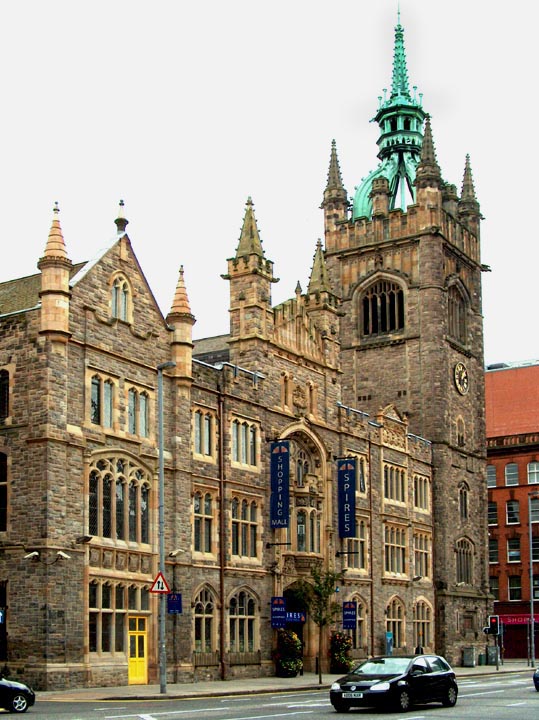
Old Life took a wee vacation last week thanks to (all about) my trip to Belfast which included delightful discussions with a historian who must remain anonymous for the sake of his good name and sightseeing with an old (not as old as mmmmeeeeeeEEE) friend who also deserves protection from tawdry associations with this blog.

I had the privilege of speaking informally with folks from the Presbyterian Church in Ireland and the Evangelical Presbyterian Church. Those communions are not in fellowship thanks to the split in 1927 over liberalism in the PCI, a debate that has all the earmarks of the so-called fundamentalist controversy in the U.S. In fact, W. J. Grier, who studied at Princeton Seminary with J. Gresham Machen, took some inspiration from conservatives in the U.S. to oppose the teaching of J. E. Davey, who taught church history and theology at Union College (in effect the seminary for Irish Presbyterians). When the trial against Davey failed, Grier led the formation of a new Presbyterian communion.

That parallel suggests that PCI is to the EPC what the PCUSA is to the OPC. But such reading of American dynamics into Ireland misses how different American Presbyterianism is. If anything, the U.S. equivalent to the PCI is the Evangelical Presbyterian Church (the American one that had Tim Keller speak at its GA). The PCI is more evangelical than the PCUSA and does not go out of its way to be inclusive. Whether it will ever go out of its way to discipline erroneous views is another matter.

Another difference is that the PCI’s moderator is tenth in the Orders of Precedence in the United Kingdom.

I have no idea how to reconcile the Wikipedia chart with the church’s website about political status in Northern Ireland. But I do suspect the matter has something to do with the Regium Donum, a “royal gift” from Charles II to dissenting Protestants (outside the Church of Ireland — Anglican) to support their ministry. In fact, the royal recognition of the PCI’s moderator means that he receives invitations to affairs in London held by the British government. I suspect it also means some sort of royal representative at PCI General Assemblies the way that the Queen still sends a delegate to the Free Church of Scotland.

This difference with the USA is striking. The federal government or POTUS never sends representatives or invitations to moderators of Presbyterian communions in the U.S. Not even the Presbyterians in the “Protestant establishment,” the PCUSA, have the standing that Presbyterians do in the UK. American Presbyterians are pikers compared to Presbyterians in the British Isles.

But we American Presbyterians compensate with celebrity.

Which raises the question whether a brand like Tim Keller has more influence in national (or urban) life than a royal gift. I am asking because inquiring minds want to know.

Why Liberty U. May Be a Better Place to Study than Duke

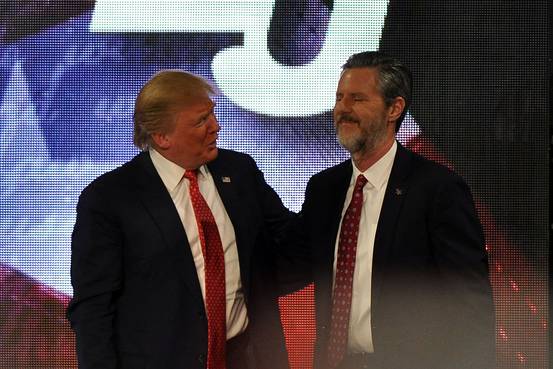
Jerry Falwell, Jr. may have and still does support Donald Trump, but I doubt he’d let happen what Paul Griffiths, a very smart Roman Catholic scholar, is now experiencing for not submitting to sensitivity training (thanks to Rod). Griffiths’ description of the consequences of the politics of identity is a reminder that we have more to fear than Donald Trump:

These disciplinary proceedings are designed not to engage and rebut the views I hold and have expressed about the matters mentioned, but rather to discipline me for having expressed them. Elaine Heath and Thea Portier-Young, when faced with disagreement, prefer discipline to argument. In doing so they act illiberally and anti-intellectually; their action shows totalitarian affinities in its preferred method, which is the veiled use of institutional power. They appeal to non- or anti-intellectual categories (‘unprofessional conduct’ in Heath’s case; ‘harassment’ in Portier-Young’s) to short-circuit disagreement. All this is shameful, and I call them out on it.

Heath and Portier-Young aren’t alone among us in showing these tendencies. The convictions that some of my colleagues hold about justice for racial, ethnic, and gender minorities have led them to attempt occupation of a place of unassailably luminous moral probity. That’s a utopia, and those who seek it place themselves outside the space of reason. Once you’ve made that move, those who disagree with you inevitably seem corrupt and dangerous, better removed than argued with, while you seem to yourself beyond criticism. What you do then is discipline your opponents.

If only liberals were liberal.

The United States of Fear

I think I have the way to form a more perfect union in this place we call the USA. It is to recognize that all Americans share a sense of fear. Anxiety is what unites us in the U.S. Consider the following.

Andrew Sullivan writes respectfully about reactionary conservatism and even grants its plausibility:

Certain truths about human beings have never changed. We are tribal creatures in our very DNA; we have an instinctive preference for our own over others, for “in-groups” over “out-groups”; for hunter-gatherers, recognizing strangers as threats was a matter of life and death. We also invent myths and stories to give meaning to our common lives. Among those myths is the nation — stretching from the past into the future, providing meaning to our common lives in a way nothing else can. Strip those narratives away, or transform them too quickly, and humans will become disoriented. Most of us respond to radical changes in our lives, especially changes we haven’t chosen, with more fear than hope. We can numb the pain with legal cannabis or opioids, but it is pain nonetheless.

If we ignore these deeper facts about ourselves, we run the risk of fatal errors. It’s vital to remember that multicultural, multiracial, post-national societies are extremely new for the human species, and keeping them viable and stable is a massive challenge. Globally, social trust is highest in the homogeneous Nordic countries, and in America, Pew has found it higher in rural areas than cities. The political scientist Robert Putnam has found that “people living in ethnically diverse settings appear to ‘hunker down,’ that is, to pull in like a turtle.” Not very encouraging about human nature — but something we can’t wish away, either. In fact, the American elite’s dismissal of these truths, its reduction of all resistance to cultural and demographic change as crude “racism” or “xenophobia,” only deepens the sense of siege many other Americans feel.

And is it any wonder that reactionaries are gaining strength? Within the space of 50 years, America has gone from segregation to dizzying multiculturalism; from traditional family structures to widespread divorce, cohabitation, and sexual liberty; from a few respected sources of information to an endless stream of peer-to-peer media; from careers in one company for life to an ever-accelerating need to retrain and regroup; from a patriarchy to (incomplete) gender equality; from homosexuality as a sin to homophobia as a taboo; from Christianity being the common culture to a secularism no society has ever sustained before ours.

Notice too that conservatives are not the only ones who are very, very afraid. It’s also feminist philosophers. But even they can’t claim privilege for their phobia:

I want to explore a much more general issue raised by this whole affair. This has to do with concept of harm, which keeps being raised. The main charge against Tuvel is that the very existence and availability of her paper causes harm to various groups, most specifically to members of the transgender community. This is a puzzling and contentious claim that deserves serious reflection.

The editorial board statement specifically refers to “the harm caused by the fact of the article’s publication.” As the concept of harm is standardly used in legal contexts, this would be a tough claim to defend. It is certainly possible for someone to suffer material or tangible loss, injury, or damage as a consequence of a 15-page article being published in an academic journal. The article might be libelous, for example. But there is no such charge here. The only individual mentioned by name besides Rachel Dolezal is Caitlyn Jenner, and it seems implausible to say that Tuvel has harmed Jenner by “deadnaming” her (i.e., using her birth name), given how public Jenner has been about her personal history.

The authors of the editorial board statement have nothing to say about how they understand harm. This already should give pause for thought. Philosophers, whatever their methodological orientation or training, usually pride themselves on sensitivity to how words and concepts are used. This makes it odd to see no attention being paid to how they are understanding this key concept of harm, which is central to many areas in legal and moral philosophy.

But the statement does clarify what the authors believe has caused the harm: “Perhaps most fundamentally, to compare ethically the lived experience of trans people (from a distinctly external perspective) primarily to a single example of a white person claiming to have adopted a black identity creates an equivalency that fails to recognize the history of racial appropriation, while also associating trans people with racial appropriation.”

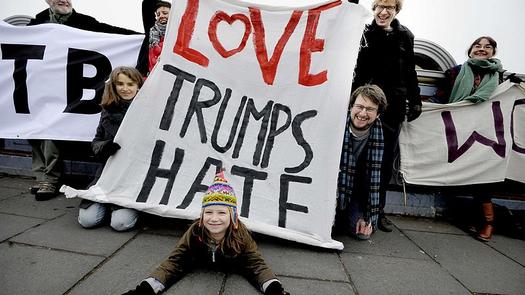
And here I thought we were supposed to be afraid of Trump. Imagine the harm a POTUS can do. But in the United States of Fear, an academic paper poses a threat capable of generating the kind of fear that many endure with our incautious and vicious president.

The question is whether those with fears can recognize fear as a basis for personal identity. Can we go from the specific to the general and recognize fear is something that every American experiences? If so, then we may finally have a common point of reference for a shared existence. We are united in fear.

Dueling Bubbles

Jim Wallis goes out on a limb by dumping on white evangelicals:

The issue here is not Christians voting differently from each other. That is normal and likely healthy given the independence that people of faith should show over partisan loyalties. This is about the moral hypocrisy of white American evangelical religious right leaders like Jerry Falwell Jr. causing a crisis in the church, dividing American Christians on racial lines, and astonishing the worldwide body of Christ — the international majority of evangelical Christians who are people of color — and whose leaders keep asking many of us what in the world is going on with white American evangelicals.

That number, 81 percent, has become an international symbol that tragically now represents what white American evangelicalism stands for. It dramatically and painfully symbolizes the white ethno-nationalism that Donald Trump appeals to and continues to draw support from among white American evangelicals. It is the most revealing and hurtful metric of what I will call the racial idolatry of white American evangelical Christianity, which clearly excludes American evangelicals of color and the global majority of evangelicals. The 81 percent number ultimately signifies a betrayal of the body of Christ — which is the most racially inclusive and diverse community in the world today.

But what are white evangelicals to do when the other side, the one that thought it was on the right side of history, looks at born-again Protestants the way that Jim Wallis does? Damon Linker explains how evangelicals, to be accepted, are supposed to agree with progressives, or else receive not policy papers but denigrating insults:

As I’ve argued on previous occasions, declaring opponents unacceptable, illegitimate, and out of bounds is a perennial temptation. That’s because politics always takes place on two distinct levels. On one level is the back and forth of partisan conflict, involving persuasion, argument, electoral battles, triumphs, and defeats. On this level, pretty much anything goes as long as it abides by the rules of the political game. But there’s also a second, more fundamental level of politics that involves a competition over who gets to set those rules, the boundaries of what is publicly acceptable — and precisely where those boundaries will be positioned.

Far more than conservatives, liberals love to rule certain positions out of bounds in this second-order sense. They do this by appealing to the courts — the branch of government that reviews, alters, and overturns the rules of the political game. They also do it in the important institutions they control within civil society — such as mainstream media outlets, universities, corporations, movie studios, and other arms of the entertainment industry. When these institutions informally decide that an issue, or a specific position on an issue, is simply unacceptable because it crosses a moral line that leading members of these institutions consider inviolable, they render it beyond the pale. As I wrote in a previous column on the subject, “Over the past several decades, a range of positions on immigration, crime, gender, and the costs and benefits of some forms of diversity have been relegated to the categories of ‘racism,’ ‘sexism,’ ‘homophobia,’ ‘white supremacy,’ or ‘white nationalism,’ and therefore excluded from first-order political debate.”

So to keep this straight, evangelicals are hypocrites for caving on moral convictions. But liberals (and the evangelicals like Wallis who loves them) are hypocrites for caving on reasonableness. At least evangelicals are still relatively green in politics. What’s the left’s excuse?

If It’s Any Consolation, Princeton Seminary Would Not Have Awarded Randy Nabors Either

As progressive as the founding pastor of New City Fellowship in Chattanooga is, Andrew Exum thinks this mixed race, multicultural church still fails to pass the Democratic/mainline Protestant litmus test:

Last weekend, I happened to be back in Jackson’s Tennessee, and my wife and I used the opportunity to go to a church we have long admired. New City Fellowship in Chattanooga was founded by a young interracial couple who grew up in housing projects in Newark, New Jersey, and started a ministry focused on racial reconciliation in my hometown in the 1970s. Today, it is a vibrant cross-cultural ministry and was one of the few places I remember growing up (that wasn’t a sporting event) where black and white Tennesseans would regularly gather together. I cannot imagine the courage it must have taken for a young white pastor and his black wife to have started that church just a few years after Martin Luther King Jr. was gunned down on the other end of the state.

Like most Protestant churches still thriving in the United States, New City follows a pretty orthodox—in this case, Presbyterian—theology. Most of the men and women with whom my wife and I were worshipping would also probably identify as evangelicals, that same group of people who have been Trump’s most committed supporters.

Now, may the Lord have mercy on me for this, but perhaps because I have lived in Washington, D.C., for the past several years, as I worshipped last weekend, I also saw something else in the pews: voters. These people—God-fearing Christians committed to racial reconciliation and social justice—should be among the voters for whom a multicultural Democratic Party is competing.

But one thing that shines through among many evangelical voters—as well as other, non-evangelical Trump supporters with whom I have spoken back home—is how turned off they are by the smug self-righteousness of contemporary progressive discourse.

Don’t support abortion rights? Well, obviously you hate women (even if you happen to yourself be a woman), and the late-night comedians are going to be merciless with what is left of your reputation.

Still believe marriage is a Biblical institution between a man and woman for the purposes of procreation? Be prepared to be mocked relentlessly on social media and shunned by peers and employers.

Last week, the Democratic Party debated whether it was even still possible to be pro-life and a Democrat before Nancy Pelosi—that arch-pragmatist who, so unlike her GOP successors, put a string of wins on the board for her party while speaker of the House—put an end to the debate by affirming that the answer remained yes.

These debates over doctrine and policy positions are exactly what the party should be doing in the aftermath of its 2016 debacle. But when paired with the self-righteous tone so characteristic of contemporary progressive discourse, it is potentially toxic to attempts to broaden the electorate for which the Democratic Party is competing. It replicates the mistakes of Alexander Hamilton’s own political writings before his own party collapsed.

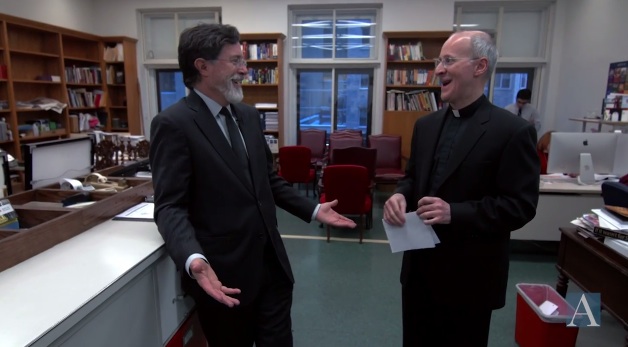
Only the current configuration of national politics could make New School Presbyterians look like J. friggin Gresham Machen. Which might also make the people who voted for Trump (I did not) look a little more reasonable than Stephen Colbert.

The Good Thing about New Calvinism

They don’t attract people like this:

The FBI closely monitors online communities that discuss ISIS, at times running so many undercover accounts that agents end up investigating one another: An FBI policy guide, obtained and published by The Intercept, notes that online investigations have “previously resulted in resources being wasted by investigating or collecting on FBI online identities,” or employees working undercover. The Bureau also takes tips from a network of sources—from security firms to random vigilantes—who monitor these communities.

The small group of people who have been arrested on ISIS-related charges are an idiosyncratic bunch—they come from a range of socioeconomic backgrounds, and each case is distinctive. But many do share important traits with Moe and Jaelyn. According to the Center on National Security at Fordham University’s School of Law, their median age is 25. Three-quarters are American citizens. Nine out of 10 are male. Over one-third are converts to Islam. Although roughly a quarter of cases have involved people of Arab descent like Moe, whose father is Palestinian, most come from other ethnic backgrounds, including African Americans like Jaelyn. Few have criminal backgrounds. Many live with their parents. And roughly 90 percent of cases involve social media, sometimes including online conversation with a recruiter, either real or undercover.

So why is voting for Trump so scary? Have Americans really lost the capacity to discern different kinds of threats? Even words that trigger PTSD don’t have the same effect as a guillotine.

But the biggest problem with the jeremiads against the new P.C. is that they treat the so-called politically correct as radical freaks who are outside of mainstream American society—opposing the common sense free-speech position held by wholesome liberals and conservatives. Yet far from outlier ideas, trigger warnings and safe spaces grow out of impulses that are broadly shared. For many decades, the United States has been the home to a thriving vernacular therapeutic culture, where ordinary citizens borrow concepts from psychology and use them as tools of self-improvement, often, in the process, forming distinct political and social identities. In a society where Oprah Winfrey is a guru to millions and self-help books are perennial best-sellers, the adoption of folk therapy is hardly the mark of eccentricity. Moreover, trigger warnings and safe spaces echo the larger jitteriness that has marked American culture for many decades, gaining special salience after September 11, 2001.

Imagine that kind of understanding for white evangelicals.

And then duck.

The World Is Turning Rod and Leaving Tim Behind

The piece on Rod Dreher and the Benedict Option in the New Yorker was remarkable on several levels. It was generally positive, respectful, and long. This was the case despite Dreher’s tendency to sound a tad hysterical about sexual irregularities and deviance. This quote by Andrew Sullivan, a gay man who has gone head to head with Rod over the years, was telling:

Sullivan has a long-standing disagreement with Dreher over same-sex marriage, but he believes that the religiously devout should be permitted their dissent. “There is simply no way for an orthodox Catholic to embrace same-sex marriage,” he said. “The attempt to conflate that with homophobia is a sign of the unthinking nature of some liberal responses to religion. I really don’t think that florists who don’t want to contaminate themselves with a gay wedding should in any way be compelled to do so. I think any gay person that wants them to do that is being an asshole, to be honest—an intolerant asshole. Rod forces you to understand what real pluralism is: actually accepting people with completely different world views than your own.”

In “The Benedict Option,” Dreher writes that “the angry vehemence with which many gay activists condemn Christianity” is the understandable result of a history of “rejection and hatred by the church.” Orthodox Christians need to acknowledge this history, he continues, and “repent of it.” He has assured his children that, if they are gay, he will still love them; he is almost—but not quite—apologetic about his views, which he presents as a theological obligation. He sees orthodox Christians as powerless against the forces of liquidly modern progressivism; on his blog, he argues that “the question is not really ‘What are you conservative Christians prepared to tolerate?’ but actually ‘What are LGBTs and progressive allies prepared to tolerate?’ ” He wants them to be magnanimous in victory; to refrain from pressing their advantage. Essentially, he says to progressives: You’ve won. You wouldn’t sue Orthodox Jews or observant Muslims. Please don’t sue us, either.

“What I really love about Rod is that, even as he’s insisting upon certain truths, he’s obviously completely conflicted,” Sullivan said. “And he’s a mess! I don’t think he’d disagree with that. But he’s a mess in the best possible way, because he hasn’t anesthetized himself. He’s honest about a lot of the questions that many liberal and conservative Christians aren’t really addressing.”

Notice that Dreher, who is outspokenly anti-gay marriage, did not receive the chorus of criticism that Tim Keller did at Princeton Seminary even from such mainstream organs and figures as the New Yorker and Andrew Sullivan.

To be sure, the PCUSA is not the New Yorker, but at a time when the magazine has identified President Trump and his supporters as an alien force in national life, a fair piece about Dreher is not what readers would have expected.

So why does Dreher receive more acclaim than Keller? The reason could be that the former promotes a thick (as he understands it) Christian identity, complete with communitarian obligations, while Keller stands for a Christianity that is chiefly reasonable and appeals to the mind. In other words, Dreher is appealing to a larger conception of Christianity that encompasses more of one’s identity than intellect while Keller is largely about defending the Apostles’ Creed (as he explained a while back in an interview at First Things) — or a Christian minimum. Rod is maximalist where Tim is a minimalist.

Naomi Schaeffer Riley picked up on this difference when she contrasted Dreher and Keller:

Keller sees an integral part of the church’s mission as being present in the big cities — no matter how culturally degraded they may seem. “Christians ought to be present and engaged everywhere that there are people. But across the world people are flocking to cities at the rate of millions per year.

“Christians don’t all need to live in cities, but they should at least be moving there in the same proportions as the people whom they want to serve.”

His approach may be falling out of favor among some more orthodox believers. Last month, the Wall Street Journal reported on a small but growing number of Christians who, “feeling besieged by secular society . . . are taking refuge” in small, often isolated communities away from negative cultural influences and surrounded by other believers.

This “Benedict Option” was named in honor of St. Benedict, who fled the moral degradation of Rome. It’s also the title of a new book by Rod Dreher, who, writing in Christianity Today, calls it a “strategic withdrawal” by “serious Christian Conservatives [who] could no longer live business-as-usual lives in America.”

Though Dreher doesn’t say Christians should all flee to isolated enclaves, those are where such withdrawal would be easiest.

Keller believes Christians in New York cannot retreat into homogeneity. They’ll be regularly faced with people who fervently disagree with them. Keller’s church is a multi-ethnic one and even if the believers have a similar religious outlook, they hail from a variety of different backgrounds.

That fear of homogeneity and retreat also explains, by the way, while Keller is somewhat uncomfortable with going all in on Presbyterianism (from his interview at First Things):

I don’t believe you can reach New York with the gospel if you only plant Presbyterian churches. There are all kinds of people who’ll never be Presbyterians. It just doesn’t appeal to them. Some people are going to be Pentecostals, some people are going to be Catholics. I mean, I know that sounds¯I’m not talking about that certain cultures reach certain people. It’s much more complicated than that. Even though there’s something to that. We all know that certain cultures seem to have more of an affinity toward a certain kind of Christian tradition than others, but I wouldn’t want to reduce it to that at all. I would just say that I only know that God seems to use all these kinds of churches to reach the whole breadth of humanity, and so that’s why we give money to start churches of other denominations, and give free training to it. And we’ve done about a hundred in the New York area, where we’ve helped people. It’s very important to us.

For Keller, apparently, Christianity resists taking overly specific and particular forms (think ecclesiology, liturgy, even creed). His ministry can transcend different cultures and expressions of Christianity. That comes up short against those Christians that Schaeffer identifies as wanting a more than “business-as-usual” faith.

But the Allies at Gospel Coalition back Keller over Dreher when they say they want both a Christianity that is meaty and one that is mainstream:

The Benedict Option is named for Benedict of Nursia, a 4th century monk who launched a monastic movement that preserved Western civilization. Today, writers like Rod Dreher enjoin Christian​s​ to take similar steps to “develop communities based on a shared sense of orthodoxy (right belief) and orthopraxy (right practice), for the sake of forming ourselves and the next generation in the Christian faith.”

The New York Times columnist Ross Douthat has called Redeemer Presbyterian Church in New York City, where Tim Keller serves as senior pastor, an effective example of the Benedict Option for our twenty-first century, post-Christian context. Like other TGC-inspired communities, Redeemer aims to blend countercultural biblical faithfulness with a Christ-exalting, city-embracing vision.

That dual commitment to faithfulness and cultural affirmation did work for the post-World War II world. It was precisely the vision of the Neo-Evangelicals who formed the National Association of Evangelicals, founded Christianity Today, and cheered and prayed for Billy Graham. It was and is a faith that harmonizes well with a nationalism confident of its role in the world, and generally progressive in its estimate of where history is going or at least who the good guys are in that narrative.

But at a time when that post-war internationalist order is under serious strain (think Brexit, Scottish Independence, Trumpian nationalism), the appeal of a rational, enlightened Christianity may have hit a wall. What Christians seem to understand is that they need a faith little more “deep-down diving and mud upbringing,” that can withstand a social order that is not congenial to their religious convictions. It is a faith that bears more resemblance to the politics of identity than to United Statesist Christianity. This faith does not go along but separates. It makes more claims on adherents than a faith that primarily relies on mental exercises demanded by w-w. It recognizes that the world is more hostile than previous generations supposed and that Christians need to be more intentional about their convictions.

Why someone living in New York City, the place that cultivated the boorish Donald Trump, doesn’t see that cities (from culture to economics) may be a problem for the practice of demanding Christianity is a real mystery.
Protest

When you see gross deficiency in the church, you don’t shrug. You object as Phil Lawler does over news of a new Roman Catholic church in Boston:

in the past 50 years, the Archdiocese of Boston has opened zero new parish churches. Over the same span, roughly 125 parishes have been shut down or merged into “cluster” units.

This might be understandable, if the Boston’s Catholic population had disappeared. But it hasn’t—at least not according to the official statistics. On paper, it has grown. There were about 1.8 million Catholics registered in the area covered by the Boston archdiocese 50 years ago; today the official figure is 1.9 million.

The trouble, of course, is that most of those 1.9 million Catholics aren’t practicing the faith. Consequently it should be no surprise that their sons don’t aspire to the priesthood. There were just over 2,500 priests working in the archdiocese 50 years ago; now there are fewer than 300. That’s right; nearly 90% of the priests are gone. If you can’t replace the priests, you can’t keep open the parishes.

Let’s be frank. These figures are not a cause for concern; they are a cause for horror. Panic is never useful, but something close to panic is appropriate here. Things have gone terribly, terribly wrong.

Lawler also identifies four possible responses:

A) “This is a disaster! Stop everything. Drop what you’re doing. “Business as usual” makes no sense; this is a pastoral emergency. We don’t just need another “renewal” program, offered by the same people who have led us into this debacle. We need to figure out what has gone wrong. More than that. We know that the Gospel has the power to bring people to Christ; therefore it follows that we have failed to proclaim the Gospel. The fault lies with us. We should begin with repentance for our failures.”

B) “Don’t worry. Times change, and we have to change with them. Religion isn’t popular in today’s culture, but the faith will make a comeback sooner or later. We just need to keep plugging away, to have confidence, to remember God’s promise that the Church will endure forever.” . . .

C) “It doesn’t really matter whether or not people go to church on Sunday. As long as we’re all nice people, God in his mercy will bring us all to heaven.”

D) “Don’t bother me with your statistics. Actually the faith is stronger than ever. Our parish/diocese is vibrant! You’re only seeing the negative.

Lawler takes no comfort from the idea common refrain that the gates of hell will not prevail against the church:

You see what’s wrong with argument B, don’t you? Yes, the Lord promised that the Church would last through the end of time. But he did not promise that the Archdiocese of Boston (or your own diocese) would last forever. The faith can disappear, indeed has disappeared, from large geographical areas—northern Africa, for instance.

If the Archdiocese of Boston won’t last, what about the global diocese centered in the Eternal City?