Reading about Machen in The Reformed Journal

Reformed Protestants 50 and up may have spent some of their reading hours with The Reformed Journal, a magazine of Dutch-American Calvinist provenance that came into existence as a forum for Christian Reformed Church progressives. I read it from my days as a seminary student until 1990 when it folded. I didn’t always agree with the politics or theology, but it was provocative and thoughtful.

Given the “progressive” character of the magazine, I should not have been surprised that TRJ’s regular contributors were slightly sympathetic but underwhelmed by J. Gresham Machen. That outlook bothered me because the deeper I went into the archives, the more impressed I was by the man who started Westminster Seminary and the OPC (with lots of help from others). In light of yesterday’s post with an excerpt from Machen’s testimony at his trial and with some reflections still fresh from the fall Presbyterian Scholars Conference (where several participants were experiencing the joy of post-PCUSA life but still not on board with Machen’s own version of that experience), I reproduce some high or low lights of TRJ takes on Machen.

First comes Rich Mouw’s argument that Machen’s departure actually hurt the cause of conservatism in the PCUSA (one echoed by George Marsden at the Wheaton conference):

Barbara Wheeler and I have argued much about the issues that threaten to divide us, but we share a strong commitment to continuing the conversation. She regularly makes her case for staying together by appealing to a high ecclesiology. The church, she insists, is not a voluntary arrangement that we can abandon just because we do not happen to like some of the other people in the group. God calls us into the church, and that means that God requires that we hang in there with one another even if that goes against our natural inclinations.

I agree with that formulation. And I sense that many of my fellow evangelicals in the PCUSA would also endorse it. The question that many evangelicals are asking these days, though, is whether God expects us to hang in there at all costs.

One of my reasons for wanting to see us stick together is that a Presbyterian split would be a serious setback for the cause that I care deeply about, namely the cause of Reformed orthodoxy. I spend a lot of time thinking about how people with my kind of theology, have acted in the past, and I am convinced that splits inevitably diminish the influence of the kind of orthodoxy that I cherish — for at least two reasons.

First, the denomination from which the dissidents depart is typically left without strong voices to defend orthodox. This is what happened in the early decades of the 20th century when J. Gresham Machen and his colleagues broke away from the northern Presbyterian church.

I know that this is not a very popular thing to say in this setting, but I happen to be a strong admirer of Machen. I think that he pretty much had things right on questions of biblical authority, the nature of Christ’s atoning work, and other key items on the theological agenda. But I have strong reservations about his ecclesiology and I regret that his views about the unity of the church led him to abandon mainline Presbyterianism. As long as he remained within the northern church, he had a forum for demonstrating to liberals that Calvinist orthodoxy could be articulated with intellectual rigor. When he and his friends departed, this kind of witness departed with them.

The evangelicals who stayed on in the northern church generally did so because they were not as polemical as the Machen group; they were also not nearly as inclined as the Machenites to engage in sustained theological discussion. This meant that the quality of theological argumentation in mainline Presbyterianism suffered for several decades — some would even say up to our present time.

Not to let facts get in the way here, but Mouw would do well to remember that the PCUSA brought Machen to trial and excommunicated him. Yesterday’s post shows that Machen was not eager to flee even if it would have been a lot more pleasant. Whether his actions were legitimate or constitutional is another question. But he asked about the constitutionality of PCUSA actions and that didn’t endear him to the people who stayed. In fact, they tried him for having the temerity to question the soundness of the Board of Foreign Missions — as if that’s never happened — and the administrative fiats that condemned dissent.

I too wonder if Mouw considers that from 1869 until 1920 the PCUSA became infected by the social gospel and Protestant ecumenism. During that very same time Princeton Seminary as the voice of Reformed orthodoxy in the northern church was still dominated by conservatives. What happened during the years when Princeton kept alive the theology that Mouw values? Princeton and it’s orthodoxy became marginal and then a nuisance — hence the reorganization of Princeton Seminary in 1929. The idea that had Machen stayed conservatives would have done better is naive and ignores what actually happened before Machen “left.” Plus, what kind of high ecclesiology settles for articulating “Calvinist orthodoxy with intellectual rigor”?

George Marsden and Mark Noll regularly wrote for TRJ and again the returns on Machen were not always positive. First, Marsden:

Both at the time and since critics of Machen have suggested that there was something peculiar about him. Most often mentioned are that Machen remained a bachelor and his very close relationship to his mother until her death in 1931. Neither of these traits, however, was particularly unusual in the Victorian era, which certainly set many of Machen’s social standards.

More to the point is that he does seem to have had a flaring temper and a propensity to make strong remarks about individuals with whom he disagreed. One striking instance is from 1913 when Machen had an intense two-hour argument with B. B. Warfield over campus policy, after which Machen wrote to his mother that Warfield, whom he normally admired immensely, was “himself, despite some very good qualities, a very heartless, selfish, domineering sort of man.” You can imagine that, if someone says things like this about one’s friends, that it might be easy to make enemies. Machen does not seem to have had a great ability to separate people from issues, and this certainly added to the tensions on the small seminary faculty. Clearly he was someone whom people either loved or hated. His students disciples were charmed by him and always spoke of his warmth and gentlemanliness. His opponents found him impossible, and it is a fair question to ask whether, despite the serious issues, things might have gone differently with a different personality involved.

This observation continues to baffle me, as if people do not distinguish public from private statements. Maybe we are only learning that lesson after Donald Trump, but historians generally know that in the archives you find people saying all sorts of things that they wouldn’t say in public. In private we blow off steam, unless we are all walking John Piper’s and sanctified all the way down. I also don’t understand why Marsden starts his sentence on Machen’s personality with the man’s opponents found him impossible. Hello. The feeling was mutual. But Machen as a sanctified believer was supposed to find his adversaries hedonistically delightful?

And finally, Mark Noll’s estimate on the fiftieth anniversary of Machen’s death:

By reading controversies within Princeton Seminary, Presbyterian missions, and eventually the Presbyterian denomination as battles between two separate religions, “Christianity and Liberalism,” Machen undermined the effectiveness of those Reformed and evangelical individuals who chose to remain at Princeton Seminary, with the Presbyterian mission board, and in the Northern Presbyterian Church. By committing himself so strongly to theological and ecclesiastical combat, Machen left successors who were ill-equipped to deal with the more practical matters of evangelism, social outreach, and devotional nurture. By pursuing the virtues of confessional integrity, he opened the door to sectarian pettiness.

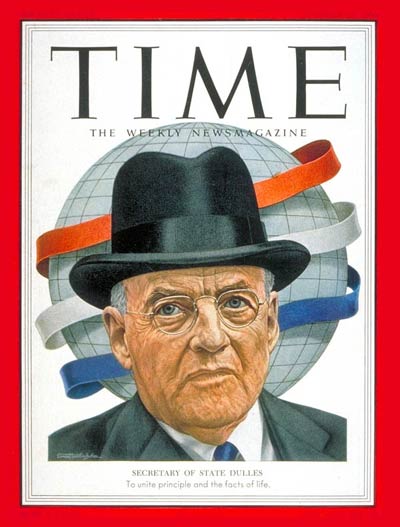
No real sense here that blaming the victim is a potential downside of such an interpretation. The perspective seemed so often in TRJ to be that Machen was a man on a mission and looking for a controversy. The bureaucrats and seminary administrators were innocent. (Yes, the lawyer who defended modernists in the 1920s, John Foster Dulles, became the Secretary of State who crafted the Eisenhower administration’s Cold War policies — the very administration that the founding editors of TRJ questioned.) The Presbyterian hierarchy simply responded — with a hammer, mind you — to Machen’s provocations. That could have been the case but no one argued that. They largely reduced Machen to a cantankerous figure who got what most of us would expect if we rock the boat the way he did.

And now in hindsight I wonder what these same men would think of Abraham Kuyper who was also part of a church that came out of the Netherlands’ state church. Didn’t Kuyper’s GKN (Reformed Churches of the Netherlands) make it a lot harder for conservatives who stayed in the NHK (Dutch Reformed Church)? And didn’t Kuyper’s Free University make life more complicated for orthodox theologians who remained at Leiden or Utrecht? (In other words, why wouldn’t it be possible to imagine Machen akin to Kuyper? Why doesn’t the Kuyper glow trickle down to Machen? Because Kuyper became Prime Minister and Machen merely president of the Independent Board for Presbyterian Foreign Missions?)

And what of John Calvin? Was he wrong to leave France? Did he leave Huguenots in the lurch? Was the Roman Catholic Church worse off without Calvin’s ministry and theological reflection? Or does the mind boggle at the questions you need to start asking other historical figures when you become so demanding of a figure of which you disapprove?

Could You Write this after 9-11?

David Koyzis tries to turn B. B. Warfield into a Kuyperian and quotes this:

For there shall be a new heaven, we are told, and a new earth. Under these new heavens, in this new earth, shall gather redeemed humanity, in the perfection of its idea, and in perfect harmony with its perfected environment. In the perfection of physical vigour: for what is sown in corruption shall have been raised in incorruption, what is sown in dishonour shall have been raised in glory, what is sown in weakness shall have been raised in power, what is sown in selfishness shall have been raised in spirituality. In the perfection of social organization and intercourse: for there shall be none to hurt or destroy in all God’s holy mountain, and all the people of the Lord shall have learned righteousness. In the perfection of spiritual communion with God: for then it is that the Lord shall make Himself known to His people and shall dwell with them, and they shall need no Temple to which men should require to repair in order to meet the Lord, for the Lord God the Almighty and the Lamb are the Temple thereof, and the grace of the Lord shall flow down the streets in a river of the water of Life washing into every nook and corner.

Such is the picture the Scriptures draw for us of the salvation of our God. And let us not fail to note that it is a picture of a saved world. As no sphere of human life is left untouched by it; as on its touch, every sphere of human life is transformed; so the completeness and the profundity of its renovation of man is matched by the wideness of its extension over man. It is the renewed heavens and the renewed earth that we are bidden to contemplate; and dwelling in them in endless bliss renewed humanity.

Hard not to think that with the British Empire chugging along, the Ottomans still in charge of an unruly part of the world, the Austro-Hungarians doing their part to keep order in the Balkans, and western dominance spreading around the globe, the world was getting better and that Christians (of a kind) had a large hand in that betterment. This quotation comes from a book published in 1913.

But when the world looks less stable and life less predictable, can any Reformed Protestant still be post-millennial? (And doesn’t Koyzis have a duty to protect Warfield’s good name?)

Inside the Bubble, All White Christians Look the Same

President-elect Trump’s pick for Department of Education, Betsy Devos, has deep ties to the Christian Reformed Church:

She is daughter of Edgar Prince, the founder of Prince Corp., an automobile parts supplier based in Holland, Mich. While her mother, Elsa, and her husband’s parents have supported anti-gay marriage efforts in the past, Betsy Devos has focused primarily on education.

DeVos has been member and an elder at Mars Hill Bible Church in Grand Rapids, which was formerly led by popular author Rob Bell. Former president of Fuller Seminary Rich Mouw said he served on a committee with her to replace Bell, and he said DeVos is heavily influenced by Abraham Kuyper, a Dutch writer and Calvinist theologian.

“I wouldn’t consider her to be right wing,” Mouw said. “She’s a classic free-enterprise conservative. She takes public life, art and politics very seriously.”

Middle-class work ethic – check

Anti-gay marriage – check

Abraham Kuyper – check

Rob Bell – what the bleep?

Re-THINK!

Here‘s how comprehensive Christianity breeds Manichaeism (and paranoia) to boot:

In the meantime, we live in the midst of a cosmic struggle. As C. S. Lewis once said:

There is no neutral ground in the universe. Every square inch, every split second is claimed by God, and counterclaimed by Satan.

Thus every act of obedience—including political obedience—is a part of Christian mission, a bold declaration that we support God’s claim to the throne. And because the assault on that throne comes from every nook and cranny of creation, we must aim our redirective efforts at every nook and cranny as well.

Does Bruce Ashford really mean to implicate cats?

But consider where this notion that the assault on Christ’s reign comes from everywhere. Christians in the United States live with non-Christians. So how do comprehensive Christians live with Jews, Mormons, Roman Catholics, and Muslims? And wouldn’t such either-or language signal some kind of aggression to those who don’t trust Christ? In other words, doesn’t this use of the antithesis turn non-Christians into people “of Satan”? If Aryan science is bad, why not Christian culture?

That’s why those inspired by Abraham Kuyper need to take a page from Augustine:

This heavenly city, then, while it sojourns on earth, calls citizens out of all nations, and gathers together a society of pilgrims of all languages, not scrupling about diversities in the manners, laws, and institutions whereby earthly peace is secured and maintained, but recognizing that, however various these are, they all tend to one and the same end of earthly peace. It therefore is so far from rescinding and abolishing these diversities, that it even preserves and adopts them, so long only as no hindrance to the worship of the one supreme and true God is thus introduced. Even the heavenly city, therefore, while in its state of pilgrimage, avails itself of the peace of earth, and, so far as it can without injuring faith and godliness, desires and maintains a common agreement among men regarding the acquisition of the necessaries of life, and makes this earthly peace bear upon the peace of heaven…

The Limits of W-w

Like I say, transformationalism is good on inspiration but not so good on transformation. Jim Bratt gave a peak behind the curtain of neo-Calvinist culture in the U.S. in his last post before heading to China on a Fulbright (happy trails, Jim):

Boy, do we need that now. I’m thinking of the death this past week of Tim LaHaye. The span of tomfoolery he pumped out in the name of Christianity has created lasting disrepute for the faith. The creation “science.” The “end-times” irresponsibility, compounded of self-pity, blaming others, and a certain cultural idolatry. All of it redolent of the John Birch Society swamp from which he first slithered. Still, it’s the sort of religious fantasy you can expect to hit the American best-seller list. The death that really strikes home for me is the moral nadir of Mr. Family Values, “Dr.” James Dobson. His endorsement of Donald Trump puts paid to any pretense that the ethics and politics he pushed, lo, these many years have come to anything but authoritarian nationalism with a particular macho strut. For that is Trump. Dobson’s worse for covering it with smarmy God-talk.

I say this hits home for me because back when I was on a denominational committee studying the future of the CRC’s magazine, The Banner, we were given some research stats of readership habits and opinion. James Dobson turned out to be the CRC’s #1 rated authority on current events. Charles Colson was its #1 theologian. The Fraud and the Felon atop the Calvinist hit parade. Two minor sins in that revelation somehow stuck out for me. Dobson, a member of the Church of the Nazarene. Read rank Armininian. Colson, invoking the name of Kuyper as he bullied along.

All this, I mused, was the price of that “Americanization” to which the CRC, as an immigrant church, had been long pushed to accede. Well, nationalist mush compounded by militancy turns out to be the bitter fruit of that process. And so it is today.

I don’t pretend that Kuyper ever represented more than a small fraction of Dutch people claiming a Reformed commitment. Ditto, in Dutch-American Reformed circles, for The Forum, The Journal, or Perspectives. But these magazines have fought hard and punched way above their weight because of that magic formula that Kuyper caught, and taught. And it’s worth carrying on their mission, worth trying to maintain cultural, political, and theological integrity above the open sewer into which white-American Christianism has descended.

I bring this up not to delight in the sufferings of neo-Calvinists, nor to take a shot at Jim on his way out of the blogosphere. Bratt, it must be said, is honest about the state of neo-Calvinism and properly annoyed at its abuses.

I do refer to this to remind those would-be Kuyperians that the neo-Calvinist project is a lot harder than it sounds. Take every thought captive. Christ is Lord of every square inch. Television (and plumbing) redeemed. Integration of faith and learning. New York City as a tipping point for global revival. Bratt’s own account of the CRC is a ready warning that even with all the infrastructure of neo-Calvinist culture — church, school, catechesis, denominational magazine, world-and-life bleep, you are a poor match for mass culture in a liberal capitalist democracy.

Take every though captive? More like, kid yourself that you are large and in charge.

I truly admire the grit and determination of Dutch-American Calvinists. They are one of the true success stories of transplanting a distinct form of Old World Calvinism to the New World. They were BenOp Calvinists before the Benedict Option became hip.

But as all immigrant groups know, leaving the ghetto for the suburbs is part of the American dream. So for w-w to happen you may need to hunker down in the ghetto (or if Amish on the farm or if Benedictine in the monastery). But if you are going to live and move and have your being as a citizen of a modern nation state, chances are many of your square inches will be taken captive.

And if you want a theological rationale or explanation for that, for being part of the mainstream society but not, learn, live, and love 2k. The water’s warm.

The Abraham Option (or been there, done that)

Kuyper, that is.

Rod Dreher leaves another hint that he has no real feel for the fundamentalist or confessional Protestant world:

That said, I think lots of Christian parents are going to have to make some hard calls now and in the years to come about moving for the sake of educating their children, and raising them in a peer environment where they are more likely to absorb the faith, or at the very least not have their faith leached out of them. Radical times call for radical measures.

Granted, the world of Dutch-American Calvinism is small and so faulting Rod for not knowing the Christian day school phenomenon is misguided. At the same time, when Abraham Kuyper is largely a household name to cultural conservatives in the U.S., you would think that Rod might know something about the tradition of family-run schools and its history that goes back to the 1850s!!!

At the same time, Rod’s proposals for the Benedict Option sound, as I’ve indicated before, like a person who has been part of mainstream churches and identified with the establishment for all of his spiritual life. For those of us who grew up on the other side of the spiritual tracks, whether fundamentalist or ethnic Protestant, we’ve known for a long time that worldliness is a danger and its a besetting sin of establishments, political and ecclesiastical.

If Kuyper Could, Why Can’t Swanson?

Rebecca Hamilton adds U.S. political parties to the list of spheres to be evangelized (now that the Vatican has removed Jewish persons):

We must, if we are survive as a nation and a people, re-take control of these run-away political parties. We must also, if we ever hope to build a culture of life, convert both of them.

That means, my dear pro-life brothers and sisters, that we must stop thinking of the other political party as the devil incarnate and begin to look on it as a mission field, ripe for the harvest. In short, we need to stop following political hucksters who want to use our votes to gain power for themselves to be used for themselves, and follow Christ the Lord.

It was Jesus who told us to go out and convert the world. It is Satan who tells us to look at those folks over there and condemn them and damn them to hell with all the smug self-righteousness we can muster. Even if the thought that converting people is what Christ specifically told us to do doesn’t move you, then consider once again the sheer political cliff that we are standing on due to Justice Scalia’s death.

We’ve been trying to pack this court for almost 50 years now, and what we’ve gotten for our efforts is corporatism that is breaking the backs of the people of this nation and gay marriage.

We need to convert the Democratic Party to a party of life. We need to convert the Republican party to a party of conservatism rather than abject corporatism. We need to convert both of them into entities that are focused on how to help America and Americans rather than just raid the national treasury for those who pay for their political campaigns.

Here’s the problem: maybe the existing parties aren’t ripe for taking over. So why not start a new political party? Abraham Kuyper did and it became the vehicle for his tenure of prime minister:

Moving from the pastorate to the Dutch parliament by age 35, Kuyper also became the editor of a daily newspaper, De Standaard. From this post, he rallied and educated a movement that would have a transformative impact in the 1870s. Besides ushering in a new denomination, that movement would launch the Anti-Revolutionary Party (ARP), which endured for several decades thereafter. (About 30 years ago, it merged with two other parties that were important to Kuyper’s governing coalition.) By 1901, as leader of the ARP, Kuyper would become prime minister, an office he held for four tumultuous years.

His political vision was worked out over decades, and aimed to impede the centralizing tendencies that capitalism appeared to require. The vision rested upon the notion of “sphere sovereignty”: The belief that God created the distinct realms of life—church, education, family, state—to function independently, each ruled by the “ordinances” God had set in place. “It was identifying, celebrating, guarding, and translating those ordinances into action,” Bratt notes, “that defined his ultimate purpose in politics.” Under Kuyper, the ARP sought to convince the nation of these ordinances and align its policy and law according to them. It was a narrow pathway indeed, yet for a time, the ARP was able to follow it with success, thanks in part to an alliance with Roman Catholics seeking to “restore a Christian Netherlands.”

To be sure, I have reservations about parts of the neo-Calvinist project. But Kuyper’s political savvy sure looks much more important and effectual than Christians kvetching about the state of their nation from the relatively comfortable locations of podcasts, blogs, radio shows, or conference addresses. At least Kuyper did more than theorize, cheerlead for w-w, and write op-eds. He built institutions and forged political alliances. Even more, he governed.

If Christians want to “change” their nation, they need to do more than aim at changing the minds of their political representatives (as if that happens).

Why Credit Schaeffer but not Aristotle?

This is my problem with w-w proponents. When they explain the accomplishments of people with the wrong w-w they play the “common grace” card. Why, of course, folks without a proper w-w understand some truth because ultimately God set it up that way. Listen to a recent account of Aristotle’s abilities:

This does raise the obvious question, what about all those pagans who did get things right? Surely Aristotle, for example, was correct in much of what he said about God, virtue, etc., even if he wasn’t saved? The worldview proponent can happily concede this fact, but it doesn’t prove the existence of universally accessible axioms of reason. Any true beliefs the unbeliever does hold (and in principle there’s no limit to the number of true beliefs an unbeliever may hold) are attributable to common grace. That is, any truth, goodness, or beauty found among unbelievers is a gift from God, but these gifts are not given equally to all. Common grace does not entail common reason, nor can everyone be an Aristotle.

Granted, Aristotle entered the world with certain capacities for which he could not take credit. But can’t we attribute anything to his years of study, his clarity of prose, his competent arguments. Doesn’t he himself deserve praise for some of his accomplishments?

What’s odd about the above rendering of Aristotle and common grace is how much this same w-w apologist has no problem giving credit to Christian w-w proponents, instead of chalking up their insights to “special grace”:

The first Christian to use the term “worldview” was the Scottish theologian James Orr (1844-1913). Orr claimed that our view of Jesus affects our view of everything else in life—of God, of man, of sin and redemption, of the meaning of history, and of our destiny. While Orr gave Christians the building blocks for the idea of a Christian worldview, it was the Dutch theologian and statesman Abraham Kuyper (1837-1920) who took the idea and ran with it. . . .

Credit for popularizing the idea of a Christian worldview among evangelicals in North America undoubtedly goes to Francis Schaeffer (1912-1984), who founded the L’Abri community in Switzerland and wrote extensively on apologetics, art, and culture. Schaeffer had a profound impact upon the following generation of evangelicals, including Nancy Pearcey and Charles Colson (see How Now Shall We Live?) and James Sire (see The Universe Next Door). These evangelicals all affirmed the two key insights of Orr and Kuyper: 1) that the Christian faith forms a unified and coherent vision of all of life, and 2) that this vision stands in irreconcilable opposition to all competing non-Christian visions of life.

That’s a double standard.

I thought w-wers were opposed to dualism.

In point of fact, w-w theory has a serious flaw if it fails to recognize the goodness of creation and the accomplishments of creatures who use their gifts with remarkable ability even without the aid of the Holy Spirit’s redemptive work. That seems like all the more reason to give folks like Aristotle even more credit (humanly speaking) than Schaeffer.

Another Case for the Gateway Drug

Once again comes a suggestion that neo-Calvinism in its desire for comprehensiveness paves the way for Roman Catholicism:

As it happened, the young pastor Abraham Kuyper found something to like in the “Syllabus [of Errors]” too, and said so on no less an occasion than his Reformation Day sermon in 1865! The pope went too far, Kuyper quickly assured his startled (if not outraged) congregation; the document was not to be affirmed in all its details. But its intention was correct. The rising philosophy of naturalism and ethical materialism which the pope was condemning was exactly the enemy that needed to be opposed, Kuyper said, and that opposition would mark his work in church, state, and cultural commentary across the 50+-year career upon which he was just embarking. In fact, this philosophical challenge—this rise of a cruel worldview antithetical to Christianity—is what motivated Kuyper’s turn to strict Calvinism from the more nebulous piety in which he had started out his ministry a few years before. A much older Brownson, now near the end of his career, held much the same sentiments.

If I understand the implications of James Bratt’s argument, reasoning about politics, society, economics, and education apart from first principles (read revealed truth) — one of the building blocks of modern liberalism (and secularism) — is an indication of naturalism, and the enemy of Christians. Thus the antithesis between Christianity and secularism, between 1689 (the Glorious Revolution) and 1789 (the Inglorious French Revolution), between Christian schools, labor unions, and political parties and secular schools, labor unions and political parties.

I can understand that. But if the antithesis is right and if Christians live in societies with unbelievers, on what basis are non-Christians supposed to operate in their social endeavors? If Christians alone have the true w-w, then should they allow those with false w-w’s to “run things?” Or if unbelievers do have access to positions of authority, wouldn’t they need to rely on what they know which does not include revealed truth?

Separating church and state was a long and difficult struggle for Roman Catholics. Distinguishing the differences between neo-Calvinist and theonomic arguments is also difficult. Of course, it needs to be noted that Kuyper did affirm social pluralism and found remarkable ways to include Roman Catholics in Dutch society. Still, when you start with opposition to naturalism and the antithesis between Christians and unbelievers, how you avoid winding up in theonomy or church-above-the-state (e.g. Roman Catholicism) is not at all obvious.

Who's Radical Now?

After lots of push back (at least from some readers) on gay marriage and resistance to it (the Summer of SSM), an attempt to reset the 2k thermostat might be in order.

Once again, a common objection to 2k is that if you don’t oppose same sex marriage or support Kim Davis “the way I do,” then you must really favor same sex marriage and the imprisonment of Kim Davis. It’s the same old problem that J. Gresham Machen faced because he opposed Prohibition. Taking issue with legislation or those who support it is not the same thing as favoring what the legislation opposes. Just because you object to Prohibition (Kim Davis) does not mean you favor drunkenness (political tyranny). The nooks and crannies of politics and legislation don’t allow for such simple calculations. But that doesn’t stop some attorneys from being simplistic (oh the inspirational qualities of Kuyperianism to hyperventilate away complicated matters).

But beyond this besetting problem of Americans (looking beyond the cause to the tactics of pursuing the cause), another obstacle that 2k faces is the charge of cowardice. For some Christians, apparently, serving the Lord and pursuing holiness is insufficient if it is not also creating problems for the wider society. In other words, if Christians try to make accommodations with the new legislative and marital landscape, for instance, they are not being faithful to their Lord. Only if they stand out like a sore thumb can they be counted among the true, the faithful, the holiest.

What needs to be observed about this inclusion of obnoxiousness to the fruit of the Spirit is that it is not the practice we see among some of the heroes of Reformed Protestantism. Did J. Gresham Machen try to be a pain in the neck for the ruling authorities, such as when he objected to the proposed Federal Department of Education? No. He testified before Congress, showed respect and deference in his testimony, and tried to figure out ways for Christians to pass on the faith even in the midst of legal challenges (which is why he supported private Christian schools)?

Or how about Abraham Kuyper? For all of his emphasis on the antithesis and his opposition to political liberalism (read secularization), Kuyper figured out a way to accommodate the diversity of Dutch society such that Calvinists would be able to maintain their faith and associational life even while accepting the presence of Roman Catholics and secular liberals as part of Dutch nation.

The way that previous Reformed leaders have tried to get along in their society — rather than taking the Amish or Islamist option — suggests that the real radicals today are not 2kers but the anti-2kers (RA2K). It is indeed radical to oppose the social and political order. Sometimes it may be necessary. But to make it a badge of Christian faithfulness is not only historically unprecedented but anti-biblical. Peter and Paul preached submission to and honor for the emperor, and Paul said Christians should pray for peace and quiet so they could live out their lives faithfully. But if 2kers employ arguments designed to secure such social stability, we are traitors and deny our Lord.

Funny thing is, we are actually in the majority of Americans:

62 percent of those polled support jailing people for contempt of court; only 15 percent said they opposed it

Of Republicans polled, 64 percent said they supported jailing people for contempt of court

Strong majorities in every demographic category (except for African-Americans) supported jailing people for contempt of court The region where support for jailing them was strongest? The South, Kim Davis’s home region

An overall majority of people (53 percent) believe religious liberty is under threat in America. Four out of five Republicans believe that, and 55 percent of Independents do. The only demographics that didn’t believe that? Democrats, those making over $100K per year, and those living in the Midwest (though in the Midwestern case, it was a plurality).

A slight overall majority (52 percent) believes that elected officials should not be given a religious exemption from doing their job, though the numbers break down along partisan and regional lines. Republicans alone among the political orientations are divided equally.

Majorities in all regions except the South believe elected officials should be required do their jobs regardless of their conscience — and in the
South, the “do your job” faction polled a 47 percent plurality, versus 38 percent of Southerners who believe in the conscience deferment, and 16 percent who aren’t sure.

An overall majority said Kim Davis, in particular, ought to have gone to jail for contempt of court. Interestingly, Republicans, who answered generically that someone in Davis’s position should go to jail, were evenly split when Davis’s name came up.

Big majorities across every demographic category say that Kim Davis ought to resign as a matter of principle. It’s not even close. Only 22 percent of people say she should keep her job and remain defiant

Those numbers may suggest salt that has lost its savor. I actually think it indicates which Christians are on their meds. But it hardly makes us radical.