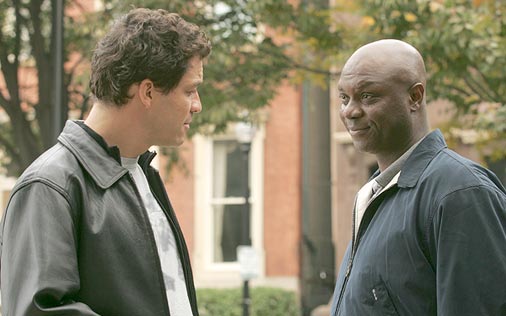
Imagine If Stringer Bell Had Won

The missus and I are three episodes into High Profits, a reality tv show about the legal business of producing and selling marijuana in Breckenridge, Colorado. It’s not great. But setting the drug trade — which is illegal and aggressive where illegal — on the right side of the law gives this show way more interest than most reality shows. You get to see city council members who have Chamber-of-Commerce outlooks and want to preserve a family-friendly ski resort town figure out what to do with a venture with which they have some experience in their youth. It’s like Walter and Schuyler White finding out there meth business is legit and trying to gain a business license to sell meth in one of the storefronts on Lomas Blvd. in Albuquerque. Or, it’s like Stringer Bell outwitting Avon Barksdale and eliminating the gangster element from slinging cocaine and heroin. The big question is whether drug business can be respectable. Of course, we all know it can. Can you say alcohol? But how do you take a drug that has all the not so attractive aspects of illegality and stoner culture and make it normal, even Chamber-of-Commerce promotable?

As I say we’re only three episodes in and the city council is debating the fate of the only in-town marijuana store. But in light of what I just read about David Bowie, I think I know which way the vote is going to go:

The media is portraying Bowie as a mainstream saint—one whose life and death are worthy of emulation. The Huffington Post ran articles entitled, “What Would David Bowie Do?” and “David Bowie—Our Hero.” In a piece that I first thought was a joke, Morgan Shanahan of BuzzFeed.com advises parents on “16 Ways to Teach Your Kids About David Bowie (And the World).” BuzzFeed may not be a serious journalistic enterprise, but it has its finger on the pulse of society and is the primary news source of many young adults. Shanahan treats them to profundities such as, “Teach them how he was never anything less than his authentic self;” “Show them there are endless ways to reinvent yourself while staying true to who you are;” “Help them see there’s beauty in being different, the way he helped so many of us;” and “Show them the way he saw the world. Teach them to be superhuman.”

How is it that a man who was a drug addict, was extremely promiscuous, and flagrantly flouted all sexual boundaries is being held up as an example for our children to emulate?

Breaking Bad Is Peaking Early

The cats have been sleeping through a lot lately, especially the little hellion (Cordelia) who now that the wood burning stove is running cooks until she almost turns soggy. We have watched, for instance, Margin Call (a well done movie about Wall Street on the eve of the 2008 meltdown), Newlyweds (pretty good movie about modern romance even if borrowing too much from Woody Allen as Edward Burns is wont), Whistle Blower (a decent English movie about intelligence and the Cold War that pines for an England innocent of espionage and mightier than the U.S.), and Republic of Love (a lame movie about modern romance unless you like seeing Bruce Greenwood’s naked chest — I am not that metrosexual). But the subject of discussion between the missus and me of late is the television series, Breaking Bad. Having spared Mrs. Hart of the ghoulish opening episodes and the indelicate elimination of bodies (I believe in eschatological discontinuity but I hope the resurrection won’t be so radical), we are now into the second season and the era of Walt’s shaved head.

The early returns are that the series has transgressed the line of suspension of disbelief. The reason for the trespass may be the writer’s sense of needing to keep viewers’ attention with a fairly minimal set of characters. Compared to The Wire which had all of the resources of Baltimore at the creator’s disposal, this is supposed to be the story of one man’s struggle to survive.

Whatever the reason, the episodes with Tucco, while entertaining and dramatic, are simply implausible and make the prospects for another three seasons after this one even more unbelievable. How is Walt going to keep this a small operation? Or will he need to become an Avon Barksdale and Stringer Bell in order to pay his medical bills? But to come as close to being killed (by Tucco) and discovered (by his DEA brother-in-law, Hank) and live to see a return to cooking seems just too much. These tensions would have been more appropriate at the end of Walt’s tenure as meth dealer, not as the beginning of a new stage in his evolution.

The most unbelievable part was Tucco’s father failure to ring the bell on Jesse while being interrogated by Hank. If this had been a stand alone instance of remarkable providence, maybe it would have been plausible. But it was part of too many other very strange circumstances that had to break not bad but right for Walt and Jesse to live to see another batch. And the problem with cutting it so close to being discovered — can we really believe that Hank doesn’t know what’s going on — is that the writers don’t have the backup that David Simon did in The Wire. If Walt goes to jail, the series ends. When Avon went to jail, The Wire became even more interesting.

This doesn’t mean that Breaking Bad is bad. It only means that so far the Harts are not hooked. After season one, episode five of The Wire, we were all in.

Mark Emmert, the Avon Barksdale of College Athletics

Christians, Mormons, Muslims, and Jews worried about the spread of moral relativism in the United States should be encouraged by the sanctions against Penn State imposed this morning by the NCAA (which include vacating all of Joe Paterno’s victories between 1998 and 2011). Granted, Americans show no consensus on gay marriage or abortion, but with slavery and racism now child molestation also is settled. Actually, instead of being relativistic, Americans are morally rigid about most matters. Even pro-choice advocates are emphatic about the moral good of a woman’s right to choose, as well as the immorality of the pro-life position. The problem in the United States is not a lack of morality. It is that most every issue comes in either black or white. This means that a lack of moral consensus among Americans is to put it mildly, contested.

What is less clear is whether Americans are capable of distinguishing among the depravity of various vices the way, say, the Shorter Catechism talks about some transgressions of the law being more heinous in the sight of God than others. The case of Joe Paterno is proof. The overwhelming condemnation of the recently deceased coach would tempt a visitor from Mars to think that Paterno himself had molested the boys who came through Penn State’s football facility. But covering up a felony is not the same level of offense as committing a felony. Just ask Chuck Colson and Richard Nixon.

The laws of Indiana, the site of NCAA headquarters, may be instructive here (even though they played no role in Mark Emmert’s decision to punish Penn State and the reputation of Joe Paterno. Child molestation is a Class A felony in Indiana and is punishable by a sentence of a minimum of six years in prison (according to a 2000 summary). Perjury, on the other hand, is a Class D felony in Indiana and brings with it up to ten months in prison and a possible fine of $10,000. It is fairly clear that Paterno did not commit child molestation. The worst that he did was to lie before the Grand Jury, a difference between a Class A and Class D felony (it would seem to this legally challenged observer). If his offense was simply not reporting Sandusky, Indiana law classifies this as a Class B misdemeanor, which could bring a fine of $1,000 and a prison sentence of up to 180 days.

But this is all based on Indiana law, the jurisdiction where Mark Emmert and his colleagues work. According to one story from last fall, Pennsylvania has no law requiring persons to report child abuse.

What this suggests is that the NCAA is a lot harder on crime than the states themselves which have law enforcement officers with real guns and facilities with real bars and really sharp barbed wire. That may be a good thing, though I can’t imagine Emmert taking away JoePa’s wins if the coach were still alive. (The courage of the NCAA only goes so far.) But it does confirm my impression, after several viewings of The Wire, that justice mediated the state is more forgiving than justice executed outside the law. For anyone who challenged Avon or Marlo, eliminating the challenger’s existence was the only way to maintain order. But inside the agencies of the police, public school teachers, city administration, or journalism, if you violated procedures or lied to bosses, you got a reassignment, a demotion, or at worst lost your job. But unlike Barksdale’s lieutenants who cheated their boss, if you lied to the city editor of the Sunpapers about your source, you lived to see another day.

After today’s actions, the NCAA appears to exhibit a form of justice much closer to drug dealers than to civil authorities. Unfortunately for Paterno, he is not alive to see a day on his calendar that includes a visit to Emmert’s office in Indianapolis.

Hate the Sin, Demonize the Sinner?

Shameless self-promotion alert: a post I wrote for First Things’ blog “On the Square” about the recent vote within the Presbyterian Church U.S.A. on the ordination of sexually active gays and lesbians prompted me to reflect on a point that I could not include because of space constraints.

One of the responses from a joyous Presbyterian to the news that gays and lesbians could now be ordained in the PCUSA (though the constitutional process forward is anything but clear) was to the effect that homosexuals could be regarded as normal, or better as moral. Instead of regarding homosexuality as inherently perverted, the recent presbytery votes indicated, to this happy observer, that mainline Presbyterians are more willing than before to see that within the spectrum of homosexuality are standards that run the gamut from virtue to sexual license. In other words, a gay man can be part of a committed relationship and faithful to his partner, or he can live like most young men – gay or straight. The important consideration, accordingly, is not the sexual practice or orientation per se but whether a person pursues these acts modestly and responsibly.

I appreciate this distinction, especially since fans of The Wire are forced to confront a similar ethical dilemma in countless of the series’ characters. Jimmy McNulty doesn’t follow the chain of command within the police force but he is really trying to bring criminals to justice. Omar steals from drug lords but he has an honor code that only allows him to retaliate for just reasons. Avon Barksdale makes millions of dollars in dealing drugs and destroys many lives but is a man committed to his family (and only gives up family members for justifiable reasons).

In other words, the reality of the fall is that sinners are human beings and they do wicked things even while they retain the image of God in ways that endear them to friends, family, and writers.
This also means that sinners are not monsters. “Monster” was the word I heard repeatedly on CNN when the perky evening news anchor (I never once found her attractive, really!) interviewed various officials about the significance of Mr. Laden’s death. She kept referring to Mr. Laden as a “monster.”

This way of demonizing evil helps may help to make better sense of how ordinary people can commit such heinous acts. If we can simply chalk them up as deranged or as inhuman then we have a ready explanation for their wickedness and don’t have to reflect upon the extent of the fall.

But such demonization also shelters us from recognizing the sinfulness that afflicts each and everyone one of us. If only monsters commit wicked acts, and if I am not a monster, then I must not be so bad after all. Whew!

In reality, sin does not turn human beings into monsters. Some of the most evil figures in human history such as Adolf Hitler were real people with feelings, loyalties, reason, and virtues (see Downfall). In which case, the standard for sin is not the degree to which a person is a human being or a monster, but whether his or her acts conforms to the law of God.

Plenty of gays and lesbians are great people or characters (think Omar), and many are likely involved in very caring, faithful, and committed relationships. But none of this excuses the nature of homosexuality, nor avoids what the Bible (in the case of the PCUSA) reveals about sexual relations.

What Bushy Top and Stringer Bell Might Teach Us About Mr. Laden

After saying my morning prayers (see, I am devout), tending to the livestock, and fixing the coffee, I tuned into my favorite radio show (my wife’s most hated) to learn not only that Phillies had lost but that Osama Bin Laden had lost his life. To hear sports-talk radio hosts commenting on life, death, and terrorism was obviously strange, though they would have also been my path to news of 9-11 if streaming audio were available back in the dark days of Windows XP.

But even stranger and more inappropriate was to listen to sports fans chime in with glee about Mr. Laden’s death. To treat this man’s execution and burial like another Joe Blanton loss is clearly not fitting. What the event seems to call for is a ceremony – akin to the one in which President participated at the National Cathedral after 9/11. My Old Life sensibility tempts me to conclude that our culture cannot ceremonialize the death of a national enemy because we are no longer a ceremonial culture – too much Praise & Worship worship. But this would be a cheap shot in the worship wars. What is actually the case is that human beings have a long history of celebrating an enemy’s death in a manner more appropriate to a sporting even. Just think of what the Italians did to Mussolini. The communist Partisans captured him, executed him, and then hung him by his feet in a public square in Milano where the locals proceeded to jeer and throw rocks. Don’t underestimate human vindictiveness.

But don’t underestimate either the dark side of this bright moment in this chapter in the chronicles of justice. Since I have been re-watching Season Three of The Wire – the season where the fate of the drug lords, Stringer Bell and Avon Barksdale is settled – I have thought about the events of last night through the lens of human frailty so brilliantly depicted in that award-winning HBO series.

First, I heard on NPR that one of the oddities about Mr. Laden’s compound was that such a massive and expensive place would not have either internet or phone service. Boy, does that have The Wire written all over it. To evade the special unit given the task of catching Avon, which had used a fairly sophisticated system of wire taps, even to be able to track disposable phones, the head of the entire drug enterprise went without a phone altogether. To contact him, people had to talk to his minions, or executive minions. Mr. Laden didn’t need to be a fan of The Wire to see the logic of going without electronic communication, but sometimes life does imitate art.

Second, if Mr. Laden were an American citizen selling drugs or directing terror, chances are the authorities would not have had the freedom to kill him on sight. Their first action would have been to capture him, read him his rights, and then start the wheels of U.S. jurisprudence rolling – which might involve some roughing up behind closed doors in police office buildings. But if Mr. Laden were like Avon, he would likely still be alive (if he did not resist arrest).

Third, what kind of strategy did the American military use in killing Mr. Laden? In The Wire the mayor and police chief are often more interested in symbolic victories – declines in statistics, or drugs piled on tables for journalists to see and photograph – than the real source of the problem. In other words, they are more interested in winning re-election than in strategic allocation of resources. In which case, was Mr. Laden a target of military and intelligence officials? Or was he a trophy for administrators in the Pentagon to maintain budgets and for the White House to look tough on terror?

Another layer in managing the publicity of Mr. Laden’s death is the relationship among the United States, its Western and middle-Eastern allies, and Pakistan. Military and civilian authorities are choosing their words carefully to prevent embarrassment for the Pakistanis. What The Wire’s police chief Burrell says to his Colonels is different from what he says to the mayor behind closed doors which is different from what Burrell says to the press. Another instance of personal, professional, and civic calculations is Tommy Carcetti’s decision to run for mayor of Baltimore. As one of the few white councilmen in the city, the only shot he has to defeat the black incumbent is if another black councilman runs in the Democratic primary and splits the African-American vote, thereby letting Tommy emerge as the great white hope – who even during the mayoral campaign is calculating how to manage city politics in a way that will allow him to run for state (governor) and or federal (senator) office. Celebrators should not let Mr. Laden’s death prevent them from seeing the layers of interests – what the Coen brothers do when exploring the mixed motives of their characters – that inform presidents, generals, chiefs of staff, kings, ministers of parliament and journalists in their massaging of, taking credit for, or distancing from this event.

Last, celebrators should remember the experience of Bushy Top, Jimmy McNulty, once he finally hit his target. Jimmy had to do some real soul searching about whether he was going after Avon and Stringer for the sake of the city, his commander, or personal fulfillment – colleagues did tell him he needed to get a life. To the degree that his own identity was bound up with convicting one of B&B Enterprises’ co-owners, Jimmy also saw how incomplete he was. The defeat of Avon and Stringer turned out to be a thin reed on which to hang Jimmy’s search for meaning. The death of Mr. Laden will generate great ebullience. Americans should beware of the rapid and scary descent on the other side of this roller coaster ride.

What in anyway does any of this have to do with Reformed faith and practice? In keeping with the neo-Puritan insistence on application, the theological payoff of a Wired reading of Mr. Laden’s death is this: although the Bible teaches human depravity God’s word doesn’t really explore it in its amazing and complicated depth – as in the wickedness that clings to the best of human actions – the way that productions like The Wire do, or the Coen Brothers’ movies, or even the occasional French film like Jean de Florette. To be alert to the variety and tenacity of human sinfulness, you need to look at the poignant portrayals of human existence that come from some of the best artistic expressions (though the Old Testament has its moments).

What the Bible does teach is the remedy for sin. Its salvation is not a government that enforces God’s law or even that reinforces the rule of law, as good as those forms of rule may be. The only remedy is a savior whose work of redemption is so amazing that he could even, pending faith and repentance, save Mr. Laden from his obvious sin.