After All These Years It’s Still Theonomy vs. 2K

From David VanDrunen’s review of Brad Littlejohn’s Called to Freedom: Retrieving Christian Liberty in an Age of License.

On a general level, Littlejohn at times seems to jump from the observation that without certain virtues, people won’t use their outward freedoms well the conclusion that civil officials may therefore legitimately restrict these freedoms. But although the observation is valid, the conclusion doesn’t necessarily follow. On what basis do civil officials have authority, for example, to restrict market transactions or prohibit non-Christian religions for the “common good” when no force or fraud is involved?

Perhaps instructive is Littlejohn’s understanding of civil authorities as “fathers of their people” who ought to “exercise paternal care” for them. There is some similarity between fathers and civil magistrates, but there are also so many differences that it seems dangerous to invoke this analogy as grounds for specific government regulations. For one thing, fathers have extensive authority over even minute details of their children’s lives. On that analogy, civil officials could regulate almost anything. Perhaps even worse, the analogy presumes that citizens are children. This seems to work at cross-purposes to Littlejohn’s oft-stated ideal that citizens be morally mature and self-governing.

We see another reason for Littlejohn’s openness to extensive government authority in his support for the “classical Protestant theory of religious liberty.” He explains this theory as follows: In Romans 13 and 1 Peter 2, God calls civil authorities to punish evil and praise the good (although not, contra Littlejohn, to “reward” or “promote” the good). The natural moral law defines what is evil and good. The Ten Commandments summarize the natural moral law. This means, in Littlejohn’s telling, that civil officials have authority to enforce the “full scope” of the Ten Commandments.

But there’s a problem with this reasoning. The fact that civil officials punish evil and praise the good doesn’t entail giving them jurisdiction over all that is evil and good. What’s more, the natural moral law—what we know about right and wrong from the testimony of nature—doesn’t provide nearly enough guidance for civil authorities on which religion to promote or restrain. The testimony of nature itself doesn’t reveal truths about the Trinity, atonement for sin, the church, and other core matters.

At best, Littlejohn’s belief that civil magistrates may restrain non-Christian worship and proselytizing needs more extensive argument. Could Scripture provide it? One might appeal to the precedent of Old Testament kings under the Mosaic theocracy, which is exactly what many pre-modern Christian theologians did. But since contemporary political communities are not God’s holy people, in redemptive covenant with God, such appeals are highly problematic. Littlejohn briefly glances at these issues but doesn’t really discuss them.

At one point, Littlejohn states that Christians can disregard ungodly rulers when they issue clear commands to transgress Scripture. Yet in other cases, he argues, we can cheerfully tolerate them. Are there really no other instances when Christians might justly disregard such rulers? When rulers act contrary to the laws of their own community, for example, shouldn’t citizens commit to following the law instead?

Littlejohn himself, when discussing political freedom as liberty under law, appeals to the classical notion that law should be consensual. In other words, it ought to emerge from “time-tested customs and communal practices, unwritten laws that written laws should respect.” This is indeed a noble idea. But if we take it seriously, it requires the people to have a great deal of independence to forge their own ways of life, which entails corresponding limitations on civil authority. It would have been interesting to see Littlejohn develop this theme and reflect more on its implications.

Even if Littlejohn’s conception of the extent of civil authority needs further defense, his larger perspective on Christian liberty is solid, insightful, and sometimes eloquent. Called to Freedom usefully clarifies the issues at stake, even if it doesn’t settle all of them. It should stimulate, but not end, important discussions on what it means to be free.
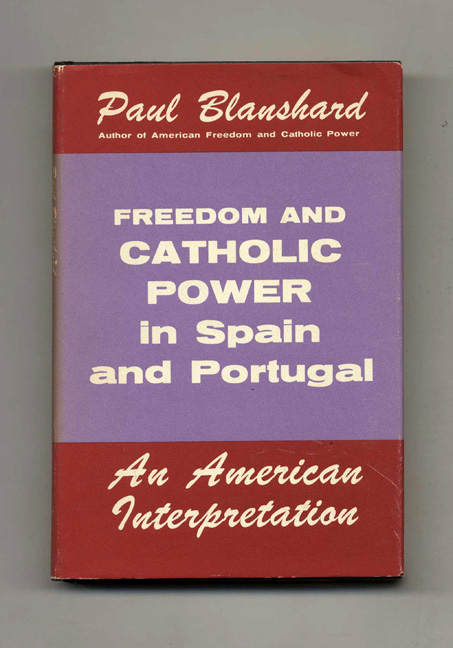
That Sound You Heard Was Paul Blanshard’s Head Exploding

Paul Blanshard, for those born after Richard Nixon defeated George McGovern, was a lapsed Congregationalist (redundant?) who wrote the last best-selling work of anti-Catholicism. American Freedom and Catholic Power was perhaps the last gasp of Protestant bigotry, but it was still sufficiently forceful and plausible into the 1950s that Blanshard did not get cancelled for expressing hurtful thoughts.

That was 15 years before the end of Vatican II (roughly), when Rome still on paper and through political channels was skeptical about the kind of freedoms embodied in American political norms. In 1950 the church still insisted that “error has no rights,” a position that ran into something of a hurdle with the United States’ Bill of Rights which guaranteed rights for all sorts of groups who held erroneous views (even Roman Catholics).

But Vatican II sort of kind of ended all that and Rome changed its mind about freedom for false religions. That explains this post, an argument that assumes Roman Catholicism and freedom go hand in hand. That Americanist position is receiving push back from integralists (among others). So imagine writing advice about liberal democratic institutions with Roman Catholic integralists as the ones defenders of civil liberties need to fear:

I think the recent intra-conservative French-Ahmari debate can be partially resolved by determining the extent to which secular progressives integralists can be trusted to protect robust freedom of religion for religious traditionalists with conservative views about human sexuality.

If secular progressives integralists are trustworthy, at least by and large, then French’s strategy of working within liberal democratic institutions makes sense. Conservatives should hold secular progressives integralists to a constitutional order that they accept in general, but chafe at in certain cases. Secular progressives Integralists cannot always be trusted to uphold robust freedom of religion, but they’re trustworthy enough not to fundamentally undermine Christianity in the United States. They will obey liberal democratic norms on the whole; conservatives just have to fight to keep them honest.*

However, if secular progressives integralists aren’t trustworthy, then Ahmari’s approach starts ceases to make sense. Secular progressives Integralists will tend to undermine robust protections for freedom of religion in a systematic way, and so ignore constitutional constraints whenever they can get away with it. In that case, politics is war regarding freedom of religion, and conservatives may be permitted to respond in kind. Perhaps the liberal legal settlement is therefore unstable because the left cannot be trusted to uphold it, and so the only truly feasible arrangement is cultural and political victory in the fight against the left. There’s no peace and no middle ground because the other side isn’t trustworthy, and so can’t be trusted to keep a liberal democratic peace.

Actually, I’m not sure if more sentences need to be changed to maintain the parallels. Either way, secular progressives are not the only ones about which to worry. They would likely let Presbyterians worship (and other groups). That was not an option in Roman Catholic societies.

Machen Day (eve) 2019

Theological liberalism is one thing, political liberalism is entirely different.

“A school, institute, class or course licensed as provided In this section shall be subject to visitation by officers and employees of the university of the state of New York.” See Laws of the State of New York, 1921, Vol. III, Chapter 667, pp. 2049-2051. This law is so broadly worded that it could not possibly be enforced, even by the whole German army in its prewar efficiency or by all the espionage system of the Czar. The exact measure of enforcement is left to the discretion of officials, and the citizens are placed in constant danger of that intolerable interference with private life which real enforcement of the provision about “courses of instruction in any subjects whatever” would mean. One of the exemptions is in principle particularly bad. “Nor shall such license he required:’ the law provides. “by schools now or hereafter established and maintained by a religious denomination or sect well recognized as such at the time this section takes effect.” One can certainly rejoice that the existing churches are freed, for the time being, from the menace involved in the law. But in principle the limitation of the exemption to the existing churches really runs counter to the fundamental idea Of religious liberty; for it sets up a distinction between established religions and those that are not established. There was always tolerance for established religious bodies, even in the Roman Empire; but religious liberty consists in equal rights for religious bodies that are new. The other exemptions do not remove in the slightest the oppressive character of the law. Bad as the law must be in its immediate effects, it is far more alarming in what it reveals about the temper of the people. A people which tolerates such preposterous legislation upon the statute books is a people that has wandered far away from the principles of American liberty. True patriotism will not conceal the menace, but will rather seek to recall the citizens to those great principles for which our fathers, in America and In England, were willing to bleed and die. There are some encouraging indications that the Lusk Laws may soon be repealed. If they are repealed, they will still serve as A warning that only by constant watchfulness can liberty be preserved. (Christianity and Liberalism)

From Mortara to Murray

Michael Sean Winters reviews a new book on John Courtney Murray, the man whom many believe is responsible for warming up the Roman curia and the magisterium to America’s version of political liberty. In his first part, Winters highlights the real change that took place at Vatican II on a theological assumption that Rome had defended longer than any other Christian communion:

Hudock quotes from a 1948 article in Civilta Cattolica that stated:

The Roman Catholic Church, convinced, through its divine prerogatives, of being the only true Church, must demand the right to freedom for herself alone, because such a right can only be possessed by truth, never by error. As to other religions, the Church will certainly never draw the sword, but she will require that by legitimate means they shall not be allowed to propagate false doctrine. Consequently, in a State where the majority of the people are Catholic, the Church will require that legal existence be denied to error, and that if religious minorities actually exist, they shall have only a de facto existence, without opportunity to spread their beliefs. If, however, actual circumstances….make the complete application of this principle impossible, then the Church will require for herself all possible concessions…..

This is a decent emblematic statement of the received position. The preferred arrangement, known in theological jargon as the “thesis,” was legal unification of Church and State wherever Catholics were in the majority. In countries like Murray’s United States, the “hypothesis” of Church-State separation could be accepted given the circumstances. The double standard was obvious to all, but trapped inside a closed theological circle, the authorities in Rome, with plenty of assistance from conservative Catholic theologians in the U.S., simply persisted in saying the double standard was appropriate, because truth had rights that could never be extended, in principle, to error.

As hard as it may be for boomer and millennial Roman Catholics to believe, Murray’s positive reading of American political liberty got him in trouble with the bishops:

That same year, 1948, Murray gave a paper at the Catholic Theological Society of America meeting in which he criticized the “thesis-hypothesis” approach. He noted, correctly, the rights inhere in persons, not in propositions, and so the claim that “error has not rights” was meaningless, that “if it means anything, it means that error is error; but it is hardly a ‘principle’ from which to draw any conclusions with regard to the powers of the state.” Murray also introduced an historical analysis of the issue, arguing that the current teaching was rooted in the experience of the Middle Ages, in which Church and State were “coextensive and united,” membership in the one was essential to membership in the other, and in this context, deviation from Church doctrine really was understood as a threat to the common good of society. . . .

Attacking a “received opinion” made Murray enemies on both sides of the Atlantic and Hudock relishes telling the cloak-and-dagger, better to say ferriola and quill, struggle that ensued. The reader is introduced to Francis Connell and Joseph Fenton who would not only oppose Murray in theological journals, but use their extensive contacts with Roman authorities to place Murray under a cloud of suspicion. Hudock ably recapitulates Murray’s ideas as they developed, which may be the best contribution the book makes. But, despite Hudock’s comments in the introduction to the effect that this is a story both contemporary conservatives and liberals can celebrate, on nearly every page of the tale, Murray is the good guy pitted against the various bad guys. To be clear, some of Fenton’s shenanigans really strike the modern reader as underhanded, although it is clear that Murray was also pushing the less powerful levers of ecclesiastical power to which he had access as well. The author might have delved more deeply into what motivated Connell and Fenton.

In the second part of his review, Winters unintentionally shows the bind in which Roman Catholic bishops have operated since Vatican II. Is political freedom good or is it destructive?

Murray favored a political-historical argument for religious freedom that was more accessible to unbelievers and relevant to the work of lawmaking in the modern world. Among European bishops and theologians (Yves Congar, for example) there was a preference for a more scriptural-theology approach. Murray explained privately that the text produced in March [by the Europeans] dialed to “do justice to the political-social argument” and that the Europeans were “over-theologizing” the concept of religious freedom.

Hudock does not cite which scriptural and theological arguments the Europeans wanted. Nor does he explain why the difference of opinion was important – at the time, and even more, subsequently. Murray wanted the Church to embrace the negative conception of liberty, freedom from, that is at the heart of the American constitutional framework. But, the European theologians perceived the difficulty here. A formal freedom was not the contentless, free market of religious ideas Murray claimed it to be, but rested on an ontological prioritization of freedom over truth. As well, the dualism he suggested between the temporal and the spiritual was too absolutized, and while it might work in a country in which the Christian moral framework largely held sway through democratic means, it was ill-equipped to use the power of the State to achieve the common good if that framework atrophied.

Murray was asked about this difference at a colloquium at the University of Notre Dame after the Council concluded its work. He admitted that the document “skated around” the difficulty of whether or not the Church can embrace a negative conception of liberty. But, the ice was thinner than Murray imagined and the skating would not last for long. As we have seen in our own time, and despite his argument to the contrary, an immunity from government coercion can be strengthened or weakened by civil law for which a negative conception of liberty has no answer. That is what the fights over the Religious Freedom Restoration Act are all about.

No one said church-state relations in the modern era would be easy. Nor did Protestants ever think that an infallible magisterium would figure those relations out. That’s why pastors are called to a different and higher work.

2 Paradigms and a 2K Wrinkle

Maura Jane Farrelly thinks the difference between the way Roman Catholics and Protestants know God also explains support for political freedom:

What is curious about this unwillingness of non-specialists in American Catholic history to entertain the possibility that nineteenth-century anti-Catholicism might have been rooted in something real is that historians who focus on the American Catholic experience have acknowledged for many years now that there was (and to some extent still is) a fundamental tension between “American” and “Catholic” values. Granted, polemicists like George Weigel and Michael Novak would have us believe that there is a seamless philosophical and even theological line running from “Thomas Aquinas to [the Italian Jesuit] Robert Bellarmine to the Anglican divine, Richard Hooker; then from Hooker to John Locke to Thomas Jefferson.” In an essay kicking off the American Catholic bishops’ campaign against the Affordable Care Act in 2012, Weigel insisted that the United States owes more to Catholics for its tradition of religious liberty “than the Sage of Monticello likely ever knew.”

But among those writers on Catholicism who have been motivated by a desire to engage with a faithful rendering of the past (rather than a desire to use history to dismantle the signature legislative achievement of a Democratic president), the consensus is that American Catholics have been animated, in historian Jay Dolan’s words, by “two very diverse traditions,” one exemplified by “Thomas Aquinas and Ignatius of Loyola,” and the other exemplified by “Jefferson and Lincoln.”

Dolan has been joined by John McGreevy, Jim O’Toole, Mark Massa, and others in acknowledging that—to quote Massa —”in the history of Western Christianity, there have been two distinctive (and to some extent, opposing) conceptual languages that have shaped how Christians understand God and themselves.” The first language—which shapes the world of people who have been raised as Catholics, American or otherwise—”utilizes things we know to understand things we don’t know, including and especially God.” The Church, in this language, becomes an incarnation of Jesus—its community and the doctrines and hierarchies that govern that community and can be known and experienced by the community’s members become a tangible (dare we even say “fleshy”?) way for Catholics to comprehend God and the salvation that God promises. The mindset that emerges from a language such as this, according to Mark Massa, is one that exhibits a “fundamental trust and confidence in the goodness of … human institutions.”

The second language, utilized by Protestant theologians from Martin Luther and Jean Calvin to Reinhold Niebuhr and Paul Tillich, emphasizes the “fact of human estrangement and distance from God.” In this language, it is the Word—the message of judgment and grace, embodied in Christ and found not in the institution of the Church, but in the sanctified lines of Scripture—that convicts the soul, convinces it of its sinfulness, and “prepares us for an internal conversion that makes us true children of God.” The mindset that emerges from language such as this is one that tends to be suspicious of institutions and sees them as distractions that stand between the individual and the Word. Doctrines and hierarchies are “potentially an idolatrous source of overweening pride,” Massa writes; the danger in them is that they are corruptible examples of human beings’ mistaken belief that they can save themselves.

(Parenthetically, if a difference does exist between American and Roman Catholic ideals, then Pope Francis’ encyclical may be another indication of such.)

Farrelly goes on to use this difference — between respect for institutions and hierarchy and promoting civil liberties — to conclude that the U.S. bishops Fortnight for Freedom is more American than Roman Catholic:

It is probably still true that the politicians and religious leaders who railed against Catholicism in the first half of the nineteenth century were motivated by a certain degree of status anxiety—some, perhaps, such as Lyman Beecher, more than others. But it is also true that these leaders were motivated by a real sense that the Catholic understanding of freedom was different from theirs, and they were right to see Catholics’ support of the institution of slavery as the embodiment of this difference. Freedom, for Catholics, was corporate; it was born of the “reciprocal duties” that one priest from colonial Maryland insisted all people had to one another. Freedom, for Catholics, was not “personal,” the way it was for Protestants like Theodore Parker.

It is no small irony, therefore, that modern-day Catholics like Bishop William Lori of Baltimore have been appealing to personal freedom in their attempt to protect the collective freedom of the Catholic Church from the mandates of a law that supporters say defines healthcare as a “requirement of a free life that the community has an obligation to provide.” In 2012, on the eve of the Church’s first “Fortnight for Freedom”—a now annual event that highlights “government coercions against conscience” such as the birth control provision in the Affordable Care Act—Lori made his reasons for opposing the healthcare overhaul clear: “If we fail to defend the rights of individuals,” he warned, “the freedom of institutions will be at risk.”

The problem with this analysis is — see what I’m doing here — two-fold.

Conceptually, a religious conviction need not — and here I duck because of the A2K blow back — require a political practice or ideal. At least for confessional Protestants who distinguish between the civil and spiritual realms, one can, for instance, advocate aristocracy (Presbyterianism) in the church while still supporting monarchy in the kingdom (most Scottish Presbyterians did this). And if Roman Catholics were 2k, you could conceivably support hierarchy and submission in the church (say hello to papal monarchy) and republicanism in society. Think Richard John Neuhaus.

Practically, Farrelly’s distinction also fails to make sense of American Protestants and the civil religion they have cultivated. If God is only known in Scripture, then why can his ways be discerned either in the “redeemer nation,” the United States, or in the God-and-country party, the GOP? If only Protestants were as wary of nation-states and political parties as Farrelly suggests they are.

The difference between Roman Catholics and Protestants is this. The former are conflicted about the United States. The options appear to be either a sloppy wet kiss of America and its ways, or an ultramontanist critique of the United States as a land of self-centered, imperialistic ambition (see Laudato Si). Protestants are also conflicted but not in the same way. Evangelical and liberal Protestants think of America as a Christian nation — either it is a beacon of truth and liberty and justice or it should be condemned for failing to be such. Confessional Protestants who reside in America think about the nation not redemptively but politically and so appear to be insufficiently patriotic.