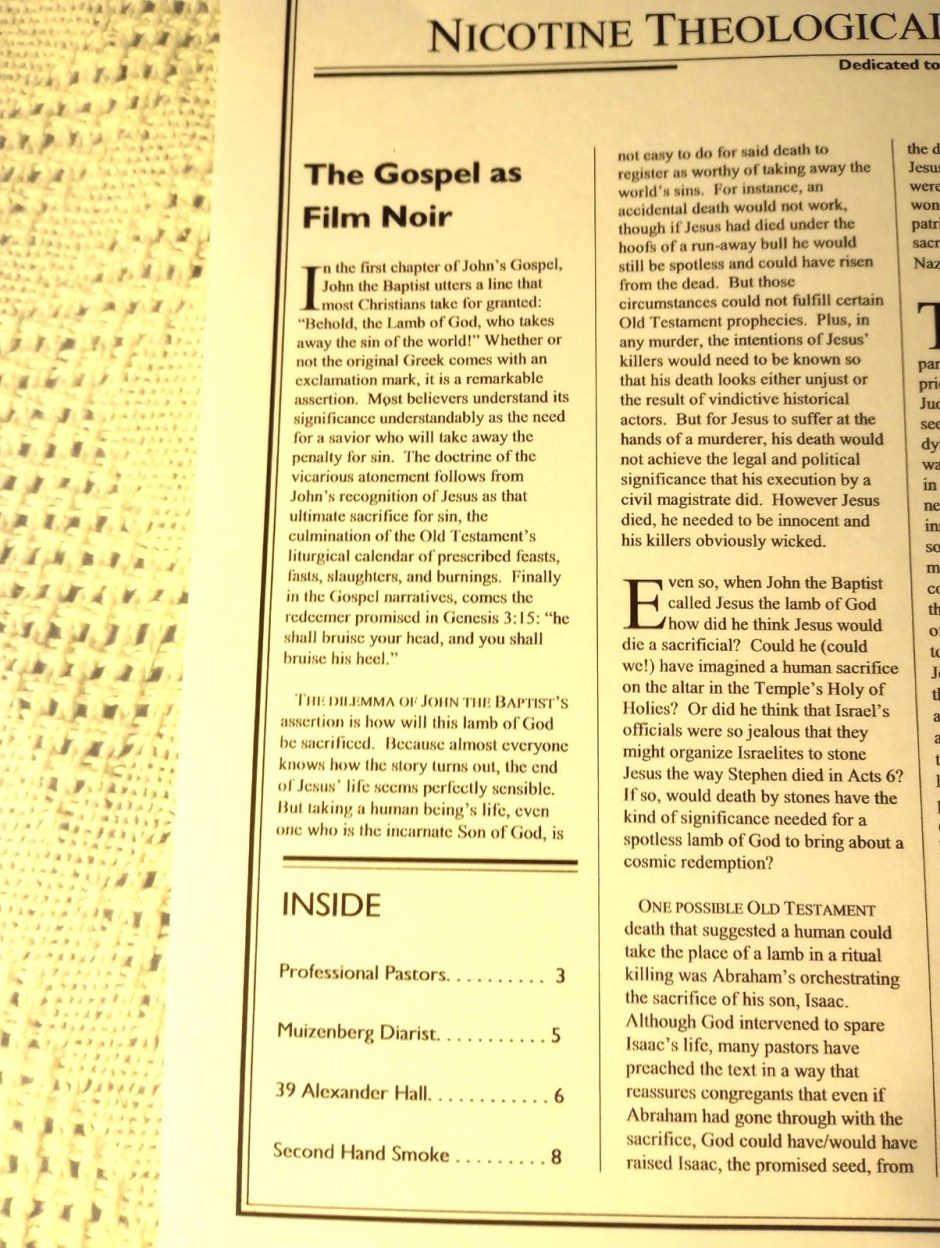
Summer 2023 NTJ (not a typo) Is Out

For those who have subscribed (simply by sending an email address), the Summer 2023 issue of the Nicotine Theological Journal is in their inbox. In that number readers will see the entire short piece that begins this way:

Idolatry in the Negative World

Aaron Renn says that American Christians now experience a culture that is hostile to the Christian faith in contrast to previous eras that either viewed Christianity positively or in which believing was neutral, neither offensive nor appealing. He argues the change came sometime around 2014.

Another change seems to have occurred that may say more about American Protestants than about the nation they inhabit. Somewhere in the mix of changing perceptions of American society and churches, conservative Protestants developed a different conception of sin. One sign of this change was a worship service recently broadcast from Moody Memorial Church in Chicago (Moody, of course, named after the urban evangelist, Dwight L. Moody). The broadcast included the prayer of confession. In it the pastor asked forgiveness on behalf of the congregation for desiring sex, money, and power.

That trilogy struck this listener as odd. . .

And Here I Thought W-w Was Hard

Turns out, obedience is harder:

In the first place, it seems that Gahl does not consider adequately the role of conscience. Is it sufficient that the confessor enunciates a principle such that it can be assumed that the conscience has been sufficiently enlightened? Perhaps not. Cardinal Newman made an illuminating distinction between a merely notional assent and a real assent of the conscience. It is possible that the penitent does not understand or does not accept the confessor’s admonition and refuses to promise that, in the same situation, he will not act once again in the same manner. The conscience will be enlightened only in the moment in which it has given real assent. What should be done if the penitent does not give real assent to the confessor’s admonition?

Pity the potato farmer who needed to find Denzinger‘s entry on notional assent.

The Sinner's Prayer

I worshiped at Christ Reformed Church, Washington, DC on Sunday and this was our corporate confession of sin:

Our Father, we are sinful and you are holy. We recognize that we have heard in your Law difficult words, knowing how often we have offended you in thought, word and deed, not only by obvious violations, but by failing to conform to its perfect commands, by what we have done and by what we have left undone. There is nothing in us that gives us reason for hope, for where we thought we were well, we are sick in soul.

Where we thought we were holy, we are in truth unholy and ungrateful. Our hearts are filled with the love of the world; our minds are dark and are assailed by doubts; our wills are too often given to selfishness and our bodies to laziness and unrighteousness. By sinning against our neighbors, we have also sinned against you, in whose image they were created. In this time of silent confession we bring you our particular sins.

Depressing? Yes.

Accurate? Yes.

But if sanctification and obedience are as much a part of the Christian life as the Obedience Boys and the Anti-Antinomians say, then isn’t this more like the prayer of a convert than a believer?

On the other hand, if this is a legitimate ordinary prayer for a believer — and I think it is — what ever are the critics of a justification-centric understanding of salvation talking about? If sin persists in the believer’s life to such an extent that she needs to pray prayers like this routinely, maybe the calls for obedience come across as more oppressive than inspiring.