Two-Kingdom Tuesday: How Can You Not Be 2K If You Are Spirituality of the Church?

Calvin makes it easy; you only have to get over the National Covenant, Kuyper, Bahnsen, and Wilson:

My kingdom is not of this world. By these words he acknowledges that he is a king, but, so far as was necessary to prove his innocence, he clears himself of the calumny; for he declares, that there is no disagreement between his kingdom and political government or order; as if he had said, “I am falsely accused, as if I had attempted to produce a disturbance, or to make a revolution in public affairs. I have preached about the kingdom of God; but that is spiritual, and, therefore, you have no right to suspect me of aspiring to kingly power.” This defense was made by Christ before Pilate, but the same doctrine is useful to believers to the end of the world; for if the kingdom of Christ were earthly, it would be frail and changeable, because the fashion of this world passeth away, (1 Corinthians 7:31;) but now, since it is pronounced to be heavenly, this assures us of its perpetuity. Thus, should it happen, that the whole world were overturned, provided that our consciences are always directed to the kingdom of Christ, they will, nevertheless, remain firm, not only amidst shakings and convulsions, but even amidst dreadful ruin and destruction. If we are cruelly treated by wicked men, still our salvation is secured by the kingdom of Christ, which is not subject to the caprice of men. In short, though there are innumerable storms by which the world is continually agitated, the kingdom of Christ, in which we ought to seek tranquillity, is separated from the world.

We are taught, also, what is the nature of this kingdom; for if it made us happy according to the flesh, and brought us riches, luxuries, and all that is desirable for the use of the present life, it would smell of the earth and of the world; but now, though our condition be apparently wretched, still our true happiness remains unimpaired. We learn from it, also, who they are that belong to this kingdom; those who, having been renewed by the Spirit of God, contemplate the heavenly life in holiness and righteousness. Yet it deserves our attention, likewise, that it is not said, that the kingdom of Christ is not in this world; for we know that it has its seat in our hearts, as also Christ says elsewhere, The kingdom of God is within you, (Luke 17:21.) But, strictly speaking, the kingdom of God, while it dwells in us, is a stranger to the world, because its condition is totally different.

My servants would strive. He proves that he did not aim at an earthly kingdom, because no one moves, no one takes arms in his support; for if a private individual lay claim to royal authority, he must gain power by means of seditious men. Nothing of this kind is seen in Christ; and, therefore, it follows that he is not an earthly king.

But here a question arises, Is it not lawful to defend the kingdom of Christ by arms? For when Kings and Princes are commanded to kiss the Son of God, (Psalm 2:10-12) not only are they enjoined to submit to his authority in their private capacity, but also to employ all the power that they possess, in defending the Church and maintaining godliness.

I answer, first, they who draw this conclusion, that the doctrine of the Gospel and the pure worship of God ought not to be defended by arms, are unskillful and ignorant reasoners; for Christ argues only from the facts of the case in hand, how frivolous were the calumnies which the Jews had brought against him.

Secondly, though godly kings defend the kingdom of Christ by the sword, still it is done in a different manner from that in which worldly kingdoms are wont to be defended; for the kingdom of Christ, being spiritual, must be founded on the doctrine and power of the Spirit. In the same manner, too, its edification is promoted; for neither the laws and edicts of men, nor the punishments inflicted by them, enter into the consciences. Yet this does not hinder princes from accidentally defending the kingdom of Christ; partly, by appointing external discipline, and partly, by lending their protection to the Church against wicked men. It results, however, from the depravity of the world, that the kingdom of Christ is strengthened more by the blood of the martyrs than by the aid of arms. (Calvin’s Commentary on John 18)

Important to notice is Calvin’s otherworldliness. The kingdom is not in this world, but it is in believers’ hearts. And it comes not through laws or enforcement of legislation, or clever policy, but by the word and Spirit. If magistrates assist the kingdom of Christ it not because of law or enforcement because Christ’s kingdom is spiritual, and therefore different from the rule of kings.

This would also mean that all those people who cite Calvin and his godly regime in Geneva, like the Baylys, Dr. Kloosterman, and Rabbi Bret are missing the point. Calvin even calls arguments like their “ignorant and unskillful. God’s kingdom is not earthly. And efforts to make this world heavenly are just one more example of immanentizing the eschaton.

I would have thought that differentiation of Christ’s rule from earthly regimes would appeal to the Vossian contingent. I wonder when will they ever come over to the 2k side. 2kers won’t bite, at least not physically.


Kuyperians and Theonomists, Say "Hello" to the Old School Presbyterians

I continue to be amazed by the decibels of hostility and venom heaped upon 2k. From bloggers like Nelson Kloosterman, James K. A. Smith, David Koyzis, Doug Wilson, Steven Wedgeworth, Rabbi Bret and the Bayly Bros., to your average and pseudonymous commenters at various Reformed blogs, many Reformed Protestants and evangelicals believe that 2k theology is either foreign because it is Lutheran or unbiblical because it exempts God’s law from part of life and nurtures dualism.

But for anyone who has spent time with Old School Presbyterians and Old Princeton Seminary, 2k feels comfortable like an old shoe, and that’s because one of the Old School’s hallmark doctrines, the spirituality of the church, is basically the Presbyterian version of 2k.

David Coffin, pastor of New Hope Church (PCA) in Fairfax, Virginia, recently preached on the doctrine of the spirituality of the church. A link to the first sermon is here. It is well worth hearing and filled with numerous quotations that neo-Calvinists and their theological cousins, theonomists, Federal Visionaries, and Erastians, have yet to fit into their schemes of denying dualism and making Christ Lord of every square inch, like the following from Calvin, who is commenting on Christ’s response to a request to settle a property dispute between two brothers (Luke 12:13):

Our Lord, when requested to undertake the office of dividing an inheritance, refuses to do so. Now as this tended to promote brotherly harmony, and as Christ’s office was, not only to reconcile men to God, but to bring them into a state of agreement with one another, what hindered him from settling the dispute between the two brothers? There appear to have been chiefly two reasons why he declined the office of a judge. First, as the Jews imagined that the Messiah would have an earthly kingdom, he wished to guard against doing any thing that might countenance this error. If they had seen him divide inheritances, the report of that proceeding would immediately have been circulated. Many would have been led to expect a carnal redemption, which they too ardently desired; and wicked men would have loudly declared, that he was effecting a revolution in the state, and overturning the Roman Empire. Nothing could be more appropriate, therefore, than this reply, by which all would be informed, that the kingdom of Christ is spiritual. . . .

Secondly, our Lord intended to draw a distinction between the political kingdoms of this world and the government of his Church; for he had been appointed by the Father to be a Teacher, who should “divide asunder, by the sword of the word, the thoughts and feelings, and penetrate into the souls of men, (Hebrews 4:12,)” but was not a magistrate to divide inheritances. This condemns the robbery of the Pope and his clergy, who, while they give themselves out to be pastors of the Church, have dared to usurp an earthly and secular jurisdiction, which is inconsistent with their office; for what is in itself lawful may be improper in certain persons. . . .

P.S. If Dutch-American Calvinists want to write off nineteenth-century American Presbyterians, fine. But don’t be surprised if those Presbyterians descendants remind you that it was the Presbyterians at Princeton that domesticated Kuyper and Vos for American Protestants. Without Benjamin Warfield, Abraham Kuyper and Geerhardus Vos would still be available only in Dutch.

I Did Not Know that Idaho Was In Canada

Over the weekend I was doing a little internet searching for churches that still confess the 16th and 17th century Reformed teachings on the civil magistrate’s role. Practically all of the Reformed and Presbyterian churches, both mainline and conservative, have modified the creeds of the Reformation and scholastic eras, even to the point, in the case of the Christian Reformed Church (circa 1958), of calling the original Belgic Confession’s construction “unbiblical.”

One set of churches, I thought, might actually still hold to the original Westminster Assembly’s teaching — that church being the Confederation of Reformed Evangelical Churches, which emanates from Doug Wilson’s Christ Church in Moscow, Idaho. So I went to Christ Church’s website and was not surprised to see the original Westminster Confession in force “for use in doctrinal accountability for officers of the church.” What was surprising was to see a set of creeds, almost like a Book of Confessions, adopted by Christ Church, including the Thirty-Nine Articles of the Church of England.

The Thirty-Nine Articles are noteworthy in their teaching on the civil magistrate because they specify the magistrate in view. This makes a lot of sense since the monarch of the United Kingdom is also the supreme head of the Church of England. But this is different from the other Reformed confessions which provide a general description of the magistrate’s responsibilities that can then be applied in various lands and political orders. Here is the bulk of Article XXXVII (see how the NFL unwittingly helps in the ecclesiastical realm?):

The Queen’s Majesty hath the chief power in this realm of England and other her dominions, unto whom the chief government of all estates of this realm, whether they be ecclesiastical or civil, in all causes doth appertain, and is not nor ought to be subject to any foreign jurisdiction.

Where we attribute to the Queen’s Majesty the chief government, by which titles we understand the minds of some slanderous folks to be offended, we give not to our princes the ministering either of God’s word or of sacraments, the which thing the Injunctions also lately set forth by Elizabeth our Queen doth most plainly testify: but that only prerogative which we see to have been given always to all godly princes in Holy Scriptures by God himself, that is, that they should rule all estates and degrees committed to their charge by God, whether they be ecclesiastical or temporal, and restrain with the civil sword the stubborn and evil-doers. The Bishop of Rome hath no jurisdiction in this realm of England.

It is indeed odd for Christians to confess allegiance to a particular civil authority as part of their profession, as if Christ died specifically for the subjects of the English crown. It is also odd for citizens of the United States to confess the supreme authority of the English monarch over the Church of England. And to keep the oddity going, it is indeed strange for members of a church outside the Church of England to confess anything about the Church of England. The introductory statement at Christ Church leaves me all the more perplexed: “we therefore commend the Thirty-Nine Articles of Religion as an faithful and historic testimony of the martyr church. . .” What kind of martyrdom is it that professes the sovereignty of a monarchy that did its fair share in producing martyrs and non-conformists? Can martyrs really identify with the establishment?

This is one of those examples of what happens when you try to add to your confessional play book. You think you are affirming the catholicity of the church and situating yourself in that breadth of voices. Meanwhile, you have so many documents to confess that you lose track of the disagreements among those voices.

Barefoot, Pregnant, and Unplugged

To say that the Bayly brothers have a one track mind would be to traffic in innuendo. I do not know them well enough to speculate on their sexual desires. I presume that as ministers of the gospel and as husbands their sexual passions are properly regulated.

But in a sense they do have sex on the brain, not in the sense of your average beer sipping NFL fan, but in the sense of men’s and women’s roles and sexual relations that produce offspring. After all, if you have a web page at Amazon dedicated to the ten best and worst books on sex, people might properly conclude you have women on the brain.

Beyond book lists and blog categories, Tim Bayly gave a good example of the borderline obsessiveness that he and his brother have about keeping men men and women women and never the twain shall meet except . . . well, . . .this is a PG blog. When news came out that the Presbytery of Missouri had exonerated the Federal Vision pastor, Jeff Myers, Doug Wilson posted a short notice that led to a rather moderate number of comments. Responses were chugging along about the merits and ties of Federal Visionaries, with an occasional distaff iteration when Tim decided to weigh in – not about Federal Vision, its theology, or merits – but about whether or not women should be discussing such matters at a public forum like a blog. To one female writer, Tim wrote (with love, of course):

it might be best for you to limit your comments when the subject matter here is the discipline of ordained officers of Christ’s Church and the application of God’s Word to that discipline. If there’s ever a time when it might be good for women to limit their online contributions, this would be a good candidate for careful consideration.

When another woman rose to the rebuked woman’s defense, especially because of a recent personal loss, Tim, to his credit, conceded that he should have been more circumspect and offered comfort.

But in further explanations, Tim reminded readers about the need for women to respect church officers like Doug Wilson. He wrote:

We’re not talking about submission, here, but the public rebuke of teaching elders on a matter of doctrine by a woman who does so, publicly, and with some considerable invective. Read what she said about my dear friend, Doug Wilson (who by the way is one of the more humble pastors I’ve met), and ask yourself if it’s seemly for a Christian woman to address a pastor in such a way at all, let alone in public?

Feminine deference is not “submission,” nor is a teaching elder “all men.”

For some reason, the public rebukes that he heaps out on ruling elders and pastors is fine. But the little ladies need to watch out for men and especially for the ordained ones.

I do wonder if Tim realizes the propensity he displays to view almost every issue according to what women are doing as sexual beings. We were once having a very nice conversation at Old Life about Presbyterian justice when Tim had to intervene and censor us for not talking about abortion even though that was not the subject. Now he interjects femininity into a discussion of a controversial and potentially damaging teaching like Federal Vision. Does Tim think that our society and churches would be fine if we could put the genie of women’s spunk back in the bottle of Calvin’s Geneva?

Update: I forgot to add this: when will the Baylys notice that Tenth Presbyterian Church in Philadelphia has two pastors with feminine names? Shocking.

Gospel or Lord of the Rings?

Doug Wilson is a clever fellow and arguably as much fun as a beer-drinking companion as Mike Horton. But his wit may have gotten ahead of him when he responded to Dane Ortlund’s request for a one sentence answer to the message of the Bible (thanks to Justin Taylor). Wilson wrote:

Scripture tells us the story of how a Garden is transformed into a Garden City, but only after a dragon had turned that Garden into a howling wilderness, a haunt of owls and jackals, which lasted until an appointed warrior came to slay the dragon, giving up his life in the process, but with his blood effecting the transformation of the wilderness into the Garden City.

Not only is this reply a little more literary than theological, but it also shows the besetting problem of neo-Calvinism’s attachment to this world, the limits of transformationalism, and the trend to regard redemption as re-creation.

Plus, it demonstrates a cultural insensitivity to those of us who live in the East and have to contend with the New Jersey’s Garden State Parkway. Simply slapping “Garden” in front of a polity, whether city of state, does nothing to transform a Garden City or Garden State’s six-lane highway into streets of gold. That will only come with glorification.

Stellman Nails It

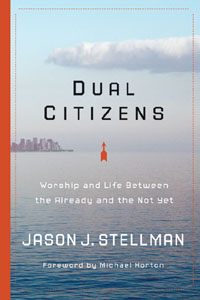
N. T. Wright’s recent appearance at the Evangelical Theological Society has most evangelical biblical and theological professors swooning the way that teenaged females greeted the Beatles almost fifty years ago. What is it with the American obsession with English accents (or Scottish for that matter)? In response to a post by Doug Wilson on yet further discussion of Wright’s views in which Wilson criticizes Scott Clark, Stellman spots the subtext of Wilson’s beef with Clark:

But when you stop and think about it, it becomes immediately clear that the errors for which Clark faults Wright are the very same errors for which he faults Wilson. Wilson’s mocking dismissal of Clark’s disagreements with the New Perspective, therefore, can seemingly be explained by the fact that they also apply to the Federal Vision.

It would appear, then, that the reason Wilson wants people like Clark banned from the New Perspective discussion is not really because of the overly-scrupulous nature of his attacks, but because those attacks aren’t narrow enough to just zero in on Durham, but they also set their sights upon Moscow, Idaho. In a word, Wilson’s problem isn’t that Clark is too nitpicky, it’s that he’s not nitpicky enough, for if he would agree to pinpoint only those errors of Wright’s that Wilson agrees are erroneous, then all would be well and Clark would welcomed back into the discussion. But since his attacks on Wright are broader than what Wilson is comfortable with, he is branded a mere irritant and dismissed with a wave of the hand.

Not only a ding ding ding ding moment, but Stellman’s outlook is further proof that 2k is far more reliable than its hysterical opponents suppose. In fact, we are still waiting for the anti-2k folks to step up to the plate on justification.

Whither Muslims In Doug Wilson's American Christendom?

The Kuyper of Idaho (you know, pastor, college founder, magazine editor, culture warrior – so far, no prime ministry) has spoken on the proposed mosque in New York City near Ground Zero. As complicated as the issue is, because of the delicate balance between legal freedoms and democratic politeness, Wilson has used the occasion to denounce – you guessed it – secularisim. (Thanks to the Brothers Bayly for the link.) Wilson concludes:

. . . Muslims know what they are doing. What is that exactly? They are exposing the intellectual, theological, and ethical bankruptcy of secularism, and they are doing it on purpose. . . . Someone really does need to tell secularist America that her gods are genuinely pathetic. And currently, the Muslims are doing this because the Christians won’t. And the Christians who won’t do this are not so much in need of a different kind of theology as they are in need of a different kind of spine.

According to Wilson, the problem with America’s gods is that all sectarian faiths need to go along with the president in order to get along. He doesn’t like what such accommodation means for those who protest abortion and gay marriage on religious grouds. But if the United States prohibited abortion and gay marriage, would Wilson be content? Would Muslims have a place in Christendom. Over at another site Doug and I went round on this one and he seems to argue that Christendom makes plenty of space for freedom of conscience. He allowed that Servetus would conceivably grow to a ripe old age in Moscow, Idaho, if Wilson were in fact prime minister, and that Muslims would be free to hold their views, just not to practice their faith in a Wilsonian Christendom. I am not sure that Wilson’s version of Christendom does justice to the actual history of Christian Europe, where the relations between Christians, Jews, and Muslims was hardly harmonious. So if you want the freedom to practice your faith in America, don’t you need to allow for the freedom of other religious adherents to practice? I guess you don’t have to if your religious group is the one holding keys to the White House. But if you are going to make the cult the basis for the cultus, you are going to have a few conundrums about how to handle those “poor” and “tired” “masses,” streaming to the United States, “yearning to breathe free.”

Just as thorny as Wilson’s ideal of Christendom is his denunciation of secularism. In his post he cites what he regards as an ineffective piece by Charles Krauthammer on the “hallowedness” of Ground Zero’s ground. I concede that the idea of sacred space in secular America is a puzzle and I also believe that more effective arguments can be made about the impropriety (as opposed to illegality), for instance, of putting a German Lutheran church across the street from the National Holocaust Museum. It’s just not right.

But Wilson is so intent to denounce secularism (in order to prove the merits of Christendom) that he misses other fine points in Krauthammer’s secular piece. The op-ed includes this:

Even New York mayor Michael Bloomberg, who denounced opponents of the proposed 15-story mosque and Islamic center near Ground Zero as tramplers on religious freedom, asked the mosque organizers “to show some special sensitivity to the situation.” . . .

Bloomberg’s implication is clear: If the proposed mosque were controlled by “insensitive” Islamist radicals either excusing or celebrating 9/11, he would not support its construction.

But then, why not? By the mayor’s own expansive view of religious freedom, by what right do we dictate the message of any mosque? Moreover, as a practical matter, there’s no guarantee this couldn’t happen in the future. Religious institutions in this country are autonomous. Who is to say that the mosque won’t one day hire an Anwar al-Awlaki — spiritual mentor to the Fort Hood shooter and the Christmas Day bomber, and one-time imam at the Virginia mosque attended by two of the 9/11 terrorists?

And not to be missed is what Wilson’s secular pal, Christopher Hitchens wrote about the mosque. Hitchen’s calls for a discussion of the matter based less on the feelings of both sides – whether the Muslims or the survivors of 9/11 – and more on reasonable premises of American law and knowledge or recent experience.

Even within Wilson’s own post he acknowledges that the Supreme Court of the United States, in its Chaplinsky v. New Hampshire (1942) decision was able to see clearly through the lens of secular reason that “that freedom of speech did not include the right to stand on the sidewalk outside the funeral of somebody’s mom in order to taunt the mourners.”

Which leads to the question: why does Wilson go out of his way to denounce secularism when secular people in the United States provide plenty of evidence that secularism has its moments. One of those moments is the distinction between public (involuntary) and private (voluntary) associations. According to this division, religionists have the freedom to maintain their own institutions and keep out those who disagree. But in the public ones, everyone has access, no matter what their faith. This was the arrangement of secular America and it has worked reasonably well for Christians since they still are able to worship freely (along with Mormon, Jews, and Muslims). And it is what Wilson rejects, as if not maintaining one’s private views in public settings is a form of bad faith.

Of course, a secularism that tries to impose public standards on private associations is a real danger and this has been a feature of court rulings for the last four decades where justices do not respect either private associations or the rights of states. I understand that this is partly responsible for the reaction of the Religious Right. Many evangelicals felt and still feel threatened by the federal government extending its reach into private associations. (I also think this is more a political than a religious problem.)

But Wilson’s solution is not to return to the good secularism because for him only Christendom is good and secularism is always bad. In which case, his Christendom model is an effort to impose private rules of association on public institutions. That presents a problem not only for the construction of mosques but the presence (if you’re Reformed) of Roman Catholics and Anabaptists in the United States. One of the more perceptive readers of Wilson’s blog made this very point:

Interesting post, Douglas. But I’m not entirely clear about what you are saying. You say that building a mosque so close to ground zero should be prohibited because the existence of such a mosque would be “fighting words.” But using that standard, wouldn’t the building of any mosque be prohibited anywhere in the United States?

In fact, if we applied that standard, wouldn’t the establishment of New St. Andrews College in downtown Moscow be unconstitutional using the “fighting words” standard?

It seems to me that you should stay away from the constitution (you don’t like it much anyway, do you?) and stick to the Bible. The Bible is clear: permit only correct forms of worship (like Christ Church) and destroy all others.

In which case, the problem with the situation in New York City is not America’s gods but the nation’s feelings. Many officials are worried about offending the sensibilities of some aggrieved group, and they want to be sure to be seen as sensitive (as opposed to intolerant and insensitive). Now, if I were prone to the single-cause explanations as Wilson appears to be, I’d be tempted to blame the current predicament on evangelicals. After all, ever since Jonathan Edwards wrote Religious Affections, born-again types have been far more attentive to sincerity of motives than to formal expressions of doctrine or worship. If this is so, then the moral and political impasse to which this blessedly secular land has come could be the direct result of the success of Whitefield, Finney, Graham, and Rock the River Tours. But I am far too charitable to take the bait and blame it all on evangelicalism.

Two Kingdom Tuesday: Doug Wilson Gets It More Than Chuck Colson

The latter has written a piece for Christianity Today in which he argues that Christian creeds should inform the U.S. search for a national identity:

I believe, then, that for national identity to be salient in the midst of our changing society, we need to promote a recommitment to our creeds, a respect for American history, and a proper role of patriotism, rooted in love of neighbor. Our founders’ Judeo-Christian heritage helped produce a culture in which moral responsibility, transcendent ethical principles, and the dignity of all people could flourish—a culture in which our creedal values made sense. This is why our role as leaven within society is so important, and why we must continue to bring a biblical influence to the public square, reinvigorating society.

As we do so, we must guard against the easy tendency to embrace xenophobic notions or fall into the equally perilous trap of promoting subcultural identities over national identity. People will not live with, let alone die for, a nation that has abandoned its religious moorings and adopted a creed that suggests we simply live together in cosmopolitan bliss. Millions of us, however, have been willing to live and die for beliefs rooted in our deepest convictions about God and man—convictions that were expressed so well in the stirring words of our national creed, the Declaration of Independence.

So where exactly does this leave Mormons and Jews? I understand why Colson, one of the co-hatchers of Evangelicals and Catholics Together, would not think that Protestant creeds might make life difficult for Roman Catholics. But are our creeds so generic that the U.S. can use them for a political identity that embraces all faith? I don’t think so!

Meanwhile, Doug Wilson shows that he understands one of the reasons for a 2k theology. In this video he answers a question about the propriety of having a U.S. flag in church or reciting the Pledge of Allegiance.

Ask Doug: American Flag and the Pledge of Allegiance in Church? from Canon Wired on Vimeo.

I guess Wilson is not fully comfortable with 2k theology. Given what he’s said in defense of Christendom, I suspect that if Christendom or Constantinople had flags he might allow them in church – these are empires big enough to reflect the bigness of Jesus’ reign. So he is likely still unwilling to accept a spiritual rule for Christ’s redemptive kingship in this age of redemptive history. But this is a step in the right direction.

This and That's Big Adventure


For those who may be wondering why N.T. Wright is speaking at the church of one of the founders of the Gospel Coalition – as in justification by faith alone coalition – Justin Taylor may have a clue. Here is a quotation from a piece in Christianity Today from 2008 on Keller and the gospel:

Tim Keller and his Redeemer Presbyterian Church in New York City fall somewhere between Wright and Dever. Writing for Leadership [JT: , Keller answered this year’s question for the Christian Vision Project, “Is our gospel too small?” (The article is not yet available online.) In so doing he took a stab at defining the gospel. “Through the person and work of Jesus Christ, God fully accomplishes salvation for us, rescuing us from the judgment for sin into fellowship with him, and then restores the creation in which we can enjoy our new life together with him forever.”

It’s the last clause of this sentence that makes the difference. Is God’s plan to renew creation part of the gospel message? If so, is it the center of the gospel or a peripheral component of the Good News? Again, how you answer these questions affects how you will live, and how you will expect fellow church members to act.

“When the third, ‘eschatological’ element is left out, Christians get the impression that nothing much about this world matters,” Keller wrote. “Theoretically, grasping the full outline should make Christians interested in both evangelistic conversions as well as service to our neighbor and working for peace and justice in the world.”

______________

Doug Wilson is sounding more and more like Mark Horne.

So, saving faith yields, trembles, and embraces. It yields obedience, it trembles at threats, and it embraces promises. But its principal acts are accepting, receiving, and resting upon Christ alone for justification. These are indeed its principal acts, but saving faith does other things. It hunts down the red law passages and yields obedience to them. It comes across passages which threaten divine displeasure, and saving faith trembles at these red law passages also. But what is saving faith doing responding to the law passages at all? Don’t the law passages just beat you up? No — in the broader context they are part of God’s saving intention for us. They are gospel. They are totus lex, part of the covenant of grace.

Then what do you do with Paul’s assertion that “the law is not of faith”? Or what do you do with the Protestant protest against Rome that we are saved not by works but by faith?

______________

Apparently Craig Higgins, who pastors one of the congregations in the Redeemer New York network of Redeemer-like churches in the New York vicinity, is still a Presbyterian. Will N. T. Wright tempt him to become an English Christian?

______________

If abortion is an abomination, why isn’t this blasphemy?

______________

For Doug Wilson Apparently Being Reformed Means Evangelicalism That Is Effective


Doug Wilson joins the Bayly Bros in heaping scorn on our good friend Scott Clark and the case for recovering the Reformed confessions. To Doug’s credit, he avoids the vituperative edge that characterizes the Baylys’ outbursts.

What unites Wilson and the Brothers Bayly in their criticism of Clark, apart from disdain for Meredith Kline, mind you, one of the true geniuses of twentieth-century Reformed Christianity, is nostalgia for Geneva. Of course, this is not the Geneva that sent Castellio packing or Servetus to the flames – well, it is, but most contemporary pining for Geneva manages to overlook the downside of Constantianism even when practiced by Reformer pastors.

Wilson is writing in response to a piece that Clark did for Table Talk on what evangelicals should expect from a Reformed church. Clark tries to cushion the blow that might come from the doctrinal, polity, and liturgical trappings that disorient the average born-again Christian. When Clark explains that “confessional churches are isolated from both the old liberal mainline and the revivalist traditions” and so offer an alternative to liberal and evangelical Protestantism, Wilson goes off.

First, Wilson laments Clark’s isolationism. Not only are Reformed confessionalists separated from evangelicals and liberals, but also “from the cultural potency of Reformed theology and piety.” This is lamentable because for Wilson, the Reformed theology that he has read and studied “built a great civilization.” In contrast, Clark’s brand of Reformed theology, that of “the truncated brethren,” “would have trouble building a taco stand.”

Wilson also takes exception to Clark’s claim that confessional churches today approximate the churches of the sixteenth century more than other Protestant congregations. For Wilson, this is patently untrue because the sixteenth-century Reformed churches were actually Reformed cities – that is, they were more than merely religious institutions. They were civil polities where supposedly Calvinism shaped all of Geneva’s or Strasbourg’s or Edinburgh’s life (tell that to the magistrates who stuck their neck out against the Holy Roman Empire and hired the Reformed pastors). This suggests that Wilson regards Reformed Protestantism as a way of taking names and kicking butt.

Furthermore, when Clark claims that evangelicals coming to Reformed churches will need time to acclimate to the new spiritual environment, Wilson retorts that Clark has the picture “exactly backwards” because Clark’s otherworldly version of the Reformed faith turns out to be warmed over evangelicalism (read: pietism). According to Wilson:

As an evangelical, and the son of an evangelical, allow me to give my testimony. I was part of the exodus from pop evangelicalism (not historic evangelicalism). I was sick of the cultural irrelevance and impotence of “believe in Jesus, go to Heaven when you die.” I was sick of a pietism that couldn’t find its way out of the prayer closet. I wanted to stop confessing that Jesus was Lord of an invisible seventeenth dimension somewhere. Why not here? Why not now? It was a long story, but the trail to historic evangelicalism, God-honoring worship, and a culturally potent and world transforming faith led me straight to the Reformed faith — the same faith that John Calvin and his successors confessed. Calvin preached to milkmaids and Calvin wrote letters to princes. Calvin drafted catechisms, and he drafted ordinances for the city council. Calvin thought that the idea of a civil society without enforcement of the first table of the law was “preposterous.” Calvin was a loyal son of Christendom, as am I.

It is remarkable that Wilson would seemingly dismiss the idea of people going to heaven, unless he thinks that this world is more than a foretaste but an actual embodiment of the world to come. I mean, people who milk cows to the glory of God still die, at which point the realities of the after life become fairly pressing compared to a Reformed way to pasteurize milk.

Also odd is Wilson’s sleight of hand regarding “pop” and “historic” evangelicalism. My own testimony (both from experience and study) instructs me that appeals to historic evangelicalism generally depend less on historical realities and more to the point the appellant is trying to make. Does Wilson really mean to suggest that Clark has more in common with Joel Osteen than Carl Henry? Let me testify again and say that I’ve spent time with Clark and know that his locks cannot compete with Osteen’s.

But the really arresting aspect of Wilson’s critique of Clark is the idea that cultural relevance and effective change of this world is what characterizes Reformed Christianity. I get it that post-Niebuhr and post-Kuyper Wilson’s brand of transformationalism is par for the course. But what is shocking is the conceit that Reformed are more effective than evangelicals in changing things.

The history of Protestantism in the United States shows that the groups that were most influential in creating the Protestant establishment and its many institutions, along with a civil religion that made the greatest nation on God’s green earth unfriendly to Roman Catholics, Jews, Mormons, and other forms of infidelity, were those evangelicals like Charles Finney and Lyman Beecher, or the ecumenical and liberal Protestants like Josiah Strong and Reinhold Niebuhr. Funny how Calvinism did not characterize those influential voices.

The reason for evangelicalism’s can-do body (as well as spirit) has to do with the inherently activistic and this-worldly faith of born-again Protestantism. Here I am reminded of Mark Noll’s response to a paper by Nick Wolsterstorff about the need for evangelicals to become more engaged in cultural and social matters. Noll said that telling evangelicals to be more active was like pointing an addict to dope.

So Doug Wilson may be the real evangelical. He may be more culturally relevant and effective than Clark and other two-kingdom proponents, though I hear that even in Moscow, Idaho the work of cultural clean up is not perhaps a model for taking on the rest of the nation, globe, or cosmos. Granted, if Wilson can rid the United States of automobiles, Walmart, and illegal drugs, I won’t complain. But I would ask that he put church reform higher on his list. All the infidelity among churches that claim to be Christian (even some Reformed communions) certainly appears to be a matter of greater alarm than getting non-believers to conform outwardly to the manners and customs of Credenda Agenda ‘s readers.

Which means that if Wilson think’s Reformed confessionalism’s dualism is bad ju ju, his works righteousness is bad do do (is the works righteousness of do doism ever good?).