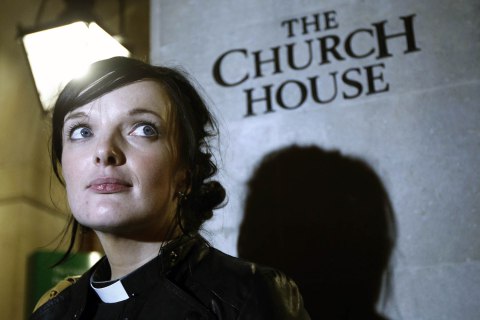
Predictable?

From our southern correspondent comes confirmation of an earlier prediction:

That –

The Assembly form a study committee on the issue of women serving in the ministry of the church (RAO 9-1; 9-3). The Assembly authorizes the Moderator to appoint the study committee. The study committee should be made up of competent men and women representing the diversity of opinions within the PCA (RAO 9-1; Robert’s Rules of Order [11th edition], §13, pp. 174-175, §50, pp.495- 496, §50, pp. 497-498 §56, p. 579]).

The committee should give particular attention to the issues of:

The biblical basis, theology, history, nature, and authority of ordination;

The biblical nature and function of the office of deacon;

Clarification on the ordination or commissioning of deacons/deaconesses;

Should the findings of the study committee warrant BCO changes, the study committee will propose such changes for the General Assembly to consider.

The committee will have a budget of $15,000 that is funded by designated donations to the AC from churches and individuals (RAO 9-2).

A Pastoral Letter to be proposed by the ad interim study committee and approved by the General Assembly be sent to all churches, encouraging them to (1) promote the practice of women in ministry, (2) appoint women to serve alongside elders and deacons in the pastoral work of the church, and (3) hire women on church staff in appropriate ministries.

Grounds: The Cooperative Ministries Committee may not make recommendations directly to the General Assembly but must do so through an appropriate committee or agency (RAO 7-3 c; 7-6). The CMC has had a subcommittee on the role of women and has sent several recommendations to the AC (including a proposal for a study committee on the issue women serving in the church) and CDM to bring to the Assembly.

The former moderator of the PCA GA, Michael Ross, likely approves of this proposal:

The third reason is close to Ross’ heart, since it relates to the theme for this General Assembly, “Generations in Community.” A champion of church revitalization, he recognizes understandable tension and unrest within the PCA – as with most denominations – between older and younger generations.

“In biblical terms 40 years is a generation, and it’s normal to hear younger people saying, ‘This isn’t 1972 anymore,’” he explained. “As moderator, it’s important to have the ear of both the older and younger groups, so everybody has a voice and can be well-heard.”

Past General Assemblies have dealt with a variety of controversial issues, and although Ross does not expect “any landmines this year … there are always overtures that come up.” As for the PCA as a whole, Ross commented, “I tend to be optimistic about where we are and where we’re headed.”

When he entered the pastorate, the PCA was “either all-white suburbanites or in little towns. Now we’re coast-to-coast, much more ethnically diverse, and there is a strong PCA presence in large urban areas.

“Our seminary and college are doing well, as is the women’s ministry. The women and men in the PCA work together very well, which is not typical of many denominations. But we also are in a time of transition. It’s time for change, and change is always scary.”

But as I asked before, isn’t racism different from egalitarianism?

To be clear, racism is arguably different from excluding women from church office. Furthermore, the consequences of racism have been far more consequential than barring women from special ecclesiastical office (though I know some feminists disagree). But the question is whether the PCA’s condemnation of racism leaves wiggle room for distinguishing racial equality from equality of the sexes. (Have we all forgotten the CRC‘s arguments for ordaining women?)

In fact, the power of egalitarianism is so strong you have to wonder if the PCA will have the wits in a decade to avoid repenting not merely for tolerating financial inequality among its members but even advocating it. After all, once you start down the road of equality, doesn’t history suggest your brake fluid runs dry?

Politics of Inclusion

Matt Tuininga calls for the gospel politics of inclusion even while excluding some — ahem — from the Reformed camp. But let’s not go there.

Let’s go instead to an apparent confusion of categories that invariably happens when you make the gospel (Jesus Christ died for sinners, there’s not one square inch, man’s chief end is to glorify God — which is it?) the basis for society. (And if the gospel is the basis for society, where are non-Christians supposed to go? Theonomy with a smile and a hug is still a state that makes little room for non-Christians.)

A few excerpts:

Embracing the call to be conformed to the image of Christ means not that we parade around trumpeting the lordship of Christ, but that, like Christ, we take up the form of a servant, humbling ourselves if necessary even to the cross. Thus we fulfill the law not by enforcing its every jot and tittle at the point of the sword, excluding from the political community those who refuse to tow the cultural, moral or religious line, but by loving and serving those with whom God has placed us in community, paying particular attention to the needs of the poor and the weak, the marginalized and the oppressed.

So what does this say about immigration policy and undocumented aliens? Is the gospel thing to do, the inclusive policy, to include immigrants? Or might a recognition of national sovereignty, strains on certain communities, the good of the economy, cause politicians to take factors other than the gospel into account?

Another excerpt:

It is true that the Gospel does not immediately erase all distinctions of nation, gender, or economic status, but it is equally true that the unity of all things in Christ does call for the rejection of their unjust abuses. It is true that we must be realistic about what can be achieved through politics, but our realism should lead us to champion the weak rather than the strong who oppress them under the cover of law. It is true that we may not be silent about what God’s Word teaches, even when it comes to such controversial matters as human sexuality, but it is equally true that our judgment regarding how God’s will should take expression in politics is fallible, that we must learn to love, serve and work with fellow citizens who disagree with us, and that our public rhetoric is only Christian if it is infused with the grace of Christ. Finally, it is true that salvation only comes to those who place their faith in Christ, and about that we must always be clear, but it is equally true that as believers we are called to embody that salvation socially by bearing one another’s burdens, forgiving one another’s transgressions, and caring for one another’s needs.

Unjust abuses? Did Christ reject the cross, which was unjust? Did he tell Christians to turn the other cheek? Does that mean an end to capital punishment? But what about prisons? Don’t they receive persons we “exclude” from civil society?

Learn to work with fellow citizens with whom we disagree? Is bi-partisanship really a gospel imperative when practically every oped writer for the Times and the Post promotes crossing the aisle in Congress? Do we need to gussy up bi-partisanship with the gospel? Is that why Christ died?

Bearing one another’s burdens? So a Christian politician should have banks forgive all debts?

One more except from another piece on “gospel” politics:

. . . the gospel should affect social structures of nation, race, gender and class. It should call us to organize these structures, as much as possible given the constraints of the present evil age, in light of what the gospel teaches us about human dignity, about justice, and about love. That requires wrestling with the nature of each type of human relationship that involves some sort of inequality or hierarchy. . . .

There are several types of social relationships. Some of them, such as marriage and the relationship between parents and their children, are grounded in creation and ought to be protected and promoted by human beings. The key questions here revolve around how to preserve these relationships in ways that acknowledge the fundamental spiritual and moral equality between men and women, between adults and children. Obviously parents must be in authority over their children, but that doesn’t mean they should be allowed to treat their children like slaves or property. Men and women will typically perform different gender roles by virtue of their different embodied nature, but that doesn’t mean men should domineer over women.

There are other types of relationships that are not rooted in creation but that have emerged, at least in the form that we know them, due to the fall into sin. They are not evil, but their very form demonstrates that evil does exist in the world. Here I am thinking about the coercive state. Christians should support this sort of hierarchy because it is absolutely necessary for a modicum of order in this life, let alone for human flourishing. But questions remain. How do we set up political authority such that it is not tyrannically abused? How do we ensure that those who rule are held accountable to those who are ruled? How do we ensure that even where there is political inequality, all recognize a more fundamental level of moral and spiritual equality?

I’m not sure that Calvin or any of the Reformers were fans of equality. Again, a Reformed source like the Larger Catechism (but maybe the Dutch don’t consider the British Reformed) makes quite a lot of hierarchy and inequality in social stations:

Q. 127. What is the honor that inferiors owe to their superiors?
A. The honor which inferiors owe to their superiors is, all due reverence in heart, word, and behavior; prayer and thanksgiving for them; imitation of their virtues and graces; willing obedience to their lawful commands and counsels; due submission to their corrections; fidelity to, defense, and maintenance of their persons and authority, according to their several ranks, and the nature of their places; bearing with their infirmities, and covering them in love, that so they may be an honor to them and to their government.

Q. 128. What are the sins of inferiors against their superiors?
A. The sins of inferiors against their superiors are, all neglect of the duties required toward them; envying at, contempt of, and rebellion against their persons and places, in their lawful counsels, commands, and corrections; cursing, mocking, and all such refractory and scandalous carriage, as proves a shame and dishonor to them and their government.

In fact, I wonder if Matt knows how much his logic about the future reality of the new heavens and new earth breaking in to present social arrangements was one of the most used theological rationales for ordaining women in the CRC. That’s not a scare tactic. It’s only an instance of where an egalitarian stance can lead, especially one that doesn’t recognize differences among church, society, and family (sphere sovereignty anyone).

But when the gospel becomes the modifier, out goes all the differentiation that makes modern society run (and makes it secular). Matt asks, “How do we set up political authority such that it is not tyrannically abused?” Studying the framers of the U.S. Constitution might be a better place to start than the gospels of Matthew, Mark, Luke, and John. Still not sure what gospel Matt is proclaiming in his social gospel mode.

Postscript: apologies for the image to those with weaker consciences, but sometimes it’s good to be remembered of what happens to women in combat — their dresses fall off.

Why Does Complementarian Rhyme with Egalitarian?

A little while back Carl Trueman pushed back on the empasis by some gospel co-allies on complementarianism. Carl concluded this way:

This is not the only awkward question one might ask: for example, which is more unacceptable to a Baptist – a woman preaching credobaptism or a man preaching paedobaptism? But that is for another day. In the meantime, do not misunderstand me: I do write as a convinced complementarian and a member of a church where no elders or deacons are – or can be — women, though none of them are – or can be – Lutherans, Baptists or Dispensationalists either. It is thus not complementarianism in itself to which I object; I am simply not sure why it is such a big issue in organisations whose stated purpose is basic co-operation for the propagation of the gospel and where other matters of more historic, theological and ecclesiastical moment are routinely set aside. If you want simply to unite around the gospel, then why not simply unite around the gospel? Because as soon as you decide that issues such as baptism are not part of your centre-bounded set but complementarianism is, you will find yourself vulnerable to criticism — from both right and left — that you are allowing a little bit of the culture war or your own pet concerns and tastes to intrude into what you deem to be the most basic biblical priorities.

This seemed smart then and still seems so. My only quibble is with the word “complementarian” itself. Some say it is like the Trinity, a concept derived from Scripture but not actually used. Well, the same goes for “hierarchical” or “patriarchal.” Those are words that are much more likely to be derived from biblical teaching about society but are apparently offensive to gospel co-allies who don’t want to look odd to the watching world. The hierarchies assumed in Scripture, wives submit to husbands, slaves to masters, and believers to emperors, are hardly the social arrangements we take for granted in the United States after the democratic revolution inaugurated by Andrew Jackson. But they do resemble the ones that the Reformers, Puritans, and early Presbyterians took for granted. Just think of the language of “superiors, inferiors, and equals” from the Shorter Catechism’s discussion of the fifth commandment.

The logic of hierarchy and patriarchy is not something that I am going to defend, myself. The little missus and I have reached a level of concord that most observers would call an egalitarian arrangement. I have no stones to through from the windows of my glass house. I do have the shield of two-kingdom theology, though, which allows me to have my cake (egalitarianism of a kind at home) and eat it too (hierarchicalism and patriarchy of a kind in the church).

Still, I do think the Gospel Coalition’s rallying behind complementarianism is troubling. It resembles the version of Calvinism that traffics among the young and restless — lots of talk of divine sovereignty, not so much about limited atonement. After all, that biblical teaching and those Reformed creeds can sound reactionary to modern ears and we don’t ever want to sound extreme — as if believing in a God-man who died and rose again and will come again is moderate.

What is particularly troubling about the Complementarian w-w is what it seems to do to the church. For instance, in Mary Kassian’s “Complementarianism for Dummies,” she writes that complementarians don’t want to be traditional (which is surprisingly close to not wanting to be conservative):

In our name-the-concept meeting, someone mentioned the word “traditionalism,” since our position is what Christians have traditionally believed. But that was quickly nixed. The word “traditionalism” smacks of “tradition.” Complementarians believe that the Bible’s principles supersede tradition. They can be applied in every time and culture. June Cleaver is a traditional, American, TV stereotype. She is not the complementarian ideal. Period. (And exclamation mark!) Culture has changed. What complementarity looks like now is different than what it looked like 60 or 70 years ago. So throw out the cookie-cutter stereotype. It does not apply.

Well, if the culture has changed, shouldn’t the church? And if the culture now puts women into roles of authority, why shouldn’t the church also do so? In fact, the Gospel Coalition recently asked two women to exegete and interpret Scripture for its general (including male) audience. I am personally a great affirmer of the idea that non-ordained women can do whatever non-ordained men can do. But for an organization with ecclesial ambitions, allowing women to teach the Bible seems to put TGC on the road to women’s ordination (which is where some think their star allies are walking).

To come back to Carl’s point, if complementarianism lacks the deal breaker significance of the gospel, so too does women’s ordination. At the same time, the lesson of communions like the Christian Reformed Church is that distinguishing peripheral matters from central ones is not so easy. The ordination of women was not the line in the sand for all conservatives in the CRC. But it was indicative of a general unease in the denomination regarding teachings and practices that had been part and parcel of the church’s Reformed identity but now looked burdensome after a move out of immigrant quarters into suburbia. It is one thing to be prophetic about the environment. It’s another altogether to be so about relations between men and women.

So while complementarianism is not as big a deal as the gospel, the way you treat complementarianism may be indicative of how big the deals you are willing to make.

P.S. I wonder if Keller and Piper really do agree on complementarlianism, especially when it applies to the church and to marriage. This video has a certain poignancy to it that makes me wonder if the folks at Redeemer Church would invite Piper to lead a seminar on women’s role in the church.