
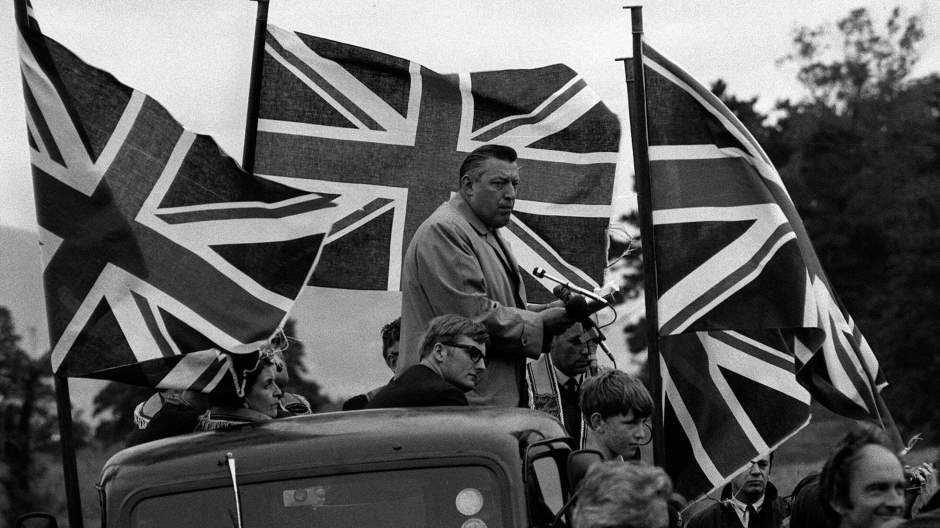
The parallels between Ulster and American Protestants striving to protect their cultural and political heritage is striking. Some of the similarities may be lost because Ulster Protestants use the language of “unionism” instead of “nationalism.” For parts of their history, Ulster Protestants have linked their religious convictions, quite plausibly, to British Protestantism instead of Irish Catholicism. Still, both groups, Ulster Protestants before the Good Friday Agreement of 1998, and American Christian nationalists (ChristNats) since roughly 2022 profess to view their societies’ governments through the lens of Protestantism (for some, “aggressive” Protestantism). Both have also viewed themselves as part of a beleaguered minority that represents the historic faith of its society (as opposed to Roman Catholics in Ireland or secular liberals in the United States).
One important difference is that Ulster Protestants have used the levers of government far more effectively than ChristNats. What is also true is that ChristNats write more books than Ulster Protestants.
Neil Southern’s 2007 article on Protestant alienation in Northern Ireland could, with a few tweaks, describe ChristNats in America:
Concomitant with the changes which have occurred at the level of politics, Protestants have had to contend with changes at the level of their cultural identity. Cultural alienation is treated as a separate analytical construct to that of politics and focuses on the emotional properties of Protestantism, whether in the form of the British identity of the Protestant and its symbolic displays in Northern Ireland, or the more regionally specific expression of Protestant culture in the form of the Loyal Orders.
. . . Protestants trace the increased presence of Irishness in Northern Ireland back to the Good Friday Agreement (and beyond). The Agreement states that, where there is a desire for the teaching and learning of the Irish language, the British government will ‘take resolute action to promote the language’ and ‘encourage the use of the language’. Yet many Protestants are alienated by the Irish language because they feel that it is not so much a cultural expression as a political tool. Protestants consider the issue of the Irish language to be used by Sinn Fein to emphasise the separateness of Irish culture within Northern Ireland as part of an overall political justification for their quest for Irish unity.
A pertinent example of Protestant cultural alienation followed in the wake of the decision of Queen’s University Belfast to dispense with the national anthem at graduation ceremonies. Many Protestants were of the opinion that the university was willingly discarding symbols of its Britishness in order to placate students from a nationalist background.
Obviously, ChristNats don’t regard the British national anthem as a marker of Protestant identity. Nor do Ulster Protestants seem to care much about blasphemy laws. They did want to align with a Christian prince – well a princess (QEII) – the way ChristNats pine for a Christian government. But Charles III’s emergence as the defender of multiple faiths may render Ulster Protestants more willing to support a Christian government in the USA. Maybe Ulster could become the fifty-first state?
But when compared side by side, Ulster Protestantism and American Christian nationalism look remarkably national (and cultural) rather than Christian. Instead of producing a common set of policies for a Protestant society anywhere, Irish and American Protestants calculate their “Christian” government according to patterns of Irish and US history respectively.
Maybe the one man who could have bridged the differences between Ulster and American Protestants was Ian Paiseley, the former First Minister of Northern Ireland. After all, Paisley worked with both Carl McIntire and Bob Jones to form a kind of trans-Atlantic Religious Right.
But I dare say no ChristNat could affirm what Paisley did in 1985 when he spoke on behalf of a Protestant Ulster. The Free Presbyterian pastor did not have American Protestants in mind when defending the Christian nationalism of Northern Ireland. he opposed political reforms in Northern Ireland that resulted in a shared Protestant and Roman Catholic government:
God has a people in this province. There are more born-again people in Ulster to the square mile than in anywhere else in the world. This little province has had the peculiar preservation of divine Providence. You only have to read the history of Ulster to see that time after time when it seemed humanly impossible to extricate Ulster from seeming disaster, that God intervened. Why? God has a purpose for this province, and this plant of Protestantism sown here in the north-eastern part of this island. The enemy has tried to root it out, but it still grows today, and I believe, like a grain of a mustard seed, its future is going to be mightier yet. God Who made her mighty will make her mightier yet in His Divine will.

