Every Square Inch of MmmmeeeeEEEEEEE

The politics of identity continue to haunt. Are you gay? Straight? Muslim? Man? Man trapped in a female body? Evangelical? Reformed Protestant? How’s a nation supposed to handle so many personal identities yearning to breathe free?

Ra’fat Aldajani offers this advice for Muslims:

The first objective is embracing being American. Too often we confuse being American with an erosion or rejection of our native culture and mores. It is quite the contrary. America is the land of immigrants, a melting pot of many diverse cultures and peoples, all contributing to what makes this country unique and strong.

Assimilation means developing a hybrid of what is good from our mother countries (family values, importance of education, respect for elders) and our adopted home (democracy, justice, rule of law) and engaging in every aspect of American life as Muslim Americans, rather than retreating defensively into our own culturally fenced-off communities.

Of course, the problem with assimilation is that it leads to liberal Protestantism where the nation’s social crises matter more than biblical teaching (also think PCA). If the nation tips toward equal rights for women, who are we mainline Presbyterians to deny the office of elder to women?

So the question for reconciling personal and national identity is where you put the qualifier.

If you are an American Christian, then national identity trumps religious loyalty.

If you are a Christian American, then your religious identity trumps patriotism.

And if you are simply present as Christian (or LBGT), and leave out any reference to the government whose laws you follow at least when you check out at the grocery store or drive a car, then you are a different order of person.

The difficulty we now face is that personal identity absorbs nationality. The nation must be or reflect my identity — it must be Christian, gay, or black. What we need in the era of transgenderism is to recognize that we (citizens of the U.S.) are all personal identities trapped in an American body.

How Far Will Racial Reconciliation Go?

Michelle Higgins and her father want it to go far:

Perhaps we evangelicals are silent – some refusal to acknowledge the whole identities of LGBTQ+ people – because we are bigoted terrorists too.
Our propaganda: circulating a petition to boycott Target. Our victims: image-bearers whose souls conditions are neither revealed to or controlled by us. We live as if faith gives us the right to direct people’s bodies. This is not faith-filled living. It is oppression.
And much like the realization breaking upon us in the current political climate: this is not evangelicalism. At all.

Evangelicals are a diverse group, thankfully some of our circles include the LGBTQ+ family. Many of us are showing up in solidarity with queer communities around the world, grateful for the invitation to grieve together. But many others in our evangelical family walk a dangerous path of passing judgment before showing compassion. If we readily proclaim that LGBTQ+ people are sacred image-bearers, we must also confess and dismantle our participation in the long history of hatred that has them scared. It is easy to express sympathy for our fellow humans. But we are called to a greater task: to confess that the lives of our gay, lesbian, queer, and trans friends are sacred. We must be willing to say that the lives of queer people of color matter to God.

What if Muslims are people of color?

Autonomy and Theonomy Again

If you don’t grant autonomy from religious authority to the political realm (including to political actors to behave in ways different from religious duties), do you wind up with Omar Mateen? Adam Garfinkle thinks so:

… defined properly, there just isn’t very much Islamist ideology. As that term is commonly used in the West, at a minimum an ideology needs to specify: some ideal political economy; some ideal relationship between society, state, and authority; and some ideal relationship between a given society and the world outside it. There is nothing special in these regards about current Islamist thinking. There are a few innovations of note that distinguish it from traditional Islam—the very strict segregation of the sexes in public spaces; the insistence that non-Muslims cannot hold public office; the re-merging of religious and temporal authority in the caliphate—but there are too few and too marginal to create much of a difference from the standard traditional Muslim understanding of the relationship of religion and politics. Hence, for example, the supremacist assumptions of Islamism are also characteristic of mainstream traditional Sunni Islam, making it impossible for us to “message” against it without alienating Sunnis who are not our enemies and who are critical extent and potential allies.

This reflects the key fact that there is nothing specifically ideological—again as we understand the term—about Islamic attitudes about the intersection of religion and politics. Neither Islamist nor Islamic “ideology” is commensurate with any system of Western political ideas. Liberalism as the epitome of the Western way of thinking about politics is based on deeper philosophical currents, but it is not a mere lesser-included case. It has its own weight, its autonomy, its own discourse. The political world is a lesser-included case within Islamist (and Islamic) thinking. It is not autonomous but derivative. It does not have its own credentialed authorities and discourse, only the authorities and discourse of the clergy whose concerns far transcend politics.

Islam, in other words, has little capacity to develop the spirituality of the mosque. Christians who oppose the spirituality of the church should be very careful.

When Did Christianity Become Imperial?

Pierre Manent begs more than he explains:

What to do about our diminished collective capacity is the great political question of Europe. Whether in relation to European unification or to Islam, it is clear that we have nothing pertinent to say if we refrain from making claims about European identity. One way to outline essential characteristics of European political and spiritual life is to contrast them with certain fundamental features of Muslim life.

Running the risk of a somewhat rough stylization, we might say something like the following: Islam throughout its history has largely preserved the form, the impulse, and the consciousness of empire (traits that are found with renewed vigor today), while Western Christianity, though born in an imperial form, and very much subject to great missionary and conquering movements, found its relative stability in a very different arrangement. Islam was never able to abandon the imperial form that ­Christianity could never assume in a lasting way. Christianity instead found its form in the nation, or in the plurality of nations once called “Christendom,” then “Europe.”

Anyone who reads the first pope Peter, finds little sense of Christian empire:

But you are a chosen race, a royal priesthood, a holy nation, a people for his own possession, that you may proclaim the excellencies of him who called you out of darkness into his marvelous light. Once you were not a people, but now you are God’s people; once you had not received mercy, but now you have received mercy.

Beloved, I urge you as sojourners and exiles to abstain from the passions of the flesh, which wage war against your soul. (1 Peter 2:9-11 ESV)

The early church thought of itself more in exile than as part of the establishment. Then came Constantine. Then came empire. Then came establishment. Only with the novos ordo seclorum did Europeans begin to question the fit between Christianity and empire.

What If Muhammad Ali Ran for President?

As I listen to journalists and sports-talk radio hosts talk about the greatest fighter of all time, I keep thinking I understand the appeal of Donald Trump.

Just look at some of these juicy quotes:

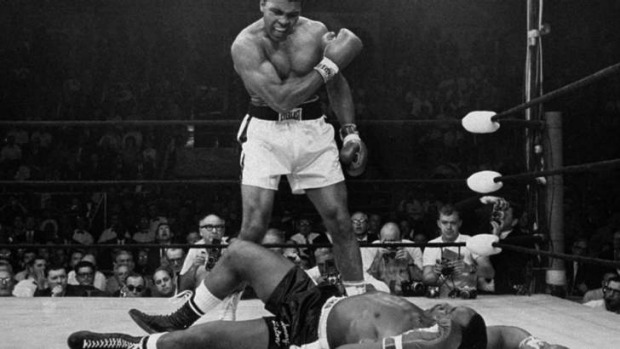
Clay was 18: bounding, fearless, leading with his mouth.

“I’m not only a fighter. I’m a poet; I’m a prophet; I’m the resurrector; I’m the savior of the boxing world. If it wasn’t for me, the game would be dead,” he said.

Young Clay made boxing an art form. He was an original, a heavyweight who didn’t move around the ring — he danced. He’d thrill the crowd with his quick scissor-step shuffle. On defense, he’d slip and slide, Dundee said, and then flick that jab.

“He had a jab that was like a snake,” he said.

Float like a butterfly, sting like a bee; rumble, young man, rumble. Boxing reporters never had so much fun.

So Ali, though seemingly a good guy on numerous fronts, was a tad egotistical. Did that cost him with the media?

And then he could be pretty divisive:

After the Liston fight, Ali revealed he was a member of the black separatist movement Nation of Islam. He wanted to be called Muhammad Ali, a name he said was given to him by the group’s leader, Elijah Muhammad.

“That’s my original name; that’s a black man name,” Ali said. “Cassius Clay was my slave name. I’m no longer a slave.”

Muhammad, the Nation of Islam leader, preached that integration and intermarriage were wrong and that white people were devils. It was an idea Ali defended in a 1971 TV interview.

“I’m gonna look at two or three white people who’re trying to do right and don’t see the other million trying to kill me? I’m not that big of a fool, and I’m not going to deny it,” he said. “I believe everything he [Muhammad] teach, and if the white people of a country are not the devil, then they should prove they’re not the devil.”

Ali became a polarizing figure in America.

Again, did that cost Ali his reputation?

So I wander as I wonder.

Where’s the Fall?

Rod Dreher hearkens back to his crunchy con days for this piece of conservative logic:

A conservatism that does not practice restraint, humility, and good stewardship—especially of the natural world—is not fundamentally conservative.

Might we then expect Rod to show some theological restraint when commenting on the murder of a Scottish Muslim?

Asad Shah is with our Creator today. I am confident of that. Please, Christians, wherever you are this Easter weekend, pray for the soul of a righteous man, murdered for his compassion and love of mankind.

Remember, too, that if you condemn all Muslims over the bloodthirsty killers of ISIS, you also condemn this good man Asad Shah, may his memory be eternal.

Sure, Rod doesn’t need to use the timing of this man’s tragic death to point out the differences between Muslims and Christians over sin, salvation, and the redemption secured by Christ (though at Easter he might have the meaning of Christ’s death on his mind). But if conservatives are going to ask the rest of society to take religious seriously, shouldn’t they show the way?

Locating Islam on the Map of the West

Sometimes Crux, though, registered a provocative take on Christianity in the West. In a piece on the Vatican’s diplomacy with Iran, Crux observed that Roman Catholicism is to the Christian world what Shia is to Islam:

Iranian writer Vali Nasr, author of the 2006 book “The Shia Revival,” argues that the divide between Sunni and Shia bears comparison to that between Protestants and Catholics, with Shia being the branch closer to Catholicism.

Among those points of contact are:

A strong emphasis on clerical authority

An approach to the Quran accenting both scripture and tradition

A deep mystical streak

Devotion to a holy family (in the case of Shiites, the blood relatives of Mohammad) and to saints (the Twelve Imams)

A theology of sacrifice and atonement through the death of Hussain, grandson of Mohammad and the first imam of Shia Islam

Belief in free will (as opposed to the Sunni doctrine of pre-destination)

Holy days, pilgrimages, and healing shrines

Intercessory prayer

Strongly emotional forms of popular devotion, especially the festival of Ashoura commemorating Hussain’s death

If only ISIS could find its inner Pope Francis:

Pope Francis apologized for Catholic mistreatment of other Christian traditions Monday, and called on Catholics to forgive followers of those traditions for any offenses of “today and in the past,” as a step toward deeper unity.

“As Bishop of Rome and Shepherd of the Catholic Church, I plead for mercy and forgiveness for non-evangelical behaviors by Catholics against Christians of other churches,” Francis said, referring to conduct not in keeping with the Gospel of Christ.

“We cannot undo what was done in the past, but we don’t want to allow the weight of past sins to pollute our relationships,” he said. “The mercy of God will renew our relations.”

Enemies Scarier than ISIS?

Faith McDonnell thinks that the war (yet to be declared by the U.S. government) against ISIS is spiritual in nature and that Christians have a duty to wage war against such enemies:

First and foremost, the battle against ISIS is spiritual warfare. If the Enemy ever used any proxies for his mission to “kill, steal, and destroy,” it is the Islamic State. Though some remain in denial about the evil we face, and pray just “for peace,” the Biblical mandate for Christians (not governments, not militaries ) is to battle — not against flesh and blood — “but against principalities, against powers, against the rulers of the darkness of this world, against spiritual wickedness in high places.” (Eph 6: 12)

Maybe not.

When you read Calvin, who is no pope, on Ephesians 6, you gain the impression that Paul may have had his sights set on a foe bigger than Rome’s armies:

To impress them still more deeply with their danger, he points out the nature of the enemy, which he illustrates by a comparative statement, Not against flesh and blood. The meaning is, that our difficulties are far greater than if we had to fight with men. There we resist human strength, sword is opposed to sword, man contends with man, force is met by force, and skill by skill; but here the case is widely different. All amounts to this, that our enemies are such as no human power can withstand. By flesh and blood the apostle denotes men, who are so denominated in order to contrast them with spiritual assailants. This is no bodily struggle.

Let us remember this when the injurious treatment of others provokes us to revenge. Our natural disposition would lead us to direct all our exertions against the men themselves; but this foolish desire will be restrained by the consideration that the men who annoy us are nothing more than darts thrown by the hand of Satan. While we are employed in destroying those darts, we lay ourselves open to be wounded on all sides. To wrestle with flesh and blood will not only be useless, but highly pernicious. We must go straight to the enemy, who attacks and wounds us from his concealment, — who slays before he appears.

In fact, Calvin suggests that if we fight enemies like ISIS as if they are spiritual opponents, we lose sight of our genuine spiritual adversaries. And when that happens, our spiritual enemies defeat us.

It’s a topsy-turvy world out there in Christ’s spiritual kingdom.

Those Were Really the Days

Christendom, Schristendom:

I recently described the tumultuous years 1675-1685, and how they shaped the future of Europe and North America. Here, I want to explore the implications for the politics of religion in this era, and for some of the stereotypes we might have. Everyone knows that religion played a vital role in the Early Modern era: according to customary stereotypes, Protestants fought Catholics, Catholics fought Protestants, and Christians struggled against Muslims. All those statements are correct as far as they go, but they stand in need of some nuance. (Orthodox Christians also had their conflicts, but I will leave those out here).

As they say in Hail Caesar: Would that it were so simple …. [mirthless chuckle].

To recap briefly, I described the Protestant-led Hungarian/Magyar revolt against the (Catholic) Holy Roman Empire in the late 1670s. That in turn led to the Muslim Ottomans intervening on the side of the Hungarian rebels. The resulting war led to the siege of Vienna in 1683, and the ensuing battle, which really marked the end of Islamic expansion into Europe. Most historians would agree that this really marked a turning point in European (and world) history.

Looking at the battle of Vienna, several thoughts come to mind. For one thing, it is odd to realize just how late that happened, and how in fact it coincides so closely with an event like the settlement of Pennsylvania or (almost) the Salem witch trials – or indeed, the height of the Royal Society in London. It’s also sobering to think through the “might have been” of an Ottoman victory in that war, which might theoretically have extended Islamic power deep into southern Germany, and who knows how much further? If that had occurred, then the immediate cause would have been tensions and persecutions between Protestants and Catholics within the Holy Roman Empire.

Further afield, an Ottoman victory would, oddly, have been good news for France’s Most Christian King, Louis XIV (1643-1715). Both Louis and the Emperor Leopold were zealous Catholics, who (as we have seen) actively persecuted Protestants within their own realms, and both wished to uproot those Protestant minorities completely. Even so, dating back to the sixteenth century, the Catholic French had a long-standing entente cordiale with the Ottomans, on the basis that both had a common enemy in the Habsburgs. In the 1540s, the French allowed the Ottoman fleet to winter at their port of Toulon, and built mosques to make the Turkish forces feel welcome.

Recall that the Empire included what we would today call Germany and Belgium as well as Austria (and several other countries). When Louis tried to push the French border eastward to the Rhine, he was encroaching on Imperial territory. He was the Empire’s aggressive neighbor on the West, as the Ottomans were on the East. Cooperation made great sense, regardless of faith.

Hence, the revival of the alliance in the 1670s. The (Catholic) French originally supported the (Protestant) Hungarian/Magyar revolt, and later:
In 1679 and 1680, Louis XIV through his envoy Guilleragues encouraged the Ottoman Grand Vizier Kara Mustafa to intervene in the Magyar Rebellion against the Habsburg, but without success. Louis XIV communicated to the Turks that he would never fight on the side of the Austrian Emperor Leopold I, and he instead massed troops at the eastern frontier of France.

That is what gave the Ottomans the confidence to launch the assault on Vienna, although at the last minute in this campaign, Louis shifted his support to the Habsburgs. So much for any sense of Christian political unity, or indeed of Christendom as such.

A few years afterwards, Ireland witnessed the pivotal Battle of the Boyne (1690). The Protestant William III defeated the Catholic James II in a victory that established Protestant supremacy in the island for two centuries afterwards. Not surprisingly, the battle lives on as a potent myth for both sides in Irish religious divisions. William was “of Orange,” and still today, Protestant Orangemen proclaim King Billy’s triumph each year when they march on the anniversary of the Boyne, on July 12. Patriotic Irish Catholics see the Boyne as a national calamity.

Yet neither Catholics nor Protestants ever like to confront the full context of the battle. When Calvinist William triumphed in 1690, his victory was celebrated joyously by his international Catholic allies, including the Emperor Leopold, and the Pope, Alexander VIII. Austrian (Catholic) cathedrals sang a Te Deum to hymn the victory. Why? Because James II was allied to Louis XIV, and any defeat of Louis must be excellent news, not to mention long-overdue payback. My enemy’s enemy is my friend, and arguably a great Christian warrior.

Religious politics in this era were distinctly messy.

Would a Christian emperor like Constantine have prevented this? An infallible pope certainly did not.

What about a Christian lord like Jesus who sits at the Father’s right hand? In which case, Christ’s rule may have a lot less to do with Europe, America, South Africa, or Scotland and a lot more to do with NAPARC.

If Muslims and Christians Worship the Same God, Can't the Forgiven and Unforgiven Too?

The latest from Wheaton College is that Larycia Hawkins and the College have agreed to part ways. In the leaks that led to this apparently amicable determination was an email from Wheaton’s provost, Stan Jones, who apologized for his handling of the incident. According to Alan Jacobs, Jones wrote:

I asked Dr. Hawkins for her forgiveness for the ways I contributed to the fracture of our relationship, and to the fracture of Dr. Hawkins’ relationship with the College…. I apologized for my lack of wisdom and collegiality as I initially approached Dr. Hawkins, and for imposing an administrative leave more precipitously than was necessary.

But according to some of Jones’ critics, this apology doesn’t go far enough, as Jacobs explains, “because it does not acknowledge Wheaton’s history (and present) of structural racism and sexism.”

Jacobs then asks:

What if, when a brother in Christ apologizes and asks for forgiveness, one were to grant that forgiveness — instead of immediately criticizing him for not having provided a fully adequate account of the reasons he went astray?

I’d follow up with another question: doesn’t the spirit of Dr. Hawkins’ show of solidarity with Muslims provide an analogy for how Jones’ critics might reach out to Wheaton’s provost? I mean, if you can overcome the division between Islam and Christianity by donning a hijab during Advent, can’t you go without a latte for the month of February to show solidarity with Wheaton’s administration?

Jacobs concludes:

So to those who say that Provost Jones’ apology is inadequate, my answer would be: of course it is inadequate. Every act of penitence, including yours and mine, is inadequate.

That could also be instructive for those who think Purgatory is going to take care of residual human guilt. Once humans sin — think one little bite of a piece of fruit — can you ever go back to being acceptable inherently?

No hope without alien righteousness.